
Electrical Engineer Resume Examples & Free Template (PDF, Word)

Start from a senior EE’s power, analog and PCB bullets, swap in your own boards and numbers, and save this electrical engineer resume template as PDF or Word. Then read 3 EE samples by seniority and my 6-step writing method.

4.9 5.0
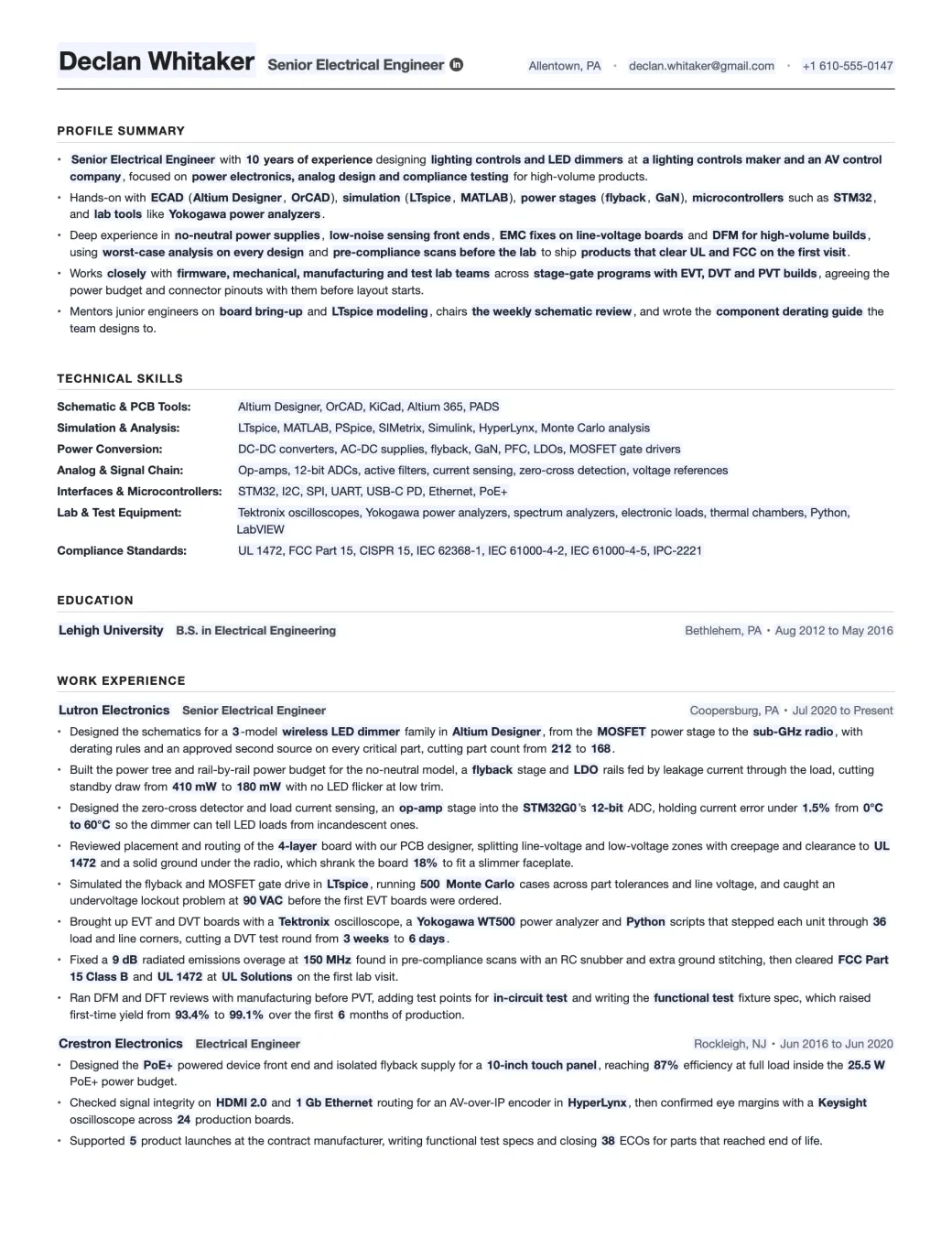
Electrical Engineer resume template, filled in for a senior electrical engineer at Lutron Electronics, with a 5-bullet profile summary, 7 skills rows and 11 work experience bullets
Emmanuel Gendre Ex-Google recruiter / Tech resume writer Updated Free, ATS-friendly, no signup

Interactive resume template generator

Interactive Electrical Engineer Resume Template

Fill in the side panel, then download your resume as a PDF or a Word file.

Edits update live as you type. Toggle Edit to rewrite paper text directly.

Edit mode is on. Click anywhere on the resume to rewrite text. Side-panel placeholders still update live.

Declan Whitaker Senior Electrical Engineer

Allentown, PA • declan.whitaker@gmail.com • +1 610-555-0147

Profile Summary

  • Senior Electrical Engineer with 10 years of experience designing lighting controls and LED dimmers at a lighting controls maker and an AV control company, focused on power electronics, analog design and compliance testing for high-volume products.
  • Hands-on with ECAD (Altium Designer, OrCAD), simulation (LTspice, MATLAB), power stages (flyback, GaN), microcontrollers such as STM32, and lab tools like Yokogawa power analyzers.
  • Deep experience in no-neutral power supplies, low-noise sensing front ends, EMC fixes on line-voltage boards and DFM for high-volume builds, using worst-case analysis on every design and pre-compliance scans before the lab to ship products that clear UL and FCC on the first visit.
  • Works closely with firmware, mechanical, manufacturing and test lab teams across stage-gate programs with EVT, DVT and PVT builds, agreeing the power budget and connector pinouts with them before layout starts.
  • Mentors junior engineers on board bring-up and LTspice modeling, chairs the weekly schematic review, and wrote the component derating guide the team designs to.

Technical Skills

Schematic & PCB Tools:
Altium Designer, OrCAD, KiCad, Altium 365, PADS
Simulation & Analysis:
LTspice, MATLAB, PSpice, SIMetrix, Simulink, HyperLynx, Monte Carlo analysis
Power Conversion:
DC-DC converters, AC-DC supplies, flyback, GaN, PFC, LDOs, MOSFET gate drivers
Analog & Signal Chain:
Op-amps, 12-bit ADCs, active filters, current sensing, zero-cross detection, voltage references
Interfaces & Microcontrollers:
STM32, I2C, SPI, UART, USB-C PD, Ethernet, PoE+
Lab & Test Equipment:
Tektronix oscilloscopes, Yokogawa power analyzers, spectrum analyzers, electronic loads, thermal chambers, Python, LabVIEW
Compliance Standards:
UL 1472, FCC Part 15, CISPR 15, IEC 62368-1, IEC 61000-4-2, IEC 61000-4-5, IPC-2221

Education

Lehigh University B.S. in Electrical Engineering
Bethlehem, PA • Aug 2012 to May 2016

Work Experience

Lutron Electronics Senior Electrical Engineer
Coopersburg, PA • Jul 2020 to Present
  • Designed the schematics for a 3-model wireless LED dimmer family in Altium Designer, from the MOSFET power stage to the sub-GHz radio, with derating rules and an approved second source on every critical part, cutting part count from 212 to 168.
  • Built the power tree and rail-by-rail power budget for the no-neutral model, a flyback stage and LDO rails fed by leakage current through the load, cutting standby draw from 410 mW to 180 mW with no LED flicker at low trim.
  • Designed the zero-cross detector and load current sensing, an op-amp stage into the STM32G0’s 12-bit ADC, holding current error under 1.5% from 0°C to 60°C so the dimmer can tell LED loads from incandescent ones.
  • Reviewed placement and routing of the 4-layer board with our PCB designer, splitting line-voltage and low-voltage zones with creepage and clearance to UL 1472 and a solid ground under the radio, which shrank the board 18% to fit a slimmer faceplate.
  • Simulated the flyback and MOSFET gate drive in LTspice, running 500 Monte Carlo cases across part tolerances and line voltage, and caught an undervoltage lockout problem at 90 VAC before the first EVT boards were ordered.
  • Brought up EVT and DVT boards with a Tektronix oscilloscope, a Yokogawa WT500 power analyzer and Python scripts that stepped each unit through 36 load and line corners, cutting a DVT test round from 3 weeks to 6 days.
  • Fixed a 9 dB radiated emissions overage at 150 MHz found in pre-compliance scans with an RC snubber and extra ground stitching, then cleared FCC Part 15 Class B and UL 1472 at UL Solutions on the first lab visit.
  • Ran DFM and DFT reviews with manufacturing before PVT, adding test points for in-circuit test and writing the functional test fixture spec, which raised first-time yield from 93.4% to 99.1% over the first 6 months of production.
Crestron Electronics Electrical Engineer
Rockleigh, NJ • Jun 2016 to Jun 2020
  • Designed the PoE+ powered device front end and isolated flyback supply for a 10-inch touch panel, reaching 87% efficiency at full load inside the 25.5 W PoE+ power budget.
  • Checked signal integrity on HDMI 2.0 and 1 Gb Ethernet routing for an AV-over-IP encoder in HyperLynx, then confirmed eye margins with a Keysight oscilloscope across 24 production boards.
  • Supported 5 product launches at the contract manufacturer, writing functional test specs and closing 38 ECOs for parts that reached end of life.


Done editing? Download a real PDF (selectable text, ATS-friendly, US Letter) or an editable Word file if a recruiter asks for one.

About this template

An Electrical Engineer resume template, built by a tech recruiter.

In a product company, an electrical engineer designs the boards that make the hardware work. You draw the schematic, pick the parts, size the power supply and the analog front end, then sit with the layout designer until the board is right. When the first boards arrive, you’ll bring them up in the lab, get them through EMC and safety testing, and hand the factory a design it can build. Chargers, patient monitors, EVs and smart lighting all need that work.

The EE resumes that cross my desk tend to start with a wall of tools: Altium, LTspice, MATLAB, a couple of UL and IEC numbers. That wall doesn’t say who designed the power stage and who ran somebody else’s test plan. Your proof sits in the lab data instead: the efficiency or standby power you hit, the error you held across temperature, the emissions margin in the chamber and the yield once the factory took over.

So every bullet slot on this template asks for one of those lab numbers. Job 1 covers schematic design, power, analog, layout, SPICE, bring-up, compliance and DFM, one bullet apiece, because that’s the checklist EE hiring managers carry in their heads. My samples underneath (junior, senior, lead) follow that same skeleton. Writing yours from scratch? My guide below breaks it into 6 steps to write an Electrical Engineer resume.

If you’ve got an EE resume drafted, send it through the upload box below. I’ll review your resume for free and reply personally.

Industry signal

What the market says about Electrical Engineer roles

The Bureau of Labor Statistics expects more electrical engineering jobs this decade, partly thanks to consumer electronics, solar arrays and semiconductors. The rules you design to don’t sit still either. Since 28 April 2026, laptops sold in the EU have to charge over USB-C. NVIDIA wants 800 V DC power in AI server racks from 2027, and chip makers like TI are already building parts for it. In January, Altium and the Global Electronics Association launched their first PCB design certifications. That’s why your resume should list the standards, power levels and tools you’ve really designed with.

+10% US electrical engineer job growth, 2025 to 2035 US Bureau of Labor Statistics
$120,630 US electrical engineer median pay, May 2025 US Bureau of Labor Statistics
  • Analog Devices, Inc. @ADI_News · Semiconductor company
    Explore precision designs faster with Signal Chain Designer, part of ADI Precision Studio. Create and simulate analog front ends, compare architectures, evaluate key performance metrics, and export designs to LTspice for deeper analysis. bit.ly/4BhQRZp
  • Altium @altium · PCB design software
    What separates experience from expertise? For advanced PCB designers, the answer comes down to consistency and technical depth. The Altium Designer Expert Certification was developed with @GlobalElecAssn to recognize those capabilities. Learn more: bit.ly/4eNb5ks
  • Robert Feranec @robertferanec · PCB design teacher, FEDEVEL
    How it looks: A simple board designed in 3 hours. Reality: started 9 months ago, 4 revisions. Watch my new tutorial here: fedevel.com/blog/how-to-de…
  • Texas Instruments @TXInstruments · Semiconductor company
    We are collaborating with @nvidia to power future-gen AI data centers. Our complete power architecture requires only two conversion stages from 800V to processor power. Our technology supports NVIDIA's vision for scalable, efficient, reliable, high-performance power delivery…

Resume Samples

Electrical Engineer Resume Examples

What should an electrical engineer resume look like at year 3, year 7 or year 12? These 3 electrical engineer resume examples answer that: a junior testing relay input boards at SEL, a senior on EV charger hardware at Rivian and a lead running a patient monitor team at GE HealthCare. Every bullet carries a real part, tool or standard plus a number. You can download each one as a PDF or a Word file, free and with no signup.

Junior Electrical Engineer Resume Example

A recruiter reading a junior electrical engineer resume is looking for one thing: hardware you actually touched. Show a board you designed or tested, a simulation that changed a part choice and a lab result with a number on it. An internship at a hardware company counts. No full-time job yet? Put your senior design project at the top, with the board, the tools and one test result.

Years of experience
3 years
Industry
Power grid equipment maker
Stack
Altium DesignerLTspiceMATLABPython
Download PDF Download Word

Click to download the Junior Electrical Engineer resume example as a PDF or a Word file. Free / No signup.

Margaret O’Hara

Junior Electrical Engineer

Pullman, WA · margaret.ohara@gmail.com · +1 509-555-0152 · linkedin.com/in/margaretohara

Profile Summary

  • Junior Electrical Engineer with 3 years at Schweitzer Engineering Laboratories, designing and testing input boards for protective relays used in power substations, after a summer internship in smart meter hardware at Itron.
  • Draws schematics in Altium Designer, simulates in LTspice, checks data in MATLAB, scripts bench tests in Python, and runs a Keysight DAQ, oscilloscopes and an Omicron relay test set.
  • Knows the analog input chain from current transformer to ADC, the surge and fast transient tests a relay has to survive and the IEC 60255 standards behind them, and writes a test plan before every bench session.
  • Works with PCB designers, the EMC lab and manufacturing test engineers on site in Pullman, and presents her boards at the weekly hardware design review.
  • Mentored 2 interns on lab safety and the bench scripts in 2025, wrote the team’s surge test checklist, and is EIT certified (FE Electrical and Computer, 2023).

Technical Skills

Schematic & PCB Tools:
Altium Designer, OrCAD Capture (coursework), KiCad
Simulation & Analysis:
LTspice, MATLAB, PSpice (coursework), worst-case tolerance sweeps
Power Conversion:
Flyback supplies, wide-input DC-DC converters for 24 to 250 Vdc, TVS and MOV surge protection
Analog & Signal Chain:
Op-amps, sigma-delta ADCs, anti-aliasing filters, current and voltage transformer inputs, optocouplers
Interfaces & Microcontrollers:
SPI, I2C, UART, Modbus, IEC 61850 basics
Lab & Test Equipment:
Oscilloscopes, Keysight DAQ970A, Omicron CMC 356, surge generator, Python
Compliance Standards:
IEC 60255-26, IEC 60255-27, IEC 61000-4-4, IEC 61000-4-5, IPC-2221
Page 2 of 2

Work Experience

Schweitzer Engineering Laboratories Associate Electrical Engineer Pullman, WA · Jul 2023 to Present
  • Drew the schematic for an 8-channel contact input board in Altium Designer, sizing optocouplers and surge parts for 250 Vdc station batteries, and cleared design review with only 3 minor comments.
  • Characterized the current and voltage input front end of a new relay platform from -40°C to 85°C, traced a gain drift to one resistor’s tempco and cut measurement error from 0.4% to 0.15%.
  • Modeled the input board’s surge clamp and RC filter in LTspice with worst-case tolerance sweeps, found a TVS diode that would overheat, and replaced it before the first build, saving a 4-week respin.
  • Ran surge and fast transient tests to IEC 61000-4-5 and IEC 61000-4-4 in the in-house EMC lab for the relay’s IEC 60255-26 report, with all 46 test points clear on the first run.
  • Wrote Python scripts that drive the relay test set and a Keysight DAQ970A, cutting a full input board characterization from 2 days to 5 hours.
Itron Electrical Engineering Intern Liberty Lake, WA · Jun 2022 to Aug 2022
  • Measured a smart meter’s flyback supply from 85 to 265 VAC and built the rail-by-rail power budget for the next board revision, which found 0.4 W to cut from the radio rail.
  • Checked a 4-layer meter board layout against IPC-2221 spacing and the team’s grounding rules, and caught 11 clearance problems on the line-voltage nets before fabrication.
  • Wrote a Python test sequence for the meter board’s production fixture that checks 27 test points in under 50 seconds a board.

Education

Washington State University B.S. in Electrical Engineering Pullman, WA · Aug 2019 to May 2023

Senior Electrical Engineer Resume Example

At 7 years, a recruiter wants a subsystem you owned from first schematic to production, not a list of tasks. Give the power level, the topology, the standard you cleared and one efficiency or reliability number. Leading a design review or a supplier call counts as leadership, even if nobody reports to you.

Years of experience
7 years
Industry
Electric vehicle maker
Stack
SimulinkAltium DesignerLabVIEWPython
Download PDF Download Word

Click to download the Senior Electrical Engineer resume example as a PDF or a Word file. Free / No signup.

Hyun-Woo Kim

Senior Electrical Engineer

Ann Arbor, MI · hyunwoo.kim@gmail.com · +1 734-555-0189 · linkedin.com/in/hyunwookim

Profile Summary

  • Senior Electrical Engineer with 7 years in EV power electronics, now designing onboard charger hardware at Rivian after almost 3 years on 48 V and 12 V power boards at General Motors.
  • Designs in Altium Designer, models in Simulink, PLECS and LTspice, checks parasitics in Ansys Q3D, and automates bench and HIL tests in LabVIEW and Python.
  • Strong in SiC power stages, totem-pole PFC, isolated gate drives and EMI filter design, with parts picked to AEC-Q100 and AEC-Q101 grades and a second source wherever one exists.
  • Works with controls firmware, thermal and vehicle integration teams through B-sample and C-sample builds, and owns the charger’s interface spec with the battery team.
  • Mentors 2 engineers on gate drive layout, co-leads the power electronics design review, and wrote the team’s SiC double-pulse test guide.

Technical Skills

Schematic & PCB Tools:
Altium Designer, Altium 365, Xpedition (GM programs)
Simulation & Analysis:
Simulink, PLECS, LTspice, Ansys Q3D, MATLAB
Power Conversion:
Totem-pole PFC, CLLC and LLC converters, SiC MOSFETs, isolated gate drivers, 48 V DC-DC, EMI filters
Analog & Signal Chain:
Shunt and Hall current sensing, isolated amplifiers, 16-bit ADCs, active filters
Interfaces & Microcontrollers:
CAN FD, SPI, TI C2000, Infineon AURIX (hardware side)
Lab & Test Equipment:
Yokogawa WT5000, double-pulse test rig, LabVIEW HIL benches, thermal chambers, Python
Compliance Standards:
CISPR 25, ISO 7637-2, ISO 16750, AEC-Q100, AEC-Q101, ISO 26262 hardware metrics
Page 2 of 2

Work Experience

Rivian Senior Electrical Engineer, Power Electronics Plymouth, MI · Mar 2022 to Present
  • Led the power stage design of the onboard charger’s totem-pole PFC and CLLC stages on SiC MOSFETs, raising peak efficiency from 94.8% to 96.6% at full load.
  • Designed the gate driver and isolated sensing board in Altium Designer, choosing AEC-Q100 parts with a second source for every IC, which cut the board’s BOM cost by $6.80 a unit.
  • Built Simulink and PLECS models of the PFC current loop and matched them to bench data within 3%, so controls could try loop changes in simulation before touching a board.
  • Cut the charger’s conducted emissions with a two-stage EMI filter and a new common-mode choke, clearing CISPR 25 Class 5 limits with 6 dB of margin on the first chamber visit.
  • Brought up B-sample chargers on a LabVIEW HIL bench with a Yokogawa WT5000, running thermal and line-sag profiles that found 9 faults before vehicle testing began.
General Motors Electrical Engineer Warren, MI · Jul 2019 to Feb 2022
  • Reviewed the layout of a 48 V mild hybrid DC-DC board with the PCB team, moving the power loop onto inner layers and cutting switch-node overshoot from 22 V to 9 V.
  • Designed current sensing for a 12 V battery monitor with a shunt and a 16-bit ADC, holding measurement error under 0.5% from -40°C to 105°C.
  • Ran DFM reviews with the Tier 1 supplier on 2 vehicle programs and closed 31 ECOs, raising end-of-line test yield from 95.2% to 98.7%.

Education

University of Michigan M.S. in Electrical and Computer Engineering Ann Arbor, MI · Sep 2017 to May 2019

Lead Electrical Engineer Resume Example

A lead electrical engineer resume has to show the team and the product side by side. Say how many engineers you lead, what you decided (the architecture, the standards, the parts rules) and what shipped. Then back it with one number for the product, like yield or runtime, and one for the team.

Years of experience
12 years
Industry
Medical device maker
Stack
LTspiceMATLABLabVIEWJira
Download PDF Download Word

Click to download the Lead Electrical Engineer resume example as a PDF or a Word file. Free / No signup.

Olu Adeleke

Lead Electrical Engineer

Waukesha, WI · olu.adeleke@gmail.com · +1 262-555-0174 · linkedin.com/in/oluadeleke

Profile Summary

  • Lead Electrical Engineer with 12 years in medical and industrial electronics, leading 6 engineers on a bedside patient monitor platform at GE HealthCare after 6 years on I/O modules at Rockwell Automation.
  • Works in OrCAD and Allegro, simulates in LTspice and MATLAB, automates validation in LabVIEW, and tracks requirements and defects in Jira and Windchill.
  • Deep in low-noise biopotential front ends, 2 MOPP isolation, medical power supplies and IEC 60601 testing, plus the ISO 14971 risk files that go with them.
  • Partners with systems, software, regulatory and quality teams under design controls, and reports hardware status at the monthly program review.
  • Hired 4 of his 6 engineers, chairs the site’s hardware design review board, and wrote the group’s IEC 60601 design checklist.

Technical Skills

Schematic & PCB Tools:
OrCAD Capture, Allegro, Altium Designer (Rockwell years), Windchill PLM
Simulation & Analysis:
LTspice, MATLAB, PSpice, SIwave, worst-case and Monte Carlo analysis
Power Conversion:
Medical AC-DC supplies, Li-ion charging, buck and boost converters, LDOs, 24 V industrial inputs
Analog & Signal Chain:
24-bit ADCs, instrumentation amplifiers, right-leg drive, active filters, isolated amplifiers
Interfaces & Microcontrollers:
SPI, I2C, USB, Ethernet, EtherNet/IP, STM32
Lab & Test Equipment:
LabVIEW, Keysight oscilloscopes, ECG patient simulators, hipot testers, thermal chambers
Compliance Standards:
IEC 60601-1, IEC 60601-1-2, ISO 14971, IEC 61010-1, CISPR 11
Page 2 of 2

Work Experience

GE HealthCare Lead Electrical Engineer Waukesha, WI · Apr 2020 to Present
  • Lead 6 electrical engineers on a new bedside patient monitor platform, setting the architecture and part selection rules for 9 boards and cutting unique part numbers by 27% across the family.
  • Set the noise budget for the ECG and SpO2 front ends and signed off the 24-bit ADC and right-leg drive design, holding input noise under 8 µV peak to peak.
  • Owned the power architecture from the medical-grade AC-DC supply to the Li-ion charger, with 2 MOPP isolation, extending battery runtime on patient transport from 4.5 to 6 hours.
  • Took the platform through IEC 60601-1 and IEC 60601-1-2 testing at an outside lab with no safety findings and a single EMC fix, closed in 9 days.
  • Ran DFM and NPI with the contract manufacturer through EVT, DVT and PVT builds, raising first-time yield from 91% to 98.5% before launch.
Rockwell Automation Senior Electrical Engineer Milwaukee, WI · Jun 2014 to Mar 2020
  • Set stackups and return paths for a family of EtherNet/IP I/O module boards with the layout team, and all 7 boards cleared radiated emissions on their first test.
  • Built LTspice and MATLAB worst-case models of the modules’ 24 V input protection, and field returns from surge damage fell by 60% the year after the redesign.
  • Set up a LabVIEW validation bench that runs modules across temperature, raising test coverage from 300 manual cases to 1,200 automated ones per release.

Education

Marquette University M.S. in Electrical and Computer Engineering Milwaukee, WI · Aug 2012 to May 2014

Free resume review

A recruiter screen, but with feedback

You applied to hundreds of jobs: no result. Companies won’t give you feedback, so you’re stuck in a loop. Rejections will keep coming until you know what’s wrong.

Let’s break this cycle today!

I’ll screen your resume the same way I did at Google.

You’ll get:

  • Your resume sections and content scored.
  • A clear list of what to improve, why, and how.
  • Behind the scenes secrets on the screening process.

How I rewrite Electrical Engineer resumes

How to write an Electrical Engineer resume

Emmanuel Gendre, ex-Google recruiter

Emmanuel Gendre Ex-Google recruiter, tech resume writer

I recruited for 13 years, a good chunk of that at Google, before resume writing became my full-time job. EE resumes show up in my queue almost every week, and they share one habit: the work gets squashed into a single vague line. A charger that took 4 board spins and 2 trips to the EMC lab becomes “Designed power supply circuits”. Read that line cold and you can’t tell the wattage, the topology or whether the product ever shipped.

That’s the first thing I change when an EE books the tech resume writing service: every bullet gets a part number, a tool and a result, and I send a list of the gaps that remain. If you’re doing it yourself, though, focus on these 6 steps. I’ve put an electrical engineering example in each one.

  1. Step 1 Format & layout One column, the usual headings and a file every ATS can read. Go to step 1
  2. Step 2 Profile Summary 5 bullets with your level, your product area and your design tools. Go to step 2
  3. Step 3 Work Experience 8 bullets for your current job, schematic through factory handoff. Go to step 3
  4. Step 4 Bullet Points Turn “designed a power supply” into a bullet with parts, tools and a number. Go to step 4
  5. Step 5 Technical Skills 7 rows from ECAD tools to compliance standards, plus 5 soft skills. Go to step 5
  6. Step 6 Keywords & Metrics Search terms from EE postings and 24 numbers worth measuring. Go to step 6

Step 1 · Format & Layout

Electrical Engineer resume format and layout

I fix layout first on every EE resume, because it’s fast and nothing else matters if the ATS can’t read the file. First the ATS sorts your text into fields. Then a recruiter looks at those same fields for the job title, company names and dates. A plain single-column page serves both readers.

01ATS Compliance

ATS compliance for your Electrical Engineer resume

Before an engineer at a hardware company ever opens your file, Workday, Greenhouse or a similar Applicant Tracking System (ATS) has chopped it into fields. Recruiters then search those fields, sometimes months later, for terms like “LTspice”, “flyback” or “CISPR 32”. Put your tools in a sidebar or a text box and the parser can drop them, which keeps you out of those searches. I’ve written up how an applicant tracking system parses your resume in more detail. For EEs, it comes down to 3 rules:

The 3 rules
  1. Use a 100% text based format (no Canva!)

  2. Avoid tables, pictures, and complex structures.

  3. Use the most predictable section names, like “Profile Summary” and “Work Experience”

02Design & Layout

Electrical Engineer resume design and layout

Some EEs design their resume like a front panel, with icons, gauges and two colored columns. Another engineer might admire it. A recruiter only wants your current title, your employer and your start date in the usual spots, and recruiters hate fancy designs that hide them.

Keep it plain and predictable instead. Your board photos and layout renders belong in a portfolio or on LinkedIn, where a hiring manager can look at them after the screen. For the resume file, stick to the specs in this table, which is what the template above uses.

Layout Spec
Columns
One. No sidebars, tables, columns, pictures or tabs.
Margins
0.7 in on all four sides
Body size
10 to 11 pt
Type
One family, weight for hierarchy
Length
One page under 5 years, two after
Section order
Summary, Skills, Experience, Education
PDF

03File Format

Resume file format for your Electrical Engineer resume

For EE roles I’d send a PDF almost every time. Margins, line breaks and the µ in “10 µV” stay put, and an ATS reads the text fine as long as the file came from your word processor and not a scanner. Defense and automotive contract agencies are the exception, since they usually retype your details onto a branded template, and that’s easier from a .docx. More edge cases are in my guide to resume file formats.

Format Guide
PDF
Your default. Layout holds, text stays selectable.
Word (.docx)
When the posting or a recruiter asks for it. Use the Word download above.
Plain text
For portals that make you paste into a box
Never
Images, scans, password-protected PDFs, shared-drive links
File name
Declan-Whitaker-Electrical-Engineer.pdf

Step 2 · Profile Summary

Electrical Engineer profile summary

New grads from EE programs ask me whether a profile summary is worth the space above their senior design project. It is. A recruiter decides in a few seconds, mostly from your name, title and first few lines, whether your resume earns a proper read later. Put your boards and lab tools up there. My article on how recruiters triage a stack of resumes walks through both stages.

An EE hiring manager wants 3 answers from those 5 lines: what hardware you build, which tools you build it with, and whether firmware and the factory like working with you. Get a number into at least 2 bullets, such as your years or a wattage. My article on resume profile summaries has more worked examples.

  1. 1

    Title, years and scope

    Copy the exact title from the posting (Electrical Engineer, Hardware Design Engineer, Power Electronics Engineer). Right after it, give your years and your product area, like chargers, patient monitors or lighting controls. That first line is how a recruiter guesses your level.

  2. 2

    Your stack

    Your daily tools, grouped the way EE postings group them: ECAD, simulation, power stages, microcontrollers and lab gear. Write exact product names (Altium Designer, LTspice, a Yokogawa analyzer), because that’s what recruiters type into the ATS.

  3. 3

    Domain expertise

    Your 3 or 4 strongest design areas (low-standby supplies, low-noise sensing, EMI fixes) and the habit behind them, like worst-case analysis on every board. From this bullet, a hiring manager pictures which block of their product you’d take over.

  4. 4

    Collaboration

    Firmware, mechanical, manufacturing, the test lab and sometimes suppliers all sit across the table from your board. Mention what you settle with each of them (the power budget, connector pinouts, test specs) and when in the program it happens.

  5. 5

    Leadership

    Show what stays with the team after you: the derating guide, the bring-up checklist, the review you chair, the intern who now runs the bench solo. This bullet works without any direct reports.

Electrical Engineer resume summary example, from the template above
  • Senior Electrical Engineer with 10 years of experience designing lighting controls and LED dimmers at a lighting controls maker and an AV control company, focused on power electronics, analog design and compliance testing for high-volume products.
  • Hands-on with ECAD (Altium Designer, OrCAD), simulation (LTspice, MATLAB), power stages (flyback, GaN), microcontrollers such as STM32, and lab tools like Yokogawa power analyzers.
  • Deep experience in no-neutral power supplies, low-noise sensing front ends, EMC fixes on line-voltage boards and DFM for high-volume builds, using worst-case analysis on every design and pre-compliance scans before the lab to ship products that clear UL and FCC on the first visit.
  • Works closely with firmware, mechanical, manufacturing and test lab teams across stage-gate programs with EVT, DVT and PVT builds, agreeing the power budget and connector pinouts with them before layout starts.
  • Mentors junior engineers on board bring-up and LTspice modeling, chairs the weekly schematic review, and wrote the component derating guide the team designs to.

Step 3 · Work Experience

Electrical Engineer work experience

Step 2’s second, slower read begins with your current job, and I’d estimate it settles about 95% of the outcome. Hiring teams care most about what you build today, so your latest boards, wattages and tools matter more than anything older.

That’s why your latest job needs 8 bullets, from schematic design down to DFM, mirroring the EE role profile (the competencies a hiring manager ticks off while reading). Drop compliance, for instance, and they’ll assume a colleague handled the trips to the test lab.

Electrical Engineer role profile
  1. Schematic Design & Component Selection

    You turn a product spec into a schematic that works the first time it’s built. Every wrong footprint or underrated part costs a board spin and weeks of schedule, so managers want to see you don’t skip reviews or part checks. Walk them through how you used derating rules and second sourcing to get a clean first build.

    Techniques
    block diagrams, design calculations, component derating, second sourcing
    Tools
    Altium Designer, OrCAD, Octopart, Arena PLM
    Metrics
    part count, BOM cost, design review findings
  2. Power Electronics & Power Budgets

    You size the power tree so every rail gets the current it needs, in every mode. Standby limits, battery life and heat all depend on it, and a budget that’s off can sink a product late in the program. Explain how you used a rail-by-rail budget and the right topology to hit an efficiency or standby target.

    Techniques
    power trees, rail-by-rail budgets, flyback and buck design, thermal derating
    Tools
    LTspice, SIMPLIS, TI WEBENCH, Yokogawa power analyzers
    Metrics
    efficiency, standby power, battery runtime
  3. Analog & Mixed-Signal Circuits

    You keep small signals accurate right next to noisy switching circuits. A sensor reading that drifts with temperature turns into field returns, and that’s why hiring managers want proof you measured noise and error yourself. Describe how you used op-amp stages, filtering and the right ADC to hold error inside the spec.

    Techniques
    op-amp stages, anti-aliasing filters, noise budgets, current sensing
    Tools
    LTspice, MATLAB, ADI Precision Studio, sigma-delta ADCs
    Metrics
    measurement error, noise floor, calibration time
  4. PCB Layout & Signal Integrity

    You work with the layout designer until the board’s right, not just routed. Most EMC and safety failures start with placement and grounding, so a manager wants to know you’re in those reviews. Point out how you used stackup choices and creepage rules to shrink a board or fix a noise problem.

    Techniques
    stackup planning, grounding and return paths, creepage and clearance, controlled impedance
    Tools
    Altium Designer, HyperLynx, Saturn PCB Toolkit, IPC-2221
    Metrics
    board area, re-spins, impedance tolerance
  5. SPICE Simulation & Worst-Case Analysis

    You test the design in SPICE before you spend money on boards. Simulation is the cheapest place to find a failure, and managers like engineers who’d rather catch problems at their desk than in the lab. Mention how you used LTspice models and Monte Carlo runs to find a margin issue before the first build.

    Techniques
    Monte Carlo runs, worst-case analysis, loop stability, transient simulation
    Tools
    LTspice, PSpice, SIMetrix, MATLAB
    Metrics
    cases simulated, sim to bench match, builds saved
  6. Board Bring-Up & Design Validation

    You bring up first boards and prove they meet spec across temperature, load and line. That’s where schedules slip, so managers hire engineers who debug step by step and keep good data. Tell them how you used scopes, power analyzers and Python scripts to finish validation faster.

    Techniques
    power-on checklists, sequencing checks, DVT test plans, test automation
    Tools
    Tektronix oscilloscopes, Yokogawa WT500, electronic loads, Python
    Metrics
    test round time, corners covered, issues found
  7. EMC & Safety Compliance

    You take the product through EMC and safety testing at an outside lab. Each failed lab visit can cost weeks and a lot of money, so a first-time clear is something a hiring manager won’t forget. Show them how you used near-field probing and pre-compliance scans to clear standards like CISPR 32 or IEC 62368-1 on the first visit.

    Techniques
    pre-compliance scans, near-field probing, EMI filter design, hipot testing
    Tools
    CISPR 32, FCC Part 15, IEC 62368-1, IEC 61000-4
    Metrics
    dB of margin, lab visits, time to certification
  8. Design for Manufacturing & NPI

    You hand the factory a design it can build at volume, with no surprises left for PVT. Yield losses and late ECOs eat margin on every unit shipped, so managers look for EEs who planned for test and manufacturing early. Let them know how you used DFM reviews and test coverage to raise first-time yield.

    Techniques
    DFM and DFT reviews, test point planning, ECO control, EVT to PVT builds
    Tools
    Arena PLM, in-circuit test, functional test fixtures, Jira
    Metrics
    first-time yield, ECOs after launch, BOM cost

Eight bullets under one employer is plenty, and recruiters are happy to read them when each one has a board and a result in it. Moving over from test or applications engineering? Spread your bench and customer work across whichever of the 8 areas it honestly covers.

Submit your resume for a free review!

Step 4 · Bullet Points

Electrical Engineer resume bullet points

Bullets eat most of my hours on an EE rewrite. That grind produced my Level System, a stricter cousin of Google’s XYZ formula with room for circuits, parts and test data. You’ll find each rule in my technical resume bullet guide.

There are 5 levels, and every level is a question whose answer you add to the bullet. In EE work, the last answer tends to be an efficiency, a standby number, a dB margin or a yield. Watch one USB-C charger bullet build up below.

  1. Level 1Task

    What did I work on? Start with a verb and the board or product. On its own, it’s just your job description.

    Designed the 65 W USB-C charger for a laptop line.

  2. Level 2+ Techniques

    How did I do it? Add the circuit and the design choices. This is where a hiring manager starts to see real engineering.

    Designed the 65 W USB-C charger for a laptop line with a GaN active clamp flyback and synchronous rectification.

  3. Level 3+ Tools

    What tools did I use? Write the simulator and the key parts by name. That’s what recruiters search for.

    Designed the 65 W USB-C charger for a laptop line with a GaN active clamp flyback and synchronous rectification, modeled in LTspice around a TI UCC28782 controller.

  4. Level 4+ Method

    What method did I follow? Say how you proved it would work: the analysis you ran or the standard you designed to.

    Designed the 65 W USB-C charger for a laptop line with a GaN active clamp flyback and synchronous rectification, modeled in LTspice around a TI UCC28782 controller, with Monte Carlo worst-case runs against IEC 62368-1 limits.

  5. Level 5+ Metric

    What was the result? Finish on one number the product team cares about, like efficiency, standby power or margin.

    Designed the 65 W USB-C charger for a laptop line with a GaN active clamp flyback and synchronous rectification, modeled in LTspice around a TI UCC28782 controller, with Monte Carlo worst-case runs against IEC 62368-1 limits, reaching 93.1% efficiency at full load.

    1. 01 Task What you worked on
    2. 02 Techniques How you did it
    3. 03 Tools The stack you used
    4. 04 Method The method you followed
    5. 05 Metric The result, one number

Odds are you’ve logged these numbers before. Check the DVT report, the power analyzer exports, the chamber scans and the factory’s yield report before you start typing.

Step 5 · Technical Skills

Electrical Engineer resume skills

The skills EE postings ask for don’t vary much. Most of the ads I read cover ECAD and simulation tools, power and analog design, interfaces, lab equipment and compliance standards. Use the ad’s spelling for every product, since recruiters search with the posting’s exact wording.

Interviewers on EE loops love to pick one line from your skills section and drill into it, so cut anything you only touched in a lab course. Next you’ll see my 7 skill rows for EE resumes, then the same rows filled in for the Lutron engineer on the template, then 5 soft skills you’ll need to prove. Keywords get their own step next.

The 7 skill categories for an Electrical Engineer resume

Starred chips are the skills most EE postings I see ask for, so lead each row with them. Add the rest once a shipped product backs them up.

Schematic & PCB Tools

The ECAD tools you draw schematics and manage layouts in. Most ads ask for Altium Designer or OrCAD, and a PLM or library tool next to them shows you’ve released real boards.

Altium DesignerOrCADAllegroKiCadPADSXpedition

Simulation & Analysis

Your circuit simulators and modeling tools. LTspice and MATLAB show up in most postings, and PLECS or SIMetrix won’t hurt for power roles.

LTspiceMATLABPSpiceSIMetrixSimulinkPLECSHyperLynx

Power Conversion

The converter types and power devices you’ve designed with. Add the topology or power level when you can, since ads often ask for one.

DC-DC convertersAC-DC power suppliesFlybackPFCBattery chargingGaNSiCGate drivers

Analog & Signal Chain

The parts of the signal chain you’ve designed: amplifiers, filters, data converters and references. Mention resolution or noise where it matters.

Op-ampsADCsDACsActive filtersVoltage referencesCurrent sensingInstrumentation amplifiers

Interfaces & Microcontrollers

The buses and microcontrollers your boards talk to. You don’t need to write firmware for this row, but you do need to know the hardware side of each interface.

I2CSPIUARTCAN busUSBEthernetSTM32TI C2000

Lab & Test Equipment

The bench gear and scripting you use to validate boards. A specific instrument (a Yokogawa analyzer, a Tektronix scope) shows real lab time.

OscilloscopesPythonPower analyzersSpectrum analyzersElectronic loadsThermal chambersLabVIEW

Compliance Standards

The EMC and safety standards your products have cleared. Write the exact standard numbers the ad uses, because recruiters search for them.

IEC 62368-1CISPR 32FCC Part 15UL 61010-1IEC 60601-1IEC 61000-4IPC-2221RoHS

A finished Electrical Engineer skills section

Technical Skills sample, from the template above
Schematic & PCB Tools
Altium Designer, OrCAD, KiCad, Altium 365, PADS
Simulation & Analysis
LTspice, MATLAB, PSpice, SIMetrix, Simulink, HyperLynx, Monte Carlo analysis
Power Conversion
DC-DC converters, AC-DC supplies, flyback, GaN, PFC, LDOs, MOSFET gate drivers
Analog & Signal Chain
Op-amps, 12-bit ADCs, active filters, current sensing, zero-cross detection, voltage references
Interfaces & Microcontrollers
STM32, I2C, SPI, UART, USB-C PD, Ethernet, PoE+
Lab & Test Equipment
Tektronix oscilloscopes, Yokogawa power analyzers, spectrum analyzers, electronic loads, thermal chambers, Python, LabVIEW
Compliance Standards
UL 1472, FCC Part 15, CISPR 15, IEC 62368-1, IEC 61000-4-2, IEC 61000-4-5, IPC-2221

Soft skills for an Electrical Engineer resume

“Team player” on a skills line won’t convince an EE hiring manager. A bullet about the schematic review where you held your ground will. Here are 5 that EE managers care about, each with a proof line you could adapt.

  • Defending a design choice at a schematic review

    Resume bulletKept the flyback design at the schematic review against a late push for a buck converter, with LTspice loss numbers showing 2.4 W less heat.

  • Settling the power budget with firmware and mechanical early

    Resume bulletAgreed the rail-by-rail power budget with firmware and mechanical in week 2 of the program, and it held through 3 board revisions without a change.

  • Keeping calm when a board fails in the EMC chamber

    Resume bulletFound the cause of a 6 dB emissions failure during the same chamber booking, a loose cable shield, and cleared the retest that afternoon.

  • Writing test specs a factory can run without you

    Resume bulletWrote functional test specs for 5 products that the contract manufacturer ran with no engineer on site.

  • Teaching a junior engineer to bring up a board safely

    Resume bulletTrained 3 junior engineers on line-voltage bring-up with isolation transformers, and all 3 now run first power-on alone.

Step 6 · Keywords & Metrics

Electrical Engineer resume keywords and metrics

On every EE resume I finish, the final check looks at 2 things. Keywords come first, so that a recruiter typing “LTspice” or “IEC 62368-1” into the ATS finds you. Metrics come second, meaning one number per bullet that backs up the claim.

Skim the 3 keyword tiers, then paste in an EE posting you’d genuinely apply for and let the finder list what your resume lacks. Down at the bottom, the 24 metrics follow the order of the Step 3 cards, schematic design first, with a sample bullet on every row.

+42%

Electrical Engineer resume keywords, ranked

Pick a chip to read how a typical EE job ad phrases that skill. The same requirement might say “SPICE”, “circuit simulation” or just “LTspice”, so learn all three spellings.

Must-have

9

Work each one into your summary, at least one bullet and the skills section.

In a job description“Own schematic capture and BOM creation for new board designs”

Strong supporting

10

Add the ones you’ve really used. They often decide between 2 close resumes.

In a job description“Schematic and layout experience in Cadence OrCAD or Allegro”

Bonus

9

Good to have. Add them only when your work backs them up.

In a job description“Professional Engineer (PE) license or EIT a plus”

Extract Electrical Engineer keywords from a job description

Copy in a posting for an electrical engineer, hardware design engineer or power electronics engineer. You’ll get back the ECAD tools, circuit types, interfaces and standards it mentions, grouped into tiers, which makes the missing ones on your resume easy to spot.

Must-have
Put these in your skills section and back each one with a bullet.
Strong supporting
Add the ones you’ve actually worked with. Skip the rest.

Nothing is uploaded: it all happens in your browser.

Metrics for an Electrical Engineer resume

Every row pairs a metric with a bullet an EE could have written. Schematic design sits at the top and DFM at the bottom, and one number per bullet is plenty.

MetricExample bullet
Schematic design
Part count Count Components on the BOM for one board or product.Cut the dimmer family’s part count from 212 to 168 by merging 2 supply rails and moving to one radio module.
Single-source parts Count Critical parts with no approved second source.Qualified second sources for 31 of 34 single-source parts ahead of a supplier allocation.
Review findings Count Problems caught at schematic review that would have forced a board spin.Caught 14 footprint and derating problems at schematic review, so the first EVT build needed no rework.
Power budgets
Conversion efficiency Percent Output power divided by input power at a stated load.Raised the touch panel supply’s full-load efficiency from 82% to 87% with a synchronous flyback.
Standby power Score What the product draws from the line while it sits idle.Cut the no-neutral dimmer’s standby draw from 410 mW to 180 mW while keeping the radio awake.
Battery life Time How long a battery-powered product runs before a change or charge.Stretched the wireless remote’s estimated coin cell life from 6 to 9 years by cutting radio wake time.
Analog circuits
Measurement error Percent How far a reading sits from the true value across temperature.Held load current error under 1.5% from 0°C to 60°C with a rescaled op-amp stage and a better reference.
Noise floor Score Noise at the ADC input, in microvolts or LSBs.Lowered the sensing channel’s noise floor from 3.1 to 0.9 LSB RMS with an RC anti-aliasing filter and a quieter reference.
Calibration time Time Factory time spent calibrating each unit’s analog channels.Dropped the per-unit current calibration step by tightening resistor tolerances, saving 14 seconds a unit on the line.
PCB layout
Board area Percent Board size against the previous design or the enclosure limit.Shrank the dimmer board by 18% to fit a slimmer faceplate, with creepage still meeting UL 1472.
Board re-spins Count Fabrication runs needed before the design was released.Released the PoE touch panel board after 1 spin instead of the usual 3 by joining every placement review.
Impedance tolerance Percent How close routed traces land to their target impedance.Kept HDMI 2.0 pairs within ±7% of 100 ohms across 24 production boards, checked by TDR.
SPICE simulation
Cases simulated Count Monte Carlo or corner runs behind a design decision.Ran 500 Monte Carlo cases on the flyback in LTspice and caught an undervoltage lockout issue at 90 VAC.
Sim to bench match Percent Gap between simulated and measured results.Matched the LTspice loss model to bench efficiency within 2% across 6 load points.
Builds saved Count Prototype builds avoided because simulation found the problem first.Saved 1 full EVT build by finding a gate drive margin problem in simulation instead of on the bench.
Lab bring-up
Validation cycle time Time Time to run one full DVT round.Cut a DVT test round from 3 weeks to 6 days with Python scripts driving the power analyzer and loads.
Corners covered Count Load, line and temperature points tested per board.Grew DVT coverage from 12 to 36 load and line corners without adding bench time.
Issues found before PVT Count Design bugs caught in EVT and DVT rather than in production.Found and closed 23 design issues across EVT and DVT before the first production build.
EMC & safety
Emissions margin Score Decibels between your measurement and the standard’s limit.Turned a 9 dB radiated emissions failure into a 4 dB margin with an RC snubber and ground stitching.
Lab visits to certify Count Paid test lab sessions needed to clear EMC and safety.Cleared FCC Part 15 Class B and UL 1472 in 1 lab visit, down from 3 on the previous dimmer.
Time to certification Time Weeks from design freeze to the final test report.Brought certification for a new dimmer model from 14 to 8 weeks by running pre-compliance scans in-house.
DFM & NPI
First-time yield Percent Share of units that clear every factory test on the first try.Raised first-time yield from 93.4% to 99.1% by adding in-circuit test points and fixing 2 footprints that tombstoned.
ECOs after launch Count Engineering changes needed once production started.Kept ECOs after launch to 2 on the dimmer family by running DFM reviews before PVT.
BOM cost Money Cost of all the parts for one unit at production volume.Lowered BOM cost by $1.40 a unit through part consolidation and a second-source resistor network.

What if you don’t have exact numbers?

  • 1

    Check the lab files. DVT reports, power analyzer exports, chamber scan PDFs and your own Python logs usually hold the number you’re after.

  • 2

    Rounded beats missing. “About 90% efficient” or “roughly 20 fewer parts” is honest, as long as you can show your working in an interview.

  • 3

    Describe the scope. If you can’t quote a result, the wattage, the board count, the product family or the standards you cleared still show the scale of what you handled.

Free resume review

A recruiter screen, but with feedback

You applied to hundreds of jobs: no result. Companies won’t give you feedback, so you’re stuck in a loop. Rejections will keep coming until you know what’s wrong.

Let’s break this cycle today!

I’ll screen your resume the same way I did at Google.

You’ll get:

  • Your resume sections and content scored.
  • A clear list of what to improve, why, and how.
  • Behind the scenes secrets on the screening process.

Frequently asked

Electrical Engineer resume FAQ

It is, start to finish. No account, no email gate, no paid tier. Fill in your own boards and numbers, export, and update it when your next product reaches PVT.

Yes. Press Word, beside Download PDF, and your EE resume comes out as an editable .docx, and Margaret’s, Hyun-Woo’s and Olu’s samples come as .docx files as well. Upload the PDF when you apply. Agencies placing contract EEs are the ones who usually want Word.

Yes. The single-column layout, plain headings and selectable PDF text let an ATS pick up terms like Altium Designer, LTspice or CISPR 32 as keywords. Test your own export in my ATS resume checker, which shows every field a parser fills in.

Under 5 years, aim for 1 page. Past that, most EEs need 2, since every product adds its own wattage, standards and test results. Length doesn’t get resumes rejected. Vague bullets do.

Put them under Education, right after your degree. Product hardware jobs rarely require a PE license (it matters far more in utility and building design), but an EIT or a PE never hurts. When you’re junior, vendor training or one of the new Altium Designer certifications is worth a line. Still, it’s your shipped products that count most.

The ones an engineer could verify on a bench or in a report: efficiency, standby draw, measurement error, emissions margin, part count, DVT time and first-time yield. Step 6 has 24, one table row per metric with an EE bullet next to it.

An EE resume centers on the board and the power around it: schematics, power supplies, analog circuits, SPICE and EMC or safety testing. A hardware engineer resume usually leans digital and system level, with processors, DDR and PCIe, so my hardware engineer resume template fits better if that’s your day. If you write RTL and close timing, use the FPGA engineer resume template. If you mostly write the code that runs on the microcontroller, pick the embedded software engineer resume template.

Put 2 or 3 hardware projects at the top, ones you’d happily talk through for 20 minutes, and give each a board, the tools and a measured result. A buck converter you designed and tested, a sensor board you laid out in KiCad, or your senior design project all work. Add internships and lab jobs under Work Experience, and put your FE exam or EIT under Education.

Only the ones you’ve released boards with. Put the tool the job ad asks for first, then the rest. Hiring managers know that Altium, OrCAD and KiCad skills carry over, so 2 tools you’re fluent in beat a list of 6 you’ve only tried.

No. A familiar layout helps recruiters, because they find your details faster. Two EE resumes only look alike when the bullets are generic, so fill this one with your own boards, parts and numbers.

More resources

More help with your Electrical Engineer resume