
SDET Resume Examples & Free Template (PDF, Word)

Start from Maya Rivera’s resume: this free SDET template holds her Playwright framework, Pact contracts and CI numbers from Roku. Type over her lines, then grab the PDF or .docx. Scroll down for 3 sample resumes by seniority and my 6-step SDET writing guide.

4.9 5.0
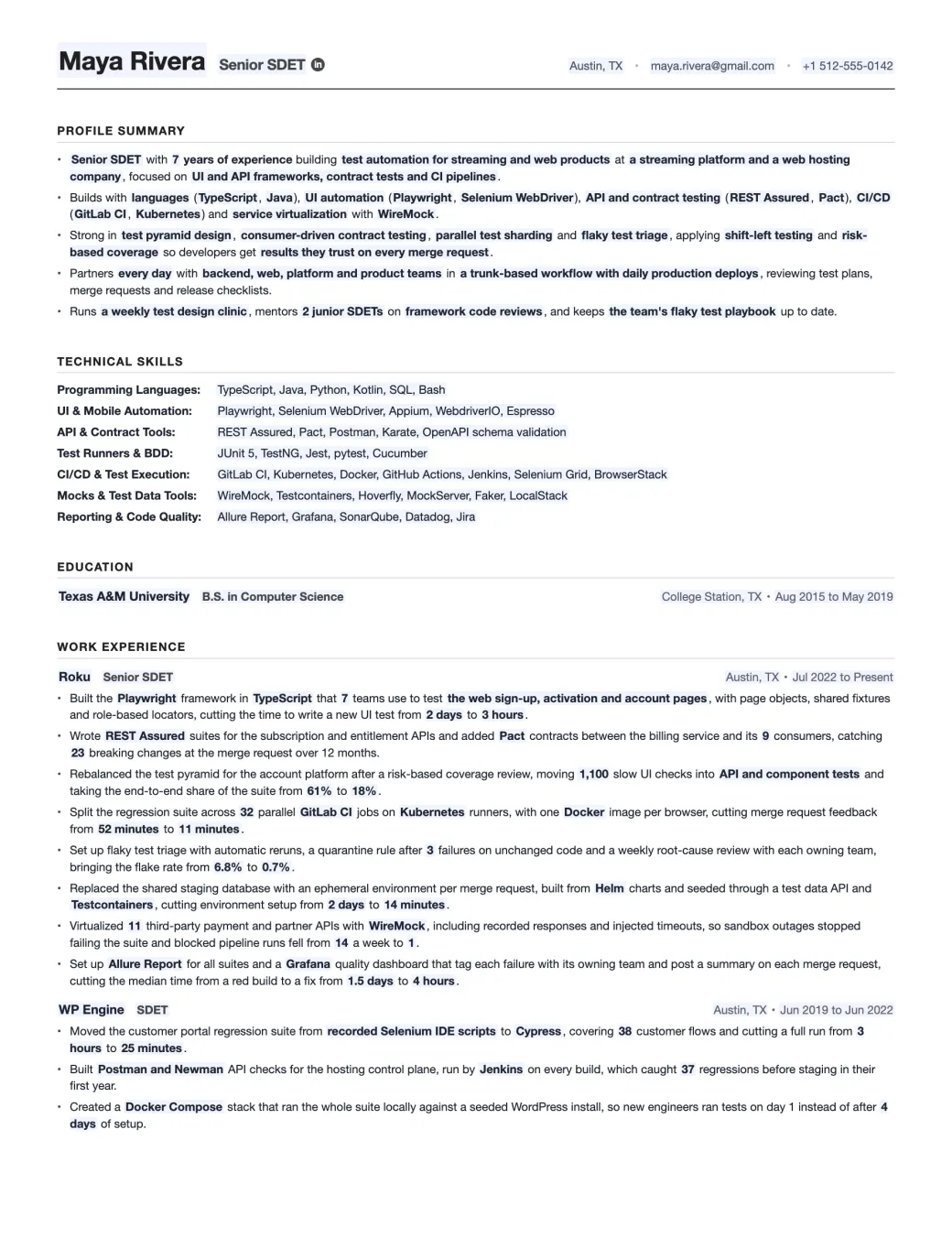
The SDET resume template filled in for Maya Rivera, a Senior SDET at Roku: profile summary, technical skills, education and two jobs of test automation bullets
Emmanuel Gendre Ex-Google recruiter / Tech resume writer Updated Free, ATS-friendly, no signup

Interactive resume template generator

Interactive SDET Resume Template

Fill in the side panel, then download your resume as a PDF or a Word file.

Edits update live as you type. Toggle Edit to rewrite paper text directly.

Edit mode is on. Click anywhere on the resume to rewrite text. Side-panel placeholders still update live.

Maya Rivera Senior SDET

Austin, TX • maya.rivera@gmail.com • +1 512-555-0142

Profile Summary

  • Senior SDET with 7 years of experience building test automation for streaming and web products at a streaming platform and a web hosting company, focused on UI and API frameworks, contract tests and CI pipelines.
  • Builds with languages (TypeScript, Java), UI automation (Playwright, Selenium WebDriver), API and contract testing (REST Assured, Pact), CI/CD (GitLab CI, Kubernetes) and service virtualization with WireMock.
  • Strong in test pyramid design, consumer-driven contract testing, parallel test sharding and flaky test triage, applying shift-left testing and risk-based coverage so developers get results they trust on every merge request.
  • Partners every day with backend, web, platform and product teams in a trunk-based workflow with daily production deploys, reviewing test plans, merge requests and release checklists.
  • Runs a weekly test design clinic, mentors 2 junior SDETs on framework code reviews, and keeps the team's flaky test playbook up to date.

Technical Skills

Programming Languages:
TypeScript, Java, Python, Kotlin, SQL, Bash
UI & Mobile Automation:
Playwright, Selenium WebDriver, Appium, WebdriverIO, Espresso
API & Contract Tools:
REST Assured, Pact, Postman, Karate, OpenAPI schema validation
Test Runners & BDD:
JUnit 5, TestNG, Jest, pytest, Cucumber
CI/CD & Test Execution:
GitLab CI, Kubernetes, Docker, GitHub Actions, Jenkins, Selenium Grid, BrowserStack
Mocks & Test Data Tools:
WireMock, Testcontainers, Hoverfly, MockServer, Faker, LocalStack
Reporting & Code Quality:
Allure Report, Grafana, SonarQube, Datadog, Jira

Education

Texas A&M University B.S. in Computer Science
College Station, TX • Aug 2015 to May 2019

Work Experience

Roku Senior SDET
Austin, TX • Jul 2022 to Present
  • Built the Playwright framework in TypeScript that 7 teams use to test the web sign-up, activation and account pages, with page objects, shared fixtures and role-based locators, cutting the time to write a new UI test from 2 days to 3 hours.
  • Wrote REST Assured suites for the subscription and entitlement APIs and added Pact contracts between the billing service and its 9 consumers, catching 23 breaking changes at the merge request over 12 months.
  • Rebalanced the test pyramid for the account platform after a risk-based coverage review, moving 1,100 slow UI checks into API and component tests and taking the end-to-end share of the suite from 61% to 18%.
  • Split the regression suite across 32 parallel GitLab CI jobs on Kubernetes runners, with one Docker image per browser, cutting merge request feedback from 52 minutes to 11 minutes.
  • Set up flaky test triage with automatic reruns, a quarantine rule after 3 failures on unchanged code and a weekly root-cause review with each owning team, bringing the flake rate from 6.8% to 0.7%.
  • Replaced the shared staging database with an ephemeral environment per merge request, built from Helm charts and seeded through a test data API and Testcontainers, cutting environment setup from 2 days to 14 minutes.
  • Virtualized 11 third-party payment and partner APIs with WireMock, including recorded responses and injected timeouts, so sandbox outages stopped failing the suite and blocked pipeline runs fell from 14 a week to 1.
  • Set up Allure Report for all suites and a Grafana quality dashboard that tag each failure with its owning team and post a summary on each merge request, cutting the median time from a red build to a fix from 1.5 days to 4 hours.
WP Engine SDET
Austin, TX • Jun 2019 to Jun 2022
  • Moved the customer portal regression suite from recorded Selenium IDE scripts to Cypress, covering 38 customer flows and cutting a full run from 3 hours to 25 minutes.
  • Built Postman and Newman API checks for the hosting control plane, run by Jenkins on every build, which caught 37 regressions before staging in their first year.
  • Created a Docker Compose stack that ran the whole suite locally against a seeded WordPress install, so new engineers ran tests on day 1 instead of after 4 days of setup.

Done editing? Download a real PDF (selectable text, ATS-friendly, US Letter) or an editable Word file if a recruiter asks for one.

About this template

An SDET resume template, built by a tech recruiter.

An SDET (software development engineer in test) is a developer whose product is the test suite. You write the automation framework other engineers use, test APIs and the contracts between services, and get thousands of tests running in parallel on every pull request. When a test fails at random, you’re the one who finds out why. Job boards list the same work as software engineer in test, QA automation engineer or test automation engineer.

A typical SDET resume that reaches me reads like a manual tester’s, with Selenium and Java stapled on. It doesn’t show whether you wrote the framework or only ran its tests. Interviews go to the resumes with engineering proof in them: the framework other teams adopted, the pipeline minutes you cut, the flake rate you brought down and the breaking changes your contract tests caught.

Maya’s Roku job on this template proves each of those, with a bullet apiece for the 8 things test engineering managers screen SDETs on, from framework design to quality signals. Change any number from the side panel to your own. 6 steps to write an SDET resume, each one using her lines as examples, sit under the 3 samples.

Already written yours? Upload it under this section and I’ll send back a resume evaluation for free, with notes on every bullet that describes a suite but skips its result.

Industry signal

What the market says about SDET roles

Thinking about SDET work as a long-term career in 2026? Watch how fast the frameworks move under suites that already work. Appium 3 removed its deprecated endpoints in August 2025 and now needs Node 20.19 or later. JUnit 6 followed in September with Java 17 as its minimum. This September, Playwright 1.63 added test locks, so tests that share an account or a service stop clashing in parallel runs. Somebody has to carry thousands of tests through each of those upgrades, and that somebody is the SDET.

+10% US software dev and tester job growth to 2035 US Bureau of Labor Statistics
$132,566 Average base pay, US software test engineer ads Indeed

Resume Samples

SDET Resume Examples

Every SDET resume I rewrite has the same core: test code, a pipeline and numbers. What changes with seniority is how far your work reaches, and you can watch it widen across the 3 SDET resume examples here. Priya, the junior, tests account opening APIs at Apex Fintech Solutions after a year as a developer. Marcus, the senior, owns test architecture for FanDuel’s sportsbook services. Renata, the lead, runs test engineering for card authorization at American Express. You can download each one as a PDF or a Word file, free and with no signup.

Junior SDET Resume Example

A junior SDET resume has to prove you write test code, not just run test cases. Show the suites you built inside someone else’s framework, a flaky test you fixed and the bugs your tests caught. Coming from development? Keep that job on the page, because it shows you can read the code you’re testing.

Years of experience
2 years
Industry
Brokerage fintech
Stack
JavaPlaywrightJUnit 5GitHub Actions
Download PDF Download Word

Click to download the Junior SDET resume example as a PDF or a Word file. Free / No signup.

Priya Naidu

Junior SDET

Dallas, TX · priya.naidu@gmail.com · +1 214-555-0117 · linkedin.com/in/priyanaidu

Profile Summary

  • Junior SDET with 2 years in fintech, writing API and UI tests for account opening and money movement at Apex Fintech Solutions, after a year building Java card services at Fiserv.
  • Writes tests in Java and TypeScript with REST Assured, Playwright and JUnit 5, runs them in GitHub Actions with Docker, and stubs partner APIs in WireMock.
  • Comfortable with API test design, test data factories and flaky test fixes, and checks where a test belongs on the test pyramid before writing it.
  • Works with backend developers, product owners and the operations team in 2-week sprints, joining story refinement to write acceptance tests before coding starts.
  • Wrote the team’s REST Assured starter guide, pairs with new hires on their first API tests, and holds the ISTQB Foundation certificate.

Technical Skills

Programming Languages:
Java, TypeScript, SQL, Python (scripting)
UI & Mobile Automation:
Playwright, Selenium WebDriver (older suites)
API & Contract Tools:
REST Assured, Postman, OpenAPI schema validation, Pact (learning)
Test Runners & BDD:
JUnit 5, Jest, Cucumber
CI/CD & Test Execution:
GitHub Actions, Docker, Jenkins (legacy jobs)
Mocks & Test Data Tools:
WireMock, Testcontainers, Mockito, Faker
Reporting & Code Quality:
Allure Report, SonarQube, Jira
Page 2 of 2

Work Experience

Apex Fintech Solutions Associate SDET Dallas, TX · Aug 2025 to Present
  • Wrote REST Assured suites for 22 account opening endpoints, checking each response against the OpenAPI schema, and caught 9 breaking changes before merge in 2 quarters.
  • Added Playwright tests in TypeScript for the advisor onboarding portal on the team’s page objects, raising automated coverage of its 4 critical flows from 30% to 85%.
  • Swapped calls to a partner bank sandbox for WireMock stubs and Testcontainers PostgreSQL seeded by data factories, cutting failed pull request runs on the ACH suite by about 60%.
  • Fixed 41 flaky tests by replacing fixed sleeps with explicit waits and giving each test its own account, taking the suite’s flake rate from 9% to 3%.
  • Split the API suite into 4 parallel GitHub Actions jobs and posted Allure results on each pull request, cutting the test job from 18 minutes to 7 minutes.
Fiserv Associate Software Engineer Alpharetta, GA · Jun 2024 to Jul 2025
  • Built 6 Java and Spring Boot endpoints for the debit card dispute service, working through code review with 2 senior engineers on a 9-person team.
  • Wrote JUnit 5 and Mockito unit tests for the team’s 3 dispute services, raising their line coverage from 52% to 86% with no production bugs on them in 4 releases.
  • Added Postman and Newman checks for the dispute API to the nightly Jenkins run, catching 5 regressions before UAT, the work that started the move into test engineering.

Education

Georgia Institute of Technology B.S. in Computer Science Atlanta, GA · Aug 2020 to May 2024
ISTQB Certified Tester Foundation Level (CTFL) Online · 2025

Senior SDET Resume Example

By senior level, the question is whether other teams rely on what you built. I look for a framework or test harness other squads use, contract tests between services and a CI number such as feedback time. Each bullet should show the decision you made, not only the tool you used.

Years of experience
7 years
Industry
Sports betting
Stack
TypeScriptPlaywrightTestcontainersGitHub Actions
Download PDF Download Word

Click to download the Senior SDET resume example as a PDF or a Word file. Free / No signup.

Marcus Tan

Senior SDET

Atlanta, GA · marcus.tan@gmail.com · +1 404-555-0188 · linkedin.com/in/marcustan

Profile Summary

  • Senior SDET with 7 years testing consumer apps and SaaS chat products, now owning test architecture for FanDuel Sportsbook bet placement and wallet services.
  • Works in TypeScript, Kotlin and Java with Playwright, REST Assured, Pact and Testcontainers, running suites on GitHub Actions and Kubernetes runners.
  • Deep experience in contract testing across service teams, event-driven test harnesses for Kafka and parallel CI design, with a habit of deleting tests that don’t earn their run time.
  • Partners with 5 product squads, the platform team and mobile engineers, reviewing test plans at kickoff and joining incident reviews when a bug reaches production.
  • Mentors 3 SDETs, interviews for the SDET hiring loop, and wrote the contract testing guide 4 teams now follow.

Technical Skills

Programming Languages:
TypeScript, Kotlin, Java, Python, SQL
UI & Mobile Automation:
Playwright, Cypress, Appium, Espresso, XCUITest
API & Contract Tools:
REST Assured, Pact, PactFlow, Postman, gRPC
Test Runners & BDD:
Jest, JUnit 5, Vitest, Cucumber
CI/CD & Test Execution:
GitHub Actions, Kubernetes, Docker, BrowserStack
Mocks & Test Data Tools:
Testcontainers, WireMock, LocalStack, Faker
Reporting & Code Quality:
Allure Report, Datadog, SonarQube, Codecov
Page 2 of 2

Work Experience

FanDuel Senior Quality Engineer, Sportsbook Atlanta, GA · Aug 2022 to Present
  • Set up Pact contracts in PactFlow between the bet placement service and its 12 consumers, blocking incompatible deploys and cutting integration bugs found in staging by 70%.
  • Wrote risk-based test plans with product and compliance for a new state launch, choosing the test layer for each wagering rule, and shipped it with 0 severity-1 bugs in its first 90 days.
  • Built a Kafka event harness on Testcontainers with WireMock stubs for the geolocation and payment vendors, isolating each test’s topics and data, which took the event suite’s flake rate from 11% to 1.2%.
  • Moved the sportsbook web Playwright suite to sharded GitHub Actions runs on Kubernetes runners behind a merge queue, cutting pull request feedback from 38 minutes to 9 minutes.
  • Added an owner tag to every test and routed failures to the right squad through Datadog, cutting the median time to fix a broken main build from 2 days to 5 hours.
Drift SDET Boston, MA · Jul 2019 to Jul 2022
  • Built the Cypress suite for the chat widget and inbox across 40 flows, raising automated coverage of release-blocking paths from 35% to 80%.
  • Wrote Karate API tests for 60 endpoints in the conversation service, catching 28 regressions before staging in 2021.
  • Set up the team’s first parallel Jenkins pipeline on Selenium Grid, taking the nightly regression from 3 hours to 45 minutes.

Education

Northeastern University B.S. in Computer Science (co-op program) Boston, MA · Sep 2014 to May 2019

Lead SDET Resume Example

A lead SDET resume has to show test engineering at the scale of a whole group: a migration you led, a standard other teams follow and the SDETs you grew. At a bank or card company, add the compliance evidence your pipeline produces, because auditors and hiring managers both ask for it.

Years of experience
11 years
Industry
Card payments
Stack
JavaPlaywrightSeleniumJenkins
Download PDF Download Word

Click to download the Lead SDET resume example as a PDF or a Word file. Free / No signup.

Renata Oduya

Lead SDET

New York, NY · renata.oduya@gmail.com · +1 212-555-0193 · linkedin.com/in/renataoduya

Profile Summary

  • Lead SDET with 11 years in card payments and trading systems, leading test engineering for authorization and dispute services at American Express.
  • Builds in Java, Kotlin and TypeScript with Playwright, Selenium Grid, REST Assured, Spring Cloud Contract and WireMock, on Jenkins and Kubernetes.
  • Known for framework migrations, test architecture reviews and audit-ready test evidence, keeping release suites fast while PCI DSS and SOX controls stay covered.
  • Works with payments engineering, risk and compliance and release management, and chairs the monthly test architecture review for 4 product groups.
  • Runs the SDET interview loop for the group, mentors 2 senior SDETs working toward staff, and set the framework coding standard new teams start from.

Technical Skills

Programming Languages:
Java, Kotlin, TypeScript, Python, SQL, Groovy
UI & Mobile Automation:
Playwright, Selenium WebDriver, Appium, XCUITest
API & Contract Tools:
REST Assured, Spring Cloud Contract, Karate, OpenAPI, gRPC
Test Runners & BDD:
JUnit 5, TestNG, Cucumber
CI/CD & Test Execution:
Jenkins, Kubernetes, Docker, Selenium Grid, Sauce Labs
Mocks & Test Data Tools:
WireMock, Testcontainers, Mockito, masked production data
Reporting & Code Quality:
ReportPortal, SonarQube, Grafana, Jira
Page 2 of 2

Work Experience

American Express Lead SDET, Card Authorization New York, NY · Mar 2021 to Present
  • Led the move of 4,200 Selenium tests to a Java Playwright framework across 3 teams in 3 quarters, cutting the release regression from 6 hours to 70 minutes.
  • Set up Spring Cloud Contract between the authorization service and its 14 consumers, ending the contract breaks behind 5 release rollbacks the year before.
  • Built a Jenkins stage that stores signed test evidence for every release, cutting PCI DSS and SOX evidence prep from 3 weeks a quarter to 2 days.
  • Replaced copied production data with masked datasets and synthetic card generators, so all 9 lower environments now clear the quarterly data privacy scan.
  • Leads 5 SDETs through weekly design reviews and pairing, and 2 of them have moved up to senior since 2023.
Morgan Stanley SDET to Senior SDET New York, NY · Jul 2015 to Feb 2021
  • Owned the REST Assured suite for 200+ trade reporting endpoints, catching 91% of API regressions before release across 4 service teams.
  • Moved nightly runs to a parallel Selenium Grid on Docker with WireMock stubs for market data feeds, cutting the run from 5 hours to 55 minutes.
  • Wrote the flaky test classification and quarantine rules that 5 teams adopted, bringing the trading suite’s flake rate from 10% to 1.5%.

Education

Columbia University B.S. in Computer Science New York, NY · Sep 2011 to May 2015
ISTQB Advanced Level Technical Test Analyst (CTAL-TTA) Online · 2020

Free resume review

A recruiter screen, but with feedback

You applied to hundreds of jobs: no result. Companies won’t give you feedback, so you’re stuck in a loop. Rejections will keep coming until you know what’s wrong.

Let’s break this cycle today!

I’ll screen your resume the same way I did at Google.

You’ll get:

  • Your resume sections and content scored.
  • A clear list of what to improve, why, and how.
  • Behind the scenes secrets on the screening process.

How I rewrite SDET resumes

How to write an SDET resume

Emmanuel Gendre, ex-Google recruiter

Emmanuel Gendre Ex-Google recruiter, tech resume writer

In 13 years of screening resumes, many of them as a Google recruiter, SDET resumes took me the longest to judge. One page has to prove you’re a real developer and a real tester. Most drafts I get prove neither: a list of 9 frameworks, then bullets like “Automated regression tests using Selenium.” Nothing about what you built or what it changed.

If you’d rather hand it over, I’ll rewrite every line through my technical resume writing service, so each bullet shows what you built, who uses it and which number moved. If you’re doing it yourself, though, focus on these 6 steps. Each one has SDET examples taken from Maya’s template.

  1. Step 1 Format & layout Plain layout rules that keep your frameworks searchable in an ATS. Go to step 1
  2. Step 2 Profile Summary 5 lines covering seniority, stack, test specialties, teams and mentoring. Go to step 2
  3. Step 3 Work Experience Maya’s Roku bullets, one per SDET role-profile area. Go to step 3
  4. Step 4 Bullet Points From “automated regression tests” to a bullet with Pact, a CI gate and a count. Go to step 4
  5. Step 5 Technical Skills 7 skill rows from languages to reporting, then 5 behaviours to prove. Go to step 5
  6. Step 6 Keywords & Metrics Which SDET keywords matter most, plus 24 metrics to end bullets on. Go to step 6

Step 1 · Format & Layout

SDET resume format and layout

Sort out the layout before anything else. It’s an evening’s job, and both of your first readers depend on it: the parser that files your resume, and the recruiter who skims it for your current employer before deciding whether to read on.

01ATS Compliance

ATS compliance for your SDET resume

Whether the company runs Greenhouse, Lever or Workday, your SDET application ends up in a database that recruiters query later. A search for “Cypress” or “REST Assured” only finds resumes the software didn’t choke on. Most bad parses come from a second column, a table or text boxes, and any framework inside them never gets indexed. For the mechanics, read what an ATS does with each section of your resume. For an SDET, the fix comes down to 3 rules:

The 3 rules
  1. Use a 100% text based format (no Canva!)

  2. Avoid tables, pictures, and complex structures.

  3. Use the most predictable section names, like “Profile Summary” and “Work Experience”

02Design & Layout

SDET resume design and layout

Some SDET resumes reach me with a test pyramid graphic, framework logos down the margin or star ratings for Java. You design systems all day, so I see why you’d want one. Recruiters hate fancy designs anyway. I learned that one screening at Google: deep into a morning stack of resumes, all you look for is the current employer and the dates.

My SDET rewrites end up boring by design: one column in Calibri, with section titles any recruiter would expect. Want them to see your test code? Add a GitHub URL to your contact line, pointing at one small framework repo with a green build. Prefer your own Word file? Maya’s template already uses the specs listed below.

Layout Spec
Columns
One. No sidebars, tables, columns, pictures or tabs.
Margins
0.7 in on all four sides
Body size
10 to 11 pt
Type
One family, weight for hierarchy
Length
One page under 5 years, two after
Section order
Summary, Skills, Experience, Education
PDF

03File Format

Resume file format for your SDET resume

PDF should be your default for SDET applications. The page renders the same on a Mac and on Windows, an exported PDF (not a scan) hands the parser clean text, and nobody can edit your flake rate by mistake. Agencies filling contract-to-hire SDET roles are the main exception, because many of them rebuild your resume in their own Word layout before sending it on. For the other cases, see which file type to send with a resume.

Format Guide
PDF
Your default. Layout holds, text stays selectable.
Word (.docx)
When the posting or a recruiter asks for it. Use the Word download above.
Plain text
For portals that make you paste into a box
Never
Images, scans, password-protected PDFs, shared-drive links
File name
Maya-Rivera-SDET.pdf

Step 2 · Profile Summary

SDET profile summary

Switched from manual QA 6 months ago? Your resume still needs a profile summary up top. In the first screen, recruiters spend seconds on your resume and read little beyond the opening lines, so your SDET title, years and main frameworks belong there. Without them, you won’t make it to the second, closer read. Both steps of that screen are in how recruiters decide which resumes to read.

A test engineering manager reads those 5 lines looking for 3 answers. Do you write test code or only run it? Which frameworks and CI systems would you be lost without? Do developers see your tests as a safety net or as something to work around? Maya’s version sits under each line’s job, and you’ll find more in my examples of tech profile summaries.

  1. 1

    Title, years and scope

    Lead with the title as the ad prints it: SDET, Software Engineer in Test or QA Automation Engineer. Add your years in testing roles and the product under test, like a payments API or a streaming app. This line sets your level.

  2. 2

    Your stack

    Bucket your daily tools the way SDET postings bucket them: language, UI framework, API and contract tools, CI, then mocking. Mirror the posting’s spelling (Selenium WebDriver, not “Selenium automation”), since exact strings are what the ATS compares.

  3. 3

    Domain expertise

    The testing problems you’re best at, like contract testing, parallel CI or flaky test triage, plus how you work (shift-left, risk-based coverage). It tells a manager where you’d fit in their test stack on day 1.

  4. 4

    Collaboration

    The people who use your tests: backend and front-end developers, platform or DevOps engineers, product owners. Mention where you show up for them, like story refinement, merge request reviews and release checks.

  5. 5

    Leadership

    Test standards you set, docs you maintain, developers and juniors you coach on writing tests. You don’t need reports. What counts is whether teams around you write better tests than before you joined.

SDET resume summary example, from the template above
  • Senior SDET with 7 years of experience building test automation for streaming and web products at a streaming platform and a web hosting company, focused on UI and API frameworks, contract tests and CI pipelines.
  • Builds with languages (TypeScript, Java), UI automation (Playwright, Selenium WebDriver), API and contract testing (REST Assured, Pact), CI/CD (GitLab CI, Kubernetes) and service virtualization with WireMock.
  • Strong in test pyramid design, consumer-driven contract testing, parallel test sharding and flaky test triage, applying shift-left testing and risk-based coverage so developers get results they trust on every merge request.
  • Partners every day with backend, web, platform and product teams in a trunk-based workflow with daily production deploys, reviewing test plans, merge requests and release checklists.
  • Runs a weekly test design clinic, mentors 2 junior SDETs on framework code reviews, and keeps the team’s flaky test playbook up to date.

Step 3 · Work Experience

SDET work experience

Get past the summary and you reach the second, slower read, often with the hiring manager looking too. Here, about 95% of the decision hangs on your latest job, in my experience. The framework, pipeline and suites you run today are the closest look they’ll get at how you’d work on their team.

So map that job onto the SDET role profile, which is my list of the 8 areas test engineering managers score you on, one bullet each in the order below. An empty area looks like experience you don’t have. No flaky test bullet, for instance, and they may guess your suite is the noisy one everyone reruns.

SDET role profile
  1. Automation Framework Design

    You build the framework every other engineer writes UI tests in. If it’s clumsy, developers stop adding tests, so a manager wants proof that teams actually adopted yours. Show them how you used page objects and shared fixtures in Playwright or Selenium to make a new test quick enough that developers write their own.

    Techniques
    page objects, shared fixtures, role-based locators, framework code reviews
    Tools
    Playwright, Selenium WebDriver, Cypress, Appium
    Metrics
    teams using it, time to write a test, tests added per sprint
  2. API & Contract Testing

    You test services below the UI, where most of the logic lives. API tests finish in seconds and point straight at the broken endpoint, and contract tests won’t let a provider break its consumers. Walk them through how you used REST Assured and Pact to catch breaking changes at the pull request instead of in staging.

    Techniques
    schema validation, consumer-driven contracts, provider verification, negative tests
    Tools
    REST Assured, Pact, Postman, Karate
    Metrics
    breaking changes caught, endpoints covered, integration bugs in staging
  3. Test Architecture & the Test Pyramid

    You decide which layer each test belongs in. A top-heavy suite full of slow UI checks burns hours of CI time and still misses bugs, and that’s why layer thinking is what a manager listens for. Explain how a risk-based review and the test pyramid helped you move checks down a layer and speed up the whole suite.

    Techniques
    risk-based coverage, test plans, layer reviews, deleting low-value tests
    Tools
    JUnit 5, TestNG, pytest, Jest
    Metrics
    share of end-to-end tests, suite runtime, bugs caught per layer
  4. CI Integration & Parallel Runs

    You wire the suite into CI so every pull request gets a result. If tests take an hour, developers won’t wait, and the suite stops protecting anything. Describe how you used sharding and containers on GitHub Actions, GitLab CI or Jenkins to bring feedback time down to minutes.

    Techniques
    test sharding, merge gates, containerized browsers, merge queues
    Tools
    GitHub Actions, GitLab CI, Jenkins, Kubernetes
    Metrics
    pull request feedback time, parallel jobs, CI cost
  5. Flaky Test Triage

    You track down the tests that fail at random. Once a team’s used to rerunning red builds, real bugs slip through with the noise, so hiring managers value an engineer who treats flakes as defects. Point out the rerun data and quarantine rules you relied on to find root causes and cut the flake rate.

    Techniques
    rerun analysis, quarantine rules, explicit waits, test isolation
    Tools
    Allure Report, Datadog CI Visibility, Jira
    Metrics
    flake rate, quarantined tests, reruns per build
  6. Test Data & Environments

    You give every test known data and a clean environment. Shared staging data causes plenty of random failures, and once that’s fixed, every team gets unblocked at once. Mention how Testcontainers, seed scripts or ephemeral environments let you shorten setup and keep parallel runs from colliding.

    Techniques
    test data factories, seed scripts, ephemeral environments, data masking
    Tools
    Testcontainers, Docker Compose, Helm, LocalStack
    Metrics
    environment setup time, data-related failures, environments per day
  7. Mocking & Service Virtualization

    You replace the dependencies your tests can’t control. A partner sandbox that goes down for an afternoon shouldn’t block a whole day of merges, and managers know how often that happens. Tell them how you used WireMock or MockServer stubs with recorded responses and injected faults to keep pipelines green when partners fail.

    Techniques
    API stubs, recorded responses, fault injection, stub drift checks
    Tools
    WireMock, MockServer, Hoverfly, Mockito
    Metrics
    blocked pipeline runs, services stubbed, error cases covered
  8. Quality Signals for Developers

    You turn test results into something developers read and act on. A red build nobody owns can sit for days, so managers like SDETs who route each failure to the right team. Detail how you used Allure or ReportPortal reports and a Grafana dashboard to get broken builds fixed the same day.

    Techniques
    failure routing, test ownership tags, pull request comments, coverage gates
    Tools
    Allure Report, ReportPortal, Grafana, SonarQube
    Metrics
    time to fix a red build, escaped bugs, coverage on changed code

If you’re the only SDET on a small team, you probably touch all 8 areas already, so write them all down. At a bigger company with a split test org, cover the areas you own and say which team you partner with for the rest.

Submit your resume for a free review!

Step 4 · Bullet Points

SDET resume bullet points

A single SDET bullet can eat a surprising amount of my time, because it has to show code, tooling and a result at once. I wrote the Level System so that work follows the same steps every time. The XYZ formula I used at Google sits underneath, and I added layers for the technical detail test engineering managers check. Every rule is in my Level System bullet point guide.

Every level poses one question about a single test project, and each answer makes the bullet longer and more specific. On SDET bullets, the fifth one is usually about feedback time, flake rate, bugs stopped before merge or hours handed back to developers. Here’s a contract testing line built up over all 5.

  1. Level 1Task

    What did I work on? Start with a verb and one thing you shipped. A recruiter skips a line that stops here.

    Set up contract testing for the checkout service.

  2. Level 2+ Techniques

    How did I do it? Add the techniques you picked, like consumer-driven contracts or test isolation. They show how you think about testing.

    Set up contract testing for the checkout service with consumer-driven contracts and provider states per payment method.

  3. Level 3+ Tools

    What tools did I use? Write the framework, the language and the CI platform. Those are the words recruiters type into the ATS.

    Set up contract testing for the checkout service with consumer-driven contracts and provider states per payment method, in Pact and Kotlin on GitHub Actions.

  4. Level 4+ Method

    What method did I follow? Say what makes the test trustworthy, like a deploy gate or a quarantine rule. Few candidates bother, so it stands out.

    Set up contract testing for the checkout service with consumer-driven contracts and provider states per payment method, in Pact and Kotlin on GitHub Actions, with a can-i-deploy gate on every release.

  5. Level 5+ Metric

    What was the result? Finish on one number a manager cares about: minutes saved, flakes removed, breaking changes caught.

    Set up contract testing for the checkout service with consumer-driven contracts and provider states per payment method, in Pact and Kotlin on GitHub Actions, with a can-i-deploy gate on every release, catching 31 breaking changes before release across 8 consumer teams.

    1. 01 Task What you worked on
    2. 02 Techniques How you did it
    3. 03 Tools The stack you used
    4. 04 Method The method you followed
    5. 05 Metric The result, one number

Most SDETs have more numbers than they think. Every CI run logs its duration, your test report keeps months of red and green runs, and the Pact Broker records each blocked deploy. Export a quarter of that data before you start writing.

Step 5 · Technical Skills

SDET resume skills

After a dozen SDET job ads, you’ll notice the same 7 buckets coming back: languages, UI and mobile frameworks, API and contract tools, test runners, CI/CD, mocks and test data, and reporting. Spell each product exactly like the posting. “Selenium WebDriver” and “Selenium” aren’t always the same string to an ATS search.

Check that each tool here also turns up in your Work Experience. A row of 15 frameworks with zero bullets to back them look like padding, and an interviewer will pick the one you know least. Up next are my 7 categories, Maya’s rows from the template and the 5 soft skills I’d want proved, with sample lines about flaky tests and framework docs. Keywords get their own step next.

The 7 skill categories for an SDET resume

Put the starred tools first: SDET hiring teams request them over and over. Keep the unstarred ones for tools you’ve run real suites on.

Programming Languages

The languages your tests and frameworks are written in. Java and TypeScript lead most SDET ads, Python is close behind, and SQL helps with test data checks.

JavaTypeScriptPythonJavaScriptKotlinC#SQLBash

UI & Mobile Automation

Browser and mobile frameworks you’ve built suites in. Playwright and Selenium WebDriver come up most, with Appium, Espresso or XCUITest for mobile teams.

PlaywrightSelenium WebDriverCypressWebdriverIOAppiumEspressoXCUITest

API & Contract Tools

How you test services below the UI. Pair an API tool like REST Assured or Postman with a contract tool like Pact if you’ve set one up.

REST AssuredPostmanPactKarateSpring Cloud ContractOpenAPIgRPC

Test Runners & BDD

The runners your suites sit on. Match the runner to your language: JUnit 5 or TestNG for Java, pytest for Python, Jest or Vitest for TypeScript.

JUnit 5TestNGpytestJestVitestCucumberMocha

CI/CD & Test Execution

The platform that runs your suites and the setup that scales them. List the CI tool, the container setup and any grid or device cloud, such as Selenium Grid or BrowserStack.

GitHub ActionsJenkinsDockerGitLab CIKubernetesSelenium GridBrowserStackSauce Labs

Mocks & Test Data Tools

Stubs, containers and data tools that keep each test independent. WireMock and Testcontainers lead this row in most ads I read.

WireMockTestcontainersMockServerHoverflyMockitoLocalStackFaker

Reporting & Code Quality

How your results reach developers. A test report like Allure, a dashboard and a quality gate like SonarQube show you care about the signal, not just the run.

Allure ReportSonarQubeReportPortalGrafanaDatadogCodecovJira

A finished SDET skills section

Technical Skills sample, from the template above
Programming Languages
TypeScript, Java, Python, Kotlin, SQL, Bash
UI & Mobile Automation
Playwright, Selenium WebDriver, Appium, WebdriverIO, Espresso
API & Contract Tools
REST Assured, Pact, Postman, Karate, OpenAPI schema validation
Test Runners & BDD
JUnit 5, TestNG, Jest, pytest, Cucumber
CI/CD & Test Execution
GitLab CI, Kubernetes, Docker, GitHub Actions, Jenkins, Selenium Grid, BrowserStack
Mocks & Test Data Tools
WireMock, Testcontainers, Hoverfly, MockServer, Faker, LocalStack
Reporting & Code Quality
Allure Report, Grafana, SonarQube, Datadog, Jira

Soft skills for an SDET resume

Developers don’t trust an SDET for adjectives. They trust what they watched you do, like killing a flaky test before their release. Prove each of these 5 the same way, with a short bullet and a figure.

  • Treating developers as the users of your framework

    Resume bulletSurveyed 40 developers about the test framework and fixed their top complaint first, doubling the tests they wrote the next quarter.

  • Deleting a test that costs more than it catches

    Resume bulletRetired 380 end-to-end checks with no caught bug in 12 months, taking 14 minutes off every pipeline run.

  • Moving a check to the API layer instead of the UI

    Resume bulletRewrote 90 pricing-rule UI checks as API tests, which now finish in 50 seconds instead of 22 minutes.

  • Writing docs so teams add tests without asking you

    Resume bulletWrote the onboarding guide for the shared framework, after which 6 teams added their first tests without asking for help.

  • Pairing with a developer on a bug they can’t reproduce

    Resume bulletPaired with a mobile developer on an Android-only crash and found the token refresh race behind it in 2 days.

Step 6 · Keywords & Metrics

SDET resume keywords and metrics

Nothing new to write here, just 2 checks. Keywords control whether recruiters ever find you, since an ATS search returns only resumes with their exact terms. Pact in the posting means Pact on your page. Metrics control whether the hiring manager trusts what they read, because “built a framework” without a number could describe a weekend script.

I’ve sorted the SDET keywords I see most often into 3 tiers. The finder under them reads a posting you paste and ranks what it asks for. At the end, a table pairs 24 SDET metrics with sample bullets, sorted by role-profile area.

+42%

SDET resume keywords, ranked

Tap one to read its usual job ad wording underneath. Some ads ask for an “automation harness”, others for a “test framework”, and plenty just write Playwright.

Must-have

8

Use each one at least twice: once in a Work Experience bullet and once in your skills rows.

In a job description“Design, build and maintain test automation for web services and user interfaces”

Strong supporting

9

Add the ones you’ve used on a real suite. They tip the balance between 2 close resumes.

In a job description“Experience with Cypress for front-end test automation”

Bonus

8

Nice to have. Add them when the posting mentions them and you can talk about them in an interview.

In a job description“Consumer-driven contract testing with Pact”

Extract SDET keywords from a job description

Paste in any SDET opening, whether it’s titled Software Engineer in Test, QA Automation Engineer or something in between. You’ll get its frameworks, languages, CI tools and test methods back in tiers. Any of them missing from your skills rows or bullets is a gap to fix before you apply.

Must-have
Put these in your skills section and back each one with a bullet.
Strong supporting
Add the ones you’ve actually worked with. Skip the rest.

Nothing is uploaded: it all happens in your browser.

Metrics for an SDET resume

Don’t stack numbers in a bullet. Choose 1 of the 3 per area, ideally the one your CI logs or dashboards can prove.

MetricExample bullet
Framework design
Teams on the framework Count Product teams that write their tests in the framework you built.Grew the shared Playwright framework from 1 team to 7 teams in 18 months by adding fixtures for the 3 flows every team tested.
Setup code per test Count Lines a developer writes before the first assertion in a new test.Cut setup code per UI test from 45 lines to 6 by moving login, test accounts and feature flags into shared fixtures.
Tests broken by UI changes Count Tests that fail because a page changed, not because of a bug.Cut tests broken by each UI redesign from about 120 to 9 by switching the suite to role-based locators.
API & contracts
Breaking changes blocked Count Provider changes your contract tests stopped before they reached a consumer.Blocked 17 breaking changes to the entitlement API before deploy with Pact’s can-i-deploy check.
Endpoint coverage Percent Share of an API’s endpoints with automated tests behind them.Raised automated coverage of the subscription API from 48% to 96% of endpoints with REST Assured and schema checks.
Integration bugs in staging Count Bugs found only when services meet in a shared environment.Cut integration bugs found in staging from 31 to 6 a quarter after moving service checks into contract tests.
Test architecture
End-to-end share Percent Share of the suite that runs through the full UI stack.Brought end-to-end tests down from 54% to 22% of the activation suite by moving rule checks into API and component tests.
Suite runtime Time Wall-clock time for one full regression run.Cut the nightly regression from 3.5 hours to 40 minutes after retiring 260 duplicate UI tests and running the rest in parallel.
Bugs caught per layer Percent How many real regressions the fast layers catch before the UI tests run.Raised the share of regressions caught by unit and API tests from 40% to 72%, so most failures show up minutes after a push.
CI & parallel runs
Pull request feedback time Time Minutes from a push to a test result on the pull request.Cut pull request feedback on the web app from 27 to 8 minutes by running only the tests affected by each change.
Parallel jobs Count Jobs a single suite run is split across.Scaled regression runs from 4 to 32 parallel jobs on Kubernetes runners without raising the monthly CI bill.
CI cost Money What the test pipeline costs in runner minutes each month.Cut monthly CI spend on test jobs by $4,100 by caching browser images and skipping suites on docs-only changes.
Flaky tests
Flake rate Percent Share of test runs that fail, then go green on a rerun of the same code.Took the web suite’s flake rate from 4.9% to 0.6% by fixing timing waits in the 30 worst tests first.
Quarantined tests Count Tests pulled from the blocking run until someone fixes them.Kept quarantined tests under 15 at any time with a 5-day fix rule and an owner on every entry.
Reruns per build Count Automatic retries the pipeline needs before it goes green.Cut automatic reruns from 2.3 to 0.2 per build after removing shared test accounts from the login suite.
Test data & environments
Environments per day Count Test environments the team spins up and tears down each day.Ran 180 ephemeral environments a day on Helm, one per merge request, each torn down when its pipeline finished.
Data-related failures Percent Red builds caused by missing or shared test data, not by code.Cut failures caused by bad or shared test data from 38% to 5% of red builds with seeded accounts per test.
Data setup time Time Time a test spends creating the data it needs.Cut data setup per API test from 9 seconds to 0.4 seconds with Testcontainers PostgreSQL snapshots instead of API calls.
Mocking
Releases blocked by sandboxes Count Releases held up because a partner’s test environment was down.Ended the sandbox failures that had blocked 9 releases in one quarter by stubbing the payment provider in WireMock.
Services stubbed Count Internal or third-party services your tests call through a stub.Stubbed the 6 internal services the account suite depended on, so it now runs on a laptop with no network.
Error cases covered Count Timeouts, rate limits and error responses your tests inject on purpose.Added 42 injected failure cases (timeouts, 429s and 5xx responses) to the billing suite and caught 3 retry bugs before release.
Quality signals
Red builds left overnight Count Main branch failures nobody fixed before the end of the day.Cut red main builds left overnight from 11 a month to 2 by posting each failure to the owning team’s channel.
Escaped bugs Count Production bugs a test could have caught.Cut escaped bugs on the account pages from 14 to 4 per quarter after adding a test for every past escape.
Coverage on changed code Percent Test coverage measured only on the lines a pull request changes.Raised coverage on changed code from 58% to 84% with a SonarQube gate on merge requests for the billing service.

What if you don’t have exact numbers?

  • 1

    Check your CI history first. GitHub Actions, GitLab CI and Jenkins keep run times and failure counts for months, so your suite duration and flake numbers are usually one filter away.

  • 2

    Estimate low. “Around 400 tests” or “about 40% of pipeline time” is fine to write, provided the estimate holds up to a follow-up question.

  • 3

    Measure reach instead. No baseline to compare against? Count the services, endpoints or teams your tests cover. That alone says how big your scope was.

Free resume review

A recruiter screen, but with feedback

You applied to hundreds of jobs: no result. Companies won’t give you feedback, so you’re stuck in a loop. Rejections will keep coming until you know what’s wrong.

Let’s break this cycle today!

I’ll screen your resume the same way I did at Google.

You’ll get:

  • Your resume sections and content scored.
  • A clear list of what to improve, why, and how.
  • Behind the scenes secrets on the screening process.

Frequently asked

SDET resume FAQ

Yes, with no account to create and no trial clock running. Edit Maya’s resume into your own, download it, and return to this page each time your stack changes.

Yes, as a .docx. The button labelled Word sits right after Download PDF, and its file opens fine in Word or Google Docs for more edits. The 3 samples have Word files too. Still, I’d apply with the PDF. Agencies are the exception, since their recruiters usually move your resume into their own branded document first.

Yes. Its single column, its 4 standard headings and the selectable text in the exported PDF let Greenhouse or Workday file Playwright, Pact and Jenkins as skills. You can confirm it with your own file in my free ATS parsing test.

Juniors with a couple of years in testing can fit everything on 1 page. Most senior SDETs run to 2, and that’s normal when each job brings its own frameworks, pipelines and results. I’ve never seen a strong SDET rejected for page 2. Thin bullets get people rejected.

Fewer than you’d think. ISTQB Foundation (CTFL) helps juniors and appears in some bank and enterprise postings, and the ISTQB Technical Test Analyst certificate suits senior SDETs. A cloud certificate helps if you own test infrastructure. None of them beats a framework you built, so list them after your degree and keep the line short.

The ones that show your tests help developers ship: pull request feedback time, flake rate, breaking changes caught before merge, suite runtime and the number of teams on your framework. The SDET metrics table above offers 3 choices per area.

A QA engineer resume can lead with test plans, exploratory testing and bug reports. An SDET resume has to read like a developer’s: code you wrote, frameworks other people use and CI work. When your bullets mostly describe executing tests rather than building them, start from the QA engineer resume template instead.

A QA manager resume template centers on people and release decisions: headcount, hiring and go/no-go calls. A performance engineer resume template is about load tests, latency and capacity. Yours lands in the middle, with the test code and tooling you built as the main proof.

Yes, provided there’s code to show. Put your strongest automation work in Job 1, even if your title says QA Analyst: an API suite you wrote, a CI job you set up, a flaky test you fixed. If your job hasn’t given you the chance yet, a GitHub repo with a small Playwright or REST Assured project fills the gap.

No. A hiring manager has never turned down an SDET because the layout looked familiar. The bullets are what get judged: did you build test systems, and did they change anything? Once Maya’s frameworks and numbers are replaced with yours, the template is invisible.

More resources

More help with your SDET resume