You submit your resume + target role
Upload a PDF or DOCX from any of the forms on this page. Add the role you are targeting so I can review against the right bar.
By a former Google recruiter
You send your resume, I read it personally and send it back as a Google Doc with line-by-line comments and a score on four rubrics. The full resume review lands in your inbox in under 12 hours.
Get your resume directly annotated, with scoring and insights.
You applied to a lot of jobs. A few callbacks at first, then silence. No feedback, no rejection email worth reading. You ran your CV through a resume checker, typed "score my resume" into a chatbot, tweaked the keywords. Nothing changed.
I'm Emmanuel, an ex-Google recruiter and tech resume writer. The free resume review is me reading your file personally and leaving line-by-line comments on a Google Doc, scored on four rubrics, back to you in 12 hours.
Here is the honest read on what is happening: the tech job market got more competitive and resumes that worked three years ago are now average. Average gets ignored. Above-average resumes still get callbacks though, even in this market, and the competition mostly isn't using a professional. The review tells you, on your own document, what is keeping you average.
How it works
Low friction on your side. The whole loop fits in a single day.
Upload a PDF or DOCX from any of the forms on this page. Add the role you are targeting so I can review against the right bar.
Within 12 hours: a Google Doc with your resume opened in it, line-by-line comments, and a score on each of the four rubrics.
Reply on the doc or by email. I clarify any comment, expand on the fix, or give you the next step. No back-and-forth limit.
A real review
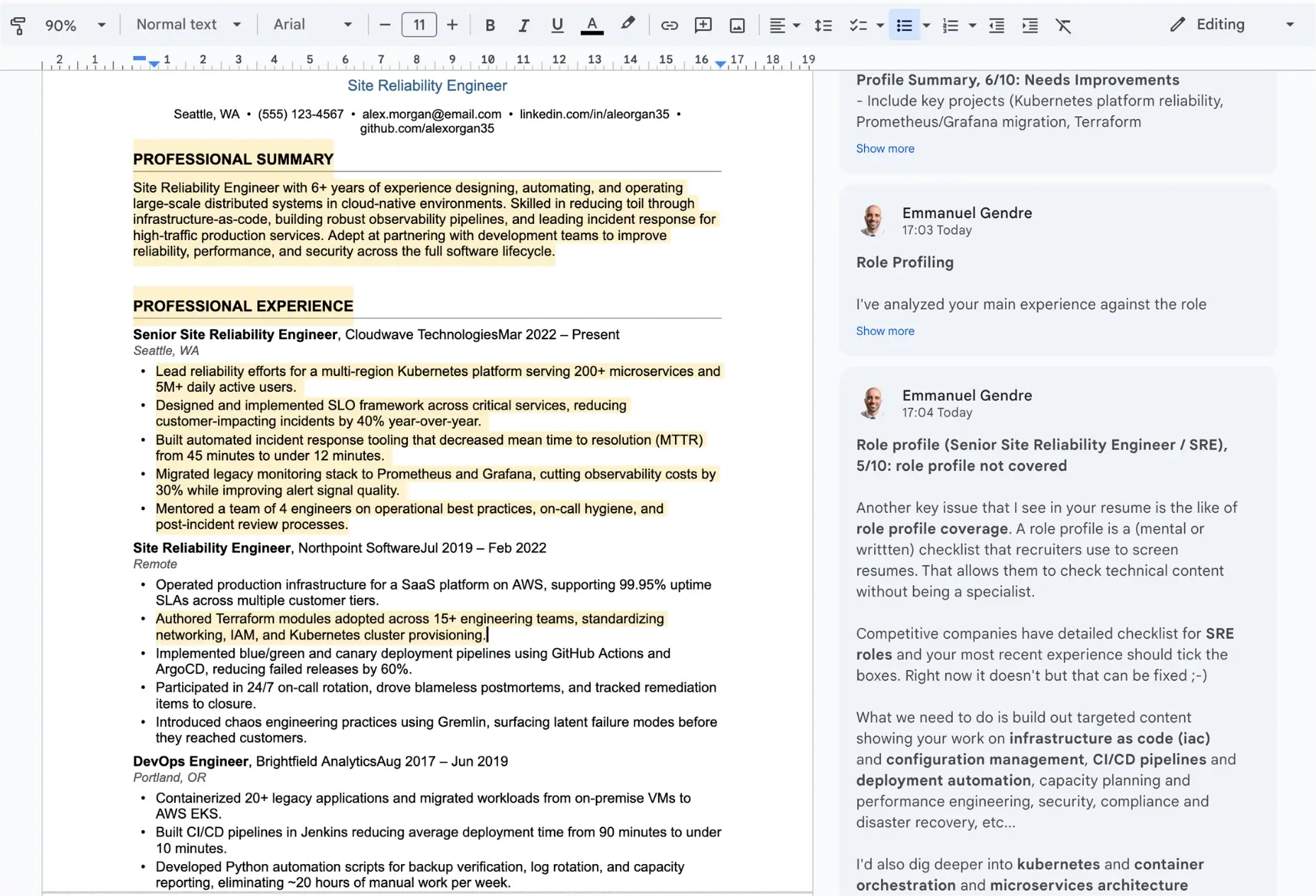
The review is delivered as a Google Doc with inline comments on each section. Below is what one looks like once I am done.
The rubric
I score four things, and I explain on your document what is missing, why it matters, and how fixing it lifts your callback rate. Not a generic resume score with no context, real notes you can act on the same day.
Will the parsing pipeline used by Workday, Greenhouse, and the rest read your file cleanly? I check file format, layout traps (tables, columns, image-based PDFs), section headers, and whether your skills end up where a recruiter can search them. If anything is invisible to the ATS, it never reaches a human.
This is the highest-leverage block on the page. Three lines that have to land four signals at once: target title, years of experience, domain, and main tech stack. Most summaries I see read like a personal statement. I rewrite the structure with you so it survives the first 6 seconds.
Does your resume cover the actual scope of the role you are targeting, or only a slice of it? I cross-check your content against what hiring managers expect for that title at your seniority. Gaps here are the quiet reason "qualified" candidates get rejected without explanation.
Bullets are where level signal lives. I check each one for scope, technique, stack, methodology, and metric. Then I tell you which bullets read junior, which read senior, and which to rewrite. This is also where most candidates have the most upside.
Each rubric gets a numerical score plus a short paragraph on what is missing and the fix. You leave the doc with a concrete punch list, not a vague "tighten this up".
Real feedback on your resume
Three short notes from people who sent their resume in, fixed what I flagged, and started getting calls back.
"I had been applying for two months with no callbacks. Emmanuel pointed out my profile summary was the issue, gave me the four signals to land, and I rewrote it the same evening. Three callbacks the week after."
"I thought my resume was fine. Emmanuel scored my bullets at 4/10 and showed me, line by line, which ones read junior. Painful but exactly what I needed to hear before another six months of silence."
"I was using a Canva template that looked great in PDF but the ATS was reading it as one big image. The review caught it in five minutes. Switched to a single-column DOCX and started showing up in recruiter searches."
You upload a PDF or DOCX. I open it in Google Docs, score each rubric, and leave concrete comments on every line that is costing you interviews. You get the doc back in under 12 hours.
No card, no signup, no upsell. The review itself is the whole offer.
Behind the scenes
Every job opening goes through at least two reads. Your resume needs to be written for both.
Verdict: in the pile, or out
A recruiter skims the page top-down looking for a small set of signals. They are not reading bullets yet. If the signals jump out, you go to the "yes" pile. If they are buried, the page is closed and the next one opens.
Verdict: invited to interview, or shortlisted out
Recruiters and hiring managers go back through the "yes" pile to choose who to invite. Now bullets get read, role coverage gets checked, and you get compared to other shortlisted candidates.
Two reads, one document. The review covers all four rubrics so you pass the first on structure and win the second on content depth.
Myth-busting
Three myths that quietly waste everyone's time. I'll point these out on your document if I see them.
No. A resume is judged "too long" when there are too many words for too little substance. Recruiters do not care about page count, they care about signal density. If you have 8 years of relevant scope, two pages is fine. If you have one strong role, one page is fine. Length is downstream of content, not a rule.
Better question: does every line on the page earn its space?
The ATS doesn't reject you, the recruiter does. The ATS parses your file and indexes the keywords, that's it. A bad parse will hurt you in search results, but a clean parse doesn't earn a callback either. Get the parse clean (rubric 1), then put your effort where the human decision actually happens.
Free ATS Checker if you want to see exactly what gets parsed from your file.
Templates and design help readability, they do not change content. I have seen beautiful one-pagers full of vague duties get rejected. I've seen plain Word documents with strong, specific bullets land senior callbacks. Pick a clean structure, then spend the time on the content.
Clean templates by role: resume templates. Use them as a structural starting point, not as a magic fix.
Who is reading your resume
I'm Emmanuel. I've spent 12 years in recruiting, including many years at Google, where I screened 1000s of resumes for engineering and tech roles. That sit-and-decide work is where I learned what actually trips a "yes" versus a "no" on the first read, and what costs candidates the second read.
Now I write tech resumes for a living. The free review exists for two reasons. First, most of the people who hit my site need a much smaller fix than a full rewrite, and a clear set of notes is enough to unlock that. Second, the people who do want me to do the rewrite get a much better outcome when we both know exactly what is broken.
So I do every review myself. No outsourcing, no template responses. You get my actual time, my actual notes, and my honest read. More about my background if you want it.
Side by side
Three different things that all promise feedback on your resume. Here is what each one actually tells you, and what it cannot.
Personal review (this page) · ex-Google recruiter
Software / ATS parser
Chatbot / AI tool
Run a resume checker for the parse, ask AI to score my resume for a quick gut-check, and use this free resume review for the part that actually moves your callback rate.
Tools that pair with the review
The review handles the human judgment. These free tools cover the mechanical checks you can run anytime: parse, simulated 6-second screen, and funnel diagnostic.
Read while you wait for your review
If you want to start fixing things now, these three guides cover the highest-leverage parts of the page. They pair directly with rubrics 1, 2, and 4 of the review.
You've seen what the review covers and how the screen works. The fastest way to know what is keeping you average is to let me read your file and tell you.
Free, personally reviewed, back in your inbox in under 12 hours. No card, no signup.
Yes. The resume review is free, with no signup, no card, no upsell. I read your resume personally and send back a Google Doc with line-by-line comments and a score on each of the four rubrics. If you later want a full rewrite, my paid packages exist, but the review itself comes with no obligation.
Under 12 hours in most cases. I do this work personally, not a tool, so turnaround depends on volume that day. If something would push it past 12 hours I will tell you.
PDF or DOCX, under 5MB. I open the file directly in Google Docs and leave inline comments on each section. You get a shareable link back, so you can act on every comment one by one.
A resume checker scores syntax, formatting, and keyword density. A resume grader gives you a number with no explanation. Neither knows what a recruiter actually scans for in the first 6 seconds, what level signal your bullets carry, or whether your profile summary matches the role. I do, because I screened 1000s of resumes at Google. That is the difference between a quick way to improve your resume score and feedback that lifts your callback rate.
The free resume review gives you a clear plan and rubric scores. If you want me to do the rewriting too, that is the paid resume writing service. The review tells you exactly what is broken; the rewrite is me sitting down and fixing it for you.
The market changed. Three years ago many engineers got interviews with weaker resumes because hiring volume was high. Now there are more applicants per opening, and recruiters reject faster. A resume that used to perform fine is now average, and average gets ignored. The fix is treating your resume as a marketing document for a specific audience.
Heads up. Resume reviews are first-come first-served and depend on my availability that day. If volume gets unmanageable I temporarily pause new submissions on the forms above.