
Front-End Developer Resume Examples & Free Template (PDF, Word)

Here’s a free front-end developer resume template, built by an ex-Google recruiter! Edit it in the side panel and save a PDF or Word copy. Below it, you’ll find 3 front-end developer resume examples (junior to staff) and a step-by-step writing guide.

4.9 5.0
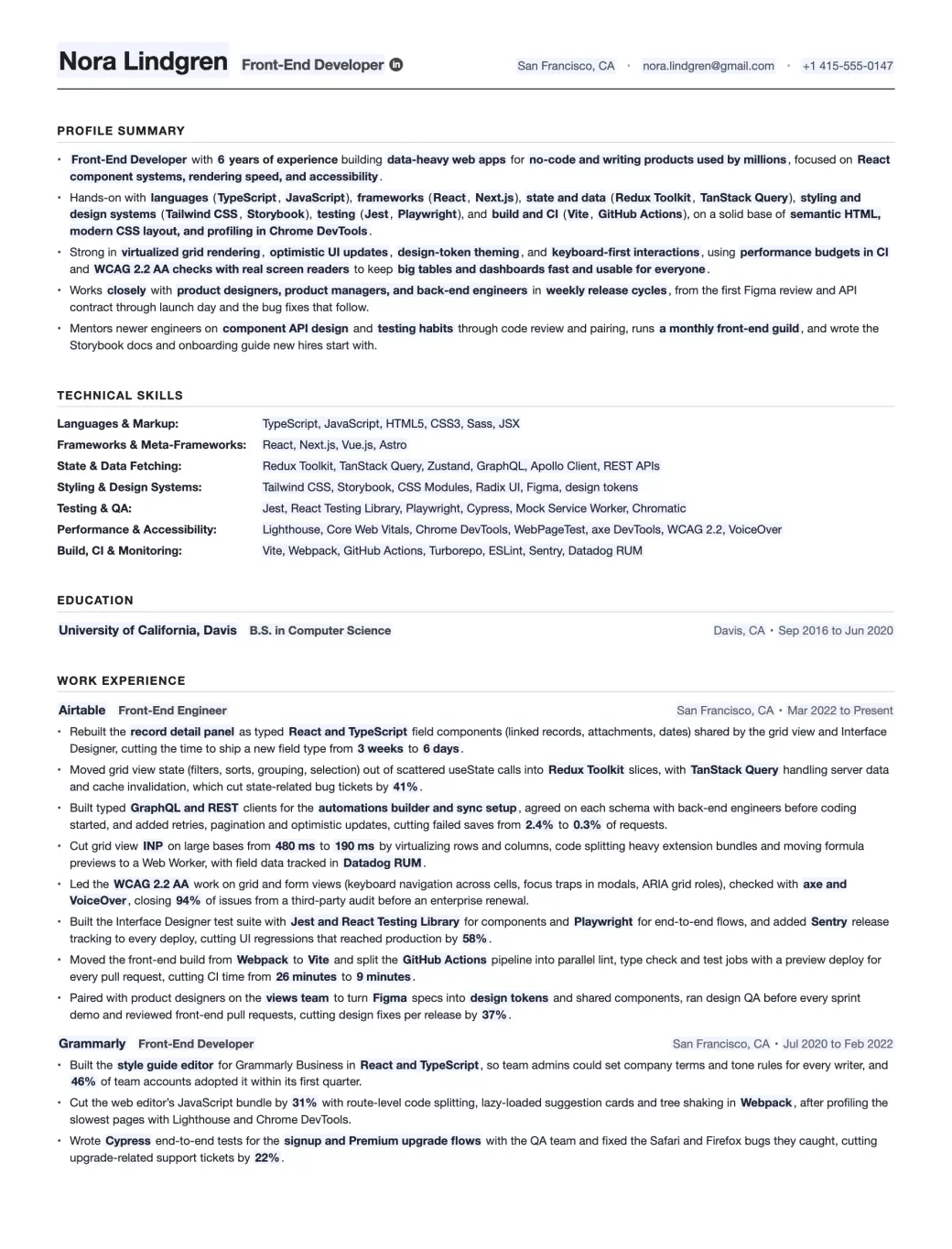
The Front-End Developer resume template filled in for a React and TypeScript developer: profile summary, technical skills, education and work experience
Emmanuel Gendre Ex-Google recruiter / Tech resume writer Updated Free, ATS-friendly, no signup

Interactive resume template generator

Interactive Front-End Developer Resume Template

Fill in the side panel, then download your resume as a PDF or a Word file.

Edits update live as you type. Toggle Edit to rewrite paper text directly.

Edit mode is on. Click anywhere on the resume to rewrite text. Side-panel placeholders still update live.

Nora Lindgren Front-End Developer

San Francisco, CA • nora.lindgren@gmail.com • +1 415-555-0147

Profile Summary

  • Front-End Developer with 6 years of experience building data-heavy web apps for no-code and writing products used by millions, focused on React component systems, rendering speed, and accessibility.
  • Hands-on with languages (TypeScript, JavaScript), frameworks (React, Next.js), state and data (Redux Toolkit, TanStack Query), styling and design systems (Tailwind CSS, Storybook), testing (Jest, Playwright), and build and CI (Vite, GitHub Actions), on a solid base of semantic HTML, modern CSS layout, and profiling in Chrome DevTools.
  • Strong in virtualized grid rendering, optimistic UI updates, design-token theming, and keyboard-first interactions, using performance budgets in CI and WCAG 2.2 AA checks with real screen readers to keep big tables and dashboards fast and usable for everyone.
  • Works closely with product designers, product managers, and back-end engineers in weekly release cycles, from the first Figma review and API contract through launch day and the bug fixes that follow.
  • Mentors newer engineers on component API design and testing habits through code review and pairing, runs a monthly front-end guild, and wrote the Storybook docs and onboarding guide new hires start with.

Technical Skills

Languages & Markup:
TypeScript, JavaScript, HTML5, CSS3, Sass, JSX
Frameworks & Meta-Frameworks:
React, Next.js, Vue.js, Astro
State & Data Fetching:
Redux Toolkit, TanStack Query, Zustand, GraphQL, Apollo Client, REST APIs
Styling & Design Systems:
Tailwind CSS, Storybook, CSS Modules, Radix UI, Figma, design tokens
Testing & QA:
Jest, React Testing Library, Playwright, Cypress, Mock Service Worker, Chromatic
Performance & Accessibility:
Lighthouse, Core Web Vitals, Chrome DevTools, WebPageTest, axe DevTools, WCAG 2.2, VoiceOver
Build, CI & Monitoring:
Vite, Webpack, GitHub Actions, Turborepo, ESLint, Sentry, Datadog RUM

Education

University of California, Davis B.S. in Computer Science
Davis, CA • Sep 2016 to Jun 2020

Work Experience

Airtable Front-End Engineer
San Francisco, CA • Mar 2022 to Present
  • Rebuilt the record detail panel as typed React and TypeScript field components (linked records, attachments, dates) shared by the grid view and Interface Designer, cutting the time to ship a new field type from 3 weeks to 6 days.
  • Moved grid view state (filters, sorts, grouping, selection) out of scattered useState calls into Redux Toolkit slices, with TanStack Query handling server data and cache invalidation, which cut state-related bug tickets by 41%.
  • Built typed GraphQL and REST clients for the automations builder and sync setup, agreed on each schema with back-end engineers before coding started, and added retries, pagination and optimistic updates, cutting failed saves from 2.4% to 0.3% of requests.
  • Cut grid view INP on large bases from 480 ms to 190 ms by virtualizing rows and columns, code splitting heavy extension bundles and moving formula previews to a Web Worker, with field data tracked in Datadog RUM.
  • Led the WCAG 2.2 AA work on grid and form views (keyboard navigation across cells, focus traps in modals, ARIA grid roles), checked with axe and VoiceOver, closing 94% of issues from a third-party audit before an enterprise renewal.
  • Built the Interface Designer test suite with Jest and React Testing Library for components and Playwright for end-to-end flows, and added Sentry release tracking to every deploy, cutting UI regressions that reached production by 58%.
  • Moved the front-end build from Webpack to Vite and split the GitHub Actions pipeline into parallel lint, type check and test jobs with a preview deploy for every pull request, cutting CI time from 26 minutes to 9 minutes.
  • Paired with product designers on the views team to turn Figma specs into design tokens and shared components, ran design QA before every sprint demo and reviewed front-end pull requests, cutting design fixes per release by 37%.
Grammarly Front-End Developer
San Francisco, CA • Jul 2020 to Feb 2022
  • Built the style guide editor for Grammarly Business in React and TypeScript, so team admins could set company terms and tone rules for every writer, and 46% of team accounts adopted it within its first quarter.
  • Cut the web editor’s JavaScript bundle by 31% with route-level code splitting, lazy-loaded suggestion cards and tree shaking in Webpack, after profiling the slowest pages with Lighthouse and Chrome DevTools.
  • Wrote Cypress end-to-end tests for the signup and Premium upgrade flows with the QA team and fixed the Safari and Firefox bugs they caught, cutting upgrade-related support tickets by 22%.


Done editing? Download a real PDF (selectable text, ATS-friendly, US Letter) or an editable Word file if a recruiter asks for one.

About this template

A Front-End Developer resume template, built by a tech recruiter.

As a Front-End Dev, you get to build things that people actually interact with, which makes it unique in the tech world. Some say it’s not real engineering, but we both know they’re wrong. On top of the (too many) frameworks to master, you’ve got to be able to translate Figma designs into React or Vue components, work with your back-end colleagues to connect APIs and guarantee UI performance & accessibility. You’re one of the engineers with the most impact on traffic, user experience, and therefore revenue. Job postings also call the job front-end web developer, front-end engineer or UI developer, so make sure you adapt the resume title on this template based on the specific job opening.

Here’s the problem with front-end CVs. Nearly every front-end resume I read lists React, TypeScript and Tailwind, which are now industry standard, with generic duties. The way to differentiate in this crowded market is to show hiring managers that you’ve built complex UI with these tools. Your impact and results are what they care about. By that, I mean the features you shipped and who used them, the load times you cut, the accessibility issues you fixed and the tests that kept releases from breaking production.

That’s why this template gives you one bullet for each of the 8 areas a front-end hiring manager checks, with a number in every one. Below the template, there are 3 finished front-end resumes you can download, and after those, 6 steps to write a Front-End Developer resume.

Already applying and hearing nothing back? I’ll review your resume for free with the same eye I used at Google, then email you what I’d fix first.

Industry signal

What the market says about Front-End Developer roles

Web developer jobs are growing slowly, so don’t count on a hiring boom anytime soon. What is rapidly changing in the industry is standards, including those for accessibility. Google has scored responsiveness (INP) as a Core Web Vital since March 2024. The European Accessibility Act has covered online shops and consumer banking in the EU since June 2025, and US state and local governments face WCAG 2.1 AA deadlines starting in April 2027. A Front-End Developer has to represent the user from engineering, UX and compliance perspectives, which in my opinion should contribute to employment safety. They still need you!

+4% US web developer job growth, 2025 to 2035 US Bureau of Labor Statistics
$127,269 Average base pay, US Front End Developer job ads Indeed
  • Chrome for Developers @ChromiumDev · Google Chrome's developer account
    We launched our new two-week release cycle → goo.gle/4hsULH0 Here's what this means for web devs: 🔭 Smaller, more manageable release scopes 🌐 Modern Web Platform capabilities land sooner 🔒 Speedier delivery for critical security patches
  • React @reactjs · Official React account
    React 19.3 is now available! This release makes View Transitions and Fragment Refs stable, and adds browser(), Trusted Types support, and Context in Server Components. react.dev/blog/2026/09/0…
  • Lea Verou, PhD @LeaVerou · CSS WG Invited Expert, W3C TAG alum
    Before we claim that LLMs generate bad frontend code, we should establish the frame of reference. Bad compared to what?

    Excerpt. The full post is longer.

  • WebAIM @webaim · Web accessibility org, Utah State University
    New WebAIM Million Report: webaim.org/projects/milli… #A11y errors & #WCAG failures are up as pages grow in size/complexity, driven by increased use of ARIA, reliance on 3rd-party frameworks/libraries, and "vibe coding." Way forward: simpler systems, strong fundamentals.

Resume Samples

Front-End Developer Resume Examples

What changes on a front-end developer resume between your first dev job and staff level? Mostly scope! So I wrote 3 front-end developer resume samples to show you the difference. These frontend CVs tell 3 different stories: the junior is a former UX designer 2 years into her first developer job at a Toronto fintech, and the senior builds billing screens at Stripe. The staff engineer sets the front-end architecture for the Microsoft 365 admin center (where that level is called “Principal”). You can download each one as a PDF or a Word file, free and with no signup.

Junior Front-End Developer Resume Example

At junior or entry level, your front-end resume has to prove you can ship real screens under code review: the components you’ve built, the tests you write, and one speed or accessibility fix you measured.

Years of experience
2 years
Industry
Fintech (consumer investing)
Stack
ReactTypeScriptStorybookFigma
Download PDF Download Word

Click to download the Junior Front-End Developer resume example as a PDF or a Word file. Free / No signup.

Priya Mehta

Junior Front-End Developer

Toronto, ON · priya.mehta@gmail.com · +1 416-555-0142 · linkedin.com/in/priyamehta

Profile Summary

  • Junior Front-End Developer with 2 years building client-facing investing screens at a Canadian fintech after 7 years as a UX/UI designer, focused on account sign-up flows, shared components, and accessible forms.
  • Writes TypeScript and semantic HTML in React and Next.js, fetches data with Apollo Client and GraphQL, documents components in Storybook, and tests with Vitest and Playwright in GitHub Actions.
  • Building depth in form validation, GraphQL caching, and Core Web Vitals, and checks every screen with a keyboard and VoiceOver before opening a pull request, so accessibility bugs get fixed before release.
  • Works in a squad of 4 developers, a designer, and a product manager, joins design reviews to agree on component states early, and pairs with back-end developers on GraphQL schema changes.
  • Wrote the squad’s accessible form checklist, runs monthly Figma-to-React sessions for 3 product designers learning to code, and is preparing for the IAAP Web Accessibility Specialist (WAS) exam.

Technical Skills

Languages & Markup:
TypeScript, JavaScript (ES2023), HTML5, CSS3, Sass, JSX
Frameworks & Meta-Frameworks:
React 19, Next.js (Pages Router, App Router basics), React Hook Form, Zod
State & Data Fetching:
Apollo Client, GraphQL, Redux Toolkit (basics), React Context, REST APIs
Styling & Design Systems:
Storybook, design tokens, Style Dictionary, CSS Modules, Figma (Dev Mode, Auto Layout)
Testing & QA:
Vitest, React Testing Library, Playwright, Mock Service Worker
Performance & Accessibility:
Lighthouse, Core Web Vitals, Chrome DevTools, WCAG 2.2 AA, AODA, axe DevTools, VoiceOver
Build, CI & Monitoring:
Vite, GitHub Actions, ESLint, Prettier, Sentry, Git
Page 2 of 2

Work Experience

Wealthsimple Junior Front-End Developer Toronto, ON · Oct 2024 to Present
  • Built the contribution and beneficiary steps of FHSA account opening as typed React and TypeScript components, in a flow clients use to open about 3,400 accounts a month.
  • Rewired the transfer-in screen around Apollo Client with typed GraphQL queries, cache updates per step, and clear loading and error states, cutting its bug reports from 23 a quarter to 7.
  • Cut p75 LCP on the public TFSA page from 3.1s to 1.6s by preloading the hero font, serving sized AVIF images, and lazy-loading the fee calculator with Next.js dynamic imports.
  • Wrote Vitest and React Testing Library tests for the recurring deposit screens, mocking the GraphQL API with Mock Service Worker, which raised coverage on those screens from 41% to 86%.
  • Added type checks, ESLint, and Playwright smoke tests to the squad’s GitHub Actions workflow for every pull request, cutting broken builds on main from 9 a month to 2.
Indigo UX/UI Designer Toronto, ON · Sep 2017 to Jun 2024
  • Kept the Figma library for indigo.ca in sync with the coded components and wrote handoff specs for every state and breakpoint, which cut design QA tickets per release by 37%.
  • Audited checkout against AODA and WCAG 2.1 AA with axe DevTools and VoiceOver, then redesigned focus states, error messages, and contrast with the web team, fixing 48 of 52 issues.
  • Moved color, type, and spacing styles into design tokens in Style Dictionary, shared with the web team’s Sass build, so a brand refresh shipped across 140 screens in 3 weeks.

Education

General Assembly Software Engineering Immersive Toronto, ON · Jul 2024 to Sep 2024
OCAD University Bachelor of Design in Graphic Design Toronto, ON · Sep 2013 to Apr 2017

Senior Front-End Developer Resume Example

At senior level, hiring managers look for features you took from design review to release, the Core Web Vitals or business numbers they moved, and proof you make the developers around you better.

Years of experience
7 years
Industry
Payments infrastructure
Stack
ReactTanStack QueryPlaywrightDatadog
Download PDF Download Word

Click to download the Senior Front-End Developer resume example as a PDF or a Word file. Free / No signup.

Marcus Okonkwo

Senior Front-End Developer

San Francisco, CA · marcus.okonkwo@gmail.com · +1 415-555-0188 · linkedin.com/in/marcusokonkwo

Profile Summary

  • Senior Front-End Developer with 7 years building payments and marketplace apps at Stripe and Airbnb, specializing in billing dashboards, large data tables, and React performance on screens used by millions of businesses.
  • Works across languages (TypeScript), frameworks (React, Next.js), server state (TanStack Query), design systems (Storybook), testing (Jest, Playwright), builds (Webpack, Vite), and real-user monitoring (Datadog RUM, Sentry).
  • Deep in INP and render profiling, server-state caching, and typed API contracts, using React Profiler traces and RUM data to pick fixes that improve p75 numbers for real merchants, not lab scores.
  • Partners with Billing designers, product managers, and API engineers, writes the front-end design doc for each quarter’s largest feature, and joins the Dashboard on-call rotation for UI incidents.
  • Mentors 4 mid-level engineers through code review and 1:1s, leads front-end interview calibration for the Dashboard org, and wrote the TanStack Query conventions the Billing teams follow.

Technical Skills

Languages & Markup:
TypeScript (strict), JavaScript, HTML5, CSS3, JSX
Frameworks & Meta-Frameworks:
React 19, Next.js (App Router), React Server Components, React Router
State & Data Fetching:
TanStack Query, Redux Toolkit, Zustand, Apollo Client, GraphQL, REST, OpenAPI
Styling & Design Systems:
Storybook, design tokens, CSS Modules, styled-components, Figma
Testing & QA:
Jest, React Testing Library, Playwright, Cypress, Mock Service Worker
Performance & Accessibility:
Core Web Vitals (INP, LCP, CLS), React Profiler, Chrome DevTools, TanStack Virtual, WCAG 2.2 AA, axe-core
Build, CI & Monitoring:
Webpack, Vite, GitHub Actions, ESLint, Datadog RUM, Sentry, LaunchDarkly
Page 2 of 2

Work Experience

Stripe Senior Front-End Engineer San Francisco, CA · Apr 2022 to Present
  • Rebuilt the Dashboard subscription editor as composable React and TypeScript components with typed props for every pricing model, now reused on 11 Billing screens in place of forked copies.
  • Moved server data on the invoice pages from a hand-rolled Redux cache to TanStack Query with shared query keys and targeted invalidation, cutting stale-balance tickets from support by 71%.
  • Built typed clients from Stripe’s OpenAPI spec for the invoice editor, with optimistic updates, idempotency keys, and retries with backoff, cutting failed saves on weak connections from 2.6% to 0.3%.
  • Brought p75 INP on the invoices table from 410ms to 160ms with TanStack Virtual row virtualization, memoized cells, and filtering moved to a Web Worker, measured in Datadog RUM.
  • Reviewed every Figma spec with the Billing designers before coding started, then added the shared pieces to the Dashboard design system in Storybook, now used by 9 product teams.
Airbnb Front-End Engineer San Francisco, CA · Jul 2019 to Mar 2022
  • Fixed keyboard traps, focus order, and screen reader labels across the listing editor to meet WCAG 2.1 AA, checked with axe-core and VoiceOver, closing 63 audit issues before launch.
  • Rewrote the Hosting team’s component tests from Enzyme to React Testing Library and added Cypress runs for listing creation, cutting production bugs in that area by 44% in a year.
  • Set bundle-size budgets in Webpack that blocked oversized pull requests in CI, then code-split the listing editor by route, which cut its JavaScript payload by 31%.

Education

University of California, Berkeley B.A. in Computer Science Berkeley, CA · Aug 2015 to May 2019

Staff Front-End Developer Resume Example

At staff level, you need to show work that changed how several teams build: the architecture calls you made, shared tooling or a design system others rely on, and the senior engineers you’ve coached.

Years of experience
10 years
Industry
Enterprise software
Stack
ReactTypeScriptNxPlaywright
Download PDF Download Word

Click to download the Staff Front-End Developer resume example as a PDF or a Word file. Free / No signup.

Renée Cho

Staff Front-End Developer

Seattle, WA · renee.cho@gmail.com · +1 206-555-0177 · linkedin.com/in/reneecho

Profile Summary

  • Staff-level Front-End Developer with 10 years on enterprise apps at Microsoft and Tableau, leading front-end architecture across teams, design-system adoption, and performance work for admin and analytics products.
  • Sets standards for languages (TypeScript), UI (React, Fluent UI), data (Redux Toolkit, TanStack Query, GraphQL), testing (Playwright, Jest), builds (Nx, Azure Pipelines), and real-user data (Application Insights).
  • Expert in monorepo design, INP and long-task fixes, and accessibility at scale, writing design docs and RFCs that let 9 teams ship to one product without breaking each other’s screens.
  • Works with Fluent UI design leads, product managers, and service owners, runs the monthly front-end architecture review, and agrees on API contracts with back-end teams before either side writes code.
  • Coaches 6 senior engineers, built the admin center’s front-end interview loop and onboarding path, and gives talks on web performance at Microsoft’s internal engineering conferences.

Technical Skills

Languages & Markup:
TypeScript (strict), JavaScript, HTML5, CSS3, Sass
Frameworks & Meta-Frameworks:
React 18, Fluent UI React v9, Next.js, Module Federation, Web Components
State & Data Fetching:
Redux Toolkit, TanStack Query, Apollo Client, GraphQL, REST, OData
Styling & Design Systems:
Fluent UI design tokens, Griffel (CSS-in-JS), Storybook, Figma, theming
Testing & QA:
Jest, React Testing Library, Playwright, visual regression, contract tests
Performance & Accessibility:
Core Web Vitals, long-task profiling, Lighthouse CI, WCAG 2.2 AA, Accessibility Insights, NVDA, JAWS
Build, CI & Monitoring:
Nx, pnpm workspaces, Webpack, Vite, Azure Pipelines, ESLint, Application Insights
Page 2 of 2

Work Experience

Microsoft Principal Software Engineer Redmond, WA · Mar 2021 to Present
  • Moved 9 teams in the Microsoft 365 admin center onto shared Fluent UI React v9 components with clear module boundaries, removing about 140,000 lines of duplicate UI code.
  • Led INP work across the admin center’s busiest pages, breaking up long tasks, deferring third-party scripts, and setting per-team budgets in Application Insights, cutting p75 INP from 380ms to 170ms.
  • Merged 23 front-end packages into one Nx monorepo with remote caching and affected-only Playwright runs in Azure Pipelines, cutting pull request builds from 41 minutes to 12.
  • Made Accessibility Insights and axe checks required on every pull request, plus quarterly NVDA and JAWS reviews, cutting open WCAG 2.2 AA bugs from 312 to 27.
  • Ran the monthly front-end architecture review with Fluent UI design and product leads, and coached 6 senior engineers on cross-team design docs, 2 of whom have since been promoted to principal.
Tableau (Salesforce) Senior Software Engineer Seattle, WA · Aug 2016 to Feb 2021
  • Rebuilt web authoring state in Redux Toolkit with normalized sheets and a command history for undo and redo, cutting authoring crash reports in Tableau Online by 58%.
  • Built the data source and lineage pages on Tableau’s REST API and GraphQL Metadata API, with paged loading, retries, and clear error states, cutting related support tickets by 34%.
  • Set up visual regression tests for every Show Me chart type with Storybook and Jest image snapshots in CI, catching 19 rendering bugs ahead of release during its first year.

Education

University of Washington B.S. in Computer Science Seattle, WA · Sep 2012 to Jun 2016

Free resume review

A recruiter screen, but with feedback

You applied to hundreds of jobs: no result. Companies won’t give you feedback, so you’re stuck in a loop. Rejections will keep coming until you know what’s wrong.

Let’s break this cycle today!

I’ll screen your resume the same way I did at Google.

You’ll get:

  • Your resume sections and content scored.
  • A clear list of what to improve, why, and how.
  • Behind the scenes secrets on the screening process.

How I rewrite Front-End Developer resumes

How to write a Front-End Developer resume

Emmanuel Gendre, ex-Google recruiter

Emmanuel Gendre Ex-Google recruiter, tech resume writer

Before TechieCV, I screened resumes for 13 years as a recruiter, including many years at Google. Front-end is where I’ve seen the market turn the hardest. In 2021, a React portfolio got you offers. In 2026, I still get front-end resumes written like it’s 2021: a list of frameworks and no proof of what shipped.

In my technical resume writing service, I go through a client’s resume line by line and rewrite anything that doesn’t prove something. If you’re doing it yourself, though, focus on these 6 steps. I’ve put them in the order I work on them.

  1. Step 1 Format & layout A plain one-column layout that ATS software reads without errors. Go to step 1
  2. Step 2 Profile Summary 5 bullets that tell a recruiter your level, stack and product. Go to step 2
  3. Step 3 Work Experience Your current job, covering all 8 areas of the front-end role profile. Go to step 3
  4. Step 4 Bullet Points My 5-level method for turning a task into a bullet with proof. Go to step 4
  5. Step 5 Technical Skills 7 skill categories with the must-haves starred, plus 5 soft skills. Go to step 5
  6. Step 6 Keywords & Metrics The keywords front-end postings repeat, and the numbers behind your bullets. Go to step 6

Step 1 · Format & Layout

Front-End Developer resume format and layout

Let’s start with format, because it’s the fix that takes the least time. Two readers see your file before anyone talks about hiring you: an ATS that stores your text in a database, and a recruiter who expects your titles and dates in the usual spots.

01ATS Compliance

ATS compliance for your Front-End Developer resume

Before a recruiter sees your front-end resume, an Applicant Tracking System (ATS) has already read it. It copies your employers, titles, dates and skills into fields and matches them against the job posting. If a fancy layout confuses it, the React and TypeScript on your resume never get counted. I explain the mechanics in my article on how an ATS reads your resume. On a front-end resume, that comes down to 3 rules:

The 3 rules
  1. Use a 100% text based format (no Canva!)

  2. Avoid tables, pictures, and complex structures.

  3. Choose the most predictable section names (“Profile Summary” rather than “Career Highlights”)

02Design & Layout

Front-End Developer resume design and layout

Front-end developers are the most tempted to design their own resume, and I get it: it’s your craft. But I spent years on the other side of the table, and recruiters hate fancy designs. They expect the title, employer and dates in the same spots on every resume. Sidebars, skill bars and custom fonts just make them hunt.

So keep the layout boring and save your design skills for the portfolio link in your header, which a hiring manager might actually click. Every spec below is already set up in the template above, in case you’d rather start from a blank Google Doc or Word file.

Layout Spec
Columns
One. No sidebars, tables, columns, pictures or tabs.
Margins
0.7 in on all four sides
Body size
10 to 11 pt
Type
One family, weight for hierarchy
Length
One page under 5 years, two after
Section order
Summary, Skills, Experience, Education
PDF

03File Format

Resume file format for your Front-End Developer resume

Send your front-end resume as a PDF unless the posting asks for something else. The text stays readable for the ATS, your layout won’t move on a recruiter’s laptop, and no one can change a word by accident. If a staffing agency wants Word (they’ll often add their logo on top), use the Word download. My guide to which resume file format to use compares the other options.

Format Guide
PDF
Your default. Layout holds, text stays selectable.
Word (.docx)
When the posting or a recruiter asks for it. Use the Word download above.
Plain text
For portals that make you paste into a box
Never
Images, scans, password-protected PDFs, shared-drive links
File name
Nora-Lindgren-Front-End-Developer.pdf

Step 2 · Profile Summary

Front-End Developer profile summary

A front-end developer resume summary is the block of 5 short bullets at the top of your resume, and it replaces the old resume objective. You need one even as a junior. Recruiters screen in 2 rounds, and in the fast first one, they often read nothing but your summary.

On a front-end resume, the summary has to answer 3 questions in a few seconds: which framework you work in, what kind of product you build, and how senior you are. Each of the 5 bullets below has one job. My article on how to write a profile summary covers the method in more detail.

  1. 1

    Title, years and scope

    The title you’re going for, how many years you’ve done the job, and what you build (B2B dashboards, e-commerce, a design system). If you’ve worked somewhere a recruiter will recognize, this is the line to mention it.

  2. 2

    Your stack

    Your framework first, then the tools around it, each with its category: framework (React, Next.js), styling (Tailwind), state (Redux Toolkit, TanStack Query), testing (Playwright). It’s the line recruiters compare with the posting first.

  3. 3

    Domain expertise

    The parts of the front-end role profile you’re strongest in, with the methods behind them: component architecture, Core Web Vitals work, WCAG 2.2 AA. This is where “knows React” turns into “builds fast, accessible React apps”.

  4. 4

    Collaboration

    The people you ship with every week (designers, product managers, back-end engineers, QA) and the handoffs you own, like Figma to code or the API contract. Hiring managers want to know you’ll fit into their team.

  5. 5

    Leadership

    What you leave behind for the team: Storybook docs, a code review checklist, the juniors you onboarded. You don’t need direct reports for this bullet. It shows you make other developers faster, not just yourself.

Front-End Developer resume summary example, from the template above
  • Front-End Developer with 6 years of experience building data-heavy web apps for no-code and writing products used by millions, focused on React component systems, rendering speed, and accessibility.
  • Hands-on with languages (TypeScript, JavaScript), frameworks (React, Next.js), state and data (Redux Toolkit, TanStack Query), styling and design systems (Tailwind CSS, Storybook), testing (Jest, Playwright), and build and CI (Vite, GitHub Actions), on a solid base of semantic HTML, modern CSS layout, and profiling in Chrome DevTools.
  • Strong in virtualized grid rendering, optimistic UI updates, design-token theming, and keyboard-first interactions, using performance budgets in CI and WCAG 2.2 AA checks with real screen readers to keep big tables and dashboards fast and usable for everyone.
  • Works closely with product designers, product managers, and back-end engineers in weekly release cycles, from the first Figma review and API contract through launch day and the bug fixes that follow.
  • Mentors newer engineers on component API design and testing habits through code review and pairing, runs a monthly front-end guild, and wrote the Storybook docs and onboarding guide new hires start with.

Step 3 · Work Experience

Front-End Developer work experience

Step 2 got you through the fast sort. On the second read, the recruiter goes through your jobs in order, but your current job decides most of it. If your best front-end work happened 2 jobs ago, it won’t count for much, so your latest role has to carry your strongest projects.

It makes sense when you think about it: what you do today is what they’re hiring. So in your current role, every one of the 8 areas in the Front-End Developer role profile needs a bullet. That’s the skill set hiring managers use as their checklist, and the template above already has a bullet ready for each.

Front-End Developer role profile
  1. Component Architecture & UI Builds

    You build the screens users click on every day, out of components other developers can reuse. A messy component tree makes every later feature slower to build, so hiring managers look for structure, not just output. Show how you used TypeScript and shared UI primitives to ship features without rewriting the same button 5 times.

    Techniques
    component composition, typed props, shared UI primitives, code splitting by route
    Tools
    React, TypeScript, Next.js, Storybook
    Metrics
    features shipped, components reused, users reached
  2. State Management & Data Flow

    You decide where state lives, so a busy screen behaves the same way every time. When state is scattered across components, each new feature adds a bug, and most hiring managers have lived through that. Explain how you used Redux Toolkit and TanStack Query to keep client state and server data apart and end the stale-data bugs.

    Techniques
    client vs server state, caching, normalized stores, URL and form state
    Tools
    Redux Toolkit, Zustand, TanStack Query, React Hook Form
    Metrics
    state bugs fixed, re-renders cut, time to usable data
  3. API Integration & Data Fetching

    You connect the interface to the APIs behind it and handle everything that can go wrong in between. Slow networks, failed calls and half-loaded lists are what users actually complain about, so teams want developers who plan for them. Walk them through how you used typed GraphQL or REST clients and optimistic updates to make screens feel instant.

    Techniques
    typed API clients, optimistic updates, pagination, retries and error states
    Tools
    GraphQL, Apollo Client, REST, OpenAPI, Mock Service Worker
    Metrics
    requests per screen, failed requests, integration time
  4. Web Performance & Core Web Vitals

    You make pages load fast and respond the moment someone taps. Google counts Core Web Vitals in search ranking, and a slow checkout costs sales, so it’s a number the business already watches. Tell them how you used real-user data and code splitting to bring LCP and INP down, with the before and after.

    Techniques
    code splitting, lazy loading, image and font loading, list virtualization
    Tools
    Lighthouse, Chrome DevTools, WebPageTest, Datadog RUM
    Metrics
    LCP, INP, CLS, bundle size
  5. Accessibility & UX Quality

    You ship interfaces that work with a keyboard, a screen reader and an old Android phone. With lawsuits and new rules like the European Accessibility Act, it’s now a legal question for a lot of companies. Point out how you used axe audits and VoiceOver testing to bring key flows up to WCAG 2.2 AA.

    Techniques
    keyboard navigation, focus management, semantic HTML, ARIA
    Tools
    axe DevTools, Lighthouse, VoiceOver, NVDA
    Metrics
    flows at WCAG 2.2 AA, issues fixed, accessibility score
  6. Front-End Testing & Reliability

    You catch broken UI before your users do. One regression on the login page can cost more trust than a new feature wins back, so senior interviews almost always get to testing. Mention how you used React Testing Library and Playwright to cover the critical flows and keep releases uneventful.

    Techniques
    component tests, end-to-end tests, visual regression, error monitoring
    Tools
    Jest, Vitest, React Testing Library, Playwright, Sentry
    Metrics
    test coverage, production regressions, crash-free sessions
  7. Build Pipelines & CI/CD

    You own the tooling that turns a pull request into a production release. When a build takes 15 minutes and preview links break, everyone’s slower, and engineering managers notice who fixed it. Describe how you used Vite and GitHub Actions to speed up builds and give every pull request its own preview deploy.

    Techniques
    CI checks, preview deploys, feature flags, monorepo builds
    Tools
    Vite, Webpack, GitHub Actions, Turborepo, Vercel
    Metrics
    build time, deploy frequency, time to merge
  8. Design Collaboration & Delivery

    You turn Figma files into working features, with designers, product and back-end engineers in the same sprint. Front-end sits between all of them, so hiring managers check that you can disagree with a designer and still ship on time. Let them know how you used Storybook and design tokens to keep design and code in sync.

    Techniques
    Figma handoff, design tokens, sprint planning, code review
    Tools
    Figma, Storybook, Chromatic, Jira
    Metrics
    components adopted, design review rounds, on-time delivery

Freelancing or contracting? Write one entry per client, with the stack and the result for each. No front-end job yet? Treat your best side project as your current role, add a live link, and cover the same 8 areas with it.

Submit your resume for a free review!

Step 4 · Bullet Points

Front-End Developer resume bullet points

Bullet points are where most of my writing hours go, so I turned my process into a method: the Level System. It started as Google’s XYZ formula, and I’ve reworked it over the years for technical resumes. Every detail is in my guide on how to write bullet points for tech resumes.

The method has 5 levels, and each one asks you a question. Whatever you answer becomes the detail you’ll add. Front-end bullets usually end on a load time, a Core Web Vitals score, a conversion rate or how many users saw the change. Here’s one bullet, built up level by level.

  1. Level 1Task

    What did I work on? Pick one feature you shipped from start to finish. Without more detail, it reads like a job description.

    Rebuilt the product search page.

  2. Level 2+ Techniques

    How did I do it? Add the techniques. They show a hiring manager the decisions you made along the way.

    Rebuilt the product search page, adding server-side rendering and virtualized result lists.

  3. Level 3+ Tools

    What tools did I use? Write the real framework and library names. Recruiters search for them, so it’s free keyword matching.

    Rebuilt the product search page for 2M monthly shoppers in Next.js and TanStack Query, adding server-side rendering and virtualized result lists.

  4. Level 4+ Method

    What method did I follow? Mention the approach or standard behind the work. Few front-end candidates do, and it shows how you think.

    Rebuilt the product search page for 2M monthly shoppers in Next.js and TanStack Query, adding server-side rendering and virtualized result lists with performance budgets for each Core Web Vital enforced in Lighthouse CI.

  5. Level 5+ Metric

    What was the result? End on one number your team tracked. That’s what makes the bullet believable.

    Rebuilt the product search page for 2M monthly shoppers in Next.js and TanStack Query, adding server-side rendering and virtualized result lists with performance budgets for each Core Web Vital enforced in Lighthouse CI, and cut mobile LCP from 3.8s to 1.7s.

    1. 01 Task What you worked on
    2. 02 Techniques How you did it
    3. 03 Tools The stack you used
    4. 04 Method The method you followed
    5. 05 Metric The result, one number

You probably have more numbers than you think. Lighthouse reports, Sentry, the analytics dashboard and old pull request descriptions are full of them. Most developers just never copy them onto their resume.

Step 5 · Technical Skills

Front-End Developer resume skills

The skills to put on a front-end developer resume are TypeScript and JavaScript, one main framework (React, Vue or Angular), your state, styling and testing tools, performance and accessibility tools, and your build setup. Recruiters and the ATS search this section by keyword, so copy the posting’s exact words: if it asks for Next.js, write Next.js.

Still, a skill only counts if a bullet backs it up. If you list Playwright here, one of your bullets should show what you tested with it. Below are the 7 front-end skill categories I use, a finished skills section, plus the 5 soft skills I’d prove with bullets. Keywords get their own step next.

The 7 skill categories for a Front-End Developer resume

Put the starred items first, since most front-end postings ask for them. One row per category is enough, and leave out ratings like “Advanced React”: no recruiter can check them, so they don’t count. Worked in React, Vue and Angular? Lead with the one the posting asks for. If React is your main framework, my React developer resume template goes deeper on it.

Languages & Markup

The languages you write every day. List TypeScript and JavaScript separately, since recruiters search for both.

TypeScriptJavaScriptHTML5CSS3SassJSX

Frameworks & Meta-Frameworks

Your main framework and the meta-framework around it, like React with Next.js or Vue with Nuxt.

ReactNext.jsVue.jsNuxtAngularSvelteRemix

State & Data Fetching

Your client-side store and your server-state library. They’re listed apart because postings ask for them apart.

Redux ToolkitTanStack QueryZustandSWRApollo ClientGraphQLREST APIsPinia

Styling & Design Systems

How you style components and the design system tools you’ve worked in, from Tailwind to Storybook.

Tailwind CSSStorybookCSS Modulesstyled-componentsFigmaDesign tokensRadix UI

Testing & QA

Your unit, component and end-to-end test tools. Senior postings usually ask for both kinds.

JestReact Testing LibraryPlaywrightVitestCypressMock Service WorkerChromatic

Performance & Accessibility

The tools you measure speed and accessibility with, and the standard you’re building to (WCAG 2.2).

LighthouseWCAG 2.2axe DevToolsCore Web VitalsChrome DevToolsWebPageTestARIAVoiceOver

Build, CI & Monitoring

What builds, ships and watches your code once it’s live: bundlers, CI, hosting and error tracking.

ViteGitHub ActionsWebpackTurborepoESLintVercelSentryDatadog RUM

A finished Front-End Developer skills section

Technical Skills sample, from the template above
Languages & Markup
TypeScript, JavaScript, HTML5, CSS3, Sass, JSX
Frameworks & Meta-Frameworks
React, Next.js, Vue.js, Astro
State & Data Fetching
Redux Toolkit, TanStack Query, Zustand, GraphQL, Apollo Client, REST APIs
Styling & Design Systems
Tailwind CSS, Storybook, CSS Modules, Radix UI, Figma, design tokens
Testing & QA
Jest, React Testing Library, Playwright, Cypress, Mock Service Worker, Chromatic
Performance & Accessibility
Lighthouse, Core Web Vitals, Chrome DevTools, WebPageTest, axe DevTools, WCAG 2.2, VoiceOver
Build, CI & Monitoring
Vite, Webpack, GitHub Actions, Turborepo, ESLint, Sentry, Datadog RUM

Soft skills for a Front-End Developer resume

Don’t put soft skills in the skills list. Show them in your bullets. Here are 5 I check for on front-end resumes, each with an example bullet.

  • Talking through trade-offs with designers before the build starts

    Resume bulletReviewed Figma specs with design before every sprint, cutting mid-sprint redesign requests from 6 per quarter to 1.

  • Explaining a performance problem to a product manager in plain words

    Resume bulletTurned a Lighthouse audit into a one-page brief for product, which got 3 sprints set aside for performance work.

  • Leaving code review comments that teach instead of just blocking

    Resume bulletLeft teaching notes on about 40 pull requests a month, and 2 junior developers were shipping features on their own within a quarter.

  • Raising a scope risk early instead of on demo day

    Resume bulletCaught a third-party API rate limit in week 1 of a 6-week launch and reported it the same day, so the team reworked the sync plan and shipped on time.

  • Writing component docs other teams actually use

    Resume bulletWrote Storybook docs for 38 shared components, which cut design-system questions in Slack by about half.

Step 6 · Keywords & Metrics

Front-End Developer resume keywords and metrics

Before you hit apply, you’ll want to check 2 things. Start with keywords. The ATS matches your words against the posting, and recruiters search for the same terms. Then look at your metrics, the numbers that make a claim like “improved page speed” believable.

First come the front-end keywords I see most, split into 3 tiers. Next is a keyword finder: paste a job description and you’ll see what that posting asks for. Last comes a table of 24 metrics, grouped by the 8 areas from Step 3, each next to an example bullet.

+42%

Front-End Developer resume keywords, ranked

Tap a keyword to see a typical job description line for it. Postings word the same skill in different ways, and this helps you recognize them.

Must-have

7

Put each one in your summary, in a bullet and in your skills section.

In a job description“Strong JavaScript (ES6+) fundamentals, including async code and the DOM”

Strong supporting

8

Add the ones that are true for you. They often decide between 2 close candidates.

In a job description“Experience with Next.js (App Router, server components) or a similar framework”

Bonus

6

Worth a mention when you have them, usually in your skills section or one bullet.

In a job description“Familiarity with WCAG 2.2 and testing with assistive technology”

Extract Front-End Developer keywords from a job description

Paste a front-end, UI engineer or React developer job posting into the box. The finder sorts the frameworks, testing tools and standards it mentions by how much they matter, so you’ll see what’s missing from your resume.

Must-have
Put these in your skills section and back each one with a bullet.
Strong supporting
Add the ones you’ve actually worked with. Skip the rest.

Nothing is uploaded: it all happens in your browser.

Metrics for a Front-End Developer resume

Each area of the front-end role profile gets 3 metrics below, with a bullet showing how to use them. You’ll only need one per bullet.

MetricExample bullet
Components & UI
Features shipped Count User-facing features you built and released, start to finish.Shipped 11 user-facing features in React and TypeScript in 2025, including the new record detail panel.
Component reuse Percent Share of new screens built from shared components instead of one-off code.Built a shared component kit that 74% of new screens now use, up from under 30% a year earlier.
Users reached Count People who use the UI you built, per week or per month.Rebuilt the grid toolbar used by 310,000 people a week with no rollback after launch.
State & Data Flow
State bugs Percent Drop in bugs caused by stale or out-of-sync state.Moved grid view filters, sorts and selection into Redux Toolkit slices, cutting state-related bug tickets by 41%.
Re-renders Percent Drop in component re-renders on a busy screen, measured in the React Profiler.Split one global store into 3 slices with memoized selectors, cutting re-renders on the record panel by 58%.
Time to usable data Time Time until a screen shows data the user can work with, from cache or network.Added query caching and prefetch on hover, so returning users see their records in under 300ms instead of 1.4s.
API Integration
Requests per screen Count Network calls a screen makes before it’s usable.Replaced 9 REST calls on the dashboard with 1 GraphQL query through Apollo Client.
Failed requests Percent Share of client API calls that end in an error the user sees.Added retries and optimistic updates to the automations client, cutting failed saves from 2.4% to 0.3% of requests.
Integration time Time Time from a new API endpoint going live to the UI using it.Generated a typed client from the OpenAPI spec, cutting new endpoint integration from 3 days to half a day.
Web Performance
Largest Contentful Paint (LCP) Time How long the largest element on screen takes to render.Cut mobile LCP on the shared-view page from 4.1s to 1.8s with code splitting and preloaded fonts.
Interaction to Next Paint (INP) Time How fast the page responds after a tap, click or key press.Brought grid view INP on large bases from 480ms to 190ms by virtualizing rows and moving formula previews to a web worker.
JavaScript bundle size Count Kilobytes of JavaScript a page downloads before it runs, gzipped.Trimmed the main bundle from 612KB to 248KB gzipped by lazy-loading the chart and rich-text editor libraries.
Accessibility
Flows at WCAG 2.2 AA Count Key user flows that meet WCAG 2.2 AA after an audit.Brought 14 key flows, including sign-up and billing, up to WCAG 2.2 AA after a full axe and VoiceOver audit.
Accessibility issues fixed Count Violations from axe or manual audits that you cleared.Fixed 186 axe violations across the interface editor, including every critical and serious issue.
Lighthouse accessibility score Score Lighthouse’s automated accessibility grade, out of 100.Raised the Lighthouse accessibility score of the public form pages from 72 to 98.
Testing & Reliability
Test coverage Percent Share of front-end code your automated tests run through.Raised test coverage on the interface editor from 38% to 81% with React Testing Library and Playwright.
Production regressions Count UI bugs that reached users after a release.Added Playwright smoke tests to every pull request, cutting UI regressions in production from 12 to 5 a quarter.
Crash-free sessions Percent Share of user sessions that end without a JavaScript crash, from Sentry.Kept crash-free sessions above 99.8% while releasing to production 4 times a week.
Build & CI/CD
Build time Time How long a production build or CI run takes.Moved the front-end build from Webpack to Vite and split CI into parallel jobs, cutting CI time from 26 minutes to 9.
Deploy frequency Frequency How often front-end changes reach production.Set up preview deploys and feature flags so the team went from weekly releases to daily ones.
Time to merge Time Time from opening a pull request to merging it.Added lint, type and test checks in GitHub Actions, cutting the average time to merge from 3.2 days to 1.4.
Collaboration & Delivery
Design system adoption Count Components you maintain and the teams that use them.Grew the design system to 52 components used by 7 product teams, each one documented in Storybook.
Design review rounds Count Rounds of fixes after design review, per feature.Started reviewing Figma specs with design before each sprint, cutting design review rounds per feature from 3 to 1.
On-time delivery Percent Share of committed work shipped in the sprint it was planned for.Delivered 92% of committed sprint work over 4 quarters while mentoring 2 junior developers.

What if you don’t have exact numbers?

  • 1

    Check the tools you already use. Lighthouse, Sentry, your analytics dashboard and your pull request history hold most of your numbers. Your product manager’s dashboards have the rest.

  • 2

    A careful estimate is fine. Round it down and be ready to explain it in an interview. “About 40 shared components” is better than no number at all.

  • 3

    Fall back on scope. If there’s no result you can measure, give the size: the users who saw the feature, the pages it touched, the teams that use your components.

Free resume review

A recruiter screen, but with feedback

You applied to hundreds of jobs: no result. Companies won’t give you feedback, so you’re stuck in a loop. Rejections will keep coming until you know what’s wrong.

Let’s break this cycle today!

I’ll screen your resume the same way I did at Google.

You’ll get:

  • Your resume sections and content scored.
  • A clear list of what to improve, why, and how.
  • Behind the scenes secrets on the screening process.

Frequently asked

Front-End Developer resume FAQ

Yes. You don’t need an account or an email address. Fill in the side panel, then download your front-end resume as a PDF or a Word file as often as you like.

Yes. Click Word in the toolbar above the preview to get an editable .docx file. The 3 front-end resume examples also come with a Word version under each one. Send the PDF when you apply, and the Word file only when someone asks for it.

Yes. For tech jobs in the US, most recruiters use CV and resume for the same document, so this front-end developer CV template is the same file. If a posting asks for a CV, send this one.

Yes. It’s a single column with standard section names (Profile Summary, Technical Skills, Education, Work Experience), and the PDF holds real, selectable text. If you want to check your own file, run it through my ATS resume checker.

No. An objective says what you want, and recruiters care about what you’ve built. Use a profile summary instead: 5 bullets with your title, years, stack and the products you’ve worked on. Step 2 shows how to write each one.

One page is enough under 5 years of experience. After that, 2 pages are fine, as long as every line shows something you built, fixed or improved. Recruiters don’t mind a second page. They mind padding.

Front-end hiring doesn’t really run on certifications. If you hold one that fits the job, like the IAAP CPACC for accessibility-heavy roles or an AWS certification for roles that touch deployment, list it under Education. Otherwise, a live portfolio and your GitHub count for much more.

Treat your 2 or 3 best projects like jobs. Give each one a live link, a GitHub repo, the stack and bullets with numbers, such as a Lighthouse score or how many people used it. If you went to a bootcamp, list it under Education. The junior example above shows the layout.

A front-end resume goes deep on the browser: components, state, performance and accessibility. A full-stack resume also has to prove you own the server side, with APIs, databases and deployments (see my full-stack developer resume template). A UX/UI designer resume is about research and design decisions, and yours has to show the code that ships them. If you’ve built some APIs but you’re applying to front-end roles, keep that work to 1 or 2 bullets.

Yes, in the header next to your LinkedIn and GitHub. Link 2 or 3 live projects you can talk about in detail, not a page of tutorial apps. Hiring managers for front-end roles do click, so check that it loads fast on a phone.

More resources

More help with your Front-End Developer resume