Front-End Resume Writing Service
by an ex- Google Recruiter

Get a Free Front-End Resume Review today

I review personally all resumes within 12 hrs

PDF, DOC, or DOCX • under 5MB

By a former recruiter

star rating for tech resume writing

4.9 / 5

388 reviews

Clients got hired at

The Only Front-End Resume Writing Service

Front-End is unusual: the role spans junior React developers shipping their first component all the way up to Staff Front-End Architects stewarding design systems across a hundred product surfaces. Generic resume services treat it like "JavaScript with extra steps", and that's exactly why recruiters drop Front-End resumes at the summary line.

The TechieCV tech resume writing process is built to speak the vocabulary: component architecture, state management, Core Web Vitals, accessibility, design systems. That's what I write. That's the only thing I write. Pricing and packages are listed on a separate page; this one is about the work itself.

2026 market note: Front-End hiring has split sharply. Product UI roles now expect React Server Components and Suspense fluency, plus measurable Core Web Vitals wins on every senior+ resume. Design-system roles expect component-API governance and adoption metrics. Generic “built with React and Redux” bullets no longer clear the Phase-1 recruiter screen.
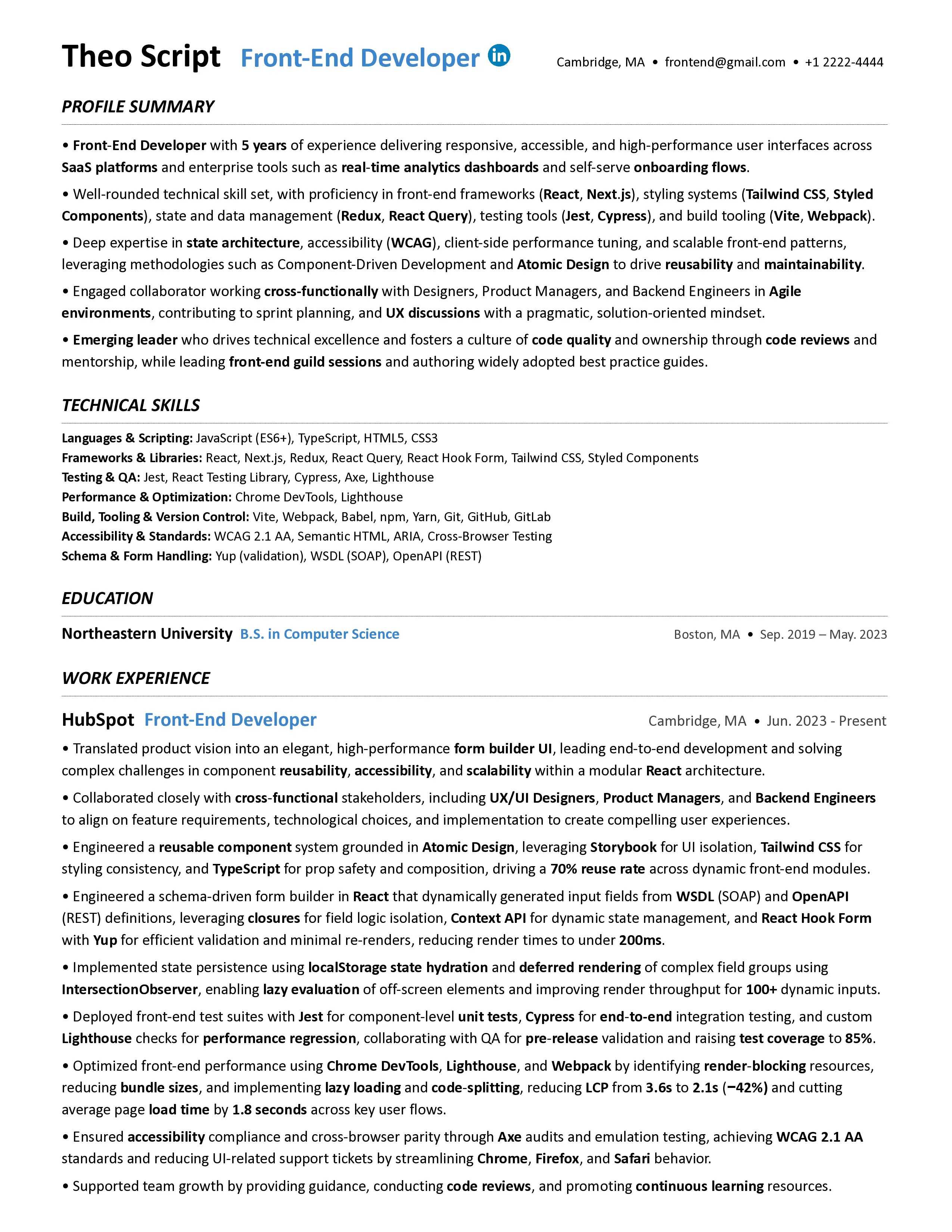
Typical Frontend roles I write for

From hands-on framework developers to Front-End Architects and niche specialists (a11y, performance, creative coding), this service writes resumes across the full Frontend spectrum. If you land anywhere in the buckets below, you're in the right place.

Core Front-End

  • Front-End Developer
  • Front-End Engineer
  • Senior Front-End Engineer
  • Front-End Architect

Framework Developers

  • React Developer
  • Vue Developer
  • Angular Developer
  • Svelte Developer

UI / UX / Web

  • UI Engineer
  • UX Engineer
  • Web Developer
  • Mobile Web / PWA Developer

Specialist Engineers

  • WebGL / Creative Developer
  • Accessibility (a11y) Engineer
  • Performance Engineer
  • Design Systems Engineer

How recruiters screen Front-End resumes

Every Front-End resume that lands in a recruiter's queue gets a similar scan. Below is the type of checklist I used at Google and still use on every resume I write. Miss a few and your resume gets rejected.

Recruiter scan checklist Front-End Engineer · 2026
  1. Profile Summary

    The top 3 to 4 lines. The recruiter checks in a glance that the target role, seniority, and primary framework are all legible before scrolling.

  2. Role Profile coverage

    Does the work experience cover the Front-End Role Profile? Components, state, performance, accessibility, integration, testing, build & tooling, collaboration: ticked off or flagged as gaps.

  3. Framework weighting

    Is React, Vue, or Angular the headline, calibrated to the target company? Wrong-framework-on-top resumes get filtered before bullets are read.

  4. Quantified UX & performance impact

    LCP/FCP/INP improvements, bundle-size reductions, conversion lifts, form-completion gains, defect-density drops. If there are no numbers, the recruiter can't tell a senior Front-End from a JSX-pusher.

  5. Seniority signal

    Scope of influence, design-system stewardship, UI architecture decisions, cross-team component contracts. Visible without the recruiter having to hunt for it.

  6. Accessibility & web-standards literacy

    Semantic HTML, ARIA, keyboard support, WCAG audits. The bar is now compliance + inclusive UX; engineers who can't talk a11y get pre-filtered for consumer-facing roles.

  7. Domain expertise

    Comparable problem domains (fintech UX, healthcare forms, e-commerce checkout, B2B data-heavy dashboards, gaming UI). Domain-fluent Front-Ends get read first; generalist Front-Ends get benchmarked against them.

  8. Stand-out projects

    Named, defensible work: the design-system rebuild, the SSR migration, the accessibility overhaul that lifted compliance. Vague “helped redesign” bullets get filtered. Specific projects with scope and outcome get remembered.

Reviewer E. Gendre · ex-Google recruiter

What makes hiring managers
say yes to a Front-End resume

Eight competencies a Front-End hiring manager scans for, mapped to the full front-end engineering surface from UI craft to delivery. Built from screening hundreds of Front-End and UI engineers at Google.

01

UI Development & Component Engineering

Hiring managers want to read about engineering judgment, not framework lists. Composable APIs, prop contracts, and slot patterns that scaled across teams.

02

Accessibility, Usability & UX Quality

Companies care about legal risk and conversion lift. Show WCAG audits, semantic HTML, keyboard flows, and screen-reader testing you actually ran.

03

State, Data Flow & Client Architecture

You need to demonstrate that you can tame complexity. Cache invalidation, suspense boundaries, and reasoned choice across TanStack Query, Redux, or Zustand.

04

Performance & Optimization

Hiring managers want hard Core Web Vitals numbers, not vibes. Real LCP, INP, CLS results you hit through bundle splits, lazy loading, and hydration discipline.

05

Integration with APIs & Back-End Systems

To convince recruiters, prove you keep apps usable when networks fail. Auth, retry/backoff, Zod-validated schemas, and real workflow ownership: payments, uploads, async.

06

Testing, Reliability & Observability

Companies care about engineers who ship without breaking prod. Layered tests in Vitest and Playwright, plus Sentry or Datadog RUM driving MTTR down.

07

Build Systems, Tooling & CI/CD

You need to demonstrate that you make the team faster. Type-checked CI, preview deploys, and bundle-size budgets enforced in PR with Vite or Turbopack.

08

Collaboration, Delivery & Front-End Processes

Companies promote engineers with release discipline. PR-review standards you raised, design-system contributions, and rollouts behind flags that protected customers.

Each card shows how heavily that competency weighs in a recruiter screen. Three dots flag must-haves; two dots flag strong nice-to-haves. Calibrated from 2026 hiring data.

Every bullet rewritten from Level 1 to Level 5

Each bullet on your resume is rebuilt using my 5-Level System: from a basic task description (Level 1) to a hiring-manager-grade signal combining engineering techniques, tech stack, methodology, and quantified impact (Level 5).

  1. 01 Task What you did
  2. 02 Techniques How you did it
  3. 03 Tools Stack used
  4. 04 Method Why it worked
  5. 05 Metric Quantified impact

Level 1 Task only

Built React components and improved page load times across the app.

Level 5 Techniques + Tools + Method + Metric

Re-architected a 120-screen React app onto Next.js 15 App Router with Server Components and Suspense-driven data fetching, replacing client-only rendering and a tangle of useEffect calls. Cut LCP from 4.2s to 1.6s (-62%) and JS bundle from 1.4MB to 380KB across 12 product surfaces, lifting checkout conversion by +8.4%.

TechniquesToolsMethodMetric

How It Works

No video calls. No back-and-forth scheduling. Just a clear, structured process that happens in writing, moves at your pace, and keeps you in control at every step.

Working in writing is a deliberate choice. Google Docs lets us attach comments to specific bullets, technical terms, and individual sections. You can see every change, ask questions in context, and provide input whenever it suits you.

01

You Share Your Requirements

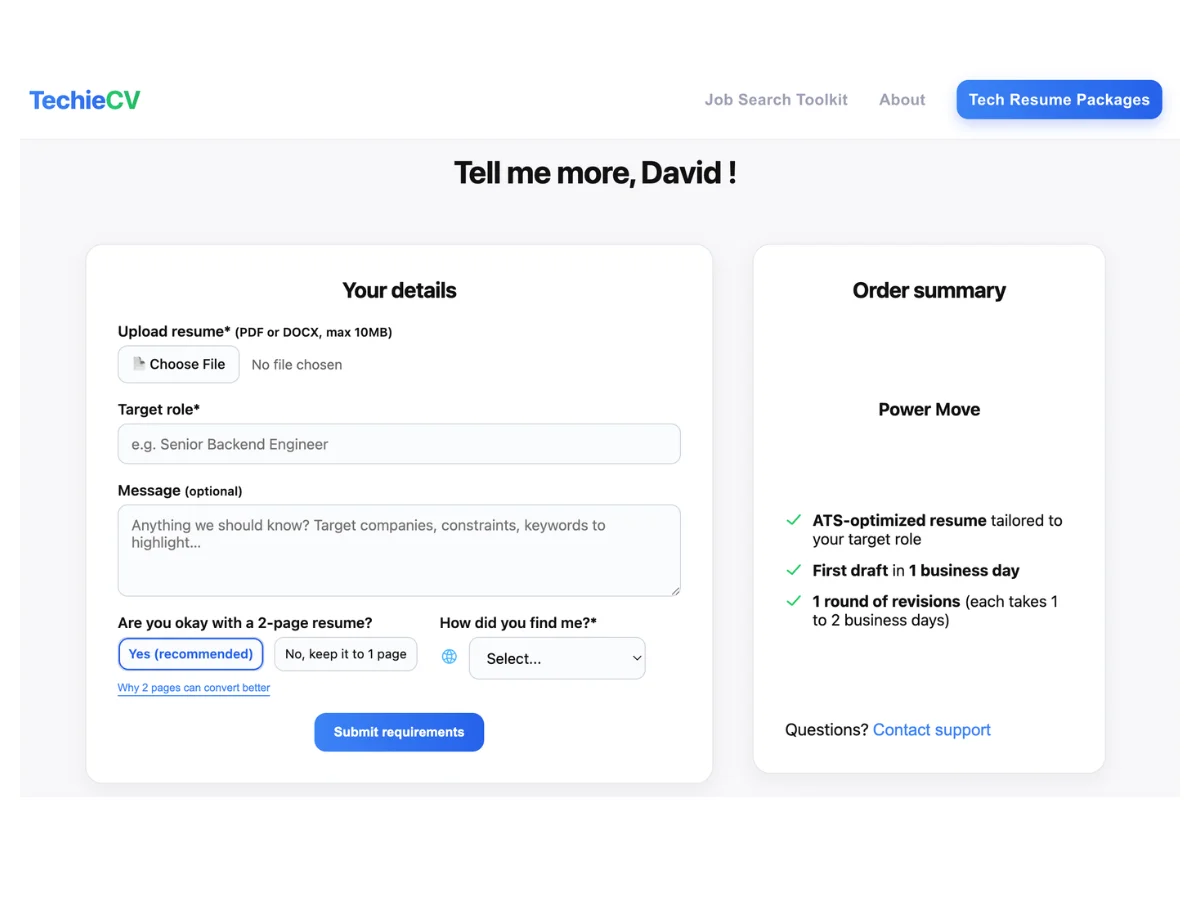
I start from your current resume and a short requirements form: your target role, seniority level, and any specific job descriptions you're targeting.

If your resume isn't up to date or there's context it doesn't include yet, you can add a brain dump document. No formatting required, just write whatever comes to mind.

You also get direct email access throughout the entire process, so no questions are left unanswered!

Front-End resume writing requirements form

02

First Draft Delivered in 4 Business Days

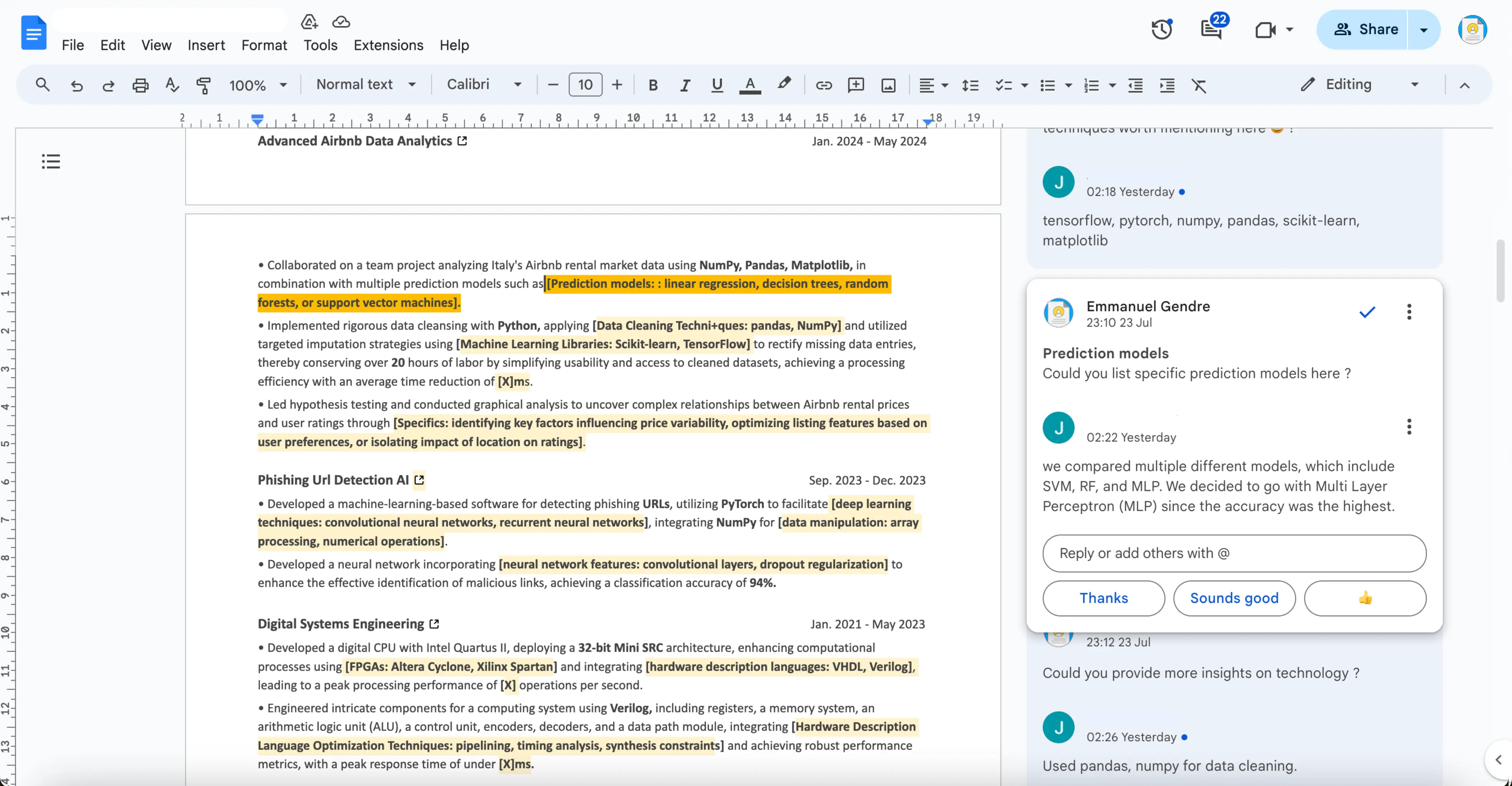
Your resume is rewritten entirely and delivered as a shared Google Doc. Not edited. Not cleaned up. Rewritten from scratch.

The draft includes comments throughout explaining specific decisions: why a bullet was restructured, why a section was added, what a recruiter is looking for in that specific area.

Placeholders flag suggestions for technical depth: specific tools, architectural patterns, engineering techniques, metrics, etc... so you know exactly what to fill in and why it matters.

Power Move clients receive their first draft within 1 business day.

Front-End resume first draft in Google Docs with recruiter comments and technical placeholders

03

Your Input

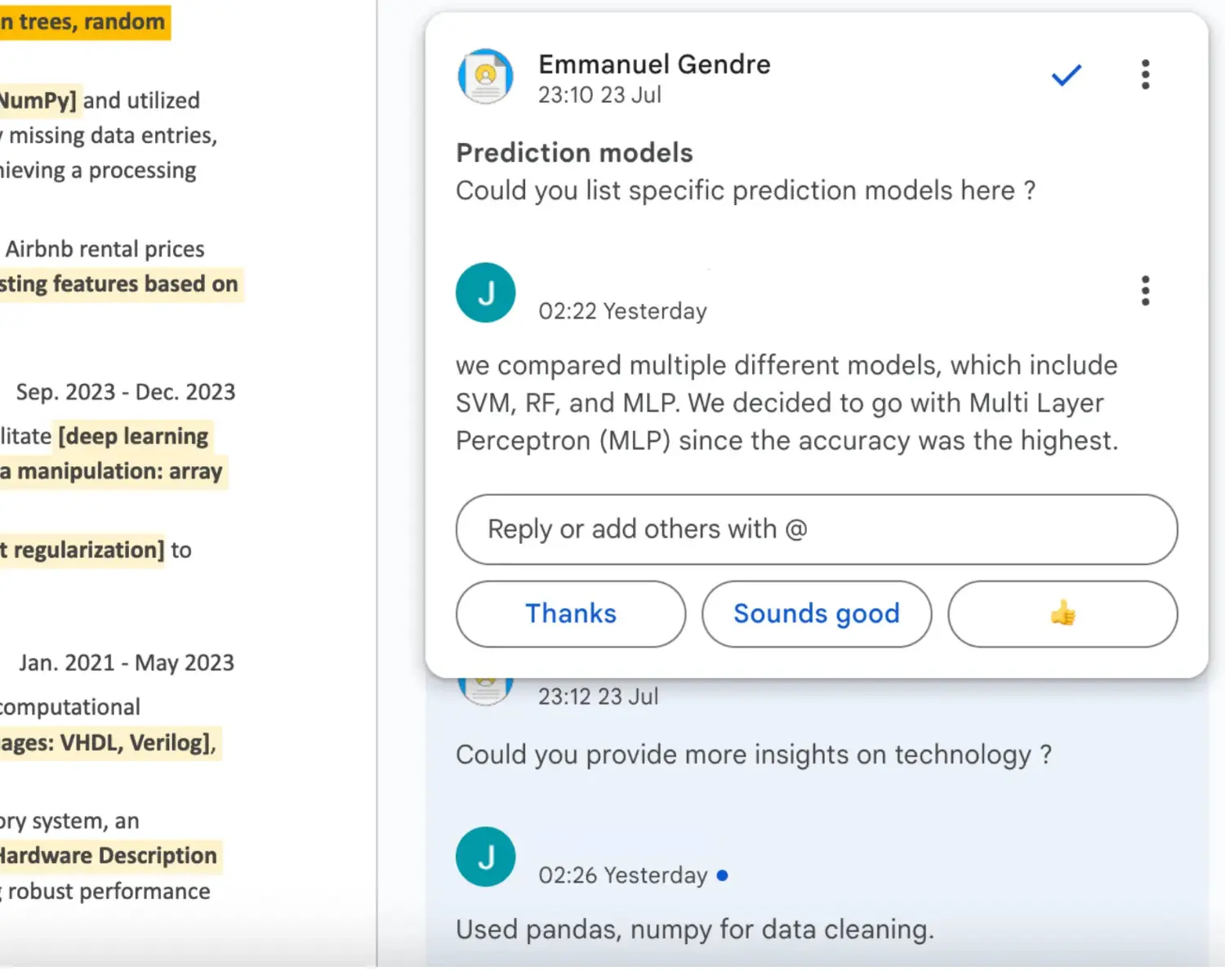
Take as much time as you need. The comments in the doc lay out clearly how to respond to each suggestion. You can edit directly in the document, reply via comment, ask questions, or add more context. There's no right or wrong way to engage. Some clients write paragraphs, others leave one-line notes. Both work.

This is the part most clients don't expect. Responding to specific technical questions about your own work tends to surface things you'd forgotten, undervalued, or never thought to include. Most clients say this is where the real material surfaces: accomplishments they'd forgotten, impact they'd undervalued, or context they never thought belonged on a resume.

Front-End engineer providing input on resume rewrite via Google Doc comments

04

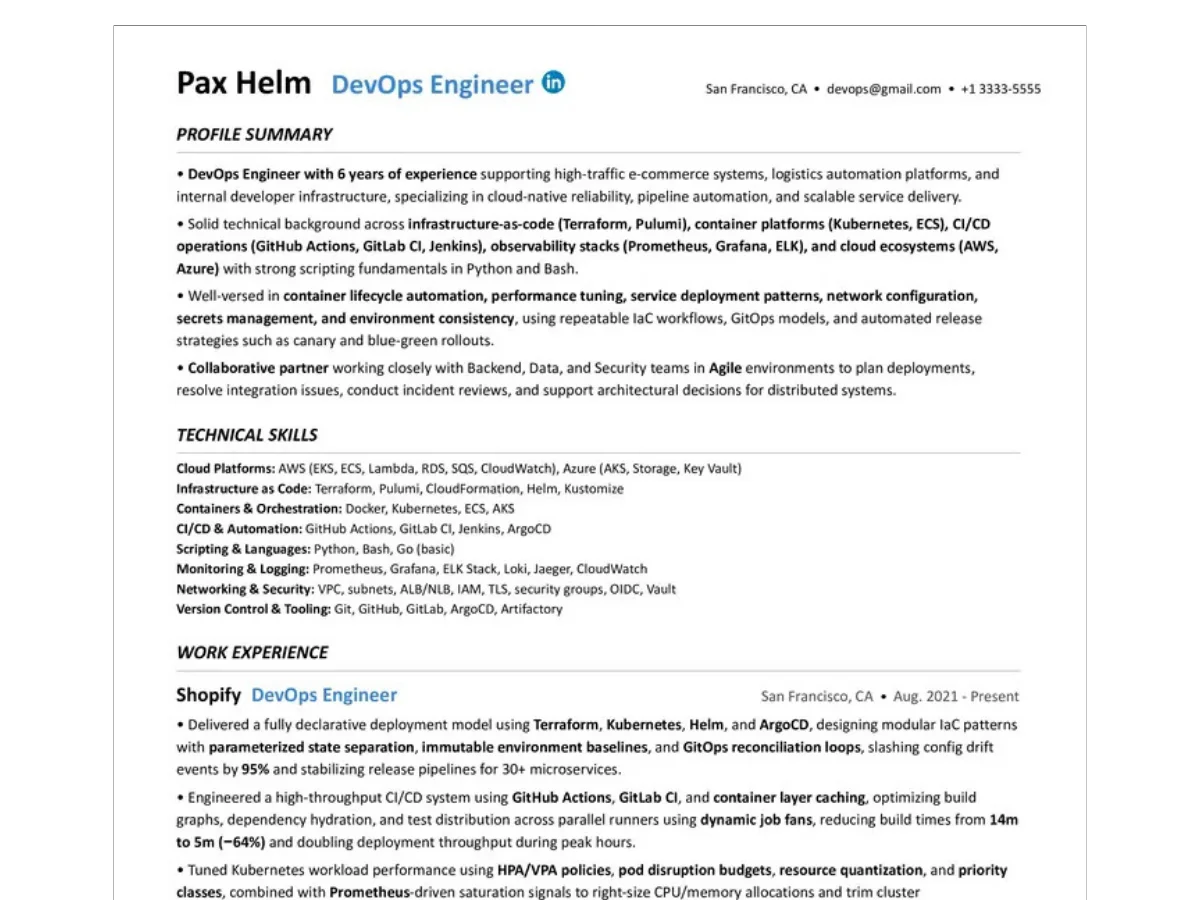
Final Version Within 1 Business Day

Once you have provided your input, the final version is delivered within 1 business day. Climb The Ladder and Power Move clients get unlimited revisions for 30 days from the date of first delivery, so we can iterate as many times as needed until the resume is exactly right.

Final version of a rewritten Front-End resume ready for job applications
Requirements form for tech resume writing service Front-End resume first draft in Google Docs with recruiter comments and technical placeholders Front-End engineer providing input on resume rewrite via Google Doc comments Final delivered tech resume

Step 1 of 4: Share Your Requirements

TechieCV's track record with Frontend roles

Recent Frontend, UI, and Design-System offers landed by TechieCV clients.
Dates are when the offer was signed.

Company Position Offer signed
Airbnb
Sr. Frontend Engineer Mar 2026
Vercel
Staff Frontend Engineer Feb 2026
Figma
Front-End Engineer Dec 2025
Stripe
Senior UI Engineer Sep 2025
Shopify
Frontend Tech Lead Jul 2025
Meta
Front-End Engineer Apr 2025

Placements reflect signed offers. Client identities are kept confidential.

Front-End Engineers get a free resume review

Upload your resume. I'll send back a recruiter-grade assessment within 12 hours. No charge, no catch.

Google-level recruiter screen + clear grading & checklist, on your Front-End Engineer resume.

Get a Free Front-End Resume Review

I review personally all resumes within 12 hrs

PDF, DOC, or DOCX • under 5MB

Front-End resume FAQ

About the role

Yes, all three. They overlap but the emphasis differs. UI Engineer resumes lean on interaction design, motion, and visual craft. Design System resumes lean on component API design, governance, and adoption metrics. Front-End resumes sit in between. I tune the summary, skills, and bullet weighting to the exact target.

A Full-Stack resume proves you can build top-to-bottom features. A Front-End resume proves you can ship UI that performs, scales, and feels right. Recruiters screen Front-End resumes for component architecture, Core Web Vitals, accessibility, and design-system literacy, none of which a Full-Stack resume emphasizes.

Yes, about 55% of my Front-End clients are senior+ (Senior, Staff, Principal, Front-End Tech Lead). The senior content is very different: less framework enumeration, more architectural judgment, design-system stewardship, and cross-team UI standards.

Process & tech

Both. FAANG Front-End resumes emphasize scale: hundreds of components, multi-product surfaces, A/B-tested UX. Startup Front-End resumes emphasize breadth: you own the whole UI stack, and bullets need to show that range without sounding scattered. I tune the angle to the target.

By target. Recruiters skim for the framework on the JD before anything else. If you're applying to a React shop, React belongs in the summary, the skills block, and the top bullets. Adjacent frameworks go in the secondary skills line. The same content reordered for a Vue or Angular target reads completely differently.

One page if you're under ~8 years in. Two pages once you're a Staff-level engineer with multiple design-system or platform UI milestones worth the space. Length-for-length's-sake hurts you. Recruiters skim in seconds, and padding dilutes your strongest signals. More on this in the resume length guide.

Free Front-End Resume Review