How to write amazing Bullet Points
Learn about the Level System: the framework I developed to write amazing bullet points. Follow this 5 steps checklist to rank your resume within the top 1%.
Posted on June 20, 2025

Last updated: January 12th, 2026 | 20 min read
How to answer open-ended interview questions? The most effective method to deal with tough interview questions is to master a thought process built on structure, complexity, and reasoning. Frameworks like the STAR method can help with providing structure, but your success depends on your ability to deal with key elements like timeframe, scale, and contingencies.
As part of my tech resume writing services, I spend a lot of time on answering questions about interviewing from clients who landed interviews.
One that comes up a lot is how to interview well, and more specifically how to answer open-ended interview questions (often asked at FAANG, etc…). There’s mostly generic/vague advice online, which you probably found hard to apply.
So I wrote this step-by-step guide with everything you need to know on the topic. This is an article you can keep referring to, so you can get better at this skill which will serve you for your entire career.
This method is based on my 13 years recruiting experience, especially for Google, where part of my job was to analyze interview performance.
In this guide, we will cover:
The purpose of an open-ended question is not to get a final answer. It is to get a thought-process.
You're forced to expose your actual chain of thoughts, because:
The experience can be nerve-wracking, especially if you're new to it. You're already in a stressful situation (interviewing), and you're essentially asked to improvise. You have to think about the answer and communicate it at the same time, which is a lot for your brain to process so it removes all posturing. You're exposed and you have no other choice than to reason out loud.
These interview questions are much more telling than “Where do you see yourself in 5 years?” 😉
Among the many types of interview questions you'll encounter, the simplest split is open-ended questions vs. closed-ended questions.
Closed-ended questions have a finite set of valid answers: yes/no, a date, a number, a name. "Have you used Kubernetes in production?" is a closed-ended question. They're efficient for screening factual job interview questions, but they don't reveal much about how you think.
Open-ended questions can't be answered in one word. They force you to reason out loud, structure a position, and walk through trade-offs. That's why they dominate the harder job interview questions at FAANG and other competitive employers: among all types of interview questions, they're the most reliable way to evaluate how a candidate actually thinks.
So what do these open-ended interview questions actually look like? They come in 2 flavors: behavioral (also called behaviour-based interview questions or hypothetical) and situational. In reality, they're often put in the same basket as open-ended and behaviour-based interview questions.
Behavioral questions are based on past experiences. Their goal is to trigger the memory of an event, which you will then articulate as an answer. By walking the interviewer through what happened, you expose your behavior in a certain context.
They often start with Tell me about a time when… Here’s one:
“Tell me about a time when you opposed your managerial decision?”
That's a classic question used at FAANG to evaluate someone's ability to do what's best for the company despite the hierarchy. This fits Amazon's "Have Backbone" principle, or Google's "Do The Right Thing" rubric.
Situational questions are made-up scenarios. They’re in my experience the hardest to answer, because the context could be totally unfamiliar to you. It’s like a simulation lab.
Here’s the hypothetical twist on our previous question, so that you can see the difference:
“Your manager just made the decision to which you disagree. What do you do?”
The context is much narrower, so that situation likely hasn't happened to you yet.
Typically, competitive companies (FAANG, etc…) will use both types of questions during the same interview, so that they can confirm that past behaviors are consistent with potential (future) behaviors.
Even though these 2 types of questions may feel different, the methodology and assessment are the same.
Understand that big companies take their tough open-ended interview questions extremely seriously. FAANG have detailed interview questions repositories with vetted questions to select from. Questions sometimes require approval from the recruiter so that interview feedback is deemed valid. I am not joking: I have had cases where new interviews had to be redone because the wrong set of questions was selected. (nope, candidates weren't happy...)
It's also not just one question: they also have pre-calibrated follow-up questions. They do this to stress-test your plan and to allow you to elaborate. You will give your first "main" answer, and the interviewer will guide you through digging deeper.
You shouldn't see these follow-up questions as a challenge, unless you're forcing the interviewer to ask basic questions on obvious details. They're mostly here to help. My advice is to think of these interviews as a conversation, rather as a Q&A.
Smaller organizations may be less sophisticated, but my advice is to prepare as you would for a top player.
This section is super important, because once you understand how you're evaluated, it will make everything else much clearer.
I can't go over the specific evaluation rubric of each company, and I don't need to. They all tend to gravitate around 3 components: Structure, Complexity and Logic.
Let's go over each of them in detail, so you can visualize the interviewer's checklist.
The most obvious part is structure, which comes down to these 4 questions
You've probably heard of the STAR method, which helps you organize your answer in successive steps.. That part is actually well covered online, so I won't elaborate on it with this article. No myth busting here: it does work. Unfortunately though, most of the general advice stops here. But we'll go much deeper 😉
During my previous career as a recruiter, I had to analyze and document interview feedback to support candidates in front of hiring committees. What I found is that most candidates understood the structure part, and most of the difference was made by their ability to handle complexity.
During interviews, complexity is 3 components:
Each of these bring an additional dimension to the basic structure, which creates more depth to your answer. This is the part top candidates nail.
The last part is the quality of your reasoning itself. There are 2 components to it, which I'll call critical thinking and support.
Critical thinking is your argumentation. It's whether you made reasonable claims or statements based on the given context. Are you solving the right problems and making relevant hypotheses?
Support is your ability to back your hypotheses. It is a bit tricky: on your resume, you're told to quantify achievements with metrics, but with open-ended questions you won't have those.
Interviewers need to see that you can deduce/infer useful data, or use logical statements to confirm your claims. In the more abstract cases (like the Q&A example at the end of this article), you should at least explain why an action should lead you to the desired outcome.
For more concrete cases (especially for situational questions), you can support your argumentation with past examples, which is what my “Story bank” technique (see below) is perfect for.
Recruiter Insight: Having analyzed thousands of interview feedback for Google, I can tell you that most candidates stop at the basic STAR structure when faced with tough open-ended interview questions. To reach the "Strong Hire" bar, you must intentionally layer in Complexity. My tip: always include a "contingency" at the end of your answer and explain what you would have done if your initial plan failed. It shows a level of maturity that standard candidates lack!
Now that you know what you're up against, let's begin your training, young Padawan! 🏋️♂️ how do you actually prepare for these, if you don’t know which question will be asked?
I'll give you the method that got me my job at Google, which I kept recommending to candidates.
The key is to train a thought process, instead of specific answers. The best way to get better at this is to focus on each aspect (structure, complexity, and reasoning) individuallyfirst, before putting it all together.
I'll give you an exercise, with 3 levels you can clear.
For the structure, you need a framework that will help you organize the steps of your problem solving.
The most well-known is STAR (Situation > Task > Action > Result), but there are others (PAR, CAR, SOAR, etc…). They’re all essentially the same thing: pick one. What matters is that you can visualize the steps.
As a quick reminder, here's how you should think of it:
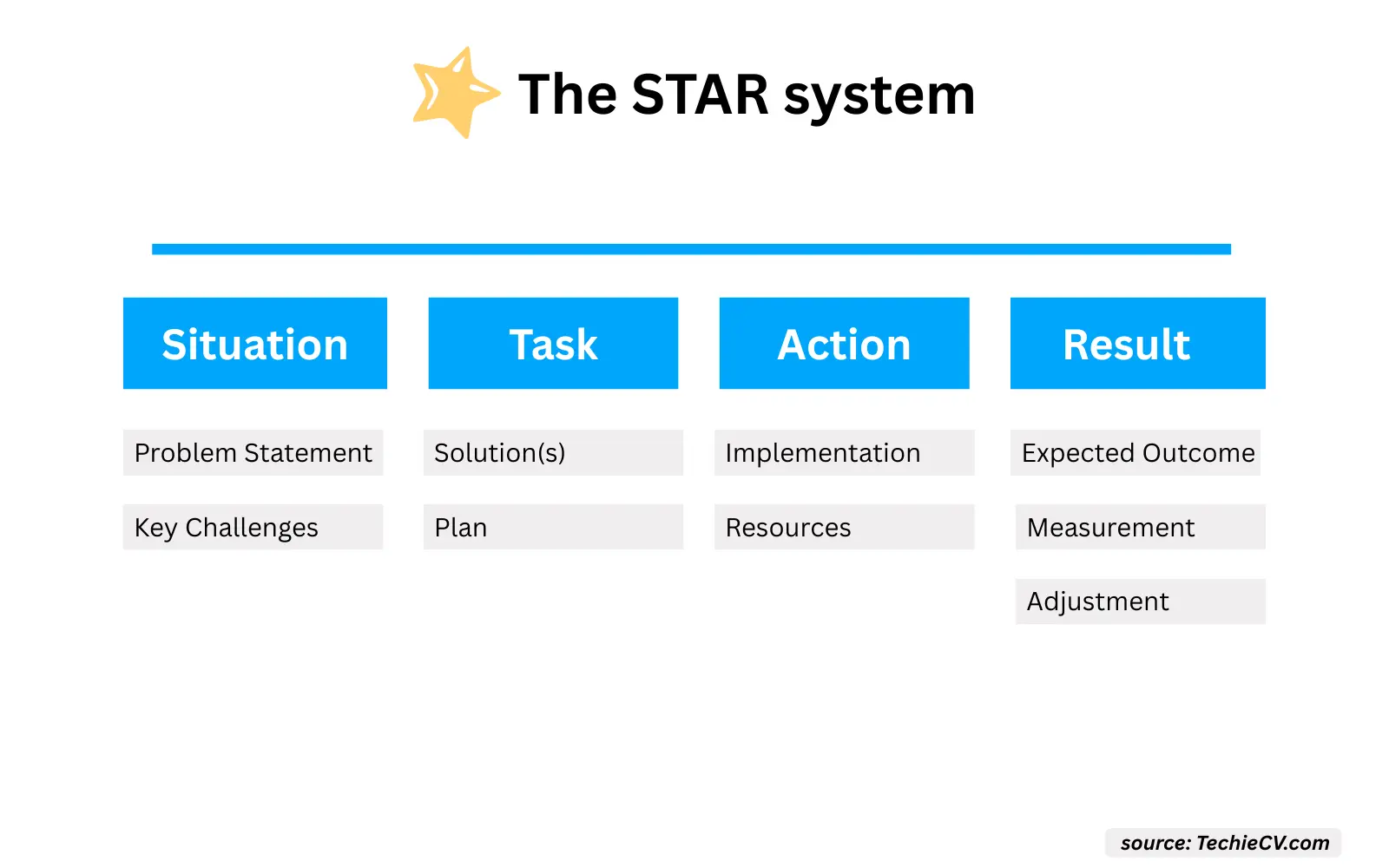
Here's the Exercise:
This will eventually help you internalize the structure and instinctively think in terms of steps. This is essential to free up cognitive load, so that you can focus your brain power on complexity and reasoning, rather than structure. I did not invent it: this is how musicians prepare for improvisation. They "hard code" scales, patterns and musical phrases, which then come out naturally so that they can focus on creativity on stage.
Training for complexity is a bit harder, because it's less linear. I made a simple diagram to show you where each of the components would fit within the STAR structure (see below).
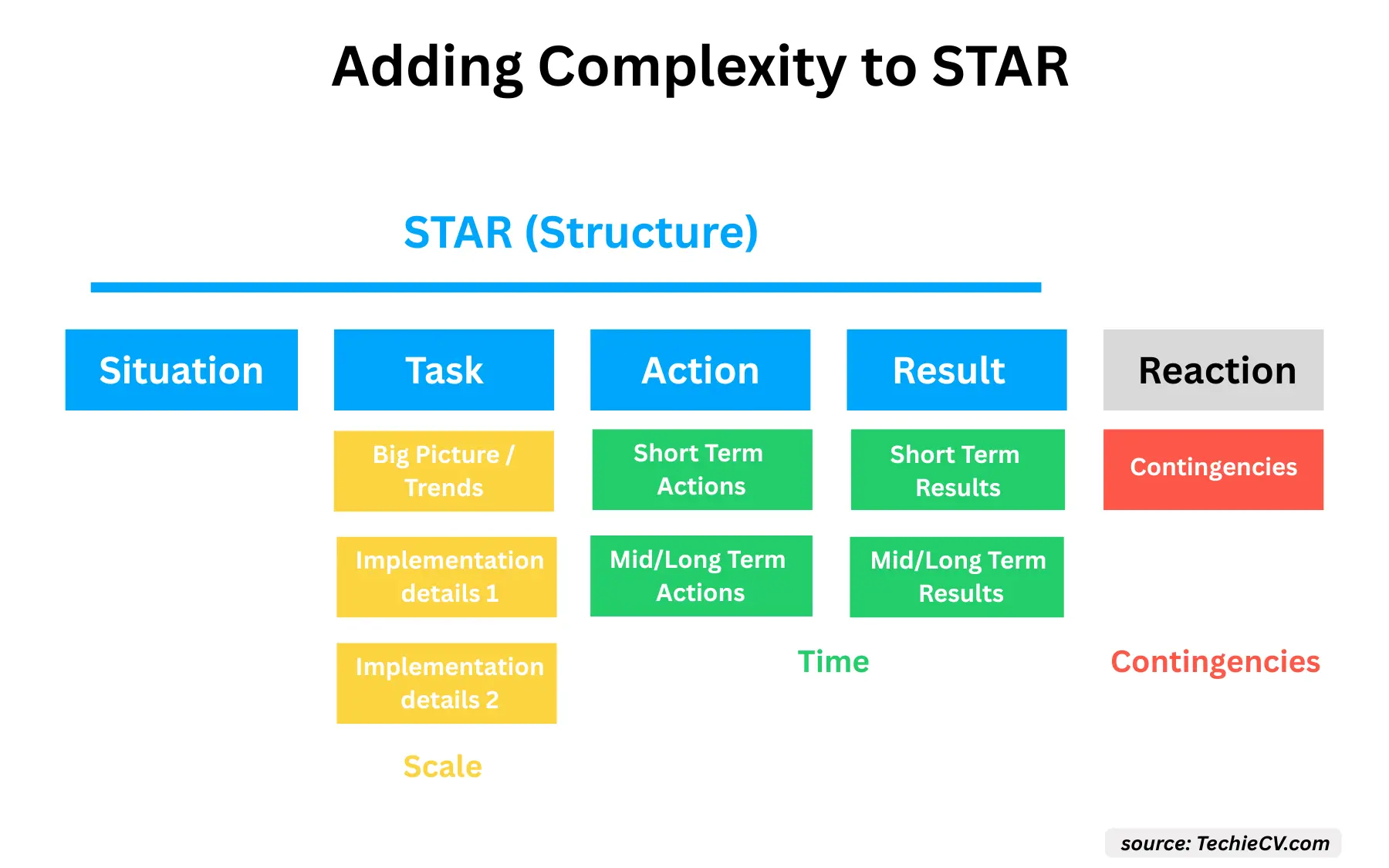
To train on this, use the the same exercise as before, but this time, add more details on one of the 3 components of complexity (Time, Scale, Contingencies).
Work on timeframe first: you can think of that as adding several Action > Result loops (for short term, then mid-term, then long-term) instead of the unique one you had within the original STAR structure.
Then focus on scale, which fits best within the "Task" step. You can split it into (i) the overall strategy and then divide it into (ii) 2/3 areas of implementation. There's no limit to how complex you can go with creating more "sub-parts", but start by using the simplest version possible first, and complexify later.
Once you're comfortable with timeframe and scale, add the contingency part after the Result step of your STAR system. You should ask yourself "What could go wrong?" and answer the 1/2 first issues that come to mind with (a) problem statement, (b) solution, and (c) expected result.
It's hard to train your reasoning with a specific technique. Doing the exercise itself trains that muscle and you should find logical connections more quickly over time.
Here's are the 3 ways to handle the support part:
Because the interviewer wants to uncover past behavior, you have to come up with stories to illustrate the cause and effects. This brings a new problem: how do you think of the right story on the spot?
When preparing for my Google interviews, I built what I called a Story Bank, and I then recommended candidates to do the same. Here's how it works:
While training on situational questions, you'll realise that even if they're all different, they cover the same list of topics (types of behaviors). Topics that come up often are: conflict management, acting as an owner, taking & giving feedback, challenging authority, communicating clearly/adapting messaging, creating resources, etc...
Once you know that, you can prepare a couple of past stories for each topic, and train on communicating these. During the interview, you can just call in the right story at the right time. Because you will be trained on these, your delivery will become excellent, and you can test/swap/improve them from one interview to the next.
This makes situational questions easier to get right over time 😁
Recruiter "Cheat Code": I saw candidates fail not because they lacked experience, but because they picked the wrong story for the question. Don't prepare for specific questions; prepare for topics. Build a "Story Bank" of 5-6 versatile projects that cover conflict, ownership, and feedback. If you master the story, you can adapt it to any situational question they throw at you.
Before reviewing a concrete example together, I wanted to give you 4 techniques I use to give candidates to improve their performance. Once you're comfortable with the training above, you can start adding them to improve your game even further.
If you follow the STAR method, you know that assessing the situation (the problem at hand) is the first step, and follow up questions are a great tool to gather information.
2 small tips:
You might need to use metrics, volumes, scales, proportions, etc in your answer, for which you don't know real world numbers. If that's the case, make assumptions and tell the interviewer that "your reasoning takes X as a base to measure Y". >Again, they evaluate you on your reasoning, so the actual number doesn't matter.
The third advice is to take your time to answer. Interviewers do not expect you to answer within seconds, but when it does come they do expect your thoughts to be organized. It also helps with perception: someone who pauses before answering appears more thoughtful than someone who rushes to answer.
Don’t try to build the whole answer in your mind before answering. Instead…
(1) Create a rough plan in your head. (2) Then walk the interviewer through your reasoning while adding complexity. Yes, it's a hard gymnastic to handle without experience (hence my training recommendation above), but once it becomes natural it reduces cognitive effort. You get the best of both worlds: a well-thought out structure (prepared mentally), and complexity + quality of reasoning (thought “out loud”).
So... after all that theory it's time to give you a concrete idea of a good answer. We’ll use my favorite hypothetical question (Yay!).
“You've been working on a mission-critical project for 6 months and you're suddenly asked to hand it over to a colleague. What do you do next?”
{SITUATION - Problem Statement} I believe there are 2 problems to address here: first the reason for the handover, then make sure it happens in the most efficient and safe way, while maintaining team cohesion.
{SITUATION - Follow-up} Did the handover happen because of my own performance issue or because of external factors?
(let's say the interviewer answers that it was because "your manager was unsatisfied with your performance.")
{TASK - Scale: Big Picture View} You mentioned that the project is mission-critical, so the focus should first be on ensuring a smooth handover (short-term), before analyzing my own performance in detail (mid-term) and working toward a (long-term) upskilling plan.
{TASK + ACTION - Scale: Granular details / Timeframe: Short-term}
Here are the actions I will take during the first couple of days:
I'll first ask for direct feedback from my manager to identify the basis of the decision. This is the surest way to understand key mistakes or shortcomings. I'll also schedule a conversation with them to hear their detailed assessment of my performance in these areas in comparison to their expectation. This will give me an idea of what to strive for, and how far I was from it.
I'll then request feedback from all collaborators specifically on the areas to be improved, to understand how it impacted their work with specific examples. It should allow me to internalize how important success in the area is.
For the sake of this argument, I'm going to assume that the feedback is that I was too slow in making decisions, which created a bottleneck and stakeholder frustration, while risking timely delivery.
So, during the following days...
I will communicate my mistakes and stakeholder feedback to my colleague so that they understand the context and prior issues. I'll stress that speed is crucial and that they should keep a sense of urgency.
I will organize key information and resources to handover rapidly so that project timelines aren't impacted further, and I will introduce them to key stakeholders rapidly.
I might help them formulate a new plan if they assess that they need my input or more context from me.
{TASK + ACTION - Scale: Granular details / Timeframe: Mid-term}
Within the following weeks...
My colleague is now leading the project, but I do want to stay available for periodical check-ins. This will be a 2-way street:
I will provide my input when necessary so that I can transfer any useful knowledge.
I will ask how they are performing, specifically where I didn't. I'll ask them detailed questions on their tactics to handle such a complex project with speed. I will seek their advice on decision making and ask about concrete examples of recent decisions.
I will also seek education on the topic internally (trainings, workshops, sessions with more senior colleagues) and externally (courses, books) to learn about productivity, project delivery and decision making
I will create my own speed and decision making framework, which I will apply to all new projects, while documenting situations, decisions and outcomes for reviews.
{TASK + ACTION - Scale: Granular details / Timeframe: Long-term}
For the months to come, I will probably be working on new projects. So I will check-in periodically with my managers and seek feedback from new stakeholders with a focus on the topics of speed and decision making. This will help me "keep my finger on the pulse", and allow me to measure progress.
I will review my personal documentation of decision making to assess improvements, take in lessons from recent decisions, and further improve my own framework so that it becomes a mature, solidified practice.
I will also seek opportunities to transfer this knowledge to other colleagues who may be in the same situation I was, while sharing my own journey of improvement in the area.
{CONTINGENCIES}
Things don't always go accordingly to the plan, and I anticipate that these 2 new issues could happen:
{Problem > Solution 1}
My colleague, who is now in charge of the project, might be struggling with similar issues. This may mean that expectations might be too high (necessitating a push back), or that the project is particularly challenging in that area.
In such a case, I would partner more closely with them so that we can find solutions and learn from the issue at hand together. This should increase speed and accelerate ramp-up for the both of us.
{CONTINGENCIES - Problem 2}
In the long-run, I might also get the feedback (or realise on my own) that my decision-making and ability to move fast aren't improving.
If that's the case, I would conduct another assessment of the skill-gap, seek more detailed and concrete feedback and consider a more personalized training approach like coaching services or seminars.
I tried to write the answer part above in one go, so that it can feel more realistic and less "polished" than a carefully written answer. If yours is within that ballpark, you're definitely equipped to nail open-ended interview questions at top companies.
The last thing I want to say is that all the above concepts are general guidelines. They're here to help you visualize, organize and train, but they're not law, and they are other ways to think about the topic. Once you're comfortable with the key principles, don't obsess over them and start playing with the rules. That's also what great improvisers do 🎸
Behavioral questions focus on your past experiences (e.g., "Tell me about a time when..."). Situational questions are hypothetical scenarios (e.g., "What would you do if...") that test your reasoning in unfamiliar contexts.
Address three dimensions: Timeframe (short vs. long-term), Scale (big picture vs. granular details), and Contingencies (anticipating what could go wrong).
Use Support by applying "napkin math" for logical assumptions or by explaining the expected cause-and-effect of your actions based on your professional "gut feeling."
Yes. Taking a moment to organize your thoughts makes you appear more thoughtful and composed. It is better to pause for 5-10 seconds than to start with a disorganized response.
A Story Bank is a collection of 5-6 versatile past experiences you’ve prepared in advance. Instead of memorizing answers to specific questions, you prepare stories for topics (like conflict or ownership) that can be adapted to almost any situational question.
Yes. Even though the "Result" hasn't happened yet in a hypothetical scenario, you should use the STAR method to structure your plan and explain the expected results and how you would measure them.
It means walking the interviewer through your logic as you build the answer. This reduces your "cognitive load" and allows the interviewer to see your chain of thoughts, which is often more important than the final answer itself.
Big tech companies use calibrated rubrics focusing on Structure, Complexity, and Reasoning. They often use pre-vetted follow-up questions to stress-test your plan and see if your behavior is consistent across both past and future scenarios.
You applied to hundreds of jobs: no result.
Companies won’t bother giving you
feedback,
so you’re stuck in a loop. This will keep happening until you know what’s wrong.
Let’s break this cycle today.
Learn why you’re getting rejected with a Free resume review. You get a simulated recruiter screen and a clear list of action items.
Want to read more first? See how the resume review works →