Engineering resume writing service for software, DevOps, SRE, data, and ML
engineers. Written by a recruiter who screened 10,000s of resumes at Google.
There are three times as many applicants per opening as there were in 2021. Big tech layoffs put a lot of very good engineers back on the market, making it harder for everyone to land interviews.
97% of qualified engineers get rejected during the first screen, because recruiters can’t find the evidence they’re looking for in their resumes.
Using a recruiter as your engineering resume writer
Recruiter screens are not conducted randomly. They work the same way almost everywhere, and a former recruiter knows how decisions are made: based on content depth.
That is the whole point of this engineering resume writing service: it specializes in engineering to pass screens and focuses on writing deep technical content to provide recruiters with the info they need to say “yes”.
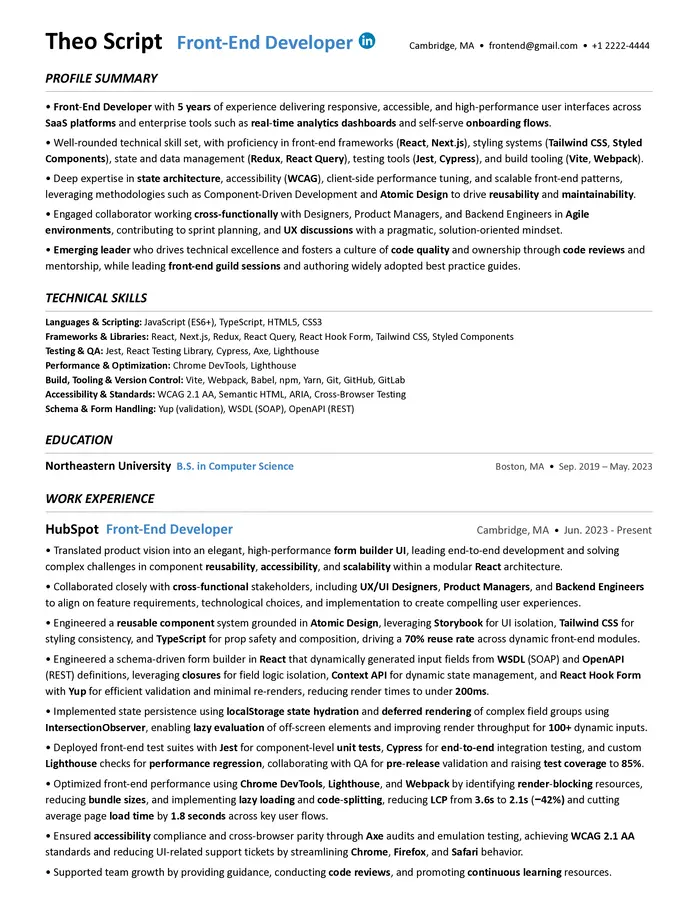
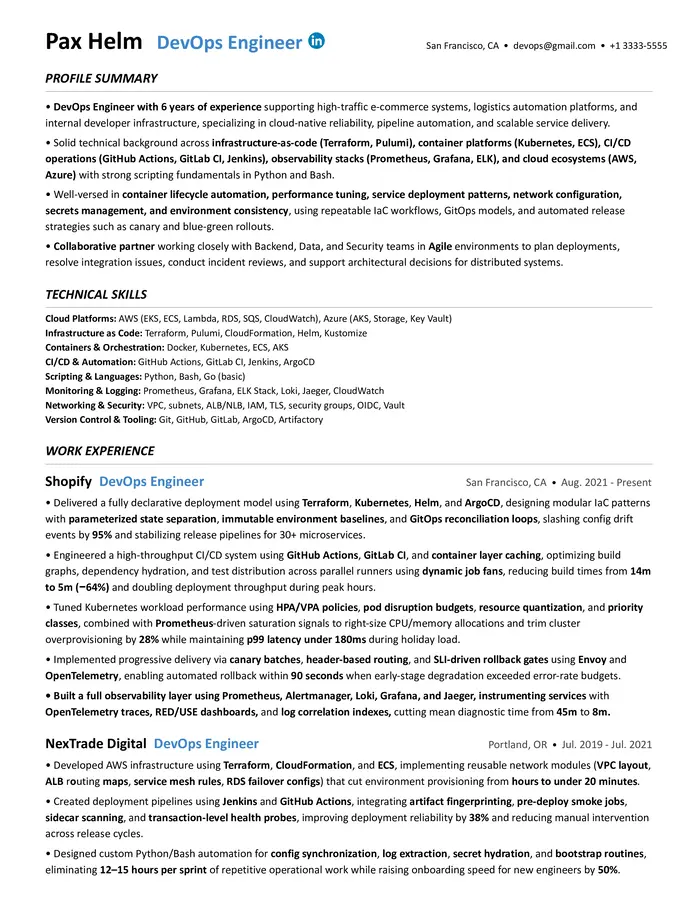
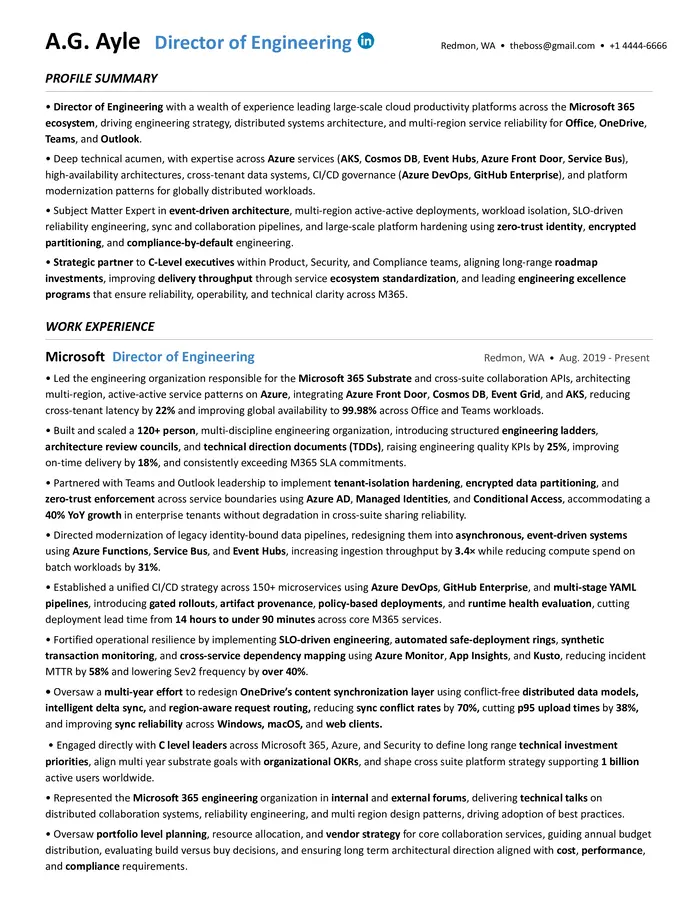
TechieCV covers software, data and ML, cloud and DevOps, security, IT and networking, hardware and firmware, testing, game development, solutions engineering, and engineering leadership.
Free resume review
A recruiter screen, but with feedback
You applied to hundreds of jobs: no result. Companies won’t give you feedback, so you’re stuck in a loop. Rejections will keep coming until you know what’s wrong.
Let’s break this cycle today!
I’ll screen your resume the same way I did at Google.
You’ll get:
Your resume sections and content scored.
A clear list of what to improve, why, and how.
Behind the scenes secrets on the screening process.
I’ll review your resume personally within 12 hrs
Why your engineering resume gets you rejected
Recruiters reject faster than ever
You sent 100, maybe 200 applications. A few responses, then silence. Companies don’t tell you why you got rejected, so you’re guessing as time passes. If you’re looking for a job for the first time in years, you’ve noticed that your old resume doesn’t work as well as it used to. Here’s why.
The 2026 engineering hiring market is brutal
The job market for engineers is employer-driven: there are too many applicants per open role, for the first time in decades.
A few years back, recruiters DM’ed you every day with new opportunities. You barely needed a resume. But today, you have to compete hard for the job you want. If you can’t consistently pass resume screens, you miss out on opportunities. The cost isn’t just lost income. It’s also the senior offer that went to someone else, the skill set you worked on for nothing, and your career trajectory that flattens.
First, a little bit of clarity: here are the 3 reasons why you’re stuck.
01
Engineering roles are more competitive
The number of applicants per role tripled during the last 5 years for software, hardware, and leadership positions. Your competition has improved in quality too, due to the massive tech layoffs. You’re now fighting with more engineers for fewer spots, with many of them coming from the best companies.
02
The hiring process is opaque
Rejections come back as automated email. That’s if you hear back at all. You’ve stared at your own resume so long you can’t read it objectively. Your friends say it “looks fine”. The recruiters reading it disagree, but you’ll never know why because they’re not going to tell you. Yet as an engineer, you know that you can’t improve a tool without a feedback loop.
03
Online advice is messy and contradictory
Everyone on LinkedIn or Reddit claims to be a resume expert, but every post or blog says a different thing. Advice from Claude or ChatGPT comes from the same generic content. There’s a new AI building tool every week, but none of it works. That’s because at the end of the day the only thing that matters is technical depth. To write a resume that gets chosen above everyone else’s, you need someone who understands both recruiting and engineering.
Using a resume writing service vs. doing it alone
AI only helps with syntax
Whether it’s a resume builder or a chatbot, AI tools do improve your writing. Your resume will read better at first glance, but read it again carefully. It’s mostly “fluff”: pretty sentences with no intent behind the words. Recruiters are complaining about resume slop more than ever. AI isn’t the issue in and of itself, but an engineering resume needs to be intentional. It should be deliberate when writing about core competencies, engineering techniques, tools, technologies, and technical metrics. It’s editorial work that requires a human.
Resume builders work against you
Resume builders sell you pretty templates. Recruiters don’t want pretty. They spend 6 to 10 seconds on the first screen and need a sober, predictable format that helps them find the key information fast. Pretty templates make you feel better, but they make both ATS and recruiter reviews harder. The net result is fewer callbacks, not more. Again, the solution is better content, not a better design.
01
A resume built by a recruiter, for recruiters
Your resume is a marketing material targeted at a very specific audience: recruiters. Engineering resumes that perform best are built with a full understanding of how tech recruiters work. So who better to write it than the recruiter himself? I spent 13 years recruiting, many of them at Google, making interview calls every day. All my writing decisions are based on experience and data.
02
An engineering resume writer who understands what you do
Recruiters aren’t the only decision makers. Hiring managers make the final call, and I worked with hundreds of them at Google. They care most about technical depth and performance signals, so you need a writer who’s technical enough to write about both. As a resume writer, I have a unique background that combines 13 years of recruitment experience, 6 years of self-taught software development (pre-AI), and 6 years of writing resumes for engineers in software, hardware, networking, etc.
03
A technical conversation about your engineering work
Most of the other resume writing services out there are generic. They start with a basic meeting or requirement form and do surface-level rewriting (syntax, structure, vocabulary). One and done. Because this resume service is engineering-focused, it’s built differently: it’s a technical conversation.
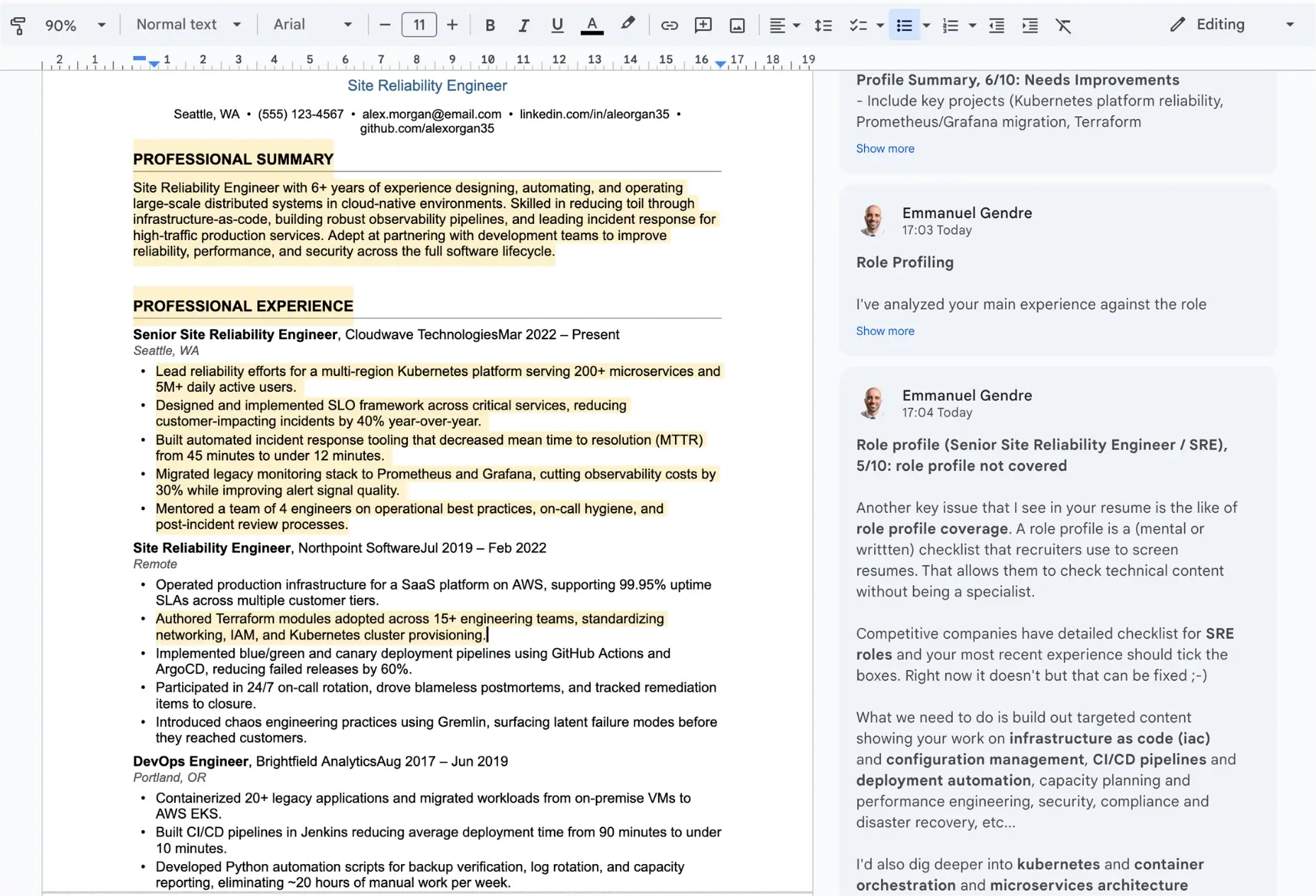
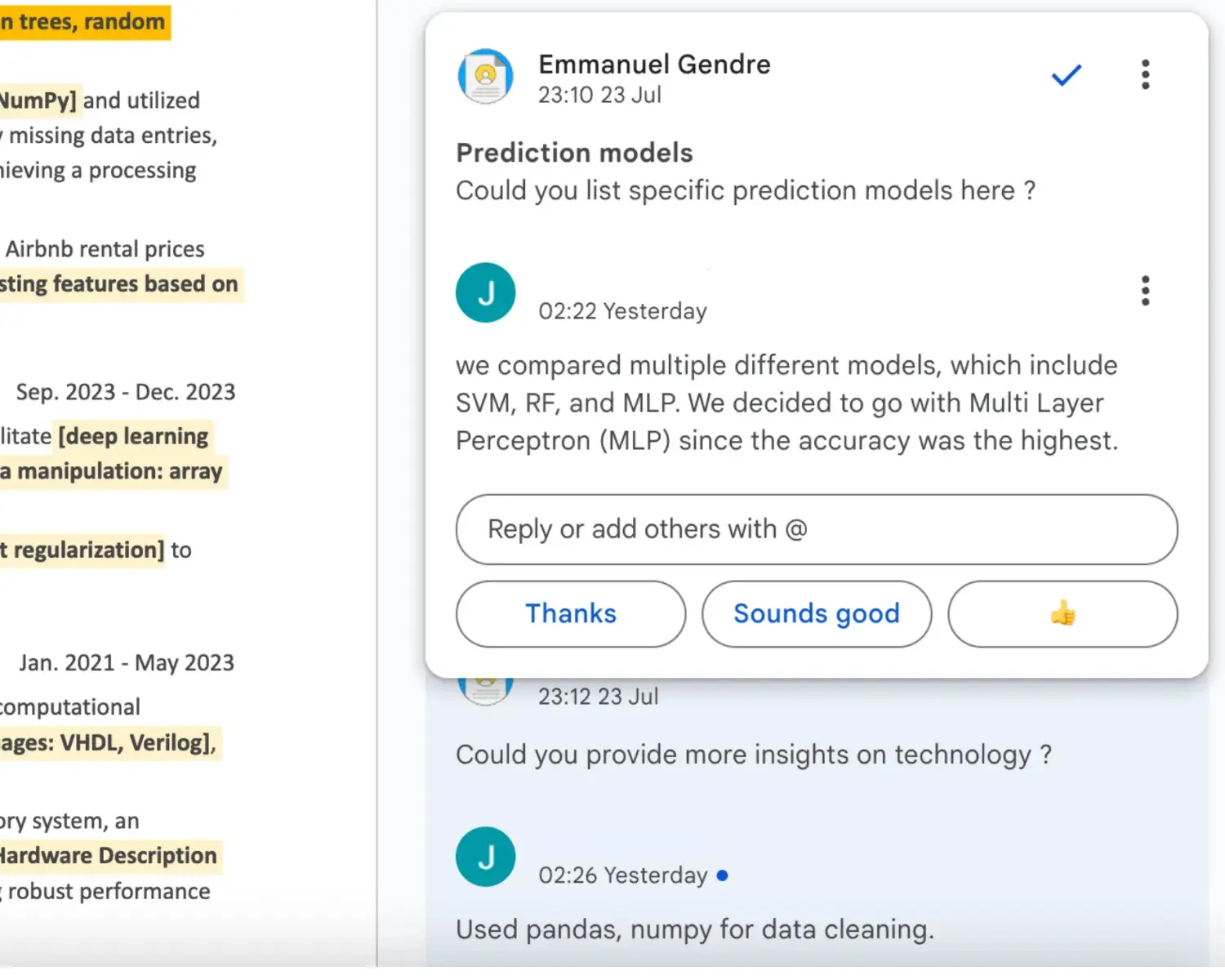
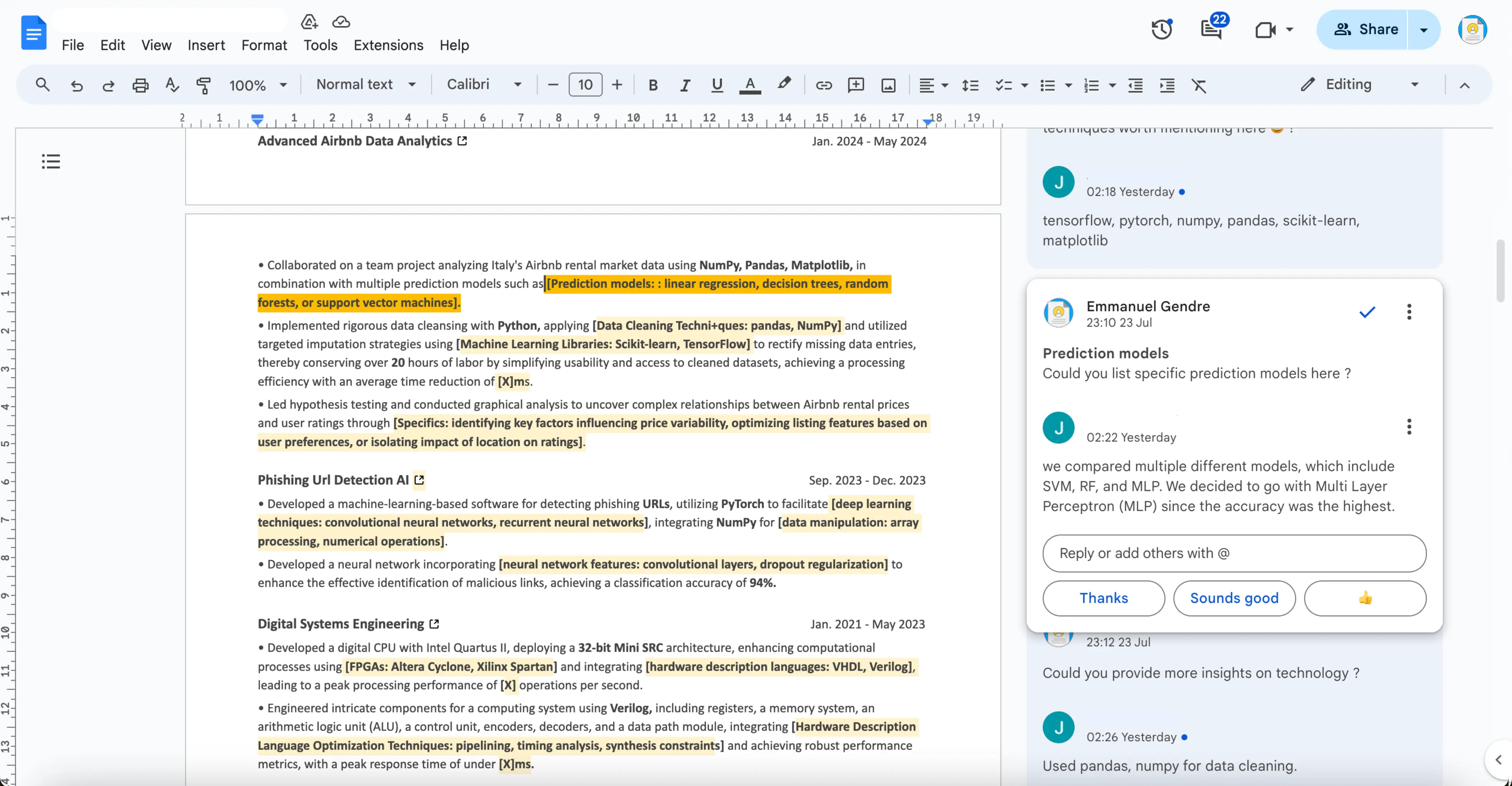
The whole rewrite happens on a shared Google Doc. Every decision is a comment you can push back on, add context to, or ask a question about. No video calls, no scheduling. You verify every claim so the result is 100% accurate, with full version history saved within the doc. Your tone of voice stays in the resume, and the conversation helps you remember past work you’d forgotten about. We’ll go deep into the complexity of your engineering work.
Why use a resume writing service dedicated to engineers
When it comes to resume writing, I believe there are only 2 real options: you either learn to do it yourself, or use a resume writer who specializes in engineering. Everything in between (generic services, AI tools, resume software) gives you the illusion of progress without results.
Run AI for a brainstorm, run a generic service if all you need is a polish, hire an engineering resume writer when the callbacks aren't coming and the resume is the actual blocker.
A resume writing service for every engineering discipline
I write for engineers across the whole stack, not just software. Find your discipline below, and the role guide under it is the same one I work from when I write your resume.
Software Engineering
About half of my clients are software engineers. I write resumes for front-end, back-end, full stack, mobile engineers, and software architects every day. I know exactly what recruiters expect and I can articulate what you’ve built beautifully :-)
Data, ML, and AI engineers are my second biggest group of clients. I write resumes for data engineers, data scientists, machine learning engineers, AI engineers, and MLOps engineers every week. Recruiters want to see the models, the pipelines, and the metrics behind them: accuracy, latency, data volume, cost savings, etc. I know how to make all of that clear without turning your resume into a keyword list.
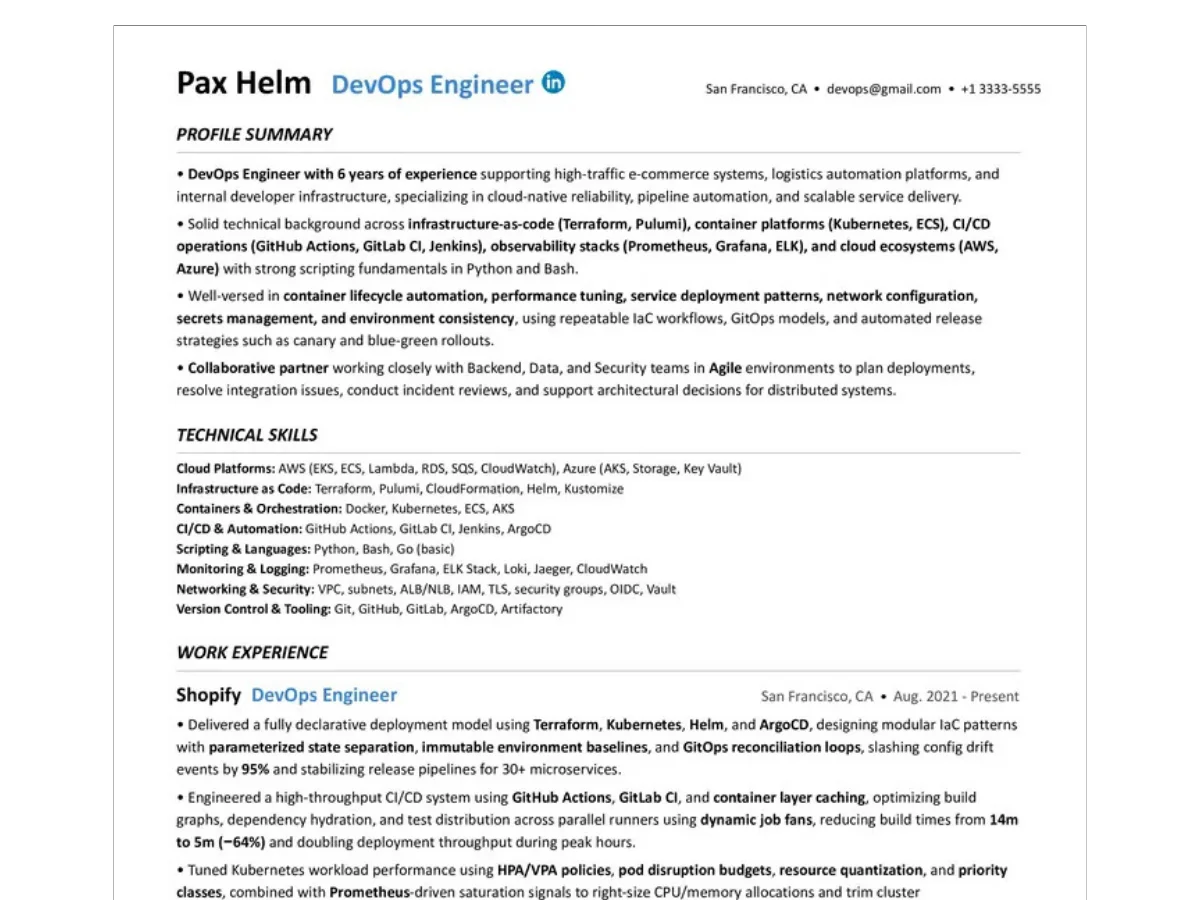
I write resumes for DevOps engineers, SREs, cloud engineers, platform engineers, and DevSecOps engineers too. The hard part with infrastructure is that the wins are invisible when nothing breaks, so we need to articulate your architecture decisions, the automation you built, the migrations you led, and the incidents you prevented.
This resume writing service is also for security engineers, SOC analysts, penetration testers, GRC analysts, and cloud security engineers. Cybersecurity is more important than ever, which means many opportunities for those who can display their expertise in threat detection, incident response, vulnerability management, cloud security, identity and access, or compliance (SOC 2, ISO 27001, NIST).
IT gets treated as support work on paper, and it costs you offers. I write it as ownership instead: the systems you run, the users you carry, the uptime you hold.
Silicon, boards, and the code closest to them. I write timing, power and yield the way a hardware manager reads them, and I ask the follow-up questions a non-technical writer would not know to ask.
QA resumes read like checklists. Yours will read like engineering: the frameworks you built, the coverage you moved, the bugs you caught before they shipped.
At staff level and above the resume stops being about code. I write scope, headcount, cross-team decisions and the calls you owned, because that is what the hiring panel is scoring.
Games hiring cares about shipped titles and engine depth. I write your credits, your systems work and your frame-time numbers the way studios expect to read them.
Send it over anyway. I keep an internal Role Profile for almost every engineering job in tech, and the roles listed above are only the ones with a public guide.
Whatever your title is, the screen works the same way. Send me the resume and I’ll tell you what a recruiter sees in the first 10 seconds.
For your role, I’ll tell you:
Whether your target role reads clearly off the top of page one.
Which bullets a hiring manager in your discipline would stop on.
The technical detail you left out that should have been in there.
I’ll review your resume personally within 12 hrs
How I rewrite engineering CVs
Three steps, all of it in writing. Nothing to schedule, and you see every decision as it is made.
Step 1 of 3
You send your resume and target role
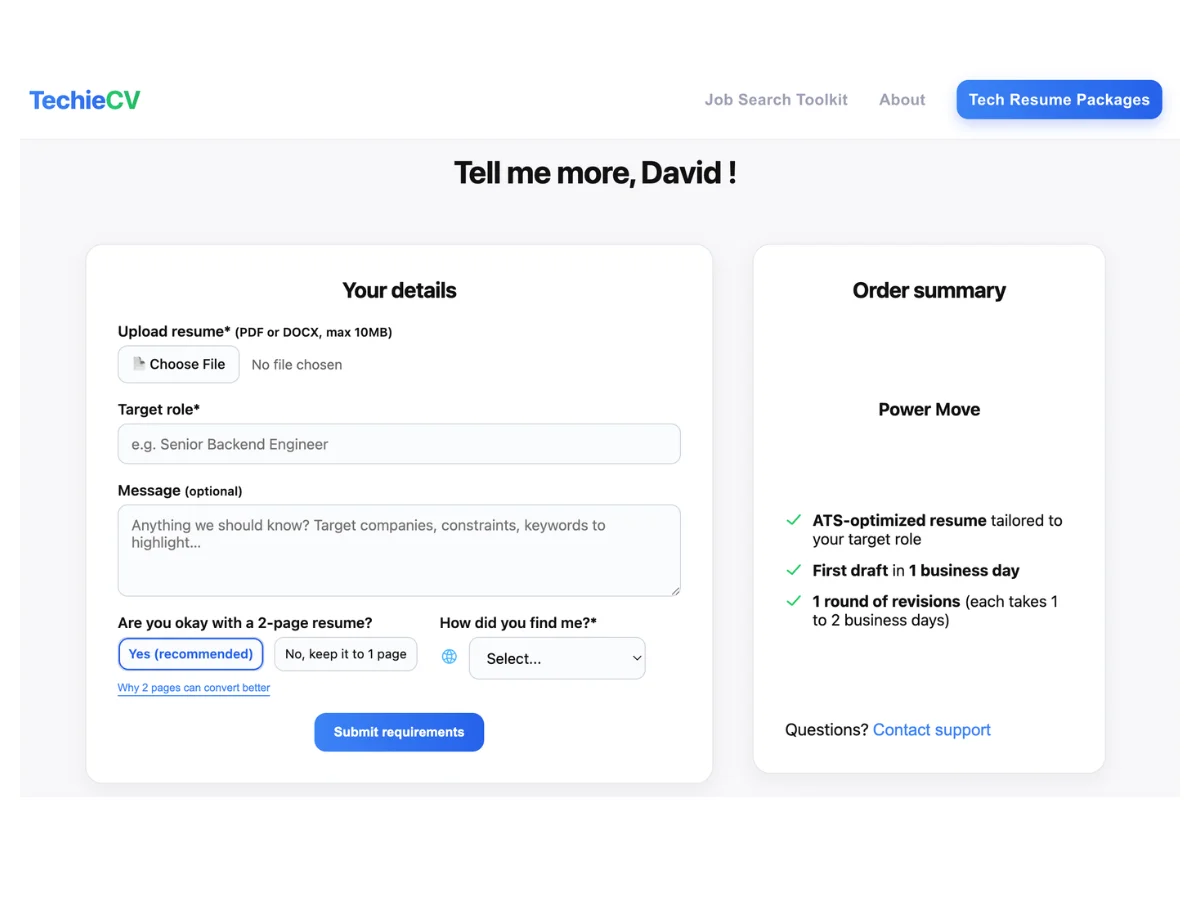
Upload your resume and tell me the roles you're going after. I send back a short requirements form: target companies, seniority, and anything the resume doesn't already say about what you built. That is the whole intake.
Takes 5 minutes
Step 2 of 3
We build it together in a shared doc
I rewrite in a Google Doc and leave a comment on every decision. You push back, add the context I am missing, and correct anything I got wrong about your stack. No calls to schedule, and you watch the reasoning as it happens.
First draft in 4 business days
Step 3 of 3
You get the finished resume
The final resume comes back as DOCX and PDF, ATS-checked, with the doc and its full version history still yours. Revisions stay open for 30 days on Climb the Ladder and Power Move.
Quick intro: I'm Emmanuel. I started recruiting in Tokyo as a rookie headhunter, and spent four years on agency-side work for clients like Warner, Disney, and Universal. I moved in-house with Groupon, then joined Google in the UK, hiring for both engineering and commercial functions. Total time in recruiting is 14 years.
Around the same time I got tired of being the non-technical person in technical conversations, so I taught myself to code. I've been writing code for over 6 years, for internal web applications and commercial apps. I ship features every week. I'm not a senior engineer, but I'm good enough to understand what you do, ask the right follow-up questions, and write deeply about the technical parts. Add that to my knowledge of how to convince hiring managers, and you get the right expertise to get you in.
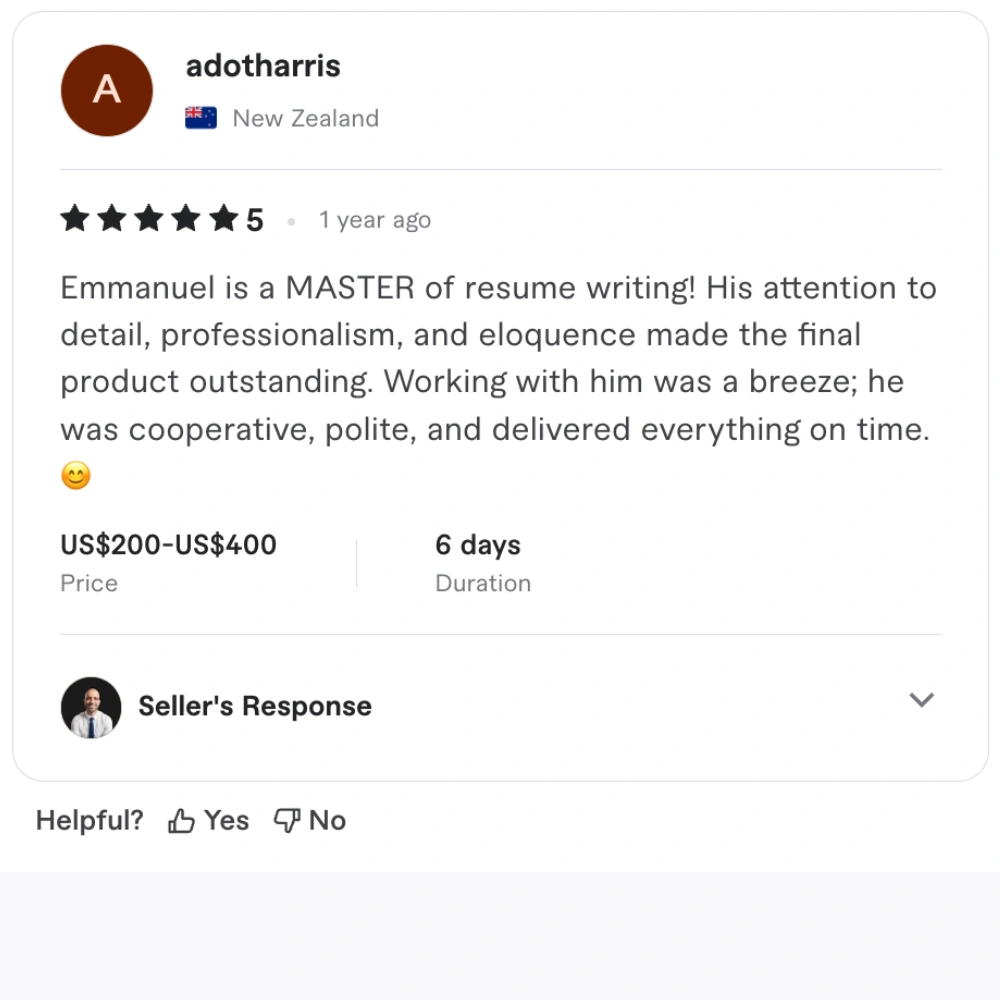
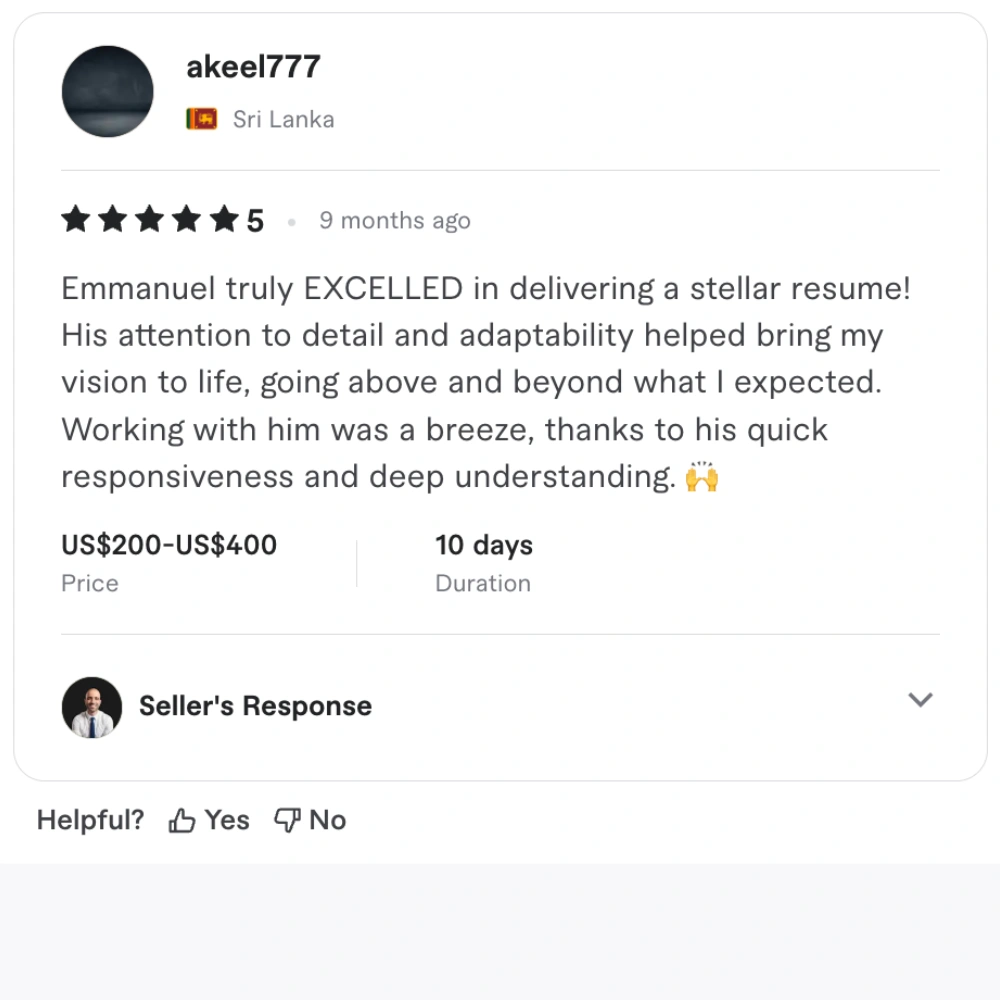
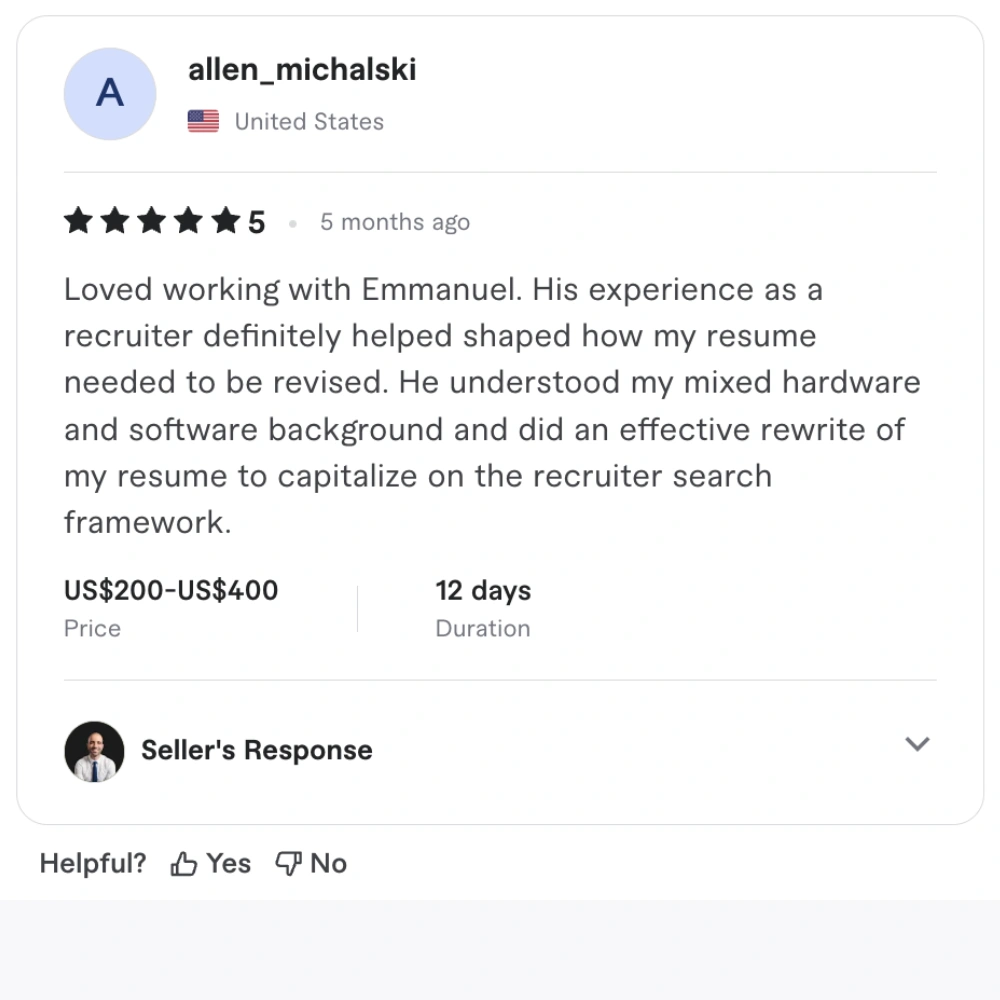
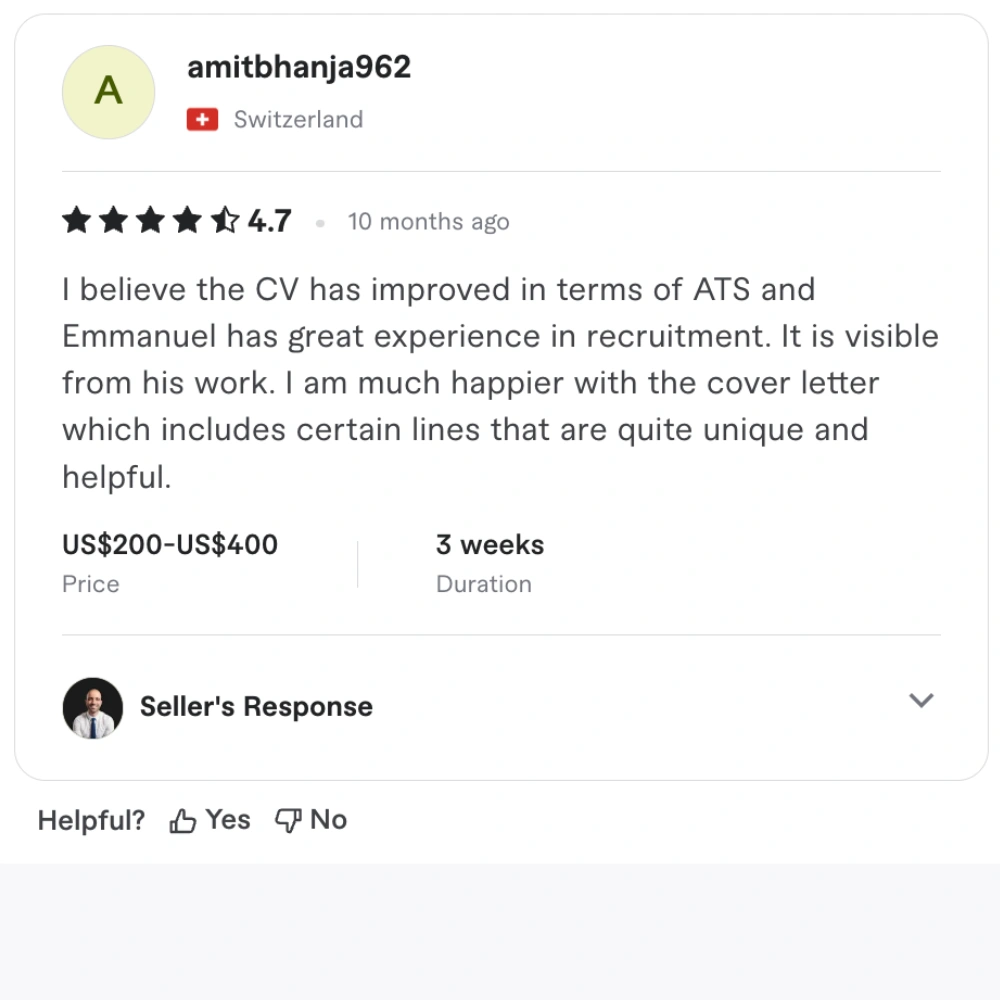
The track record so far: 1,500+ resumes rewritten end-to-end, 10,000s screened during my recruiting years, 4.9 / 5 across 419 Fiverr reviews and Top Rated Seller status, and clients hired at Google, Meta, Amazon, Microsoft, Electronic Arts and many smaller scale-ups.
Choose this if you are a student or a junior with a limited budget.
Includes:
Full resume rewrite, ATS-compatible
First draft in 4 business days
1 round of revisions
You get a 100% refund if requested within 14 days of draft delivery. No questions asked.
Most popular
Climb the Ladder
The best value for mid-career to seniors applying to competitive roles.
Includes:
Full resume rewrite, ATS-compatible
You can request additional changes at any time during 30 days. Each revision is generally completed within 1 business day (max. 2, in rare cases).
You get custom content written specifically for your LinkedIn profile + a checklist of updates to get more recruiters to reach out. You don’t need to provide your login info.
You get a cover letter especially written for your target position. It includes a few placeholders so that you can tailor it to specific companies with minimal effort.
You get a spreadsheet with a list of 5,000+ companies with direct access to their career pages, Indeed/Glassdoor job postings, Interview Questions and more. It also includes an Application Tracker, Email Templates, a Job Offer Comparator and Job Search Analytics.
You get a 100% refund if requested within 14 days of draft delivery. No questions asked.
Power Move
Choose this package if you are in a hurry and/or if you want personal coaching.
Everything in Climb the Ladder, plus:
First draft in 1 business day
The chat coaching is delivered in writing via WhatsApp: you can ask 1 question (and therefore get 1
response) from me per business day for 4 weeks. We can cover anything related to job searching,
interviewing, career development and planning.
You get a 100% refund if requested within 14 days of draft delivery. No questions asked.
All prices are USD (they’ll be converted to your local currency and shown before checkout).
Free resume review
Let me screen your resume and give you feedback (for free)
Send your resume in. I open it in Google Docs, add line-by-line comments on every section, and grade it across four rubrics: ATS, profile summary, role coverage, bullet depth. You get the doc back with every comment ready to act on.
Free, personally reviewed within 12 hours by a former Google recruiter. No card, no signup, no upsell.
An engineering resume writer reads your stack like an engineer and writes your bullets like a recruiter. Generic services clean up grammar and swap weak verbs for stronger ones. The technical depth, the architecture decisions, the metrics that signal seniority, none of that gets touched because the writer cannot read it. I can. Six years of self-taught coding plus 13 years of recruiting means a bullet about Kafka partitioning, Terraform module reuse, or feature engineering pipelines gets framed in a way a hiring manager actually responds to.
Probably yes. The roles I write for span software engineering (frontend, backend, full stack, mobile, embedded, game dev), data and ML (data engineer, data scientist, ML engineer, AI engineer), cloud and infra (DevOps, SRE, platform, security, cloud architect), engineering leadership (staff, principal, eng manager, director, VP), and IT systems (sysadmin, network, helpdesk, support engineer). If your role title isn't on the list, send me a note: I keep an internal Role Profile for almost every engineering title in tech.
Especially then. Junior engineers compete with candidates who have longer track records, so the projects section has to carry weight that work experience normally would. I write personal and open-source projects to the same depth as work bullets, mapped to the Role Profile for your target role. That's how a bootcamp grad or self-taught dev competes for a first engineering role without three years of experience to lean on.
Yes. FAANG resumes lean on scale (multi-region, hundreds of services, latency budgets, regulatory constraints). Scale-up resumes lean on judgment under ambiguity and cross-functional ownership. Startup resumes lean on breadth: you were the whole infra team, you owned three things at once, the bullets need to show range without sounding scattered. I tune the angle to where you're applying.
AI rewords. It does not strategize. It cannot tell you whether your Kafka work is the right thing to lead with for a distributed systems role, whether your profile summary is getting you filtered out in 6 seconds, or what a Staff Engineer Role Profile looks like at a Series B versus a FAANG. Most engineers who hire me have already tried AI. The output looks polished. The callbacks still don't come. There is a difference between well-written and strategically written, and that gap is where this engineering resume writing service lives.
No. The one-page rule is folklore. Recruiters do not care about page count, they care about signal density. If you have 8 years of relevant scope, two pages is fine. If you have one strong role, one page is fine. Length is downstream of content. The right question is whether every line earns its space.
Most engineering resume writing services sit between $150 and $400. Mine are $195 to $495, and the gap is what the writer can actually read. A generalist charges less because they are editing your grammar, not deciding whether your Kafka work or your Terraform work is the thing to lead with for the role you want. If your resume is already close and needs a polish, the cheaper option is fine. If the callbacks are not coming, the polish was never the problem.
Start with the target role, not your history. Pull up three job posts you actually want, find what they keep asking for, and check whether your resume answers it in the first third of page one. Then rewrite each bullet so it says what you built, what you chose, and what it moved. Most engineers write what they were responsible for and stop there, which is the difference between a resume that reads as a job description and one that reads as evidence.
Projects carry the weight that work experience normally would. Write your coursework builds, hackathon projects and open source contributions the way you would write a job: the stack, the decision you made, the result. Two projects written properly beat six listed as titles. Add the repo link if the code is clean, because a hiring manager who opens it is already halfway to a call.
Ask three questions. Can they read your stack, or will you spend the engagement explaining what Kubernetes does? Have they screened resumes at volume, or only written them? And do you see the reasoning, or just a finished file? Anyone who cannot answer the first one will tidy your verbs and leave the technical depth exactly where it was, which is the part that got you screened out. The longer version, with the questions to ask before you pay, is in how to choose a resume writer.
Still on the fence? The free resume review is the lowest-friction way to find out whether you actually need an engineering resume writer or just a small fix you can do yourself.