
Full-Stack Developer Resume Examples & Free Template (PDF, Word)

This full-stack developer resume template costs nothing: fill it in tonight and send it tomorrow as a PDF or Word file. Scroll past it for 3 full-stack resume samples, from a bootcamp grad to a principal engineer, plus my 6-step guide to each section.

4.9 5.0
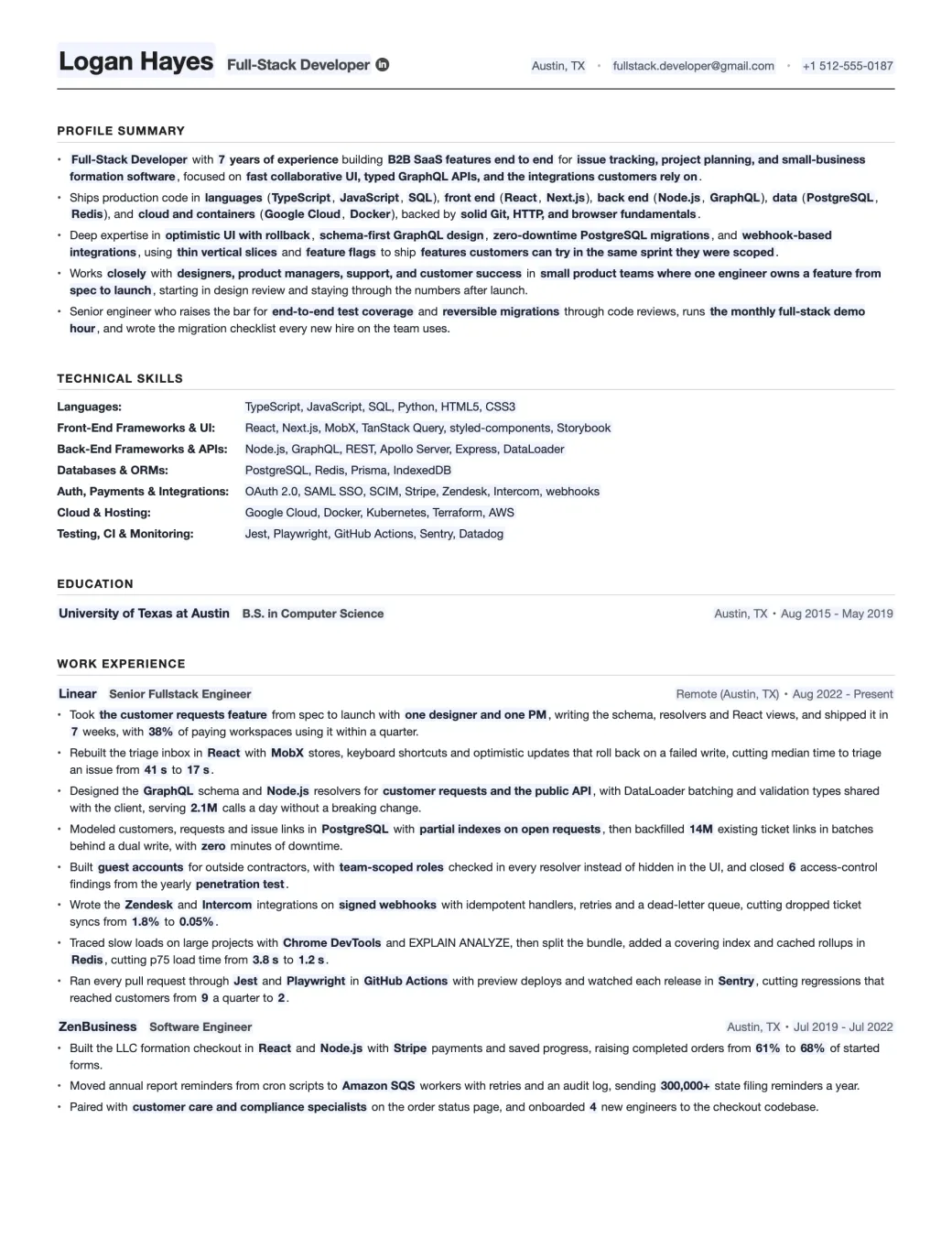
The Full-Stack Developer resume template filled in for Logan Hayes: a 5-line summary, skills from React to PostgreSQL, a computer science degree and his Linear job with 8 bullets
Emmanuel Gendre Ex-Google recruiter / Tech resume writer Updated Free, ATS-friendly, no signup

Interactive resume template generator

Interactive Full-Stack Developer Resume Template

Fill in the side panel, then download your resume as a PDF or a Word file.

Edits update live as you type. Toggle Edit to rewrite paper text directly.

Edit mode is on. Click anywhere on the resume to rewrite text. Side-panel placeholders still update live.

Logan Hayes Full-Stack Developer

Austin, TX • fullstack.developer@gmail.com • +1 512-555-0187

Profile Summary

  • Full-Stack Developer with 7 years of experience building B2B SaaS features end to end for issue tracking, project planning, and small-business formation software, focused on fast collaborative UI, typed GraphQL APIs, and the integrations customers rely on.
  • Ships production code in languages (TypeScript, JavaScript, SQL), front end (React, Next.js), back end (Node.js, GraphQL), data (PostgreSQL, Redis), and cloud and containers (Google Cloud, Docker), backed by solid Git, HTTP, and browser fundamentals.
  • Deep expertise in optimistic UI with rollback, schema-first GraphQL design, zero-downtime PostgreSQL migrations, and webhook-based integrations, using thin vertical slices and feature flags to ship features customers can try in the same sprint they were scoped.
  • Works closely with designers, product managers, support, and customer success in small product teams where one engineer owns a feature from spec to launch, starting in design review and staying through the numbers after launch.
  • Senior engineer who raises the bar for end-to-end test coverage and reversible migrations through code reviews, runs the monthly full-stack demo hour, and wrote the migration checklist every new hire on the team uses.

Technical Skills

Languages:
TypeScript, JavaScript, SQL, Python, HTML5, CSS3
Front-End Frameworks & UI:
React, Next.js, MobX, TanStack Query, styled-components, Storybook
Back-End Frameworks & APIs:
Node.js, GraphQL, REST, Apollo Server, Express, DataLoader
Databases & ORMs:
PostgreSQL, Redis, Prisma, IndexedDB
Auth, Payments & Integrations:
OAuth 2.0, SAML SSO, SCIM, Stripe, Zendesk, Intercom, webhooks
Cloud & Hosting:
Google Cloud, Docker, Kubernetes, Terraform, AWS
Testing, CI & Monitoring:
Jest, Playwright, GitHub Actions, Sentry, Datadog

Education

University of Texas at Austin B.S. in Computer Science
Austin, TX • Aug 2015 - May 2019

Work Experience

Linear Senior Fullstack Engineer
Remote (Austin, TX) • Aug 2022 - Present
  • Took the customer requests feature from spec to launch with one designer and one PM, writing the schema, resolvers and React views, and shipped it in 7 weeks, with 38% of paying workspaces using it within a quarter.
  • Rebuilt the triage inbox in React with MobX stores, keyboard shortcuts and optimistic updates that roll back on a failed write, cutting median time to triage an issue from 41 s to 17 s.
  • Designed the GraphQL schema and Node.js resolvers for customer requests and the public API, with DataLoader batching and validation types shared with the client, serving 2.1M calls a day without a breaking change.
  • Modeled customers, requests and issue links in PostgreSQL with partial indexes on open requests, then backfilled 14M existing ticket links in batches behind a dual write, with zero minutes of downtime.
  • Built guest accounts for outside contractors, with team-scoped roles checked in every resolver instead of hidden in the UI, and closed 6 access-control findings from the yearly penetration test.
  • Wrote the Zendesk and Intercom integrations on signed webhooks with idempotent handlers, retries and a dead-letter queue, cutting dropped ticket syncs from 1.8% to 0.05%.
  • Traced slow loads on large projects with Chrome DevTools and EXPLAIN ANALYZE, then split the bundle, added a covering index and cached rollups in Redis, cutting p75 load time from 3.8 s to 1.2 s.
  • Ran every pull request through Jest and Playwright in GitHub Actions with preview deploys and watched each release in Sentry, cutting regressions that reached customers from 9 a quarter to 2.
ZenBusiness Software Engineer
Austin, TX • Jul 2019 - Jul 2022
  • Built the LLC formation checkout in React and Node.js with Stripe payments and saved progress, raising completed orders from 61% to 68% of started forms.
  • Moved annual report reminders from cron scripts to Amazon SQS workers with retries and an audit log, sending 300,000+ state filing reminders a year.
  • Paired with customer care and compliance specialists on the order status page, and onboarded 4 new engineers to the checkout codebase.


Done editing? Download a real PDF (selectable text, ATS-friendly, US Letter) or an editable Word file if a recruiter asks for one.

About this template

A Full-Stack Developer resume template, built by a tech recruiter.

A full-stack developer builds a feature from one end to the other. In the same sprint, you might add a column to the database, write the API endpoint that reads it, build the React screen that shows it and ship the whole thing behind a feature flag. At a startup, you’re often the only engineer on that feature, so when it breaks on a Friday night, the alert comes to you.

Half the full-stack resumes in my inbox list both ends of the stack and only back up one. The skills line says React, Node.js, PostgreSQL and AWS, then every bullet’s a UI ticket. Hiring managers spot that gap fast. The candidates who get called show proof from both sides: features you shipped end to end, schemas and migrations you wrote, auth and integrations you got right and production issues you fixed yourself.

That’s why Logan’s Linear job in this template carries 8 bullets, one per layer of the work, from shipping a feature to babysitting it in production. The junior, senior and staff samples below copy that pattern. No resume yet, or one you’d rather throw away? Scroll past the samples and you’ll reach 6 steps to write a Full-Stack Developer resume, starting with the layout.

Already sending one that gets silence? I’ll do a free tech resume review and tell you what I’d change first.

Industry signal

What the market says about Full-Stack Developer roles

Work across the whole stack and your tools change under you every few months. Node.js 26 became the long-term support release on October 28, six months after Node.js 20 was retired, and Next.js 16.4 switched new apps to Cache Components. Teams are getting leaner too. The 2026 Stack Overflow survey found the share of developers working as a company of one more than doubled, to 10%. When one person owns the screen, the API and the schema, your resume should prove all three, versions included.

174,700 New US software developer jobs, 2025 to 2035 US Bureau of Labor Statistics
$137,622 Average base pay, US full stack developer ads Indeed
  • Node.js @nodejs · Official Node.js account
    Node.js 26 “Lithium” is now Long Term Support 🎉 v26.13.0 is out, with updates through April 2029. Heads-up for Linux users coming from an earlier LTS: libatomic may need to be installed separately. nodejs.org/en/blog/releas…
  • Next.js @nextjs · Official Next.js account, Vercel
    Next.js 16.3 Preview: Instant Navigations A new suite of tools that brings the responsiveness of client-driven SPAs to Next.js, without giving up what Server Components do best. The speed of the server, with the feel of the client. Try it and tell us what you think ↓…
  • Prisma @prisma · Official Prisma account
    Prisma ORM 7.5.0 just shipped 🚀 ✨ Nested transaction rollbacks via save-points 🧰 Prisma Studio upgrades: • Multi-cell selection • Full table search • Cmd+K command palette • Run raw SQL in Studio Release notes 👇 pris.ly/FJMhwUX

Resume Samples

Full-Stack Developer Resume Examples

How do you prove both halves of the stack on one page? My answer is the 3 full-stack developer resume examples below, one for each level. The junior left an online jewelry store’s operations team for a Rails and React job at Fullscript. The senior owns lab inventory features at Benchling, and the staff example leads Confluence features that several Atlassian teams build together. You can download each one as a PDF or a Word file, free and with no signup.

Junior Full-Stack Developer Resume Example

A junior full-stack resume has to show you can finish a small feature on both sides of the stack, with a reviewer’s help. Put one change you took from the database to the screen on the page, with the tests you wrote and what happened once it shipped. Changed careers? Keep the old job and show the technical work you did there.

Years of experience
2 years
Industry
Health tech
Stack
Ruby on RailsReactGraphQLPostgreSQL
Download PDF Download Word

Click to download the Junior Full-Stack Developer resume example as a PDF or a Word file. Free / No signup.

Sofia Rojas

Junior Full-Stack Developer

Ottawa, ON · sofia.rojas@gmail.com · +1 613-555-0142 · linkedin.com/in/sofiarojas

Profile Summary

  • Junior Full-Stack Developer with 2 years building practitioner and patient features at Fullscript, after 3 years running day-to-day store operations for Mejuri’s online shop.
  • Works in languages (Ruby, TypeScript, SQL), front end (React, Apollo Client), back end (Ruby on Rails, GraphQL), data (PostgreSQL, Active Record) and testing (RSpec, Jest, Cypress).
  • Comfortable with small end-to-end changes: an Active Record migration, the GraphQL mutation behind it and the React form that calls it, with request specs and an accessibility check before review.
  • Works with a product designer, a product manager and the practitioner support team on the treatment plans squad, and pairs every week with 2 senior developers.
  • Wrote the squad’s first-week setup guide for local Rails and React development, and runs a monthly accessibility review of new screens with the design team.

Technical Skills

Languages:
Ruby, TypeScript, JavaScript, SQL, HTML5, CSS3
Front-End Frameworks & UI:
React, Apollo Client, React Hook Form, Liquid (Shopify themes)
Back-End Frameworks & APIs:
Ruby on Rails, GraphQL (graphql-ruby), REST, Sidekiq, Node.js and Express (bootcamp)
Databases & ORMs:
PostgreSQL, Active Record, Redis (basics), schema migrations
Auth, Payments & Integrations:
Devise, role-based permissions, Shopify webhooks, Klaviyo, Stripe (bootcamp project)
Cloud & Hosting:
AWS (S3), Docker, Heroku (bootcamp), Git, GitHub
Testing, CI & Monitoring:
RSpec, Jest, React Testing Library, Cypress, GitHub Actions, Sentry
Page 2 of 2

Work Experience

Fullscript Junior Fullstack Developer Ottawa, ON · Sep 2024 to Present
  • Shipped refill reminders for patient treatment plans end to end, from the Active Record migration to the GraphQL mutation and the React settings page, and 18% of active patients turned them on within 2 months.
  • Built the practitioner’s product swap dialog in React and TypeScript with Apollo Client, focus handling and screen reader labels, closing 27 issues from the team’s last WCAG 2.1 AA audit.
  • Added 9 GraphQL mutations in Ruby on Rails with input validation and plain error messages, each covered by RSpec request specs and reviewed by a senior developer before merge.
  • Backfilled a new dosage unit column across 1.4M treatment plan rows with a batched Sidekiq job, after a senior review of the migration, without locking the table during clinic hours.
  • Wrote Cypress tests for the refill and checkout flows and fixed the top Sentry errors on the squad’s pages, cutting weekly error events on those screens by 63%.
Mejuri E-commerce Coordinator Toronto, ON · May 2021 to Dec 2023
  • Compressed and lazy-loaded product images in the Shopify theme’s Liquid templates with the web team’s sign-off, cutting mobile load time on collection pages from 5.2 s to 3.1 s.
  • Set up back-in-stock emails by connecting Shopify inventory webhooks to Klaviyo flows, bringing back about $40K a quarter in sales from shoppers who had found a piece sold out.
  • Audited Shopify staff accounts with the IT lead, removing 34 stale logins with full admin rights and moving store staff to role-based permissions with two-factor sign-in.

Education

Lighthouse Labs Web Development Bootcamp (12 weeks) Toronto, ON · Jan 2024 to Apr 2024
York University B.A. in Communication Studies Toronto, ON · Sep 2017 to Apr 2021

Senior Full-Stack Developer Resume Example

At senior level, a hiring manager expects you to own a feature area, not a ticket queue. Show the trade-offs you made between the UI, the API and the schema, the permissions and integrations you got right, and the numbers that moved after release.

Years of experience
7 years
Industry
Biotech R&D software
Stack
PythonReactTypeScriptPostgreSQL
Download PDF Download Word

Click to download the Senior Full-Stack Developer resume example as a PDF or a Word file. Free / No signup.

Daniel O'Brien

Senior Full-Stack Developer

San Francisco, CA · daniel.obrien@gmail.com · +1 415-555-0188 · linkedin.com/in/danielobrien

Profile Summary

  • Senior Full-Stack Developer with 7 years on scientific and fintech SaaS, now owning sample registration and inventory features at Benchling, after 3 years on equity management products at Carta.
  • Works in languages (Python, TypeScript, SQL), front end (React, TanStack Query), back end (Flask, Django, REST), data (PostgreSQL, SQLAlchemy, Redis) and cloud (AWS, Docker).
  • Knows large-table migrations, row-level permissions and bulk data entry screens well, and writes a short design doc mapping each change across the React view, the API and the schema before building it.
  • Works with product managers, designers, customer scientists and the platform team, and joins calls with biotech lab managers whenever a feature changes how their teams log samples.
  • Runs the inventory squad’s design review, mentors 2 mid-level engineers through their first schema changes, and keeps the team’s migration runbook up to date.

Technical Skills

Languages:
Python, TypeScript, JavaScript, SQL
Front-End Frameworks & UI:
React, TanStack Query, Redux Toolkit, Storybook
Back-End Frameworks & APIs:
Flask, Django, Django REST Framework, REST, GraphQL, Celery
Databases & ORMs:
PostgreSQL, SQLAlchemy, Alembic, Redis, Elasticsearch
Auth, Payments & Integrations:
OAuth 2.0, SAML SSO, role-based access control, signed webhooks, Stripe
Cloud & Hosting:
AWS (ECS, RDS, S3, SQS), Docker, Terraform
Testing, CI & Monitoring:
pytest, Jest, Playwright, Cypress, CircleCI, Datadog, Sentry
Page 2 of 2

Work Experience

Benchling Senior Software Engineer, Full Stack San Francisco, CA · May 2022 to Present
  • Owned bulk sample registration from design doc to launch, with spreadsheet import, server-side validation and a review step, cutting the time a lab needs to register a 96-well plate from 40 minutes to 6 minutes.
  • Redesigned the PostgreSQL schema for sample lineage as a parent-child table with recursive queries, then moved 210M rows with Alembic batches and dual writes, with no customer downtime.
  • Moved inventory permissions from UI checks to row-level rules enforced in the API, with an audit trail for regulated customers, closing 4 findings from a pharma customer’s vendor audit.
  • Cut p95 load time for freezer box views holding 10,000+ samples from 4.6 s to 1.1 s by virtualizing the React grid, removing N+1 queries and caching box layouts in Redis.
  • Built signed webhooks for inventory events with retries and a replay tool, so 40+ customers could sync sample moves into their own LIMS and instrument software.
Carta Software Engineer San Francisco, CA · Jul 2019 to Apr 2022
  • Built Django REST Framework endpoints for cap table exports with pagination, permission checks and background generation in Celery, bringing the largest exports under 30 seconds.
  • Rebuilt the option exercise flow in React and TypeScript with step-by-step validation and saved drafts, cutting support tickets about failed exercises by 45%.
  • Added pytest integration tests and Cypress runs for the exercise flow to CI and set up Sentry alerts per release, catching 11 regressions before they reached employees.

Education

University of Wisconsin-Madison B.S. in Computer Sciences Madison, WI · Sep 2015 to May 2019

Staff Full-Stack Developer Resume Example

At staff level, you’re judged on the features no single team could ship alone. Show the cross-team designs you led, the API and performance standards other teams now follow, and the trade-offs you wrote down when speed and safety pulled in different directions.

Years of experience
11 years
Industry
Collaboration software
Stack
TypeScriptReactNode.jsGraphQL
Download PDF Download Word

Click to download the Staff Full-Stack Developer resume example as a PDF or a Word file. Free / No signup.

Lakshmi Iyer

Staff Full-Stack Developer

San Francisco, CA · lakshmi.iyer@gmail.com · +1 415-555-0177 · linkedin.com/in/lakshmiiyer

Profile Summary

  • Staff Full-Stack Developer with 11 years on collaboration and personal finance products, now a Principal Full Stack Engineer on Confluence at Atlassian, after 6 years on comparison and account features at NerdWallet.
  • Works in languages (TypeScript, Java, Kotlin, SQL), front end (React, react-sweet-state), back end (Node.js, GraphQL, Spring Boot), data (PostgreSQL, DynamoDB) and cloud (AWS).
  • Known for cross-team feature design, GraphQL schema standards and page load budgets, and writes the decision records that settle where logic lives: the browser, the backend for frontend or a service.
  • Partners with product and design leads, engineering managers, security and the platform teams, and chairs the Confluence architecture review every other week.
  • Mentors 6 senior engineers working toward principal, calibrates the full-stack interview loop with hiring managers, and wrote the onboarding path for engineers joining Confluence.

Technical Skills

Languages:
TypeScript, JavaScript, Java, Kotlin, SQL
Front-End Frameworks & UI:
React, react-sweet-state, Atlassian Design System, Storybook
Back-End Frameworks & APIs:
Node.js, GraphQL (federated gateway), Spring Boot, REST, gRPC
Databases & ORMs:
PostgreSQL, Amazon DynamoDB, Redis, Elasticsearch
Auth, Payments & Integrations:
OAuth 2.0, OpenID Connect, role-based access control, webhooks, Plaid
Cloud & Hosting:
AWS (Lambda, ECS, S3, CloudFront), Docker, Kubernetes, Terraform
Testing, CI & Monitoring:
Jest, Playwright, Pact, Bitbucket Pipelines, Datadog, Sentry
Page 2 of 2

Work Experience

Atlassian Principal Full Stack Engineer San Francisco, CA · Mar 2021 to Present
  • Led inline comments on Confluence whiteboards across 4 teams, splitting the work into UI, API and storage milestones, and shipped on the planned date, with whiteboard comments up 23% in the first quarter.
  • Wrote the GraphQL schema guidelines for Confluence’s federated API (naming, pagination, nullability, deprecation) and reviewed 140+ schema changes from 11 teams against them in year one.
  • Designed the comment storage model in PostgreSQL with per-tenant partitions and moved 1.3B existing comments into it through dual writes and staged backfills, with no downtime customers could see.
  • Set page load budgets for the Confluence page view and wired them into CI, then led fixes across the React bundle, the backend for frontend and caching, cutting p90 load time by 34%.
  • Brought Pact contract tests between the Node.js backend for frontend and 6 Java services into the release pipeline, cutting rollbacks caused by API mismatches from 7 a quarter to 1.
NerdWallet Senior Software Engineer (joined as Software Engineer) San Francisco, CA · Jul 2015 to Feb 2021
  • Moved the credit card comparison pages from a PHP and jQuery front end to server-rendered React with a shared component library, lifting card application clicks per visit by 12%.
  • Rebuilt account sign-in on OAuth 2.0 and OpenID Connect with short-lived tokens and step-up checks before bank linking, cutting account takeover reports by 70%.
  • Built the Plaid account-linking flow and the nightly sync jobs behind it, with retries and alerts for broken bank connections, raising successful links from 71% to 86%.

Education

University of California, Los Angeles B.S. in Computer Science Los Angeles, CA · Sep 2011 to Jun 2015

Free resume review

A recruiter screen, but with feedback

You applied to hundreds of jobs: no result. Companies won’t give you feedback, so you’re stuck in a loop. Rejections will keep coming until you know what’s wrong.

Let’s break this cycle today!

I’ll screen your resume the same way I did at Google.

You’ll get:

  • Your resume sections and content scored.
  • A clear list of what to improve, why, and how.
  • Behind the scenes secrets on the screening process.

How I rewrite Full-Stack Developer resumes

How to write a Full-Stack Developer resume

Emmanuel Gendre, ex-Google recruiter

Emmanuel Gendre Ex-Google recruiter, tech resume writer

Full-stack resumes were the hardest ones for me to size up, at Google and in the rest of my 13 years of recruiting. One of them means a React developer who once wrote an Express route. The next means someone who ran a whole product with 2 cofounders. On paper, they’re identical.

When I rewrite a full-stack resume for a client of my technical resume writing services, most of my edits are about visibility: the screens, endpoints, tables and alerts they own all need a place on the page. If you’re doing it yourself, though, focus on these 6 steps. You’ll see a full-stack example inside every step.

  1. Step 1 Format & layout Single column, standard headings, a PDF by default. Nothing fancy, on purpose. Go to step 1
  2. Step 2 Profile Summary 5 lines that prove you work on both sides of the stack. Go to step 2
  3. Step 3 Work Experience Today’s job, with one bullet for every layer you own. Go to step 3
  4. Step 4 Bullet Points Grow “worked on checkout” into something a hiring manager remembers. Go to step 4
  5. Step 5 Technical Skills 7 rows, from languages to monitoring, the most requested tools first. Go to step 5
  6. Step 6 Keywords & Metrics Copy the ad’s terms and close each bullet on a result. Go to step 6

Step 1 · Format & Layout

Full-Stack Developer resume format and layout

Format is the quickest fix here, so we’ll do it first. Your file meets a parser first and a recruiter second, and the recruiter goes straight for your last employer, title and dates. ATS compliance, layout and file type take care of both of them.

01ATS Compliance

ATS compliance for your Full-Stack Developer resume

Almost every tech employer has an Applicant Tracking System (ATS) sitting between you and the recruiter. Your resume gets split into database fields, and recruiters fill a search box with words like “Next.js” or “PostgreSQL” to find people in them. Full-stack resumes love a two-column layout with a skills sidebar, and that sidebar’s exactly what parsers drop or mix up. Want the details? I wrote up what an ATS does with your resume. Parsing your full-stack resume without errors comes down to 3 rules:

The 3 rules
  1. Use a 100% text based format (no Canva!)

  2. Avoid tables, pictures, and complex structures.

  3. Use the most predictable section names, like “Profile Summary” and “Work Experience”

02Design & Layout

Full-Stack Developer resume design and layout

A lot of full-stack developers build their resume like a portfolio site: a dark theme, a skills radar chart, project cards with screenshots. I get why. You can build that in an afternoon. But recruiters hate fancy designs, and I was one of them. At Google, I wanted the employer, the title and the dates in the same spot on every resume, so I could compare candidates in seconds.

Save the creativity for your portfolio link and keep the resume boring and easy to scan. Use one column, Arial or Helvetica, the standard headings (Profile Summary, Technical Skills, Work Experience, Education) and a GitHub URL only when it points to code you shipped. The template’s built on those rules, and you can copy the specs below into your own file.

Layout Spec
Columns
One. No sidebars, tables, columns, pictures or tabs.
Margins
0.7 in on all four sides
Body size
10 to 11 pt
Type
One family, weight for hierarchy
Length
One page under 5 years, two after
Section order
Summary, Skills, Experience, Education
PDF

03File Format

Resume file format for your Full-Stack Developer resume

I send full-stack clients off with a PDF. It looks the same on a recruiter’s phone and a hiring manager’s 4K monitor, every modern ATS can extract its text, and your bullets arrive exactly as you wrote them. Word only comes out when someone requests it, usually a staffing agency that adds its own logo. My article on choosing a PDF or Word resume format covers the rest.

Format Guide
PDF
Your default. Layout holds, text stays selectable.
Word (.docx)
When the posting or a recruiter asks for it. Use the Word download above.
Plain text
For portals that make you paste into a box
Never
Images, scans, password-protected PDFs, shared-drive links
File name
Logan-Hayes-Full-Stack-Developer.pdf

Step 2 · Profile Summary

Full-Stack Developer profile summary

Open your full-stack resume with a profile summary, even if you finished a bootcamp last spring. Screening happens in 2 rounds (I explain the 2 rounds of a recruiter’s resume screen elsewhere), and round one lasts a few seconds, mostly spent on your title, current employer and summary. If those lines miss, round 2 never happens.

In those few seconds, a full-stack summary has to answer one thing above all: does this person really build on both sides? After that, the recruiter matches your stack to the ad and looks for signs designers and PMs enjoy working with you. Those are the jobs of the 5 bullets below, and there’s a deeper walkthrough in my guide to writing a summary for a technical resume.

  1. 1

    Title, years and scope

    Lead with the posting’s exact title and your years in the role. Then say what you build (B2B SaaS, a marketplace, internal tools) and finish with 2 or 3 strengths that match the ad. By the end of the line, it should be obvious what level you’re at.

  2. 2

    Your stack

    Group your tools by layer: languages, front end, back end, data and cloud. Two or three per layer is plenty. If the line only has front-end tools, the recruiter reads you as a front-end developer who’s changed the title, and that’s hard to undo.

  3. 3

    Domain expertise

    The handful of things people come to you for, like optimistic UI, schema design or payment integrations, and the way you build them, like vertical slices or feature flags. From this line, hiring managers guess which part of their product you’d own in month one.

  4. 4

    Collaboration

    Full-stack developers sit between design, product, support and the other engineers. Mention those teams and the moments you meet them: design reviews, sprint planning, a support thread about a broken invoice. Small teams can’t afford someone who won’t talk to them, so they check.

  5. 5

    Leadership

    Things the team still uses once you’ve left: a migration checklist, a project starter, a weekly demo, a junior you helped ship their first full feature. Individual contributors can fill this line too.

Full-Stack Developer resume summary example, from the template above
  • Full-Stack Developer with 7 years of experience building B2B SaaS features end to end for issue tracking, project planning, and small-business formation software, focused on fast collaborative UI, typed GraphQL APIs, and the integrations customers rely on.
  • Ships production code in languages (TypeScript, JavaScript, SQL), front end (React, Next.js), back end (Node.js, GraphQL), data (PostgreSQL, Redis), and cloud and containers (Google Cloud, Docker), backed by solid Git, HTTP, and browser fundamentals.
  • Deep expertise in optimistic UI with rollback, schema-first GraphQL design, zero-downtime PostgreSQL migrations, and webhook-based integrations, using thin vertical slices and feature flags to ship features customers can try in the same sprint they were scoped.
  • Works closely with designers, product managers, support, and customer success in small product teams where one engineer owns a feature from spec to launch, starting in design review and staying through the numbers after launch.
  • Senior engineer who raises the bar for end-to-end test coverage and reversible migrations through code reviews, runs the monthly full-stack demo hour, and wrote the migration checklist every new hire on the team uses.

Step 3 · Work Experience

Full-Stack Developer work experience

Remember round 2 from Step 2? This is it. The recruiter reads every job now, newest first, but 95% of the call is based on your current role. That’s fair, because your current employer shows what a team trusts you with in 2026, and a 2019 internship doesn’t show much at all.

So each area of the full-stack role profile, which works like the recruiter’s checklist for the job, gets a bullet in your current role. Miss the data layer, and a hiring manager will guess a DBA wrote your migrations. The 8 cards below follow the order I use when I write them.

Full-Stack Developer role profile
  1. End-to-End Feature Ownership

    You carry a feature from the spec to the numbers after launch. A small team can’t wait on hand-offs between 3 specialists, so the hiring manager wants one person who scopes, builds and ships. Walk them through how you used vertical slices and feature flags to release a feature in weeks and see who adopted it.

    Techniques
    vertical slices, scoping with design, feature flags, launch checklists
    Tools
    Linear, Jira, LaunchDarkly, PostHog
    Metrics
    weeks to launch, adoption rate, conversion
  2. Web UI & Client-Side State

    You make the screens people click through all day. Customers complain about a clumsy form or a stale list long before they notice a slow query, and it’s you who gets those tickets. Show them how you used React and a state library like TanStack Query to keep the UI quick and in sync with the server.

    Techniques
    component design, optimistic updates, form validation, accessibility fixes
    Tools
    React, Next.js, TanStack Query, Tailwind CSS
    Metrics
    task completion time, INP, accessibility issues closed
  3. Server Logic & API Endpoints

    You write the endpoints your own UI calls, plus the jobs that run behind them. Recruiters check this layer closely, because it’s the half full-stack candidates stretch most often. Explain how you used GraphQL or REST with shared types to ship endpoints that didn’t break the front end on release day.

    Techniques
    schema-first APIs, shared types, input validation, background jobs
    Tools
    Node.js, GraphQL, tRPC, Django
    Metrics
    calls per day, error rate, breaking changes
  4. Data Modeling & Migrations

    You shape the tables before anyone writes a query. A bad schema makes every later feature harder, and a careless migration can lock a busy table at noon, which nobody forgets. Describe how you used an ORM like Prisma and batched backfills to change the model with zero downtime.

    Techniques
    relational modeling, indexing, batched backfills, expand and contract migrations
    Tools
    PostgreSQL, Prisma, Active Record, MySQL
    Metrics
    rows migrated, query time, downtime minutes
  5. Auth, Sessions & Permissions

    You control who sees and changes what. A permission checked only in the UI is a data leak waiting for someone to open dev tools, and that’s the first thing security reviewers test. Point out how you used SSO and server-side role checks to add access rules that held up in an audit.

    Techniques
    OAuth 2.0 flows, SSO, role-based access, tenant isolation
    Tools
    Auth0, Okta, Clerk, Auth.js
    Metrics
    findings closed, takeover reports, SSO customers
  6. Payments, Webhooks & Third-Party APIs

    You wire the product into Stripe, Slack, the CRM and whatever else customers ask for. Those vendors don’t fail on your schedule, and one lost webhook can mean a customer charged with no order. Mention how you used signed webhooks and idempotent handlers to keep data in sync when a vendor had a bad day.

    Techniques
    webhook verification, idempotency keys, retries with backoff, sync jobs
    Tools
    Stripe, Twilio, Slack API, Zendesk API
    Metrics
    sync failure rate, payment errors, integrations shipped
  7. Performance Across the Stack

    You figure out which layer is slow before you touch any code. A developer who can tell a bundle problem from a missing index saves a team with no performance specialist a lot of guessing, and that’s rare. Tell them how you used browser profiling and query plans to cut load time on a page customers use every day.

    Techniques
    bundle splitting, N+1 query fixes, caching, server rendering
    Tools
    Chrome DevTools, Lighthouse, EXPLAIN ANALYZE, Redis
    Metrics
    LCP, p95 latency, page load time
  8. Testing, Releases & Production Support

    You test your own code and watch it after release. When a feature is yours from top to bottom, your phone is the one that buzzes, so managers want proof you catch breakage before customers report it. Detail how you used Playwright runs and Sentry alerts to cut the bugs that slipped into production.

    Techniques
    unit and end-to-end tests, preview deploys, canary releases, on-call
    Tools
    Jest, Playwright, GitHub Actions, Sentry
    Metrics
    escaped bugs, change failure rate, time to fix

Freelancing, or the only engineer at a 5-person startup? That’s fine, you’ve touched all 8 areas anyway. Pick your strongest example for each one, and save the rest of the story for the interview.

Submit your resume for a free review!

Step 4 · Bullet Points

Full-Stack Developer resume bullet points

The bullets are where most of my effort goes on a full-stack rewrite, by far. I write them with my Level System. Google’s XYZ formula was the starting point, but XYZ has no slot for your tools or the way you shipped, and on a full-stack bullet those matter a lot. I’ve put the details of every level in writing resume bullet points, level by level.

Each of the 5 levels asks you something about the work, and your answer becomes part of the sentence. For full-stack bullets, aim to show 2 layers in one line, like the screen and the payment provider. Below, a checkout bullet gets built up level by level.

  1. Level 1Task

    What did I work on? Start with the feature, not the ticket number. On its own, it reads like any developer’s to-do list.

    Rebuilt the checkout flow for a subscription box store.

  2. Level 2+ Techniques

    How did I do it? Add the techniques. They show where the work happened: in the browser, on the server or in the database.

    Rebuilt the checkout flow for a subscription box store, adding saved carts and server-side price validation.

  3. Level 3+ Tools

    What tools did I use? Write the real names. A recruiter searching for Stripe won’t find “a payment provider”.

    Rebuilt the checkout flow for a subscription box store in Next.js, Node.js and Stripe, adding saved carts and server-side price validation.

  4. Level 4+ Method

    What method did I follow? Say how you shipped it. A careful rollout tells a hiring manager you won’t break checkout on a Friday.

    Rebuilt the checkout flow for a subscription box store in Next.js, Node.js and Stripe, adding saved carts and server-side price validation, released to 10% of traffic first behind a feature flag.

  5. Level 5+ Metric

    What was the result? End on one number the business cares about, like conversion or failed payments.

    Rebuilt the checkout flow for a subscription box store in Next.js, Node.js and Stripe, adding saved carts and server-side price validation, released to 10% of traffic first behind a feature flag, and cut abandoned checkouts from 31% to 22% in the first month.

    1. 01 Task What you worked on
    2. 02 Techniques How you did it
    3. 03 Tools The stack you used
    4. 04 Method The method you followed
    5. 05 Metric The result, one number

The numbers are usually sitting in tools you open every week: payment errors in the Stripe dashboard, adoption in PostHog or Amplitude, bug counts in Sentry. Grab them before you start, and you’ll find the writing’s a lot easier.

Step 5 · Technical Skills

Full-Stack Developer resume skills

When I read full-stack postings, the requirements almost always come layer by layer: a front-end framework, a server language, a database, a cloud, then testing and CI. Put your rows in that order so a recruiter can’t miss a layer. Match each product name to the ad’s spelling: “Node.js”, not “Node”, and “PostgreSQL”, not “Postgres”.

Only list what you can defend, though. Write GraphQL and you’ll get 15 minutes of schema questions, and full-stack interviews often hop from CSS to SQL in the same hour. Lower on the page, you’ll see 7 skill rows for full-stack resumes, a skills section taken from Logan’s resume, and 5 soft skills you prove with stories from work. Keywords get their own step next.

The 7 skill categories for a Full-Stack Developer resume

Stars sit on the tools I see in most full-stack postings. Lead every row with the starred ones you’ve used in production, and keep the rest only if you can talk about them for 10 minutes.

Languages

TypeScript and JavaScript carry most full-stack jobs, and SQL belongs here because recruiters search for it on its own. Add Python, Ruby or Go when one of your bullets proves you’ve shipped with it.

TypeScriptJavaScriptSQLPythonRubyGoHTML5CSS3

Front-End Frameworks & UI

Your main framework, the meta-framework you ship with and how you style. React with Next.js covers most ads. Add the state library you’ve really used, not the one you’ve read about.

ReactNext.jsVue.jsAngularSvelteTailwind CSSTanStack QueryRedux Toolkit

Back-End Frameworks & APIs

The runtime or framework your endpoints run on and the API style you build. Node.js with REST or GraphQL is the usual ask, then Rails and Django.

Node.jsRESTGraphQLExpressNestJSDjangoFastAPIRuby on RailstRPC

Databases & ORMs

A relational database, a cache and the ORM you write migrations with. PostgreSQL and Redis lead most ads. List the ORM too, since some teams filter on it.

PostgreSQLRedisMySQLMongoDBPrismaSequelizeSupabase

Auth, Payments & Integrations

The identity and payment services you’ve wired in, plus the protocols behind them. Write the vendor names (Stripe, Auth0, Okta), since those are the words a recruiter searches.

OAuth 2.0StripeAuth0ClerkOktaTwiliowebhooks

Cloud & Hosting

Where your code runs: a cloud provider, containers and any hosting platform. AWS and Docker are the safe pair. Vercel or Cloudflare belong here if that’s where you deploy.

AWSDockerVercelGoogle CloudCloudflareKubernetesTerraform

Testing, CI & Monitoring

How you check a change before release and watch it after: a unit test runner, an end-to-end tool, your CI and an error tracker like Sentry. Don’t skip this row, even as a junior.

JestPlaywrightGitHub ActionsVitestCypressSentryDatadog

A finished Full-Stack Developer skills section

Technical Skills sample, from the template above
Languages
TypeScript, JavaScript, SQL, Python, HTML5, CSS3
Front-End Frameworks & UI
React, Next.js, MobX, TanStack Query, styled-components, Storybook
Back-End Frameworks & APIs
Node.js, GraphQL, REST, Apollo Server, Express, DataLoader
Databases & ORMs
PostgreSQL, Redis, Prisma, IndexedDB
Auth, Payments & Integrations
OAuth 2.0, SAML SSO, SCIM, Stripe, Zendesk, Intercom, webhooks
Cloud & Hosting
Google Cloud, Docker, Kubernetes, Terraform, AWS
Testing, CI & Monitoring
Jest, Playwright, GitHub Actions, Sentry, Datadog

Soft skills for a Full-Stack Developer resume

Listing “communication” in your skills rows won’t move anyone. A bullet about a real week at work will. These are the 5 I hunt for on full-stack resumes, and there’s a sample bullet under each.

  • Giving product a straight estimate for every layer before a date gets set

    Resume bulletGave product separate UI, API and migration estimates, then shipped the reporting feature in the 3 sprints we agreed.

  • Cutting scope on one layer so the whole feature still ships

    Resume bulletDropped custom chart themes to keep the API work on schedule, and the dashboard reached 1,200 accounts on time.

  • Following a bug across the stack instead of handing it off

    Resume bulletTraced a double-charge report from the checkout button to a missing idempotency key, and shipped the fix in 2 days.

  • Asking specialists to review the parts of a change they know best

    Resume bulletHad the database team review a 40M-row migration plan, and their index change made the backfill 4 times faster.

  • Telling support what changed before customers start asking

    Resume bulletWrote plain release notes for support on every launch, and tickets in the week after a release fell by 30%.

Step 6 · Keywords & Metrics

Full-Stack Developer resume keywords and metrics

Two last checks before you hit send. Keywords matter because recruiters search the ATS by exact term: type “Next.js” and a resume that only says “React SSR” won’t come up. Metrics matter because a bullet that ends without a number reads like a task list, and nobody gets an interview for a task list.

Read the tiers first. Then paste the text of a full-stack opening you want into the finder below them, and anything it lists that you’ve used but left out is a quick win. The step ends with 24 full-stack metrics, grouped by area.

+42%

Full-Stack Developer resume keywords, ranked

Click any chip to read how job ads tend to phrase it. One ad asks for “React”, the next for “modern JavaScript frameworks”, and you want to catch both.

Must-have

8

Each one belongs in your summary or skills rows, and in at least one bullet that shows you used it.

In a job description“Strong JavaScript skills, including modern ES features and async code”

Strong supporting

9

If you’ve shipped with one, prove it in a bullet. If you’ve only used it, the skills row is enough.

In a job description“Experience with Next.js, server-side rendering and the App Router”

Bonus

8

Only list these when the ad asks for them. They can break a tie between two good candidates.

In a job description“Experience with an ORM such as Prisma, TypeORM or Sequelize”

Extract Full-Stack Developer keywords from a job description

Paste a full-stack, fullstack or product engineer posting into the box, then hit the button. You’ll see which frameworks, data stores and hosting tools it wants, ranked in 3 tiers. Anything you’ve used but haven’t listed should go straight onto your resume.

Must-have
Put these in your skills section and back each one with a bullet.
Strong supporting
Add the ones you’ve actually worked with. Skip the rest.

Nothing is uploaded: it all happens in your browser.

Metrics for a Full-Stack Developer resume

One metric per bullet is enough. Most of these come straight from Sentry, PostHog or the database itself.

MetricExample bullet
Feature ownership
Spec to launch time Time Weeks from an approved spec to the feature in customers’ hands.Took customer requests from approved spec to general release in 7 weeks, with one designer and one PM.
Feature adoption Percent Share of active accounts that use a feature you shipped.Shipped customer requests to all paid plans, and 38% of paying workspaces used it within a quarter.
Conversion lift Percent Change in the share of users who finish the action a feature was built for.Rebuilt the LLC formation checkout, raising completed orders from 61% to 68% of started forms.
Web UI & state
Task completion time Time How long a user takes to finish a core task on a screen you built.Cut median time to triage an issue from 41 s to 17 s with keyboard shortcuts and optimistic updates in React.
Interaction to Next Paint (INP) Time Delay between a click or key press and the next frame the browser paints.Brought p75 INP on the issue list from 310 ms to 120 ms by moving filtering off the main thread.
Accessibility issues closed Count Problems from an accessibility audit that you fixed and verified.Closed 23 audit issues against WCAG 2.2 AA on the settings screens, from focus order to missing form labels.
Server logic & APIs
API calls per day Count Requests your endpoints serve on a typical day.Designed the GraphQL schema and resolvers for customer requests, now serving 2.1M calls a day.
Breaking changes Count Releases that forced a client or integration to change its code.Added 14 fields and 3 mutations to the public API over a year with 0 breaking changes, using shared generated types.
Server error rate Percent Share of requests to your endpoints that end in a 5xx response.Cut 5xx responses on the request intake endpoint from 0.6% to 0.04% by validating input before it reached the database.
Data & migrations
Rows backfilled Count Existing records moved or rewritten when the data model changed.Backfilled 14M ticket links into a new join table in batches behind a dual write.
Migration downtime Time Minutes users couldn’t read or write during a schema change.Split the requests table into 3 with expand and contract migrations and 0 minutes of downtime.
p95 query time Time How long a key query takes for the slowest 5% of calls.Added partial indexes on open requests, cutting p95 query time on the triage list from 480 ms to 35 ms.
Auth & permissions
Access findings closed Count Access-control issues from a security review or penetration test that you fixed.Moved role checks into every resolver and closed 6 access-control findings from the yearly penetration test.
Workspaces on SSO Count Customer accounts that sign in through SAML or OIDC single sign-on.Added SAML SSO and SCIM provisioning, and 140 enterprise workspaces switched to it in the first 6 months.
Account takeover reports Frequency Users reporting that someone else got into their account, per month.Added rate limits and new-device emails to sign-in, cutting account takeover reports from 19 to 3 a month.
Integrations
Sync failure rate Percent Share of webhook events or sync jobs that fail or get lost.Cut dropped Zendesk and Intercom ticket syncs from 1.8% to 0.05% with idempotent handlers and a dead-letter queue.
Duplicate charges Frequency Customers charged twice by a payment integration, per month.Fixed a retry bug in the Stripe webhook handler, taking duplicate charges from 12 a month to 0.
Integrations shipped Count Third-party services you connected and now maintain.Shipped 5 integrations (Zendesk, Intercom, Front, Slack and Salesforce) on one shared webhook framework.
Performance
Page load time Time Time until a page’s main content is usable, at the 75th percentile.Cut p75 load time on large projects from 3.8 s to 1.2 s with bundle splitting and cached rollups.
JavaScript shipped Percent How much less JavaScript a page sends on first load.Split the editor and charts out of the main bundle, cutting JavaScript on first load by 42%.
p95 API latency Time Response time for the slowest 5% of requests to an endpoint.Removed N+1 queries from the project view resolver, cutting p95 latency from 900 ms to 140 ms.
Testing & releases
Escaped regressions Frequency Bugs customers found after a release, per quarter.Added Playwright runs on preview deploys, cutting regressions that reached customers from 9 to 2 a quarter.
Time to fix Time Time from the first error alert to a fix in production.Set up Sentry alerts per release and cut median time to fix a production error from 2 days to 5 hours.
Deploys per week Frequency How often your team ships to production.Moved the team to trunk-based releases with preview deploys, going from 2 to 15 deploys a week.

What if you don’t have exact numbers?

  • 1

    Start with your team’s tools. PostHog or Amplitude holds adoption, Sentry holds error counts, and old pull requests often state the before and after. You don’t need to remember numbers you can look up.

  • 2

    Round down, then remember where it came from. If adoption landed between 35% and 40%, write “35%+”. You’ll want to say which dashboard showed it if an interviewer asks.

  • 3

    No result? Show the size instead. Some projects just weren’t measured. Their scope still tells a recruiter a lot: 3 integrations, 14M rows, 9 screens rebuilt.

Free resume review

A recruiter screen, but with feedback

You applied to hundreds of jobs: no result. Companies won’t give you feedback, so you’re stuck in a loop. Rejections will keep coming until you know what’s wrong.

Let’s break this cycle today!

I’ll screen your resume the same way I did at Google.

You’ll get:

  • Your resume sections and content scored.
  • A clear list of what to improve, why, and how.
  • Behind the scenes secrets on the screening process.

Frequently asked

Full-Stack Developer resume FAQ

Yes, completely. No account, no trial period, no locked sections. Download it as often as you need and reuse it for every job switch.

Yes. Click Word to download an editable .docx of what’s in the preview, and all 3 sample resumes come in Word as well. Applications should go out as PDFs, and the .docx is your backup for agencies that want to rework your file before forwarding it.

Yes. The layout is one column of selectable text under standard headings, with no skill bars, icons or tables, which is what Greenhouse, Lever and Workday parse best. If you rebuild it in another editor, upload the result to my ATS checker for resumes and compare what comes back with your file.

Under about 5 years of experience, 1 page. Beyond that, 2 pages is fine for most full-stack developers, because every job has a UI side, an API side and a data side to cover. Staff engineers can stretch to a third page, though I’d cut the oldest jobs first.

Not many, honestly. Full-stack hiring managers look at what you’ve shipped. A cloud certification that matches the job’s stack can help, like AWS Certified Developer or Google Cloud’s Professional Cloud Developer. Bootcamp certificates belong under Education, not in your summary.

The ones your tools already track: feature adoption, conversion, page load time, API latency, rows migrated, failed webhooks, escaped bugs. Choose one per bullet, whichever proves that bullet’s point. There are 24 in the Step 6 table, sorted by area.

Front-end resumes put most of their space into components, page speed and accessibility, like the one in my front-end developer template. Back-end resumes go deep on services, queues and on-call (compare the back-end engineer template). Yours needs both, inside the same features. If the role is mostly marketing sites and a CMS, start from the web developer resume template instead.

Copy the ad. This job comes in at least 4 spellings (Full-Stack Developer, Full Stack Engineer, Fullstack Engineer, Software Engineer, Full Stack), and recruiters tend to search the one they posted. Your headline can change with each application, but past job titles stay exactly as your employers had them.

Show one project that runs online with a real database behind it. Describe it like a job: what you built on each layer, plus one number such as users, load time or test coverage. Changing careers? Keep your previous job and highlight the technical parts of it, like the junior example does with Shopify and Klaviyo.

No. An ATS reads text, not design history, and a recruiter cares about your work, not who made the layout. The thing that does hurt is leftover sample content, so swap every employer, number and tool for your own before you send it.

More resources

More help with your Full-Stack Developer resume