Data Engineer Resume Examples & Free Template (PDF, Word)

I’m an ex-Google recruiter, and this is my free data engineer resume template. Fill it in, then download a PDF or Word file. Below are 3 data engineer resume examples (junior, senior and staff) and a 6-step writing guide.

4.9 5.0
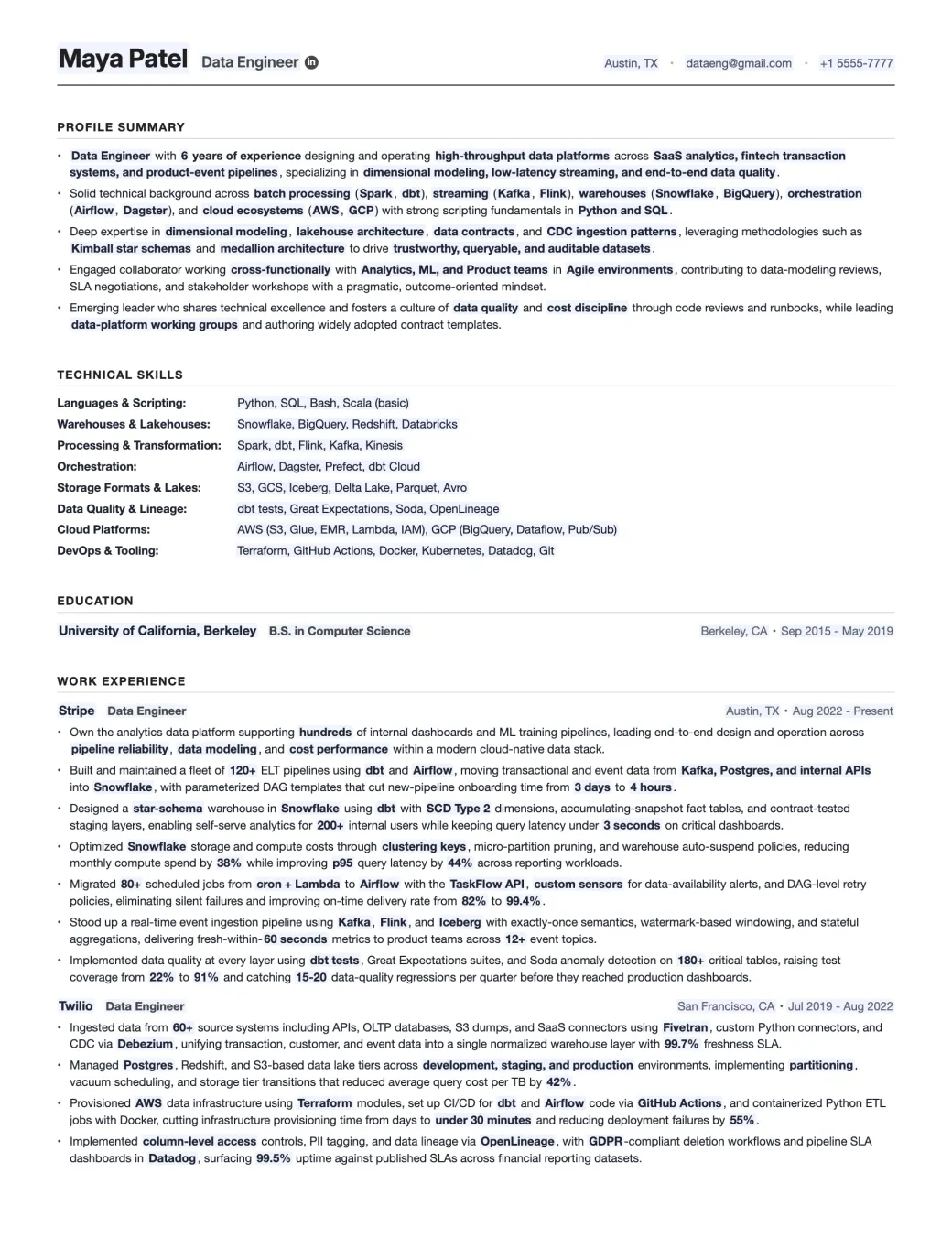
The Data Engineer resume template filled in for a Snowflake, Airflow and Kafka engineer: profile summary, technical skills, education and work experience
Emmanuel Gendre Ex-Google recruiter / Tech resume writer Updated Free, ATS-friendly, no signup

Interactive resume template generator

Interactive Data Engineer Resume Template

Fill in the side panel, then download your resume as a PDF or a Word file.

Edits update live as you type. Toggle Edit to rewrite paper text directly.

Edit mode is on. Click anywhere on the resume to rewrite text. Side-panel placeholders still update live.

Farah Siddiqui Data Engineer

San Francisco, CA • farah.siddiqui@gmail.com • +1 415-555-0163

Profile Summary

  • Data Engineer with 6 years of experience building batch and streaming data platforms for consumer banking and rideshare apps with millions of users, focused on dimensional modeling, change data capture, and data quality.
  • Hands-on with languages (Python, SQL), processing (Apache Spark, dbt), streaming (Apache Kafka, Apache Flink), orchestration and ingestion (Apache Airflow, Fivetran), warehouses and table formats (Snowflake, Apache Iceberg), and cloud and infrastructure (AWS, Terraform), backed by a solid grasp of query plans, distributed systems, and data structures.
  • Strong in star schemas with slowly changing dimensions, incremental ELT, CDC with Debezium, and Iceberg table design, using schema contracts with source teams and freshness SLAs with automated alerts to deliver tables that analysts and ML models can rely on every morning.
  • Works every day with analysts, ML engineers, and the backend teams that own source systems in two-week sprints with a shared on-call rotation, from scoping a new dataset with the people who will query it to the fixes after it ships.
  • Mentors newer engineers on SQL performance and testing dbt models through code review and pairing, leads the monthly data platform design review, and wrote the dbt style guide every new hire on the data team follows.

Technical Skills

Languages:
Python, SQL, Scala, Bash
Processing & Transformation:
Apache Spark, dbt, PySpark, Trino, pandas
Streaming & Messaging:
Apache Kafka, Apache Flink, Debezium, Kafka Connect, Amazon Kinesis
Orchestration & Ingestion:
Apache Airflow, Fivetran, Dagster, Airbyte
Warehouses & Lakehouses:
Snowflake, Apache Iceberg, BigQuery, Delta Lake, PostgreSQL
Cloud & Infrastructure:
AWS, Terraform, Docker, Kubernetes, GitHub Actions
Data Quality & Observability:
dbt tests, Great Expectations, Monte Carlo, OpenLineage, Datadog

Education

University of California, San Diego B.S. in Computer Science
La Jolla, CA • Sep 2016 to Jun 2020

Work Experience

Chime Senior Data Engineer
San Francisco, CA • Sep 2022 to Present
  • Built 140 ELT pipelines with Fivetran and Python connectors that load card transactions, support tickets and partner bank files into Snowflake, with incremental loads and idempotent reruns, cutting the time to add a new source from 2 weeks to 3 days.
  • Designed the member and transactions marts in dbt as a star schema with Type 2 slowly changing dimensions, replacing 310 overlapping SQL views with one model that 180 analysts in finance, risk and growth now query.
  • Moved 85 cron and Lambda jobs onto Airflow with data-aware scheduling, sensors, retries and one-command backfills, raising on-time delivery of the 7am finance tables from 86% to 99.6%.
  • Built change data capture from the transactions Postgres database with Debezium, streamed through Kafka and processed in Flink with exactly-once checkpoints, cutting the lag on fraud model features from 4 hours to 40 seconds.
  • Put Great Expectations checks and Monte Carlo freshness SLAs on 210 critical tables and masked PII columns with tag-based policies, so 93% of data incidents were caught before anyone saw them on a dashboard.
  • Cut monthly Snowflake spend by 34% by clustering the largest fact tables, turning full refreshes into incremental dbt models, and right-sizing warehouses with auto-suspend and per-team cost tags.
  • Moved the data platform to Terraform modules and GitHub Actions pipelines that lint SQL, build dbt models against staging and test Airflow DAGs on every pull request, cutting failed production deploys from 9 a month to 1.
  • Agreed on schema contracts with the payments and card engineering teams that own the source services and ran monthly data reviews with the analytics and ML teams, cutting pipeline breaks from upstream schema changes from 11 a quarter to 2.
Lyft Data Engineer
San Francisco, CA • Jul 2020 to Aug 2022
  • Built PySpark jobs on Amazon EMR that turn 900 million ride events a day into hourly marketplace tables for the pricing team, cutting the nightly batch runtime from 5.5 hours to 1.8 hours.
  • Documented 420 core tables in Amundsen, the company’s data catalog, with owners, descriptions and lineage, which cut data questions in the analytics Slack channel by 35%.
  • Moved driver incentive reporting from nightly Hive jobs to Flink streaming jobs on Kafka, so city operations teams could see incentive spend within 15 minutes instead of the next morning.

Done editing? Download a real PDF (selectable text, ATS-friendly, US Letter) or an editable Word file if a recruiter asks for one.

About this template

A Data Engineer resume template, built by a tech recruiter.

As a data engineer, you build the pipelines behind every report, dashboard and ML model at a company. You pull data from production databases, SaaS tools and event streams, model it in Snowflake or BigQuery, and keep it fresh, tested and cheap to query. Nobody notices you when it works, and everyone notices at 9am when it doesn’t.

Other similar job titles include data platform engineer, ETL developer or database engineer, and the template on this page matches these too.

But how do you set yourself apart from your competition, when every modern Data/Platform Engineer shares the same experience with Python, SQL, Spark, Airflow, dbt, Snowflake, etc.? Well, you need to focus on listing deliverables, describing engineering challenges and showing tangible results. That’s the pipelines you own and the volume they move, the freshness you cut from hours to minutes, the data incidents your tests caught and the cloud bill you brought down.

That’s why every one of the 8 areas data engineering managers check gets its own bullet in this template, with a number in each. You’ll also find 3 data engineer sample resumes below it, and further down, 6 steps to write a Data Engineer resume.

Hearing nothing back from your applications? I’ll give you honest resume feedback for free, the way I read resumes at Google, and tell you what to fix first.

Industry signal

What the market says about Data Engineer roles

If you’re wondering whether data engineering is still a safe bet in 2026, follow the money. IBM closed its roughly $11 billion purchase of Confluent, the company started by Kafka’s creators, in March, and Fivetran and dbt Labs finished their merger in June. The rules keep adding work too: the EU Data Act has applied since September 2025, and the AI Act’s data rules for high-risk systems start applying in December 2027. Every AI project needs clean, governed data first, and that’s your job.

+9% US database architect job growth, 2025 to 2035 US Bureau of Labor Statistics
$136,640 Average base pay, US Data Engineer job ads Indeed
  • Snowflake @Snowflake · Snowflake's official account
    Testing Apache Iceberg™ streaming at 1M+ TPS shouldn’t require building the surrounding infrastructure first. Snowpark Container Services generates the load, Snowpipe Streaming batches it server-side, and Snowflake lands and compacts the Parquet files.
  • Apache Spark @ApacheSpark · Apache Spark project's official account
    Auto CDC arrives in Spark Declarative Pipelines with Apache Spark 4.2: first-class SCD Type 1. Configure how change events update a target table, and Spark handles deletions and out-of-order events, in place of hand-written merge logic.
  • Confluent, an IBM Company @confluentinc · Data streaming platform, now part of IBM
    Batch reports only tell models what has already happened. AI agents need data that moves as fast as they do. Learn how to power agentic projects with real-time data: ibm.co/6011ErswN
  • Andreas Kretz @andreaskayy · Founder, Learn Data Engineering Academy
    🔧 Road to Data Engineering, should be: Stage 1: Python + Github (SW dev basics) Stage 2: SQL & Relational Databases (incl. Modeling) Stage 3: Infrastructure (Servers, Networking basics) Stage 4: Docker (host your python scripts)…

Resume Samples

Data Engineer Resume Examples

What should a data engineer resume look like for 2, 5, or 10 years of experience? It’s a different answer at each level, so I’ve put together 3 data engineer resume samples. I wrote those around common career paths for Data Engineers: a junior who switched from BI reporting to engineering, a senior who runs Kafka and Spark pipelines at DoorDash, and a staff engineer / Principal Engineer who owns a risk data platform in Finance. You can download each of these data engineering CVs as a PDF or a Word file, free and with no signup.

Junior Data Engineer Resume Example

As a junior or entry-level data engineer with up to 2 years of experience, your resume needs pipelines and models you shipped yourself, the tests you wrote to catch bad data, and a fix you measured, like a faster load or a cheaper query.

Years of experience
2 years
Industry
BI software (SaaS)
Stack
dbtSnowflakeApache AirflowPython
Download PDF Download Word

Click to download the Junior Data Engineer resume example as a PDF or a Word file. Free / No signup.

Nadia Hassan

Junior Data Engineer

San Francisco, CA · nadia.hassan@gmail.com · +1 415-555-0124 · linkedin.com/in/nadiahassan

Profile Summary

  • Junior Data Engineer with 2 years building ELT pipelines and dbt models at a BI software company, after 3 years of Looker reporting as a BI analyst at a real estate brokerage.
  • Uses Python and SQL daily, builds models in dbt on Snowflake, loads sources with Fivetran, schedules jobs in Apache Airflow, and ships changes through GitHub Actions and Terraform with senior review.
  • Learning dimensional modeling, incremental loads, and Kafka from senior engineers, and adds dbt tests and row-count checks to every model before merge, so bad numbers stay off revenue dashboards.
  • Sits on a 4-person data team serving finance, sales ops, and product analysts, joins weekly intake to scope new requests, and takes a monthly turn on Airflow on-call.
  • Wrote the team’s Airflow failure runbook, coaches 3 analysts through their first dbt models in pairing sessions, and is booked for the SnowPro Core exam in January 2027.

Technical Skills

Languages:
Python, SQL, Bash
Processing & Transformation:
dbt Core, pandas, Polars, LookML, PySpark (basics)
Streaming & Messaging:
Apache Kafka, Kafka Connect, Snowpipe Streaming
Orchestration & Ingestion:
Apache Airflow, Fivetran, Segment
Warehouses & Lakehouses:
Snowflake, PostgreSQL, Apache Parquet
Cloud & Infrastructure:
AWS (S3, IAM, Lambda), Terraform, Docker, GitHub Actions
Data Quality & Observability:
dbt tests, Great Expectations, Elementary, SQLFluff, Datadog
Page 2 of 2

Work Experience

Sigma Computing Junior Data Engineer San Francisco, CA · Oct 2024 to Present
  • Built Python loaders for the internal billing and licensing APIs next to Fivetran syncs for Salesforce and Zendesk, with incremental pulls and duplicate-safe reruns, bringing 14 sources into Snowflake.
  • Split the nightly Airflow refresh into per-source DAGs with sensors, retries, and Slack alerts, so stale sales dashboards at 8am dropped from 6 mornings a month to 1.
  • Paired with a senior engineer to move product usage events from hourly S3 loads to Kafka Connect and Snowpipe Streaming, cutting table lag from 70 minutes to 4.
  • Rewrote the slowest dbt models in the product usage project as incremental merges clustered on event date, which cut their nightly Snowflake credit use by 43%.
  • Set up GitHub Actions jobs that lint SQL with SQLFluff and build only changed dbt models in a dev schema, catching 31 broken models before merge in the first quarter.
Compass BI Analyst San Francisco, CA · Jul 2021 to Sep 2024
  • Modeled closed deals, agents, and offices as a dbt star schema in Snowflake for commission reporting, cutting the monthly agent payout close from 3 days to 6 hours.
  • Added dbt tests for duplicates and nulls on the listings models, plus row-count checks against the MLS feeds, which caught 38 bad loads before agents saw them in Looker.
  • Met biweekly with brokerage ops managers to turn report requests into tickets with agreed metric definitions, and documented each field in LookML, cutting duplicate dashboard requests by 41%.

Education

DataTalks.Club Data Engineering Zoomcamp (certificate) Online · Jan 2024 to Apr 2024
University of California, Davis B.S. in Statistics Davis, CA · Sep 2017 to Jun 2021

Senior Data Engineer Resume Example

A senior data engineer resume has to show pipelines you own end to end at real volume, the freshness and cost numbers you improved, and design decisions that other engineers on your team now follow.

Years of experience
7 years
Industry
Food delivery marketplace
Stack
Apache KafkaApache FlinkApache SparkDatabricks
Download PDF Download Word

Click to download the Senior Data Engineer resume example as a PDF or a Word file. Free / No signup.

Pedro Alves

Senior Data Engineer

Sunnyvale, CA · pedro.alves@gmail.com · +1 408-555-0172 · linkedin.com/in/pedroalves

Profile Summary

  • Senior Data Engineer with 7 years on delivery marketplace data at DoorDash and Instacart, owning Kafka and Flink streams, CDC ingestion, and Spark batch jobs behind Dasher pay, ETAs, and merchant menus.
  • Writes Python, Scala, and SQL, processes data in Apache Spark, Flink, and dbt, streams with Kafka and Debezium, schedules in Airflow, and lands tables in Delta Lake and Snowflake on AWS.
  • Specializes in event-time processing with watermarks, CDC merges into Delta tables, and Spark job tuning, and checks each change against freshness SLAs and cost per run before it ships to production.
  • Works with ETA model engineers, logistics analysts, and the service teams that own source databases, shares the data platform on-call rotation, and writes a design doc before any new pipeline.
  • Mentors 3 mid-level engineers in weekly pairing sessions, sits on the logistics data hiring loop, and wrote the Flink backfill playbook the team follows after outages.

Technical Skills

Languages:
Python, SQL, Scala, Bash
Processing & Transformation:
Apache Spark, PySpark, dbt, Trino, Polars
Streaming & Messaging:
Apache Kafka, Apache Flink, Debezium, Kafka Connect, Confluent Schema Registry, Protobuf
Orchestration & Ingestion:
Apache Airflow, Fivetran, AWS Step Functions
Warehouses & Lakehouses:
Databricks, Delta Lake, Snowflake, PostgreSQL, Apache Parquet
Cloud & Infrastructure:
AWS (S3, EKS, MSK, IAM), Terraform, Docker, Kubernetes, GitHub Actions
Data Quality & Observability:
Monte Carlo, Great Expectations, dbt tests, Datadog, PagerDuty
Page 2 of 2

Work Experience

DoorDash Senior Software Engineer, Data Engineering Sunnyvale, CA · Jul 2022 to Present
  • Built a Flink job on Kafka that joins order and Dasher location events into ETA model features with watermarks for late data, cutting feature lag from 15 minutes to 22 seconds.
  • Swapped nightly Postgres dumps of menu and store-hours data for Debezium CDC merged into Delta Lake, so menu edits reach the search tables in 6 minutes instead of the next day.
  • Tuned the daily Dasher earnings jobs in Apache Spark on Databricks with Z-ordered Delta tables, broadcast joins, and right-sized job clusters, cutting their compute spend by $37,400 a month.
  • Added Monte Carlo freshness and volume monitors on the merchant payout tables, each paging the owning team, so finance now reports 78% fewer payout data issues.
  • Wrote the Protobuf event contract template that 11 logistics teams now use for new Kafka topics, working out field ownership with ML and analytics leads in a monthly design review.
Instacart Data Engineer San Francisco, CA · Jul 2019 to Jun 2022
  • Split the single SQL script behind the fulfillment dashboards into dbt staging, intermediate, and mart models on Snowflake, with snapshots for store fee history, cutting dashboard load times by 58%.
  • Rebuilt the shopper supply Airflow DAGs with cross-DAG sensors and idempotent, date-partitioned tasks, so only affected partitions rerun after a late load, cutting manual reruns from 30 a month to 4.
  • Moved the team’s Python jobs into Docker images on Kubernetes, with Terraform-built staging and production environments and CI tests on every pull request, cutting deploy rollbacks by 64%.

Education

University of Illinois Urbana-Champaign B.S. in Computer Science Urbana, IL · Aug 2015 to May 2019

Staff Data Engineer Resume Example

Staff data engineers get hired on decisions that affect the whole platform, so your resume should show the architecture you set for several teams, the reliability and cost numbers you answer for, and the people you’ve mentored.

Years of experience
11 years
Industry
Banking (consumer and commercial)
Stack
BigQueryGoogle CloudApache SparkTerraform
Download PDF Download Word

Click to download the Staff Data Engineer resume example as a PDF or a Word file. Free / No signup.

Ji-Won Park

Staff Data Engineer

Charlotte, NC · jiwon.park@gmail.com · +1 704-555-0149 · linkedin.com/in/jiwonpark

Profile Summary

  • Staff-level Data Engineer with 11 years at Wells Fargo and American Express, leading the risk data platform behind regulatory reporting for credit, market, and liquidity risk under BCBS 239 and SOX.
  • Chooses the platform stack across languages (Python, Scala, SQL), processing (Apache Spark on Dataproc, dbt), storage (BigQuery, Apache Iceberg), streaming (Kafka), orchestration (Airflow on Cloud Composer), and infrastructure (Terraform).
  • Expert in risk data aggregation, column-level lineage, and migrations off Teradata and Hadoop, tying every critical data element to an owner, a quality check, and a control that auditors can test.
  • Partners with risk reporting, finance, and compliance leaders and internal audit on what the platform must prove, briefs the technology risk committee every quarter, and reviews designs across 6 data engineering teams.
  • Grew 4 senior engineers into lead roles, wrote the data platform engineering standards and ADR template used across risk technology, and sits on the principal engineer promotion panel for data.

Technical Skills

Languages:
Python, SQL, Scala, Java, Bash
Processing & Transformation:
Apache Spark (Dataproc), PySpark, dbt, Apache Beam, Trino
Streaming & Messaging:
Apache Kafka, Spark Structured Streaming, Google Cloud Pub/Sub, Avro, Schema Registry
Orchestration & Ingestion:
Apache Airflow (Cloud Composer), Control-M, Informatica PowerCenter, Datastream
Warehouses & Lakehouses:
BigQuery, Apache Iceberg, BigLake, Teradata, Hadoop (Hive, HDFS), Apache Parquet
Cloud & Infrastructure:
Google Cloud, Microsoft Azure, Terraform, Kubernetes (GKE), Docker, Jenkins
Data Quality & Observability:
OpenLineage, DataHub, Great Expectations, dbt tests, Dataplex, Datadog
Page 2 of 2

Work Experience

Wells Fargo Principal Engineer Charlotte, NC · Mar 2021 to Present
  • Led the move of 1,140 risk feeds from Teradata and Hadoop to BigQuery on Google Cloud, running both stacks in parallel with row-level reconciliation, and missed no regulatory filing dates during cutover.
  • Designed a shared risk data model on Apache Iceberg with conformed counterparty, product, and legal-entity dimensions as the one source for FR Y-14 and FR 2052a reporting, cutting reconciliation breaks by 81%.
  • Built column-level lineage in OpenLineage and DataHub from source feeds to each line item in the regulatory reports, cutting internal audit findings against BCBS 239 from 17 to 3.
  • Partitioned and clustered the largest position tables in BigQuery and moved each risk team onto its own slot reservation with a monthly cost report, saving $2.3M a year in compute.
  • Started a monthly data contract review where source-system owners, risk reporting, and compliance agree on schemas, quality thresholds, and SOX control owners, with 52 contracts signed so far.
American Express Senior Data Engineer Phoenix, AZ · Jul 2015 to Feb 2021
  • Built Kafka and Spark Structured Streaming jobs that turn card authorization events into real-time spend alerts in the Amex app, with p99 delivery under 2 seconds during holiday peaks.
  • Replaced Control-M schedules with Apache Airflow DAGs for merchant reporting, adding sensors on upstream files and SLA alerts, which cut missed file deadlines from 11 a quarter to 1.
  • Wrote Terraform modules and Jenkins pipelines so data engineers could create Kafka topics, storage paths, and service accounts by pull request, cutting the wait for each from 3 weeks to 2 days.

Education

Virginia Tech B.S. in Computer Science Blacksburg, VA · Aug 2011 to May 2015

Free resume review

A recruiter screen, but with feedback

You applied to hundreds of jobs: no result. Companies won’t give you feedback, so you’re stuck in a loop. Rejections will keep coming until you know what’s wrong.

Let’s break this cycle today!

I’ll screen your resume the same way I did at Google.

You’ll get:

  • Your resume sections and content scored.
  • A clear list of what to improve, why, and how.
  • Behind the scenes secrets on the screening process.

How I rewrite Data Engineer resumes

How to write a Data Engineer resume

Emmanuel Gendre, ex-Google recruiter

Emmanuel Gendre Ex-Google recruiter, tech resume writer

Recruiting was my job for 13 years, much of it at Google, before I switched to writing resumes. I’ve read more data engineer resumes than I can count since then, and most make the same mistake: they list tools and skip the outcome. A line like “Built ETL pipelines in Airflow” tells me you showed up. It doesn’t tell me what broke less, ran faster or cost less after you got there.

In my tech resume writing service, I rewrite every bullet until it proves a result someone at the company would care about. If you’re doing it yourself, though, focus on these 6 steps. They follow the order I work in, from the layout down to the keywords and numbers.

  1. Step 1 Format & layout One column and plain section names, so the ATS reads every line. Go to step 1
  2. Step 2 Profile Summary 5 bullets that show your seniority, your stack and the data you work with. Go to step 2
  3. Step 3 Work Experience Your current job, one bullet per area of the data engineer role profile. Go to step 3
  4. Step 4 Bullet Points How I grow a plain pipeline task into a bullet with a number. Go to step 4
  5. Step 5 Technical Skills Your stack in 7 categories, the must-have tools and 5 soft skills. Go to step 5
  6. Step 6 Keywords & Metrics The keywords data engineering postings repeat, and the numbers that prove your bullets. Go to step 6

Step 1 · Format & Layout

Data Engineer resume format and layout

We’ll start with the layout, because it’s the one thing you can fix in an afternoon. A data engineer resume gets read by software first and a person second, and a fancy layout can throw off both of them.

01ATS Compliance

ATS compliance for your Data Engineer resume

When you apply, an Applicant Tracking System (ATS) reads your resume before anyone else does. It splits the file into fields (employer, title, dates, skills), and recruiters then search those fields for terms like Snowflake or Airflow. If your layout confuses the parser, those terms land in the wrong field or don’t show up at all. I go deeper in my guide to how ATS software reads and sorts a resume. On a data engineer resume, all of that comes down to 3 rules:

The 3 rules
  1. Use a 100% text based format (no Canva!)

  2. Avoid tables, pictures, and complex structures.

  3. Use the most predictable section names, like “Profile Summary” and “Work Experience”

02Design & Layout

Data Engineer resume design and layout

I know the temptation to make your resume look like a dashboard, with skill bars, two columns and a dark sidebar. Don’t. After years on the recruiting side, I can tell you that recruiters hate fancy designs. They want your title, employer and dates in the same place as on the last 50 resumes they read, and anything clever just slows them down.

So keep it boring, with one column, black text and a standard font. Put your GitHub link in the header if you have pipeline code worth showing. Hiring managers do click those. Every spec below is already built into the template above, so you only need them if you’re starting from a blank Word or Google Doc.

Layout Spec
Columns
One. No sidebars, tables, columns, pictures or tabs.
Margins
0.7 in on all four sides
Body size
10 to 11 pt
Type
One family, weight for hierarchy
Length
One page under 5 years, two after
Section order
Summary, Skills, Experience, Education
PDF

03File Format

Resume file format for your Data Engineer resume

PDF is the right file for almost every data engineering application. Your layout stays put on any screen, the ATS reads the text fine, and no one can change a word without you knowing. Recruiting agencies sometimes want an editable copy to put their logo on, and that’s when you send the Word version. My guide to choosing the right resume file format covers the other options.

Format Guide
PDF
Your default. Layout holds, text stays selectable.
Word (.docx)
When the posting or a recruiter asks for it. Use the Word download above.
Plain text
For portals that make you paste into a box
Never
Images, scans, password-protected PDFs, shared-drive links
File name
Farah-Siddiqui-Data-Engineer.pdf

Step 2 · Profile Summary

Data Engineer profile summary

The profile summary sits right under your name: 5 bullets that replace the old objective statement. And yes, juniors need one too. The first screen is quick (my article on how recruiters screen your resume explains it), and in those few seconds, the summary is often all a recruiter reads.

For a data engineer, those bullets have to tell a recruiter 3 things quickly: how much data you handle, which stack you run it on, and whether the teams downstream can trust what you’ve built. Each bullet below has one job. For the full method, see my guide to writing a resume profile summary.

  1. 1

    Title, years and scope

    Your target title, your years in data engineering and the kind of platform you run (batch, streaming, lakehouse), plus the industry. If you’ve worked somewhere known for its data, like a big marketplace or a bank, this is where it goes.

  2. 2

    Your stack

    Your tools, grouped the way the job posting groups them: languages, processing, streaming, orchestration, warehouses and cloud. Recruiters hold this bullet up against the requirements list, so use the posting’s own tool names.

  3. 3

    Domain expertise

    The areas you’re strongest in and the methods behind them, like dimensional modeling, change data capture or data contracts. Hiring managers read this line to check you’ve done the hard parts of the job, not just the tutorials.

  4. 4

    Collaboration

    Who uses your data and how you work with them: analysts, ML engineers, finance, and the backend teams that own the source systems. Mention your cadence too, like sprints and an on-call rotation, because teams hire people who fit their rhythm.

  5. 5

    Leadership

    What you’ve given the team beyond your own pipelines, like a dbt style guide, runbooks, design reviews or the juniors you’ve trained. You don’t need direct reports. It tells a hiring manager you make other engineers better too.

Data Engineer resume summary example, from the template above
  • Data Engineer with 6 years of experience building batch and streaming data platforms for consumer banking and rideshare apps with millions of users, focused on dimensional modeling, change data capture, and data quality.
  • Hands-on with languages (Python, SQL), processing (Apache Spark, dbt), streaming (Apache Kafka, Apache Flink), orchestration and ingestion (Apache Airflow, Fivetran), warehouses and table formats (Snowflake, Apache Iceberg), and cloud and infrastructure (AWS, Terraform), backed by a solid grasp of query plans, distributed systems, and data structures.
  • Strong in star schemas with slowly changing dimensions, incremental ELT, CDC with Debezium, and Iceberg table design, using schema contracts with source teams and freshness SLAs with automated alerts to deliver tables that analysts and ML models can rely on every morning.
  • Works every day with analysts, ML engineers, and the backend teams that own source systems in two-week sprints with a shared on-call rotation, from scoping a new dataset with the people who will query it to the fixes after it ships.
  • Mentors newer engineers on SQL performance and testing dbt models through code review and pairing, leads the monthly data platform design review, and wrote the dbt style guide every new hire on the data team follows.

Step 3 · Work Experience

Data Engineer work experience

Once your summary gets you past the quick screen, the recruiter reads your jobs, newest first. I’d say 95% of the decision is made on your current role, and that’s logical: the work you’re doing right now is the work they’re hiring you to do.

So your current job should cover all 8 areas of the Data Engineer role profile, one bullet each. Hiring managers use that list as a checklist when they read data engineering resumes, and a missing area (say, no streaming or no data quality) is a question you won’t get to answer. The template above already has one bullet ready per area.

Data Engineer role profile
  1. Data Ingestion & ELT Pipelines

    You move data from source systems into the warehouse without losing a row. When a load half-fails at 2am, finance doesn’t have the right numbers at 9, so hiring managers want pipelines you can rerun safely. Show how you used incremental loads and Fivetran or Spark to add new sources quickly and keep every load complete.

    Techniques
    incremental loads, idempotent reruns, schema evolution, backfills
    Tools
    Fivetran, Airbyte, Apache Spark, Python
    Metrics
    sources onboarded, rows loaded per day, failed loads
  2. Data Modeling & Warehouse Design

    You design the tables analysts actually query, with a grain that makes sense. Bad models get copied into dozens of dashboards, and they’re expensive to unwind, so modeling comes up in almost every interview loop. Explain how you used dimensional modeling and dbt to replace messy views with marts people trust.

    Techniques
    star schemas, slowly changing dimensions, dbt staging and marts, Iceberg tables
    Tools
    dbt, Snowflake, BigQuery, Databricks
    Metrics
    tables modeled, views retired, analysts served
  3. Workflow Orchestration & Scheduling

    You schedule hundreds of jobs and make sure they run in the right order. When a DAG fails quietly, every report downstream is wrong and nobody knows it’s wrong, so teams want retries and alerts built in from day one. Walk them through how you used Airflow sensors and backfills to keep delivery on time.

    Techniques
    DAG design, sensors, retries, backfills, SLA alerts
    Tools
    Apache Airflow, Dagster, Prefect
    Metrics
    on-time delivery, failed runs, backfill time
  4. Streaming & Change Data Capture

    You process events and database changes within seconds of them happening. Fraud checks, pricing and live dashboards can’t wait for a nightly batch, and most senior postings I read ask for streaming. Describe how you used Kafka and Debezium CDC to cut latency from hours to seconds without double-counting.

    Techniques
    change data capture, windowed aggregations, exactly-once delivery
    Tools
    Apache Kafka, Debezium, Apache Flink, Amazon Kinesis
    Metrics
    end-to-end latency, events per second, consumer lag
  5. Data Reliability & Governance

    You catch bad data early and keep sensitive data locked down. One wrong revenue number in a board deck can cost a data team months of trust, and a PII leak is a legal problem. Point out how you used dbt tests and masking policies to catch incidents early and clear audits.

    Techniques
    schema and freshness tests, anomaly alerts, lineage, PII masking
    Tools
    dbt tests, Great Expectations, Monte Carlo, OpenLineage
    Metrics
    test coverage, incidents caught early, time to detect
  6. Query Performance & Cost Control

    You cut query times and keep the Snowflake bill from growing every month. Warehouse spend is one of the biggest lines in most data budgets, and finance watches it, so a dollar figure gets a hiring manager’s attention fast. Mention how you used clustering and incremental models to bring runtime and monthly spend down.

    Techniques
    partitioning and clustering, incremental models, warehouse sizing, Spark tuning
    Tools
    Snowflake Query Profile, Spark UI, dbt
    Metrics
    monthly spend, query time, cost per TB
  7. Data Infrastructure & CI/CD

    You run the data platform as code instead of clicking around a console. Hand-built environments drift apart until a Friday deploy breaks production, and managers don’t forget who fixed that. Tell them how you used Terraform and GitHub Actions to test every change before it reached production.

    Techniques
    infrastructure as code, CI for dbt and Airflow, separate environments
    Tools
    Terraform, GitHub Actions, Docker, Kubernetes
    Metrics
    deploy frequency, failed deploys, setup time
  8. Data Contracts & Cross-Team Delivery

    You agree on what each team needs from the data, in writing. You sit between the teams that produce data and the ones that use it, and hiring managers want to know both sides trust you. Let them know how you used schema contracts and data reviews to stop upstream changes from breaking pipelines.

    Techniques
    schema contracts, data reviews, request intake, code review
    Tools
    Jira, Confluence, dbt docs, DataHub
    Metrics
    teams served, schema breaks, request turnaround

Coming from analytics or backend work? Lead your current job with the data work you already do there, like dbt models or event pipelines. That’s often enough to get a first data engineering interview.

Submit your resume for a free review!

Step 4 · Bullet Points

Data Engineer resume bullet points

A recruiter decides whether you’re senior enough mostly from your bullets, so this is the step to take slowly. I write them with a method I call the Level System. It’s my take on the XYZ formula Google teaches, adjusted for technical resumes, and my guide to writing strong resume bullet points covers it in full.

Each of the 5 levels asks you one question about the work, and your answer becomes a new layer in the same sentence. For data engineers, the last layer is usually freshness, volume, reliability or cost. Here’s a single pipeline bullet growing from Level 1 to Level 5.

  1. Level 1Task

    What did I work on? Start with one pipeline or migration you owned end to end. On its own, it could be anyone’s bullet.

    Migrated the month-end finance pipeline.

  2. Level 2+ Techniques

    How did I do it? Add the techniques. They’re the engineering calls a hiring manager wants to see, like loading incrementally instead of reloading everything.

    Migrated the month-end finance pipeline, adding incremental loads and reconciliation checks.

  3. Level 3+ Tools

    What tools did I use? Add the real tool names, written the way postings write them. Recruiters search for dbt and Snowflake, not “modern data tools”.

    Migrated the month-end finance pipeline for 25 analysts from Redshift stored procedures to dbt models on Snowflake, adding incremental loads and reconciliation checks.

  4. Level 4+ Method

    What method did I follow? Mention the standard or pattern you worked to. Most data engineers don’t, and it shows how you think about reliability.

    Migrated the month-end finance pipeline for 25 analysts from Redshift stored procedures to dbt models on Snowflake, adding incremental loads and reconciliation checks, with a parallel run against the old system for 2 closes.

  5. Level 5+ Metric

    What was the result? Finish on one number the business already tracks, like freshness or cost. That’s what makes a hiring manager believe the rest.

    Migrated the month-end finance pipeline for 25 analysts from Redshift stored procedures to dbt models on Snowflake, adding incremental loads and reconciliation checks, with a parallel run against the old system for 2 closes, and cut the wait for close numbers from 3 days to 4 hours.

    1. 01 Task What you worked on
    2. 02 Techniques How you did it
    3. 03 Tools The stack you used
    4. 04 Method The method you followed
    5. 05 Metric The result, one number

Most of your numbers are already sitting in tools you’ve got open every day. Airflow’s run history, Snowflake’s query and cost views, your Monte Carlo incidents and the cloud invoice cover almost everything above. You just have to go and look.

Step 5 · Technical Skills

Data Engineer resume skills

Every data engineer job needs SQL and Python first. After that, most postings ask for Spark and dbt to process and model data, Kafka for streaming, Airflow to schedule it all, and a cloud warehouse like Snowflake or BigQuery. When you write a resume for data engineer roles, copy each tool name exactly as the posting spells it (Apache Airflow, not “Airflow scheduler”), because the ATS and recruiters search this section by keyword.

A skill only earns its spot if a bullet proves it. List Flink here and a hiring manager will look for the streaming job you built with it, so cut anything you couldn’t talk about in an interview. Next come my 7 categories, a filled-in skills section and 5 soft skills I check for. Keywords get their own step next.

The 7 skill categories for a Data Engineer resume

The starred tools show up in most data engineering postings I read, so put them first in each row. Used both Snowflake and BigQuery? Lead with the one the job asks for.

Languages

Python and SQL do almost all the work. Add Scala or Java only if you maintain code in them.

PythonSQLScalaJavaBash

Processing & Transformation

Your batch engine and your transformation layer, usually Spark with dbt, plus the query engines you use day to day.

Apache SparkdbtPySparkApache BeamTrinopandasPolars

Streaming & Messaging

Your event backbone and your stream processor, plus the CDC tooling if you capture database changes.

Apache KafkaApache FlinkDebeziumKafka ConnectAmazon KinesisGoogle Cloud Pub/SubSpark Structured Streaming

Orchestration & Ingestion

What schedules your jobs and what loads your sources. Postings often ask for Airflow and Fivetran by name.

Apache AirflowFivetranDagsterPrefectAirbyteAWS Step Functions

Warehouses & Lakehouses

Where the data lands: your warehouse, your open table format and the operational databases you load from.

SnowflakeBigQueryDatabricksAmazon RedshiftApache IcebergDelta LakePostgreSQLApache Parquet

Cloud & Infrastructure

The cloud you deploy on and the tools that keep the platform reproducible, like Terraform and Docker.

AWSTerraformGoogle CloudMicrosoft AzureDockerKubernetesGitHub Actions

Data Quality & Observability

How you test data, watch freshness and trace lineage when a number on a dashboard looks wrong.

dbt testsGreat ExpectationsMonte CarloSodaOpenLineageDataHubDatadog

A finished Data Engineer skills section

Technical Skills sample, from the template above
Languages
Python, SQL, Scala, Bash
Processing & Transformation
Apache Spark, dbt, PySpark, Trino, pandas
Streaming & Messaging
Apache Kafka, Apache Flink, Debezium, Kafka Connect, Amazon Kinesis
Orchestration & Ingestion
Apache Airflow, Fivetran, Dagster, Airbyte
Warehouses & Lakehouses
Snowflake, Apache Iceberg, BigQuery, Delta Lake, PostgreSQL
Cloud & Infrastructure
AWS, Terraform, Docker, Kubernetes, GitHub Actions
Data Quality & Observability
dbt tests, Great Expectations, Monte Carlo, OpenLineage, Datadog

Soft skills for a Data Engineer resume

Writing “strong communicator” in a skills row doesn’t prove anything. A bullet where you actually did it does. Here are 5 soft skills I look for in data engineers, with a bullet for each.

  • Warning downstream teams about bad data before they find it

    Resume bulletStarted posting failed-load warnings to analysts before the morning stand-up, which cut “is this number right?” tickets by 60%.

  • Pushing back on a real-time request when hourly data would do

    Resume bulletShowed product that hourly refreshes met their dashboard needs, which saved a streaming build estimated at 3 months of engineering time.

  • Agreeing on a schema contract with the team that owns the source

    Resume bulletAgreed on a schema contract with the growth team before they rebuilt event tracking, so none of the 46 downstream models broke at launch.

  • Explaining warehouse costs to finance in plain numbers

    Resume bulletTurned the Snowflake bill into a one-page cost-per-team report for finance, which got 4 teams to drop unused scheduled queries.

  • Writing postmortems that fix the process instead of blaming a person

    Resume bulletWrote blameless postmortems for every major data incident, and their follow-up fixes cut repeat incidents by 70% in a year.

Step 6 · Keywords & Metrics

Data Engineer resume keywords and metrics

I check 2 things on every data engineer resume before it goes out. The first is keywords, because the ATS compares your resume with the posting and recruiters search by tool name. The second is metrics, the numbers that turn “improved pipeline reliability” into a claim a hiring manager won’t question.

Below, you’ll find the data engineering keywords I see most, ranked in 3 tiers, then a keyword finder where you can paste any job description. After that comes a table of 24 metrics, 3 for each of the 8 areas from Step 3, with an example bullet next to each one.

+42%

Data Engineer resume keywords, ranked

These are the data engineer ATS keywords I see most in job postings, ranked in 3 tiers. Tap one to read a line a real posting might use for it. Postings rarely word the same skill the same way twice.

Must-have

8

Put each one in your summary, in a bullet and in your skills section.

In a job description“Advanced SQL, including window functions and query tuning on a cloud warehouse”

Strong supporting

8

Add the ones that are true for you. They often decide between 2 close candidates.

In a job description“Build real-time pipelines on Kafka or a similar streaming platform”

Bonus

7

Worth a mention when you have them, usually in your skills section or one bullet.

In a job description“Experience with stream processing in Flink or Spark Structured Streaming”

Extract Data Engineer keywords from a job description

Paste a data engineer, data platform engineer or ETL developer posting into the box, and the finder sorts the tools it asks for by tier. Do it for 3 to 5 postings you like: the keywords that keep coming back are the ones your resume needs.

Must-have
Put these in your skills section and back each one with a bullet.
Strong supporting
Add the ones you’ve actually worked with. Skip the rest.

Nothing is uploaded: it all happens in your browser.

Metrics for a Data Engineer resume

For each area of the data engineer role profile, here are 3 metrics and a bullet that uses one. One metric per bullet is plenty.

MetricExample bullet
Ingestion & ELT
Sources integrated Count Source systems your pipelines load into the warehouse or lake.Brought 38 source systems into Snowflake through Fivetran and custom connectors, from the core ledger to partner bank SFTP files.
Data volume loaded Count Rows or terabytes your pipelines move per day.Loaded 1.4 TB a day into the lake with incremental Spark jobs instead of full nightly extracts.
New source lead time Time Time from a request for a new source to its first reliable load.Cut the lead time for a new data source from 10 days to 2 with a templated connector and a standard dbt staging layer.
Data Modeling
Tables modeled Count Fact and dimension tables you designed and own in the warehouse.Designed and own 64 fact and dimension tables in the dbt project behind finance and risk reporting.
Legacy views retired Count Old SQL views or duplicate tables replaced by a shared model.Retired 270 duplicate SQL views by moving 4 teams onto one shared customer dimension.
Mart adoption Percent Share of dashboards reading from your models instead of raw tables.Moved 85% of Looker dashboards off raw tables and onto modeled marts within a year.
Orchestration
On-time delivery Percent Share of scheduled datasets ready before their deadline.Raised on-time delivery of the daily finance tables from 91% to 99.7% with retries, sensors and SLA alerts in Airflow.
DAGs in production Count Scheduled workflows you built or maintain.Run 240 Airflow DAGs with about 6,000 task runs a day across dev, staging and production.
Backfill time Time Time to reprocess historical data after a fix or a new column.Cut a 2-year backfill of the payments mart from 4 days to 7 hours with partitioned, parallel Airflow runs.
Streaming & CDC
End-to-end latency Time Time from a change in the source to a row you can query.Brought source-to-warehouse latency from 6 hours to under a minute with Debezium CDC into Kafka.
Events per second Count Peak throughput your streaming jobs handle without falling behind.Scaled the Flink card-events job to 52,000 events per second at peak with no consumer lag alerts.
Consumer lag Time How far a stream consumer runs behind the newest event.Kept p99 consumer lag under 5 seconds through holiday peaks by repartitioning the busiest Kafka topics.
Reliability & Governance
Test coverage Percent Share of critical tables with automated tests.Raised test coverage on critical tables from 38% to 95% with dbt tests and Great Expectations suites.
Incidents caught upstream Count Data issues your checks caught before a stakeholder reported them.Caught 27 of 31 data incidents last year through Monte Carlo alerts, before any stakeholder reported them.
PII columns protected Count Sensitive columns tagged and masked in the warehouse.Tagged and masked 1,140 PII columns across Snowflake with tag-based policies ahead of a SOC 2 audit.
Performance & Cost
Warehouse spend Money Monthly compute bill for your warehouse or platform.Cut monthly Snowflake spend from $142K to $94K with clustering, auto-suspend and incremental models.
Query time Time How long key dashboard queries take to return.Brought p95 query time on the top 20 finance dashboards from 38 seconds to 4.
Cost per TB processed Money Compute cost of processing one terabyte in your batch jobs.Cut Spark cost per TB processed by 41% by moving batch jobs to spot instances on EMR.
Infrastructure & CI/CD
Deploy frequency Frequency How often data platform changes reach production.Took dbt and Airflow releases from once a week to 6 times a day with GitHub Actions and staging builds.
Rolled-back releases Percent Share of releases that break production or get rolled back.Cut rolled-back data releases from 14% to 2% by building dbt models against a production clone in CI.
Environment setup time Time Time to stand up a new environment for the data platform.Cut setup of a new data environment from 3 days to 25 minutes with reusable Terraform modules.
Contracts & Delivery
Teams served Count Teams that build on your datasets.Serve 14 analytics and ML teams from one documented set of marts.
Contracts in place Count Source tables covered by an agreed schema contract.Put schema contracts in place for 23 source tables with the 4 backend teams that own them.
Request turnaround Time Time from a data request to a dataset in production.Cut turnaround on new dataset requests from 3 weeks to 6 days with a standard intake form and dbt scaffolding.

What if you don’t have exact numbers?

  • 1

    Look in your own tools first. Airflow’s run history, your warehouse’s query and billing views and your dbt test results hold most of the numbers you need. Your incident channel has the rest.

  • 2

    Estimate, then round down. “About 120 pipelines” or “roughly 2 TB a day” is fine on a resume if you’re ready to explain in an interview how you got the number.

  • 3

    Use scale when there’s no result. Say how many tables you own, how many teams read from them, or how many rows move through your pipelines each day.

Free resume review

A recruiter screen, but with feedback

You applied to hundreds of jobs: no result. Companies won’t give you feedback, so you’re stuck in a loop. Rejections will keep coming until you know what’s wrong.

Let’s break this cycle today!

I’ll screen your resume the same way I did at Google.

You’ll get:

  • Your resume sections and content scored.
  • A clear list of what to improve, why, and how.
  • Behind the scenes secrets on the screening process.

Frequently asked

Data Engineer resume FAQ

Yes, completely. There’s no account and no email to enter. Edit the fields, download your resume in PDF or Word, and come back to change it whenever you want.

Yes. Click Word in the toolbar for an editable .docx version. You can also get each of the junior, senior and staff examples above as a Word file. I’d still apply with the PDF and save the Word file for recruiters who request it.

Yes. In US tech hiring, a CV and a resume are the same thing, so this data engineer CV template is the file to send when a posting asks for a CV. Outside the US, recruiters read the same sections in the same order, so you won’t need a different layout.

Yes. The layout is one column, the section names are the standard ones, and the PDF holds real text, which is what applicant tracking systems read best. You can test your own file with my free ATS resume checker.

On the first screen, roughly. A 2018 Ladders eye-tracking study measured an average of 7.4 seconds for that first look. That’s why your title, current job and stack belong at the top. If they match the posting, the recruiter reads the rest properly in a second, slower round.

Under 5 years in data engineering, aim for one page. Past that, a second page is fine if every bullet earns its place with a pipeline, a model or a result. No recruiter rejects you for 2 pages. Filler is what gets skipped.

Put SQL in your Languages row, then prove it in your bullets with work only strong SQL makes possible: window functions on a billion-row table, a query you tuned from minutes to seconds, an incremental dbt model. A bare “SQL” line tells a recruiter nothing, because every data engineering resume has one.

Write the cloud’s own service names, not just the cloud. On AWS that’s S3, Glue, EMR and Redshift. On Azure it’s Data Factory, Fabric and Synapse, and on Google Cloud it’s BigQuery, Dataflow and Pub/Sub. Add that cloud’s data engineering certification if you have it: AWS Certified Data Engineer Associate, Microsoft’s Fabric Data Engineer Associate (it replaced DP-203 in March 2025) or Google Cloud Professional Data Engineer. Databricks and SnowPro certifications work the same way for those platforms. My cloud engineer resume template covers the infrastructure side.

Make 1 or 2 projects do the work of a job. Build a pipeline end to end (load a public dataset, model it in dbt, schedule it in Airflow, add tests), put it on GitHub with a short README, and write bullets with real numbers like row counts and runtimes. On an entry level data engineer resume, Education goes above Work Experience until you have a year or two of data work, with your degree, any bootcamp and 2 or 3 relevant classes. The junior example above came over from BI work, and that’s a common way in.

A data analyst resume is about the questions you answered and the decisions they changed (see my data analyst resume template). Yours is about the pipelines and models behind those answers. An ML engineer resume or an AI engineer resume goes deeper on training and serving models, so if you build feature pipelines, keep that to 1 or 2 bullets unless you’re applying for ML roles.

More resources

More help with your Data Engineer resume