

Site Reliability Engineer (SRE) Resume Examples & Free PDF Template

A free Site Reliability Engineer resume template, put together by a tech resume writer. Everything in it is editable: edit each field and download as PDF!

4.9 5.0
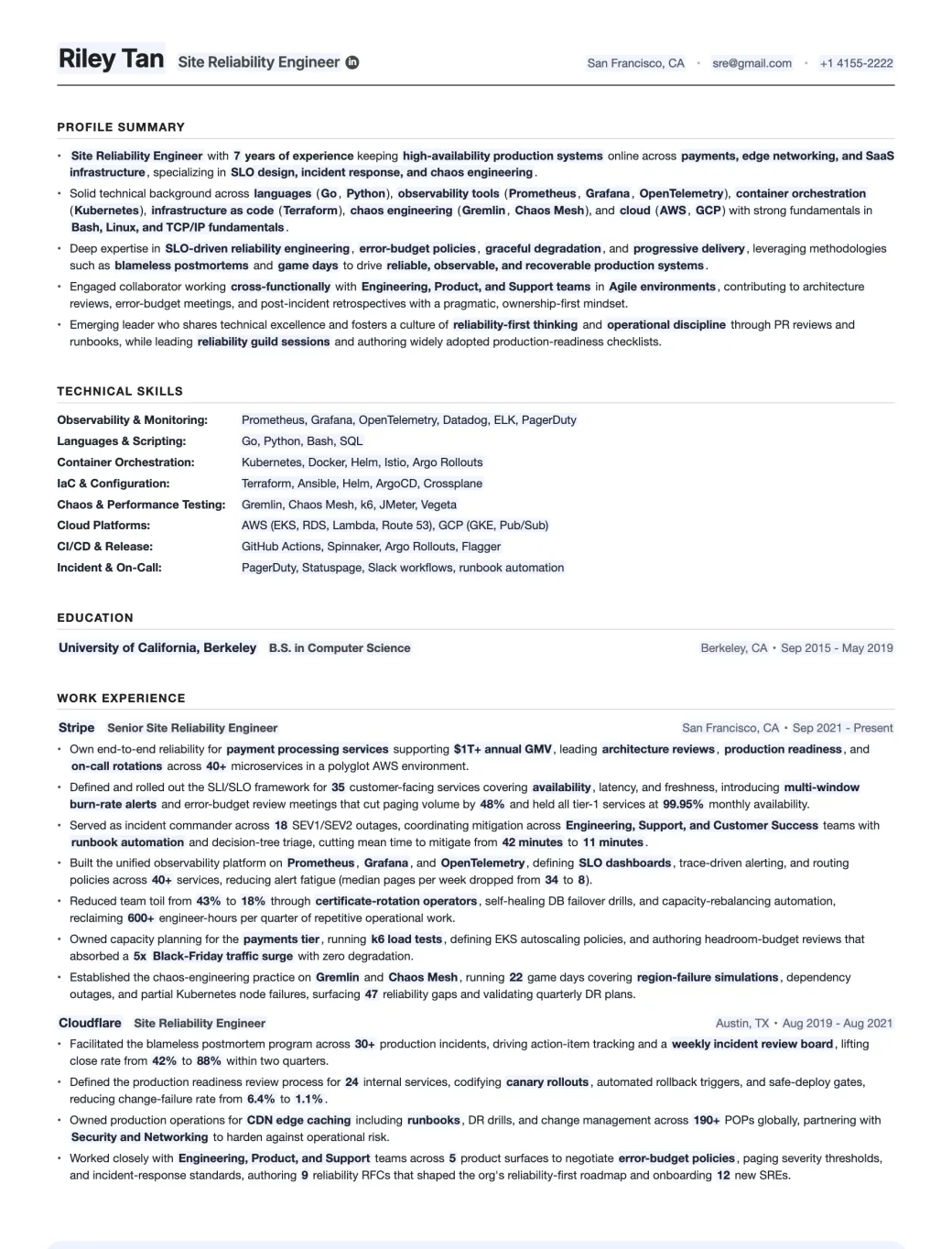
The Site Reliability Engineer resume template, filled in: profile summary, technical skills, education and work experience with the editable placeholders highlighted
Emmanuel Gendre Ex-Google recruiter / Tech resume writer Updated August 27, 2026 Free, ATS-friendly, no signup

Interactive resume template generator

Interactive Site Reliability Engineer Resume Template

Edit the side panel. The resume rewrites itself live. Save as PDF when you're done.

Edits update live as you type. Toggle Edit to rewrite paper text directly.

Edit mode is on. Click anywhere on the resume to rewrite text. Side-panel placeholders still update live.

Riley Tan Site Reliability Engineer

San Francisco, CA sre@gmail.com +1 4155-2222

Profile Summary

  • Site Reliability Engineer with 7 years of experience keeping high-availability production systems online across payments, edge networking, and SaaS infrastructure, specializing in SLO design, incident response, and chaos engineering.
  • Solid technical background across languages (Go, Python), observability tools (Prometheus, Grafana, OpenTelemetry), container orchestration (Kubernetes), infrastructure as code (Terraform), chaos engineering (Gremlin, Chaos Mesh), and cloud (AWS, GCP) with strong fundamentals in Bash, Linux, and TCP/IP fundamentals.
  • Deep expertise in SLO-driven reliability engineering, error-budget policies, graceful degradation, and progressive delivery, leveraging methodologies such as blameless postmortems and game days to drive reliable, observable, and recoverable production systems.
  • Engaged collaborator working cross-functionally with Engineering, Product, and Support teams in Agile environments, contributing to architecture reviews, error-budget meetings, and post-incident retrospectives with a pragmatic, ownership-first mindset.
  • Emerging leader who shares technical excellence and fosters a culture of reliability-first thinking and operational discipline through PR reviews and runbooks, while leading reliability guild sessions and authoring widely adopted production-readiness checklists.

Technical Skills

Observability & Monitoring:
Prometheus, Grafana, OpenTelemetry, Datadog, ELK, PagerDuty
Languages & Scripting:
Go, Python, Bash, SQL
Container Orchestration:
Kubernetes, Docker, Helm, Istio, Argo Rollouts
IaC & Configuration:
Terraform, Ansible, Helm, ArgoCD, Crossplane
Chaos & Performance Testing:
Gremlin, Chaos Mesh, k6, JMeter, Vegeta
Cloud Platforms:
AWS (EKS, RDS, Lambda, Route 53), GCP (GKE, Pub/Sub)
CI/CD & Release:
GitHub Actions, Spinnaker, Argo Rollouts, Flagger
Incident & On-Call:
PagerDuty, Statuspage, Slack workflows, runbook automation

Education

University of California, Berkeley B.S. in Computer Science
Berkeley, CA Sep 2015 - May 2019

Work Experience

Stripe Senior Site Reliability Engineer
San Francisco, CA Sep 2021 - Present
  • Own end-to-end reliability for payment processing services supporting $1T+ annual GMV, leading architecture reviews, production readiness, and on-call rotations across 40+ microservices in a polyglot AWS environment.
  • Defined and rolled out the SLI/SLO framework for 35 customer-facing services covering availability, latency, and freshness, introducing multi-window burn-rate alerts and error-budget review meetings that cut paging volume by 48% and held all tier-1 services at 99.95% monthly availability.
  • Served as incident commander across 18 SEV1/SEV2 outages, coordinating mitigation across Engineering, Support, and Customer Success teams with runbook automation and decision-tree triage, cutting mean time to mitigate from 42 minutes to 11 minutes.
  • Built the unified observability platform on Prometheus, Grafana, and OpenTelemetry, defining SLO dashboards, trace-driven alerting, and routing policies across 40+ services, reducing alert fatigue (median pages per week dropped from 34 to 8).
  • Reduced team toil from 43% to 18% through certificate-rotation operators, self-healing DB failover drills, and capacity-rebalancing automation, reclaiming 600+ engineer-hours per quarter of repetitive operational work.
  • Owned capacity planning for the payments tier, running k6 load tests, defining EKS autoscaling policies, and authoring headroom-budget reviews that absorbed a 5x Black-Friday traffic surge with zero degradation.
  • Established the chaos-engineering practice on Gremlin and Chaos Mesh, running 22 game days covering region-failure simulations, dependency outages, and partial Kubernetes node failures, surfacing 47 reliability gaps and validating quarterly DR plans.
Cloudflare Site Reliability Engineer
Austin, TX Aug 2019 - Aug 2021
  • Facilitated the blameless postmortem program across 30+ production incidents, driving action-item tracking and a weekly incident review board, lifting close rate from 42% to 88% within two quarters.
  • Defined the production readiness review process for 24 internal services, codifying canary rollouts, automated rollback triggers, and safe-deploy gates, reducing change-failure rate from 6.4% to 1.1%.
  • Owned production operations for CDN edge caching including runbooks, DR drills, and change management across 190+ POPs globally, partnering with Security and Networking to harden against operational risk.
  • Worked closely with Engineering, Product, and Support teams across 5 product surfaces to negotiate error-budget policies, paging severity thresholds, and incident-response standards, authoring 9 reliability RFCs that shaped the org's reliability-first roadmap and onboarding 12 new SREs.

Done editing? Download as a real, vector PDF. Selectable text, ATS-friendly, US Letter format.

About this template

The Site Reliability Engineer Resume Template I use with clients.

$159,492 Average advertised base salary for US SREs Indeed, 2.9k job postings

The first Site Reliability team was built at Google in 2003, but the practice stayed specific to Google for almost a decade. Google published its SRE book in 2016, and the job became mainstream within the next few years. By 2020, LinkedIn ranked site reliability engineer among the top emerging jobs in the U.S., with thousands of open roles. Unsurprisingly, the latest change involves AI: “AI agents” is now the most requested AI skill in SRE job postings, which means companies expect SREs to keep autonomous systems running.

Recruiters screening SRE resumes look for a few specific things: SLO and error budget ownership, incident response and postmortems, toil reduction and automation, and release and capacity work. Recent postings also require more platform and self-service tooling for product teams, and reliability work on AI systems themselves, from agents and model serving to the infrastructure behind them.

The template below is built around both “traditional” and modern requirements for the Site Reliability Engineer role. It will ensure that you cover the right areas, which recruiters and hiring managers expect in 2026.

Scroll down to see a few examples of finished SRE resumes (one per seniority level). You’ll also find a complete section by section walkthrough to understand the reasoning behind the template.

If you want me to take a look at your current resume, request a free review!

Resume Sample

Site Reliability Engineer Resume Examples

Want to see what a Site Reliability Engineer resume looks like at your level? I’ve written 3 examples: one junior SRE, one senior SRE, and one lead SRE. Each is a downloadable PDF.

Junior Site Reliability Engineer Resume Example

Years of experience
2 years
Industry
Payments and identity
Stack
PythonPrometheusKubernetesTerraform
Download as PDF

Click to download the Junior Site Reliability Engineer resume example as a PDF. Free / No signup.

Esteban Morales

Junior Site Reliability Engineer

New York, NY · esteban.morales@gmail.com · +1 646-555-0188 · linkedin.com/in/estebanmorales

Profile Summary
  • Junior Site Reliability Engineer with 2 years on production systems across payments and identity services, specializing in observability, on-call response, and toil automation, after two years in systems engineering.
  • Hands-on across primary language (Python), metrics stack (Prometheus), dashboards (Grafana), orchestration (Kubernetes), infrastructure as code (Terraform), and incident tooling (PagerDuty), with working knowledge of Go and distributed tracing.
  • Growing expertise in SLI instrumentation, alert tuning, and runbook authoring, using blameless postmortems and error-budget reviews to turn repeat pages into fixes that hold.
  • Carries a primary on-call rotation alongside three senior engineers, working with product teams, platform engineering, and support during incidents, joining daily stand-ups, incident reviews, and release checks.
  • Systems background built the useful half of the job: can read a stack end to end under pressure, then write the runbook so the next person on call does not have to.
Tools & Skills
Languages:
Python, Go (basics), Bash, SQL, YAML
Observability:
Prometheus, Grafana, Loki, OpenTelemetry (basics), SLI instrumentation, alert tuning
Reliability:
SLOs and error budgets, on-call rotation, runbook authoring, blameless postmortems
Platform:
Kubernetes, Docker, Terraform, Helm, Linux administration
Automation:
toil reduction scripting, cron and job hygiene, GitHub Actions, config management
Incident Tooling:
PagerDuty, Statuspage, incident channels, severity triage
Cloud:
AWS (EC2, EKS, RDS, CloudWatch), basic networking and IAM

Esteban Morales

Page 2 of 2
Work Experience
Coinbase Junior Site Reliability Engineer New York, NY · Feb 2024 - Present
  • Hold a primary on-call rotation for two payment-facing services alongside three senior engineers, triaging pages, running severity calls, and writing the postmortem for every incident carried.
  • Instrumented SLIs in Prometheus for latency, availability, and error rate across 6 services, publishing Grafana dashboards the product teams now open in their own reviews.
  • Cut alert volume by tuning thresholds against real error budgets and deleting rules nobody acted on, taking the rotation from 34 pages a week to 9 without losing a real incident.
  • Automated the certificate rotation and log-retention chores that ate the on-call day, scripting them in Python against the AWS APIs, recovering roughly 6 engineer-hours a week.
  • Wrote the first runbooks for 11 services that had none, pairing with the owning teams on failure modes and recovery steps, and folded them into the incident channel template.
Plaid Junior Systems Engineer New York, NY · Jul 2022 - Jan 2024
  • Ran Linux and Kubernetes environments for internal platform teams, handling capacity, patching, and access, with an on-call share for the cluster itself.
  • Migrated environment provisioning from hand-built hosts to Terraform modules with peer-reviewed plans, taking a new environment from two days to under an hour.
  • Sat in on incident calls to take notes and chase actions, which is where the reliability side of the job came from and why the SRE pivot stuck.
Education
CUNY Hunter College B.S. in Computer Science New York, NY · Sep 2018 - May 2022
Linux Foundation Certified Kubernetes Administrator (CKA) Remote · Nov 2024

Senior Site Reliability Engineer Resume Example

Years of experience
7 years
Industry
Developer tooling and identity
Stack
GoPrometheusOpenTelemetryKubernetes
Download as PDF

Click to download the Senior Site Reliability Engineer resume example as a PDF. Free / No signup.

Yuki Watanabe

Senior Site Reliability Engineer

Portland, OR · yuki.watanabe@gmail.com · +1 503-555-0142 · linkedin.com/in/yukiwatanabe

Profile Summary
  • Senior Site Reliability Engineer with 7 years on high-traffic SaaS across CI/CD, identity, and multi-tenant control planes, specializing in SLO design, incident command, and reliability architecture.
  • Hands-on across primary language (Go), scripting (Python), metrics stack (Prometheus), tracing (OpenTelemetry), orchestration (Kubernetes), infrastructure as code (Terraform), and chaos tooling (Gremlin), with strong fundamentals in distributed systems.
  • Deep expertise in error-budget policy, alert quality, graceful degradation, and capacity planning, using blameless postmortems and game days to ship changes that survive a bad Tuesday.
  • Acts as incident commander on major events, pairing with product engineering, support, and security across a fully remote org, running severity calls, comms, and the review that follows.
  • Sets the reliability bar for the team: owns the on-call handbook, mentors engineers through their first rotations, and keeps the postmortem backlog from turning into a graveyard.
Tools & Skills
Languages:
Go, Python, Bash, SQL, PromQL
Observability:
Prometheus, Grafana, OpenTelemetry, Loki, Tempo, structured logging, SLI/SLO instrumentation
Reliability:
error-budget policy, incident command, blameless postmortems, graceful degradation, capacity planning
Resilience Testing:
Gremlin, Chaos Mesh, game days, load and soak testing, failure injection
Platform:
Kubernetes, Terraform, Helm, Argo CD, service mesh, progressive delivery
Cloud & Data:
GCP and AWS, PostgreSQL, Redis, Kafka, object storage, multi-region failover
Ways of Working:
on-call handbook ownership, mentoring, reliability reviews, cross-team postmortem follow-through

Yuki Watanabe

Page 2 of 2
Work Experience
GitLab Senior Site Reliability Engineer Remote · Mar 2022 - Present
  • Own reliability for the CI runner control plane, a multi-tenant system serving thousands of concurrent jobs, from SLO definition through incident response and the architecture changes that follow.
  • Rewrote the SLO set around user-visible journeys rather than host metrics and wired the error budget into release gating, taking availability from 99.5% to 99.95% across four quarters.
  • Rebuilt alerting on Prometheus and OpenTelemetry with symptom-based rules and burn-rate windows, cutting pages by 62% while shortening median time to detect.
  • Introduced quarterly game days with Gremlin, injecting dependency and zone failures against real traffic shadows, which surfaced 9 latent single points of failure before customers found them.
  • Act as incident commander on Sev1 and Sev2 events and run the review afterwards, driving follow-up actions to completion and holding repeat-incident rate at under 8%.
Auth0 (Okta) Site Reliability Engineer Portland, OR · Aug 2019 - Feb 2022
  • Ran production for identity services in Kubernetes across three regions, covering capacity, rollout safety, and a shared on-call rotation with the owning product teams.
  • Led the migration to Terraform-managed infrastructure with peer-reviewed plans and drift detection, removing the hand-edited console changes behind two of the previous year’s outages.
  • Built the multi-region failover runbook and proved it in a live exercise, bringing tested recovery time down to under 12 minutes.
Education
Portland State University B.S. in Computer Science Portland, OR · Sep 2015 - Jun 2019

Lead Site Reliability Engineer Resume Example

Years of experience
11 years
Industry
Insurance and CDN
Stack
GoGrafanaTerraformKubernetes
Download as PDF

Click to download the Lead Site Reliability Engineer resume example as a PDF. Free / No signup.

Olaolu Bankole

Lead Site Reliability Engineer

Boston, MA · olaolu.bankole@gmail.com · +1 617-555-0119 · linkedin.com/in/olaolubankole

Profile Summary
  • Lead Site Reliability Engineer with 11 years across CDN and enterprise insurance platforms, currently leading a 7-engineer reliability team covering claims, policy, and customer-facing digital services.
  • Hands-on across primary language (Go), scripting (Python), metrics stack (Prometheus), tracing (OpenTelemetry), orchestration (Kubernetes), infrastructure as code (Terraform), and change control under regulatory audit, with strong fundamentals in distributed systems.
  • Deep expertise in error-budget policy, incident command at enterprise scale, capacity and cost planning, and release engineering under change control, using blameless postmortems and reliability reviews to make the same failure impossible twice.
  • Owns the reliability relationship with engineering directors, risk, and audit, running monthly service reviews and translating error-budget burn into decisions leadership will actually act on.
  • Built the function: hired and levelled the team, wrote the on-call handbook and severity model the wider org now runs on, and set the bar for what a production-ready service looks like.
Tools & Skills
Languages:
Go, Python, Bash, SQL, PromQL
Observability:
Prometheus, Grafana, OpenTelemetry, Splunk, distributed tracing, SLI/SLO instrumentation
Reliability:
error-budget policy, incident command, severity models, blameless postmortems, production readiness reviews
Release & Change:
progressive delivery, canary and blue-green, change advisory under audit, rollback design
Platform:
Kubernetes, Terraform, Argo CD, service mesh, multi-region architecture, disaster recovery
Cloud, Cost & Compliance:
AWS and Azure, capacity and cost planning, SOC 2, PCI DSS, evidence for audit
Leadership:
hiring and levelling, on-call handbook ownership, mentoring, executive service reviews

Olaolu Bankole

Page 2 of 2
Work Experience
Liberty Mutual Lead Site Reliability Engineer Boston, MA · Apr 2021 - Present
  • Lead a 7-engineer reliability team covering claims, policy, and customer-facing digital services, owning SLOs, the on-call model, and the production-readiness bar for every new service.
  • Wrote and landed the company’s error-budget policy, agreed with engineering directors and risk, which now gates feature releases and has held claims availability at 99.97%.
  • Rebuilt incident response around a clear severity model and a trained commander pool, cutting median time to mitigate on Sev1 events from 74 minutes to 21.
  • Consolidated observability onto Prometheus, Grafana and OpenTelemetry across 40 services, replacing three overlapping tools and taking $1.1M a year out of monitoring spend.
  • Own the reliability story with risk and audit, producing change-control and availability evidence under SOC 2 and PCI DSS across 3 audit cycles with zero findings.
Akamai Technologies Senior Site Reliability Engineer Cambridge, MA · Jun 2015 - Mar 2021
  • Ran production for edge delivery and DNS services at global scale, covering capacity, rollout safety, and a follow-the-sun on-call rotation.
  • Designed the automated traffic-drain procedure for unhealthy regions, tested through scheduled failure exercises, cutting customer-visible impact during regional events by 68%.
  • Built the postmortem programme the organisation still uses, taking review completion from ad hoc to 100% within five business days.
Education
Boston University B.S. in Computer Engineering Boston, MA · Sep 2011 - May 2015

Free resume review

A recruiter screen, but with feedback

You applied to hundreds of jobs: no result. Companies won’t give you feedback, so you’re stuck in a loop. Rejections will keep coming until you know what’s wrong.

Let’s break this cycle today!

I’ll screen your resume the same way I did at Google.

You’ll get:

  • Your resume sections and content scored.
  • A clear list of what to improve, why, and how.
  • Behind the scenes secrets on the screening process.

Section by section

Site Reliability Engineer sections at a glance

Below is a section-by-section breakdown of the template: what each part is doing, what a good version looks like, and why a recruiter cares about it.

01Profile Summary

Site Reliability Engineer Profile Summary example

When screening 100s of resumes, recruiters spend very little time on one given CV. This means they need to find key information quickly to make a decision. For a Site Reliability Engineer, that’s your technical skills (Go, Prometheus, Kubernetes), your domain expertise (SLOs and error budgets, incident command, capacity planning), your ability to work cross-functionally and the key projects you’ve delivered.

Want the full method for this section? It is all in my guide on How to write a profile summary.

Profile Summary Sample
  • Site Reliability Engineer with 8 years of experience across high-traffic consumer platforms in checkout, search, and media delivery, specializing in SLO design, incident command, and reliability architecture.
  • Hands-on across primary language (Go), scripting (Python), metrics stack (Prometheus), tracing (OpenTelemetry), orchestration (Kubernetes), infrastructure as code (Terraform), and chaos tooling (Gremlin), with strong fundamentals in distributed systems, capacity modelling, and calm operational judgement.
  • Deep expertise in error-budget policy, symptom-based alerting, graceful degradation, and capacity planning, using methodologies such as blameless postmortems and scheduled game days to ship systems that fail in ways the team already rehearsed.
  • Acts as incident commander with product engineering, platform teams, security, and support inside a follow-the-sun on-call rotation, running severity calls, customer comms, and the review that follows with a pragmatic, fix-the-cause mindset.
  • Senior SRE who raises the reliability bar and builds a culture of alerts people trust and postmortem actions that actually land, through production-readiness reviews and on-call mentoring, while owning the on-call handbook and severity model the wider org runs on.

02Role Profile Coverage

Site Reliability Engineer role profile coverage

Recruiters will evaluate your resume against the SRE role profile, which is the list of core competencies (skills and experiences) needed for the job. Your goal should be to write specific bullet points targeting each of these areas.

Below is the role profile for a modern Site Reliability Engineer, and the template above targets it. If you want more details on how and why role profile targeting matters, read the SRE resume writing guide.

Role Profile Coverage
  • SLO, SLI & Error Budgets
  • Observability & Instrumentation
  • Incident Response & On-Call
  • Postmortems & Follow-Through
  • Reliability Architecture
  • Automation & Toil Reduction
  • Capacity & Performance Planning
  • Release Engineering & Change Safety

03Bullet Points

A Site Reliability Engineer resume bullet point example

Bullet points carry most of the weight in a resume. An SRE bullet needs the tools you used (Prometheus, Kubernetes, Terraform), the techniques you applied (symptom-based alerting, burn-rate windows), and the domain expertise behind it (SLOs and error budgets, incident command).

It also needs a metric to measure your impact. For a Site Reliability Engineer, that can be availability against the SLO, pages per week, time to detect, or time to mitigate. (See the SRE metrics page for the full list.)

I wrote the example bullet point below based on my “Level System”, which is my methodology for writing amazing bullet points.

Bullet Point Sample

Rebuilt alerting for the checkout and payments platform around symptom-based rules and burn-rate windows, in Prometheus, OpenTelemetry and Grafana, under an error-budget policy with blameless postmortems, cutting on-call pages from 34 a week to 9.

  1. 01 Task What you worked on
  2. 02 Techniques How you did it
  3. 03 Tools The stack you used
  4. 04 Method The method you followed
  5. 05 Metric The result, one number

04Technical Skills

Site Reliability Engineer technical skills section example

The exact categories depend on your stack, but a reliable starting point is: languages, the observability tools, reliability practice, resilience testing, the platform, and cloud / data.

Below is an example for Technical Skills that follows best practice. If you want to find more skills to add to the template, check out the Site Reliability Engineer resume skills page.

Technical Skills Sample
Languages
Go, Python, Bash, SQL, PromQL
Observability
Prometheus, Grafana, OpenTelemetry, Loki, Tempo, SLI instrumentation, structured logging
Reliability
SLOs and error budgets, symptom-based alerting, incident command, blameless postmortems, graceful degradation
Resilience Testing
Gremlin, Chaos Mesh, game days, load and soak testing, failure injection
Platform & Delivery
Kubernetes, Terraform, Helm, Argo CD, service mesh, canary and blue-green rollouts
Cloud & Data
AWS, GCP, PostgreSQL, Redis, Kafka, multi-region failover, disaster recovery
On-Call Practice
Rotation design, severity models, runbook authoring, production readiness reviews, PagerDuty

Submit your resume for a free review!

SRE Template File, Format and Layout

Site Reliability Engineer template & layout

Now that we’ve covered content, we should also talk about form. That is ATS compliance (surviving the parser), design and layout (passing the recruiter’s six seconds), and the file format you use.

01ATS Compliance

ATS compliance for your Site Reliability Engineer resume

Your resume gets read by software long before a person sees it. Applicant Tracking Systems (ATS) parse the text, sort it into fields, and filter on what they find, which means your SRE resume has to be “ATS Compliant” before anything else matters. Parsers are literal and easy to confuse, so here are 3 rules to avoid easy rejections!

The 3 rules
  1. Use a 100% text based format (no Canva!)

  2. Avoid tables, pictures, and complex structures.

  3. Choose the most predictable section names (“Profile Summary” rather than “Career Highlights”)

02Design & Layout

Site Reliability Engineer resume design and layout

First of all, recruiters hate fancy designs. When I screened resumes for Google, I would usually set aside a couple of hours to screen 100 or 200 CVs. I only have a few seconds for each one, which means I need to make an assessment quickly. I didn’t want to have to “re-learn” where things are at each new resume.

So here’s the lesson: the best resume templates are boring and predictable. What I based my screening decisions on was content and nothing else. This is why the dynamic template on this page is simple and clear: this is what will get you the best results :-)

Layout Spec
Columns
One. No sidebars, tables, columns, pictures or tabs.
Margins
0.7 in on all four sides
Body size
10 to 11 pt
Type
One family, weight for hierarchy
Length
One page under 5 years, two after
Section order
Summary, Skills, Experience, Education
PDF

03File Format

Resume file format for your Site Reliability Engineer (SRE) resume

The SRE resume template on this page is a .pdf downloadable for a reason: ATS software is built for PDF and gets less reliable with .docx or .pages files. A PDF also maintains your layout and no one can change it on your behalf. If you’re curious about this topic, you can find a full comparison in my article on which resume file format to use.

Format Guide
PDF
Your default. Layout holds, text stays selectable.
Word (.docx)
Only when the posting or the recruiter asks for it
Plain text
For portals that make you paste into a box
Never
Images, scans, Pages files, Google Docs links
File name
Riley-Tan-Site-Reliability-Engineer.pdf

Free resume review

A recruiter screen, but with feedback

You applied to hundreds of jobs: no result. Companies won’t give you feedback, so you’re stuck in a loop. Rejections will keep coming until you know what’s wrong.

Let’s break this cycle today!

I’ll screen your resume the same way I did at Google.

You’ll get:

  • Your resume sections and content scored.
  • A clear list of what to improve, why, and how.
  • Behind the scenes secrets on the screening process.

Frequently asked

Your Questions about the Site Reliability Engineer (SRE) Resume Template, Answered

Yes, fully free. No signup, no email gate, no upgrade tier sitting behind it. Open the template, fill the placeholders, save the PDF, you're set.

Yes. The exported PDF is single-column with the section headers ATS systems expect by default (Profile Summary, Technical Skills, Education, Work Experience), no tables, no images, no multi-column layouts. Workday, Greenhouse, and iCIMS handle it cleanly. Drop the export into our ATS Checker after if you want a second look.

You can. Toggle Edit at the top of the resume preview, then click into any sentence and type whatever you need. The side-panel placeholders keep updating; the rest of the text is plain editable copy.

Hit Download. Your browser builds the PDF on the spot, no print dialog, no signup, no server in the loop. The result is real vector text on US Letter, parsed by ATS systems the same way they would parse any clean resume export.

Yes. The defaults lean Kubernetes plus Prometheus, Grafana, and OpenTelemetry because that's what dominates 2026 SRE JDs, but every reference is a placeholder. Swap Kubernetes for Nomad or ECS, Prometheus for Datadog or New Relic, Gremlin for Chaos Mesh or Litmus, Terraform for Pulumi. The side panel updates the resume across every mention.

No. Hiring managers screen on substance: the SLOs you held, the incidents you ran point on, the toil you reclaimed, the chaos experiments you can defend in a screen. Layout origin is not on the rubric. What does cost interviews is a template padded with vague reliability-speak, which this one is structured to prevent. The skeleton came from a former Google recruiter; the substance is yours.

Yes, free. Drop your PDF into the review form on this page and a former Google recruiter (me) will read it and email back line-by-line notes inside 12 hours. No upsell, no hidden fee.

More resources

Other Site Reliability Engineer Resume Resources