SOC Analyst Resume Examples & Free Template (PDF, Word)

Fill in this free SOC Analyst resume template from a former Google recruiter, then download it as a PDF or Word file. You also get 3 finished examples, from entry level to lead, and my 6-step guide to each section.

4.9 5.0
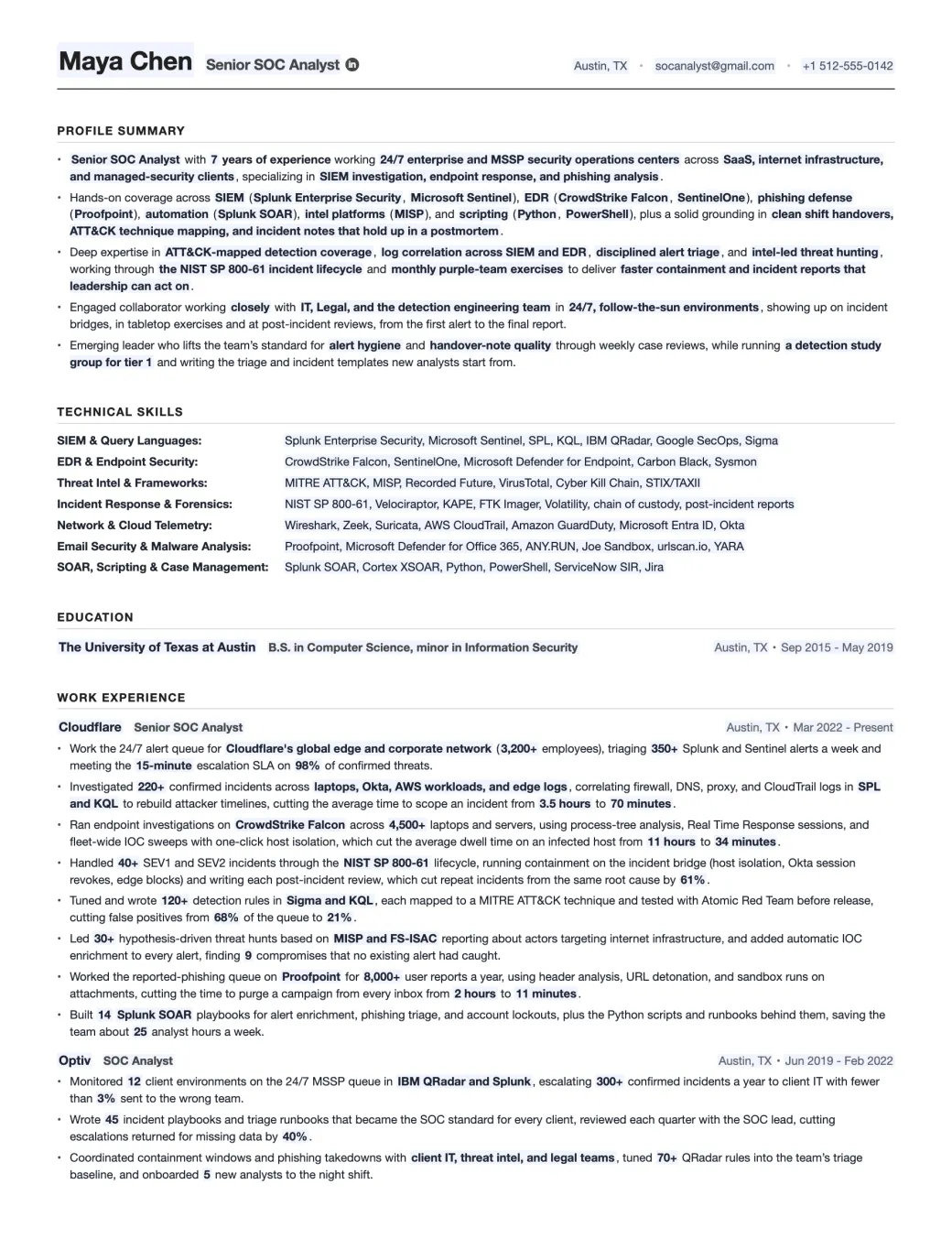
The SOC Analyst resume template filled in for a senior analyst: profile summary, technical skills, education and work experience, with the editable fields highlighted
Emmanuel Gendre Ex-Google recruiter / Tech resume writer Updated Free, ATS-friendly, no signup

Interactive resume template generator

Interactive SOC Analyst Resume Template

Edit the side panel and the resume rewrites itself live. Download it as a PDF or a Word file when you’re done.

Edits update live as you type. Toggle Edit to rewrite paper text directly.

Edit mode is on. Click anywhere on the resume to rewrite text. Side-panel placeholders still update live.

Maya Chen Senior SOC Analyst

Austin, TX • socanalyst@gmail.com • +1 512-555-0142

Profile Summary

  • Senior SOC Analyst with 7 years of experience working 24/7 enterprise and MSSP security operations centers across SaaS, internet infrastructure, and managed-security clients, specializing in SIEM investigation, endpoint response, and phishing analysis.
  • Hands-on coverage across SIEM (Splunk Enterprise Security, Microsoft Sentinel), EDR (CrowdStrike Falcon, SentinelOne), phishing defense (Proofpoint), automation (Splunk SOAR), intel platforms (MISP), and scripting (Python, PowerShell), plus a solid grounding in clean shift handovers, ATT&CK technique mapping, and incident notes that hold up in a postmortem.
  • Deep expertise in ATT&CK-mapped detection coverage, log correlation across SIEM and EDR, disciplined alert triage, and intel-led threat hunting, working through the NIST SP 800-61 incident lifecycle and monthly purple-team exercises to deliver faster containment and incident reports that leadership can act on.
  • Engaged collaborator working closely with IT, Legal, and the detection engineering team in 24/7, follow-the-sun environments, showing up on incident bridges, in tabletop exercises and at post-incident reviews, from the first alert to the final report.
  • Emerging leader who lifts the team’s standard for alert hygiene and handover-note quality through weekly case reviews, while running a detection study group for tier 1 and writing the triage and incident templates new analysts start from.

Technical Skills

SIEM & Query Languages:
Splunk Enterprise Security, Microsoft Sentinel, SPL, KQL, IBM QRadar, Google SecOps, Sigma
EDR & Endpoint Security:
CrowdStrike Falcon, SentinelOne, Microsoft Defender for Endpoint, Carbon Black, Sysmon
Threat Intel & Frameworks:
MITRE ATT&CK, MISP, Recorded Future, VirusTotal, Cyber Kill Chain, STIX/TAXII
Incident Response & Forensics:
NIST SP 800-61, Velociraptor, KAPE, FTK Imager, Volatility, chain of custody, post-incident reports
Network & Cloud Telemetry:
Wireshark, Zeek, Suricata, AWS CloudTrail, Amazon GuardDuty, Microsoft Entra ID, Okta
Email Security & Malware Analysis:
Proofpoint, Microsoft Defender for Office 365, ANY.RUN, Joe Sandbox, urlscan.io, YARA
SOAR, Scripting & Case Management:
Splunk SOAR, Cortex XSOAR, Python, PowerShell, ServiceNow SIR, Jira

Education

The University of Texas at Austin B.S. in Computer Science, minor in Information Security
Austin, TX • Sep 2015 - May 2019

Work Experience

Cloudflare Senior SOC Analyst
Austin, TX • Mar 2022 - Present
  • Work the 24/7 alert queue for Cloudflare's global edge and corporate network (3,200+ employees), triaging 350+ Splunk and Sentinel alerts a week and meeting the 15-minute escalation SLA on 98% of confirmed threats.
  • Investigated 220+ confirmed incidents across laptops, Okta, AWS workloads, and edge logs, correlating firewall, DNS, proxy, and CloudTrail logs in SPL and KQL to rebuild attacker timelines, cutting the average time to scope an incident from 3.5 hours to 70 minutes.
  • Ran endpoint investigations on CrowdStrike Falcon across 4,500+ laptops and servers, using process-tree analysis, Real Time Response sessions, and fleet-wide IOC sweeps with one-click host isolation, which cut the average dwell time on an infected host from 11 hours to 34 minutes.
  • Handled 40+ SEV1 and SEV2 incidents through the NIST SP 800-61 lifecycle, running containment on the incident bridge (host isolation, Okta session revokes, edge blocks) and writing each post-incident review, which cut repeat incidents from the same root cause by 61%.
  • Tuned and wrote 120+ detection rules in Sigma and KQL, each mapped to a MITRE ATT&CK technique and tested with Atomic Red Team before release, cutting false positives from 68% of the queue to 21%.
  • Led 30+ hypothesis-driven threat hunts based on MISP and FS-ISAC reporting about actors targeting internet infrastructure, and added automatic IOC enrichment to every alert, finding 9 compromises that no existing alert had caught.
  • Worked the reported-phishing queue on Proofpoint for 8,000+ user reports a year, using header analysis, URL detonation, and sandbox runs on attachments, cutting the time to purge a campaign from every inbox from 2 hours to 11 minutes.
  • Built 14 Splunk SOAR playbooks for alert enrichment, phishing triage, and account lockouts, plus the Python scripts and runbooks behind them, saving the team about 25 analyst hours a week.
Optiv SOC Analyst
Austin, TX • Jun 2019 - Feb 2022
  • Monitored 12 client environments on the 24/7 MSSP queue in IBM QRadar and Splunk, escalating 300+ confirmed incidents a year to client IT with fewer than 3% sent to the wrong team.
  • Wrote 45 incident playbooks and triage runbooks that became the SOC standard for every client, reviewed each quarter with the SOC lead, cutting escalations returned for missing data by 40%.
  • Coordinated containment windows and phishing takedowns with client IT, threat intel, and legal teams, tuned 70+ QRadar rules into the team’s triage baseline, and onboarded 5 new analysts to the night shift.


Done editing? Download a real PDF (selectable text, ATS-friendly, US Letter) or an editable Word file if a recruiter asks for one.

About this template

A SOC Analyst resume template, built by a tech recruiter.

A SOC Analyst watches a company’s networks, laptops and cloud accounts for signs of an attack, usually from a security operations center that runs around the clock. You’ll spend your shifts in a SIEM like Splunk or Sentinel, deciding which alerts are real, digging through logs and endpoint data, and containing the incidents that are. Plenty of companies post the same job as Information Security Analyst or Cybersecurity Analyst, so this template works for those titles too. Some shifts are quiet. Others start with ransomware on a domain controller at 3am.

The catch is that SOC resumes all look alike. Splunk, CrowdStrike and MITRE ATT&CK show up on nearly every one of them, so a tool list doesn’t tell a hiring manager how you’d handle a real incident. Your numbers do. That means the alerts you work per shift, the incidents you scoped and contained, the detections you tuned and how far your response times dropped while you were on the team.

So this template puts a number in every bullet, and its 8 bullets for your current job match the 8 things a SOC hiring manager screens for. Below it there are 3 finished SOC resumes you can download, and the 6 steps to write a SOC Analyst resume, one section at a time.

Already sending your resume out? Send it to my free resume critique service. I’ll read it like a recruiter would, then email you the changes I’d make.

Industry signal

What the market says about SOC Analyst roles

Most new cyber rules come with a reporting deadline. US public companies have had 4 business days to disclose a material incident since December 2023. NIS2 expects a 24-hour early warning from EU companies in scope, and EU financial firms have been under DORA since January 2025. The UK and the US (CIRCIA) are close to their own 24 and 72-hour rules. Each of those deadlines starts when someone spots the incident, and that someone is usually a SOC Analyst.

+21% US security analyst job growth, 2025 to 2035 US Bureau of Labor Statistics
$105,620 Average advertised US SOC Analyst base salary Indeed
  • Splunk @splunk · Security and observability platform
    More alerts ≠ better security. ICYMI: Haylee Mills spoke with @TechTargetNews about how risk-based alerting helps SOC teams cut through the noise and focus on what matters: splk.it/4zuioFv
  • Huntress @HuntressLabs · Security research and news
    In August, one of our SOC analysts dug into an IP address that turned up in the telemetry of an Adversary-in-the-Middle (AiTM) attack, and landed on the login console for a phishing kit called Knight Office. Get the details. okt.to/YfGcIV
  • Cybersecurity and Infrastructure Security Agency @CISAgov · US cyber defense agency
    We released a new Cybersecurity Advisory, A Tale of Two SOCs: Insights From Two Red Team Assessments. Learn which actions make the difference for quickly containing a breach to protect your org from cyber threats 👉 go.dhs.gov/5Xh
  • SANS Institute @SANSInstitute · Cybersecurity training and research
    SOC analysts are seeing the highest AI-driven role changes of any function in security, at 32%. Incident responders: 22%. These roles aren't disappearing. They're becoming something different. The SANS AI Cybersecurity Careers Guide maps where each one is heading.

Resume Samples

SOC Analyst Resume Examples

What does a SOC Analyst resume look like at your level? I wrote 3 sample resumes to show you. There’s a junior who traded Geek Squad for a tier-1 MSSP shift, a senior threat hunter at an MDR firm, and a lead running a card network’s SOC team. You can download each one as a PDF or a Word file, free and with no signup.

Junior SOC Analyst Resume Example

Spent 4 years fixing infected PCs at Geek Squad before moving into security. Now covers the overnight tier-1 queue at an MSSP: Splunk and Defender alerts, phishing reports and IOC sweeps.

Years of experience
2 years
Industry
Managed security (MSSP)
Stack
SplunkMicrosoft DefenderPowerShellVirusTotal
Download PDF Download Word

Click to download the Junior SOC Analyst resume example as a PDF or a Word file. Free / No signup.

Hector Diaz

Junior SOC Analyst

San Antonio, TX · hector.diaz@gmail.com · +1 210-555-0139 · linkedin.com/in/hectordiaz

Profile Summary

  • Junior SOC Analyst, 2 years on the overnight tier-1 shift of a 24/7 MSSP covering hosting and e-commerce clients, focused on alert triage, phishing reports, and first-look endpoint checks.
  • Uses SIEM (Splunk), EDR (Defender for Endpoint), case tracking (ServiceNow SIR), email security (Proofpoint TRAP), and sandboxing (ANY.RUN) every shift, with beginner KQL and PowerShell.
  • Building depth in SPL log searches, email header analysis, and IOC enrichment, working from the tier-1 runbooks so tier 2 receives escalations with the timeline already built.
  • Shares the night shift with 3 tier-1 peers and 2 tier-2 analysts, calls client IT contacts when a host needs isolating, and brings noisy-rule examples to the weekly tuning meeting.
  • Keeps the shift handover template and 5 phishing runbooks up to date, runs a weekly Security+ study group for 4 Rackspace support engineers, and is preparing for CySA+.

Technical Skills

SIEM & Query Languages:
Splunk Enterprise Security (SPL, saved searches), Microsoft Sentinel (KQL basics)
EDR & Endpoint Security:
Microsoft Defender for Endpoint (device isolation, timeline), CrowdStrike Falcon (triage), Sysmon (basics)
Threat Intel & Frameworks:
MISP, VirusTotal, AbuseIPDB, MITRE ATT&CK (basics)
Incident Response & Forensics:
NIST SP 800-61, incident timelines, evidence notes, Sysinternals (Autoruns, Process Explorer)
Network & Cloud Telemetry:
Firewall and proxy logs, DNS queries, Microsoft Entra ID sign-in logs, Wireshark (basics)
Email Security & Malware Analysis:
Proofpoint (TRAP), Defender for Office 365, ANY.RUN, urlscan.io, header analysis
SOAR, Scripting & Case Management:
ServiceNow SIR, PowerShell, Python (basics), Confluence runbooks
Page 2 of 2

Work Experience

Rackspace Technology Junior SOC Analyst San Antonio, TX · Sep 2024 to Present
  • Triaged the overnight Splunk and Defender for Endpoint queue for 27 hosting clients, closing false positives with notes and escalating real threats within the 20-minute SLA 96% of the time.
  • Cleared the user-reported phishing queue for 9 clients, checking headers and opening attachments in ANY.RUN, then pulling 38 live campaigns from every affected mailbox with Proofpoint TRAP.
  • Built SPL searches that join firewall, proxy, and DNS logs by host, cutting the time to put together an escalation timeline from 42 minutes to 16.
  • Ran a weekly IOC sweep of client Splunk data from the intel team's MISP feed, enriching hits in VirusTotal, which found 3 infected hosts still beaconing to known C2 servers.
  • Tracked a month of false positives on the impossible-travel rule, then proposed Splunk exclusions for corporate VPN egress IPs that tier 2 approved, cutting overnight alert volume by 17%.
Best Buy Geek Squad Advanced Repair Agent San Antonio, TX · Jul 2020 to Aug 2024
  • Removed malware from about 640 customer PCs, tracing persistence through services, Run keys, and scheduled tasks with Sysinternals Autoruns and Process Explorer, and reimaging only when cleanup failed.
  • Worked 11 ransomware cases for small-business customers, unplugging infected machines, imaging drives for their insurer, and restoring from backups so most offices were back up the next morning.
  • Wrote a PowerShell intake script that dumps running processes, startup items, and browser extensions into one report, cutting diagnosis time per PC from 47 minutes to 18.

Education

University of Texas at San Antonio B.S. in Cybersecurity San Antonio, TX · Aug 2019 to May 2023
CompTIA Security+ certification San Antonio, TX · Apr 2024

Senior SOC Analyst Resume Example

Senior hands-on analyst in managed detection and response. Hunts across customer EDR and cloud logs, then turns what she finds into new detections.

Years of experience
6 years
Industry
Managed detection and response
Stack
Google SecOpsCrowdStrike FalconSentinelOnePython
Download PDF Download Word

Click to download the Senior SOC Analyst resume example as a PDF or a Word file. Free / No signup.

Aliyah Thompson

Senior SOC Analyst

Reston, VA · aliyah.thompson@gmail.com · +1 703-555-0124 · linkedin.com/in/aliyahthompson

Profile Summary

  • Senior SOC Analyst and threat hunter, 6 years at MDR providers watching Fortune 500 and defense-industry customers around the clock, specializing in hypothesis-driven hunts and identity attacks in AWS and Microsoft 365.
  • Works across SIEM (Google SecOps in YARA-L, Microsoft Sentinel in KQL), EDR (CrowdStrike Falcon, SentinelOne), threat intel (VirusTotal, Mandiant Advantage), live response (Velociraptor), and scripting (Python).
  • Deep in ATT&CK-mapped hunting, noise tuning, and cloud audit log analysis, turning each confirmed hunt finding into a tested detection so the next attempt triggers an alert on its own.
  • Partners with incident responders, intel analysts, and customer security leads on 14 enterprise accounts, joins the bridge on confirmed intrusions, and gives each customer a monthly threat briefing.
  • Mentors 4 analysts through their first hunts, wrote the hunt report template and Entra ID investigation runbook the whole team uses, and holds GCIH and GCFA.

Technical Skills

SIEM & Query Languages:
Google SecOps (YARA-L, UDM search), Microsoft Sentinel (KQL), Splunk (SPL), Sigma
EDR & Endpoint Security:
CrowdStrike Falcon (Insight, Real Time Response), SentinelOne Singularity, Defender for Endpoint, Sysmon
Threat Intel & Frameworks:
MITRE ATT&CK, Mandiant Advantage, VirusTotal, MISP, STIX/TAXII, Diamond Model
Incident Response & Forensics:
NIST SP 800-61, Velociraptor, KAPE, Volatility 3, memory and disk triage
Network & Cloud Telemetry:
AWS CloudTrail, Amazon GuardDuty, Microsoft Entra ID, Okta System Log, Zeek
Email Security & Malware Analysis:
Defender for Office 365, Joe Sandbox, YARA, CAPA, static file triage
SOAR, Scripting & Case Management:
Python, Google SecOps SOAR, Cortex XSOAR, Jira, Git
Page 2 of 2

Work Experience

Mandiant (Google Cloud) Senior SOC Analyst Reston, VA · Aug 2022 to Present
  • Ran monthly hypothesis hunts across 14 customers' EDR and cloud logs in Google SecOps, and 3 of last year's 12 hunts found live intruder activity the existing rules had missed.
  • Turned hunt findings into YARA-L and KQL detections mapped to MITRE ATT&CK, each tested with Atomic Red Team, raising coverage of priority cloud techniques from 31% to 64%.
  • Correlated CloudTrail, GuardDuty, and Okta logs to trace a stolen AWS access key for a retailer, building the attacker timeline in 6 hours and confirming no data left the account.
  • Investigated CrowdStrike Falcon and SentinelOne detections down to the process tree, isolating hosts and sweeping each customer's fleet for matching hashes, keeping median time to containment at 22 minutes.
  • Wrote Python actions for the Google SecOps SOAR playbooks that pull VirusTotal verdicts, asset owners, and recent sign-ins into each case, cutting median time to first analyst action by 41%.
Secureworks SOC Analyst Atlanta, GA · Jul 2020 to Jul 2022
  • Triaged Taegis XDR and Splunk alerts for 33 mid-market customers on rotating 12-hour shifts, writing escalation notes the response team accepted without rework on 93% of cases.
  • Worked the customer phishing queue in Defender for Office 365, detonating suspect files in Joe Sandbox and running tenant-wide purges that removed 2,860 malicious messages in 2021.
  • Handled containment on 17 confirmed incidents, mostly ransomware precursors and BEC, collecting evidence with Velociraptor and writing the NIST SP 800-61 reports customers sent to their insurers.

Education

Howard University M.S. in Cybersecurity Washington, DC · Aug 2018 to May 2020
GIAC GCIH and GCFA certifications Reston, VA · 2021 and 2024

Lead SOC Analyst Resume Example

Heads a 9-person SOC team for one of the largest payment networks, split between Foster City and Singapore. Owns incident command, detection quality and the evidence auditors ask for.

Years of experience
11 years
Industry
Payments and financial services
Stack
SplunkTinesRecorded FutureAWS
Download PDF Download Word

Click to download the Lead SOC Analyst resume example as a PDF or a Word file. Free / No signup.

Krish Patel

Lead SOC Analyst

Foster City, CA · krish.patel@gmail.com · +1 650-555-0192 · linkedin.com/in/krishpatel

Profile Summary

  • Lead SOC Analyst bringing 11 years of payments security operations at a global card network and a digital wallet, specializing in incident command, detection engineering at scale, and PCI DSS audit evidence.
  • Leads a SOC built on SIEM (Splunk Enterprise Security), EDR (CrowdStrike Falcon), SOAR (Tines), threat intel (Recorded Future), and cloud telemetry (AWS CloudTrail), keeping every detection as Sigma in Git.
  • Deep expertise in detection-as-code, ATT&CK coverage measurement, and major incident command, using purple-team exercises to prove which rules fire and retiring the ones that never do.
  • Works with fraud operations, IAM, cloud engineering, and the red team, chairs the weekly detection review, and briefs the CISO each month on open incidents and ATT&CK coverage.
  • Manages 9 analysts in Foster City and Singapore, designed the follow-the-sun handover and the SOC hiring loop, and has coached 4 analysts into senior roles.

Technical Skills

SIEM & Query Languages:
Splunk Enterprise Security (SPL, risk-based alerting), Microsoft Sentinel (KQL), Sigma, Splunk UBA
EDR & Endpoint Security:
CrowdStrike Falcon Insight and RTR, Microsoft Defender for Endpoint, Carbon Black, Sysmon
Threat Intel & Frameworks:
MITRE ATT&CK, Recorded Future, FS-ISAC feeds, MISP, Cyber Kill Chain
Incident Response & Forensics:
NIST SP 800-61, incident command, Velociraptor, KAPE, chain of custody, post-incident reviews
Network & Cloud Telemetry:
AWS CloudTrail, VPC Flow Logs, Google Cloud audit logs, Zeek, Okta, Microsoft Entra ID
Email Security & Malware Analysis:
Proofpoint, Microsoft Defender for Office 365, YARA, ANY.RUN, DMARC reporting
SOAR, Scripting & Case Management:
Tines, Splunk SOAR, Python, ServiceNow SIR, Jira, GitLab CI
Page 2 of 2

Work Experience

Visa Lead SOC Analyst Foster City, CA · Apr 2021 to Present
  • Ran incident command when a compromised contractor laptop reached a jump host, working with IAM and legal under NIST SP 800-61 to contain it 2 hours 41 minutes after first alert.
  • Rebuilt Splunk ES correlation searches around risk-based alerting, scoring ATT&CK-tagged events per user and host, which cut analyst-facing alerts by 58% while catching every purple-team scenario.
  • Brought Recorded Future and FS-ISAC indicators into Splunk and ran quarterly hunts for payment-sector threat actors, which found 2 dormant web shells on an acquired company's servers before network integration.
  • Built Tines workflows that enrich alerts with Recorded Future and asset data, then open ServiceNow SIR cases with the runbook attached, which gives analysts back about 31 hours a week.
  • Led onboarding of AWS CloudTrail and VPC Flow Logs from 212 accounts into Splunk, so analysts could correlate cloud activity with Okta sign-ins, cutting cloud investigation time by 46%.
PayPal Senior SOC Analyst San Jose, CA · Jun 2015 to Mar 2021
  • Triaged account-takeover and insider alerts on the payments platform, then rewrote the severity matrix for the 24/7 queue, cutting wrong-severity escalations by 44% in a year.
  • Co-led the CrowdStrike Falcon rollout to PayPal laptops and servers, then used Real Time Response for isolation and IOC sweeps, cutting containment of an infected laptop to 11 minutes.
  • Owned the employee phishing queue in Proofpoint, adding header and URL checks plus automatic pull-back of confirmed messages, which cut report-to-purge time from 3 hours to 14 minutes.

Education

Stevens Institute of Technology M.S. in Cybersecurity Hoboken, NJ · Sep 2013 to May 2015
GIAC and ISC2 GCIH and CISSP certifications San Jose, CA · 2017 and 2020

Free resume review

A recruiter screen, but with feedback

You applied to hundreds of jobs: no result. Companies won’t give you feedback, so you’re stuck in a loop. Rejections will keep coming until you know what’s wrong.

Let’s break this cycle today!

I’ll screen your resume the same way I did at Google.

You’ll get:

  • Your resume sections and content scored.
  • A clear list of what to improve, why, and how.
  • Behind the scenes secrets on the screening process.

How I rewrite SOC Analyst resumes

How to write a SOC Analyst resume

Emmanuel Gendre, ex-Google recruiter

Emmanuel Gendre Ex-Google recruiter, tech resume writer

Before I started writing resumes, I was a recruiter for 13 years, including many years at Google. SOC Analysts send me their resumes every week, and most of them have bullets like “Monitored SIEM alerts” and “Responded to security incidents”. There’s no alert volume, no response time and nothing they actually caught, so I can’t tell a tier 1 analyst from a tier 3.

When a client hires my technical resume writer service, I rework every line. Make sure to work on each of the sections below! :-)

  1. Step 1 Format & layout A single column, standard headings and a PDF the ATS can read. Go to step 1
  2. Step 2 Profile Summary 5 bullets that tell a hiring manager your level and your stack. Go to step 2
  3. Step 3 Work Experience Your current job, written to cover everything a SOC lead screens for. Go to step 3
  4. Step 4 Bullet Points Grow a plain task into a bullet that ends on a number. Go to step 4
  5. Step 5 Technical Skills 7 skill categories, a finished example and 5 soft skills to prove. Go to step 5
  6. Step 6 Keywords & Metrics The keywords SOC postings filter on, and 24 metrics to back up your bullets. Go to step 6

Step 1 · Format & Layout

SOC Analyst resume format and layout

Let’s start with format, the quickest fix on most SOC resumes I see. Your resume has to pass 2 reviews: a first one by the ATS (that’s the software that copies your text into a database), and a second one by a recruiter, who wants your titles and dates where they expect them.

01ATS Compliance

ATS compliance for your SOC Analyst resume

Nearly every company you’ll apply to runs an Applicant Tracking System (ATS). It splits your resume into fields like job titles, employers, dates and skills, then compares them with the posting. SOC postings tend to search for tool and framework names such as Splunk, CrowdStrike or MITRE ATT&CK, and if your layout breaks the parsing, those words never get counted. My article on how applicant tracking systems parse resumes goes deeper. For your resume, it comes down to 3 rules:

The 3 rules
  1. Use a 100% text based format (no Canva!)

  2. Avoid tables, pictures, and complex structures.

  3. Use the most predictable section names, like “Profile Summary” and “Work Experience”

02Design & Layout

SOC Analyst resume design and layout

Here’s what years of screening taught me: recruiters hate fancy designs. When you read resumes all day, your eyes go straight to where the title, the employer and the dates usually sit. With two columns, skill bars or shield icons, they have to search for those details, and most of them won’t.

So keep it plain and predictable. On a SOC resume, it’s your incident numbers that should stand out, not the design. The template above follows these specs, so copy them if you’re building yours from scratch in Google Docs or Word.

Layout Spec
Columns
One. No sidebars, tables, columns, pictures or tabs.
Margins
0.7 in on all four sides
Body size
10 to 11 pt
Type
One family, weight for hierarchy
Length
One page under 5 years, two after
Section order
Summary, Skills, Experience, Education
PDF

03File Format

Resume file format for your SOC Analyst resume

Send a PDF unless the posting tells you otherwise. Applicant tracking systems read PDF text without trouble, your layout looks the same on every screen, and nobody can change a line by accident. Some staffing agencies and MSSPs still ask for Word so they can add their own header, and that’s what the Word download is for. I compare every option in my guide to the best resume file format.

Format Guide
PDF
Your default. Layout holds, text stays selectable.
Word (.docx)
When a posting or an agency asks for it. Grab the Word download above.
Plain text
For portals that make you paste into a box
Never
Images, scans, password-protected PDFs, shared-drive links
File name
Maya-Chen-SOC-Analyst.pdf

Step 2 · Profile Summary

SOC Analyst profile summary

Every SOC resume needs a profile summary, junior ones included. Recruiters read in 2 stages: a fast skim to sort the pile, then a slower read of the candidates who made the cut. That skim doesn’t last long, and your summary is often the only part that gets read in full.

On a SOC Analyst resume, the 5 bullets have to answer 3 questions fast: what tier you work at, which SIEM and EDR you know, and whether you can handle a real incident. Each bullet does one job, listed below. I go through the method in my article on writing a resume profile summary.

  1. 1

    Title, years and scope

    Your target title, how many years you have, the type of SOC you’ve worked in (MSSP, in-house, MDR) and your specialty. By the end of this line, a recruiter should be able to tell your tier.

  2. 2

    Your stack

    The tools you use every shift, grouped by type: SIEM (Splunk, Sentinel), EDR (CrowdStrike), email security, SOAR and scripting. ATS keyword matching hits this line before anything else on the page.

  3. 3

    Domain expertise

    What you’re best at (investigation, detection tuning, hunting), the methods behind it and what came out of it. This is where “knows Splunk” turns into “cut the false-positive rate in half”.

  4. 4

    Collaboration

    The teams you work with (IT, detection engineering, legal, client contacts) and the places they see you: incident bridges, tabletop exercises, post-incident reviews. A SOC runs on handovers, so recruiters look for this.

  5. 5

    Leadership

    The things the team still uses after your shift ends: runbooks, playbooks, the analysts you trained. This one doesn’t need a lead title. It shows you make the whole shift better, not just your own queue.

Profile Summary sample, from the template above
  • Senior SOC Analyst with 7 years of experience working 24/7 enterprise and MSSP security operations centers across SaaS, internet infrastructure, and managed-security clients, specializing in SIEM investigation, endpoint response, and phishing analysis.
  • Hands-on coverage across SIEM (Splunk Enterprise Security, Microsoft Sentinel), EDR (CrowdStrike Falcon, SentinelOne), phishing defense (Proofpoint), automation (Splunk SOAR), intel platforms (MISP), and scripting (Python, PowerShell), plus a solid grounding in clean shift handovers, ATT&CK technique mapping, and incident notes that hold up in a postmortem.
  • Deep expertise in ATT&CK-mapped detection coverage, log correlation across SIEM and EDR, disciplined alert triage, and intel-led threat hunting, working through the NIST SP 800-61 incident lifecycle and monthly purple-team exercises to deliver faster containment and incident reports that leadership can act on.
  • Engaged collaborator working closely with IT, Legal, and the detection engineering team in 24/7, follow-the-sun environments, showing up on incident bridges, in tabletop exercises and at post-incident reviews, from the first alert to the final report.
  • Emerging leader who lifts the team’s standard for alert hygiene and handover-note quality through weekly case reviews, while running a detection study group for tier 1 and writing the triage and incident templates new analysts start from.

Step 3 · Work Experience

SOC Analyst work experience

This is the slower second read I mentioned in Step 2. The recruiter now goes through your jobs one by one, but your most recent role carries almost all of the decision, so that’s where your best work needs to be.

That makes sense: your current job shows what you can do right now. So it has to touch every part of the SOC Analyst role profile, which is the set of core skills a hiring manager expects from the role. There are 8 areas, and the template above already gives you a bullet for every one of them.

SOC Analyst role profile
  1. Alert Triage & Escalation

    You sort real threats from noise in the alert queue, every single shift. Hiring managers care because one missed alert can turn into a breach, and every false escalation wastes tier 2’s time. Show how you used severity scoring and enrichment in Splunk or Sentinel to hit your escalation SLA.

    Techniques
    severity scoring, alert enrichment, escalation runbooks
    Tools
    Splunk Enterprise Security, Microsoft Sentinel, ServiceNow SIR
    Metrics
    alerts per shift, SLA met, escalation accuracy
  2. Log Investigation & Correlation

    You dig through logs to work out what an attacker actually did. Legal, IT and leadership all wait on the answer to “what did they touch?” before they act, so hiring managers want analysts who get there fast. Explain how you used SPL or KQL queries and timeline building across firewall, DNS and identity logs to scope incidents sooner.

    Techniques
    SPL and KQL queries, timeline building, root-cause analysis
    Tools
    Splunk, Microsoft Sentinel, Zeek, AWS CloudTrail
    Metrics
    incidents investigated, time to scope, root causes found
  3. Endpoint Investigation & Isolation

    You investigate infected machines and cut them off before the damage spreads. Most intrusions touch a laptop or a server at some point, so EDR depth is something a SOC lead checks early. Describe how you used process trees and host isolation in CrowdStrike Falcon or Defender for Endpoint to bring dwell time down.

    Techniques
    process-tree analysis, host isolation, IOC sweeps
    Tools
    CrowdStrike Falcon, Microsoft Defender for Endpoint, SentinelOne, Velociraptor
    Metrics
    endpoints covered, dwell time, hosts isolated
  4. Incident Handling & Containment

    You run confirmed incidents from containment all the way to the final report. Leadership and regulators judge the SOC on how incidents were handled, so hiring managers look for calm, well-documented responses. Walk them through how you used the NIST SP 800-61 phases and a clear bridge routine to contain incidents and stop them from coming back.

    Techniques
    containment, evidence collection, post-incident reviews
    Tools
    NIST SP 800-61, ServiceNow SIR, KAPE, Volatility
    Metrics
    SEV1 and SEV2 incidents, time to contain, repeat incidents
  5. Detection Tuning & ATT&CK Coverage

    You tune the detections that decide what lands in the queue. Noisy rules waste analyst hours and hide real attacks, so teams value anyone who makes the alerts more accurate. Point out how you used Sigma or KQL rules and MITRE ATT&CK mapping to cut false positives and close coverage gaps.

    Techniques
    rule tuning, Sigma rules, ATT&CK mapping
    Tools
    Splunk, Microsoft Sentinel, Sigma, Atomic Red Team
    Metrics
    false-positive rate, rules tuned, ATT&CK coverage
  6. Threat Hunting & Intel Enrichment

    You hunt for attackers that none of your alerts caught. It proves you can think like an attacker instead of waiting for the queue, and that’s exactly what senior SOC roles ask for. Mention how you used hypothesis-driven hunts and intel from MISP or an ISAC to find compromises earlier.

    Techniques
    hypothesis-driven hunts, IOC enrichment, actor profiling
    Tools
    MISP, Recorded Future, VirusTotal, Velociraptor
    Metrics
    hunts run, compromises found, alerts enriched
  7. Phishing & Email Threat Response

    You shut down phishing campaigns before more people click. Phishing is still one of the most common ways in, so a fast, repeatable process for reported emails matters to every security team. Tell them how you used header analysis and sandbox detonation in Proofpoint or Defender for Office 365 to purge campaigns quickly.

    Techniques
    header analysis, URL detonation, mailbox purges
    Tools
    Proofpoint, Microsoft Defender for Office 365, ANY.RUN, urlscan.io
    Metrics
    reports handled, time to purge, campaigns blocked
  8. Playbooks & SOC Automation

    You automate the repetitive parts of the job so analysts can focus on real cases. SOC teams are short on people, so every hour a SOAR playbook or a script saves goes straight back into investigations. Detail how you used Splunk SOAR or Python and clear runbooks to cut the manual work behind each alert.

    Techniques
    SOAR playbooks, enrichment scripts, runbooks
    Tools
    Splunk SOAR, Cortex XSOAR, Tines, Python
    Metrics
    playbooks built, hours saved, time per alert

Cover all 8 areas and your current job can easily reach 8 bullets or more. That’s fine. A hiring manager won’t mind a long job entry, only a vague one, and Step 4 fixes that. No SOC job yet? On an entry-level SOC Analyst resume, treat your home lab or projects as your current job and write them up against the same 8 areas.

Submit your resume for a free review!

Step 4 · Bullet Points

SOC Analyst resume bullet points

I spend more time on bullet points than on any other section, so I came up with a system for them. I call it the Level System. I built it on top of Google’s XYZ formula and adapted it for technical resumes. You’ll find every detail in my resume bullet point guide.

There are 5 levels, and each one adds a detail by answering a question. SOC bullets usually end on a response time, an alert volume, a false-positive rate or an incident count. Here’s one bullet, built level by level.

  1. Level 1Task

    What did I work on? Pick one real piece of work, like an incident or a project. A task on its own doesn’t give anyone a reason to call you.

    Tuned the SOC’s detection rules.

  2. Level 2+ Techniques

    How did I do it? Add the techniques. They show you made choices instead of just following the runbook.

    Tuned the SOC’s detection rules, rewriting noisy correlation searches and adding allowlists for known admin activity.

  3. Level 3+ Tools

    Which tools did I use? Write the product names the way the job posting does. Splunk and Sentinel are free keyword matches.

    Tuned the SOC’s detection rules in Splunk Enterprise Security and Microsoft Sentinel, rewriting noisy correlation searches in SPL and KQL and adding allowlists for known admin activity.

  4. Level 4+ Method

    Which method did I follow? Add the framework behind the work, like MITRE ATT&CK or NIST SP 800-61. Few candidates do, and hiring managers notice.

    Tuned the SOC’s detection rules in Splunk Enterprise Security and Microsoft Sentinel, rewriting noisy correlation searches in SPL and KQL and adding allowlists for known admin activity, each mapped to a MITRE ATT&CK technique.

  5. Level 5+ Metric

    What was the result? End on one number, with the before and after if you have it. That’s what makes the bullet believable.

    Tuned 120+ detection rules in Splunk Enterprise Security and Microsoft Sentinel, rewriting noisy correlation searches in SPL and KQL and adding allowlists for known admin activity, each mapped to a MITRE ATT&CK technique, and cut false positives from 68% of the queue to 21%.

    1. 01 Task What you worked on
    2. 02 Techniques How you did it
    3. 03 Tools The stack you used
    4. 04 Method The method you followed
    5. 05 Metric The result, one number

Most SOC Analysts already track these numbers without thinking about it. They’re in the SIEM dashboards, the ticket queue and the monthly report to the CISO. They just haven’t made it onto the resume yet.

Step 5 · Technical Skills

SOC Analyst resume skills

The ATS reads your skills section, and plenty of recruiters search it directly, so don’t paraphrase the job description. If the posting asks for “Microsoft Sentinel”, write Microsoft Sentinel, not “cloud SIEM”. And put the query language next to the platform, because SPL and KQL get searched on their own.

Your summary and bullets still matter more than this section, though, and any skill you list here should also show up in one of them. Below are the 7 skill categories for SOC work, a completed skills section and 5 soft skills you can back up with a bullet. Keywords get their own step next.

The 7 skill categories for a SOC Analyst resume

Put the starred items first in each row. They’re the ones most SOC job descriptions ask for by name.

SIEM & Query Languages

The SIEMs you’ve worked in, plus the query language you write in each one (SPL, KQL).

Splunk Enterprise SecurityMicrosoft SentinelKQLSPLIBM QRadarGoogle SecOpsElastic SecuritySigma

EDR & Endpoint Security

The endpoint tools you’ve actually investigated and isolated hosts with.

CrowdStrike FalconMicrosoft Defender for EndpointSentinelOneCarbon BlackCortex XDRSysmon

Threat Intel & Frameworks

The frameworks you map alerts to and the intel sources you enrich them with.

MITRE ATT&CKMISPCyber Kill ChainRecorded FutureVirusTotalOpenCTISTIX/TAXII

Incident Response & Forensics

Your incident process and the forensic tools you reach for when an alert becomes a case.

NIST SP 800-61VelociraptorKAPEFTK ImagerVolatilityChain of custodyPost-incident reports

Network & Cloud Telemetry

The network and cloud logs you can read on your own: packets, flows, CloudTrail and sign-ins.

WiresharkAWS CloudTrailZeekSuricataAmazon GuardDutyMicrosoft Entra IDOkta

Email Security & Malware Analysis

Your phishing tools and the sandboxes you use to check links and attachments.

ProofpointMicrosoft Defender for Office 365MimecastANY.RUNJoe Sandboxurlscan.ioYARA

SOAR, Scripting & Case Management

Where your automation and case work happens, from SOAR platforms to Python scripts.

PythonSplunk SOARCortex XSOARTinesPowerShellServiceNow SIRTheHiveJira

A finished SOC Analyst skills section

Technical Skills sample, from the template above
SIEM & Query Languages
Splunk Enterprise Security, Microsoft Sentinel, SPL, KQL, IBM QRadar, Google SecOps, Sigma
EDR & Endpoint Security
CrowdStrike Falcon, SentinelOne, Microsoft Defender for Endpoint, Carbon Black, Sysmon
Threat Intel & Frameworks
MITRE ATT&CK, MISP, Recorded Future, VirusTotal, Cyber Kill Chain, STIX/TAXII
Incident Response & Forensics
NIST SP 800-61, Velociraptor, KAPE, FTK Imager, Volatility, chain of custody, post-incident reports
Network & Cloud Telemetry
Wireshark, Zeek, Suricata, AWS CloudTrail, Amazon GuardDuty, Microsoft Entra ID, Okta
Email Security & Malware Analysis
Proofpoint, Microsoft Defender for Office 365, ANY.RUN, Joe Sandbox, urlscan.io, YARA
SOAR, Scripting & Case Management
Splunk SOAR, Cortex XSOAR, Python, PowerShell, ServiceNow SIR, Jira

Soft skills for a SOC Analyst resume

Skip the “team player” line in your skills section and prove soft skills inside a bullet instead. These are the 5 I’d want to see on a SOC resume, each followed by a bullet that backs it up.

  • Staying calm on a SEV1 bridge

    Resume bulletRan the incident bridge during a ransomware outbreak on 40 servers, keeping IT, legal and leadership on one timeline until containment.

  • Writing handover notes the next shift can act on

    Resume bulletRewrote the shift handover template, cutting cases reopened for missing context from 22% to 6%.

  • Explaining an incident to people outside security

    Resume bulletBriefed the CFO and general counsel on a business email compromise in plain language, and they approved $180K for new payment controls that week.

  • Knowing when to escalate and when to keep digging

    Resume bulletKept investigating an impossible-travel alert others had closed as noise, and found an active session hijack on 3 executive accounts.

  • Coaching newer analysts through the queue

    Resume bulletMentored 6 tier 1 analysts through their first 90 days, and 4 of them moved up to tier 2 within a year.

Step 6 · Keywords & Metrics

SOC Analyst resume keywords and metrics

Before you send anything, here’s a last check on 2 things. Keywords are the terms the ATS and recruiters search on, so yours should match the posting. Metrics are the numbers that turn “handled incidents” into something a hiring manager believes.

Next you’ll see 3 tiers of SOC keywords, from must-have to bonus. After that comes a finder that pulls the keywords out of any posting you paste in, then a table of metrics with a sample bullet for every one.

+42%

SOC Analyst resume keywords, ranked

Tap a keyword to see the way SOC postings tend to word it. That way you’ll still catch it when a company phrases it differently.

Must-have

7

Use each one in your summary, in a bullet and in your skills section.

In a job description“Investigate alerts and write searches in Splunk ES using SPL”

Strong supporting

10

Use the ones you’ve really worked with, in a bullet or in your skills section.

In a job description“Analyze user-reported phishing emails and remove malicious messages”

Bonus

8

Worth adding when they’re true. They help you stand out, but few filters screen on them.

In a job description“Write or adapt Sigma rules for new detections”

Extract SOC Analyst keywords from a job description

Copy a SOC Analyst, security analyst or incident response posting and paste it below. The finder lists the SIEM, EDR, framework and certification keywords it mentions, most important first, so you can add the ones you’ve really used.

Must-have
Put these in your skills section and back each one with a bullet.
Strong supporting
Add the ones you’ve actually worked with. Skip the rest.

Nothing is uploaded: it all happens in your browser.

Metrics for a SOC Analyst resume

You don’t need more than one metric per bullet. I picked 3 for every area of the SOC role profile and wrote a bullet showing each one in use.

MetricExample bullet
Alert Triage
Alerts triaged Count Alerts you closed or escalated over a shift, week or year.Triaged 350+ alerts a week across Splunk and Sentinel for a 3,200-person company.
Escalation SLA Percent Share of confirmed threats escalated inside the SLA.Raised on-time escalations within the 15-minute SLA from 84% to 98% in 2 quarters.
Escalation accuracy Percent Escalations that tier 2 confirmed as real threats.Kept escalation accuracy at 93%, so tier 2 spent its time on real cases instead of re-checking mine.
Log Investigation
Incidents investigated Count Confirmed incidents you scoped from start to finish.Investigated 220+ confirmed incidents across laptops, Okta, AWS and edge logs in 2 years.
Time to scope Time Time from escalation to a full picture of what the attacker touched.Cut the average time to scope an incident from 3.5 hours to 70 minutes with saved SPL timeline searches.
Root cause found Percent Incidents closed with a confirmed root cause.Confirmed the root cause on 95% of incidents by the second day, using firewall, DNS and CloudTrail logs.
Endpoint Response
Endpoints covered Count Hosts in the EDR fleet you investigate.Ran investigations across 4,500+ endpoints on CrowdStrike Falcon and SentinelOne.
Dwell time Time How long an attacker stays on a host before you find them.Cut average dwell time on infected hosts from 11 hours to 34 minutes with one-click isolation.
Time to isolate Time Time from a confirmed detection to the host being cut off.Isolated compromised hosts in under 5 minutes on average, down from 40 minutes.
Incident Handling
High-severity incidents Count SEV1 and SEV2 incidents you led or worked on.Handled 40+ SEV1 and SEV2 incidents through the NIST SP 800-61 lifecycle, from containment to review.
Time to contain Time Time from detection to containment on confirmed incidents.Got confirmed incidents contained in 52 minutes on average, down from 4.1 hours, using pre-approved containment steps.
Repeat incidents Percent Incidents that come back from the same root cause.Cut repeat incidents from the same root cause by 61% by tracking every post-incident fix to closure.
Detection Tuning
False-positive rate Percent Share of alerts that turn out to be harmless.Brought false positives down from 68% of the queue to 21% by rewriting the noisiest correlation searches.
Rules tuned Count Detection rules you wrote or tuned.Wrote or tuned 120+ detection rules in Sigma and KQL, each tested with Atomic Red Team.
ATT&CK coverage Percent Share of priority ATT&CK techniques with a working detection.Raised MITRE ATT&CK coverage for priority techniques from 41% to 78% in a year.
Threat Hunting
Hunt cadence Frequency How often you run structured hunts.Ran a hunt every 2 weeks for a year, 30+ in total, each based on current intel.
Compromises found Count Threats found by hunting that no alert caught.Found 9 compromises through hunting that no existing alert had caught.
Alerts enriched Percent Alerts that reach the analyst with intel context attached.Added MISP enrichment so 90% of high-severity alerts reached the analyst with context attached.
Phishing Response
Reports handled Count User-reported emails you worked through.Worked 8,000+ user-reported emails a year through the Proofpoint queue.
Time to purge Time Time to pull a malicious campaign from every inbox.Cut the time to purge a phishing campaign from every inbox from 2 hours to 11 minutes.
Click rate Percent Share of users who clicked a real phishing link.Brought the click rate on real phishing campaigns from 4.1% to 0.6% by purging faster and warning users.
SOC Automation
Playbooks built Count SOAR playbooks or scripts you put into production.Built 14 Splunk SOAR playbooks for enrichment, phishing triage and account lockouts.
Hours saved Time Analyst time your automation gives back each week.Saved the team about 25 analyst hours a week by automating alert enrichment.
Time per alert Time Average handling time for one alert.Cut average handling time per phishing alert from 18 minutes to 4 with an enrichment playbook.

What if you don’t have exact numbers?

  • 1

    Pull them from your own tools. Your SIEM dashboards, the case queue in ServiceNow or Jira, and the SOC’s monthly report already hold most of them.

  • 2

    Give an honest range. “250 to 300 alerts a week” beats no number at all, as long as you can show how you worked it out if they ask.

  • 3

    Fall back on scope. If you can’t measure a result, say how much you covered (endpoints, users, log sources or client environments). Size alone tells a hiring manager a lot about your SOC.

Free resume review

A recruiter screen, but with feedback

You applied to hundreds of jobs: no result. Companies won’t give you feedback, so you’re stuck in a loop. Rejections will keep coming until you know what’s wrong.

Let’s break this cycle today!

I’ll screen your resume the same way I did at Google.

You’ll get:

  • Your resume sections and content scored.
  • A clear list of what to improve, why, and how.
  • Behind the scenes secrets on the screening process.

Frequently asked

SOC Analyst resume FAQ

Completely free, with no signup and no email required. Type your details into the side panel, then export the result as a PDF or a Word document.

Yes. The Word button above the template gives you an editable .docx, and each of the 3 examples has a Word download too. Send the PDF by default, and keep the Word file for agencies and recruiters who ask for one.

Yes. It’s one column, with standard section names and no tables, icons or text boxes, which is what parsers like Workday, Greenhouse and iCIMS read most reliably. You can test your finished version with my free ATS resume checker.

Keep it to one page while you’re under 5 years in the field. After that, two pages is normal, and a second page full of incidents, detections and numbers won’t bother anyone. Hiring managers only mind pages that say nothing. In the US, a SOC Analyst CV and a resume are the same document, so the same rule applies.

Security+ is the one you’ll see on most entry-level postings, and CySA+ or Microsoft SC-200 are common next steps. For senior roles, GIAC certifications like GCIH and GCIA carry real weight, and BTL1 shows hands-on skills. Put them under Education, with the expected date for any you’re still working on. Even the BLS profile of information security analysts says many employers prefer certified candidates.

They’re the SOC tiers. L1 analysts monitor and triage the alert queue and escalate what’s real. L2 analysts dig into those escalations and handle containment. L3 analysts hunt for threats no alert caught, tune detections and lead major incidents. Put your tier in your title or first summary bullet, then make your bullets match it: an L2 resume full of triage counts reads as L1. Moving up from L3 into a dedicated IR role? My Incident Response Engineer resume template is built for that job.

The strongest ones are response times (time to detect, time to contain, dwell time), alert volume against your SLA, the false-positive rate after tuning, and incidents or compromises you found. Stick to one per bullet, and open each job with your strongest number. If you’ve got to pick one to lead with, choose incidents you investigated and contained over raw alert volume, because they show judgment, not just speed.

Security Engineers get hired to build things: the controls, pipelines and infrastructure that keep attackers out. SOC Analysts get hired to operate, which means triaging alerts, investigating them and containing what’s real. If your job mixes both (tuning detections, building SOAR playbooks), open with the side the posting cares about most. If building is most of your work, start from my Security Engineer resume template instead.

Use the same sections and keep it to one page. Most tier 1 SOC jobs are entry level, but they’ll still want proof you can work an alert queue. So give your home lab or projects (a Splunk or Wazuh lab, TryHackMe or Blue Team Labs rooms) the space a job would get, with bullets that end on a number. Put Security+ under Education, and mention any helpdesk work where you’ve handled security tickets. The junior example above shows the layout.

Not at all. They care about what’s written on the page, not which template you started from. A template only hurts when you leave its sample text in place, so replace every placeholder with your own alerts, incidents and numbers.

More resources

More help with your SOC Analyst resume