
Business Analyst Resume Examples & Free Template (PDF, Word)

This business analyst resume template is free and comes preloaded with a senior BA’s workshops, user stories and UAT results. Edit the details, then grab a PDF or Word copy. Further down sit 3 BA resume samples from junior to lead, plus my 6-step writing guide.

4.9 5.0
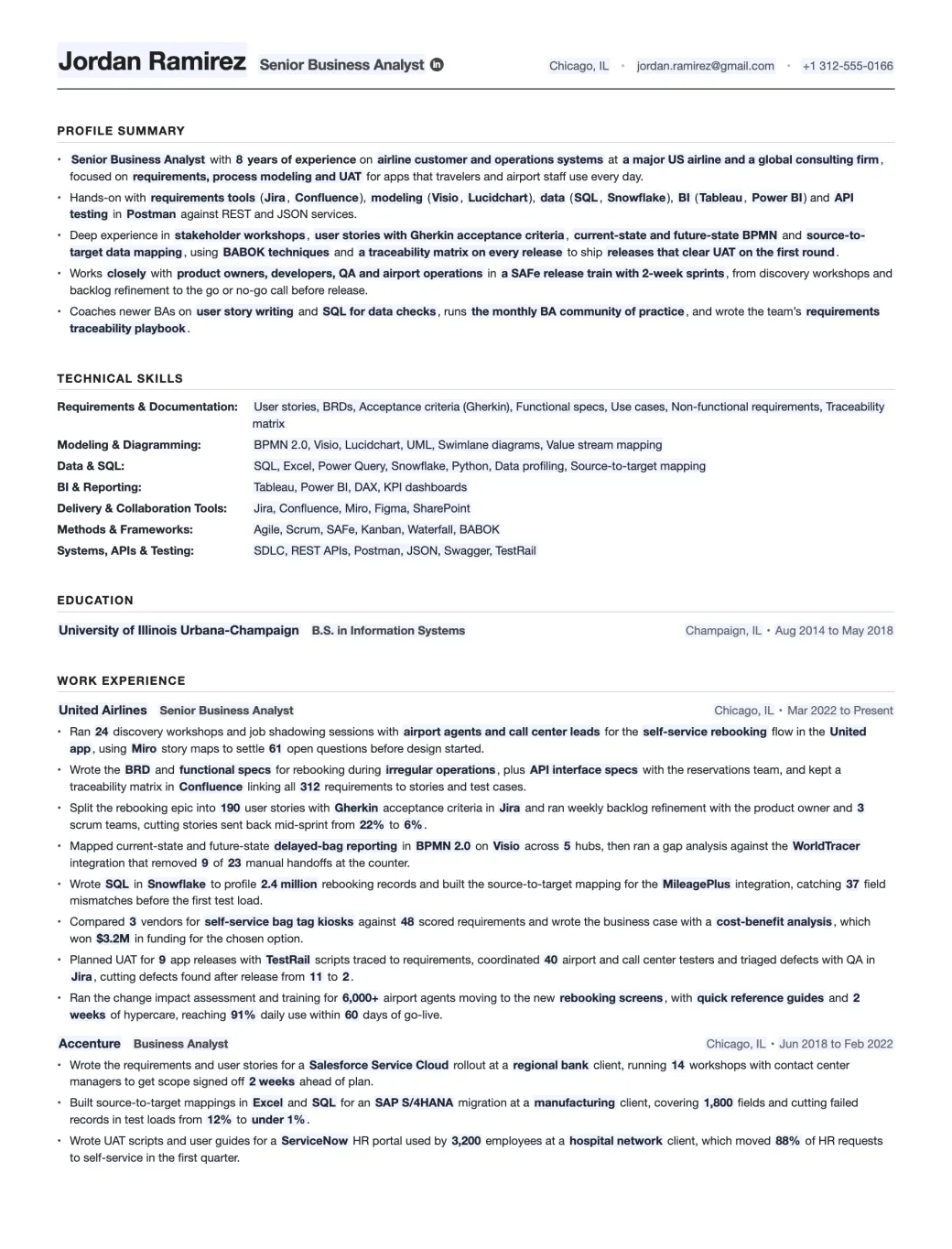
Business Analyst resume template filled in for a senior BA at United Airlines, with a 5-bullet profile summary, 7 skills rows and 11 work experience bullets
Emmanuel Gendre Ex-Google recruiter / Tech resume writer Updated Free, ATS-friendly, no signup

Interactive resume template generator

Interactive Business Analyst Resume Template

Fill in the side panel, then download your resume as a PDF or a Word file.

Edits update live as you type. Toggle Edit to rewrite paper text directly.

Edit mode is on. Click anywhere on the resume to rewrite text. Side-panel placeholders still update live.

Jordan Ramirez Senior Business Analyst

Chicago, IL • jordan.ramirez@gmail.com • +1 312-555-0166

Profile Summary

  • Senior Business Analyst with 8 years of experience on airline customer and operations systems at a major US airline and a global consulting firm, focused on requirements, process modeling and UAT for apps that travelers and airport staff use every day.
  • Hands-on with requirements tools (Jira, Confluence), modeling (Visio, Lucidchart), data (SQL, Snowflake), BI (Tableau, Power BI) and API testing in Postman against REST and JSON services.
  • Deep experience in stakeholder workshops, user stories with Gherkin acceptance criteria, current-state and future-state BPMN and source-to-target data mapping, using BABOK techniques and a traceability matrix on every release to ship releases that clear UAT on the first round.
  • Works closely with product owners, developers, QA and airport operations in a SAFe release train with 2-week sprints, from discovery workshops and backlog refinement to the go or no-go call before release.
  • Coaches newer BAs on user story writing and SQL for data checks, runs the monthly BA community of practice, and wrote the team’s requirements traceability playbook.

Technical Skills

Requirements & Documentation:
User stories, BRDs, Acceptance criteria (Gherkin), Functional specs, Use cases, Non-functional requirements, Traceability matrix
Modeling & Diagramming:
BPMN 2.0, Visio, Lucidchart, UML, Swimlane diagrams, Value stream mapping
Data & SQL:
SQL, Excel, Power Query, Snowflake, Python, Data profiling, Source-to-target mapping
BI & Reporting:
Tableau, Power BI, DAX, KPI dashboards
Delivery & Collaboration Tools:
Jira, Confluence, Miro, Figma, SharePoint
Methods & Frameworks:
Agile, Scrum, SAFe, Kanban, Waterfall, BABOK
Systems, APIs & Testing:
SDLC, REST APIs, Postman, JSON, Swagger, TestRail

Education

University of Illinois Urbana-Champaign B.S. in Information Systems
Champaign, IL • Aug 2014 to May 2018

Work Experience

United Airlines Senior Business Analyst
Chicago, IL • Mar 2022 to Present
  • Ran 24 discovery workshops and job shadowing sessions with airport agents and call center leads for the self-service rebooking flow in the United app, using Miro story maps to settle 61 open questions before design started.
  • Wrote the BRD and functional specs for rebooking during irregular operations, plus API interface specs with the reservations team, and kept a traceability matrix in Confluence linking all 312 requirements to stories and test cases.
  • Split the rebooking epic into 190 user stories with Gherkin acceptance criteria in Jira and ran weekly backlog refinement with the product owner and 3 scrum teams, cutting stories sent back mid-sprint from 22% to 6%.
  • Mapped current-state and future-state delayed-bag reporting in BPMN 2.0 on Visio across 5 hubs, then ran a gap analysis against the WorldTracer integration that removed 9 of 23 manual handoffs at the counter.
  • Wrote SQL in Snowflake to profile 2.4 million rebooking records and built the source-to-target mapping for the MileagePlus integration, catching 37 field mismatches before the first test load.
  • Compared 3 vendors for self-service bag tag kiosks against 48 scored requirements and wrote the business case with a cost-benefit analysis, which won $3.2M in funding for the chosen option.
  • Planned UAT for 9 app releases with TestRail scripts traced to requirements, coordinated 40 airport and call center testers and triaged defects with QA in Jira, cutting defects found after release from 11 to 2.
  • Ran the change impact assessment and training for 6,000+ airport agents moving to the new rebooking screens, with quick reference guides and 2 weeks of hypercare, reaching 91% daily use within 60 days of go-live.
Accenture Business Analyst
Chicago, IL • Jun 2018 to Feb 2022
  • Wrote the requirements and user stories for a Salesforce Service Cloud rollout at a regional bank client, running 14 workshops with contact center managers to get scope signed off 2 weeks ahead of plan.
  • Built source-to-target mappings in Excel and SQL for an SAP S/4HANA migration at a manufacturing client, covering 1,800 fields and cutting failed records in test loads from 12% to under 1%.
  • Wrote UAT scripts and user guides for a ServiceNow HR portal used by 3,200 employees at a hospital network client, which moved 88% of HR requests to self-service in the first quarter.

Done editing? Download a real PDF (selectable text, ATS-friendly, US Letter) or an editable Word file if a recruiter asks for one.

About this template

A Business Analyst resume template, built by a tech recruiter.

As a business analyst on a tech team, you’re the person who works out what the software actually has to do. You sit with the people who use a system, write down what they need, map how their work flows and turn it into requirements and user stories developers can build. Then you check the data, run UAT with the business and help people move to the new system after go-live.

Most BA resumes I read say the same thing: gathered requirements, ran meetings, wrote documentation. Every BA does that, so a recruiter learns nothing about you from it. What earns the interview is evidence that your requirements held up once the build started. Think of the stories that didn’t bounce back mid-sprint, the defects your UAT caught, the handoffs your process map removed or the business case that got funded.

Each of those results has a slot in this template. Jordan, the BA filled in above, has 8 bullets in his current job, one per area a BA hiring manager checks, starting with workshops and ending with user adoption. My 3 samples run from a 2-year junior to an 11-year lead. No draft yet? Scroll past the samples, where 6 steps to write a Business Analyst resume walk you through it.

If you’ve got a resume already, send it through the upload box under the examples, and I’m happy to review your CV at no cost. I look at each upload personally.

Industry signal

What the market says about Business Analyst roles

The government doesn’t track business analysts as a job of their own. The closest series is the BLS outlook for computer systems analysts, and its 10-year projection runs to 8% growth by 2035. Deadlines keep adding BA work on top of that. Health plans need new prior authorization APIs by January 1, 2027 under the CMS interoperability and prior authorization rule, and SAP ends mainstream maintenance for ECC when 2027 ends. Each of those projects needs someone to work out what the new system must do, and that person is the business analyst.

+8% US computer systems analyst job growth US Bureau of Labor Statistics
$92,935 Average base pay, US Business Analyst ads Indeed

Resume Samples

Business Analyst Resume Examples

A 2-year BA and an 11-year BA get judged on different things, and my 3 BA resume samples, all on software and systems projects, show what changes. The junior writes requirements for Costco’s buy online, pick up in store orders. The senior works on disability and absence claims systems at MetLife. The lead heads a team of BAs on prior authorization changes at Blue Cross and Blue Shield of Minnesota. You can download each one as a PDF or a Word file, free and with no signup.

Junior Business Analyst Resume Example

A junior BA resume needs proof that you can get requirements out of people and check them: show the workshops, user stories and UAT scripts you worked on. If you don’t have a BA title yet, lead with the analysis you already do at work, like a process you mapped or a report your manager now uses. Keep your real job title, even if it says functional or systems analyst.

Years of experience
2 years
Industry
Retail
Stack
JiraConfluenceLucidchartExcel
Download PDF Download Word

Click to download the Junior Business Analyst resume example as a PDF or a Word file. Free / No signup.

Tasha Williams

Junior Business Analyst

Issaquah, WA · tasha.williams@gmail.com · +1 425-555-0151 · linkedin.com/in/tashawilliams

Profile Summary

  • Junior Business Analyst with 2 years in Costco IT on the Fulfillment Solutions team, writing requirements for BOPIS orders in Manhattan Active Omni, after 3 years of part-time stock and fulfillment work at Nordstrom.
  • Writes user stories in Jira and specs in Confluence, draws process maps in Lucidchart and Visio, queries order data in SQL, checks files in Excel and Power Query, and builds reports in Manhattan SCI.
  • Knows the pickup flow from paid order to counter handoff, the order status codes shared by Manhattan Active Omni and LEA Reply, and writes Given/When/Then criteria before any story goes to refinement.
  • Works with the product owner, Manhattan developers, QA and warehouse front-end managers, and joins vendor calls with Manhattan and Reply when a defect needs a configuration fix.
  • Wrote the team’s BOPIS test data guide, shows new analysts how to read an order’s status history, holds the IIBA ECBA, and is studying for the CCBA.

Technical Skills

Requirements & Documentation:
User stories, acceptance criteria (Given/When/Then), functional specs, use cases, traceability matrix
Modeling & Diagramming:
BPMN 2.0 (basics), Lucidchart, Visio, swimlane diagrams
Data & SQL:
SQL (joins and aggregates), Excel, Power Query, data profiling
BI & Reporting:
Manhattan SCI, Power BI (basics), Excel pivot tables
Delivery & Collaboration Tools:
Jira, Confluence, ServiceNow, Microsoft Teams
Methods & Frameworks:
Agile, Scrum, BABOK v3 (ECBA)
Systems, APIs & Testing:
Manhattan Active Omni, LEA Reply, REST APIs (reading specs), Postman (basics), UAT scripts
Page 2 of 2

Work Experience

Costco Wholesale Functional Analyst, Fulfillment Solutions Issaquah, WA · Sep 2024 to Present
  • Interviewed front-end managers and shadowed pickup counter staff at 6 warehouses before the BOPIS pickup redesign, finding the partial-pickup and ID-check cases behind 23% of counter delays.
  • Wrote the functional spec for order-ready notifications in Manhattan Active Omni, with a traceability matrix in Confluence tying each requirement to a test case, and all 64 were tested before release.
  • Wrote the pickup user stories in Jira with Given/When/Then acceptance criteria and refined them each week with the product owner, cutting stories sent back at sprint planning from 31% to 8%.
  • Queried order history in SQL to compare status codes between Manhattan Active Omni and LEA Reply, and found 2 unmapped codes that left 1,180 orders a month showing as not ready.
  • Wrote the UAT scripts from the traceability matrix and ran testing with front-end staff from 4 warehouses, and the pickup release went live with 0 severity 1 defects in its first month.
Nordstrom Stock and Fulfillment Associate (part-time) Seattle, WA · Sep 2021 to Aug 2024
  • Mapped the downtown store’s online order pickup flow from stockroom to counter in Lucidchart for the operations manager, and dropping 2 duplicate scans cut the average pickup wait from 9 minutes to 5.
  • Timed pickups on 2 shelf layouts for 3 weeks and compared their costs in Excel, and the store went with the layout that was just as fast and saved $4,100 in fixtures.
  • Wrote a 1-page guide for the handheld pickup app and coached new hires on the floor, and scan-in errors on pickup orders fell from 7% to 2% over the holiday season.

Education

University of Washington Foster School of Business B.A. in Business Administration, Information Systems Seattle, WA · Sep 2020 to Jun 2024
IIBA ECBA certification Issaquah, WA · Mar 2025

Senior Business Analyst Resume Example

By senior level, nobody wonders if you can write a user story. Your resume should show the projects you’ve carried from discovery to go-live, the data and API work behind them, and a number on each result. Rework you saved and defects you caught before release both count.

Years of experience
7 years
Industry
Group insurance
Stack
JiraSnowflakeTableauPostman
Download PDF Download Word

Click to download the Senior Business Analyst resume example as a PDF or a Word file. Free / No signup.

Ferdinand Reyes

Senior Business Analyst

New York, NY · ferdinand.reyes@gmail.com · +1 646-555-0184 · linkedin.com/in/ferdinandreyes

Profile Summary

  • Senior Business Analyst with 7 years in group insurance, now on MetLife’s disability and absence claims systems (MyBenefits and Total Absence Management), after 3 years on Prudential’s group insurance data exchange team.
  • Works across requirements (Jira, Confluence), modeling (BPMN 2.0 in Visio and Lucidchart), data (SQL, Snowflake, Excel), APIs (Postman, Swagger), reporting (Tableau) and test planning in TestRail.
  • Knows short-term and long-term disability, FMLA and state paid leave rules and employer eligibility feeds, and starts every project with a current-state process map before anyone writes a requirement.
  • Works with claim operations leaders, compliance, product owners, developers and QA across New York and Cary, NC, and walks employer HR teams through feed specs during client implementations.
  • Mentors 2 business analysts on story writing and SQL, wrote the team’s UAT sign-off checklist, runs the monthly BA practice meeting for Group Benefits, and holds the IIBA CCBA.

Technical Skills

Requirements & Documentation:
BRDs, functional specs, user stories, acceptance criteria, use cases, non-functional requirements, traceability matrix
Modeling & Diagramming:
BPMN 2.0, Visio, Lucidchart, swimlane diagrams, UML activity diagrams
Data & SQL:
SQL, Snowflake, Excel, Power Query, data profiling, source-to-target mapping
BI & Reporting:
Tableau, Power BI, KPI dashboards
Delivery & Collaboration Tools:
Jira, Confluence, Miro, SharePoint
Methods & Frameworks:
Agile, Scrum, SAFe, Kanban, BABOK v3
Systems, APIs & Testing:
SDLC, REST APIs, JSON, Swagger, Postman, TestRail, EDI 834 eligibility files
Page 2 of 2

Work Experience

MetLife Senior Business Analyst New York, NY · Apr 2022 to Present
  • Ran workshops with claim specialists, compliance and employer HR teams on the new Minnesota and Delaware paid leave programs, and got the leave rules for Total Absence Management signed off 3 weeks early.
  • Wrote the functional spec and traceability matrix for the MyBenefits short-term disability claim flow, tying each requirement to a design and a test, and change requests after sign-off fell from 23 to 6.
  • Mapped current and future-state disability claim intake in BPMN 2.0, from MyBenefits to the claim file, and the gap analysis removed the re-keying in between, saving claim specialists 11 minutes a claim.
  • Built the source-to-target mapping for leave data from employer HR systems such as Workday into Total Absence Management, with SQL checks that cut rejected records per feed from 4.2% to 0.6%.
  • Led UAT for the paid leave release with claim specialists as testers, triaged defects with QA each morning in Jira, and closed all 47 high-priority defects before the Jan 1, 2026 go-live.
Prudential Financial Business Analyst, Data Exchange Newark, NJ · Jul 2019 to Mar 2022
  • Wrote user stories and acceptance criteria in Jira for onboarding employer eligibility files in Group Insurance, refining them with the product owner each sprint, and cut new client setup from 9 weeks to 5.
  • Scored 3 file validation tools against the team’s requirements and wrote the cost-benefit analysis for the one Group Insurance bought, which saved 1,870 hours a year of manual file fixes.
  • Wrote job aids and ran remote training for implementation managers moving to a new file tracker in 2020, and the post-launch review found 94% of new files logged there by week 6.

Education

NYU Stern School of Business B.S. in Business, Finance and Information Systems New York, NY · Sep 2015 to May 2019
IIBA CCBA certification New York, NY · Nov 2022

Lead Business Analyst Resume Example

At lead level, your BA resume has to show the program you run, the analysts you lead, the standards they follow and the funding your business case won. Keep 1 or 2 hands-on bullets too. Directors still want to see that you haven’t stopped writing requirements yourself.

Years of experience
11 years
Industry
Health insurance
Stack
Azure DevOpsSwaggerPower BIConfluence
Download PDF Download Word

Click to download the Lead Business Analyst resume example as a PDF or a Word file. Free / No signup.

Gabriela Stojanović

Lead Business Analyst

Minneapolis, MN · gabriela.stojanovic@gmail.com · +1 612-555-0196 · linkedin.com/in/gabrielastojanovic

Profile Summary

  • Lead Business Analyst with 11 years in health insurance at Blue Cross and Blue Shield of Minnesota and Anthem, now leading the BAs on Blue Cross’s prior authorization program under the CMS-0057-F rule.
  • Works across API specs (FHIR R4, Swagger, Postman), EDI (X12 278 and 834), data (SQL, Snowflake, Excel), modeling (BPMN 2.0 in Visio), delivery (Azure DevOps, Confluence) and reporting (Power BI).
  • Expert in prior authorization, UM decision rules and payer APIs built on the Da Vinci CRD, DTR and PAS guides, and traces every requirement back to the rule section it comes from.
  • Works with the UM and provider relations directors, compliance and IT, plus outside API vendors, and reports program status to the interoperability steering committee every month.
  • Leads 4 business analysts, wrote the BA team’s standards for user stories, traceability and UAT sign-off, has helped 2 analysts earn senior titles since 2023, and holds the IIBA CBAP.

Technical Skills

Requirements & Documentation:
BRDs, functional and non-functional requirements, use cases, user stories, acceptance criteria, interface specs, traceability matrix
Modeling & Diagramming:
BPMN 2.0, Visio, Lucidchart, UML sequence diagrams, value stream mapping
Data & SQL:
SQL, Snowflake, Excel, Python (pandas basics), data profiling, source-to-target mapping
BI & Reporting:
Power BI, DAX, Tableau, KPI dashboards
Delivery & Collaboration Tools:
Azure DevOps, Confluence, Jira, Miro, SharePoint, Smartsheet
Methods & Frameworks:
Agile, Scrum, SAFe, Waterfall, BABOK v3
Systems, APIs & Testing:
HL7 FHIR R4, Da Vinci CRD, DTR and PAS, X12 278 and 834, REST APIs, Swagger, Postman, TestRail
Page 2 of 2

Work Experience

Blue Cross and Blue Shield of Minnesota Principal Business Analyst Eagan, MN · Apr 2021 to Present
  • Ran discovery workshops with UM nurses, medical directors and provider relations ahead of the Jan 2026 decision deadlines, finding the fax and phone request types behind 61% of late standard decisions.
  • Turned the CMS-0057-F rule text into business requirements with the compliance office, tracing each one to its rule section, design and test case in Azure DevOps, and the 2025 internal audit closed with 0 findings.
  • Set the story standard for the 4 BAs on the program, with Given/When/Then criteria and a definition of ready, and ran weekly refinement that cut stories pulled mid-sprint from 19% to 5%.
  • Scored 3 vendors and an in-house build for the Prior Authorization API against the Da Vinci CRD, DTR and PAS guides, and wrote the business case the steering committee approved at $3.8M.
  • Led UAT and the go or no-go call for the 72-hour expedited and 7-day standard decision rules for Medicare Advantage and Medicaid members, and on-time standard decisions reached 98.6% in Q1 2026.
Anthem, Inc. (now Elevance Health) Business Analyst II, then Business Analyst III Indianapolis, IN · Jun 2015 to Mar 2021
  • Wrote the source-to-target mapping for member eligibility and accumulator files when pharmacy members moved from Express Scripts to IngenioRx in 2019, with SQL checks that caught 3,412 mismatched deductible balances before cutover.
  • Drew current and future-state BPMN maps of member appeals in Visio for a case management system replacement, and the gap analysis cut average appeal turnaround from 24 days to 17.
  • Wrote job aids and ran training for the appeals associates moving to the new case system, then led hypercare after go-live, with 96% of new cases worked in it by week 4.

Education

University of Minnesota Carlson School of Management B.S.B. in Management Information Systems Minneapolis, MN · Sep 2011 to May 2015
IIBA CBAP certification Indianapolis, IN · Oct 2019

Free resume review

A recruiter screen, but with feedback

You applied to hundreds of jobs: no result. Companies won’t give you feedback, so you’re stuck in a loop. Rejections will keep coming until you know what’s wrong.

Let’s break this cycle today!

I’ll screen your resume the same way I did at Google.

You’ll get:

  • Your resume sections and content scored.
  • A clear list of what to improve, why, and how.
  • Behind the scenes secrets on the screening process.

How I rewrite Business Analyst resumes

How to write a Business Analyst resume

Emmanuel Gendre, ex-Google recruiter

Emmanuel Gendre Ex-Google recruiter, tech resume writer

Google took up many of my 13 years in recruiting. Business analyst resumes still reach my inbox most weeks now that I rewrite resumes. The weak ones go wrong in one spot. Someone who spent 5 years translating between operations and engineering writes “worked with stakeholders to gather requirements” and leaves it there, and the hiring manager has no idea which system exists because of them.

If a BA books my tech resume services, every bullet I write ends up with the system, the method and the outcome in it. If you’re doing it yourself, though, focus on these 6 steps. I’ve put a BA example under every one.

  1. Step 1 Format & layout Section names any ATS knows, one column, and a PDF file. Go to step 1
  2. Step 2 Profile Summary 5 bullets on your level, your systems and your BA toolkit. Go to step 2
  3. Step 3 Work Experience Your latest role, covering all 8 BA areas from workshops to adoption. Go to step 3
  4. Step 4 Bullet Points Take “gathered requirements” and add techniques, tools, a method and a result. Go to step 4
  5. Step 5 Technical Skills 7 skill rows, from requirements to APIs, plus 5 soft skills. Go to step 5
  6. Step 6 Keywords & Metrics The keywords BA recruiters search, plus 24 metrics with sample bullets. Go to step 6

Step 1 · Format & Layout

Business Analyst resume format and layout

The layout takes the least effort to fix, which is why it comes first. Software splits your resume into titles, employers and dates before any human looks at it. Then a recruiter scans the page for those exact details, and a plain layout makes both jobs easy.

01ATS Compliance

ATS compliance for your Business Analyst resume

Your application gets stored in an Applicant Tracking System (ATS) as searchable text long before a hiring manager opens it. Recruiters query that text later, sometimes months later, for words like “BPMN” or “UAT”. Columns and text boxes can break the parsing, and then your resume never comes up in that search. The mechanics are in my article about what an ATS does with your resume file. For BA candidates, the job comes down to 3 rules:

The 3 rules
  1. Use a 100% text based format (no Canva!)

  2. Avoid tables, pictures, and complex structures.

  3. Use the most predictable section names, like “Profile Summary” and “Work Experience”

02Design & Layout

Business Analyst resume design and layout

A few BA resumes I’ve received had a swimlane timeline of the candidate’s career, or a radar chart rating their “stakeholder skills”. People who draw diagrams all day find that tempting. Still, recruiters hate fancy designs. Deep into a stack of resumes, they want to find your title, employer and start dates without hunting, and any graphic just slows that down.

That’s why I push BAs toward a boring, predictable page: one column, one font family and standard section titles. Bring the process map to the interview instead, where you can walk the panel through it. Jordan’s template follows the specs below, so copy them if you build your own file.

Layout Spec
Columns
One. No sidebars, tables, columns, pictures or tabs.
Margins
0.7 in on all four sides
Body size
10 to 11 pt
Type
One family, weight for hierarchy
Length
One page under 5 years, two after
Section order
Summary, Skills, Experience, Education
PDF

03File Format

Resume file format for your Business Analyst resume

PDF is the right default. The formatting stays put on any laptop, and as long as you exported it from a text editor, the ATS gets all of your text. Photos and scans of a paper resume give it nothing. Have the Word version on hand too, because staffing firms that place contract BAs often want a file they can edit into their own layout. Online forms and other exceptions are covered in my resume file format guide.

Format Guide
PDF
Your default. Layout holds, text stays selectable.
Word (.docx)
When the posting or a recruiter asks for it. Use the Word download above.
Plain text
For portals that make you paste into a box
Never
Images, scans, password-protected PDFs, shared-drive links
File name
Jordan-Ramirez-Business-Analyst.pdf

Step 2 · Profile Summary

Business Analyst profile summary

Don’t skip the profile summary, even in your first BA job. Recruiters go through resumes twice: once fast, to cut the pile down, and once slowly, for the ones that made the cut. On the fast round, plenty of recruiters read the summary and nothing else. My write-up on the two rounds of a recruiter resume screen covers both in detail.

Your summary should settle 3 things before the recruiter scrolls. Which systems and projects do you know? Which BA tools are part of your normal week? Will product owners, developers and the business all want you in the room? The 5 bullets below split those questions up. For more worked examples, see my guide to profile summaries on tech resumes.

  1. 1

    Title, years and scope

    Lead with the ad’s own title (Business Analyst, Business Systems Analyst, IT Business Analyst), add your years, then the systems you’ve worked on, like claims, ERP or airline apps. Recruiters set your level from this one line.

  2. 2

    Your stack

    Your everyday toolkit in labelled groups: requirements tools, modeling, data, BI and API testing. Recruiters tick this line off against the ad, so match how the ad spells each product.

  3. 3

    Domain expertise

    The BA work you do best, such as workshops, story writing or data mapping, plus the method you lean on, like BABOK techniques or a traceability matrix. It tells a hiring manager which of their projects you could pick up first.

  4. 4

    Collaboration

    Who you work with most: product owners, developers, QA, business users, vendors. Add where you meet them, like discovery workshops, backlog refinement and go or no-go calls. Recruiters look for it because BA work is mostly people work.

  5. 5

    Leadership

    The things other BAs now use because of you: a story template, a playbook, a community of practice, the newer analysts you trained. Direct reports aren’t required. Recruiters see it as proof you make the team around you better.

Business Analyst resume summary example, from the template above
  • Senior Business Analyst with 8 years of experience on airline customer and operations systems at a major US airline and a global consulting firm, focused on requirements, process modeling and UAT for apps that travelers and airport staff use every day.
  • Hands-on with requirements tools (Jira, Confluence), modeling (Visio, Lucidchart), data (SQL, Snowflake), BI (Tableau, Power BI) and API testing in Postman against REST and JSON services.
  • Deep experience in stakeholder workshops, user stories with Gherkin acceptance criteria, current-state and future-state BPMN and source-to-target data mapping, using BABOK techniques and a traceability matrix on every release to ship releases that clear UAT on the first round.
  • Works closely with product owners, developers, QA and airport operations in a SAFe release train with 2-week sprints, from discovery workshops and backlog refinement to the go or no-go call before release.
  • Coaches newer BAs on user story writing and SQL for data checks, runs the monthly BA community of practice, and wrote the team’s requirements traceability playbook.

Step 3 · Work Experience

Business Analyst work experience

Step 2 promised a slower second read, and this is where it happens. A recruiter who liked your summary jumps to your latest role next, and I’d put the share of the decision riding on it at 95%. It’s logical: the team needs the BA you are now, on today’s systems, and what you did 6 years ago counts for much less.

So give that latest job a bullet for workshops, specs, stories, process maps, data, business cases, UAT and adoption. Together they make up the Business Analyst role profile, which works as a hiring manager’s scorecard. Skip UAT, say, and they’ll assume a tester owned it, even if you ran every test session yourself.

Business Analyst role profile
  1. Requirements Elicitation & Workshops

    You draw the real requirements out of people who don’t always know how to say what they need. Plenty of failed projects started with a question nobody asked, and BA hiring managers look for someone who keeps digging past the first answer. Talk about how you used workshops, job shadowing and quick wireframes to settle open questions before design started.

    Techniques
    stakeholder interviews, discovery workshops, job shadowing, wireframes
    Tools
    Miro, Figma, Confluence, Microsoft Teams
    Metrics
    workshops run, open questions closed, changes after sign-off
  2. Requirements Specs & Traceability

    You write requirements that a developer can build and a tester can check. A vague requirement comes back later as rework or a defect, so managers want to see a clear line from each requirement to its test. Show them how you used BRDs, functional specs and a traceability matrix to keep every requirement covered at release.

    Techniques
    BRDs, functional and non-functional requirements, use cases, change control
    Tools
    Confluence, Jira, Jama Connect, Excel
    Metrics
    requirements traced, defects from unclear requirements, spec turnaround
  3. User Stories & Backlog Refinement

    You break big features into stories a scrum team can finish in one sprint. Stories that bounce back mid-sprint slow the whole team down, and product owners remember the BA who wrote them. Explain how you used Gherkin acceptance criteria and weekly backlog refinement to cut the number of stories sent back.

    Techniques
    story splitting, Gherkin acceptance criteria, backlog refinement, story mapping
    Tools
    Jira, Azure DevOps, Miro
    Metrics
    stories written, stories sent back, sprint carryover
  4. Process Modeling & Gap Analysis

    You map how the work runs today and design how it should run on the new system. A system that copies a broken process just makes the mess faster, so hiring managers like BAs who find the waste first. Point out how you used BPMN diagrams and a gap analysis to remove handoffs, steps or delays.

    Techniques
    current-state and future-state maps, gap analysis, root-cause analysis, value stream mapping
    Tools
    BPMN 2.0, Visio, Lucidchart, SAP Signavio
    Metrics
    handoffs removed, cycle time, manual steps automated
  5. Data Analysis & Data Mapping

    You check the data yourself instead of trusting what people say about it. Integrations and migrations break on data more often than on code, and a BA who writes SQL finds the problems weeks earlier. Describe how you used SQL profiling and a source-to-target mapping to catch mismatches before the first test load.

    Techniques
    data profiling, source-to-target mapping, validation rules, reconciliation
    Tools
    SQL, Snowflake, Excel, Power Query
    Metrics
    records profiled, mapping errors caught, failed records in test loads
  6. Solution Assessment & Business Cases

    You help the business choose what to buy or build, and you put a price on it. Leadership only funds what it understands, and a clear business case is frequently the reason a system project gets approved. Walk them through how you weighed vendors with a scoring model and cost-benefit analysis to win funding or avoid a cost.

    Techniques
    build-versus-buy reviews, vendor scoring, RFP requirements, cost-benefit analysis
    Tools
    Excel, PowerPoint, Smartsheet
    Metrics
    funding won, cost avoided, vendors evaluated
  7. UAT & Release Sign-Off

    You prove the system does what the business asked for before it goes live. Defects that real users find after release cost the most, in money and in trust, so managers look closely at how you ran testing. Tell them how you used UAT scripts traced to requirements and defect triage to cut the issues found after release.

    Techniques
    UAT planning, test scripts, defect triage, go or no-go criteria
    Tools
    TestRail, Zephyr Scale, Jira, Postman
    Metrics
    defects after release, first-run UAT results, releases signed off
  8. Change Management & User Adoption

    You get people using the new system for real once it’s live. A rollout people avoid has wasted the budget, and hiring managers know it. Mention how you used training, quick reference guides and hypercare to raise daily use or bring down the help desk queue.

    Techniques
    change impact assessments, training plans, user guides, hypercare
    Tools
    SharePoint, WalkMe, ServiceNow
    Metrics
    daily active users, support tickets, time to proficiency

That’s 8 bullets for your current job, and recruiters don’t mind when each line proves something. Moving into BA work from QA, support or operations? Write bullets for the areas you already cover, then build experience in the rest.

Submit your resume for a free review!

Step 4 · Bullet Points

Business Analyst resume bullet points

When I rewrite a BA resume, the bullets take longer than everything else combined. Years of that work became the Level System. Its starting point is the XYZ formula Google recruiters know, and it adds the 2 things technical hiring managers ask about: how you did the work and what you used. Every rule is written up in my bullet point guide for tech resumes.

There are 5 levels in all. Each asks something about the work, and your answer goes into the line. On a BA bullet, the final number tends to be rework you prevented, defects UAT caught, hours cut from a process or money saved. Below, one BA bullet climbs all 5.

  1. Level 1Task

    What did I work on? Start with a verb and one project you delivered. At this stage, it could be any BA’s bullet.

    Wrote the requirements for an online returns portal.

  2. Level 2+ Techniques

    How did I do it? Add the BA techniques you used. This is where a hiring manager starts to see how you work.

    Wrote the requirements for an online returns portal, running stakeholder workshops and writing use cases.

  3. Level 3+ Tools

    What tools did I use? List the products by name. Recruiters search the ATS for Jira or Visio, and vague wording won’t match.

    Wrote the requirements for an online returns portal, running stakeholder workshops and writing use cases in Confluence and Jira.

  4. Level 4+ Method

    What method did I follow? Say how you made sure the requirements held up. Few BAs add this, and it tells a manager you work with discipline.

    Wrote the requirements for an online returns portal, running stakeholder workshops and writing use cases in Confluence and Jira, with every requirement traced to a UAT test case in a traceability matrix.

  5. Level 5+ Metric

    What was the result? End on one number a hiring manager cares about: rework, defects, time or money.

    Wrote the requirements for an online returns portal, running stakeholder workshops and writing use cases in Confluence and Jira, with every requirement traced to a UAT test case in a traceability matrix, cutting defects found after launch from 31 to 4.

    1. 01 Task What you worked on
    2. 02 Techniques How you did it
    3. 03 Tools The stack you used
    4. 04 Method The method you followed
    5. 05 Metric The result, one number

Most BAs have these numbers and don’t know it. Jira keeps every story and defect, TestRail keeps your UAT runs, and the business case has the funding figure. Dig them out first, then start writing.

Step 5 · Technical Skills

Business Analyst resume skills

In the BA postings I read, skills land in the same 7 groups: requirements documents, modeling, data and SQL, BI, delivery tools, methods, and the systems and APIs you test against. Spell tools exactly like the posting. If it asks for “Azure Boards” and your resume says “Azure DevOps”, put both, because the recruiter will search for the ad’s word.

Leave off any tool you couldn’t defend for a few minutes in an interview. Put SAP Signavio on the page, and someone will ask which process you modeled in it. Next come my 7 BA skill categories, Jordan’s finished skills section and 5 soft skills, with a proof line underneath each. Keywords get their own step next.

The 7 skill categories for a Business Analyst resume

Most BA job ads ask for the starred items, which is why each row opens with them. The rest earn a place only when a real project of yours used them.

Requirements & Documentation

The documents you write and how you write them. User stories and BRDs lead most postings, and a traceability matrix matters a lot in regulated industries like banking and health.

User storiesBRDsAcceptance criteriaFunctional specsUse casesNon-functional requirementsTraceability matrix

Modeling & Diagramming

The notation and the tools you draw processes with. BPMN 2.0 in Visio or Lucidchart is the combination BA ads ask for most often, with UML for system flows.

BPMN 2.0VisioLucidchartUMLSwimlane diagramsValue stream mapping

Data & SQL

How you check data yourself. SQL is in most IT BA postings now, and Excel with Power Query still covers a lot of day-to-day analysis.

SQLExcelPower QueryPythonSnowflakeData profilingSource-to-target mapping

BI & Reporting

The dashboards you build or define. Tableau and Power BI cover most ads, so list the one you’ve built real reports in first.

Power BITableauLookerDAXKPI dashboards

Delivery & Collaboration Tools

Where your stories, specs and workshops live. Jira and Confluence appear on most postings, and Azure DevOps takes their place in Microsoft shops.

JiraConfluenceAzure DevOpsMiroFigmaSharePoint

Methods & Frameworks

How your teams deliver. Agile and Scrum are the default, SAFe shows up at large companies, and BABOK tells a reader you know the BA craft itself.

AgileScrumSAFeKanbanWaterfallBABOKLean Six Sigma

Systems, APIs & Testing

The technical side of the job: the SDLC, the REST APIs you test in Postman and the test tools behind UAT. This row is what separates an IT BA from a general one.

SDLCREST APIsPostmanJSONSwaggerTestRailSalesforceSAP

A finished Business Analyst skills section

Technical Skills sample, from the template above
Requirements & Documentation
User stories, BRDs, Acceptance criteria (Gherkin), Functional specs, Use cases, Non-functional requirements, Traceability matrix
Modeling & Diagramming
BPMN 2.0, Visio, Lucidchart, UML, Swimlane diagrams, Value stream mapping
Data & SQL
SQL, Excel, Power Query, Snowflake, Python, Data profiling, Source-to-target mapping
BI & Reporting
Tableau, Power BI, DAX, KPI dashboards
Delivery & Collaboration Tools
Jira, Confluence, Miro, Figma, SharePoint
Methods & Frameworks
Agile, Scrum, SAFe, Kanban, Waterfall, BABOK
Systems, APIs & Testing
SDLC, REST APIs, Postman, JSON, Swagger, TestRail

Soft skills for a Business Analyst resume

Calling yourself a strong communicator convinces no one, since every BA says it. A result in a bullet does the convincing. These 5 behaviours are what I hunt for when I read a BA resume, and under each is a line that shows it.

  • Keeping a workshop on track when two departments disagree

    Resume bulletSettled a dispute between finance and warehouse operations over return rules in 2 workshops, so a release that had slipped once could go ahead.

  • Turning a developer’s constraint into plain business terms

    Resume bulletExplained a vendor API’s rate limit to the claims team in plain terms, and they agreed to a nightly batch that saved 5 weeks of rework.

  • Pushing back on scope creep in the middle of a sprint

    Resume bulletMoved 11 late change requests to the next release with the product owner’s backing, and the sprint goal still shipped on time.

  • Asking the follow-up question that finds the real requirement

    Resume bulletAsked why agents printed a report every morning and found a missing system alert, which replaced 40 minutes of manual checks a day.

  • Writing a story a developer can build without a meeting

    Resume bulletWrote acceptance criteria clear enough that 9 of 10 stories went from refinement to done without a clarification call.

Step 6 · Keywords & Metrics

Business Analyst resume keywords and metrics

My last 2 checks on any BA resume are keywords and numbers. Keywords decide whether you show up at all in an ATS search for “user stories” or “BPMN”. Metrics are the proof inside each bullet, like stories sent back, defects after release or hours saved.

Begin with the 3 keyword tiers. Then paste a job ad you’re applying to in the finder below them, and it’ll list the words your resume lacks. The table at the end has 24 business analyst metrics, 3 per area, every one inside a sample bullet.

+42%

Business Analyst resume keywords, ranked

Click a chip to read a typical job ad sentence that uses it. Requirements work, for example, gets written as “requirements gathering”, “elicitation” or “discovery”, and you should spot all three.

Must-have

8

These go everywhere: the summary, at least one bullet and the skills rows.

In a job description“Gather, analyze and document business and functional requirements”

Strong supporting

10

List the ones you can back up. When two BA resumes look equal, these are often the difference.

In a job description“Document requirements and decisions in Confluence”

Bonus

8

Worth a line when the posting mentions them and you’ve actually used them.

In a job description“Experience with Azure DevOps Boards for backlog management”

Extract Business Analyst keywords from a job description

Paste in a business analyst, business systems analyst or IT business analyst posting. You’ll get back the documents, tools, methods and systems it mentions, ranked into the 3 tiers, which tells you what to add before you apply.

Must-have
Put these in your skills section and back each one with a bullet.
Strong supporting
Add the ones you’ve actually worked with. Skip the rest.

Nothing is uploaded: it all happens in your browser.

Metrics for a Business Analyst resume

These 24 metrics are sorted by role-profile area, and a bullet shows each one at work. A single number per bullet will do.

MetricExample bullet
Elicitation
Workshops run Count Discovery workshops, interviews and shadowing sessions you led on one project.Ran 18 discovery workshops with gate agents and baggage teams before writing a single requirement for the new bag tracking screens.
Open questions closed Count Requirement questions you settled before design or build started.Closed 47 of 52 open questions on the crew app redesign before the first design review.
Changes after sign-off Percent Share of signed-off requirements that changed later in the project.Kept requirement changes after sign-off to 4% on the kiosk check-in project, down from 15% on the release before.
Requirements specs
Requirements traced Count Requirements linked to a story and a test case in your traceability matrix.Traced 280 requirements to stories and test cases for the loyalty points engine, with none left untested at release.
Defects from unclear requirements Count Defects caused by a missing or vague requirement rather than a coding error.Cut defects caused by unclear requirements from 19 to 3 per release by adding non-functional requirements to every spec.
Spec turnaround Time Time from the end of discovery to an approved specification.Got the baggage API spec approved in 9 days instead of 4 weeks by reviewing it section by section with the vendor.
User stories
Stories written Count User stories you wrote and refined with acceptance criteria.Wrote 140 user stories with Gherkin acceptance criteria for the seat map rebuild across 2 scrum teams.
Stories sent back Percent Share of stories returned to refinement because they weren’t clear enough to build.Brought stories sent back from sprint planning down from 18% to 5% with a ready checklist the product owner signed off.
Sprint carryover Percent Share of committed stories that rolled into the next sprint.Cut sprint carryover on the rebooking team from 30% to 12% by splitting stories so each fit in 3 days of work.
Process modeling
Handoffs removed Count Manual handoffs between people or teams that your future-state design took out.Removed 7 manual handoffs from the lost-item claim process after mapping it in BPMN with the airport and call center teams.
Cycle time Time Time a process takes from start to finish, before and after your change.Cut the refund approval cycle from 6 days to 1 day after mapping the current process and removing 2 approval steps.
Manual steps automated Count Steps your process work handed to a system instead of a person.Found 12 manual steps in crew scheduling that the new rules engine could take over, freeing 2 analysts for other work.
Data and data mapping
Records profiled Count Rows of source data you checked with SQL before a migration or integration.Profiled 3.1 million customer records in Snowflake with SQL before the CRM migration and fixed the duplicate rules first.
Mapping errors caught Count Field mismatches you found in a source-to-target mapping before testing.Caught 52 field mismatches in the source-to-target mapping for a new loyalty partner feed before the first test load.
Failed records in test loads Percent Share of records that failed when loaded into the target system.Brought failed records in the cargo booking migration from 9% to 0.4% across 3 test loads.
Solution assessment
Funding won Money Budget approved on the strength of your business case.Wrote the business case that won $2.6M to replace the airport baggage scanning software.
Cost avoided Money Money the company didn’t spend because of your analysis.Showed that an existing CRM module covered most of the needs, avoiding a $750K license for a new vendor.
Vendors evaluated Count Vendors or options you scored against requirements in a selection.Scored 4 vendors against 60 weighted requirements for the crew messaging app and got the pick approved in one steering meeting.
UAT and sign-off
Defects after release Count Defects users found in production after a release you tested.Cut defects found after release from 14 to 3 per app release by adding UAT scripts for every edge case in the requirements.
First-run UAT success Percent Share of UAT test cases that worked on the first run.Raised first-run UAT success on the check-in kiosks from 72% to 94% by reviewing test data with QA before each cycle.
Releases signed off Count Releases you took through UAT to a go or no-go decision.Took 11 releases of the agent desktop through UAT and sign-off in one year without a rollback.
Change and adoption
Daily active users Percent Share of the target users on the new system each day after go-live.Reached 88% daily use of the new gate app among airport agents within 6 weeks of launch.
Support tickets Count Help desk tickets about the new system in the weeks after go-live.Cut how-to tickets after the crew portal launch from 420 to 90 a week with short video guides and floor walkers.
Time to proficiency Time How long new users take to work at full speed on the system.Brought training time for new call center agents on the booking tool from 3 weeks to 8 days with a sandbox and quick reference guides.

What if you don’t have exact numbers?

  • 1

    Check Jira and TestRail first. Stories written, stories reopened, defects by release and UAT runs are all logged there, often going back years.

  • 2

    Estimates are fine. Write “around 150 user stories” and round down, so you can defend the count if an interviewer asks.

  • 3

    Count what you worked on. Without a result to report, the users you trained, the systems you connected or the business units you interviewed still tell a recruiter the size of the project.

Free resume review

A recruiter screen, but with feedback

You applied to hundreds of jobs: no result. Companies won’t give you feedback, so you’re stuck in a loop. Rejections will keep coming until you know what’s wrong.

Let’s break this cycle today!

I’ll screen your resume the same way I did at Google.

You’ll get:

  • Your resume sections and content scored.
  • A clear list of what to improve, why, and how.
  • Behind the scenes secrets on the screening process.

Frequently asked

Business Analyst resume FAQ

Yes, completely. No account, no email and no paid version. Edit it here, download your copy, and return whenever there’s a new project to add.

Yes. There are 2 download buttons, PDF and Word, and the Word file stays editable in any word processor. The 3 BA samples above come in both formats as well. I’d apply with the PDF and keep the .docx in reserve for recruiters who request one.

Yes. The layout is a single column, the headings are the standard ones, and the PDF text is selectable, so an ATS reads terms like user stories, BPMN and SQL as keywords. If you’d like to check, run your finished file through my ATS compatibility checker, then compare its output with your resume.

Under 5 years, aim for 1 page. Most senior and lead BAs need 2, because every project adds its own systems, methods and results. A BA resume gets rejected for fuzzy bullets far more often than for an extra page. My resume length guide by experience level has the full rules.

The IIBA ones carry the most weight: ECBA when you’re starting out, CCBA after a few years and CBAP once you’re senior. PMI-PBA works too, and a product owner cert like CSPO helps on Agile teams. Add them to the Education section with the date you earned them. In the postings I read, a certification is usually a plus rather than a requirement, so your projects still matter more.

Numbers that show your requirements held up and your projects paid off: stories sent back, defects found after release, requirements traced, handoffs removed, funding won and daily active users. Step 6 lists 24, 3 for every role-profile area, and each sits inside a BA bullet.

A product owner resume is about owning the backlog and deciding what gets built next. A BA resume is about working out what the system has to do and proving it does it, through workshops, specs, process maps and UAT. A data analyst resume centers on analysis and reporting, while a BA uses SQL to check requirements and data mappings. If you own the backlog, my product owner resume template fits you better. If your days are dashboards and analysis, go with the data analyst resume template.

For IT and systems BA jobs, it helps a lot. In a big chunk of the IT BA postings I read, SQL is listed by name, and hiring managers like a BA who can check the data without waiting for a developer. Put it in your skills rows, then prove it in a bullet: the data you profiled, the mismatch you caught or the report you built.

Start with the analysis you’ve already done without the title. A process you mapped in support or operations, a report your manager now uses, UAT you helped run on a system rollout: each of those can be a bullet with a tool and a number. If you have the ECBA, list it under Education, and use the junior sample above as your model.

No. A familiar layout helps a recruiter find things fast. What makes resumes blur together is generic bullets, so swap every default line in this template for your own systems, stakeholders and results.

More resources

More help with your Business Analyst resume