
Salesforce Developer Resume Examples & Free Template (PDF, Word)

This free template already holds Rebecca’s Apex, LWC and Platform Events work at T-Mobile. Type your own org over it, then click download for a PDF or a Word copy. Below, there are 3 Salesforce resume samples and my 6-step Salesforce guide.

4.9 5.0
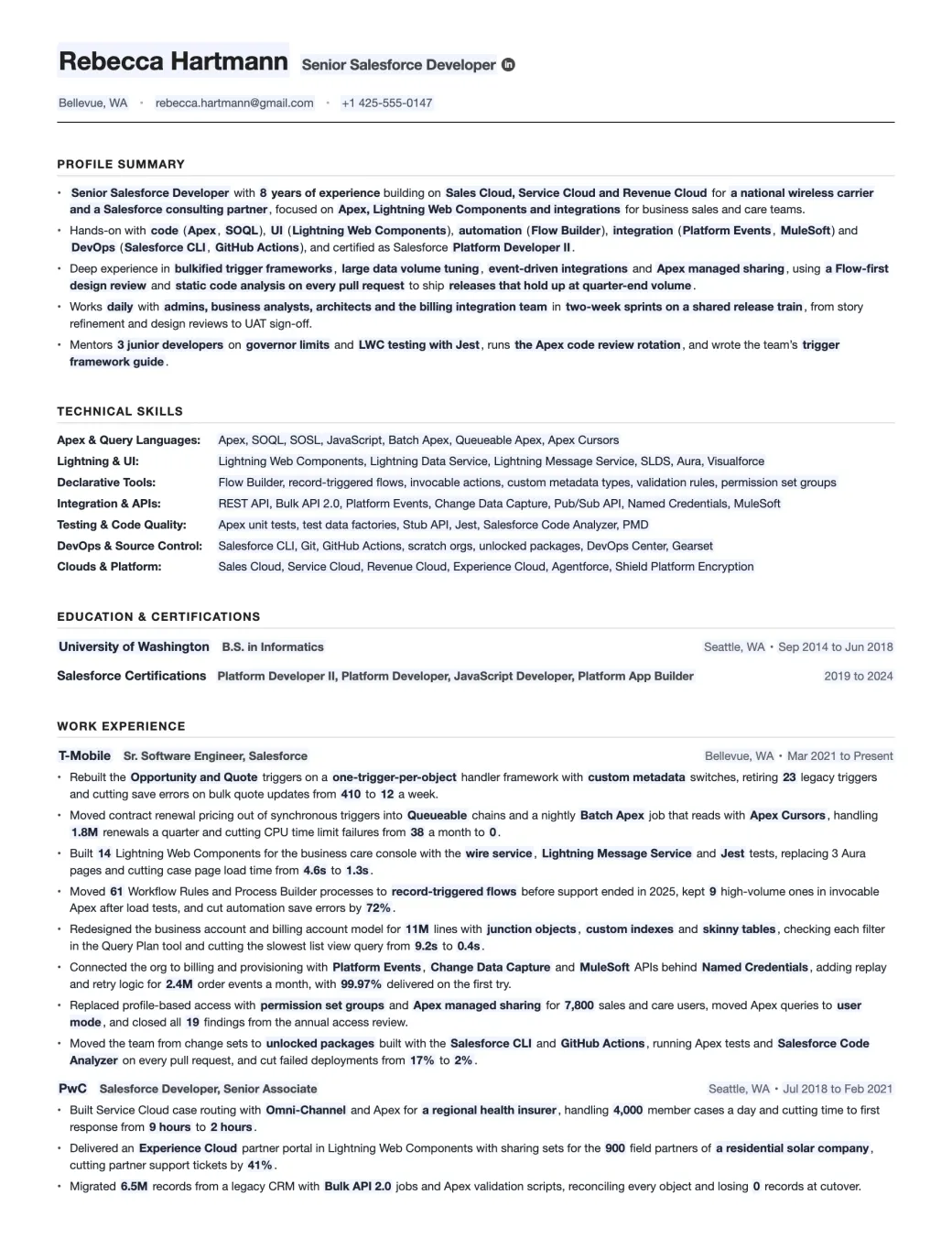
Salesforce Developer resume template filled in for a senior developer at T-Mobile, with a 5-bullet profile summary, 7 skills rows, certifications and 11 work experience bullets
Emmanuel Gendre Ex-Google recruiter / Tech resume writer Updated Free, ATS-friendly, no signup

Interactive resume template generator

Interactive Salesforce Developer Resume Template

Fill in the side panel, then download your resume as a PDF or a Word file.

Edits update live as you type. Toggle Edit to rewrite paper text directly.

Edit mode is on. Click anywhere on the resume to rewrite text. Side-panel placeholders still update live.

Rebecca Hartmann Senior Salesforce Developer

Bellevue, WA • rebecca.hartmann@gmail.com • +1 425-555-0147

Profile Summary

  • Senior Salesforce Developer with 8 years of experience building on Sales Cloud, Service Cloud and Revenue Cloud for a national wireless carrier and a Salesforce consulting partner, focused on Apex, Lightning Web Components and integrations for business sales and care teams.
  • Hands-on with code (Apex, SOQL), UI (Lightning Web Components), automation (Flow Builder), integration (Platform Events, MuleSoft) and DevOps (Salesforce CLI, GitHub Actions), and certified as Salesforce Platform Developer II.
  • Deep experience in bulkified trigger frameworks, large data volume tuning, event-driven integrations and Apex managed sharing, using a Flow-first design review and static code analysis on every pull request to ship releases that hold up at quarter-end volume.
  • Works daily with admins, business analysts, architects and the billing integration team in two-week sprints on a shared release train, from story refinement and design reviews to UAT sign-off.
  • Mentors 3 junior developers on governor limits and LWC testing with Jest, runs the Apex code review rotation, and wrote the team’s trigger framework guide.

Technical Skills

Apex & Query Languages:
Apex, SOQL, SOSL, JavaScript, Batch Apex, Queueable Apex, Apex Cursors
Lightning & UI:
Lightning Web Components, Lightning Data Service, Lightning Message Service, SLDS, Aura, Visualforce
Declarative Tools:
Flow Builder, record-triggered flows, invocable actions, custom metadata types, validation rules, permission set groups
Integration & APIs:
REST API, Bulk API 2.0, Platform Events, Change Data Capture, Pub/Sub API, Named Credentials, MuleSoft
Testing & Code Quality:
Apex unit tests, test data factories, Stub API, Jest, Salesforce Code Analyzer, PMD
DevOps & Source Control:
Salesforce CLI, Git, GitHub Actions, scratch orgs, unlocked packages, DevOps Center, Gearset
Clouds & Platform:
Sales Cloud, Service Cloud, Revenue Cloud, Experience Cloud, Agentforce, Shield Platform Encryption

Education & Certifications

University of Washington B.S. in Informatics
Seattle, WA • Sep 2014 to Jun 2018
Salesforce Certifications Platform Developer II, Platform Developer, JavaScript Developer, Platform App Builder
2019 to 2024

Work Experience

T-Mobile Sr. Software Engineer, Salesforce
Bellevue, WA • Mar 2021 to Present
  • Rebuilt the Opportunity and Quote triggers on a one-trigger-per-object handler framework with custom metadata switches, retiring 23 legacy triggers and cutting save errors on bulk quote updates from 410 to 12 a week.
  • Moved contract renewal pricing out of synchronous triggers into Queueable chains and a nightly Batch Apex job that reads with Apex Cursors, handling 1.8M renewals a quarter and cutting CPU time limit failures from 38 a month to 0.
  • Built 14 Lightning Web Components for the business care console with the wire service, Lightning Message Service and Jest tests, replacing 3 Aura pages and cutting case page load time from 4.6s to 1.3s.
  • Moved 61 Workflow Rules and Process Builder processes to record-triggered flows before support ended in 2025, kept 9 high-volume ones in invocable Apex after load tests, and cut automation save errors by 72%.
  • Redesigned the business account and billing account model for 11M lines with junction objects, custom indexes and skinny tables, checking each filter in the Query Plan tool and cutting the slowest list view query from 9.2s to 0.4s.
  • Connected the org to billing and provisioning with Platform Events, Change Data Capture and MuleSoft APIs behind Named Credentials, adding replay and retry logic for 2.4M order events a month, with 99.97% delivered on the first try.
  • Replaced profile-based access with permission set groups and Apex managed sharing for 7,800 sales and care users, moved Apex queries to user mode, and closed all 19 findings from the annual access review.
  • Moved the team from change sets to unlocked packages built with the Salesforce CLI and GitHub Actions, running Apex tests and Salesforce Code Analyzer on every pull request, and cut failed deployments from 17% to 2%.
PwC Salesforce Developer, Senior Associate
Seattle, WA • Jul 2018 to Feb 2021
  • Built Service Cloud case routing with Omni-Channel and Apex for a regional health insurer, handling 4,000 member cases a day and cutting time to first response from 9 hours to 2 hours.
  • Delivered an Experience Cloud partner portal in Lightning Web Components with sharing sets for the 900 field partners of a residential solar company, cutting partner support tickets by 41%.
  • Migrated 6.5M records from a legacy CRM with Bulk API 2.0 jobs and Apex validation scripts, reconciling every object and losing 0 records at cutover.


Done editing? Download a real PDF (selectable text, ATS-friendly, US Letter) or an editable Word file if a recruiter asks for one.

About this template

A Salesforce Developer resume template, built by a tech recruiter.

Salesforce developers write the code behind a company’s CRM, the parts that clicks in Setup can’t handle. That’s Apex triggers and classes, Lightning Web Components for the screens sales and service reps use all day, and SOQL that has to stay quick on millions of records. You’re also the one deciding when a Flow will do, hooking the org up to billing or ERP systems, and keeping the sharing model tight so each user sees only their own records.

Most Salesforce resumes I get are full of bullets like “developed Apex triggers and LWC components to meet business requirements”. Recruiters have seen that exact line on hundreds of Salesforce resumes, so it doesn’t tell them anything new. The candidates who get the call are the ones who show what their code did to a real org. Think of the limit exceptions that stopped, the list view that now loads in under a second, the nightly sync nobody has to babysit or the release that went out with no rollback.

I’ve set up this Salesforce developer resume template to give those results somewhere to go. Rebecca’s T-Mobile job covers all 8 role profile areas, Apex triggers to releases, with a bullet each, and the 3 samples below repeat that pattern from junior up to principal. For the method behind it, see 6 steps to write a Salesforce Developer resume lower on this page.

Rather have me look at the resume you’ve got? Drop it into the upload box below to get a free resume review from me, read line by line.

Industry signal

What the market says about Salesforce Developer roles

It’s a pickier market for Salesforce developers in 2026. A 10K report covered by Salesforce Ben found global demand for Salesforce talent fell 13% this year, while Agentforce demand grew 63%. In August, Salesforce said its Agentforce ARR topped $1.5 billion. And with support gone for Workflow Rules and Salesforce’s older process automation since December 2025, many orgs are now rebuilding that logic in Flow and Apex. So on your resume, show what your code does at real volume, not just which clouds you’ve used.

+10% US software developer job growth US Bureau of Labor Statistics
$120,704 Average base pay, US Salesforce Developer ads Indeed
  • Salesforce Ben @SalesforceBen · Salesforce news and careers site
    Salesforce talent demand fell 13% in 2026, but certain specialist skills are booming. So, what does this mean for your next career move? bit.ly/4ie09yi
  • AutoRABIT @autorabit · Salesforce DevSecOps platform
    AI may change how code gets written, but engineers still have a critical role. This clip explores why Salesforce developers may become even more important as teams review and govern agent-generated work. Watch the full event recording: autorabit.com/events-webinar…
  • Philippe Ozil @PhilippeOzil · Salesforce Developer Advocate
    Hey @SalesforceDevs, a nice quality of life improvement landed in the Org Explorer VS Code extension: you can now filter metadata types! In the past you had to scroll down the 200+ types to find what you were working on. Pro-tip: make sure to use wildcards (*) for text filters.
  • ApexHours @ApexHours · Salesforce developer community
    Scaling Apex and LWC with Apex Cursors youtube.com/watch?v=xaP4Ni… Thanks @andyinthecloud

Resume Samples

Salesforce Developer Resume Examples

What should change on your Salesforce resume between your first Apex trigger and the day other teams follow your code standards? My 3 Salesforce developer resume samples answer that. The junior moved from admin work at Scottish Water to Apex and Lightning Web Components at Barclays. The senior builds Service Cloud for an electric utility in Santiago. The principal sets Apex and release standards for the Salesforce teams in General Motors’ customer care. I’ve given each one bullets across all 8 areas I check when I screen a Salesforce developer. You can download each one as a PDF or a Word file, free and with no signup.

Junior Salesforce Developer Resume Example

A junior Salesforce developer resume has to prove you can write code, and that you’re not just configuring the org. Show Apex you wrote and tested, a Lightning Web Component people use, and one integration or limit problem you fixed yourself. Coming from an admin job? Don’t hide it: hiring managers like developers who already know Flow, users and access from the admin side.

Years of experience
2 years (after 4 as an admin)
Industry
Private banking
Stack
SalesforceJestGitGitHub Actions
Download PDF Download Word

Click to download the Junior Salesforce Developer resume example as a PDF or a Word file. Free / No signup.

Deirdre Callaghan

Junior Salesforce Developer

Glasgow, UK · deirdre.callaghan@gmail.com · +44 141 496 0187 · linkedin.com/in/deirdrecallaghan

Profile Summary

  • Junior Salesforce Developer with 2 years writing Apex and Lightning Web Components for a private bank’s client onboarding team, after 4 years as a Salesforce administrator at a water utility.
  • Works in Apex, SOQL and Lightning Web Components, builds record-triggered flows, calls APIs through Named Credentials, and ships with the Salesforce CLI, Git and GitHub Actions.
  • Knows the Flow vs Apex call from the admin side, writes bulkified trigger handlers that follow the team’s framework, and tests every class with real assertions, not coverage padding.
  • Works with relationship managers, business analysts and the core banking integration team in two-week sprints, demoing new screens to the bankers who use them.
  • Ran Flow lunch sessions for 6 new admins at Scottish Water, wrote the team’s Named Credentials setup guide at Barclays, and is studying for Platform Developer II.

Technical Skills

Apex & Query Languages:
Apex, SOQL, SOSL, JavaScript, Batch Apex
Lightning & UI:
Lightning Web Components, Lightning Data Service, SLDS, Lightning App Builder
Declarative Tools:
Flow Builder, record-triggered flows, validation rules, duplicate rules, permission set groups
Integration & APIs:
REST API, Named Credentials, Platform Events (basics), Data Loader
Testing & Code Quality:
Apex unit tests, test data factories, Jest, Salesforce Code Analyzer
DevOps & Source Control:
Salesforce CLI, Git, GitHub Actions, scratch orgs, sandboxes
Clouds & Platform:
Financial Services Cloud, Sales Cloud, Service Cloud
Page 2 of 2

Work Experience

Barclays Salesforce Developer Glasgow, UK · Oct 2024 to Present
  • Wrote Apex trigger handlers for the client onboarding object, moving 6 old triggers onto the team’s handler framework and cutting duplicate client records from 340 a month to 25.
  • Built 7 Lightning Web Components for relationship managers, including a client summary card on the wire service with Jest tests, cutting the clicks to open a client file from 9 to 3.
  • Wrote Apex REST callouts through Named Credentials to pull portfolio values from the core banking platform, with a retry queue that brought failed syncs down to 0.4%.
  • Moved the nightly client review job from a scheduled flow to Batch Apex, so it now handles 52,000 client records without the CPU time limit failures it hit 3 nights a week.
  • Raised Apex test coverage on the onboarding package from 68% to 91% with assertions on real outcomes, and added Salesforce Code Analyzer to the team’s GitHub Actions checks.
Scottish Water Salesforce Administrator Dunfermline, UK · Aug 2020 to Sep 2024
  • Rebuilt 34 Workflow Rules and Process Builder processes as record-triggered flows for customer service, saving the team about 6 hours of manual case updates a week.
  • Replaced 22 cloned profiles with permission sets and permission set groups for 1,400 service and field users, so each team kept only the access its work needs.
  • Cleaned up accounts and contacts with duplicate rules, matching rules and Data Loader jobs, taking duplicate accounts from 9% to under 1% before the field app went live.

Education

University of Strathclyde B.Sc. in Computer Science Glasgow, UK · Sep 2016 to Jun 2020
Salesforce Certifications Platform Developer, Platform Administrator 2021 to 2025

Senior Salesforce Developer Resume Example

At senior level, the hiring manager wants proof that you own a part of the org end to end. Show the data volumes you work at, the governor limits you designed around, an integration you built and still run, and the sharing calls you made. And don’t forget your certifications, with Platform Developer II up front.

Years of experience
8 years
Industry
Energy utility
Stack
SalesforceMuleSoftJenkinsJira
Download PDF Download Word

Click to download the Senior Salesforce Developer resume example as a PDF or a Word file. Free / No signup.

Rodrigo Peñaloza

Senior Salesforce Developer

Santiago, Chile · rodrigo.penaloza@gmail.com · +56 9 5555 0172 · linkedin.com/in/rodrigopenaloza

Profile Summary

  • Senior Salesforce Developer with 8 years in telecom and energy, now building Service Cloud for the customer care operation of an electric utility with 1,900 agents.
  • Hands-on with Apex (triggers, Queueable, Platform Event triggers), Lightning Web Components, Flow, MuleSoft and Change Data Capture, and certified as Salesforce Platform Developer II.
  • Deep experience in large data volumes (an org with 90M case records), storm-day load on Platform Events, and sharing models for contractor call centers.
  • Works with care operations, the billing and metering teams, MuleSoft developers and outsourced call center partners, from design review through hypercare after each release.
  • Runs the weekly Apex design review for 9 developers, mentors 3 mid-level engineers on governor limits, and wrote the team’s LDV query checklist.

Technical Skills

Apex & Query Languages:
Apex, SOQL, SOSL, Queueable Apex, Batch Apex, JavaScript
Lightning & UI:
Lightning Web Components, Lightning Message Service, Lightning Data Service, Aura (legacy), SLDS
Declarative Tools:
Flow Builder, record-triggered flows, invocable actions, Omni-Channel routing, restriction rules
Integration & APIs:
MuleSoft, Change Data Capture, Platform Events, REST API, Bulk API 2.0
Testing & Code Quality:
Apex unit tests, Stub API, Jest, PMD
DevOps & Source Control:
Salesforce CLI, Git, Jenkins, unlocked packages, scratch orgs
Clouds & Platform:
Service Cloud, Sales Cloud, Experience Cloud, Field Service
Page 2 of 2

Work Experience

Enel Chile Senior Salesforce Developer Santiago, Chile · Apr 2021 to Present
  • Cut the slowest case list view for 1,900 care agents from 28 seconds to 1.4 with selective filters, 2 custom indexes and a skinny table on an org holding 90M case records.
  • Moved outage case creation from a synchronous trigger to Platform Event triggers and Queueable Apex, so storm-day peaks of 40,000 cases an hour caused 0 limit incidents, down from 12 a month.
  • Built the MuleSoft and Change Data Capture sync between Service Cloud and the billing system for meter and invoice data, moving 3.1M records a day at 99.9% first-try success.
  • Rebuilt the agent console’s account and outage views as 11 Lightning Web Components with Lightning Message Service, cutting average handling time by 38 seconds a call.
  • Redesigned record access for 6 contractor call centers with criteria-based sharing rules, restriction rules and permission set groups, ending with 0 findings in the 2025 data protection audit.
Entel Salesforce Developer Santiago, Chile · Feb 2018 to Mar 2021
  • Moved 40 triggers in the business sales org onto one Apex handler per object, which cut failed bulk imports of business lines from 1 in 5 to 1 in 60.
  • Rebuilt business quote approvals as a flow with an invocable Apex action for discount checks, cutting approval time from 2 days to 3 hours.
  • Set up Salesforce DX, Git and Jenkins pipelines for 7 developers with Apex tests on every merge, cutting failed deployments from 1 in 4 to 1 in 30.

Education

Pontificia Universidad Católica de Chile Ingeniería Civil en Computación Santiago, Chile · Mar 2012 to Dec 2017
Salesforce Certifications Platform Developer II, Platform Developer, Platform App Builder 2019 to 2022

Principal Salesforce Developer Resume Example

A principal Salesforce developer resume is about the standards other developers build on. Show the frameworks, packages and review rules you set across teams, the integration and data volume calls you made, and what changed after them. Keep hands-on proof on the page too, since principals still write and review Apex every week and hiring managers know it.

Years of experience
13 years
Industry
Automotive
Stack
SalesforceMuleSoftGitHub ActionsVS Code
Download PDF Download Word

Click to download the Principal Salesforce Developer resume example as a PDF or a Word file. Free / No signup.

Wilhelmina Oduor

Principal Salesforce Developer

Detroit, MI · wilhelmina.oduor@gmail.com · +1 313-555-0191 · linkedin.com/in/wilhelminaoduor

Profile Summary

  • Principal Salesforce Developer with 13 years in automotive, setting Apex and release standards for 5 Salesforce teams in a carmaker’s customer care and dealer orgs.
  • Hands-on with Apex, Lightning Web Components, Pub/Sub API, MuleSoft and unlocked packages, and certified as Platform Developer II and Application Architect.
  • Deep experience in event-driven integrations with vehicle systems, large data volume design for 48M vehicle records, and package-based development across teams.
  • Works with enterprise architects, product owners, the dealer network team and security on design reviews, release planning and the yearly Salesforce roadmap.
  • Chairs the Salesforce technical design review, mentors 6 senior developers, and wrote the shared Apex coding standard new teams adopt on day one.

Technical Skills

Apex & Query Languages:
Apex, SOQL, SOSL, JavaScript, Apex Cursors, Batch Apex
Lightning & UI:
Lightning Web Components, Lightning Message Service, SLDS, Aura (migration), Visualforce (legacy)
Declarative Tools:
Flow Builder, record-triggered flows, invocable actions, custom metadata types
Integration & APIs:
Pub/Sub API, Platform Events, MuleSoft, REST API, Bulk API 2.0, External Credentials
Testing & Code Quality:
Apex unit tests, ApexMocks, Jest, Salesforce Code Analyzer, PMD
DevOps & Source Control:
Salesforce CLI, unlocked packages, scratch orgs, GitHub Actions, Git
Clouds & Platform:
Service Cloud, Experience Cloud, Sales Cloud, Shield Platform Encryption, Big Objects
Page 2 of 2

Work Experience

General Motors Principal Salesforce Developer Warren, MI · Mar 2019 to Present
  • Set the shared trigger framework, service and selector layers and code review rules for 5 Salesforce teams in customer care, cutting production defects per release from 14 to 4.
  • Designed the link between Service Cloud and the vehicle telematics platform on Pub/Sub API and Platform Events, carrying 6M events a day at a 99.95% delivery rate.
  • Led the redesign of the vehicle and ownership model for 48M vehicle records with skinny tables, custom indexes and a Big Objects archive, cutting the slowest report query from 14s to 0.9s.
  • Moved 5 teams from org-based deployments to 18 unlocked packages built with the Salesforce CLI, scratch orgs and GitHub Actions, cutting release lead time from 3 weeks to 4 days.
  • Led the move of the dealer case console from Aura to 26 Lightning Web Components in a shared component library, cutting case page load from 6.1s to 1.7s.
Penske Automotive Group Salesforce Developer to Senior Salesforce Developer Bloomfield Hills, MI · Jul 2013 to Feb 2019
  • Rebuilt the nightly service history import as chained Batch Apex and Queueable jobs, cutting the run from 6 hours to 70 minutes without hitting governor limits.
  • Replaced 45 Workflow Rules with Process Builder and Visual Workflow for lead routing across the US dealer group, cutting lead response time from 4 hours to 15 minutes.
  • Designed the role hierarchy and sharing rules for 9,000 dealership users so each store sees only its own leads and customers, cutting access tickets by 60%.

Education

Michigan State University B.S. in Computer Science East Lansing, MI · Aug 2009 to May 2013
Salesforce Certifications Application Architect, Platform Developer II, Platform Developer 2014 to 2021

Free resume review

A recruiter screen, but with feedback

You applied to hundreds of jobs: no result. Companies won’t give you feedback, so you’re stuck in a loop. Rejections will keep coming until you know what’s wrong.

Let’s break this cycle today!

I’ll screen your resume the same way I did at Google.

You’ll get:

  • Your resume sections and content scored.
  • A clear list of what to improve, why, and how.
  • Behind the scenes secrets on the screening process.

How I rewrite Salesforce Developer resumes

How to write a Salesforce Developer resume

Emmanuel Gendre, ex-Google recruiter

Emmanuel Gendre Ex-Google recruiter, tech resume writer

My recruiting career ran 13 years, and Google was a big chunk of it. Now I fix resumes full time, and a Salesforce developer’s resume lands in my inbox nearly every week. Most of them look like a Trailhead profile pasted into Word: 6 certifications, 4 clouds, and bullets that would fit any developer on any org. There isn’t a single line about how many users the org had or what was breaking before you got there.

For Salesforce clients of my tech resume writing service, the work starts with the bullets. Each one gets tied to the org’s real volumes and one hard result. If you’re doing it yourself, though, focus on these 6 steps. I’ve put Salesforce examples in each one.

  1. Step 1 Format & layout One column and text-only certifications, so any ATS parser can read it. Go to step 1
  2. Step 2 Profile Summary Open with your title, org scale, clouds, stack and top certification. Go to step 2
  3. Step 3 Work Experience Cover Apex to releases in the bullets of your latest Salesforce job. Go to step 3
  4. Step 4 Bullet Points Start from “wrote Apex triggers” and finish on a measured result. Go to step 4
  5. Step 5 Technical Skills 7 skills rows that open with Apex, plus soft skills backed by bullets. Go to step 5
  6. Step 6 Keywords & Metrics Check keywords against real Salesforce ads, then pick a metric per bullet. Go to step 6

Step 1 · Format & Layout

Salesforce Developer resume format and layout

Let’s start with the layout, since it’s a 10-minute fix. Software parses a Salesforce resume before anyone reads it, and when a recruiter finally opens yours, they scan for 3 details: job title, dates and Salesforce skills. A plain page makes both reads easy.

01ATS Compliance

ATS compliance for your Salesforce Developer resume

Big employers like banks, telcos and Salesforce partners push each resume they receive into an Applicant Tracking System (ATS). Workday, Greenhouse or iCIMS splits the file into fields, so titles, employers, dates and skills land in separate boxes. Months later, a recruiter searching that database for “Apex” or “Platform Developer II” won’t find a resume the parser couldn’t read. For the technical side, read what an ATS does with the file you upload. On a Salesforce resume, getting through the parser comes down to 3 rules:

The 3 rules
  1. Use a 100% text based format (no Canva!)

  2. Avoid tables, pictures, and complex structures.

  3. Use the most predictable section names, like “Profile Summary” and “Work Experience”

02Design & Layout

Salesforce Developer resume design and layout

Some Salesforce developers line up their certification badges in a strip across the header, or add a Trailhead ranger icon by their name. Those badges took real study, so I get why you’d want them there. But I learned at Google that recruiters hate fancy designs. After a long afternoon of screening, they don’t want to hunt for your current job title, and a header full of badge images usually reaches the ATS as blank space.

So I tell Salesforce developers to keep the page boring on purpose. Stick to one column, Calibri or a similar font, and the section titles any recruiter expects. Your certifications go in as typed text under Education & Certifications, never as badge images. Making your own file in Google Docs or Word? The layout specs below match this template.

Layout Spec
Columns
One. No sidebars, tables, columns, pictures or tabs.
Margins
0.7 in on all four sides
Body size
10 to 11 pt
Type
One family, weight for hierarchy
Length
One page under 5 years, two after
Section order
Summary, Skills, Experience, Education
PDF

03File Format

Resume file format for your Salesforce Developer resume

Default to a PDF. Your layout survives every laptop and phone, and the ATS gets selectable words to work with. The only catch is to export it straight out of Google Docs or Word, because a scanned printout is just an image. Still, you’ll want a Word version on hand, because Salesforce consulting partners and contract agencies often want a .docx to retype your profile into their client template. My guide on PDF versus Word resumes covers job portals and the other edge cases.

Format Guide
PDF
Your default. Layout holds, text stays selectable.
Word (.docx)
When the posting or a recruiter asks for it. Use the Word download above.
Plain text
For portals that make you paste into a box
Never
Images, scans, password-protected PDFs, shared-drive links
File name
Rebecca-Hartmann-Salesforce-Developer.pdf

Step 2 · Profile Summary

Salesforce Developer profile summary

Don’t cut the profile summary, even if it’s your first developer job after years as an admin. Recruiters screen twice. Round one is a fast sort of every applicant, round two a closer read of the few who survive it, and in round one many recruiters read your summary and stop there. Both rounds are explained in how recruiters screen resumes, round by round.

Whoever’s hiring a Salesforce developer wants 3 answers fast. Have you shipped Apex on a large, busy org, or mostly configured Setup? Which clouds and certifications do you bring? Will admins and BAs enjoy working with you? Each card below gives a summary bullet its job, and they’re in the same order as Rebecca’s.

  1. 1

    Title, years and scope

    Whichever title the posting uses (Salesforce Developer, Salesforce Engineer, Software Engineer, Salesforce) goes first. Then your years and your clouds, plus an industry like banking or telecom if it helps. Nobody should have to guess your level after this one line.

  2. 2

    Your stack

    Salesforce ads group requirements as code (Apex, SOQL), UI (Lightning Web Components), automation (Flow), integration and DevOps, so mirror that. Finish with your strongest certification in Salesforce’s exact wording, since that’s the string recruiters search for.

  3. 3

    Domain expertise

    This bullet is for your specialties, like large data volumes, event-driven integrations or the sharing model, and how you approach them. It lets a hiring manager guess which slice of their org you’d own first.

  4. 4

    Collaboration

    Admins, business analysts, architects, the integration team and the business testers in UAT all touch your work. Say who they are and where you’re working with them: refinement, design reviews, release sign-off.

  5. 5

    Leadership

    Think of the Apex reviews you lead, a framework guide you wrote, or admins you’ve taught to code. A manager title isn’t needed here. Hiring managers want to know whether your teammates write better code because you’re there.

Salesforce Developer resume summary example, from the template above
  • Senior Salesforce Developer with 8 years of experience building on Sales Cloud, Service Cloud and Revenue Cloud for a national wireless carrier and a Salesforce consulting partner, focused on Apex, Lightning Web Components and integrations for business sales and care teams.
  • Hands-on with code (Apex, SOQL), UI (Lightning Web Components), automation (Flow Builder), integration (Platform Events, MuleSoft) and DevOps (Salesforce CLI, GitHub Actions), and certified as Salesforce Platform Developer II.
  • Deep experience in bulkified trigger frameworks, large data volume tuning, event-driven integrations and Apex managed sharing, using a Flow-first design review and static code analysis on every pull request to ship releases that hold up at quarter-end volume.
  • Works daily with admins, business analysts, architects and the billing integration team in two-week sprints on a shared release train, from story refinement and design reviews to UAT sign-off.
  • Mentors 3 junior developers on governor limits and LWC testing with Jest, runs the Apex code review rotation, and wrote the team’s trigger framework guide.

Step 3 · Work Experience

Salesforce Developer work experience

Your latest Salesforce job is where recruiters slow down and read, and I’d say 95% of the screening decision sits right there. That role shows the org you work on today, how big it is, which clouds it runs, and the code you’re shipping this quarter. A Visualforce page from 2017 won’t move anyone.

Rebecca’s T-Mobile entry shows the target: every one of the 8 Salesforce Developer role profile areas gets its own bullet. Hiring managers hold your bullets against that list, and a missing area looks like a skill you don’t have. Skip the sharing model and they’ll assume an architect did your security work.

Salesforce Developer role profile
  1. Apex & Trigger Design

    You write the Apex that runs every time a record saves. A badly built trigger can’t cope with a data load, or it fires twice on one update, so a manager wants to see clean, bulkified patterns. Walk them through how you used a trigger handler framework and service classes to make saves faster and errors rarer.

    Techniques
    trigger handler framework, bulkification, service and selector layers, custom metadata switches
    Tools
    Apex, fflib Apex Commons, Trigger Actions Framework, VS Code
    Metrics
    save errors, triggers retired, records per transaction
  2. Async Processing & Governor Limits

    You keep heavy jobs running inside limits the platform won’t raise for you. A CPU time or SOQL limit error at month-end stops real work for real users, and every Salesforce manager has lived through one. Show them how you used Queueable or Batch Apex and Apex Cursors to process big volumes without a single limit failure.

    Techniques
    Queueable chaining, Batch Apex, Platform Event triggers, transaction finalizers
    Tools
    Apex Cursors, Limits class, debug logs, Event Monitoring
    Metrics
    limit failures, CPU time, job run time
  3. Lightning Web Components

    You build the Lightning screens sales and service reps live in all day. Slow or clunky pages cost minutes on every call or deal, and managers don’t wait long to hear about it. Describe how you used Lightning Web Components with the wire service and Jest tests to cut page load time or clicks for the people using them.

    Techniques
    wire service, Lightning Message Service, component composition, Aura to LWC migration
    Tools
    Lightning Web Components, Lightning Data Service, SLDS, Jest
    Metrics
    page load time, clicks per task, components reused
  4. Process Automation & Flow

    You decide what belongs in Flow and what needs Apex. Pick wrong and admins can’t maintain it, or a flow falls over at volume, so the choice shows a manager how you think. Explain how you used record-triggered flows and invocable Apex to replace old Workflow Rules and processes without new errors.

    Techniques
    record-triggered flows, subflows, invocable Apex, fault paths
    Tools
    Flow, Migrate to Flow tool, Flow Trigger Explorer, invocable Apex
    Metrics
    automations migrated, save errors, hours saved
  5. Data Model & Query Performance

    You design the objects and queries that stay fast at millions of rows. A non-selective query on a big object can freeze a list view for every user, and a bad data model isn’t something you fix in one sprint. Point out how you used custom indexes, skinny tables and the Query Plan tool to take a slow query down to milliseconds.

    Techniques
    selective SOQL, custom indexes, skinny tables, data skew fixes
    Tools
    Query Plan tool, SOSL, Big Objects, Data Loader
    Metrics
    query time, records in scope, report run time
  6. Integrations & Event-Driven Design

    You connect Salesforce to billing, ERP and every other system that needs its data. When an integration drops records, sales and finance see different numbers, and somebody’s got to explain why. Tell them how you used Platform Events, Change Data Capture or MuleSoft with retry logic to move high volumes with almost nothing lost.

    Techniques
    event-driven sync, retries and replay, OAuth JWT bearer flow, error logging
    Tools
    Platform Events, Change Data Capture, Pub/Sub API, MuleSoft
    Metrics
    events per month, first-try success rate, sync lag
  7. Security & Sharing Model

    You control which users can see and edit every record. One sharing rule set too wide can expose customer data across regions, and auditors check exactly that, so it’s real legal risk. Mention how you used permission set groups, Apex managed sharing and user mode queries to close the findings from an access review.

    Techniques
    org-wide defaults, sharing rules, Apex managed sharing, field-level security checks
    Tools
    permission set groups, user mode queries, Shield Platform Encryption, Security Health Check
    Metrics
    audit findings, users moved off profiles, access tickets
  8. Testing & Release Management

    You get every change into production without breaking last month’s work. Failed deployments and Friday rollbacks eat whole sprints, and managers don’t forget who caused them. Let them know how you used Apex tests, the Salesforce CLI and a CI pipeline with Salesforce Code Analyzer to deploy more often with fewer failures.

    Techniques
    test data factories, Stub API mocks, source-driven development, package-based releases
    Tools
    Salesforce CLI, GitHub Actions, DevOps Center, Salesforce Code Analyzer
    Metrics
    failed deployments, release frequency, test coverage

Yes, that puts 8 bullets or more under your current job. Recruiters don’t mind when every line shows real work. Spent most of your career at a consulting partner? Write the bullets per client project, with the cloud and the client’s industry in each one.

Submit your resume for a free review!

Step 4 · Bullet Points

Salesforce Developer resume bullet points

Bullets eat my hours on every Salesforce rewrite, so I turned what I do with them into the Level System. Its base is the XYZ formula I relied on for years as a Google recruiter, and on top of that it adds the Apex, data and release detail Salesforce engineering managers want. The full Level System guide to resume bullets covers every level.

You go through 5 levels, and at every level there’s a question to answer, like “which tools?” or “what was the result?”. Your answer joins the bullet. On Salesforce bullets, that final answer is often a monthly count of limit errors, a query time in seconds or the share of failed deployments. Below, one Apex bullet goes all the way up.

  1. Level 1Task

    What did I work on? Start with a strong verb and one piece of work you finished. Alone, it could be anyone’s bullet.

    Rebuilt lead assignment for a 600-person inside sales team.

  2. Level 2+ Techniques

    How did I do it? Add the techniques you used. That’s where a hiring manager starts seeing your choices.

    Rebuilt lead assignment for a 600-person inside sales team with bulkified trigger handlers and asynchronous routing.

  3. Level 3+ Tools

    What tools did I use? Write the exact Salesforce features and products. Recruiters search for those words.

    Rebuilt lead assignment for a 600-person inside sales team with bulkified trigger handlers and asynchronous routing in Apex, Queueable jobs and Platform Events.

  4. Level 4+ Method

    What method did I follow? Say how you checked it would hold up at volume, or the pattern you followed. Few candidates bother.

    Rebuilt lead assignment for a 600-person inside sales team with bulkified trigger handlers and asynchronous routing in Apex, Queueable jobs and Platform Events, load-tested with 200-record batches in a full sandbox.

  5. Level 5+ Metric

    What was the result? End on one number a hiring manager can picture: errors gone, seconds saved, records moved.

    Rebuilt lead assignment for a 600-person inside sales team with bulkified trigger handlers and asynchronous routing in Apex, Queueable jobs and Platform Events, load-tested with 200-record batches in a full sandbox, cutting assignment time from 11 minutes to under 20 seconds.

    1. 01 Task What you worked on
    2. 02 Techniques How you did it
    3. 03 Tools The stack you used
    4. 04 Method The method you followed
    5. 05 Metric The result, one number

Most Salesforce bullets I read stop at Level 3: a task and a list of features. Give the same work its method and its number, and it’ll read like a senior developer wrote it.

Step 5 · Technical Skills

Salesforce Developer resume skills

In the Salesforce developer ads I’ve read, skills come in 7 groups: Apex and SOQL, Lightning UI, declarative tools, integrations, testing, DevOps, and clouds. Salesforce renames products often and ads lag behind, so copy the posting’s version. If it says “Salesforce DX” and you wrote “Salesforce CLI”, keep both on the page.

Interviewers can ask about anything on your skills list. Write Pub/Sub API, and someone will ask how you handled replay IDs. Next you’ll see my 7 Salesforce skill categories, then Rebecca’s skills section as a finished example, then 5 soft skills, each proven by an Apex or Flow example. Keywords get their own step next.

The 7 skill categories for a Salesforce Developer resume

Starred skills appear in almost every Salesforce developer ad I see, which is why they open each row. Add the unstarred ones only after you’ve used them on a production org.

Apex & Query Languages

The code you write on the platform. Apex and SOQL top almost every ad, and async patterns like Queueable show you can handle volume.

ApexSOQLSOSLJavaScriptApex CursorsBatch ApexQueueable Apex

Lightning & UI

How you build screens. Lightning Web Components lead new work. Keep Aura and Visualforce for orgs where you maintain or migrate them.

Lightning Web ComponentsLightning Data ServiceLightning Message ServiceSLDSAuraVisualforce

Declarative Tools

The click-based side you build next to code. Hiring managers want developers who know Flow well enough to choose it over Apex.

Flow BuilderRecord-triggered flowsInvocable actionsCustom metadata typesValidation rulesPermission set groupsLightning App Builder

Integration & APIs

How data moves in and out of the org, from REST callouts to event streams and middleware like MuleSoft.

REST APIPlatform EventsBulk API 2.0Change Data CapturePub/Sub APINamed CredentialsMuleSoft

Testing & Code Quality

Proof your code works before it ships: Apex tests with real assertions, Jest for components, and a scanner in CI.

Apex unit testsJestTest data factoriesStub APISalesforce Code AnalyzerPMD

DevOps & Source Control

How your changes reach production. Source-driven work with the Salesforce CLI and Git is the baseline in most ads now.

Salesforce CLIGitScratch orgsUnlocked packagesGitHub ActionsDevOps CenterGearsetCopado

Clouds & Platform

The products you build on. Write the clouds the ad asks for, and add Agentforce or Data 360 only if you’ve built on them.

Sales CloudService CloudExperience CloudRevenue CloudAgentforceData 360Shield Platform Encryption

A finished Salesforce Developer skills section

Technical Skills sample, from the template above
Apex & Query Languages
Apex, SOQL, SOSL, JavaScript, Batch Apex, Queueable Apex, Apex Cursors
Lightning & UI
Lightning Web Components, Lightning Data Service, Lightning Message Service, SLDS, Aura, Visualforce
Declarative Tools
Flow Builder, record-triggered flows, invocable actions, custom metadata types, validation rules, permission set groups
Integration & APIs
REST API, Bulk API 2.0, Platform Events, Change Data Capture, Pub/Sub API, Named Credentials, MuleSoft
Testing & Code Quality
Apex unit tests, test data factories, Stub API, Jest, Salesforce Code Analyzer, PMD
DevOps & Source Control
Salesforce CLI, Git, GitHub Actions, scratch orgs, unlocked packages, DevOps Center, Gearset
Clouds & Platform
Sales Cloud, Service Cloud, Revenue Cloud, Experience Cloud, Agentforce, Shield Platform Encryption

Soft skills for a Salesforce Developer resume

Typing “team player” into your skills row doesn’t convince anyone. A bullet that shows it happening does. I’m always looking for these 5 behaviours on Salesforce developer resumes, and each one comes with a line you could adapt.

  • Choosing Flow over code when Flow is the simpler fix

    Resume bulletArgued against a custom Apex scheduler and built 2 scheduled flows instead, which the admins now maintain with no developer help.

  • Turning a vague business request into a buildable story

    Resume bulletTurned a one-line request for “better renewals” into 6 user stories with the BA, which let the team ship it in 1 sprint.

  • Pushing back on a change that would break the sharing model

    Resume bulletStopped a request to open every account to 1,200 partner users, and built a restriction rule that shows each partner only its own region.

  • Explaining a governor limit error to a product owner

    Resume bulletExplained a recurring CPU time error to the product owner with a one-page write-up, which got 2 sprints approved to rebuild the trigger.

  • Coaching admins who are learning Apex

    Resume bulletCoached 4 admins through their first Apex trigger and test class, 2 of whom now take developer stories each sprint.

Step 6 · Keywords & Metrics

Salesforce Developer resume keywords and metrics

I don’t send a Salesforce resume back to a client until it clears 2 checks. The first one is keywords, so an ATS search for “Apex”, “LWC” or “Platform Events” brings up your name. Then I look at metrics, meaning a number in every bullet that proves your code changed something on the org.

Start at the must-have keywords and work down. After that, paste a real Salesforce posting into the keyword finder, and you’ll see what your resume lacks. Closing the step is a table of 24 Salesforce developer metrics, 3 for every area, each one inside an Apex, Flow or release bullet.

+42%

Salesforce Developer resume keywords, ranked

Each chip hides a sample line from a Salesforce posting, so tap one to read it. LWC also turns up as “Lightning Web Components” or “Lightning components”, and you’ll want to recognise every version.

Must-have

8

Put each one in your summary, in a Work Experience bullet and in your skills section.

In a job description“Develop Apex classes, triggers and batch jobs following Salesforce best practices”

Strong supporting

10

Add the ones you’ve really used. When 2 resumes look close, these usually decide it.

In a job description“Know the Salesforce security model: profiles, permission sets, sharing rules and OWD”

Bonus

9

Nice extras. Mention them only where they’re true for you.

In a job description“Experience with second-generation or unlocked packages”

Extract Salesforce Developer keywords from a job description

Paste in a Salesforce developer, Salesforce engineer or Apex developer posting. The finder lists every Apex pattern, Lightning feature, integration tool and cloud the ad mentions, ranked from must-have down to bonus, so you’ll know what to fix first.

Must-have
Put these in your skills section and back each one with a bullet.
Strong supporting
Add the ones you’ve actually worked with. Skip the rest.

Nothing is uploaded: it all happens in your browser.

Metrics for a Salesforce Developer resume

Next to each metric you’ll find a Salesforce bullet built on it. A single figure per bullet is plenty, and a modest one still beats an empty claim.

MetricExample bullet
Apex & triggers
Save errors Count Errors users hit when saving records your triggers touch.Cut weekly save errors on bulk Opportunity updates from 230 to 9 by taking SOQL queries out of a loop in the old trigger.
Triggers merged Count Old triggers you removed or folded into the handler framework.Merged 17 triggers on Account and Contact into 2 handler classes with custom metadata switches.
Records per transaction Count The batch size your trigger logic handles without an error.Rewrote the Contract trigger to handle full 200-record Data Loader batches, where the old code failed above 40.
Async & limits
Limit failures Count Governor limit exceptions your jobs or triggers throw in production.Took CPU time limit failures in the nightly territory job from 21 a month to 0 after splitting it into Queueable chains.
Job run time Time How long a Batch Apex or scheduled job takes from start to finish.Cut the nightly contract renewal batch from 5.5 hours to 48 minutes with Apex Cursors and a smaller scope per chunk.
Records processed Count Records your async jobs handle per run or per quarter.Built the Batch Apex job that prices 1.8M contract renewals each quarter with no manual reruns.
Lightning Web Components
Page load time Time Seconds until a Lightning page or console tab is ready to use.Cut the business care console’s case page load from 4.6s to 1.3s by replacing 3 Aura components with LWC.
Clicks per task Count Clicks a user needs to finish a common task.Took the clicks to add a line to a business quote from 11 to 4 with a custom LWC line editor.
Components reused Count Components other teams or pages use from your library.Built a shared LWC library of 9 components now used in 3 Lightning apps across sales and care.
Flow automation
Automations migrated Count Workflow Rules and Process Builder processes you moved to Flow or Apex.Migrated 48 Process Builder processes on Case to 6 record-triggered flows before support ended in 2025.
Automation save errors Percent Change in errors raised by flows and processes on record save.Cut flow-related save errors on Opportunity by 72% after merging 14 flows into 3 with fault paths.
Manual hours saved Time Hours a week users no longer spend on work you automated.Saved the business care team about 30 hours a week with a screen flow that files number porting requests.
Data model & SOQL
Query time Time How long your slowest SOQL query or list view takes to return.Took the slowest billing account list view from 9.2s to 0.4s with a custom index on the status field.
Records in scope Count Records the objects you designed hold today.Designed the billing account model that now holds 11M business lines without data skew errors.
Report run time Time Time a key report or dashboard takes to refresh.Cut the weekly churn dashboard refresh from 12 minutes to 90 seconds with a skinny table on Account.
Integrations
Events per month Count Platform Events or Change Data Capture messages your integrations handle.Built the order event integration that handles 2.4M Platform Events a month between Salesforce and billing.
First-try success rate Percent Share of messages delivered without a retry or a manual fix.Raised the provisioning sync’s first-try success rate from 96.1% to 99.97% with replay IDs and a retry queue.
Sync lag Time Delay between a change in one system and the same change in the other.Cut the lag between a billing change and Salesforce from 4 hours to 90 seconds by moving from a nightly batch to Change Data Capture.
Security & sharing
Audit findings closed Count Findings from access reviews or security audits that you fixed.Closed 11 of 11 Apex findings from the yearly security review with user mode queries and FLS checks.
Users moved off profiles Count Users switched from profile-based access to permission set groups.Moved 7,800 sales and care users from 40 cloned profiles to 12 permission set groups.
Access tickets Count Requests or complaints about wrong record access.Cut monthly access tickets from 140 to 25 by replacing manual shares with Apex managed sharing.
Testing & releases
Failed deployments Percent Share of production deployments that fail or get rolled back.Cut failed production deployments from 17% to 2% by running Apex tests and Code Analyzer on every pull request.
Release frequency Frequency How often your team ships to production.Moved the Salesforce team from monthly releases to weekly releases with unlocked packages and GitHub Actions.
Test coverage Percent Share of Apex lines your tests cover, with real assertions.Raised Apex coverage on the quoting package from 71% to 93% with test data factories and Stub API mocks.

What if you don’t have exact numbers?

  • 1

    Look in the org first. It’s already logged most of these figures, so check the Apex Jobs page, debug logs, Event Monitoring, deployment history in Setup and your CI runs.

  • 2

    Round down, then check your math. “About 40 triggers” or “close to 2M records” works on a resume when you’re able to explain the estimate to a hiring manager.

  • 3

    Show the scale instead. No clean result? Records in the org, licensed users, objects you maintain and connected systems still show the size of your job.

Free resume review

A recruiter screen, but with feedback

You applied to hundreds of jobs: no result. Companies won’t give you feedback, so you’re stuck in a loop. Rejections will keep coming until you know what’s wrong.

Let’s break this cycle today!

I’ll screen your resume the same way I did at Google.

You’ll get:

  • Your resume sections and content scored.
  • A clear list of what to improve, why, and how.
  • Behind the scenes secrets on the screening process.

Frequently asked

Salesforce Developer resume FAQ

Yes. Nothing to sign up for, nothing to pay, and I never ask for your email. Edit Rebecca’s resume into yours, export it, and update it whenever you ship a big release or earn a new certification.

Yes. To save an editable .docx, use the Word button beside Download PDF. Each Salesforce sample here has a Word file too. Send the PDF with your applications, and keep the .docx for recruiters who request it.

Yes. The layout sticks to a single column and standard section names, and the PDF contains selectable text, so an ATS indexes Apex, LWC and your certification titles as searchable keywords. Wondering how yours parses? My free ATS resume checker shows the fields it pulls from your file.

If you’ve been in the Salesforce ecosystem less than 5 years or so, 1 page is enough. Senior and principal developers with several orgs and integration programs can use 2 pages, and recruiters will read both if every bullet carries real work. Padding hurts you, the page count doesn’t. My guide to tech resume length breaks it down by level.

Start with Platform Developer and Platform Developer II, then add JavaScript Developer or an architect credential if you’ve earned them. Salesforce renamed many certifications in July 2025 (Platform Developer I is now just Platform Developer), so use the current titles and add the old one in brackets if the job ad still uses it. List them under Education & Certifications, and don’t forget to repeat your top one in the summary.

Pick numbers a Salesforce manager could check against their own org: records, users or events your code handles, and what got faster or failed less after your change. Step 6 has 24 worked examples in its metrics table for Salesforce developers.

A Salesforce business analyst gathers requirements, writes user stories and runs UAT, and their resume proves those requirements held up. Yours has to prove the build: Apex, LWC, integrations and releases, with the limits and volumes behind them. If you’re doing some BA work too, don’t give it more than one bullet. Compare with my business analyst resume template.

Back-end engineers run their own services, databases and cloud infrastructure, and their resumes show it. You build inside a shared, multi-tenant platform with governor limits, so your bullets need to show how you worked within them. SAP developers write ABAP for SAP’s ERP modules, a different world again. If you’re switching between them, compare my back-end engineer resume template and my SAP developer resume template.

Use what you’ve got. Admin work counts: flows you built, access you cleaned up, data loads you ran. Add a project on a free Developer Edition org with Apex, a Lightning Web Component and tests in a public GitHub repo, and put it where your first developer job would go. At this level, it’s worth getting the Platform Developer certification too.

No. A recruiter reads your bullets, not the layout’s origin, and there’s no way to tell which free template you started from. The real risk is sending my sample bullets, so rewrite every one with your own org, code and numbers.

More resources

More help with your Salesforce Developer resume