FPGA Engineer Resume Examples & Free Template (PDF, Word)

This free FPGA engineer resume template opens with a senior engineer’s RTL, timing and lab work already in it. Swap in your own, export to PDF or Word, then read my 3 FPGA resume samples and the 6 steps I’d follow.

4.9 5.0
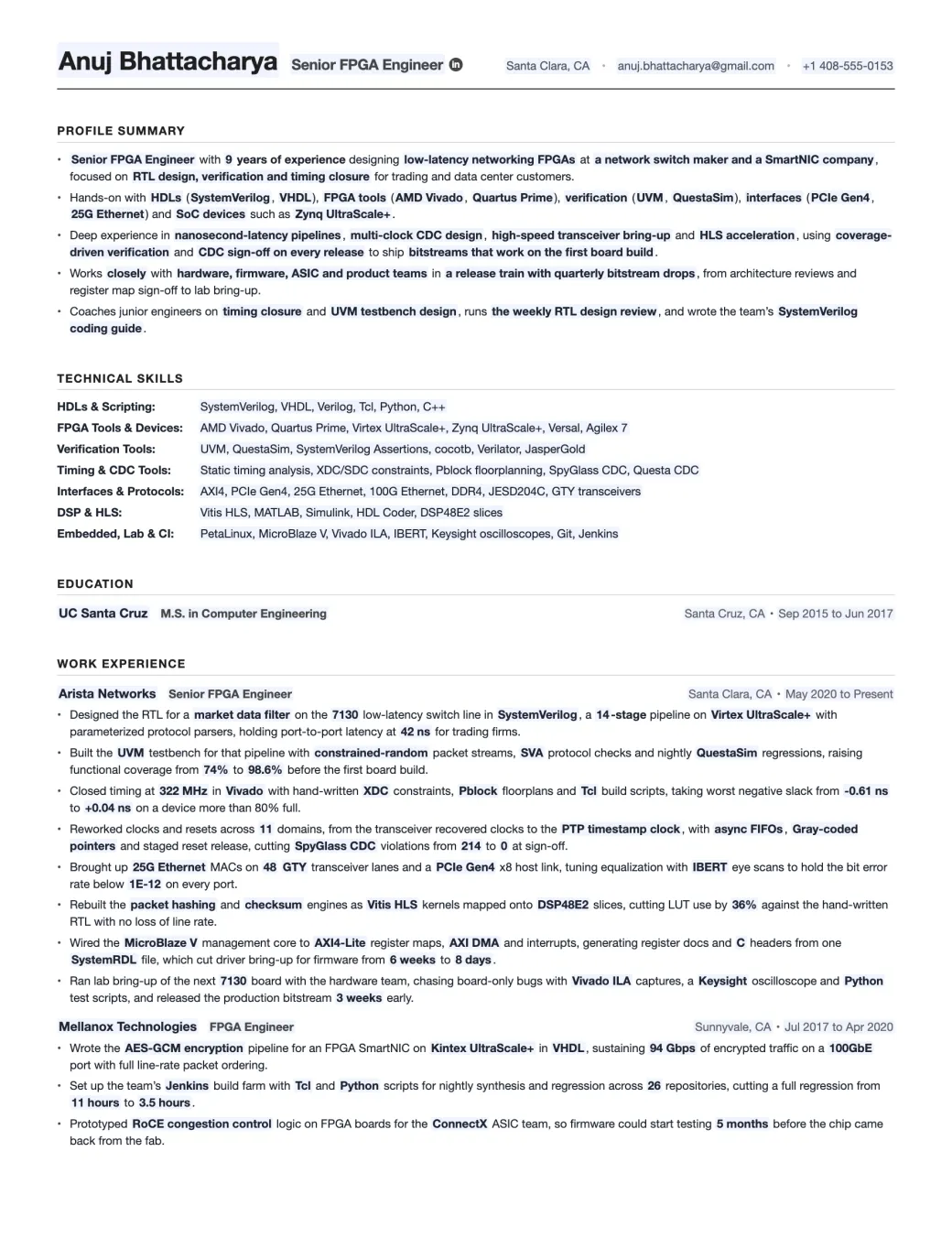
FPGA Engineer resume template, pre-filled for a senior FPGA engineer at Arista Networks, with a 5-bullet profile summary, 7 skills rows and 11 work experience bullets
Emmanuel Gendre Ex-Google recruiter / Tech resume writer Updated Free, ATS-friendly, no signup

Interactive resume template generator

Interactive FPGA Engineer Resume Template

Fill in the side panel, then download your resume as a PDF or a Word file.

Edits update live as you type. Toggle Edit to rewrite paper text directly.

Edit mode is on. Click anywhere on the resume to rewrite text. Side-panel placeholders still update live.

Anuj Bhattacharya Senior FPGA Engineer

Santa Clara, CA • anuj.bhattacharya@gmail.com • +1 408-555-0153

Profile Summary

  • Senior FPGA Engineer with 9 years of experience designing low-latency networking FPGAs at a network switch maker and a SmartNIC company, focused on RTL design, verification and timing closure for trading and data center customers.
  • Hands-on with HDLs (SystemVerilog, VHDL), FPGA tools (AMD Vivado, Quartus Prime), verification (UVM, QuestaSim), interfaces (PCIe Gen4, 25G Ethernet) and SoC devices such as Zynq UltraScale+.
  • Deep experience in nanosecond-latency pipelines, multi-clock CDC design, high-speed transceiver bring-up and HLS acceleration, using coverage-driven verification and CDC sign-off on every release to ship bitstreams that work on the first board build.
  • Works closely with hardware, firmware, ASIC and product teams in a release train with quarterly bitstream drops, from architecture reviews and register map sign-off to lab bring-up.
  • Coaches junior engineers on timing closure and UVM testbench design, runs the weekly RTL design review, and wrote the team’s SystemVerilog coding guide.

Technical Skills

HDLs & Scripting:
SystemVerilog, VHDL, Verilog, Tcl, Python, C++
FPGA Tools & Devices:
AMD Vivado, Quartus Prime, Virtex UltraScale+, Zynq UltraScale+, Versal, Agilex 7
Verification Tools:
UVM, QuestaSim, SystemVerilog Assertions, cocotb, Verilator, JasperGold
Timing & CDC Tools:
Static timing analysis, XDC/SDC constraints, Pblock floorplanning, SpyGlass CDC, Questa CDC
Interfaces & Protocols:
AXI4, PCIe Gen4, 25G Ethernet, 100G Ethernet, DDR4, JESD204C, GTY transceivers
DSP & HLS:
Vitis HLS, MATLAB, Simulink, HDL Coder, DSP48E2 slices
Embedded, Lab & CI:
PetaLinux, MicroBlaze V, Vivado ILA, IBERT, Keysight oscilloscopes, Git, Jenkins

Education

UC Santa Cruz M.S. in Computer Engineering
Santa Cruz, CA • Sep 2015 to Jun 2017

Work Experience

Arista Networks Senior FPGA Engineer
Santa Clara, CA • May 2020 to Present
  • Designed the RTL for a market data filter on the 7130 low-latency switch line in SystemVerilog, a 14-stage pipeline on Virtex UltraScale+ with parameterized protocol parsers, holding port-to-port latency at 42 ns for trading firms.
  • Built the UVM testbench for that pipeline with constrained-random packet streams, SVA protocol checks and nightly QuestaSim regressions, raising functional coverage from 74% to 98.6% before the first board build.
  • Closed timing at 322 MHz in Vivado with hand-written XDC constraints, Pblock floorplans and Tcl build scripts, taking worst negative slack from -0.61 ns to +0.04 ns on a device more than 80% full.
  • Reworked clocks and resets across 11 domains, from the transceiver recovered clocks to the PTP timestamp clock, with async FIFOs, Gray-coded pointers and staged reset release, cutting SpyGlass CDC violations from 214 to 0 at sign-off.
  • Brought up 25G Ethernet MACs on 48 GTY transceiver lanes and a PCIe Gen4 x8 host link, tuning equalization with IBERT eye scans to hold the bit error rate below 1E-12 on every port.
  • Rebuilt the packet hashing and checksum engines as Vitis HLS kernels mapped onto DSP48E2 slices, cutting LUT use by 36% against the hand-written RTL with no loss of line rate.
  • Wired the MicroBlaze V management core to AXI4-Lite register maps, AXI DMA and interrupts, generating register docs and C headers from one SystemRDL file, which cut driver bring-up for firmware from 6 weeks to 8 days.
  • Ran lab bring-up of the next 7130 board with the hardware team, chasing board-only bugs with Vivado ILA captures, a Keysight oscilloscope and Python test scripts, and released the production bitstream 3 weeks early.
Mellanox Technologies FPGA Engineer
Sunnyvale, CA • Jul 2017 to Apr 2020
  • Wrote the AES-GCM encryption pipeline for an FPGA SmartNIC on Kintex UltraScale+ in VHDL, sustaining 94 Gbps of encrypted traffic on a 100GbE port with full line-rate packet ordering.
  • Set up the team’s Jenkins build farm with Tcl and Python scripts for nightly synthesis and regression across 26 repositories, cutting a full regression from 11 hours to 3.5 hours.
  • Prototyped RoCE congestion control logic on FPGA boards for the ConnectX ASIC team, so firmware could start testing 5 months before the chip came back from the fab.


Done editing? Download a real PDF (selectable text, ATS-friendly, US Letter) or an editable Word file if a recruiter asks for one.

About this template

An FPGA Engineer resume template, built by a tech recruiter.

As an FPGA engineer, you turn a spec into logic that runs on real hardware, at full speed, every time the board powers up. You write the RTL in SystemVerilog or VHDL, prove it in simulation, then work through Vivado or Quartus until timing closes. Then it’s off to the lab, where you’ll find out what the simulator missed. That work ends up in network switches, radars, 5G radios, trading systems and AI accelerators.

Most FPGA resumes I read open with the same block of tools: SystemVerilog, Vivado, UVM, AXI. From that list alone, a hiring manager can’t tell whether you owned a design or ran someone else’s build script. The proof is in numbers your tools already report. Think of the clock you closed timing at, the coverage you reached, the LUTs or DSP slices you saved, or the link you brought up at a clean bit error rate.

This FPGA engineer resume template gives each of those numbers a place. The latest job on it covers all 8 areas an FPGA hiring manager checks, RTL design through lab bring-up, with one bullet each. My 3 samples follow the same plan at junior, senior and lead level. Prefer to start from scratch? Then work through the 6 steps to write an FPGA Engineer resume I lay out below.

If you already have a resume, upload it below. I go through every one myself, and the resume evaluation is free.

Industry signal

What the market says about FPGA Engineer roles

There’s no official job count for FPGA engineers, so here’s the closest one: the Bureau of Labor Statistics puts growth for computer hardware engineers at 9% from 2025 to 2035. The tools keep moving, too. Altera became a standalone company in September 2025, and AMD moved Vivado to tiered licensing with the 2026.1 release. In September 2026, AMD and Lattice both launched AI assistants that connect to their design tools. That’s why your resume should say exactly which devices and tools you’ve shipped designs on.

+9% US computer hardware engineer job growth US Bureau of Labor Statistics
$151,142 Average base pay, US FPGA Engineer ads Indeed
  • Zip CPU @zipcpu · FPGA design engineer and blogger
    Today's bug: two simulators (XCelium, Icarus), same logic, one test case passes, one doesn't. Why? It's a race condition. The model sets its data on the same cycle as it gets sampled. One simulator samples the data before it gets set by the model, the other afterwards.
  • Adam Taylor @ATaylorFPGA · FPGA consultant and author
    How do you measure the frequency of a unknown clock in FPGA. This was a question recently asked on R/FPGA following a interview at a financial company.
  • Altera @AlteraFPGA_ · Altera's FPGA account
    An FPGA development board is useless without development tools. Those tools shouldn't cost more than the board. At Altera, we’re committed to accelerating innovators with powerful, accessible FPGA development solutions, regardless of budget or operating system preference.
  • AMD Embedded @AMDembedded · AMD's embedded and adaptive computing account
    IEEE recently recognized the 40th anniversary of the FPGA at an event at AMD in San Jose. When it made its debut four decades ago, the FPGA introduced a new kind of flexibility in hardware that has reshaped the semiconductor industry.

Resume Samples

FPGA Engineer Resume Examples

How much should your FPGA resume change between year 3 and year 15? A lot, and these 3 FPGA engineer resume samples show where. The junior writes and tests PCIe and memory reference designs at Achronix. The senior builds video IP for Microchip’s PolarFire SoC chips. The lead runs the FPGA team on an airborne electronic warfare receiver at BAE Systems. I wrote all 3 with the tools and numbers I look for when I read an FPGA resume. You can download each one as a PDF or a Word file, free and with no signup.

Junior FPGA Engineer Resume Example

Hiring managers know a junior FPGA engineer hasn’t led anything yet. Your resume has to show RTL you wrote yourself and proof it works: the tests and coverage behind it, the timing you closed, and a bug you found on a real board. Internships with real hardware count. On an entry-level FPGA engineer resume with no full-time job yet, put your strongest FPGA project where Job 1 would go.

Years of experience
3 years
Industry
FPGA chipmaker
Stack
cocotbQuestaSimSynplify ProPython
Download PDF Download Word

Click to download the Junior FPGA Engineer resume example as a PDF or a Word file. Free / No signup.

Salma Bouchareb

Junior FPGA Engineer

San Jose, CA · salma.bouchareb@gmail.com · +1 408-555-0186 · linkedin.com/in/salmabouchareb

Profile Summary

  • Junior FPGA Engineer with 3 years at Achronix, designing and testing the PCIe and GDDR6 reference designs shipped with the Speedster7t tools, after a summer internship in FPGA prototyping at MaxLinear.
  • Writes SystemVerilog and reads VHDL, builds in Achronix ACE with Synplify Pro, tests in QuestaSim and cocotb, and scripts builds and lab runs in Tcl and Python with Git and Jenkins.
  • Knows the Speedster7t 2D network on chip and the MLP blocks for int8 math, writes a short design spec before starting RTL, and keeps every block lint and CDC clean before review.
  • Works with applications engineers and the ACE software team, settles each register map with the driver developers before writing logic, and presents new blocks at the weekly RTL review.
  • Coached 1 summer intern through the cocotb setup in 2025, wrote the team’s Snapshot debug guide, and is learning the UVM flow the verification group uses on larger IP.

Technical Skills

HDLs & Scripting:
SystemVerilog, VHDL (reading and small fixes), Tcl, Python, C
FPGA Tools & Devices:
Achronix ACE, Speedster7t AC7t1500, Quartus Prime (internship), AMD Vivado (school projects)
Verification Tools:
cocotb, QuestaSim, SystemVerilog assertions, Verilator, UVM (learning)
Timing & CDC Tools:
Static timing analysis, SDC constraints, Synplify Pro, Questa CDC
Interfaces & Protocols:
AXI4, AXI4-Stream, PCIe, GDDR6, SPI, I2C
DSP & HLS:
MATLAB, fixed-point modeling, Speedster7t MLP blocks, FIR and decimation filters
Embedded, Lab & CI:
Achronix Snapshot, Signal Tap, oscilloscopes, Git, Jenkins
Page 2 of 2

Work Experience

Achronix Semiconductor FPGA Design Engineer Santa Clara, CA · Jul 2023 to Present
  • Wrote the SystemVerilog for a scatter-gather AXI4 DMA engine in the Speedster7t PCIe reference design, moving host data into GDDR6 memory at 21.7 GB/s.
  • Built cocotb tests in QuestaSim for the descriptor logic, with random descriptor chains, error injection and an AXI4 memory model, raising functional coverage from 71% to 94%.
  • Added 2 pipeline stages to the descriptor fetch path and fixed false-path SDC constraints in ACE, taking worst negative slack at 500 MHz from -412 ps to +38 ps.
  • Ran Questa CDC on the DMA block before each release and swapped 2 unsafe crossings between the NoC and user clocks for async FIFOs, clearing all 17 reported violations.
  • Brought the design up on the VectorPath card with the Snapshot debugger and wrote Python lab scripts that cut the board test for each ACE release from 2 days to 7 hours.
MaxLinear FPGA Engineering Intern Carlsbad, CA · Jun 2022 to Aug 2022
  • Turned a MATLAB fixed-point model of a decimation filter into VHDL on a Cyclone V board in Quartus Prime, matching the model output on all 4,096 test vectors.
  • Wrote Tcl and Python scripts that ran the prototyping team’s nightly Quartus builds and posted timing summaries to the team channel, saving about 40 minutes of checks each morning.
  • Found a clock polarity mismatch on the SPI bus between the FPGA test board and an RF transceiver with Signal Tap and a scope, which unblocked 3 lab test plans.

Education

San José State University B.S. in Computer Engineering San Jose, CA · Aug 2019 to May 2023

Senior FPGA Engineer Resume Example

At senior level, the question changes to what you own end to end. Your resume should show IP you designed and verified, links you brought up at full speed, the timing and CDC sign-off you ran, and the engineers you’re mentoring, each with a number behind it.

Years of experience
7 years
Industry
Semiconductors
Stack
Libero SoCRISC-VQuestaSimGit
Download PDF Download Word

Click to download the Senior FPGA Engineer resume example as a PDF or a Word file. Free / No signup.

Bram van Dijk

Senior FPGA Engineer

Chandler, AZ · bram.vandijk@gmail.com · +1 480-555-0147 · linkedin.com/in/bramvandijk

Profile Summary

  • Senior FPGA Engineer with 7 years in semiconductors, now designing the video and Ethernet IP in Microchip’s PolarFire SoC reference designs, after building camera evaluation FPGAs for onsemi’s automotive image sensors.
  • Works in SystemVerilog and VHDL, builds in Microchip Libero SoC with Synplify Pro, verifies with UVM in QuestaSim, writes SmartHLS C++ for image math, and runs nightly builds from Tcl in Jenkins.
  • Knows MIPI CSI-2 camera pipelines, fixed-point image processing and transceiver bring-up, signs off CDC with SpyGlass, and starts each block with a spec that lists its clocks, resets and resource budget.
  • Works with the Linux BSP team, board designers and applications engineers, leads the weekly RTL design review for the video IP group, and handles customer support cases that need an RTL fix.
  • Mentors 3 engineers on UVM and timing reports, wrote the team’s IP release checklist (lint, CDC, coverage, timing), and signs off each video IP release for the Libero IP catalog.

Technical Skills

HDLs & Scripting:
SystemVerilog, VHDL, Verilog, Tcl, Python, C++
FPGA Tools & Devices:
Microchip Libero SoC, PolarFire SoC, PolarFire, Quartus Prime, Intel Arria 10 and Cyclone V, AMD Vivado (basics)
Verification Tools:
UVM, QuestaSim, SystemVerilog assertions, functional coverage, cocotb
Timing & CDC Tools:
Static timing analysis, SDC constraints, Synplify Pro, SpyGlass CDC, Questa CDC, Libero floorplanning
Interfaces & Protocols:
AXI4, AXI4-Stream, MIPI CSI-2, 10GBASE-R Ethernet, DDR4, PCIe Gen2
DSP & HLS:
SmartHLS, MATLAB, fixed-point modeling, image scaling, color correction
Embedded, Lab & CI:
RISC-V (PolarFire SoC CPU cluster), Yocto, SmartDebug, Signal Tap, Git, Jenkins
Page 2 of 2

Work Experience

Microchip Technology Senior FPGA Design Engineer Chandler, AZ · Mar 2022 to Present
  • Wrote the SystemVerilog video pipeline for the PolarFire SoC Video Kit reference design, from the MIPI CSI-2 receiver to the scaler, as parameterized IP that 6 later reference designs reuse.
  • Built a UVM testbench in QuestaSim for the video IP with random frame sizes, pixel formats and back-pressure, closing functional coverage at 97.3% before each IP catalog release.
  • Moved the image scaler from hand-written RTL to SmartHLS C++ checked against a MATLAB fixed-point model, so adding a scaling mode went from 3 weeks to 4 days.
  • Added an AXI4 frame DMA into DDR4 for the RISC-V cores, with a register map agreed with the Linux driver team, cutting CPU load per 1080p60 stream from 38% to 7%.
  • Brought up 10GBASE-R Ethernet on the PolarFire transceivers for a video-over-IP design, tuning equalization from SmartDebug eye scans until the link ran 72 hours with 0 CRC errors.
onsemi FPGA Engineer Phoenix, AZ · Sep 2019 to Feb 2022
  • Retimed the HDR merge datapath and rewrote the SDC constraints for the Intel Arria 10 FPGA on the automotive camera evaluation boards in Quartus Prime, raising Fmax from 164 to 223 MHz.
  • Added reset synchronizers between the sensor and system clock domains after a start-up hang, checked them in Questa CDC, and ran 3,000 power cycles on the lab rack with no repeat.
  • Brought up each new sensor sample with Signal Tap and a scope, and wrote Python register tests so the lab’s sensor checkout went from 3 days to 1 day.

Education

Delft University of Technology M.Sc. in Electrical Engineering (Microelectronics) Delft, Netherlands · Sep 2017 to Aug 2019

Lead FPGA Engineer Resume Example

Your lead FPGA engineer resume gets read for scope. Show the device architecture you picked, the flow your team builds and verifies with, the reviews and audits you got the design through, and how many engineers you lead and hire, with a number on each.

Years of experience
15 years
Industry
Defense electronics
Stack
AMD VivadoMATLABJasperGoldJenkins
Download PDF Download Word

Click to download the Lead FPGA Engineer resume example as a PDF or a Word file. Free / No signup.

Magnus Östlund

Lead FPGA Engineer

Nashua, NH · magnus.ostlund@gmail.com · +1 603-555-0168 · linkedin.com/in/magnusostlund

Profile Summary

  • Lead FPGA Engineer with 15 years in defense electronics at BAE Systems and MITRE, now leading FPGA design for an airborne electronic warfare receiver, and holds an active Secret clearance.
  • Sets the team’s flow for VHDL-2008 RTL, AMD Vivado builds from Tcl in Jenkins, UVM and cocotb tests in QuestaSim and JasperGold formal, with a MATLAB model behind each DSP block.
  • Expert in wideband channelizers, RF data converter sync, DO-254 DAL B design assurance and SEU mitigation (TMR, configuration scrubbing) for airborne hardware, and sizes every device against a DSP and timing budget.
  • Works with systems engineering, the RF, board and embedded software teams and the program office, reports FPGA status at each PDR and CDR, and chairs the weekly FPGA design review.
  • Leads 7 FPGA engineers and hired 4 of them, wrote the team’s VHDL coding and CDC guidelines, and has mentored 3 engineers into senior roles since 2021.

Technical Skills

HDLs & Scripting:
VHDL-2008, SystemVerilog, Verilog, Tcl, Python, C++
FPGA Tools & Devices:
AMD Vivado, Vitis, Zynq UltraScale+ RFSoC and MPSoC, Kintex UltraScale, Versal
Verification Tools:
UVM, QuestaSim, cocotb, JasperGold, SystemVerilog assertions, IBM DOORS Next
Timing & CDC Tools:
Static timing analysis, XDC constraints, Pblock floorplanning, SpyGlass CDC and RDC
Interfaces & Protocols:
AXI4, JESD204B/C, RF-ADC and RF-DAC, 100G Ethernet, PCIe Gen3, Aurora 64B/66B, VITA 49
DSP & HLS:
MATLAB, Simulink, HDL Coder, Vitis HLS, polyphase channelizers, FFTs, pulse detection
Embedded, Lab & CI:
PetaLinux, Vivado ILA, Soft Error Mitigation IP, MicroBlaze, Git, Jenkins, spectrum analyzers
Page 2 of 2

Work Experience

BAE Systems Lead FPGA Engineer Nashua, NH · Apr 2018 to Present
  • Set the FPGA architecture of an EW digital receiver on Zynq UltraScale+ RFSoC, folding 3 Kintex-7 FPGAs and 2 ADC cards into 1 device and cutting receiver power by 38%.
  • Led the bring-up of all 8 RF-ADC channels with multi-tile sync and a matched LMK04828 clock tree, holding channel-to-channel phase error under 1.6 degrees after every power cycle.
  • Set up requirements-based verification for the DO-254 DAL B receiver FPGA, tracing every UVM test to a requirement in DOORS Next, and cut design assurance audit findings from 27 to 4.
  • Floorplanned the channelizer with Pblocks and moved the team to scripted Tcl builds in Jenkins, raising the share of nightly Vivado runs that meet timing at 491.52 MHz from 58% to 96%.
  • Made SpyGlass CDC and reset checks a release gate across the receiver’s 14 clock domains, and the lab has logged 0 clock-crossing bugs in the 26 months since.
MITRE Senior FPGA Engineer Bedford, MA · Aug 2011 to Mar 2018
  • Hand-mapped a 64-channel polyphase channelizer from its MATLAB model onto DSP48E2 slices on Zynq UltraScale+ for a sponsor’s spectrum monitoring prototype, using 27% fewer slices than the HDL Coder version.
  • Brought up PetaLinux on the Zynq UltraScale+ ARM cores with an AXI DMA path from the channelizer, so sponsor analysts could record all 64 channels to NVMe at 1.4 GB/s.
  • Traced JESD204B link drops between an AD9625 ADC and a Kintex UltraScale FPGA to SYSREF timing with Vivado ILA and a scope, after the lab had been stuck on them for 5 weeks.

Education

KTH Royal Institute of Technology M.Sc. in System-on-Chip Design Stockholm, Sweden · Aug 2009 to Jun 2011
University of New Hampshire B.S. in Electrical Engineering Durham, NH · Sep 2005 to May 2009

Free resume review

A recruiter screen, but with feedback

You applied to hundreds of jobs: no result. Companies won’t give you feedback, so you’re stuck in a loop. Rejections will keep coming until you know what’s wrong.

Let’s break this cycle today!

I’ll screen your resume the same way I did at Google.

You’ll get:

  • Your resume sections and content scored.
  • A clear list of what to improve, why, and how.
  • Behind the scenes secrets on the screening process.

How I rewrite FPGA Engineer resumes

How to write an FPGA Engineer resume

Emmanuel Gendre, ex-Google recruiter

Emmanuel Gendre Ex-Google recruiter, tech resume writer

I recruited in tech for 13 years (Google was a big part of that), and now I rewrite resumes for a living. I see FPGA resumes most weeks, and the same thing keeps going wrong. Three years of timing fights and lab nights turn into one line: “Developed and verified RTL for FPGA designs”. A hiring manager reads that and still has no idea whether you closed timing on a full device or wrote one small block.

When an FPGA engineer hires me as their technical resume writer, I rework every line and point out what the resume still lacks. By the end, each bullet carries a device, a tool and a number. If you’re doing it yourself, though, focus on these 6 steps. I’ve added FPGA examples to every one of them.

  1. Step 1 Format & layout A plain layout and headings that an ATS reads without trouble. Go to step 1
  2. Step 2 Profile Summary 5 bullets that give your level, your devices and your toolchain. Go to step 2
  3. Step 3 Work Experience One bullet per area in your current job, from RTL to the lab. Go to step 3
  4. Step 4 Bullet Points Take a bare task like “wrote RTL” and add tools, a method, then a result. Go to step 4
  5. Step 5 Technical Skills 7 rows from HDLs to lab tools, and 5 soft skills to prove. Go to step 5
  6. Step 6 Keywords & Metrics The keywords FPGA recruiters search for, and 24 metrics to put in bullets. Go to step 6

Step 1 · Format & Layout

FPGA Engineer resume format and layout

Get the layout out of the way first, since it’s a short job. Software reads the file before any person does, pulling out your titles, dates and skills, and the recruiter who opens it later looks for those same details. A plain layout helps both of them.

01ATS Compliance

ATS compliance for your FPGA Engineer resume

Your resume almost never goes straight to a person. It lands in an Applicant Tracking System (ATS) first, and the ATS cuts it into fields like titles, dates and skills. When a recruiter searches those fields months later for “JESD204” or “UVM”, only the resumes it parsed cleanly come up. Columns, tables and text boxes are what usually break the parsing. The details are in my article on how an applicant tracking system reads your resume. For FPGA engineers, this part comes down to 3 rules:

The 3 rules
  1. Use a 100% text based format (no Canva!)

  2. Avoid tables, pictures, and complex structures.

  3. Use the most predictable section names, like “Profile Summary” and “Work Experience”

02Design & Layout

FPGA Engineer resume design and layout

I’ve had FPGA resumes come in with a block diagram in the header, a skills radar chart, even a timing waveform as a page border. Engineers love a good diagram, and I understand the temptation. Still, recruiters hate fancy designs, because after dozens of resumes in one sitting they want your title, employer name and dates in the spot they always check.

That’s why I tell FPGA engineers to go plain and boring: a single column, Arial or Calibri, and headings every recruiter has seen a thousand times. Link a GitHub repo only if it holds HDL you’d happily walk an interviewer through, like a verified core or a cocotb testbench. If you’re building your resume in a word processor, use the specs below. The template above follows them already.

Layout Spec
Columns
One. No sidebars, tables, columns, pictures or tabs.
Margins
0.7 in on all four sides
Body size
10 to 11 pt
Type
One family, weight for hierarchy
Length
One page under 5 years, two after
Section order
Summary, Skills, Experience, Education
PDF

03File Format

Resume file format for your FPGA Engineer resume

Send a PDF by default. Your layout can’t move around on the recruiter’s laptop, and the text stays readable to an ATS, provided the PDF came out of Word or Google Docs and isn’t a scan. Keep the Word version for when a recruiter asks: agencies placing contract FPGA engineers with defense primes often ask for a .docx so they can reformat it for their client. Online forms and other edge cases are covered in my guide on which resume file format to send.

Format Guide
PDF
Your default. Layout holds, text stays selectable.
Word (.docx)
When the posting or a recruiter asks for it. Use the Word download above.
Plain text
For portals that make you paste into a box
Never
Images, scans, password-protected PDFs, shared-drive links
File name
Anuj-Bhattacharya-FPGA-Engineer.pdf

Step 2 · Profile Summary

FPGA Engineer profile summary

New grads ask me if they can skip the profile summary. They can’t, and neither can anyone else. Recruiters screen in 2 steps, a fast skim and then a proper read, and during the skim, the summary is often the only part they read. I explain the whole process in my write-up on how a recruiter screens your resume.

A hiring manager has 3 questions about you, and your summary should answer them. Which designs and devices have you worked on? Which HDLs and tools do you open every day? Will the board, firmware and verification teams find you easy to work with? Below is the job of each bullet, and there are more examples in my profile summary guide for engineers.

  1. 1

    Title, years and scope

    Start with the title the posting uses (FPGA Engineer, FPGA Design Engineer, RTL Design Engineer), then add your years and your design area: networking, radar, wireless or video. Recruiters judge your level from this line, so don’t bury it.

  2. 2

    Your stack

    The tools you use daily, sorted into the buckets FPGA postings use: HDLs, vendor tools, verification, interfaces and SoC devices. A recruiter will compare it with the requirements list, so match the ad’s product names.

  3. 3

    Domain expertise

    Your strongest skills, such as low-latency pipelines, CDC or transceiver bring-up, plus how you work, like coverage-driven verification. From this bullet, a hiring manager figures out which part of their design you’d be able to take over.

  4. 4

    Collaboration

    The teams on the other side of your interfaces: board designers, firmware and driver engineers, the ASIC or systems group, verification. Mention where you’ve agreed on register maps, pinouts or interface specs with them.

  5. 5

    Leadership

    Design reviews you run, coding guides you wrote, juniors you helped close timing for the first time. No direct reports? That’s fine. What counts is whether other engineers copy the way you work.

FPGA Engineer resume summary example, from the template above
  • Senior FPGA Engineer with 9 years of experience designing low-latency networking FPGAs at a network switch maker and a SmartNIC company, focused on RTL design, verification and timing closure for trading and data center customers.
  • Hands-on with HDLs (SystemVerilog, VHDL), FPGA tools (AMD Vivado, Quartus Prime), verification (UVM, QuestaSim), interfaces (PCIe Gen4, 25G Ethernet) and SoC devices such as Zynq UltraScale+.
  • Deep experience in nanosecond-latency pipelines, multi-clock CDC design, high-speed transceiver bring-up and HLS acceleration, using coverage-driven verification and CDC sign-off on every release to ship bitstreams that work on the first board build.
  • Works closely with hardware, firmware, ASIC and product teams in a release train with quarterly bitstream drops, from architecture reviews and register map sign-off to lab bring-up.
  • Coaches junior engineers on timing closure and UVM testbench design, runs the weekly RTL design review, and wrote the team’s SystemVerilog coding guide.

Step 3 · Work Experience

FPGA Engineer work experience

Once the summary has done its job, the recruiter scrolls straight to your current role. I’d say 95% of the decision gets made there. Your latest job is the best picture of the devices, tools and design sizes you work with right now, and that’s what the team is hiring for.

That role should hit every line of the FPGA Engineer role profile below: 8 areas, 8 bullets. A hiring manager checks your bullets against it, and a missing area reads like a missing skill. Leave out CDC, and they’ll wonder who handled the clock crossings on your last design.

FPGA Engineer role profile
  1. RTL Design & Microarchitecture

    You turn a spec into RTL that synthesizes cleanly and still makes sense to the next engineer. Most hiring managers have inherited messy RTL before, and they look for proof that you think in pipelines and reusable blocks. Walk them through how you used a pipelined microarchitecture and parameterized SystemVerilog to hit a latency or throughput target.

    Techniques
    pipelined datapaths, state machines, parameterized IP, lint-clean coding
    Tools
    SystemVerilog, VHDL, Verilator lint, Git
    Metrics
    latency in cycles or ns, IP blocks reused, lint warnings
  2. Simulation & Verification

    You prove the design is right before anyone loads a bitstream. A bug that’s found on the bench can cost you a week of lab time, so managers want to know how much your testbench catches first. Show them how you used UVM or cocotb with constrained-random stimulus and assertions to reach coverage closure before the first board build.

    Techniques
    constrained-random stimulus, SVA assertions, functional coverage, formal property checks
    Tools
    UVM, cocotb, QuestaSim, JasperGold
    Metrics
    functional coverage, bugs found before the lab, regression run time
  3. Timing Closure & Implementation

    You close timing at the target clock on a device that’s getting fuller with every release. A design that misses timing doesn’t ship, and every FPGA team has a story about a release that slipped because of it. Explain how you used constraints, floorplanning and extra pipeline stages in Vivado or Quartus to take negative slack to positive.

    Techniques
    XDC and SDC constraints, Pblock floorplanning, retiming, Tcl build flows
    Tools
    Vivado, Quartus Prime, Synplify Pro
    Metrics
    Fmax, worst negative slack, LUT and BRAM use
  4. Clocking, Reset & CDC

    You keep data safe as it moves between clock domains. Metastability bugs are rare, random and painful to find in the lab, which is why a senior engineer looks for CDC discipline early in your resume. Describe how you used synchronizers, async FIFOs and a CDC tool like SpyGlass to get every crossing signed off.

    Techniques
    async FIFOs, 2-flop synchronizers, Gray-coded pointers, reset sequencing
    Tools
    SpyGlass CDC, Questa CDC, Vivado report_cdc
    Metrics
    CDC violations, clock domains, CDC bugs found in the lab
  5. High-Speed Interfaces & Memory

    You bring up the links that move data on and off the chip. A transceiver that won’t hold a clean eye can stall a whole product, so managers value engineers who’ve tuned one on real boards. Point out how you used IBERT eye scans and PCIe, Ethernet or JESD204 IP to hit the lane rate at a clean bit error rate.

    Techniques
    transceiver equalization, eye scans, link training, DDR calibration
    Tools
    IBERT, PCIe Gen4 IP, 100G Ethernet MAC, JESD204C
    Metrics
    lane rate, bit error rate, memory efficiency
  6. DSP & Hardware Acceleration

    You map algorithms onto DSP slices and fabric so they run at full rate. Systems teams hand you a MATLAB model and a throughput target, and the real question is whether it’ll fit the device budget. Mention how you used fixed-point design and Vitis HLS or hand-written RTL to hit that throughput with fewer DSP slices or LUTs.

    Techniques
    fixed-point modeling, FIR and FFT design, HLS pragmas, DSP slice mapping
    Tools
    MATLAB, Simulink, HDL Coder, Vitis HLS
    Metrics
    DSP slices used, processing latency, speedup over software
  7. SoC Integration & Embedded Processors

    You connect the fabric to the processors the firmware team builds on. If the register map or the DMA is wrong, software can stall for weeks, so managers look for engineers who make that handoff smooth. Tell them how you used AXI interconnect, DMA and PetaLinux on a Zynq or a soft core to get drivers running sooner.

    Techniques
    AXI interconnect, DMA, register maps, interrupts
    Tools
    Zynq UltraScale+, MicroBlaze V, PetaLinux, SystemRDL
    Metrics
    DMA efficiency, boot time, interrupt latency
  8. Board Bring-Up & Lab Debug

    You run first power-on of new boards and track down what simulation missed. Lab time costs money and ship dates rarely move, so a hiring manager looks for an engineer who debugs step by step, one capture at a time. Let them know how you used Vivado ILA or Signal Tap and an oscilloscope to root-cause board bugs and ship the release on time.

    Techniques
    board power-on, in-system debug, root-cause analysis, lab test automation
    Tools
    Vivado ILA, Signal Tap, oscilloscopes, Python
    Metrics
    bring-up time, board bugs fixed, share of tests scripted

Yes, that makes your latest job 8 bullets long, maybe more. Recruiters don’t mind length when every line has a real design behind it. Coming from a mostly verification role? Map testbenches, coverage and formal onto as many of the 8 areas as you honestly can.

Submit your resume for a free review!

Step 4 · Bullet Points

FPGA Engineer resume bullet points

No part of a rewrite eats more of my hours than the bullet points. Years of doing them turned into a step-by-step method I’ve called the Level System ever since. It builds on the XYZ formula that Google recruiters know well, then goes further into the technical detail engineers need. If you want every rule behind it, read my engineering resume bullet points guide.

Each of the 5 levels answers one question about the work, starting with what you did and ending with what it achieved. For FPGA work, that final answer tends to be a clock frequency, a latency, a resource count or a coverage figure. Watch one FPGA bullet get longer and better as it climbs the 5 levels.

  1. Level 1Task

    What did I work on? Open with a strong verb and one design you delivered. On its own, it could describe anyone on the team.

    Designed the digital downconverter for a phased-array radar receiver.

  2. Level 2+ Techniques

    How did I do it? Add the techniques. This is where a hiring manager starts to see your design choices.

    Designed the digital downconverter for a phased-array radar receiver with polyphase FIR filters and a CORDIC NCO.

  3. Level 3+ Tools

    What tools did I use? Write the language, the device and the vendor tool. Recruiters search for those exact words.

    Designed the digital downconverter for a phased-array radar receiver with polyphase FIR filters and a CORDIC NCO, in VHDL on an AMD Zynq UltraScale+ RFSoC in Vivado.

  4. Level 4+ Method

    What method did I follow? Say how you made sure it worked: the verification approach or the standard you followed.

    Designed the digital downconverter for a phased-array radar receiver with polyphase FIR filters and a CORDIC NCO, in VHDL on an AMD Zynq UltraScale+ RFSoC in Vivado, checked bit-exact against the MATLAB model in a UVM testbench.

  5. Level 5+ Metric

    What was the result? End on one number a hiring manager can picture: DSP slices saved, a clock frequency, a latency.

    Designed the digital downconverter for a phased-array radar receiver with polyphase FIR filters and a CORDIC NCO, in VHDL on an AMD Zynq UltraScale+ RFSoC in Vivado, checked bit-exact against the MATLAB model in a UVM testbench, cutting DSP slice use by 31% across 16 channels.

    1. 01 Task What you worked on
    2. 02 Techniques How you did it
    3. 03 Tools The stack you used
    4. 04 Method The method you followed
    5. 05 Metric The result, one number

Don’t worry if you’ve never tracked any of this. Every Vivado or Quartus run saves a timing report and a resource report, and your coverage database, IBERT scans and regression dashboard keep months of history. Dig through them first, then write.

Step 5 · Technical Skills

FPGA Engineer resume skills

Put 5 FPGA job ads next to each other and the requirements fall into the same groups: languages, vendor tools and devices, verification, timing and CDC, interfaces, DSP, and embedded or lab work. Copy the ad’s spelling for each product. If the ad still says Xilinx and you wrote AMD, put both (AMD Vivado, formerly Xilinx), because recruiters search with the words in front of them.

Only list what you’d be happy to be grilled on: write JasperGold, and an interviewer will ask which properties you proved with it. Below, you’ll see how I group FPGA skills into 7 rows, the finished skills section on the template above, and 5 soft skills to back up with proof. Keywords get their own step next.

The 7 skill categories for an FPGA Engineer resume

Stars mark what nearly every FPGA posting asks for, so those go first in each row. The others are worth adding when you’ve shipped a design with them.

HDLs & Scripting

The languages you write RTL in, and the scripts that run your builds and tests. SystemVerilog and VHDL lead most ads, with Tcl and Python right behind.

SystemVerilogVHDLVerilogTclPythonC++

FPGA Tools & Devices

Your vendor toolchains and the device families you’ve shipped on. Pair the family with the tool (Vivado on Versal, Quartus on Agilex) so a reader can tell it was real work.

AMD VivadoQuartus PrimeZynq UltraScale+VersalAgilexLattice RadiantMicrochip Libero SoC

Verification Tools

Your verification method, your simulator and any formal tool you use. UVM on QuestaSim is the pairing I see requested most, with cocotb a common extra.

UVMQuestaSimcocotbSynopsys VCSCadence XceliumVerilatorJasperGold

Timing & CDC Tools

How you close timing and check clock crossings. Listing your constraint format and a CDC tool shows a hiring manager you’ve signed off designs yourself.

Static timing analysisXDC/SDC constraintsSpyGlass CDCQuesta CDCSynplify ProPblock floorplanning

Interfaces & Protocols

The buses and high-speed links you’ve integrated or brought up. Add the generation or speed (PCIe Gen4, 100G Ethernet), because ads usually ask for a specific one.

AXI4PCIe100G EthernetDDR4JESD204CSerDesAurora

DSP & HLS

The tools you use to turn a model into hardware: MATLAB and Simulink for the model, then Vitis HLS or HDL Coder when the RTL isn’t written by hand.

Vitis HLSMATLABSimulinkHDL CoderDSP BuilderVitis AI

Embedded, Lab & CI

Embedded Linux, soft cores, on-chip debug and the build tools that run your regressions. Vivado ILA or Signal Tap on this row shows you’ve debugged on real hardware.

PetaLinuxVivado ILAYoctoMicroBlazeRISC-VSignal TapGitJenkins

A finished FPGA Engineer skills section

Technical Skills sample, from the template above
HDLs & Scripting
SystemVerilog, VHDL, Verilog, Tcl, Python, C++
FPGA Tools & Devices
AMD Vivado, Quartus Prime, Virtex UltraScale+, Zynq UltraScale+, Versal, Agilex 7
Verification Tools
UVM, QuestaSim, SystemVerilog Assertions, cocotb, Verilator, JasperGold
Timing & CDC Tools
Static timing analysis, XDC/SDC constraints, Pblock floorplanning, SpyGlass CDC, Questa CDC
Interfaces & Protocols
AXI4, PCIe Gen4, 25G Ethernet, 100G Ethernet, DDR4, JESD204C, GTY transceivers
DSP & HLS
Vitis HLS, MATLAB, Simulink, HDL Coder, DSP48E2 slices
Embedded, Lab & CI
PetaLinux, MicroBlaze V, Vivado ILA, IBERT, Keysight oscilloscopes, Git, Jenkins

Soft skills for an FPGA Engineer resume

Writing “strong communicator” in a list doesn’t convince anyone. Showing it in a bullet does. Here are the 5 behaviours I look for on FPGA resumes, and a line that proves each one.

  • Writing a design spec the verification team can test from

    Resume bulletWrote the design spec before any RTL, so verification had its test plan 4 weeks before the code was done.

  • Agreeing on the register map with firmware before writing RTL

    Resume bulletSigned off the register map with the driver team before the first line of RTL, and it needed 0 changes through 3 releases.

  • Staying methodical when a bug only shows up on the board

    Resume bulletTraced a packet drop seen only above 70°C to a missing constraint on a GTY reference clock.

  • Pushing back on a late feature that would break timing

    Resume bulletMoved a late timestamping feature to the next release once it pushed slack to -0.3 ns, and the release shipped on time.

  • Coaching a junior through their first timing report

    Resume bulletCoached 3 junior engineers through reading Vivado timing reports and fixing their own failing paths, and all 3 now close timing on their blocks alone.

Step 6 · Keywords & Metrics

FPGA Engineer resume keywords and metrics

Before I hand back an FPGA resume, I check 2 last things. The first is keywords: when a recruiter types “UVM” or “PCIe” into the ATS search box, will your resume show up? The second is metrics, meaning a number in each bullet that proves the claim, like an Fmax, a latency, a coverage figure or the LUTs you saved.

Start with the keyword tiers, then paste a posting you actually want into the keyword finder. It’ll show you what’s missing. The metrics table comes last, with 24 FPGA metrics sorted by role-profile area and an example bullet for each.

+42%

FPGA Engineer resume keywords, ranked

Pick any keyword below and the line under the chips shows how FPGA postings tend to word it. One skill can hide behind “STA”, “timing analysis” or “timing closure”, so get used to all of them.

Must-have

9

Put each one in your summary, in a Work Experience bullet and in your skills section.

In a job description“Write synthesizable SystemVerilog RTL for high-speed datapath blocks”

Strong supporting

10

Add the ones you’ve really used. When 2 resumes look close, these usually tip it.

In a job description“Build UVM-based verification environments with constrained-random stimulus”

Bonus

8

Nice extras. Mention them only where they’re true for you.

In a job description“High-level synthesis with Vitis HLS or Intel HLS is a plus”

Extract FPGA Engineer keywords from a job description

Paste an FPGA engineer, FPGA design engineer or RTL design engineer posting below. The finder picks out the HDLs, vendor tools, verification methods and interfaces in it and ranks them by tier, which shows you the gaps in your resume before you hit apply. For a quick must-have list, run 5 postings through it: whatever shows up in 3 of them belongs on your resume.

Must-have
Put these in your skills section and back each one with a bullet.
Strong supporting
Add the ones you’ve actually worked with. Skip the rest.

Nothing is uploaded: it all happens in your browser.

Metrics for an FPGA Engineer resume

Each metric below comes with an FPGA bullet that uses it, sorted by area. One real number per bullet is plenty, and a small one still counts.

MetricExample bullet
RTL design
Pipeline latency Time Clock cycles or nanoseconds from input to output through your design.Cut the market data filter’s latency from 61 ns to 42 ns by merging 2 parser stages and moving the checksum off the critical path.
IP blocks reused Count Blocks you wrote that other designs or teams now use as they are.Wrote a parameterized packet parser that now ships in 4 product bitstreams across 2 FPGA teams.
Lint warnings Count Warnings the RTL linter reports on your code at release.Took Verilator lint warnings on the switch datapath from 1,140 to 0 before the first release review.
Verification
Functional coverage Percent Share of the coverage points in your verification plan that tests have hit.Raised functional coverage on the timestamping block from 81% to 99.2% with new constrained-random sequences in UVM.
Bugs caught before the lab Count Design bugs found in simulation or formal before a bitstream reached a board.Found 37 RTL bugs in simulation before the first board build, with SVA checks on every AXI4-Stream interface.
Regression run time Time How long the full nightly regression takes to finish.Cut the nightly regression from 9 hours to 2.5 hours by splitting QuestaSim runs across 24 Jenkins workers.
Timing closure
Fmax Frequency The highest clock frequency your design meets timing at.Raised Fmax on the hashing engine from 250 MHz to 390 MHz with retiming and 2 extra pipeline stages.
Worst negative slack Time How far the slowest path misses (or beats) its timing requirement.Closed timing on the 100G Ethernet build, taking worst negative slack from -1.2 ns to +0.08 ns with Pblocks around the MAC.
Device resource use Percent Share of the device’s LUTs, flip-flops, BRAM or DSP slices your design uses.Fit 2 extra filter channels into the same Virtex UltraScale+ part by sharing resources, holding LUT use at 78%.
Clocking & CDC
CDC violations Count Unsafe crossings a CDC tool reports at sign-off.Brought Questa CDC violations on the PCIe DMA block from 58 to 0 with handshake synchronizers on every control path.
Clock domains planned Count Separate clock domains in the design that you planned, constrained and checked.Planned clocks and resets for a design with 9 asynchronous domains and wrote the CDC constraints the whole team now reuses.
CDC bugs found in the lab Count Clock crossing bugs that slipped through to a board or a customer.Shipped 6 releases without a single CDC bug from the lab after making CDC sign-off a release gate.
High-speed interfaces
Transceiver lanes brought up Count Serial lanes you got running at their target rate on real boards.Brought up 48 GTY lanes at 25.78 Gbps on the new switch board in 3 weeks of lab time.
Bit error rate Score Errors per bit sent over a link during a test. Lower is better.Fixed a marginal 25G link by retuning receiver equalization, bringing its bit error rate from 1E-9 to below 1E-13.
Memory efficiency Percent Share of the memory interface’s peak bandwidth your design actually sustains.Raised DDR4 efficiency on the packet buffer from 62% to 88% by grouping reads and writes into longer bursts.
DSP & acceleration
DSP slices saved Percent How much less of the DSP budget your design needs than the version before it.Cut DSP48E2 use on the 16-channel FIR bank by 34% with symmetric coefficients and time-shared multipliers.
Processing latency Time Time from a sample or packet entering your engine to the result coming out.Brought order book update latency from 740 ns to 190 ns by moving the price-level logic from software into FPGA fabric.
Speedup over software Score How many times faster your FPGA engine runs than the CPU version.Made checksum and hash offload 11 times faster than the CPU path, freeing 2 x86 cores per switch for the control plane.
SoC integration
Boot time Time Time from power-on to Linux being ready on the SoC.Cut PetaLinux boot time on the Zynq UltraScale+ management board from 48 to 11 seconds by trimming the boot image and loading the bitstream from QSPI.
DMA efficiency Percent Share of the host link’s bandwidth your DMA engine moves as real data.Raised PCIe Gen4 x8 DMA efficiency from 71% to 93% with deeper descriptor prefetch and 512-byte payloads.
Interrupt latency Time Time from a hardware event to the processor’s handler running.Cut interrupt latency on the MicroBlaze V core from 3.1 µs to 0.8 µs with a vectored interrupt controller.
Lab bring-up
Bring-up time Time Time from first power-on of a new board to a working bitstream carrying traffic.Took a new 25G line card from first power-on to carrying traffic in 6 days with scripted Python lab tests.
Board bugs root-caused Count Problems seen only on hardware that you traced to a cause and fixed.Root-caused 14 board-only bugs in one bring-up, from a swapped GTY reference clock to a missing reset constraint, using Vivado ILA captures.
Lab tests scripted Percent Share of the lab test plan that runs from your scripts.Scripted 85% of the bring-up test plan in Python with PyVISA, so each new board revision gets its full test run in one evening.

What if you don’t have exact numbers?

  • 1

    Ask the build server. Jenkins or GitLab keeps every nightly run, so regression times, failing tests and build counts so it’s all there to count.

  • 2

    Round your numbers down. “About 40 ns” or “close to 30% fewer LUTs” sounds honest, and it holds up when an interviewer asks where the number came from.

  • 3

    Fall back on size. No result to measure? The device you targeted, the lanes you brought up, the clock domains you handled or the boards you got running still show how big the job was.

Free resume review

A recruiter screen, but with feedback

You applied to hundreds of jobs: no result. Companies won’t give you feedback, so you’re stuck in a loop. Rejections will keep coming until you know what’s wrong.

Let’s break this cycle today!

I’ll screen your resume the same way I did at Google.

You’ll get:

  • Your resume sections and content scored.
  • A clear list of what to improve, why, and how.
  • Behind the scenes secrets on the screening process.

Frequently asked

FPGA Engineer resume FAQ

Completely free. There’s no account to create, no email to hand over and no paywall. Edit the template, download your file, and come back whenever you’ve shipped a new design.

Yes. Hit the Word button beside Download PDF and you’ll have a .docx you can open in any word processor. Each of my 3 FPGA samples comes in Word too. I’d still apply with the PDF, though, and save the .docx for agency recruiters who want to reformat it.

Yes. With a single column, the usual section headings and selectable text in the PDF, an ATS reads SystemVerilog, UVM or PCIe as real keywords. To check yours, upload the finished file to my free ATS resume checker and you’ll see every field it filled in.

Under 5 years, keep it to 1 page. Senior FPGA engineers usually need 2, because each design brings its own device, tools and numbers. What gets an FPGA resume rejected is vague bullets, whatever its length.

In the US, most recruiters treat a CV and a resume as the same 1 or 2 page document, so this template works as either. In the UK and most of Europe, people simply call it a CV. Academia is the exception: an FPGA research CV is longer and adds your publications and conference papers.

A good one tells a recruiter your level, your devices and your daily tools before they reach your first job. Write it as 5 bullets, put numbers in them, and don’t invent a title: copy the one in the posting. Here’s a first bullet that works: “Senior FPGA Engineer with 9 years of experience designing low-latency networking FPGAs at a network switch maker and a SmartNIC company.”

It comes from a real study. In its 2018 eye-tracking study, Ladders measured an average of 7.4 seconds for a recruiter’s first screen of a resume. That’s the quick skim. If your title, devices and current job are easy to find in those seconds, you’ll get the slower second read.

Put your degree first: most FPGA job ads ask for a bachelor’s in electrical or computer engineering, and the BLS lists a bachelor’s degree as the typical entry-level education for computer hardware engineers. I rarely see an FPGA job ad ask for a certification, so your designs matter far more. If you’re junior, vendor training from AMD, Altera or Microchip is worth a line under Education. For defense and aerospace jobs, mention DO-254 experience and an active security clearance, because those ads often require them.

Numbers for speed, size and quality: Fmax, latency, LUT, BRAM and DSP use, coverage, CDC violations, bit error rate and bring-up time. Step 6 has 24 of them, grouped by area, and every one appears in an FPGA bullet.

Both are RTL jobs, but what happens after the RTL is different. FPGA engineers close timing in Vivado or Quartus, ship bitstreams and debug on boards in the lab. ASIC engineers work toward a tape-out with tools like Design Compiler and PrimeTime, often with physical design and DFT in the mix. If your days are mostly synthesis, sign-off and tape-out, my ASIC engineer resume template is the better pick. If you mostly design boards, use my hardware engineer resume template, and for firmware work, the embedded software engineer resume template.

List every HDL you’ve shipped a design in, and put the one the job ad asks for first. Defense and aerospace teams still write a lot of VHDL, while networking and data center teams mostly use SystemVerilog. Interviewers will test you on the one at the top, so lead with your strongest.

Yes. NVIDIA’s job listings include FPGA prototyping and emulation roles, where engineers map chip designs onto FPGA boards to test them before the silicon exists. FPGA vendors, defense and aerospace companies, network equipment makers and trading firms hire FPGA engineers too, so match your keywords to the posting you’re targeting.

Pick 2 or 3 FPGA projects you can defend in an interview, each with a board, an HDL and a number. Good ones include a UART or SPI controller verified in cocotb, an HDMI video pipeline on a Zynq board, a FIR filter checked against a MATLAB model, or a small RISC-V core that closes timing at a clock you state. Senior design projects and research labs work the same way. Add your GitHub link if the HDL is clean and has tests.

No. Hiring managers like a layout they can scan fast. What makes resumes look the same is generic bullets. Replace every default line with your own devices, designs and results, and nobody’s going to ask where the layout came from.

More resources

More help with your FPGA Engineer resume