ASIC Engineer Resume Examples & Free Template (PDF, Word)

Edit this ASIC engineer resume template, set up for a senior chip designer with GPU and modem tape-outs, and save it as a PDF or Word file. Then compare yours with 3 ASIC resume examples and an ex-Google recruiter’s 6-step guide.

4.9 5.0
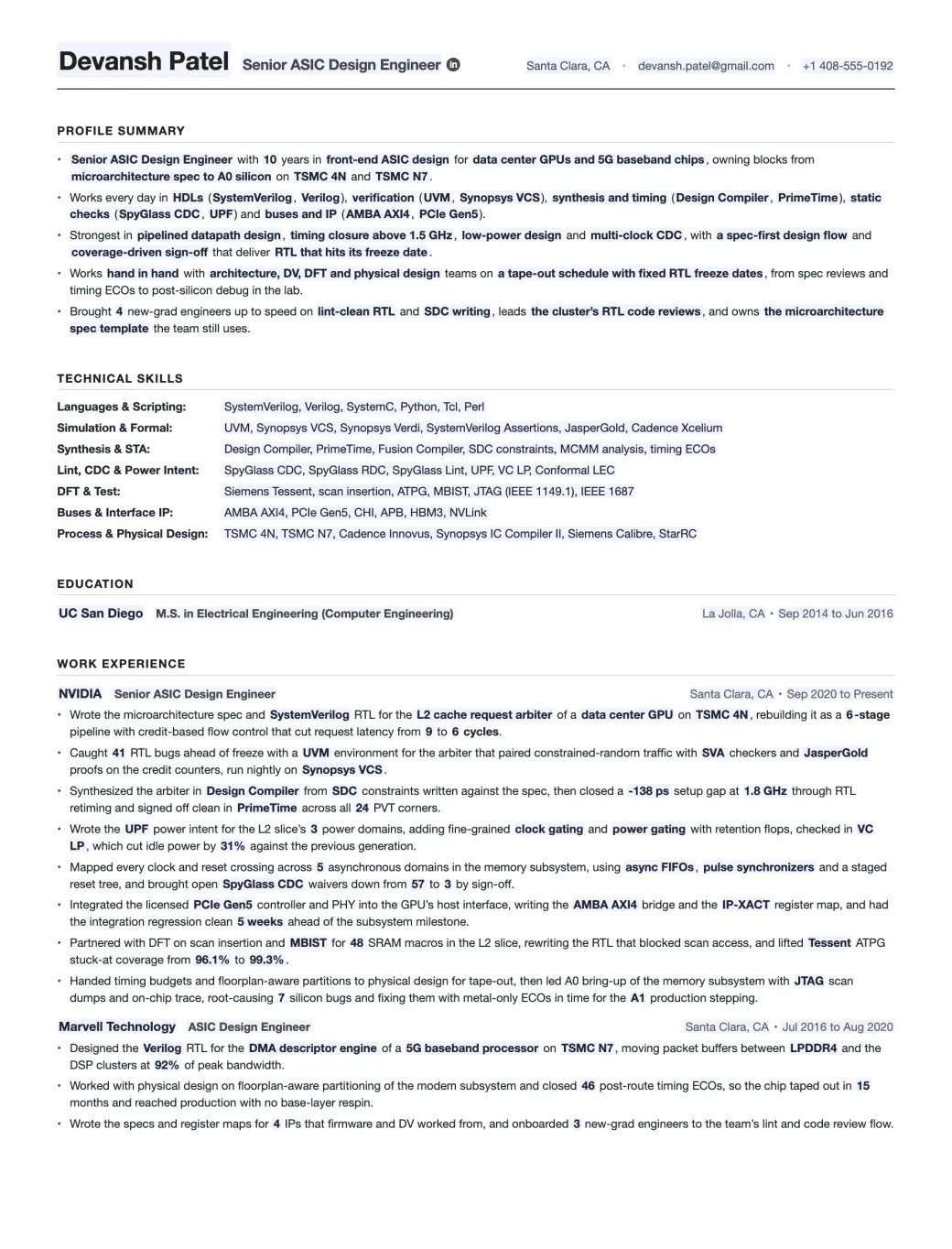
Preview of the ASIC Engineer resume template with Devansh Patel’s details: a 5-line profile summary, technical skills by category, education, and NVIDIA and Marvell work history
Emmanuel Gendre Ex-Google recruiter / Tech resume writer Updated Free, ATS-friendly, no signup

Interactive resume template generator

Interactive ASIC Engineer Resume Template

Fill in the side panel, then download your resume as a PDF or a Word file.

Edits update live as you type. Toggle Edit to rewrite paper text directly.

Edit mode is on. Click anywhere on the resume to rewrite text. Side-panel placeholders still update live.

Devansh Patel Senior ASIC Design Engineer

Santa Clara, CA • devansh.patel@gmail.com • +1 408-555-0192

Profile Summary

  • Senior ASIC Design Engineer with 10 years in front-end ASIC design for data center GPUs and 5G baseband chips, owning blocks from microarchitecture spec to A0 silicon on TSMC 4N and TSMC N7.
  • Works every day in HDLs (SystemVerilog, Verilog), verification (UVM, Synopsys VCS), synthesis and timing (Design Compiler, PrimeTime), static checks (SpyGlass CDC, UPF) and buses and IP (AMBA AXI4, PCIe Gen5).
  • Strongest in pipelined datapath design, timing closure above 1.5 GHz, low-power design and multi-clock CDC, with a spec-first design flow and coverage-driven sign-off that deliver RTL that hits its freeze date.
  • Works hand in hand with architecture, DV, DFT and physical design teams on a tape-out schedule with fixed RTL freeze dates, from spec reviews and timing ECOs to post-silicon debug in the lab.
  • Brought 4 new-grad engineers up to speed on lint-clean RTL and SDC writing, leads the cluster’s RTL code reviews, and owns the microarchitecture spec template the team still uses.

Technical Skills

Languages & Scripting:
SystemVerilog, Verilog, SystemC, Python, Tcl, Perl
Simulation & Formal:
UVM, Synopsys VCS, Synopsys Verdi, SystemVerilog Assertions, JasperGold, Cadence Xcelium
Synthesis & STA:
Design Compiler, PrimeTime, Fusion Compiler, SDC constraints, MCMM analysis, timing ECOs
Lint, CDC & Power Intent:
SpyGlass CDC, SpyGlass RDC, SpyGlass Lint, UPF, VC LP, Conformal LEC
DFT & Test:
Siemens Tessent, scan insertion, ATPG, MBIST, JTAG (IEEE 1149.1), IEEE 1687
Buses & Interface IP:
AMBA AXI4, PCIe Gen5, CHI, APB, HBM3, NVLink
Process & Physical Design:
TSMC 4N, TSMC N7, Cadence Innovus, Synopsys IC Compiler II, Siemens Calibre, StarRC

Education

UC San Diego M.S. in Electrical Engineering (Computer Engineering)
La Jolla, CA • Sep 2014 to Jun 2016

Work Experience

NVIDIA Senior ASIC Design Engineer
Santa Clara, CA • Sep 2020 to Present
  • Wrote the microarchitecture spec and SystemVerilog RTL for the L2 cache request arbiter of a data center GPU on TSMC 4N, rebuilding it as a 6-stage pipeline with credit-based flow control that cut request latency from 9 to 6 cycles.
  • Caught 41 RTL bugs ahead of freeze with a UVM environment for the arbiter that paired constrained-random traffic with SVA checkers and JasperGold proofs on the credit counters, run nightly on Synopsys VCS.
  • Synthesized the arbiter in Design Compiler from SDC constraints written against the spec, then closed a -138 ps setup gap at 1.8 GHz through RTL retiming and signed off clean in PrimeTime across all 24 PVT corners.
  • Wrote the UPF power intent for the L2 slice’s 3 power domains, adding fine-grained clock gating and power gating with retention flops, checked in VC LP, which cut idle power by 31% against the previous generation.
  • Mapped every clock and reset crossing across 5 asynchronous domains in the memory subsystem, using async FIFOs, pulse synchronizers and a staged reset tree, and brought open SpyGlass CDC waivers down from 57 to 3 by sign-off.
  • Integrated the licensed PCIe Gen5 controller and PHY into the GPU’s host interface, writing the AMBA AXI4 bridge and the IP-XACT register map, and had the integration regression clean 5 weeks ahead of the subsystem milestone.
  • Partnered with DFT on scan insertion and MBIST for 48 SRAM macros in the L2 slice, rewriting the RTL that blocked scan access, and lifted Tessent ATPG stuck-at coverage from 96.1% to 99.3%.
  • Handed timing budgets and floorplan-aware partitions to physical design for tape-out, then led A0 bring-up of the memory subsystem with JTAG scan dumps and on-chip trace, root-causing 7 silicon bugs and fixing them with metal-only ECOs in time for the A1 production stepping.
Marvell Technology ASIC Design Engineer
Santa Clara, CA • Jul 2016 to Aug 2020
  • Designed the Verilog RTL for the DMA descriptor engine of a 5G baseband processor on TSMC N7, moving packet buffers between LPDDR4 and the DSP clusters at 92% of peak bandwidth.
  • Worked with physical design on floorplan-aware partitioning of the modem subsystem and closed 46 post-route timing ECOs, so the chip taped out in 15 months and reached production with no base-layer respin.
  • Wrote the specs and register maps for 4 IPs that firmware and DV worked from, and onboarded 3 new-grad engineers to the team’s lint and code review flow.


Done editing? Download a real PDF (selectable text, ATS-friendly, US Letter) or an editable Word file if a recruiter asks for one.

About this template

An ASIC Engineer resume template, built by a tech recruiter.

An ASIC engineer designs the custom chips inside GPUs, phones, network switches and AI servers. You take an architecture spec, turn it into RTL, prove it works with simulation and formal checks, and get it through synthesis, timing, power and test before it tapes out. Then you’re waiting months for silicon. The fab doesn’t take returns, so every bug you miss means a respin and a late launch.

Open almost any ASIC resume in my inbox and you’ll find a skills block with Design Compiler, PrimeTime, VCS and SpyGlass, then bullets that never say what you used them for. Everyone in the pile has that list, so it can’t set you apart. A hiring manager is hunting for the block you designed, the coverage you closed, the slack you fixed at sign-off and the chips you taped out.

That’s why each of those proofs gets its own line on this ASIC engineer resume template. Devansh’s NVIDIA job carries 8 bullets, one per role-profile area, from microarchitecture through A0 bring-up. The 3 samples further down cover 3, 7 and 11 years of experience. Would you rather write yours from scratch? For that, I’ve put 6 steps to write an ASIC Engineer resume lower on this page.

Got a draft already? Drop it in the upload box below for a free CV review. I’ll go through it myself.

Industry signal

What the market says about ASIC Engineer roles

According to the BLS job outlook for computer hardware engineers, the category ASIC designers fall under, jobs should grow 9% between 2025 and 2035. Most of the momentum is in custom chips. Broadcom’s AI chip revenue reached $16.7 billion in the quarter that ended in August 2026, up 221% in a year, and TSMC’s 2nm process has been in volume production since late 2025. Cadence and Synopsys now sell AI agents for RTL and verification, too. So your resume should show the nodes, tools and sign-off you’ve really done.

+9% US hardware engineer jobs, 2025 to 2035 US Bureau of Labor Statistics
$161,740 Median pay, US computer hardware engineers US Bureau of Labor Statistics
  • Synopsys @Synopsys · Synopsys, EDA company
    🚨 Synopsys and @OpenAI are partnering to create GPT-Synopsys, a specialized frontier model for AI-native chip design, built using OpenAI's frontier intelligence with Synopsys' trusted EDA technology and deep domain expertise. Learn more: bit.ly/46Y1SBl
  • Taalas Inc. @taalas_inc · Taalas, inference chip startup
    We are pleased to share that Taalas has agreed to join AMD. We built Taalas to rethink AI inference from the ground up: hardware designed around the model, rather than the other way around. The result is the world's fastest and most cost-effective inference silicon. Joining AMD…
  • Cadence @Cadence · Cadence, EDA company
    Cadence and Rapidus are collaborating to advance agentic AI for advanced-node SoC design. By integrating the Cadence InnoStack AI Super Agent into the Rapidus AI-Agentic Design Solution (Raads), we're helping automate complex workflows, improve productivity, and accelerate…

Resume Samples

ASIC Engineer Resume Examples

Almost every ASIC engineer I talk to wants to know the same thing: what should my resume look like at my level? These 3 ASIC engineer resume samples answer it. The junior builds peripherals and runs first lab tests at Tenstorrent. The senior owns display pipeline blocks in Apple’s iPhone and Mac chips. The lead runs an 8-person modem team at Qualcomm. You can download each one as a PDF or a Word file, free and with no signup.

Junior ASIC Engineer Resume Example

Nobody expects a junior to own a chip. A hiring manager wants to see that you can take a small block from spec to clean RTL on your own: the tests and coverage you closed, the lint and CDC issues you fixed, and a first taste of the lab or a tape-out.

Years of experience
3 years
Industry
AI chip startup
Stack
SystemVerilogCadence XceliumSpyGlass CDCPython
Download PDF Download Word

Click to download the Junior ASIC Design Engineer resume example as a PDF or a Word file. Free / No signup.

Diya Krishnan

Junior ASIC Design Engineer

Austin, TX · diya.krishnan@gmail.com · +1 512-555-0173 · linkedin.com/in/diyakrishnan

Profile Summary

  • Junior ASIC Design Engineer with 3 years at Tenstorrent, writing and verifying the AXI and APB peripherals and small compute blocks that sit around the RISC-V cores on AI accelerator chips.
  • Writes RTL in SystemVerilog, verifies it with UVM in Cadence Xcelium, runs block synthesis in Cadence Genus, and checks lint and CDC in SpyGlass before every RTL drop.
  • Comfortable with clock domain crossings, block-level timing fixes and coverage closure, and starts each block with a one-page spec listing its ports, clocks, resets and registers.
  • Works with DV, physical design and firmware engineers across the Austin and Toronto teams, joins the weekly RTL review, and helped on first-silicon bring-up in the lab.
  • Runs lint triage for the peripheral team each release, wrote the peripheral hub user guide firmware codes against, and showed a summer intern how to set up the SpyGlass flow.

Technical Skills

Languages & Scripting:
SystemVerilog, Verilog, Python, Tcl, C (test code)
Simulation & Formal:
UVM, Cadence Xcelium, SystemVerilog Assertions, Verilator, Synopsys VCS (coursework)
Synthesis & STA:
Cadence Genus, Cadence Tempus, SDC constraints, Design Compiler (coursework)
Lint, CDC & Power Intent:
SpyGlass Lint, SpyGlass CDC, clock gating, UPF (reading and small edits)
DFT & Test:
Scan rules for RTL, Synopsys TestMAX (internship), JTAG
Buses & Interface IP:
AMBA AXI4, AXI4-Lite, APB, I2C, SPI, UART
Process & Physical Design:
TSMC N6, Cadence Innovus timing reports, Git, Jenkins
Page 2 of 2

Work Experience

Tenstorrent ASIC Design Engineer Austin, TX · Jul 2023 to Present
  • Wrote the SystemVerilog RTL for an AXI4-Lite peripheral hub (I2C, SPI, GPIO and timers) in the chip’s management block, which 2 later chips reused with only parameter changes.
  • Built the UVM agents and scoreboard for the peripheral hub in Cadence Xcelium, writing random register and bus traffic that took code coverage on the block to 98.4%.
  • Fixed 23 clock crossing violations on the always-on timer path with 2-flop synchronizers and a request and acknowledge handshake, then signed the block off in SpyGlass CDC with no waivers.
  • Ran block synthesis in Cadence Genus and timing in Tempus, then moved logic out of 11 long paths in the APB bridge so the block met its 800 MHz target.
  • Helped bring up the peripherals on first silicon in the Austin lab, writing Python tests over JTAG that cut the peripheral check from 2 days to 3 hours.
SiFive ASIC Design Intern Santa Clara, CA · May 2022 to Aug 2022
  • Added clock gating enables to 2 APB peripherals on a RISC-V core complex test chip, lowering their estimated dynamic power by 18% in PrimePower.
  • Integrated a UART and an SPI controller into the test chip’s APB subsystem, writing the address map and 9 directed C tests that ran on the core in simulation.
  • Ran scan insertion and ATPG on the intern block with the DFT team in Synopsys TestMAX, fixing 2 gated clocks that blocked scan and reaching 97.8% stuck-at coverage.

Education

The University of Texas at Austin B.S. in Electrical and Computer Engineering Austin, TX · Aug 2019 to May 2023

Senior ASIC Engineer Resume Example

A senior ASIC resume has to show a block that’s yours from spec to silicon. Hiring managers look for the PPA you hit (area, power, frequency), the sign-off you ran yourself, a hard bug you caught before tape-out, and the engineers you’re helping grow.

Years of experience
7 years
Industry
Consumer SoCs
Stack
Fusion CompilerPrimeTimeJasperGoldTSMC N3E
Download PDF Download Word

Click to download the Senior ASIC Design Engineer resume example as a PDF or a Word file. Free / No signup.

Hyun-woo Park

Senior ASIC Design Engineer

Sunnyvale, CA · hyunwoo.park@gmail.com · +1 408-555-0218 · linkedin.com/in/hyunwoopark

Profile Summary

  • Senior ASIC Design Engineer with 7 years in SoC and networking silicon, now owning display pipeline RTL for Apple’s iPhone and Mac chips, after building packet engines for AWS Nitro cards at Annapurna Labs.
  • Writes SystemVerilog, synthesizes in Fusion Compiler, signs off timing in PrimeTime, writes UPF and checks CDC in SpyGlass, with JasperGold for control logic that random tests can’t reach.
  • Knows pixel pipelines, multi-clock design and low-power design on TSMC N3E, and writes each block’s microarchitecture spec with its area, power and latency budget before the RTL.
  • Works with display architects, DV, physical design and the display driver team, and runs the biweekly RTL review for the display pipeline across 2 SoC programs.
  • Mentors 3 engineers on timing closure and UPF, wrote the display team’s UPF handbook, and reviews every new block spec before anyone starts writing RTL.

Technical Skills

Languages & Scripting:
SystemVerilog, Verilog, Python, Tcl, Perl
Simulation & Formal:
UVM, Synopsys VCS, Synopsys Verdi, JasperGold, SystemVerilog Assertions
Synthesis & STA:
Fusion Compiler, Design Compiler, PrimeTime, SDC constraints, MCMM sign-off
Lint, CDC & Power Intent:
SpyGlass CDC, SpyGlass RDC, SpyGlass Lint, UPF (IEEE 1801), VC LP
DFT & Test:
Scan insertion, MBIST, ATPG, Synopsys TestMAX
Buses & Interface IP:
AMBA AXI4, AXI4-Stream, APB, PCIe Gen4, MIPI DSI
Process & Physical Design:
TSMC N3E, TSMC N7, floorplan reviews, Synopsys IC Compiler II reports
Page 2 of 2

Work Experience

Apple Senior ASIC Design Engineer Sunnyvale, CA · Mar 2022 to Present
  • Redesigned the display pipeline’s blend and dither stages in SystemVerilog for TSMC N3E chips, sharing one multiplier array across 4 layers and cutting block area by 14%.
  • Closed the display pipeline at 1.1 GHz with Fusion Compiler and PrimeTime sign-off, fixing a -96 ps worst path by splitting the gamma lookup across 2 cycles.
  • Wrote the UPF for the display block’s 4 power domains, with retention for frame state and clock gating on idle layers, cutting display power during video playback by 23%.
  • Rebuilt the pixel clock to fabric clock crossings with async FIFOs after a frame underflow showed up in emulation, then signed off SpyGlass CDC and RDC with 0 open waivers.
  • Wrote SVA properties and JasperGold proofs for the layer arbiter with the DV team, finding 6 corner-case bugs that constrained-random UVM tests had missed.
Annapurna Labs (AWS) ASIC Design Engineer Austin, TX · Oct 2019 to Feb 2022
  • Integrated a licensed PCIe Gen4 controller and the AXI4 interconnect into a Nitro card ASIC on TSMC N7, writing integration tests that found 9 wiring bugs before the full-chip build.
  • Fixed scan blockers in the packet engine with the DFT team and added MBIST to 36 SRAMs, raising TestMAX stuck-at coverage on the block to 98.9%.
  • Debugged the packet engine on A0 silicon with JTAG and on-chip trace buffers, root-causing 3 silicon bugs that were fixed with metal-only ECOs before production.

Education

KAIST (Korea Advanced Institute of Science and Technology) M.S. in Electrical Engineering (VLSI Design) Daejeon, South Korea · Mar 2017 to Aug 2019

Lead ASIC Engineer Resume Example

At lead level, the chip matters more than the block. Show the subsystem you own and the tape-outs you got it through, how you set budgets with physical design and the SoC team, what you fixed on A0 silicon, and the engineers you hired and promoted.

Years of experience
11 years
Industry
Wireless and networking chips
Stack
JasperGoldDesign CompilerCadence XceliumUVM
Download PDF Download Word

Click to download the Lead ASIC Design Engineer resume example as a PDF or a Word file. Free / No signup.

Jovana Marković

Lead ASIC Design Engineer

San Diego, CA · jovana.markovic@gmail.com · +1 619-555-0145 · linkedin.com/in/jovanamarkovic

Profile Summary

  • Lead ASIC Design Engineer with 11 years in networking and 5G modem silicon, leading 8 engineers on the data subsystem of Qualcomm’s Snapdragon modems through 3 tape-outs on TSMC N4 and N3E.
  • Hands-on in SystemVerilog, UVM and JasperGold for verification, Design Compiler and PrimeTime for timing, UPF for power, and SpyGlass for CDC and RDC sign-off.
  • Known for subsystem microarchitecture, power and timing budgets split across teams, and A0 bring-up, and puts every block through a written spec, a verification plan and a sign-off checklist.
  • Works with modem systems engineers, firmware, SoC integration and physical design, and reports tape-out readiness to the program office at each milestone review.
  • Hired 4 of the 8 engineers on the team, promoted 2 to senior, and chairs the modem group’s design review board for new subsystem specs.

Technical Skills

Languages & Scripting:
SystemVerilog, Verilog, SystemC, Python, Tcl, Perl
Simulation & Formal:
UVM, JasperGold, Cadence Xcelium, Synopsys VCS, Synopsys Verdi
Synthesis & STA:
Design Compiler, Fusion Compiler, PrimeTime, Cadence Tempus, SDC constraints
Lint, CDC & Power Intent:
SpyGlass CDC, SpyGlass RDC, UPF (IEEE 1801), VC LP, Conformal LEC
DFT & Test:
Scan compression, ATPG, MBIST, Synopsys TestMAX, IEEE 1687
Buses & Interface IP:
AMBA AXI4, CHI, APB, network-on-chip, LPDDR5, PCIe Gen4
Process & Physical Design:
TSMC N4, TSMC N3E, TSMC 7nm and 16nm, Cadence Innovus budget and ECO reviews
Page 2 of 2

Work Experience

Qualcomm Lead ASIC Design Engineer San Diego, CA · Apr 2020 to Present
  • Lead 8 ASIC engineers on the 5G modem data subsystem for Snapdragon modems, owning its microarchitecture and RTL across 3 tape-outs on TSMC N4 and N3E.
  • Brought JasperGold formal sign-off to every arbiter and FIFO in the subsystem alongside UVM regressions, cutting bugs found late in emulation from 34 to 9 per tape-out.
  • Drove the subsystem’s UPF with the SoC power team, adding power gating for idle carrier paths and DVFS support, which cut its power in low-throughput modes by 27%.
  • Set block timing budgets with physical design so the subsystem closed PrimeTime sign-off at 1.6 GHz on TSMC N4, 2 weeks ahead of the tape-out date.
  • Led A0 bring-up of the data subsystem in the San Diego lab with systems and firmware, triaging 22 silicon issues and getting every fix into the B0 stepping as a metal-only ECO.
Broadcom ASIC Design Engineer San Jose, CA · Sep 2015 to Mar 2020
  • Integrated packet classification blocks with the SerDes and MAC IP on Tomahawk Ethernet switch ASICs at TSMC 16nm and 7nm, keeping full line rate on all 32 400G ports.
  • Owned SpyGlass CDC and RDC sign-off for the ingress pipeline across 14 clock domains, fixing crossings with async FIFOs and reset synchronizers until 0 unwaived violations were left.
  • Worked with the DFT team on scan compression and MBIST for the packet buffers, reaching 99.1% stuck-at coverage while keeping test time inside the tester budget.

Education

University of Belgrade, School of Electrical Engineering M.Sc. in Electronics and Microelectronics Belgrade, Serbia · Oct 2014 to Jul 2015

Free resume review

A recruiter screen, but with feedback

You applied to hundreds of jobs: no result. Companies won’t give you feedback, so you’re stuck in a loop. Rejections will keep coming until you know what’s wrong.

Let’s break this cycle today!

I’ll screen your resume the same way I did at Google.

You’ll get:

  • Your resume sections and content scored.
  • A clear list of what to improve, why, and how.
  • Behind the scenes secrets on the screening process.

How I rewrite ASIC Engineer resumes

How to write an ASIC Engineer resume

Emmanuel Gendre, ex-Google recruiter

Emmanuel Gendre Ex-Google recruiter, tech resume writer

For 13 years my job was recruiting, and a lot of those years were spent at Google. Now I rewrite tech resumes full time, and ASIC resumes land on my desk every week with the same gap. A designer who closed timing on a 4nm GPU block writes “Responsible for RTL design and verification”, and from that line nobody can tell a tape-out owner from an intern.

When ASIC engineers hire me through my technical resume services, I rework each bullet until it says which block, which EDA tool and what result. I also show them the role-profile areas they’ve left out. If you’re doing it yourself, though, focus on these 6 steps. I’ve put ASIC examples in all of them.

  1. Step 1 Format & layout Get the layout and file type right before anything else. Go to step 1
  2. Step 2 Profile Summary Who you are, what you design and which EDA tools you know. Go to step 2
  3. Step 3 Work Experience 8 bullets for your latest job, from microarchitecture to first silicon. Go to step 3
  4. Step 4 Bullet Points Start from the task, then add how, with what, and the result. Go to step 4
  5. Step 5 Technical Skills Your tools sorted into 7 rows, and 5 soft skills worth proving. Go to step 5
  6. Step 6 Keywords & Metrics Keywords from real ASIC job ads, plus slack, coverage and power metrics. Go to step 6

Step 1 · Format & Layout

ASIC Engineer resume format and layout

Layout is the cheapest thing to fix on an ASIC resume, so I always start there. Software parses the file first, then a recruiter skims it for your title, employer, dates and tools. Below are the 3 parts I check: ATS rules, layout and file type.

01ATS Compliance

ATS compliance for your ASIC Engineer resume

Big chip companies get far more applications than recruiters can open one by one, so they search their Applicant Tracking System (ATS) instead. They type “UPF” or “Tempus” and read the matches. If the ATS couldn’t pull clean text out of your file, you won’t be one of them, however good your experience is. I cover the technical side in my explainer on ATS resume parsing. For ASIC engineers, staying readable comes down to 3 rules:

The 3 rules
  1. Use a 100% text based format (no Canva!)

  2. Avoid tables, pictures, and complex structures.

  3. Use the most predictable section names, like “Profile Summary” and “Work Experience”

02Design & Layout

ASIC Engineer resume design and layout

Chip designers like to show they’re detail people, and some do it with a two-column layout, skill bars and a die photo in the corner. The trouble is that recruiters hate fancy designs, and it’s nothing personal. After the 40th resume of the day, they want the title, the employer and the dates exactly where they expect them.

So go boring and predictable. Use a single column, a plain font such as Calibri, and headings like Work Experience that every ATS knows. Let the tape-outs and sign-off numbers be the interesting part. If you’d rather build the file yourself, copy these specs. They’re the ones the template above uses.

Layout Spec
Columns
One. No sidebars, tables, columns, pictures or tabs.
Margins
0.7 in on all four sides
Body size
10 to 11 pt
Type
One family, weight for hierarchy
Length
One page under 5 years, two after
Section order
Summary, Skills, Experience, Education
PDF

03File Format

Resume file format for your ASIC Engineer resume

PDF is what I’d send for almost every ASIC application. Your layout won’t shift between laptops, and ATS software has no trouble with it if you exported the file from a text editor instead of scanning a printout. Keep the Word file for semiconductor staffing firms, which sometimes move resumes into their own house style before a client sees them. My guide to resume file formats covers the odd cases.

Format Guide
PDF
Your default. Layout holds, text stays selectable.
Word (.docx)
When the posting or a recruiter asks for it. Use the Word download above.
Plain text
For portals that make you paste into a box
Never
Images, scans, password-protected PDFs, shared-drive links
File name
Devansh-Patel-ASIC-Engineer.pdf

Step 2 · Profile Summary

ASIC Engineer profile summary

New grads need a profile summary too, and so does everyone else. A recruiter goes through your resume twice at most: a few seconds of skimming, then a careful read if you make the cut. During the skim, the top 5 lines are often all they see. My write-up on the 2 stages of a recruiter’s resume screen explains it.

For an ASIC role, I want the summary to cover your chips and node, the flow you run from simulation to sign-off, and how you work with architects, DV and physical design. That’s 5 bullets, and I give each one a single job. Here’s what goes in each one, with an example from the template above.

  1. 1

    Title, years and scope

    Copy the title the posting uses (ASIC Design Engineer, RTL Design Engineer or Digital Design Engineer), then add your years, the chips you work on and your process nodes. By the end of the line, a recruiter knows your level.

  2. 2

    Your stack

    The tools you open every day, in groups a recruiter can scan: HDLs, simulation, synthesis and timing, lint and CDC, buses and IP. Write PrimeTime, not “STA tools”, because ATS searches match product names.

  3. 3

    Domain expertise

    Your strongest areas, like low-power design or closing timing at high clock speeds, plus how you work (spec first, coverage-driven sign-off). End on what that means for the team, such as RTL that hits its freeze date.

  4. 4

    Collaboration

    The people your block depends on: architects, DV, DFT, physical design and firmware. Say where you meet them, from spec reviews and ECO meetings to bring-up in the lab.

  5. 5

    Leadership

    What the team keeps when you move on: the new grads you trained, the code reviews you run, the spec template or coding rules you wrote. Plenty of strong leadership bullets come from engineers with no direct reports.

ASIC Engineer resume summary example, from the template above
  • Senior ASIC Design Engineer with 10 years in front-end ASIC design for data center GPUs and 5G baseband chips, owning blocks from microarchitecture spec to A0 silicon on TSMC 4N and TSMC N7.
  • Works every day in HDLs (SystemVerilog, Verilog), verification (UVM, Synopsys VCS), synthesis and timing (Design Compiler, PrimeTime), static checks (SpyGlass CDC, UPF) and buses and IP (AMBA AXI4, PCIe Gen5).
  • Strongest in pipelined datapath design, timing closure above 1.5 GHz, low-power design and multi-clock CDC, with a spec-first design flow and coverage-driven sign-off that deliver RTL that hits its freeze date.
  • Works hand in hand with architecture, DV, DFT and physical design teams on a tape-out schedule with fixed RTL freeze dates, from spec reviews and timing ECOs to post-silicon debug in the lab.
  • Brought 4 new-grad engineers up to speed on lint-clean RTL and SDC writing, leads the cluster’s RTL code reviews, and owns the microarchitecture spec template the team still uses.

Step 3 · Work Experience

ASIC Engineer work experience

Get past the skim and the recruiter starts reading your experience properly. Here’s the part most people miss: about 95% of that decision comes down to your most recent job, which is why your best ASIC work belongs there.

It makes sense. They’re hiring the engineer you are today, not the one from 5 years ago. Your current job is where I’d cover every area of the ASIC Engineer role profile, from microarchitecture to silicon bring-up. That profile is the checklist a hiring manager holds your experience up against. Here are the 8, with the techniques, tools and metrics I’d mention.

ASIC Engineer role profile
  1. Microarchitecture & RTL Design

    You decide how a block works on the inside, from pipeline depth to buffer sizes, and then write its RTL. Area and latency are decided at this stage and stay with the chip for good, so managers want choices you made, not code you were handed. Explain how you used pipelining and credit-based flow control in SystemVerilog to hit your latency and area budget.

    Techniques
    pipelining, arbitration, FIFO sizing, parameterized RTL
    Tools
    SystemVerilog, Verilog, SpyGlass Lint, Git
    Metrics
    latency in cycles, gate count, block area
  2. Functional Verification & Coverage

    You catch the bugs before the masks are made. After tape-out, a missed bug means a metal fix at best and a full respin at worst, so coverage is the first thing a hiring manager asks about. Describe how you used UVM and formal proofs in JasperGold to close coverage and find the bugs random tests missed.

    Techniques
    constrained-random stimulus, SVA assertions, formal property checks, coverage closure
    Tools
    UVM, Synopsys VCS, Cadence Xcelium, JasperGold
    Metrics
    functional coverage, bugs found before freeze, regression run time
  3. Synthesis & Timing Sign-Off

    You get the design to gates and make it meet the target clock on every corner. A chip that misses its frequency ships slower or not at all, and sign-off is where many schedules slip. Point out how you used SDC constraints, retiming and PrimeTime ECOs to take worst slack from negative to clean.

    Techniques
    SDC constraints, retiming, MCMM analysis, timing ECOs
    Tools
    Design Compiler, Fusion Compiler, PrimeTime, Tempus
    Metrics
    worst negative slack, sign-off corners, ECO count
  4. Low-Power Design & UPF

    You keep the block inside its power budget, both busy and idle. Power decides battery life on a phone and rack density in a data center, so teams want proof you cut it, not just that you wrote UPF. Mention how you used UPF power intent and clock gating, checked in VC LP, to cut dynamic or leakage power by a real percentage.

    Techniques
    power domains, clock gating, power gating with retention, multi-Vt choices
    Tools
    UPF, VC LP, PrimePower, Conformal Low Power
    Metrics
    dynamic power, leakage power, idle power
  5. Clock Domain Crossing & Reset

    You move data safely between clocks and bring the chip out of reset in the right order. CDC bugs slip past simulation and show up as random hangs on silicon, which makes them some of the costliest bugs a team can ship. Walk them through how you used async FIFOs, reset synchronizers and SpyGlass CDC sign-off to reach RTL freeze with no open crossings.

    Techniques
    2-flop synchronizers, async FIFOs, handshakes, reset sequencing
    Tools
    SpyGlass CDC, SpyGlass RDC, Questa CDC
    Metrics
    open CDC waivers, clock domains, CDC bugs on silicon
  6. IP & SoC Integration

    You wire licensed and in-house IP into a chip that works as one. Modern SoCs are built largely from IP, and one wrong address map or PHY setting can hold up a full-chip build for weeks. Tell them how you used AXI or CHI interconnect and IP-XACT register maps to get the integration tests clean on schedule.

    Techniques
    interconnect design, register map generation, address map checks, IP bring-up
    Tools
    AMBA AXI4, CHI, IP-XACT, PCIe controller IP
    Metrics
    integration bugs found, IPs integrated, time to a clean full-chip build
  7. Design for Test & ATPG

    You make every die testable at the factory. Low test coverage lets bad parts reach customers and long test times raise the cost of every chip, so DFT work shows a manager you’re thinking past tape-out. Show how you used scan insertion, MBIST and ATPG in Tessent or TestMAX to raise stuck-at coverage.

    Techniques
    scan insertion, test compression, MBIST, ATPG
    Tools
    Siemens Tessent, Synopsys TestMAX, JTAG
    Metrics
    stuck-at coverage, transition coverage, test time per die
  8. Tape-Out & Silicon Bring-Up

    You carry the design through tape-out and bring up first silicon in the lab. Companies hire for this because A0 silicon always brings surprises, and engineers who root-cause them quickly save the program months. Detail how you used JTAG, scan dumps and metal-only ECOs to fix silicon bugs before the production stepping.

    Techniques
    timing budgets for PD, post-route ECOs, silicon debug, metal-only ECOs
    Tools
    JTAG, on-chip trace, Cadence Innovus, PrimeTime
    Metrics
    silicon bugs root-caused, respins avoided, bring-up time

Don’t panic if that makes your current job longer than the others. A recruiter would rather read 8 solid bullets than 4 vague ones. More of a DV or physical design engineer? Then map your work to the areas you really touched and leave the rest out.

Submit your resume for a free review!

Step 4 · Bullet Points

ASIC Engineer resume bullet points

Bullets are the slowest part of any resume I rewrite. To speed them up, I came up with the Level System: Google’s XYZ formula, plus room for the technical detail an engineering manager wants. Every rule is in my resume bullet point guide.

The bullet grows over 5 levels. Each level is a question you ask about the work, and the answer goes into the sentence. On an ASIC resume, the last answer is usually slack, coverage, power or a silicon result. Below, one ASIC bullet goes from level 1 to level 5.

  1. Level 1Task

    What did I work on? Write down the block and the chip. Alone, it reads like a line from a job description.

    Designed the HBM3 memory controller scheduler for an AI accelerator.

  2. Level 2+ Techniques

    How did I do it? List the design techniques you chose. They prove the block was your design, not your manager’s.

    Designed the HBM3 memory controller scheduler for an AI accelerator with an out-of-order command queue and bank-aware arbitration.

  3. Level 3+ Tools

    What tools did I use? Add the HDL, the process node and the EDA tools. They’re the exact words ATS searches run on.

    Designed the HBM3 memory controller scheduler for an AI accelerator with an out-of-order command queue and bank-aware arbitration, in SystemVerilog on TSMC N3E with Fusion Compiler.

  4. Level 4+ Method

    What method did I follow? Mention the process behind the design, like a written spec and formal sign-off. Most ASIC resumes skip it.

    Designed the HBM3 memory controller scheduler for an AI accelerator with an out-of-order command queue and bank-aware arbitration, in SystemVerilog on TSMC N3E with Fusion Compiler, following a reviewed microarchitecture spec and JasperGold formal sign-off.

  5. Level 5+ Metric

    What was the result? Close with the number that proves it: cycles saved, picoseconds of slack, milliwatts or coverage.

    Designed the HBM3 memory controller scheduler for an AI accelerator with an out-of-order command queue and bank-aware arbitration, in SystemVerilog on TSMC N3E with Fusion Compiler, following a reviewed microarchitecture spec and JasperGold formal sign-off, raising bandwidth use from 71% to 89%.

    1. 01 Task What you worked on
    2. 02 Techniques How you did it
    3. 03 Tools The stack you used
    4. 04 Method The method you followed
    5. 05 Metric The result, one number

Can’t remember your numbers? Open your old sign-off reports. PrimeTime, VC LP and the coverage database keep every run, and so do the DFT team’s ATPG logs. You’ll find more numbers than you need.

Step 5 · Technical Skills

ASIC Engineer resume skills

Nearly every ASIC posting I read asks for skills from 7 groups: languages, simulation and formal, synthesis and timing, lint and CDC, DFT, buses and IP, and the process node. Write each tool exactly the way the ad does. If a posting says “VC SpyGlass” and you wrote “SpyGlass”, a recruiter’s search can still miss you.

Skills are the finishing touch here, since your summary and bullets do the real work. I’d only list a tool you’re ready to defend in a technical interview. Below, I group ASIC skills into 7 categories, show you the template’s skills section and pick out the soft skills I look for. Keywords get their own step next.

The 7 skill categories for an ASIC Engineer resume

Starred chips appear in most ASIC postings, so lead each row with them. The unstarred ones are worth adding once you’ve shipped silicon with them.

Languages & Scripting

The HDLs you write RTL in, plus the scripting languages that drive your flows. SystemVerilog and Verilog are in nearly every ad, with Python and Tcl close behind.

SystemVerilogVerilogVHDLSystemCPythonTclPerl

Simulation & Formal

Your testbench method, your simulator and debugger, and any formal tool. UVM with VCS or Xcelium is the usual pairing, and JasperGold shows up more at senior level.

UVMSynopsys VCSCadence XceliumSynopsys VerdiJasperGoldVC FormalSystemVerilog Assertions

Synthesis & STA

The tools that turn your RTL into gates and prove it meets timing. Don’t write “synthesis tools”: list the synthesis tool and the sign-off STA tool by name, plus how you write constraints.

Design CompilerPrimeTimeFusion CompilerCadence GenusCadence TempusSDC constraints

Lint, CDC & Power Intent

The static checks you run before RTL freeze and the format you write power intent in. SpyGlass and UPF appear in most front-end ASIC postings.

SpyGlass CDCUPF (IEEE 1801)SpyGlass LintQuesta CDCVC LPConformal LEC

DFT & Test

How you make the design testable after manufacturing. Even if a DFT team owns the flow, you’ve probably touched parts of it, like scan rules or MBIST, so list them.

Scan insertionATPGMBISTJTAG (IEEE 1149.1)Siemens TessentSynopsys TestMAX

Buses & Interface IP

The on-chip buses and the licensed interface IP you’ve integrated. Add the version (PCIe Gen5, LPDDR5) because recruiters search with it.

AMBA AXI4PCIe Gen5ACE and CHIAPBLPDDR5HBM3Network-on-Chip

Process & Physical Design

The process nodes you’ve taped out on and the physical design tools you can read results from. A node like TSMC N5 tells a manager how current your experience is.

TSMC N5Cadence InnovusTSMC N3Synopsys IC Compiler IISiemens CalibreAnsys RedHawk-SC

A finished ASIC Engineer skills section

Technical Skills sample, from the template above
Languages & Scripting
SystemVerilog, Verilog, SystemC, Python, Tcl, Perl
Simulation & Formal
UVM, Synopsys VCS, Synopsys Verdi, SystemVerilog Assertions, JasperGold, Cadence Xcelium
Synthesis & STA
Design Compiler, PrimeTime, Fusion Compiler, SDC constraints, MCMM analysis, timing ECOs
Lint, CDC & Power Intent
SpyGlass CDC, SpyGlass RDC, SpyGlass Lint, UPF, VC LP, Conformal LEC
DFT & Test
Siemens Tessent, scan insertion, ATPG, MBIST, JTAG (IEEE 1149.1), IEEE 1687
Buses & Interface IP
AMBA AXI4, PCIe Gen5, CHI, APB, HBM3, NVLink
Process & Physical Design
TSMC 4N, TSMC N7, Cadence Innovus, Synopsys IC Compiler II, Siemens Calibre, StarRC

Soft skills for an ASIC Engineer resume

Soft skills don’t belong in your skills section, because anyone can type them. Hiring managers believe them when a work bullet shows them. These 5 matter most on ASIC teams, and each comes with a bullet that proves it.

  • Backing a microarchitecture choice with PPA numbers

    Resume bulletKept a 2-stage arbiter in the design review by showing it saved 0.08 mm² against the single-cycle version at the same clock.

  • Treating a DV bug report as help, not as blame

    Resume bulletFixed 17 bugs filed by DV in one sprint and added an SVA check for each, so none of them came back.

  • Keeping a cool head in the weeks before tape-out

    Resume bulletRan the daily timing ECO list in the final weeks before tape-out, and the block reached clean sign-off 2 days early.

  • Getting neighbouring block owners to agree on interfaces early

    Resume bulletHad every neighbouring block owner sign one interface spec before RTL started, and the first full-chip build had 0 port mismatches.

  • Bringing new grads up to speed on the team’s RTL rules

    Resume bulletPaired with 3 new grads on their first blocks, and each one delivered lint-clean RTL by their second release.

Step 6 · Keywords & Metrics

ASIC Engineer resume keywords and metrics

This last step is the check I run at the end of each ASIC rewrite. Keywords are how the ATS matches you to a search for “UPF” or “PrimeTime”. Metrics are what make a hiring manager believe the bullet, so each one needs a number like slack, coverage or power.

Take it in order. Use the 3 keyword tiers to decide what goes in first, run a real ASIC job ad through the keyword finder, then pick numbers from the metrics table, which has 3 per role-profile area.

+42%

ASIC Engineer resume keywords, ranked

Tap any keyword and you’ll get the phrasing ASIC postings usually wrap around it. The same skill might appear as “low-power design”, “UPF” or “power intent”, so learn all 3.

Must-have

9

These go in your summary, in at least one bullet and in your skills rows.

In a job description“Develop synthesizable SystemVerilog RTL for complex datapath and control blocks”

Strong supporting

10

List the ones you’ve really used, in your skills rows and in the bullet where you used them.

In a job description“Define power intent in UPF and support low-power verification”

Bonus

8

Nice to have. Add them only where they’re true, since they mostly help at senior level.

In a job description“Formal property verification with JasperGold or VC Formal is a plus”

Extract ASIC Engineer keywords from a job description

Got an ASIC job ad you like? Paste all of it below. The finder lists the EDA tools, languages, buses and sign-off terms in it, tier by tier, and the ones your resume lacks are the ones to work into your skills rows and bullets. RTL design and digital design postings work too.

Must-have
Put these in your skills section and back each one with a bullet.
Strong supporting
Add the ones you’ve actually worked with. Skip the rest.

Nothing is uploaded: it all happens in your browser.

Metrics for an ASIC Engineer resume

One number per bullet is all you need. The metrics below are sorted into the 8 areas, and each one sits next to a sample ASIC bullet.

MetricExample bullet
Microarchitecture & RTL
Pipeline latency Time Clock cycles from request to response through your block.Cut read latency in the copy engine from 14 to 10 cycles by merging 2 address decode stages.
Block area Percent Area of your block after synthesis, against its budget or the last version.Shared one multiplier array across 4 lanes and cut the shader path’s block area by 17% at the same clock.
Spec changes after RTL start Count Changes to the microarchitecture spec once coding has begun.Wrote the arbiter spec with DV and architecture up front, and it needed only 2 changes after RTL started.
Verification
Functional coverage Percent Share of the coverage points in your test plan that regressions hit.Took functional coverage on the L2 arbiter from 81% to 99.2% with new constrained-random traffic patterns.
Bugs found before freeze Count RTL bugs your testbench or formal checks caught before RTL freeze.Found 12 deadlock bugs in the crossbar with JasperGold proofs that constrained-random UVM tests had missed.
Regression run time Time Wall-clock time for a full nightly regression.Split the nightly VCS regression across the compute farm and cut it from 14 hours to 5.
Synthesis & timing
Worst negative slack Time How far the worst timing path misses or meets the clock at sign-off.Took worst negative slack on the arbiter from -85 ps to +11 ps at 1.8 GHz through RTL retiming.
Sign-off corners closed Count PVT corners and modes where your block meets setup and hold.Closed setup and hold in PrimeTime on 24 of 24 corners, up from 17 at the first netlist drop.
Timing ECOs Count Netlist or RTL changes made to fix timing after synthesis.Fixed the last hold violations with 31 netlist ECOs instead of a full re-synthesis 2 weeks before tape-out.
Low power
Dynamic power Percent Power your block uses while active, against the baseline.Cut dynamic power in the memory subsystem by 19% with fine-grained clock gating on idle banks.
Leakage power Percent Power the block loses while idle but switched on.Lowered leakage in the L2 slice by 26% by moving paths with spare slack to high-Vt cells with physical design.
Power domains Count Separate power domains your UPF defines and verifies.Wrote UPF for 3 power domains with isolation and retention, clean in VC LP on the first full-chip run.
CDC & reset
Open CDC waivers Count CDC waivers still open when the block signs off.Cut open SpyGlass CDC waivers on the subsystem from 64 to 2, each one reviewed with the architect.
Clock domains Count Asynchronous clock domains your design crosses safely.Handled crossings across 7 clock domains in the baseband DMA engine with async FIFOs and handshakes.
CDC bugs on silicon Count Clock or reset crossing bugs found after tape-out.Shipped 0 CDC bugs to silicon across 2 GPU generations after adding RDC checks to every RTL drop.
IP integration
Integration bugs found Count Wiring, address map or parameter mistakes your integration tests caught.Caught 14 address map errors in the host interface with automated register map checks before the full-chip build.
Time to a clean build Time Time from a new IP drop to a full-chip build with clean integration tests.Cut the time from a new IP drop to a clean full-chip build from 3 weeks to 6 days with scripted IP-XACT checks.
Bus bandwidth Percent Share of peak bandwidth your interconnect or DMA sustains.Kept the modem interconnect at 88% of peak bandwidth under full traffic in performance simulation.
DFT & test
Stuck-at coverage Percent Share of stuck-at faults your ATPG patterns detect.Raised Tessent stuck-at coverage on the L2 slice from 95.4% to 99.1% by fixing RTL that blocked scan.
Transition coverage Percent Share of at-speed transition faults the patterns detect.Reached 93.6% transition fault coverage on the crossbar after adding test points with the DFT team.
Test time per die Time Seconds each die spends on the tester.Cut tester time for the memory subsystem from 1.9 s to 1.4 s per die with higher scan compression.
Tape-out & bring-up
Silicon bugs root-caused Count Bugs found on first silicon that you traced to a cause.Root-caused 5 silicon bugs on the baseband chip’s first silicon with JTAG and on-chip trace.
Base-layer respins Count Full respins the chip needed after tape-out.Shipped the baseband processor with 0 base-layer respins, using 2 metal-only ECOs for the silicon fixes.
Bring-up time Time Time from silicon reaching the lab to your block working.Had the memory subsystem running its full test suite 9 days after A0 silicon reached the lab.

What if you don’t have exact numbers?

  • 1

    Look in the project records. Tape-out review slides, Jira, the silicon bug tracker and the release notes for each RTL drop are where you’ll usually find the counts and dates.

  • 2

    Estimate, then say how. If you only know it roughly, write “about 30 timing ECOs” and be ready to explain your count in an interview.

  • 3

    Give the size of the job. No result to show? A 4nm node, 6 million gates or 48 SRAM macros gives a hiring manager a sense of scale.

Free resume review

A recruiter screen, but with feedback

You applied to hundreds of jobs: no result. Companies won’t give you feedback, so you’re stuck in a loop. Rejections will keep coming until you know what’s wrong.

Let’s break this cycle today!

I’ll screen your resume the same way I did at Google.

You’ll get:

  • Your resume sections and content scored.
  • A clear list of what to improve, why, and how.
  • Behind the scenes secrets on the screening process.

Frequently asked

ASIC Engineer resume FAQ

Yes, all of it. There’s no sign-up, and nothing on the page is locked. I make my living from resume rewrites, so the template is here for engineers who’d rather do the work themselves.

Yes. Next to Download PDF in the toolbar there’s a Word button, and it saves a .docx with the same sections and bullets. You can keep editing it in Word, Google Docs or Pages.

Yes. The PDF has one column, plain section names and selectable text, so an ATS can pick up every tool name from SystemVerilog to PrimeTime. Curious what it pulls out? Upload the finished PDF to my ATS checker tool and check every field it filled.

A new grad’s resume usually fits on one page. Once you’ve been through a few tape-outs, 2 pages is fine, and no recruiter will hold it against you if every bullet describes real work. My guide to tech resume length explains how it changes with seniority.

Most ASIC roles ask for a B.S. or M.S. in EE or computer engineering, and plenty of design teams prefer the master’s. Certifications count for far less than in IT. A vendor course on UVM or DFT is worth a line, but tape-outs, DAC or DVCon papers and patents carry much more weight.

Use the numbers your sign-off and test reports already give you: worst slack at the target frequency, coverage, power saved and silicon bugs you root-caused. One per bullet is enough. You’ll find 24 of them with sample bullets in the ASIC metrics table in Step 6.

An ASIC resume describes silicon that can’t change after tape-out, so it needs sign-off detail: PrimeTime corners, UPF, DFT coverage and metal-only ECOs. FPGA work ends in a bitstream you can reload, and my FPGA engineer resume template is set up for that kind of job. For board-level design (schematics, PCB layout, board bring-up), go with the hardware engineer resume template.

Use what you have. Give your class or capstone chip projects their own section, each with the block, the tools and a number, like a RISC-V core in SystemVerilog and the frequency it closed at in synthesis. Internships count as real experience, so write full bullets for them. The junior sample above shows the layout.

No, unless you keep my sample bullets. A hiring manager never asks where the layout came from. What they read is whether each bullet describes a real block, a real tool flow and a real result, and that part has to come from you.

More resources

More help with your ASIC Engineer resume