
Mobile Engineer Resume Examples & Free Template (PDF, Word)

A mobile engineer resume template for people who ship to both stores: add your iOS and Android work, shared Kotlin code and release numbers, and keep a PDF or Word copy. Next come 3 filled-in samples (Duolingo, Bumble, Marriott) and my 6-step writing guide.

4.9 5.0
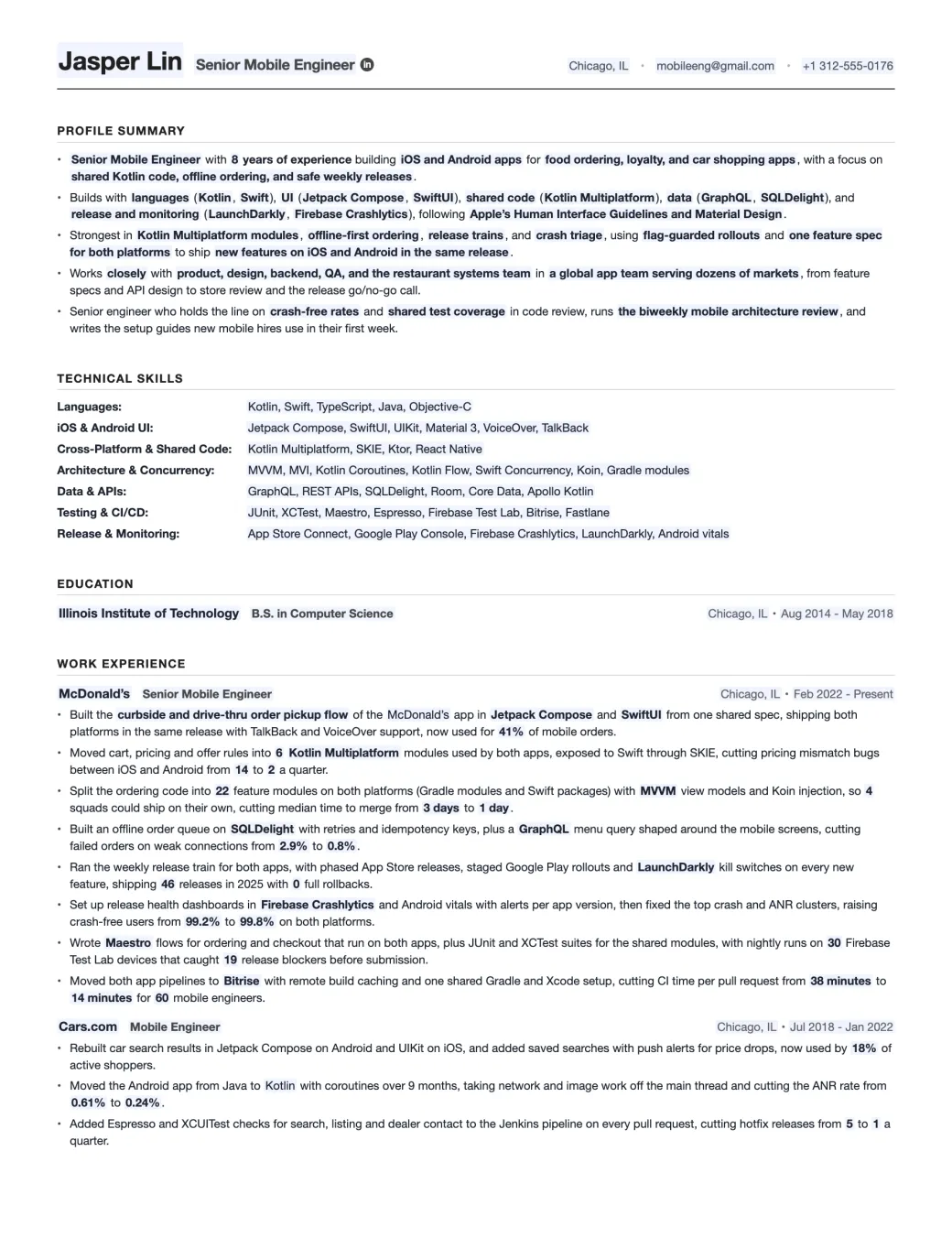
The Mobile Engineer resume template filled in for Jasper Lin, with his summary, skills, education and 8 bullets from his McDonald’s app job
Emmanuel Gendre Ex-Google recruiter / Tech resume writer Updated Free, ATS-friendly, no signup

Interactive resume template generator

Interactive Mobile Engineer Resume Template

Fill in the side panel, then download your resume as a PDF or a Word file.

Edits update live as you type. Toggle Edit to rewrite paper text directly.

Edit mode is on. Click anywhere on the resume to rewrite text. Side-panel placeholders still update live.

Jasper Lin Senior Mobile Engineer

Chicago, IL • mobileeng@gmail.com • +1 312-555-0176

Profile Summary

  • Senior Mobile Engineer with 8 years of experience building iOS and Android apps for food ordering, loyalty, and car shopping apps, with a focus on shared Kotlin code, offline ordering, and safe weekly releases.
  • Builds with languages (Kotlin, Swift), UI (Jetpack Compose, SwiftUI), shared code (Kotlin Multiplatform), data (GraphQL, SQLDelight), and release and monitoring (LaunchDarkly, Firebase Crashlytics), following Apple’s Human Interface Guidelines and Material Design.
  • Strongest in Kotlin Multiplatform modules, offline-first ordering, release trains, and crash triage, using flag-guarded rollouts and one feature spec for both platforms to ship new features on iOS and Android in the same release.
  • Works closely with product, design, backend, QA, and the restaurant systems team in a global app team serving dozens of markets, from feature specs and API design to store review and the release go/no-go call.
  • Senior engineer who holds the line on crash-free rates and shared test coverage in code review, runs the biweekly mobile architecture review, and writes the setup guides new mobile hires use in their first week.

Technical Skills

Languages:
Kotlin, Swift, TypeScript, Java, Objective-C
iOS & Android UI:
Jetpack Compose, SwiftUI, UIKit, Material 3, VoiceOver, TalkBack
Cross-Platform & Shared Code:
Kotlin Multiplatform, SKIE, Ktor, React Native
Architecture & Concurrency:
MVVM, MVI, Kotlin Coroutines, Kotlin Flow, Swift Concurrency, Koin, Gradle modules
Data & APIs:
GraphQL, REST APIs, SQLDelight, Room, Core Data, Apollo Kotlin
Testing & CI/CD:
JUnit, XCTest, Maestro, Espresso, Firebase Test Lab, Bitrise, Fastlane
Release & Monitoring:
App Store Connect, Google Play Console, Firebase Crashlytics, LaunchDarkly, Android vitals

Education

Illinois Institute of Technology B.S. in Computer Science
Chicago, IL • Aug 2014 - May 2018

Work Experience

McDonald’s Senior Mobile Engineer
Chicago, IL • Feb 2022 - Present
  • Built the curbside and drive-thru order pickup flow of the McDonald’s app in Jetpack Compose and SwiftUI from one shared spec, shipping both platforms in the same release with TalkBack and VoiceOver support, now used for 41% of mobile orders.
  • Moved cart, pricing and offer rules into 6 Kotlin Multiplatform modules used by both apps, exposed to Swift through SKIE, cutting pricing mismatch bugs between iOS and Android from 14 to 2 a quarter.
  • Split the ordering code into 22 feature modules on both platforms (Gradle modules and Swift packages) with MVVM view models and Koin injection, so 4 squads could ship on their own, cutting median time to merge from 3 days to 1 day.
  • Built an offline order queue on SQLDelight with retries and idempotency keys, plus a GraphQL menu query shaped around the mobile screens, cutting failed orders on weak connections from 2.9% to 0.8%.
  • Ran the weekly release train for both apps, with phased App Store releases, staged Google Play rollouts and LaunchDarkly kill switches on every new feature, shipping 46 releases in 2025 with 0 full rollbacks.
  • Set up release health dashboards in Firebase Crashlytics and Android vitals with alerts per app version, then fixed the top crash and ANR clusters, raising crash-free users from 99.2% to 99.8% on both platforms.
  • Wrote Maestro flows for ordering and checkout that run on both apps, plus JUnit and XCTest suites for the shared modules, with nightly runs on 30 Firebase Test Lab devices that caught 19 release blockers before submission.
  • Moved both app pipelines to Bitrise with remote build caching and one shared Gradle and Xcode setup, cutting CI time per pull request from 38 minutes to 14 minutes for 60 mobile engineers.
Cars.com Mobile Engineer
Chicago, IL • Jul 2018 - Jan 2022
  • Rebuilt car search results in Jetpack Compose on Android and UIKit on iOS, and added saved searches with push alerts for price drops, now used by 18% of active shoppers.
  • Moved the Android app from Java to Kotlin with coroutines over 9 months, taking network and image work off the main thread and cutting the ANR rate from 0.61% to 0.24%.
  • Added Espresso and XCUITest checks for search, listing and dealer contact to the Jenkins pipeline on every pull request, cutting hotfix releases from 5 to 1 a quarter.

Done editing? Download a real PDF (selectable text, ATS-friendly, US Letter) or an editable Word file if a recruiter asks for one.

About this template

A Mobile Engineer resume template, built by a tech recruiter.

A mobile engineer looks after both apps, iOS and Android, and the plumbing between them. You might write Kotlin in the morning and Swift after lunch, argue over which logic both apps should share, and keep a weekly build going out to two stores with different review rules. And when crashes jump on just one platform, you’re usually the one digging into why.

Here’s the catch: most cross-platform resumes look like two job ads stapled together, a Swift list, a Kotlin list, and bullets that never mention a release. A hiring manager on a two-app team is hunting for the hard stuff. Think a feature both stores got the same week, logic you pulled into shared code, a release train that left on time and fewer crashes on both apps.

This template is set up so you’d write those down. Jasper’s McDonald’s job has a bullet for each of the 8 parts of a mobile engineer’s work, starting with features on both platforms and ending with CI and tooling, and the Duolingo, Bumble and Marriott samples do too. No resume yet? My 6 steps for a two-platform Mobile Engineer resume show an iOS plus Android example at each stage.

Wondering whether your own resume shows the two-app work? Send it in for resume feedback, and I’ll reply with the lines I’d change before anything else.

Industry signal

What the market says about Mobile Engineer roles

Both stores changed the rules on mobile teams in 2026. Since September 30, Android apps in Brazil, Indonesia, Singapore and Thailand need a verified developer to install on certified phones, and Google plans to take it worldwide in 2027. From February 1, 2027, Google Play blocks updates that don’t support 16 KB memory pages. Apple’s first foldable, iPhone Duo, went on sale October 23. That’s work on 2 platforms at once, which is exactly the job a mobile engineer gets hired for.

5.3T Hours spent in iOS and Google Play apps, 2025 Sensor Tower, State of Mobile 2026
$136,388 Average base pay, US mobile developer job ads Indeed

Resume Samples

Mobile Engineer Resume Examples

Does a mobile engineer resume change when you work on both apps instead of one? It does, and my 3 mobile engineer resume examples show how at each level. The junior ships the same Duolingo screens in Compose and SwiftUI, the senior moved Bumble’s chat logic into Kotlin Multiplatform, and the principal sets the build and release rules behind Marriott’s Bonvoy apps. You can download each one as a PDF or a Word file, free and with no signup.

Junior Mobile Engineer Resume Example

On a junior mobile resume, I look for one feature you shipped on both iOS and Android, a test or a crash fix with a number on it, and proof you’ve been through a real store release. An internship on a live app counts.

Years of experience
2 years
Industry
EdTech
Stack
KotlinSwiftJetpack ComposeFirebase
Download PDF Download Word

Click to download the Junior Mobile Engineer resume example as a PDF or a Word file. Free / No signup.

Tomás Pereira

Junior Mobile Engineer

Pittsburgh, PA · tomas.pereira@gmail.com · +1 412-555-0163 · linkedin.com/in/tomaspereira

Profile Summary

  • Junior Mobile Engineer with 2 years on a language learning app used by millions, shipping streak and lesson features on both the iOS and Android apps every week.
  • Builds with Kotlin and Swift, Jetpack Compose and SwiftUI, a shared Kotlin Multiplatform module, Room for offline data, and Maestro, JUnit and XCTest for tests.
  • Growing in shared Kotlin code, offline lesson sync and crash triage on older Android phones, using Crashlytics data and the team’s weekly release train.
  • Works with 2 senior mobile engineers, a product designer, a learning scientist and QA on the streaks squad, from the feature spec to the release go/no-go.
  • Keeps the squad’s Maestro test list up to date, writes the release notes for streak features, and pairs with new interns on their first Compose screen.

Technical Skills

Languages:
Kotlin, Swift, Java (reading), Python (scripts)
iOS & Android UI:
Jetpack Compose, SwiftUI, Material 3, VoiceOver, TalkBack
Cross-Platform & Shared Code:
Kotlin Multiplatform, kotlin.test
Architecture & Concurrency:
MVVM, Kotlin Coroutines, Kotlin Flow, Hilt
Data & APIs:
REST APIs, Room, Core Data, Retrofit
Testing & CI/CD:
JUnit, XCTest, Maestro, Firebase Test Lab, GitHub Actions
Release & Monitoring:
Firebase Crashlytics, Firebase Remote Config, Google Play Console, App Store Connect
Page 2 of 2

Work Experience

Duolingo Software Engineer, Mobile Pittsburgh, PA · Aug 2024 to Present
  • Built the streak repair screen in Jetpack Compose and SwiftUI from one spec, shipped on both apps in the same weekly release under senior review, and used by over 2 million learners in its first month.
  • Moved the streak date logic into a shared Kotlin Multiplatform module with kotlin.test cases, replacing separate Swift and Kotlin versions and cutting time zone streak tickets from 11 a week to 2.
  • Added an offline queue in Room for lessons finished without signal, synced on reconnect with retries, cutting support tickets about lost lesson progress by 37%.
  • Fixed the top 3 Crashlytics crash clusters in the Android lesson player on Android 9 and 10, raising crash-free users on those versions from 99.1% to 99.6%.
  • Wrote Maestro flows for lesson start and streak repair that run nightly on both apps on Firebase Test Lab, catching 4 release blockers on older phones before submission.
PNC Mobile Engineering Intern Pittsburgh, PA · Jun 2023 to Aug 2023
  • Moved 4 screens of the bank’s Android app to MVVM with Hilt under a senior engineer’s review, with unit tests that raised that module’s coverage from 22% to 61%.
  • Put the new card controls screen behind a Firebase Remote Config flag and helped run its staged Google Play rollout, which reached all users in 3 weeks with no hotfix.
  • Wrote a Gradle check that caught missing Spanish strings in CI before each build, saving the Android team about 3 hours of manual checking per release.

Education

Carnegie Mellon University B.S. in Computer Science Pittsburgh, PA · Aug 2020 to May 2024

Senior Mobile Engineer Resume Example

A senior mobile engineer should own a slice of both apps end to end. I want to see the shared code call you made, how the data holds up offline, how your features reach users through flags and staged rollouts, and the crash or ANR numbers that moved.

Years of experience
7 years
Industry
Consumer social
Stack
KotlinSwiftSentryLaunchDarkly
Download PDF Download Word

Click to download the Senior Mobile Engineer resume example as a PDF or a Word file. Free / No signup.

Brett Halvorsen

Senior Mobile Engineer

Austin, TX · brett.halvorsen@gmail.com · +1 512-555-0189 · linkedin.com/in/bretthalvorsen

Profile Summary

  • Senior Mobile Engineer with 7 years on dating and job search apps, now owning chat and video calls across the iOS and Android apps of a dating app with tens of millions of users.
  • Builds with Kotlin and Swift, Kotlin Multiplatform with SQLDelight, Jetpack Compose and SwiftUI, GraphQL, and LaunchDarkly and Sentry for releases and monitoring.
  • Strongest in shared chat logic, offline message sync and staged feature rollouts, using an outbox pattern and per-feature flags so new chat features reach every market safely.
  • Works with product, design, the backend chat team, trust and safety, and QA, from the API schema review to the go/no-go call on each weekly release.
  • Mentors 3 mobile engineers on the chat squad, runs the monthly shared code review with the iOS and Android leads, and wrote the team’s KMP debugging guide.

Technical Skills

Languages:
Kotlin, Swift, Java, Objective-C (reading)
iOS & Android UI:
Jetpack Compose, SwiftUI, UIKit, VoiceOver, TalkBack
Cross-Platform & Shared Code:
Kotlin Multiplatform, SKIE, Ktor
Architecture & Concurrency:
MVI, MVVM, Kotlin Coroutines, Kotlin Flow, Swift Concurrency, Dagger
Data & APIs:
GraphQL, SQLDelight, Room, Apollo Kotlin, WebSockets
Testing & CI/CD:
JUnit, XCTest, Espresso, XCUITest, BrowserStack, GitHub Actions, Fastlane
Release & Monitoring:
LaunchDarkly, Sentry, Android vitals, Google Play Console, App Store Connect
Page 2 of 2

Work Experience

Bumble Senior Mobile Engineer Austin, TX · Mar 2022 to Present
  • Moved chat message handling and sync rules into Kotlin Multiplatform for the Bumble iOS and Android apps, sharing about 40% of the chat code and ending the logic bugs that showed up on one app only.
  • Rebuilt chat sync on a SQLDelight store with an outbox for unsent messages and a cursor-based GraphQL history query, cutting missing or duplicate message reports from 1.4% to 0.3% of chats.
  • Moved the chat squad onto the weekly release train with LaunchDarkly flags and kill switches per feature, rolling voice notes out to 12 markets in stages with no hotfix.
  • Added per-release Sentry and Android vitals alerts for chat, then fixed an ANR in the photo picker, cutting the Android chat ANR rate from 0.52% to 0.19%.
  • Shipped video call screens in SwiftUI and Jetpack Compose with matching flows and full VoiceOver and TalkBack labels, used in 9% of matches within 2 months.
Indeed Mobile Engineer Austin, TX · Aug 2019 to Feb 2022
  • Split the Android job search app into 14 Gradle modules with MVVM and Dagger, so 3 squads could build only their own code, cutting clean builds from 11 minutes to 4.
  • Wrote Espresso and XCUITest suites for the apply flow and ran them on a BrowserStack device matrix, raising apply flow test coverage from 35% to 80%.
  • Built a GitHub Actions pipeline with Fastlane lanes that sent both apps to TestFlight and Play internal testing on every merge, cutting release prep from 2 days to 3 hours.

Education

University of Texas at Austin B.S. in Computer Science Austin, TX · Aug 2015 to May 2019

Principal Mobile Engineer Resume Example

At principal level, your bullets should show what every mobile squad now works with because of you: the module rules, the release schedule, the shared code plan, the CI setup and the crash and startup budgets each release has to meet.

Years of experience
12 years
Industry
Hospitality
Stack
KotlinSwiftFastlaneDatadog
Download PDF Download Word

Click to download the Principal Mobile Engineer resume example as a PDF or a Word file. Free / No signup.

Adelina Bianchi

Principal Mobile Engineer

Bethesda, MD · adelina.bianchi@gmail.com · +1 301-555-0127 · linkedin.com/in/adelinabianchi

Profile Summary

  • Principal Mobile Engineer with 12 years in hospitality and banking apps, now setting architecture and release standards for the iOS and Android apps of a global hotel loyalty program.
  • Builds with Kotlin, Swift and Objective-C, Jetpack Compose, SwiftUI and UIKit, Kotlin Multiplatform, GraphQL, Fastlane and Jenkins, and Datadog RUM with Firebase Crashlytics.
  • Strongest in mobile architecture, release trains, build and CI speed and shared code decisions, using written proposals, small pilots and per-release budgets that every squad can check.
  • Works with engineering directors, product, the API platform team, security and the mobile DevOps engineers across a large digital organization, from roadmap planning to release reviews.
  • Co-runs the monthly mobile architecture review with the other iOS and Android principals, mentors senior engineers on both platforms, and sits on the hiring loop for mobile roles.

Technical Skills

Languages:
Kotlin, Swift, Objective-C, Java
iOS & Android UI:
Jetpack Compose, SwiftUI, UIKit, Android Views, VoiceOver, TalkBack
Cross-Platform & Shared Code:
Kotlin Multiplatform, SKIE, React Native (evaluated)
Architecture & Concurrency:
MVVM, Kotlin Coroutines, Swift Concurrency, Hilt, Gradle modules, Swift Package Manager
Data & APIs:
GraphQL, REST APIs, Room, Core Data, URLSession, Retrofit
Testing & CI/CD:
JUnit, XCTest, Espresso, XCUITest, Fastlane, Jenkins, GitHub Actions
Release & Monitoring:
App Store Connect, Google Play Console, Firebase Crashlytics, Datadog RUM, LaunchDarkly
Page 2 of 2

Work Experience

Marriott International Principal Engineer, Mobile Bethesda, MD · Jun 2019 to Present
  • Set the module boundaries and deep link routing contract for the Marriott Bonvoy iOS and Android apps (Swift packages, Gradle modules, MVVM), cutting cross-squad merge conflicts by about 60%.
  • Wrote the shared code proposal and ran a 2-quarter Kotlin Multiplatform pilot for stay and reservation rules, then rolled it out to 7 squads, retiring 3 duplicated rule sets between the apps.
  • Moved both apps from monthly releases to a 2-week release train with phased App Store releases, staged Play rollouts and LaunchDarkly kill switches, with 1 rollback in all of 2025.
  • Set crash and cold start budgets per release in Firebase Crashlytics and Datadog RUM, keeping crash-free users above 99.8% and cutting Android median cold start from 2.6s to 1.4s.
  • Worked with the mobile DevOps engineers to add remote build caching and module templates to the Jenkins and Fastlane pipelines, cutting average CI time from 52 to 18 minutes.
Capital One Senior Software Engineer, Mobile McLean, VA · Jun 2014 to May 2019
  • Built the offline cache and retry layer for account screens on Room and Core Data, cutting balance screen load on weak connections from 4.1s to 1.3s.
  • Shipped card lock and virtual card numbers on iOS (Swift, UIKit) and Android (Kotlin) with VoiceOver and TalkBack labels, closing 23 of 25 findings from an accessibility audit.
  • Set up screenshot tests for both apps and ran UI tests on a device farm before each release, cutting UI bugs found by customers by 45% over 2 years.

Education

Università di Bologna Laurea Magistrale in Ingegneria Informatica Bologna, Italy · Sep 2009 to Mar 2014

Free resume review

A recruiter screen, but with feedback

You applied to hundreds of jobs: no result. Companies won’t give you feedback, so you’re stuck in a loop. Rejections will keep coming until you know what’s wrong.

Let’s break this cycle today!

I’ll screen your resume the same way I did at Google.

You’ll get:

  • Your resume sections and content scored.
  • A clear list of what to improve, why, and how.
  • Behind the scenes secrets on the screening process.

How I rewrite Mobile Engineer resumes

How to write a Mobile Engineer resume

Emmanuel Gendre, ex-Google recruiter

Emmanuel Gendre Ex-Google recruiter, tech resume writer

I recruited for 13 years, and Google was home for many of those. These days I see cross-platform resumes every week, and they tend to repeat one habit. Each platform gets its own tool list, and then the bullets say “worked on the iOS and Android apps.” Read that cold and you’ve got no clue whether anything shipped on either one.

Whenever someone books my tech resume writing service, my opening edit puts the two-platform proof back. That’s the feature both apps got in one release, the code you moved into a shared module, the rollout you paused with a kill switch. If you’re doing it yourself, though, focus on these 6 steps. I’ve written each example in them for someone who works on both apps.

  1. Step 1 Format & layout A single column and the usual headings, saved as a clean PDF. Go to step 1
  2. Step 2 Profile Summary Show iOS, Android and the shared code before the recruiter scrolls. Go to step 2
  3. Step 3 Work Experience Your latest role, written area by area, features to CI speed. Go to step 3
  4. Step 4 Bullet Points Grow a vague two-app bullet until a real number closes it. Go to step 4
  5. Step 5 Technical Skills 7 skill rows covering both platforms, then 5 people skills. Go to step 5
  6. Step 6 Keywords & Metrics What mobile ads ask for, a finder for postings, and 24 metrics. Go to step 6

Step 1 · Format & Layout

Mobile Engineer resume format and layout

Format first, because it’s quick to get right. You’re checking 3 things here: can an ATS read the file, can a recruiter find every employer and date at a glance, and are you sending the right file type?

01ATS Compliance

ATS compliance for your Mobile Engineer resume

Before a mobile lead sees your application, it’s usually been stored in Workday, Greenhouse or Lever. The ATS (Applicant Tracking System) cuts the page up into employers, job titles, dates and skills. When a recruiter later looks up “Kotlin” or “SwiftUI”, resumes that got cut up badly don’t show. Two-column layouts and skill bars cause most of that, and there’s more on it in why ATS parsing breaks on fancy layouts. To keep your Kotlin and Swift keywords searchable, follow these 3 rules:

The 3 rules
  1. Use a 100% text based format (no Canva!)

  2. Avoid tables, pictures, and complex structures.

  3. Use the most predictable section names, like “Profile Summary” and “Work Experience”

02Design & Layout

Mobile Engineer resume design and layout

You spend your days on screens people tap, so a resume with a phone frame, app icons and a colored sidebar feels like a good idea. It isn’t. Recruiters hate fancy designs. Someone screening a pile of Kotlin and Swift resumes before lunch only wants your employer, title and dates sitting in the spot they always look.

Keep it plain, on purpose: 1 column, Arial or Helvetica, and the 4 headings everybody uses. App Store and Google Play links are fine for apps you’d happily demo in an interview. My template already uses these settings, and I’ve listed them below for anyone setting up their own file.

Layout Spec
Columns
One. No sidebars, tables, columns, pictures or tabs.
Margins
0.7 in on all four sides
Body size
10 to 11 pt
Type
One family, weight for hierarchy
Length
One page under 5 years, two after
Section order
Summary, Skills, Experience, Education
PDF

03File Format

Resume file format for your Mobile Engineer resume

Pick PDF unless the ad says Word. It’ll look identical in the ATS preview, on a big monitor and on the iPhone or Pixel a hiring manager reads it on. Parsers have no trouble with a PDF saved straight out of Word or Google Docs, but a scanned page is only an image to them. A few agencies ask for .docx files so their logo can sit at the top. My comparison is in which resume file format to send.

Format Guide
PDF
Your default. Layout holds, text stays selectable.
Word (.docx)
If the job ad or an agency asks. Use the Word button above.
Plain text
For portals that make you paste into a box
Never
Images, scans, password-protected PDFs, shared-drive links
File name
Jasper-Lin-Mobile-Engineer.pdf

Step 2 · Profile Summary

Mobile Engineer profile summary

Even with 1 year on the job, you need a profile summary. As I show in why recruiters screen in 2 rounds, the opening look rarely gets below your Work Experience heading. If those lines only show Swift, you’ll get filed as an iOS developer.

That’s the extra job a mobile summary has: Kotlin, Swift and your shared code all need to show up near the top. Below are the 5 summary bullets I use with mobile clients, in the order I write them, and my article on profile summaries goes through the reason for each.

  1. 1

    Title, years and scope

    Take the title straight from the posting (Mobile Engineer, Software Engineer, Mobile, Senior Mobile Developer), then your years. Say whether you build two native apps, a KMP app or a React Native one, plus the product: ordering, banking or social.

  2. 2

    Your stack

    Your tools under short labels so both platforms jump out: languages (Kotlin, Swift), UI (Compose, SwiftUI), shared code, data, release and monitoring. Recruiters type those exact product names into ATS search boxes.

  3. 3

    Domain expertise

    Pick 3 or 4 mobile problems you’d gladly own again, like shared Kotlin modules, orders that survive a dead zone or release trains, with how you handle them. A hiring lead compares that line with their own backlog.

  4. 4

    Collaboration

    Mobile engineers sit in the middle of product, design, backend, QA and, during a bad release, support. Write down who’s in that group for you and when you meet, like spec reviews, API planning and the go/no-go call.

  5. 5

    Leadership

    What other mobile engineers use because you built it: the architecture review you run, the new hire setup guide, a module template, the juniors you coach. Plenty of ICs with zero reports fill this line easily.

Mobile Engineer resume summary example, from the template above
  • Senior Mobile Engineer with 8 years of experience building iOS and Android apps for food ordering, loyalty, and car shopping apps, with a focus on shared Kotlin code, offline ordering, and safe weekly releases.
  • Builds with languages (Kotlin, Swift), UI (Jetpack Compose, SwiftUI), shared code (Kotlin Multiplatform), data (GraphQL, SQLDelight), and release and monitoring (LaunchDarkly, Firebase Crashlytics), following Apple’s Human Interface Guidelines and Material Design.
  • Strongest in Kotlin Multiplatform modules, offline-first ordering, release trains, and crash triage, using flag-guarded rollouts and one feature spec for both platforms to ship new features on iOS and Android in the same release.
  • Works closely with product, design, backend, QA, and the restaurant systems team in a global app team serving dozens of markets, from feature specs and API design to store review and the release go/no-go call.
  • Senior engineer who holds the line on crash-free rates and shared test coverage in code review, runs the biweekly mobile architecture review, and writes the setup guides new mobile hires use in their first week.

Step 3 · Work Experience

Mobile Engineer work experience

After the quick look comes a slower read, and almost all of it goes to your current job. It carries about 95% of the screening decision, and that’s logical. How you handle both apps right now is what they’re hiring for, and a 2019 job on one platform can’t show it.

So the 8 McDonald’s bullets above follow the mobile role profile, area by area. Skip one and a manager notices. Say nothing about releases, and they’ll wonder if you’ve ever pushed a build through App Review and Play Console, or only merged code and let someone else ship it.

Mobile Engineer role profile
  1. iOS & Android Feature Delivery

    You ship each feature on both apps, not only on your stronger platform. When Android lands 3 sprints after iOS, product misses its launch date and marketing tells half the users “coming soon”. Point out how you used one shared spec and parallel Compose and SwiftUI work to release both together.

    Techniques
    shared feature specs, platform conventions, parity tracking, TalkBack and VoiceOver
    Tools
    Jetpack Compose, SwiftUI, UIKit, Material 3
    Metrics
    features shipped on both apps, adoption, parity gaps closed
  2. Shared Code Strategy

    You decide which code both apps share and which stays native. A bad call here costs a team for years in slow builds or a bridge nobody can debug, so senior interviews always come back to it. Tell them how you used Kotlin Multiplatform or React Native, and what you measured, to remove duplicated logic and its bugs.

    Techniques
    shared business logic, Swift interop, pilot before rollout, native escape hatches
    Tools
    Kotlin Multiplatform, SKIE, Ktor, React Native, Flutter
    Metrics
    code shared, duplicate bugs removed, squads on shared modules
  3. Mobile Architecture & Modularization

    You lay out two big codebases so 4 squads can work in them without collisions. In a tangled app every pull request turns into a merge fight, and managers see that in the time-to-merge chart. Explain how you used feature modules and an MVVM or MVI pattern to give each squad its own corner of the code.

    Techniques
    feature modules, unidirectional data flow, dependency injection, deep link routing
    Tools
    Gradle modules, Swift Package Manager, Hilt, Koin
    Metrics
    time to merge, modules split out, build time
  4. Offline Sync & Mobile APIs

    You keep the app working in an elevator or a basement car park. Phones drop signal all the time, and a lost order or message means a refund and an annoyed customer. Describe how you used a local queue and an API shaped for mobile screens to stop failures on bad connections.

    Techniques
    offline queues, retries and idempotency, pagination, API versioning
    Tools
    Room, Core Data, SQLDelight, GraphQL, Apollo Kotlin
    Metrics
    failed requests, sync errors, screen load time
  5. Release Trains & Feature Flags

    You get both apps out the door on a fixed schedule. Unlike a website, a mobile bug can’t just be rolled back, since old builds sit on phones for months. Mention how you used phased releases, staged rollouts and kill switches to ship every week without pulling a build.

    Techniques
    release trains, phased and staged rollouts, kill switches, forced upgrades
    Tools
    LaunchDarkly, Firebase Remote Config, App Store Connect, Google Play Console
    Metrics
    releases per year, rollbacks, hotfixes
  6. Crash & Performance Monitoring

    You keep an eye on the app on real phones once it’s out. Google Play ranks apps with bad ANR and crash rates lower, and angry users write one-star reviews long before they contact support. Let them know which dashboards and alerts you set up in Crashlytics, Sentry or Android vitals, and which rate went up.

    Techniques
    release health alerts, crash clustering, ANR fixes, cold start budgets
    Tools
    Firebase Crashlytics, Sentry, Android vitals, MetricKit
    Metrics
    crash-free users, Android ANR rate, cold start time
  7. Automated Testing & Device Coverage

    You catch bugs on old phones before users find them. Your users run dozens of OS versions and screen sizes, and a manual test on the team’s new Pixel misses most of them. Show them how you used UI test flows and a device farm to stop release blockers before submission.

    Techniques
    UI test flows, screenshot tests, shared module tests, device matrix runs
    Tools
    Maestro, Espresso, XCUITest, JUnit, Firebase Test Lab
    Metrics
    release blockers caught, test coverage, flaky test rate
  8. Mobile Platform & Developer Experience

    You make every other mobile engineer faster. A 40-minute CI wait on each pull request wastes hours across a big team, and engineering directors notice the cost. Walk them through how you used build caching, shared CI setups and templates to cut waiting time for everyone.

    Techniques
    remote build caching, CI pipelines, module templates, onboarding docs
    Tools
    Bitrise, GitHub Actions, Gradle, Xcode, Bazel, Fastlane
    Metrics
    CI time, build time, time to first merge for new hires

Did you spend years on one platform before going cross-platform? Keep those jobs, and lead their bullets with any work you did on the other app. For agency work, use one entry and put each client app you built in its own bullet.

Submit your resume for a free review!

Step 4 · Bullet Points

Mobile Engineer resume bullet points

Bullets are where a mobile rewrite takes the longest. My fix is the Level System: Google’s XYZ formula as a base, with extra room for techniques, the tools on each platform and the way you worked. The whole method is laid out in how I build bullets level by level.

It boils down to 5 questions you answer about a single project. Every answer makes the bullet a bit longer and a lot more convincing, and for two-app work the last one is usually a crash rate or a failure rate. Here’s a double-charge bug in a grocery app going through all 5.

  1. Level 1Task

    What did I work on? A verb and the thing you fixed. Any mobile engineer could write this line, so it can’t stop here.

    Fixed double charges in the checkout flow of a grocery delivery app.

  2. Level 2+ Techniques

    How did I do it? Add the techniques. These are the things a mobile lead will ask you to explain on a whiteboard.

    Fixed double charges in the checkout flow of a grocery delivery app with idempotency keys and a retry queue.

  3. Level 3+ Tools

    What tools did I use? Write the real names, on both platforms. A recruiter searching for “Kotlin Multiplatform” won’t find “shared code”.

    Fixed double charges in the checkout flow of a grocery delivery app with idempotency keys and a retry queue in a shared Kotlin Multiplatform payments module, stored in SQLDelight on iOS and Android.

  4. Level 4+ Method

    What method did I follow? Show how you found the cause. Reproducing it first tells a manager you don’t guess.

    Fixed double charges in the checkout flow of a grocery delivery app with idempotency keys and a retry queue in a shared Kotlin Multiplatform payments module, stored in SQLDelight on iOS and Android, after matching Sentry traces to payment logs from timed-out requests.

  5. Level 5+ Metric

    What was the result? Finish on the number the team watched, here the share of orders charged twice.

    Fixed double charges in the checkout flow of a grocery delivery app with idempotency keys and a retry queue in a shared Kotlin Multiplatform payments module, stored in SQLDelight on iOS and Android, after matching Sentry traces to payment logs from timed-out requests, cutting double-charged orders from 0.7% to 0.05%.

    1. 01 Task What you worked on
    2. 02 Techniques How you did it
    3. 03 Tools The stack you used
    4. 04 Method The method you followed
    5. 05 Metric The result, one number

You’ll find most of your numbers in 3 spots: Crashlytics or Sentry for crashes, Android vitals and Xcode Organizer for ANRs and launch times, and your feature flag tool for rollout history. Keep those tabs open while you write.

Step 5 · Technical Skills

Mobile Engineer resume skills

Mobile engineer ads usually go Kotlin and Swift first, then UI frameworks, the shared code approach, architecture, data, tests and release tools. Copy that order and the official product names. Write “Jetpack Compose”, never “Android UI toolkit”, since that’s the exact string a recruiter searches.

Expect questions on everything you list. Put SKIE in a row and somebody will ask how a Kotlin Flow looks from Swift. Coming up are 7 groups of mobile skills, Jasper’s completed Technical Skills block, and the people skills two-app teams screen for. Keywords get their own step after this one.

The 7 skill categories for a Mobile Engineer resume

I see the starred items in most mobile engineer job ads, so open each row with them. Fill the rest with tools that run in production on one of your apps.

Languages

Kotlin and Swift up front, because nearly every mobile ad wants both. TypeScript or Dart only if you ship React Native or Flutter, and Java or Objective-C if old code still needs you.

KotlinSwiftTypeScriptJavaObjective-CDart

iOS & Android UI

The UI frameworks you build screens with on each side, usually Jetpack Compose and SwiftUI, plus UIKit or Android Views for older screens and the accessibility tools you test with.

Jetpack ComposeSwiftUIUIKitAndroid ViewsMaterial 3VoiceOverTalkBack

Cross-Platform & Shared Code

How your team shares code between the two apps. In mobile engineer postings that’s mostly Kotlin Multiplatform, with React Native or Flutter at companies that already run them.

Kotlin MultiplatformCompose MultiplatformSKIEReact NativeFlutterKtor

Architecture & Concurrency

Your pattern (MVVM or MVI), how you handle async work on each platform (coroutines, Flow, Swift Concurrency), and how you split code into modules and inject dependencies.

MVVMKotlin CoroutinesMVIKotlin FlowSwift ConcurrencyHiltKoinGradle modulesSwift Package Manager

Data & APIs

How each app gets data from the backend and keeps it on the phone: GraphQL or REST, a local database such as Room, Core Data or SQLDelight, and the client libraries on top.

GraphQLRoomREST APIsCore DataSQLDelightRetrofitURLSessionApollo KotlingRPC

Testing & CI/CD

Unit and UI test tools for both apps, the device farm you run them on, and the CI service and Fastlane lanes that build and sign every release.

JUnitXCTestFastlaneEspressoXCUITestMaestroFirebase Test LabBitriseGitHub ActionsBazel

Release & Monitoring

The store consoles, your crash and performance tools, and your feature flag service. These show a recruiter you’ve owned releases, not only code.

Firebase CrashlyticsGoogle Play ConsoleApp Store ConnectSentryLaunchDarklyFirebase Remote ConfigAndroid vitalsDatadog

A finished Mobile Engineer skills section

Technical Skills sample, from the template above
Languages
Kotlin, Swift, TypeScript, Java, Objective-C
iOS & Android UI
Jetpack Compose, SwiftUI, UIKit, Material 3, VoiceOver, TalkBack
Cross-Platform & Shared Code
Kotlin Multiplatform, SKIE, Ktor, React Native
Architecture & Concurrency
MVVM, MVI, Kotlin Coroutines, Kotlin Flow, Swift Concurrency, Koin, Gradle modules
Data & APIs
GraphQL, REST APIs, SQLDelight, Room, Core Data, Apollo Kotlin
Testing & CI/CD
JUnit, XCTest, Maestro, Espresso, Firebase Test Lab, Bitrise, Fastlane
Release & Monitoring
App Store Connect, Google Play Console, Firebase Crashlytics, LaunchDarkly, Android vitals

Soft skills for a Mobile Engineer resume

“Strong communicator” on a resume proves nothing. A real situation with a result does, so I’ve matched each of the 5 soft skills below with a bullet where it actually happens.

  • Getting the iOS and Android leads to agree on one approach

    Resume bulletCompared 3 offline sync designs in a 2-page doc for both platform leads, who picked one that both apps shipped that quarter.

  • Telling product a feature should wait for the next release train

    Resume bulletMoved a loyalty feature to the next train after QA hit a checkout bug on old Android phones; it shipped 7 days later, no hotfix.

  • Keeping support in the loop while a crash fix waits in store review

    Resume bulletSent support a daily status note during a login crash, cutting repeat tickets by 40% until the fixed build went live.

  • Working out API changes with backend that old app versions can survive

    Resume bulletAgreed a field deprecation plan with the menu API team that kept 18-month-old app versions working, with 0 broken installs.

  • Onboarding new mobile engineers onto the build and release process

    Resume bulletWrote the mobile setup guide and paired on each new hire’s first release, cutting their first merged pull request from day 9 to day 3.

Step 6 · Keywords & Metrics

Mobile Engineer resume keywords and metrics

Two things get a mobile resume onto the shortlist. Keywords are the platform, framework and tool names recruiters type into the ATS, for iOS and Android alike. Metrics close out your bullets and prove the change helped people using the app, through fewer crashes, fewer failed orders or faster screens.

Read the 3 keyword tiers, then copy a posting you like into the finder to see which of those words your Skills rows lack. Underneath, one table lists 24 mobile metrics, 3 for each part of the role profile, each paired with a bullet from Jasper’s resume.

+42%

Mobile Engineer resume keywords, ranked

Tap Kotlin Multiplatform, Jetpack Compose or another chip and you’ll see how postings usually word it. That way “shared business logic” in an ad reads to you as KMP.

Must-have

7

Put these in your summary, your skills rows and at least one bullet each.

In a job description“Strong experience with Kotlin for Android development”

Strong supporting

8

Add a bullet for each one you’ve actually used. The rest can sit in your skills rows.

In a job description“Experience sharing business logic with Kotlin Multiplatform”

Bonus

8

Nice to have. Include them when they’re true, and move them up when the ad asks.

In a job description“Experience with React Native or another cross-platform framework is a plus”

Extract Mobile Engineer keywords from a job description

Reading a mobile engineer or mobile developer posting right now? Paste the text here to split its platforms, frameworks and tools into 3 groups, then copy over the ones you’ve actually shipped with.

Must-have
Put these in your skills section and back each one with a bullet.
Strong supporting
Add the ones you’ve actually worked with. Skip the rest.

Nothing is uploaded: it all happens in your browser.

Metrics for a Mobile Engineer resume

Stick to one number in each bullet. Every example here comes from Jasper’s McDonald’s and Cars.com jobs, so put your own figures in their place.

MetricExample bullet
Features on both apps
Features shipped on both apps Count Features you released on iOS and Android, ideally in the same release.Shipped 11 ordering features on iOS and Android in 2025, each released on both apps in the same week.
Feature adoption Percent Share of users or orders that use a feature you built.Built the curbside and drive-thru pickup flow in Compose and SwiftUI, now used for 41% of mobile orders.
Parity gap Time How long one platform lagged behind the other on a feature.Cut the gap between iOS and Android launches of the same feature from 5 weeks to 0 by working from one shared spec.
Shared code
Code shared Percent Share of app logic that runs from shared modules on both platforms.Moved cart, pricing and offer rules into Kotlin Multiplatform, sharing about 35% of the ordering code between the apps.
Platform-only bugs Count Bugs caused by the two apps applying the same rule differently.Cut pricing mismatch bugs between iOS and Android from 14 to 2 a quarter after moving pricing into a shared module.
Squads on shared modules Count Teams building features on top of the shared code.Got 4 squads building on the shared cart module within 2 quarters of the first release.
Architecture
Time to merge Time Median time from opening a pull request to merging it.Cut median time to merge from 3 days to 1 after splitting the ordering code into 22 feature modules.
Modules split out Count Feature modules you extracted from a large app target.Split the ordering code into 22 feature modules across Gradle and Swift Package Manager.
Incremental build time Time How long a local rebuild takes after a small change.Cut incremental Android builds from 3.5 minutes to 50 seconds once feature modules stopped depending on each other.
Offline & APIs
Failed requests Percent Share of orders or requests that fail, often split by connection quality.Cut failed orders on weak connections from 2.9% to 0.8% with an offline order queue and retries.
Screen load time Time Time from opening a screen to showing its data.Cut menu load time on 3G from 3.2s to 1.1s with a GraphQL query shaped around the menu screen and a local cache.
Payload size Percent How much data a screen downloads, before and after a change.Cut the home screen payload by 62% by replacing 4 REST calls with one GraphQL query.
Releases & flags
Release cadence Frequency How often you ship to the App Store and Google Play.Moved both apps from monthly releases to a weekly release train with phased and staged rollouts.
Rollbacks and hotfixes Count Releases you had to pull back or patch after launch.Shipped 46 releases in 2025 with no full rollback, turning bad features off with LaunchDarkly instead.
Flagged features Percent Share of new features shipped behind a feature flag or kill switch.Put every new feature behind a kill switch in 2025, after a 2024 rollback took 4 days to reach users.
Crashes & performance
Crash-free users Percent Share of daily users who never hit a crash.Raised crash-free users from 99.2% to 99.8% on both apps by fixing the top crash clusters per release.
ANR rate Percent Share of Android sessions with an App Not Responding error, as shown in Android vitals.Cut the Android ANR rate from 0.61% to 0.24% by moving network and image work off the main thread.
Cold start time Time Time from tapping the icon to a usable first screen.Cut cold start on mid-range Android phones from 2.4s to 1.3s with Baseline Profiles and lazy module loading.
Testing & devices
Release blockers caught Count Bugs your automated tests caught before store submission.Caught 19 release blockers before submission with nightly Maestro runs on Firebase Test Lab.
Device coverage Count Phones and OS versions your automated tests run on.Grew the nightly test matrix to 30 devices, including the 5 oldest Android versions still in use.
Hotfix releases Frequency Emergency releases needed after a bug got through.Cut hotfix releases from 5 to 1 a quarter after adding Espresso and XCUITest checks to every pull request.
Platform & DX
CI time per pull request Time How long engineers wait for CI before they can merge.Cut CI time per pull request from 38 to 14 minutes with remote build caching on Bitrise.
Engineers served Count Mobile engineers who use the pipelines, templates or tools you built.Moved 60 mobile engineers onto one shared Gradle and Xcode setup across both apps.
Time to first merge Time How long a new hire takes to merge their first pull request.Brought new hires’ time to first merged pull request from 9 days to 3 with a setup guide and module templates.

What if you don’t have exact numbers?

  • 1

    Check the store consoles. App Store Connect and Google Play Console keep ratings, crash counts and release dates per version, even if nobody on your team built a dashboard.

  • 2

    Estimate low, and remember how. “Around 20 shared screens” is fine if you could walk a mobile lead through how you counted them.

  • 3

    Use the size of the app. Daily active users, markets, squads in the codebase or devices in your test matrix give a recruiter a sense of scale.

Free resume review

A recruiter screen, but with feedback

You applied to hundreds of jobs: no result. Companies won’t give you feedback, so you’re stuck in a loop. Rejections will keep coming until you know what’s wrong.

Let’s break this cycle today!

I’ll screen your resume the same way I did at Google.

You’ll get:

  • Your resume sections and content scored.
  • A clear list of what to improve, why, and how.
  • Behind the scenes secrets on the screening process.

Frequently asked

Mobile Engineer resume FAQ

It is. There’s no sign-up of any kind, so fill in your Kotlin and Swift work, save the file, and you can reopen it whenever a new posting catches your eye.

Sure. Click Word and you’ll download an editable .docx of your resume, and every sample on this page comes with a Word copy next to its PDF. For applications, upload the PDF. Recruiters at agencies who want to tweak your resume are the main reason to keep the .docx.

Yes. One column, common headings and real text mean Kotlin, SwiftUI and the rest stay searchable. Want proof? Run your PDF through my free ATS resume checker and check the text it pulls out.

Keep it to 1 page until you’ve got 5 years behind you. After that, a second page is normal, since two apps, shared code and release work all need room. Your current job should still start on page 1.

Hardly. Google retired its Associate Android Developer exam, and nobody offers a well-known cert for cross-platform work. An app live on both stores, or Kotlin Multiplatform code on GitHub, carries far more weight.

Whatever your work changed: crash-free users, the Android ANR rate, cold start time, failed requests, release cadence or CI time. You’ll see 24 in the Step 6 table, three for each of the 8 profile areas.

Lead with one feature you shipped on both platforms, even if one side was small. Then add a test you wrote, a crash you fixed and what the crash rate did afterward, and a store release you helped with. An internship on a live app counts as a job.

Yes, if you wrote or maintained shared code yourself. Put it in the Cross-Platform row and give it one bullet about what you moved into it. If you’ve only read about KMP, skip it, because a mobile lead will ask how you exposed it to Swift.

No. Recruiters don’t compare layouts. The real problem is applying with Jasper’s McDonald’s bullets left in, so swap every company, app and figure for yours first.

More resources

More help with your Mobile Engineer resume