
Technical Product Manager Resume Examples & Free Template (PDF, Word)

Niko owns Postman’s public API, and his specs, latency wins and one API deprecation are loaded into this TPM template. Swap his platform work for yours and you’ve got a PDF or Word file in minutes. Scroll past the tool for TPM samples at 3 levels and my 6-step guide.

4.9 5.0
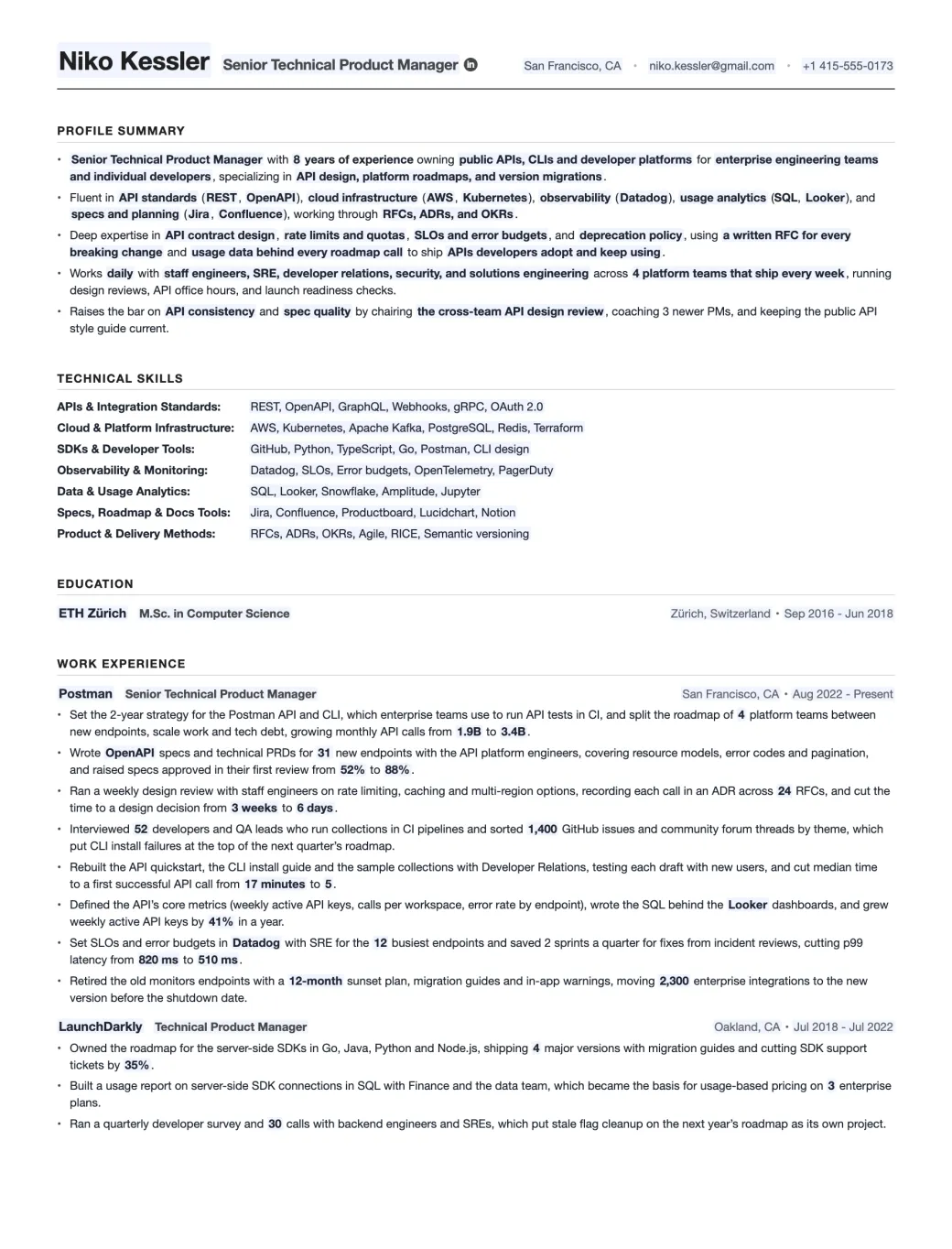
Filled-in Technical Product Manager resume for Niko Kessler, a senior TPM at Postman, showing API, cloud and observability skills and 11 work bullets
Emmanuel Gendre Ex-Google recruiter / Tech resume writer Updated Free, ATS-friendly, no signup

Interactive resume template generator

Interactive Technical Product Manager Resume Template

Fill in the side panel, then download your resume as a PDF or a Word file.

Edits update live as you type. Toggle Edit to rewrite paper text directly.

Edit mode is on. Click anywhere on the resume to rewrite text. Side-panel placeholders still update live.

Niko Kessler Senior Technical Product Manager

San Francisco, CA • niko.kessler@gmail.com • +1 415-555-0173

Profile Summary

  • Senior Technical Product Manager with 8 years of experience owning public APIs, CLIs and developer platforms for enterprise engineering teams and individual developers, specializing in API design, platform roadmaps, and version migrations.
  • Fluent in API standards (REST, OpenAPI), cloud infrastructure (AWS, Kubernetes), observability (Datadog), usage analytics (SQL, Looker), and specs and planning (Jira, Confluence), working through RFCs, ADRs, and OKRs.
  • Deep expertise in API contract design, rate limits and quotas, SLOs and error budgets, and deprecation policy, using a written RFC for every breaking change and usage data behind every roadmap call to ship APIs developers adopt and keep using.
  • Works daily with staff engineers, SRE, developer relations, security, and solutions engineering across 4 platform teams that ship every week, running design reviews, API office hours, and launch readiness checks.
  • Raises the bar on API consistency and spec quality by chairing the cross-team API design review, coaching 3 newer PMs, and keeping the public API style guide current.

Technical Skills

APIs & Integration Standards:
REST, OpenAPI, GraphQL, Webhooks, gRPC, OAuth 2.0
Cloud & Platform Infrastructure:
AWS, Kubernetes, Apache Kafka, PostgreSQL, Redis, Terraform
SDKs & Developer Tools:
GitHub, Python, TypeScript, Go, Postman, CLI design
Observability & Monitoring:
Datadog, SLOs, Error budgets, OpenTelemetry, PagerDuty
Data & Usage Analytics:
SQL, Looker, Snowflake, Amplitude, Jupyter
Specs, Roadmap & Docs Tools:
Jira, Confluence, Productboard, Lucidchart, Notion
Product & Delivery Methods:
RFCs, ADRs, OKRs, Agile, RICE, Semantic versioning

Education

ETH Zürich M.Sc. in Computer Science
Zürich, Switzerland • Sep 2016 - Jun 2018

Work Experience

Postman Senior Technical Product Manager
San Francisco, CA • Aug 2022 - Present
  • Set the 2-year strategy for the Postman API and CLI, which enterprise teams use to run API tests in CI, and split the roadmap of 4 platform teams between new endpoints, scale work and tech debt, growing monthly API calls from 1.9B to 3.4B.
  • Wrote OpenAPI specs and technical PRDs for 31 new endpoints with the API platform engineers, covering resource models, error codes and pagination, and raised specs approved in their first review from 52% to 88%.
  • Ran a weekly design review with staff engineers on rate limiting, caching and multi-region options, recording each call in an ADR across 24 RFCs, and cut the time to a design decision from 3 weeks to 6 days.
  • Interviewed 52 developers and QA leads who run collections in CI pipelines and sorted 1,400 GitHub issues and community forum threads by theme, which put CLI install failures at the top of the next quarter’s roadmap.
  • Rebuilt the API quickstart, the CLI install guide and the sample collections with Developer Relations, testing each draft with new users, and cut median time to a first successful API call from 17 minutes to 5.
  • Defined the API’s core metrics (weekly active API keys, calls per workspace, error rate by endpoint), wrote the SQL behind the Looker dashboards, and grew weekly active API keys by 41% in a year.
  • Set SLOs and error budgets in Datadog with SRE for the 12 busiest endpoints and saved 2 sprints a quarter for fixes from incident reviews, cutting p99 latency from 820 ms to 510 ms.
  • Retired the old monitors endpoints with a 12-month sunset plan, migration guides and in-app warnings, moving 2,300 enterprise integrations to the new version before the shutdown date.
LaunchDarkly Technical Product Manager
Oakland, CA • Jul 2018 - Jul 2022
  • Owned the roadmap for the server-side SDKs in Go, Java, Python and Node.js, shipping 4 major versions with migration guides and cutting SDK support tickets by 35%.
  • Built a usage report on server-side SDK connections in SQL with Finance and the data team, which became the basis for usage-based pricing on 3 enterprise plans.
  • Ran a quarterly developer survey and 30 calls with backend engineers and SREs, which put stale flag cleanup on the next year’s roadmap as its own project.

Done editing? Download a real PDF (selectable text, ATS-friendly, US Letter) or an editable Word file if a recruiter asks for one.

About this template

A Technical Product Manager resume template, built by a tech recruiter.

A technical product manager owns a product whose users write code: an API, an SDK, a cloud platform, a data pipeline or the internal tools other engineering teams build on. You’re still the one choosing what gets built. What’s different is that your specs talk about endpoints, latency and rate limits, your design reviews happen with staff engineers, and customers judge you by how fast they get a working integration.

Put most TPM resumes next to a regular PM resume and I can’t tell them apart. Roadmaps, stakeholders, “cross-functional”, and one line of tech buzzwords at the bottom. A platform hiring manager sees that and concludes the engineers made every real call. You change their mind with evidence: the spec you wrote, the architecture call you made with engineering, the developer adoption number and the migration you got customers through.

That’s why every line of this template has a technical job. Niko’s Postman role covers the 8 areas a TPM gets screened on, one bullet each, from platform strategy down to deprecations, and so do my associate, senior and principal samples. Writing yours from zero? Read 6 steps to write a Technical Product Manager resume before you fill in the template.

Got a TPM resume that isn’t getting callbacks? Put it in the review form under the template, and I’ll write you a resume critique myself, with the points a platform hiring manager will poke at.

Industry signal

What the market says about Technical Product Manager roles

Government job data has no TPM category, so the first stat above comes from the BLS outlook for software developers: developers are your engineering team and, on API products, your customers. Some of your next users won’t be human. In December 2025 the Linux Foundation counted more than 10,000 MCP servers, yet Postman’s 2025 State of the API report found only 24% of developers design APIs with AI agents in mind. And the reporting rules in the EU Cyber Resilience Act have applied to software sold in Europe since 11 September 2026. Deciding how your platform handles all 3 falls to the TPM.

10% Projected job growth, US software developers US Bureau of Labor Statistics
$144,567 Avg base pay, US Technical Product Manager ads Indeed

Resume Samples

Technical Product Manager Resume Examples

How much of the platform should your resume claim? It depends on your level, so I’ve written 3 technical product manager resume samples at 3 very different ones. The associate TPM moved into product from backend engineering on a CRM’s developer platform. The senior TPM owns serverless functions at a front-end cloud, and the principal TPM decides where a data platform’s drivers and connectors go next. You can download each one as a PDF or a Word file, free and with no signup.

Associate Technical Product Manager Resume Example

An associate technical product manager resume has to show you can write a spec engineers accept, talk to developers yourself and read your own usage data, while a senior PM sets the direction.

Years of experience
5 years (2 in product)
Industry
CRM software
Stack
OpenAPIGitHubDatadogAmplitude
Download PDF Download Word

Click to download the Associate Technical Product Manager resume example as a PDF or a Word file. Free / No signup.

Adina Voss

Associate Technical Product Manager

Boston, MA · adina.voss@gmail.com · +1 617-555-0162 · linkedin.com/in/adinavoss

Profile Summary

  • Associate Technical Product Manager with 5 years in software, 2 of them in product, working on the public APIs and webhooks that partners use to build apps on a CRM platform.
  • Writes specs in OpenAPI and reviews them in GitHub, pulls usage data with SQL and Amplitude, watches endpoint health in Datadog and plans sprints in Jira.
  • Strongest at API contract reviews, developer interviews and webhook delivery metrics, backed by almost 3 years as a backend engineer on the same platform.
  • Works every day with 9 platform engineers, a senior product manager and 2 developer advocates, and sits in on the monthly call with app partners.
  • Runs the weekly new endpoint review for the platform team and wrote the onboarding guide the last 2 associate PMs on the developer platform used.

Technical Skills

APIs & Integration Standards:
REST, OpenAPI, Webhooks, OAuth 2.0
Cloud & Platform Infrastructure:
AWS, Apache Kafka, Kubernetes, MySQL
SDKs & Developer Tools:
GitHub, Java, Python, Postman
Observability & Monitoring:
Datadog, SLOs, PagerDuty
Data & Usage Analytics:
SQL, Amplitude, Looker
Specs, Roadmap & Docs Tools:
Jira, Confluence, Lucidchart
Product & Delivery Methods:
Agile, Scrum, RFCs, Semantic versioning
Page 2 of 2

Work Experience

HubSpot Associate Product Manager, Developer Platform Cambridge, MA · Apr 2024 to Present
  • Drafted the half-year webhooks roadmap with the senior PM, ranking 38 partner requests by usage data and support load so 2 platform squads could commit to the top 6.
  • Wrote OpenAPI specs and PRDs for 9 new CRM API endpoints, with error codes, pagination and rate limits, and got each one through design review before engineering started.
  • Interviewed 24 partner developers about failed webhook deliveries and grouped their support tickets by cause, which showed that retry behavior, not payload size, was the main complaint.
  • Rewrote the webhooks quickstart and sample app with a developer advocate and tested it with new partners, cutting median time to a first delivered event from 40 minutes to 12.
  • Built a dashboard in Amplitude and SQL for webhook subscriptions, failures and retries by app, which found the 14 partner apps behind most of the retry traffic.
HubSpot Software Engineer Cambridge, MA · Jul 2021 to Mar 2024
  • Wrote the design doc for splitting webhook delivery into per-app Kafka topics, comparing cost and ordering trade-offs, and cut delivery delays during traffic spikes from 9 minutes to under 30 seconds.
  • Set the team’s first latency SLO for the contacts API in Datadog during on-call, and kept 99.9% of requests under 300 ms for 4 quarters in a row.
  • Built the migration script and usage report that moved 120 internal services off a retired contacts endpoint before its shutdown date, with no customer-facing errors.

Education

Northeastern University B.S. in Computer Science Boston, MA · Sep 2016 to May 2021

Senior Technical Product Manager Resume Example

A senior technical product manager resume has to show you own a platform area end to end: the architecture calls, the adoption numbers and the reliability you promise customers.

Years of experience
7 years
Industry
Front-end cloud platform
Stack
TypeScriptNode.jsDatadogLinear
Download PDF Download Word

Click to download the Senior Technical Product Manager resume example as a PDF or a Word file. Free / No signup.

Sebastian Vogel

Senior Technical Product Manager

San Francisco, CA · sebastian.vogel@gmail.com · +1 415-555-0124 · linkedin.com/in/sebastianvogel

Profile Summary

  • Senior Technical Product Manager with 7 years on developer platforms, now owning the serverless functions runtime and the deployments API of a front-end cloud platform.
  • Reads TypeScript and Node.js code, queries usage in SQL on Snowflake, tracks latency in Datadog and OpenTelemetry, and plans in Linear.
  • Deep in runtime architecture trade-offs, cold-start performance, usage-based limits and runtime version deprecations, with an RFC and a rollback plan behind every breaking change.
  • Partners with 3 engineering leads, SRE, developer relations, solutions engineers and the support team that handles enterprise escalations.
  • Mentors 2 newer TPMs on spec writing and runs the monthly runtime review where product and engineering leads agree on the next quarter.

Technical Skills

APIs & Integration Standards:
REST, OpenAPI, Webhooks, GraphQL
Cloud & Platform Infrastructure:
AWS, Kubernetes, Redis, PostgreSQL
SDKs & Developer Tools:
TypeScript, Node.js, GitHub, CLI design
Observability & Monitoring:
Datadog, OpenTelemetry, SLOs, Error budgets
Data & Usage Analytics:
SQL, Snowflake, Looker
Specs, Roadmap & Docs Tools:
Linear, Notion, Lucidchart
Product & Delivery Methods:
RFCs, ADRs, OKRs, Semantic versioning
Page 2 of 2

Work Experience

Vercel Senior Product Manager San Francisco, CA · Mar 2022 to Present
  • Set the 18-month roadmap for Vercel Functions with 3 runtime and infrastructure teams, giving a third of capacity to cold starts and scale work, and grew monthly invocations 2.6x over that period.
  • Weighed per-request against shared-instance execution with staff engineers, wrote the ADR on cost, isolation and latency, and lowered compute cost per request by 31% after the switch.
  • Rebuilt the framework starter templates and the CLI deploy flow with Developer Relations, raising new projects that reach a second deploy within 7 days from 44% to 61%.
  • Agreed SLOs and error budgets for cold starts and the deployments API with SRE, and held 99.99% monthly uptime against enterprise SLAs for 4 quarters.
  • Ran the retirement of an old Node.js runtime version with dated warnings, an upgrade guide and a one-command codemod, moving 92% of active projects before the cut-off.
Netlify Product Manager San Francisco, CA · Jun 2019 to Feb 2022
  • Wrote the API spec and PRD for outgoing deploy webhooks with 5 engineers, defining payloads, retries and signing, and saw 40,000+ sites turn them on in the first year.
  • Ran 35 interviews with front-end developers and agency leads about failed builds, then matched them against build logs to rank the 5 failure types the build team fixed next.
  • Built SQL and Looker dashboards for serverless functions (invocations, errors, duration by framework) and used them to size free-tier limits, cutting compute spent on abusive accounts by 48%.

Education

Karlsruhe Institute of Technology (KIT) M.Sc. in Informatics Karlsruhe, Germany · Oct 2016 to Mar 2019

Principal Technical Product Manager Resume Example

A principal technical product manager resume has to show direction across several teams: a multi-year platform bet, standards other teams follow, and numbers measured across the whole business.

Years of experience
12 years
Industry
Cloud data platform
Stack
SnowflakeApache KafkaPythonConfluence
Download PDF Download Word

Click to download the Principal Technical Product Manager resume example as a PDF or a Word file. Free / No signup.

Vidya Ramaswamy

Principal Technical Product Manager

San Mateo, CA · vidya.ramaswamy@gmail.com · +1 650-555-0193 · linkedin.com/in/vidyaramaswamy

Profile Summary

  • Principal Technical Product Manager with 12 years in data infrastructure, setting direction for the drivers, connectors and APIs enterprises use to load and query data in the cloud.
  • Reads Java, Python and Go driver code, writes SQL every day, knows Apache Kafka and Apache Iceberg well enough to argue design choices, and plans in Jira and Confluence.
  • Expert in streaming ingestion, client driver lifecycles, API standards across teams and enterprise SLAs, with a metric tree behind every roadmap decision.
  • Works with 5 engineering teams, principal engineers, SRE, field engineering and partner teams, and presents the ingestion roadmap at the quarterly product review.
  • Coaches 4 product managers in the data engineering area and chairs the API review that signs off every new public endpoint.

Technical Skills

APIs & Integration Standards:
REST, OpenAPI, OAuth 2.0, JDBC, ODBC
Cloud & Platform Infrastructure:
AWS, Microsoft Azure, Google Cloud, Apache Kafka, Apache Iceberg
SDKs & Developer Tools:
Java, Python, Go, GitHub
Observability & Monitoring:
SLOs, Error budgets, Grafana, PagerDuty
Data & Usage Analytics:
SQL, Snowflake, Tableau
Specs, Roadmap & Docs Tools:
Jira, Confluence, Productboard
Product & Delivery Methods:
OKRs, RFCs, Agile, RICE
Page 2 of 2

Work Experience

Snowflake Senior Product Manager to Principal Product Manager San Mateo, CA · Jun 2019 to Present
  • Set the 3-year strategy for client drivers, connectors and the SQL API across 5 engineering teams, putting streaming ingestion first, which 1 in 3 new enterprise accounts now use.
  • Wrote the API style rules for async queries, result paging and error codes with the principal engineers, now followed by 14 product teams on every new public endpoint.
  • Agreed latency and uptime SLOs for streaming ingestion with SRE and support, matched them to enterprise SLAs, and cut P1 connector incidents from 11 a quarter to 3.
  • Ran the retirement of driver versions older than 2 years with in-product warnings and account team outreach, moving 96% of query traffic to supported drivers in 18 months.
  • Built the ingestion metric tree (connector usage, rows loaded, credits by account) with data science, and used it to win funding for 2 new connector teams.
Informatica Product Manager to Senior Product Manager Redwood City, CA · Jul 2014 to May 2019
  • Ran the build-versus-buy review for a cloud connector framework with the architecture group, chose to build on an open standard, and cut the time to ship a connector from 10 weeks to 3.
  • Interviewed 45 data engineers at enterprise customers about failed cloud data loads, and turned what they said into new error messages and retry rules for the 20 busiest connectors.
  • Launched a connector developer kit with sample code, docs and a partner certification, growing partner-built connectors from 12 to 70 in 2 years.

Education

Carnegie Mellon University, Tepper School of Business MBA Pittsburgh, PA · Aug 2012 to May 2014
Indian Institute of Technology Madras B.Tech in Computer Science and Engineering Chennai, India · Jul 2006 to May 2010

Free resume review

A recruiter screen, but with feedback

You applied to hundreds of jobs: no result. Companies won’t give you feedback, so you’re stuck in a loop. Rejections will keep coming until you know what’s wrong.

Let’s break this cycle today!

I’ll screen your resume the same way I did at Google.

You’ll get:

  • Your resume sections and content scored.
  • A clear list of what to improve, why, and how.
  • Behind the scenes secrets on the screening process.

How I rewrite Technical Product Manager resumes

How to write a Technical Product Manager resume

Emmanuel Gendre, ex-Google recruiter

Emmanuel Gendre Ex-Google recruiter, tech resume writer

TPM resumes gave me more trouble than almost any other profile in 13 years of recruiting, and that includes the many years I spent at Google. They almost never show how technical the person really is. I read “partnered with engineering on platform initiatives” and still can’t tell if you wrote the API spec or just booked the room where an engineer presented it.

TPMs who buy my tech resume service send me their specs, RFCs and usage dashboards first, and the rewrite gets that work onto the page. If you’re doing it yourself, though, focus on these 6 steps. Every step below uses TPM examples.

  1. Step 1 Format & layout Plain headings in one column, saved as a PDF. Go to step 1
  2. Step 2 Profile Summary 5 bullets that prove you’re technical enough. Go to step 2
  3. Step 3 Work Experience 8 bullets, from platform strategy to API deprecations. Go to step 3
  4. Step 4 Bullet Points My Level System, shown on one API onboarding bullet. Go to step 4
  5. Step 5 Technical Skills The 7 skill rows platform teams scan for, and 5 soft skills. Go to step 5
  6. Step 6 Keywords & Metrics Keywords from TPM job ads and 24 platform metrics with bullets. Go to step 6

Step 1 · Format & Layout

Technical Product Manager resume format and layout

Format comes first whenever I rework a TPM resume. Fixing it takes an hour, and if it’s broken, nothing else gets read. Parsing software must extract every line, and then a recruiter’s eye needs to land on the platform you own and your current title in seconds. Plain formatting handles both.

01ATS Compliance

ATS compliance for your Technical Product Manager resume

Before a human sees a platform PM application, Workday, Greenhouse or Ashby has already parsed it. That’s the Applicant Tracking System (ATS), and it files your titles, employers and skills into separate fields that recruiters query for months, typing “OpenAPI” or “developer platform”. Skills tucked into a sidebar often get filed under the wrong heading, which takes you out of those results. The mechanics are in my breakdown of how ATS software parses resumes. Getting a TPM resume past the parser comes down to 3 rules:

The 3 rules
  1. Use a 100% text based format (no Canva!)

  2. Avoid tables, pictures, and complex structures.

  3. Use the most predictable section names, like “Profile Summary” and “Work Experience”

02Design & Layout

Technical Product Manager resume design and layout

TPMs think in boxes and arrows, and every month someone sends me a resume shaped like an architecture diagram, skills radar included. I understand why, but don’t. Recruiters hate fancy designs, and a recruiter 40 resumes into the afternoon knows exactly where titles and dates belong. A diagram sends them hunting.

Make it boring: Calibri or Arial in one column, with section headings any recruiter would expect. A public API reference, an RFC you wrote or a conference talk can go in the header as a link, right after GitHub. Niko’s file already matches every spec listed below.

Layout Spec
Columns
One. No sidebars, tables, columns, pictures or tabs.
Margins
0.7 in on all four sides
Body size
10 to 11 pt
Type
One family, weight for hierarchy
Length
One page under 5 years, two after
Section order
Summary, Skills, Experience, Education
PDF

03File Format

Resume file format for your Technical Product Manager resume

Send TPM applications as a PDF. Parsers handle it without fuss, and your spacing survives whatever laptop opens it. A .docx is only worth sending when an agency asks, usually because they rebuild resumes in their own branded format. Portal quirks and stranger requests are in my guide on resume file formats.

Format Guide
PDF
Your default. Layout holds, text stays selectable.
Word (.docx)
When the posting or a recruiter asks for it. Use the Word download above.
Plain text
For portals that make you paste into a box
Never
Images, scans, password-protected PDFs, shared-drive links
File name
Niko-Kessler-Technical-Product-Manager.pdf

Step 2 · Profile Summary

Technical Product Manager profile summary

Associate or principal, keep the profile summary. Recruiters skim first and read properly only if the skim works out, and on the skim, 5 summary bullets might be all they take in. My explainer on the recruiter screening process covers both reads.

On a TPM resume, these bullets carry one message before anything else: you’re technical enough for this platform. So mention the system you own, the stack you could debate with engineers, and the people you build with. You’ll find one card per bullet type below, and the profile summary guide for tech resumes on my site has even more examples.

  1. 1

    Title, years and scope

    Match the title in the ad, whether it says TPM, Product Manager, Technical or Platform PM. Follow with years in the job and scope, like a public API with thousands of integrations or an internal platform used by 30 teams. That’s where your level gets decided.

  2. 2

    Your stack

    Technologies you could defend in front of a staff engineer, under 5 labels: API standards, cloud, observability, data, planning. Add SQL if you query usage yourself. ATS keyword matches start on this line.

  3. 3

    Domain expertise

    Your strongest platform topics (API design, rate limits, SLOs, deprecations) and a working habit that backs them, like an RFC before any breaking change. It’s how hiring managers spot the backlog problem you’ve already solved elsewhere.

  4. 4

    Collaboration

    Your regular partners: staff engineers, SRE, developer relations, security, solutions engineers. Add what you run with them, say API office hours or a weekly design review. Engineers on platform teams want a TPM they’re glad to see in a meeting.

  5. 5

    Leadership

    Things you built for others to use: the API style guide, a review forum you chair, the newer PMs you coach. It’s fine to write with zero direct reports. It shows a recruiter your standards don’t stop at your own team.

Technical Product Manager resume summary example, from the template above
  • Senior Technical Product Manager with 8 years of experience owning public APIs, CLIs and developer platforms for enterprise engineering teams and individual developers, specializing in API design, platform roadmaps, and version migrations.
  • Fluent in API standards (REST, OpenAPI), cloud infrastructure (AWS, Kubernetes), observability (Datadog), usage analytics (SQL, Looker), and specs and planning (Jira, Confluence), working through RFCs, ADRs, and OKRs.
  • Deep expertise in API contract design, rate limits and quotas, SLOs and error budgets, and deprecation policy, using a written RFC for every breaking change and usage data behind every roadmap call to ship APIs developers adopt and keep using.
  • Works daily with staff engineers, SRE, developer relations, security, and solutions engineering across 4 platform teams that ship every week, running design reviews, API office hours, and launch readiness checks.
  • Raises the bar on API consistency and spec quality by chairing the cross-team API design review, coaching 3 newer PMs, and keeping the public API style guide current.

Step 3 · Work Experience

Technical Product Manager work experience

Here comes the slower read from Step 2. Recruiters now go through your experience line by line, and 95% of the screening decision sits on your current TPM job. That job is how a hiring manager judges the platform in your hands today and how far engineering trusts your calls.

Under that title, write one bullet for each of the 8 competencies below. They form the Technical Product Manager role profile, and hiring managers screen against every one, so a skipped area costs you. Leave out migrations, and they’ll doubt you’ve ever retired an API version without upsetting a customer.

Technical Product Manager role profile
  1. Platform Strategy & Roadmaps

    You set the direction for an API or platform and plan what each platform team builds. Platform work rarely shows up in a demo, so leadership won’t fund it until someone explains what it changes for customers and other teams. Explain the usage data and capacity math behind your split of the roadmap between new APIs, scale work and tech debt.

    Techniques
    multi-year platform strategy, capacity splits, dependency mapping, platform OKRs
    Tools
    Confluence, Productboard, Jira, Google Slides
    Metrics
    API calls, platform adoption, tech debt retired, roadmap delivered
  2. Technical Specs & API Design

    You write the API spec before anyone writes the code. A bad contract is expensive to fix once developers depend on it, which is why engineering managers look for resource names, error codes and versioning that are right in the first review. Show them one spec where your OpenAPI review caught a problem before engineering built it.

    Techniques
    API specs, technical PRDs, RFCs, contract reviews
    Tools
    OpenAPI, AsyncAPI, GitHub, Confluence
    Metrics
    endpoints specced, first-review approval rate, breaking changes avoided
  3. Architecture Trade-Offs with Engineering

    You work through design choices with staff engineers and write down the call. Platform teams have been burned by PMs who say yes to everything, and they trust the ones who know why caching or a second region costs money. Walk them through an RFC or ADR where you settled a latency, cost or build-versus-buy question with engineering.

    Techniques
    design reviews, build-versus-buy analysis, cost modeling, ADRs
    Tools
    Lucidchart, Confluence, GitHub, AWS Pricing Calculator
    Metrics
    decisions recorded, time to decision, cost per request
  4. Developer Research & Feedback

    You find out how developers really use the product, rough edges included. Unhappy developers rarely fill in a survey: they open a GitHub issue, post in a forum or switch to a competitor, and a good TPM goes looking for that pain early. Tell them where you looked (interviews, GitHub issues, support tickets) and which fix it moved up the roadmap.

    Techniques
    developer interviews, friction logs, issue triage, usage log review
    Tools
    GitHub, Dovetail, Zendesk, Discourse
    Metrics
    developers interviewed, issues sorted, top pain points fixed
  5. Developer Adoption & Onboarding

    You get developers from an API key to a working integration fast. On a technical product, onboarding is the sales funnel, and every extra minute before the first successful call loses sign-ups the company paid for. Mention the quickstart, SDK or sample app you shipped with developer relations, and the time to first call before and after.

    Techniques
    quickstarts, sample apps, sandbox keys, docs testing
    Tools
    GitHub, ReadMe, Mintlify, Postman
    Metrics
    time to first call, keys activated, active integrations
  6. API Usage & Platform Metrics

    You track the numbers your platform lives on and pull them yourself. A TPM who waits a week for an analyst can’t answer a VP in the meeting, and interviewers test for that. Point out a query or dashboard you built that found an endpoint, a customer or an error pattern worth changing the plan for.

    Techniques
    metric definitions, usage dashboards, cohort analysis, cost per request
    Tools
    SQL, Looker, Snowflake, Amplitude
    Metrics
    API calls, weekly active keys, error rate by endpoint
  7. Reliability, SLAs & Performance

    You protect the uptime and latency your customers pay for. When a platform goes down, every product built on it goes down too, so a TPM who books reliability work before an outage forces it stands out. Describe an SLO or error budget you set with SRE, and the feature work you moved to keep the SLA.

    Techniques
    SLOs, error budgets, incident reviews, capacity planning
    Tools
    Datadog, Grafana, PagerDuty, Statuspage
    Metrics
    uptime, p99 latency, incidents per quarter
  8. Versioning, Migrations & Deprecations

    You retire old versions without breaking the companies that depend on them. A rushed deprecation can cost a big account, and a version nobody retires slows down every engineer stuck supporting it. Let them know the length of the sunset window, the migration help customers got, and how many moved on time.

    Techniques
    sunset plans, breaking-change policy, migration guides, codemods
    Tools
    GitHub, Statuspage, LaunchDarkly, Postman
    Metrics
    customers migrated, versions retired, migration escalations

Niko’s Postman role has 8 bullets. For a TPM that length is fine, provided each one holds a technical decision. Coming from engineering? Your design docs, on-call fixes and migrations count, so file each one under the area it really belongs to.

Submit your resume for a free review!

Step 4 · Bullet Points

Technical Product Manager resume bullet points

No part of a TPM rewrite eats my time like the bullets do. I write all of them with the Level System, a method that takes Google’s XYZ formula as its base and then adds what platform teams want to read about: the protocol, the infrastructure, the measurement. My tips for writing resume bullet points list every rule.

The method is 5 questions about the same project, with your answers stacking onto the bullet one by one. For TPM resumes, the 5th answer is usually a reliability figure like p99 latency, or a developer one such as time to first call. Here’s one API onboarding bullet growing through every level.

  1. Level 1Task

    What did I work on? Open with a verb and the platform change. Right now it could be anyone’s bullet on the team.

    Rebuilt the onboarding flow for the public API.

  2. Level 2+ Techniques

    How did I do it? Add what you did to shape the work. This is where a recruiter sees you think like a PM.

    Rebuilt the onboarding flow for the public API, rewriting the quickstart and testing each draft with new developers.

  3. Level 3+ Tools

    What tools did I use? Write the real product names. Platform recruiters search the ATS for them, word for word.

    Rebuilt the onboarding flow for the public API, rewriting the quickstart in ReadMe, shipping Python and TypeScript SDK samples and testing each draft with new developers.

  4. Level 4+ Method

    What method did I follow? Say how you measured it. For a TPM, that usually means a funnel you defined before you shipped.

    Rebuilt the onboarding flow for the public API, rewriting the quickstart in ReadMe, shipping Python and TypeScript SDK samples and testing each draft with new developers, with a sign-up to first-call funnel defined before launch.

  5. Level 5+ Metric

    What was the result? Close on one number a developer platform cares about, like time to first call.

    Rebuilt the onboarding flow for the public API, rewriting the quickstart in ReadMe, shipping Python and TypeScript SDK samples and testing each draft with new developers, with a sign-up to first-call funnel defined before launch, cutting median time to first call from 22 minutes to 6.

    1. 01 Task What you worked on
    2. 02 Techniques How you did it
    3. 03 Tools The stack you used
    4. 04 Method The method you followed
    5. 05 Metric The result, one number

You’ve probably got these numbers somewhere already: API gateway logs, Datadog, usage tables, incident reviews, old launch docs. Spend an hour collecting them first. Writing the bullets goes much faster once they’re on your desk.

Step 5 · Technical Skills

Technical Product Manager resume skills

When I sort the skills in TPM job ads, they fall into 7 groups: API standards, cloud infrastructure, SDKs and developer tools, observability, usage analytics, planning tools and product methods. Copy every tool the way the ad writes it (OpenAPI stays OpenAPI, not Swagger), and skip anything you’ve never touched at work.

Expect interviewers to pick a line from this section and dig. Put Kafka on it and you might get asked about back pressure on your platform. Below that you’ll see the 7 rows I give every TPM resume, Niko’s finished version and 5 soft skills, while keywords wait until Step 6.

The 7 skill categories for a Technical Product Manager resume

Most TPM ads I’ve seen include the starred chips, which is why they open each row. Unstarred ones go in only when they were part of a real job of yours.

APIs & Integration Standards

The API styles and specs you design with engineers. REST and OpenAPI are in most TPM ads, while GraphQL, webhooks and gRPC depend on the platform.

RESTOpenAPIGraphQLWebhooksgRPCOAuth 2.0AsyncAPI

Cloud & Platform Infrastructure

The infrastructure your product runs on or exposes. You don’t operate it, but you need to talk AWS, Kubernetes and Kafka with the engineers who do.

AWSKubernetesGoogle CloudApache KafkaPostgreSQLRedisTerraform

SDKs & Developer Tools

How developers reach your product: SDKs in their languages, a CLI, GitHub, API clients. Reading Python or TypeScript is the usual bar for a TPM.

GitHubPythonTypeScriptGoPostmanCLI designDocs as code

Observability & Monitoring

The tools and practices behind your reliability numbers. SLOs and Datadog come up most, with error budgets on teams that run a real SRE practice.

SLOsDatadogError budgetsOpenTelemetryGrafanaPagerDutyStatuspage

Data & Usage Analytics

How you measure usage on your own, with no analyst in the loop. SQL is close to required, with Looker, Snowflake or Amplitude depending on the company.

SQLLookerSnowflakeAmplitudeBigQueryJupyter

Specs, Roadmap & Docs Tools

Where your specs, roadmap and tickets live. Jira and Confluence are in most postings, with Linear and Notion at younger developer tools companies.

JiraConfluenceProductboardLucidchartNotionLinear

Product & Delivery Methods

How you plan and record decisions. RFCs and ADRs show you work the way engineering does, and OKRs show how you set goals.

AgileRFCsOKRsADRsRICESemantic versioning

A finished Technical Product Manager skills section

Technical Skills sample, from the template above
APIs & Integration Standards
REST, OpenAPI, GraphQL, Webhooks, gRPC, OAuth 2.0
Cloud & Platform Infrastructure
AWS, Kubernetes, Apache Kafka, PostgreSQL, Redis, Terraform
SDKs & Developer Tools
GitHub, Python, TypeScript, Go, Postman, CLI design
Observability & Monitoring
Datadog, SLOs, Error budgets, OpenTelemetry, PagerDuty
Data & Usage Analytics
SQL, Looker, Snowflake, Amplitude, Jupyter
Specs, Roadmap & Docs Tools
Jira, Confluence, Productboard, Lucidchart, Notion
Product & Delivery Methods
RFCs, ADRs, OKRs, Agile, RICE, Semantic versioning

Soft skills for a Technical Product Manager resume

Every TPM I’ve worked with calls themselves a strong communicator, which is exactly why the phrase doesn’t mean anything. Platform hiring managers test for these 5 behaviours instead, so here’s a resume line for each.

  • Standing your ground with staff engineers in a design review

    Resume bulletChallenged a proposed second database in an RFC review with 4 staff engineers, and the team kept one, saving $180K a year.

  • Explaining a latency or cost trade-off to sales and executives

    Resume bulletShowed sales leaders why a 99.99% SLA would cost 3x more to run, and agreed a 99.95% tier that closed 6 enterprise deals.

  • Giving a big customer bad news about a sunset date

    Resume bulletTold our 3 largest customers on a call that the v1 API would shut down on schedule, and all 3 migrated 2 months early.

  • Reading an angry GitHub issue as research, not an attack

    Resume bulletTurned a heated GitHub issue on pagination into 5 developer interviews and a new spec, and the fix got 300+ upvotes from users.

  • Putting reliability work ahead of your own feature

    Resume bulletMoved my own SDK launch back a quarter so the team could fix rate-limit outages, cutting quarterly P1 incidents from 7 to 1.

Step 6 · Keywords & Metrics

Technical Product Manager resume keywords and metrics

You won’t write anything new in this step, you’ll just check 2 things. Picture a recruiter running an ATS search for “OpenAPI” or “SLOs”, and ask whether those keywords pull up your resume. Then look for metrics, a number like monthly API calls, p99 latency or customers migrated in every bullet.

Read the 3 keyword tiers from the must-haves down. Then drop a real TPM posting into the finder and check which of its terms your draft lacks. The last table pairs every platform metric with an example bullet, sorted by competency.

+42%

Technical Product Manager resume keywords, ranked

Pick a chip and the phrasing job ads use for it shows up below. TPM ads say “developer experience”, “DX” and “time to first value” for much the same work.

Must-have

8

Use them in your summary, in at least one bullet and in your skills rows.

In a job description“Own the roadmap for our public APIs and developer platform”

Strong supporting

10

Add each one you’ve worked with on a real product. Leave the rest out.

In a job description“Experience with REST APIs, webhooks or GraphQL”

Bonus

8

Nice to have. Add one only if a bullet can back it up.

In a job description“Experience building APIs or tools for AI agents, such as MCP servers”

Extract Technical Product Manager keywords from a job description

Paste in an ad for a technical product manager, platform PM or API product manager job. You’ll see the APIs, cloud tools, data skills and methods it lists, ranked by tier, so missing terms are obvious before you hit send.

Must-have
Put these in your skills section and back each one with a bullet.
Strong supporting
Add the ones you’ve actually worked with. Skip the rest.

Nothing is uploaded: it all happens in your browser.

Metrics for a Technical Product Manager resume

One metric per bullet. Choose numbers you could trace back to a dashboard if an interviewer pushed.

MetricExample bullet
Platform strategy
Internal teams on the platform Count Product teams building on your platform instead of their own version.Moved 17 product teams onto the shared events platform in a year, retiring 5 team-owned queues.
Roadmap delivered Percent Share of committed platform roadmap items shipped in the quarter.Raised committed roadmap items shipped per quarter from 55% to 83% across 3 platform teams.
Capacity on tech debt Percent Share of platform engineering time planned for tech debt and scale work.Set aside 25% of platform capacity for tech debt, which retired 4 legacy services in 2 quarters.
Specs & API design
Endpoints specced Count New or changed endpoints you wrote the spec for.Wrote OpenAPI specs for 46 new endpoints across the payments and refunds APIs.
First-review approval Percent Share of specs engineering approved without a second round.Raised specs approved at first review from 48% to 85% with a shared API style guide.
Breaking changes shipped Count Changes that broke existing integrations after release.Cut breaking changes that reached customers from 6 to 0 a year by adding contract tests to spec reviews.
Architecture trade-offs
Time to a design decision Time Days from an RFC being posted to a recorded decision.Cut the time from RFC to recorded decision from 4 weeks to 8 days with a weekly design review.
Cost per request Money Infrastructure cost to serve API requests, per million calls.Lowered cost per million API requests from $4.10 to $2.60 by moving cold data to object storage.
Build-versus-buy savings Money Engineering or vendor cost avoided by a build or buy call.Chose a managed queue over an in-house build after an RFC review, saving $420K in engineering time.
Developer research
Developers interviewed Count Developers or engineers you interviewed about the product.Interviewed 60 backend engineers about SDK pain and moved retries and logging to the top of the roadmap.
Issues sorted Count GitHub issues, tickets and forum posts you grouped by theme.Sorted 2,100 GitHub issues and support tickets by theme to pick the next quarter’s 3 bets.
Top pain points fixed Count Top developer complaints closed by shipped work.Closed 7 of the top 10 developer pain points from the annual survey within 2 quarters.
Developer adoption
Time to first call Time Minutes from sign-up to a developer’s first successful API call.Cut median time to first API call from 25 minutes to 7 with a new quickstart and sandbox keys.
Activated API keys Percent Share of new keys that make a successful call within 7 days.Raised new API keys making a successful call within 7 days from 38% to 57%.
Active integrations Count Customer or partner integrations sending traffic each month.Grew monthly active partner integrations from 1,200 to 3,050 in 18 months.
Usage metrics
API call volume Count Requests your API serves in a month.Grew monthly API calls from 800M to 2.1B after launching batch endpoints for enterprise accounts.
Error rate by endpoint Percent Share of requests to an endpoint that fail with a server error.Brought the server error rate on the search API down from 1.8% to 0.3%.
Usage-based revenue Money Revenue billed on API calls, compute or data volume.Grew usage-based API revenue from $3.2M to $7.9M a year after new pricing tiers.
Reliability & SLAs
Uptime Percent Share of time the service met its availability target.Held 99.98% uptime on the public API for 4 straight quarters against a 99.95% SLA.
p99 latency Time Response time of the slowest 1% of requests.Cut p99 latency on the checkout API from 1.2 s to 380 ms by giving 2 sprints to caching.
Incidents per quarter Frequency Customer-facing P1 and P2 incidents each quarter.Reduced P1 and P2 incidents from 9 a quarter to 2 with error budgets agreed with SRE.
Versions & migrations
Customers migrated Count Customers moved off an old version before its shutdown.Moved 4,800 customers from API v2 to v3 before the shutdown date with no escalations.
Migration completion Percent Share of traffic on the new version by the sunset date.Reached 97% of traffic on the new SDK by the sunset date, up from 40% at announcement.
Versions retired Count Old API, SDK or runtime versions shut down.Retired 5 legacy API versions in 2 years, cutting the support matrix in half.

What if you don’t have exact numbers?

  • 1

    Check the gateway and the dashboards. You’ve probably got call volume, error rates, latency and active keys logged already, in Datadog, your API gateway or a usage table in the warehouse.

  • 2

    Round down and write “about”. “About 40 partner integrations” is fine when you know which report gave you the 40.

  • 3

    Use the platform’s size. Endpoints owned, engineers on your teams or companies building on your API show a recruiter the stakes of your work.

Free resume review

A recruiter screen, but with feedback

You applied to hundreds of jobs: no result. Companies won’t give you feedback, so you’re stuck in a loop. Rejections will keep coming until you know what’s wrong.

Let’s break this cycle today!

I’ll screen your resume the same way I did at Google.

You’ll get:

  • Your resume sections and content scored.
  • A clear list of what to improve, why, and how.
  • Behind the scenes secrets on the screening process.

Frequently asked

Technical Product Manager resume FAQ

Free, with no catch. You don’t create an account and there’s no paid tier waiting at the download step. Keep your copy and add the next API launch or migration when it ships.

Yes, there’s a Word version: use the button labelled Word, right beside Download PDF. The associate, senior and principal samples each have a .docx too. When you apply, send the PDF. The Word file is for agencies who reformat resumes before sending them to a client.

It’s built for it. A single column, section names every parser knows, and a PDF whose text you can highlight, so OpenAPI, Kubernetes and SLOs register as keywords. Upload your edited file to my free ATS resume checker to see the field each line lands in.

Under 5 years of total experience, engineering included, aim for 1 page. From senior level up, 2 pages is fine, since each job adds platforms, migrations and numbers worth reading. Length won’t cost a TPM the interview. Bullets with no decision in them will.

You won’t write production code, no. But a platform hiring manager has to believe you’re able to read code and argue a design with the engineers who write it. Show it on the page with specs you wrote, SQL you run yourself and APIs you designed with engineering. A past engineering job counts too, so list it.

There aren’t many, and few TPM ads require one. If you’re coming to platform work without an engineering background, an AWS Solutions Architect Associate can reassure a recruiter, but one bullet about an API you shipped still counts for more.

Platform numbers first: API calls, active integrations, time to first call, uptime, p99 latency, and customers moved off an old version. Revenue numbers help when the platform is sold, like usage-based billing. In Step 6 you’ll find a 24-row table, 3 metrics per competency.

Technical product managers get judged on the product’s engineering side: API specs, architecture calls, developer adoption and migrations. Product managers are judged more on customer discovery, launches and business metrics, and that’s what my resume template for product managers is built around. If your days go to delivery across several teams, with schedules and risk logs, my resume examples for program managers fit better.

A product owner’s resume lives in Scrum: backlog refinement, user stories, sprint reviews. A TPM resume goes further, into platform strategy, API design and developer numbers. If backlog grooming fills your days, the resume template for product owners suits you better.

Show the technical product work you did before you had the title: an API you built as an engineer, a design doc you wrote, a migration you ran, developer calls you joined. Lots of associate TPMs started as engineers, and that’s a path hiring managers like. Cover whichever of the 8 competencies in Step 3 you honestly can.

More resources

More help with your Technical Product Manager resume