Application Security Engineer Resume Examples & Free Template (PDF, Word)

This free AppSec resume template comes from a former Google recruiter: fill in the side panel and export a PDF or Word file. Below the tool, you’ll find 3 application security engineer resume examples, from a bug bounty triager to a principal, plus a 6-step writing guide.

4.9 5.0
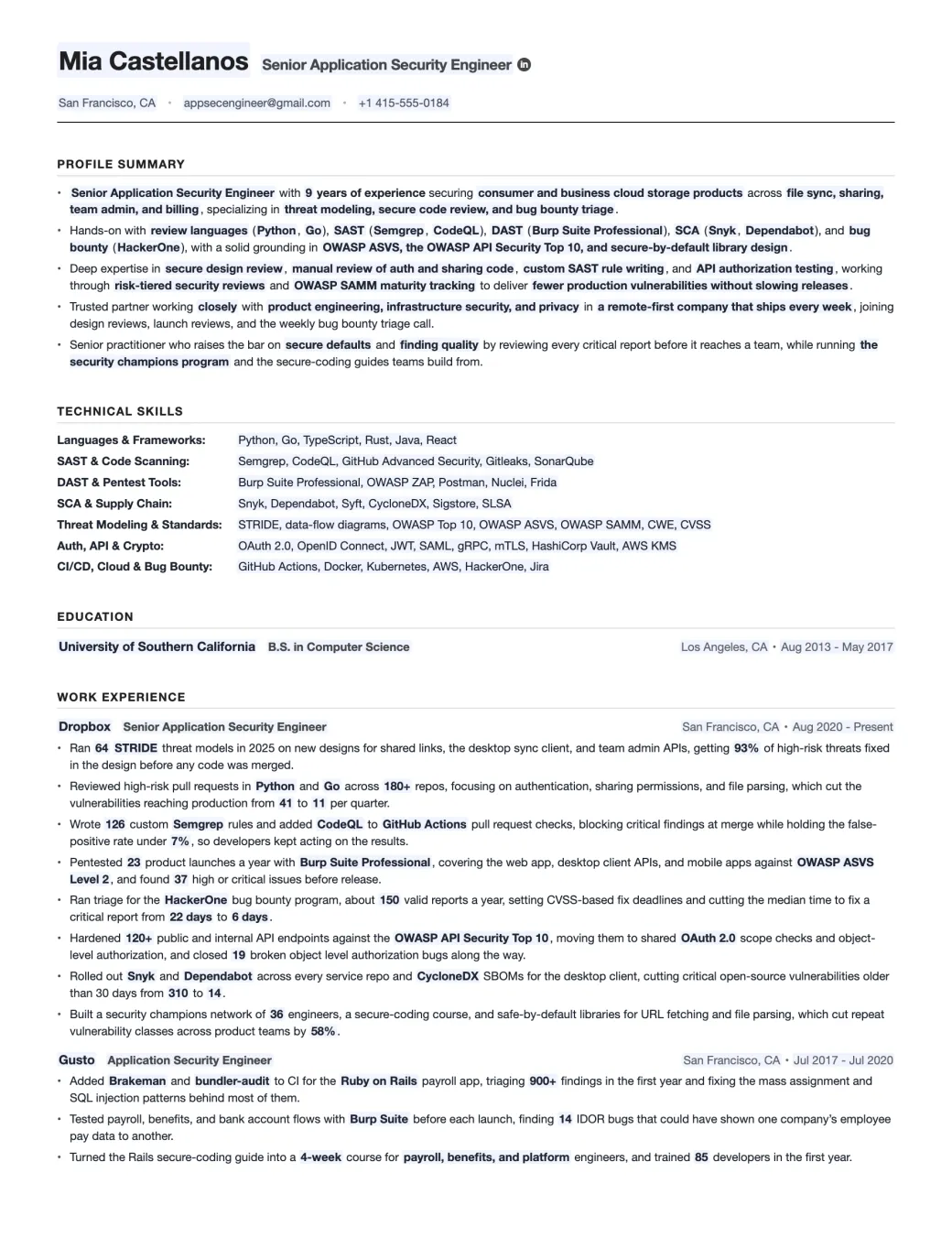
The Application Security Engineer resume template, filled in for Mia Castellanos at Dropbox, with her summary, technical skills, education and 8 AppSec bullets in her current job
Emmanuel Gendre Ex-Google recruiter / Tech resume writer Updated Free, ATS-friendly, no signup

Interactive resume template generator

Interactive Application Security Engineer Resume Template

Fill in the side panel, then download your resume as a PDF or a Word file.

Edits update live as you type. Toggle Edit to rewrite paper text directly.

Edit mode is on. Click anywhere on the resume to rewrite text. Side-panel placeholders still update live.

Mia Castellanos Senior Application Security Engineer

San Francisco, CA • appsecengineer@gmail.com • +1 415-555-0184

Profile Summary

  • Senior Application Security Engineer with 9 years of experience securing consumer and business cloud storage products across file sync, sharing, team admin, and billing, specializing in threat modeling, secure code review, and bug bounty triage.
  • Hands-on with review languages (Python, Go), SAST (Semgrep, CodeQL), DAST (Burp Suite Professional), SCA (Snyk, Dependabot), and bug bounty (HackerOne), with a solid grounding in OWASP ASVS, the OWASP API Security Top 10, and secure-by-default library design.
  • Deep expertise in secure design review, manual review of auth and sharing code, custom SAST rule writing, and API authorization testing, working through risk-tiered security reviews and OWASP SAMM maturity tracking to deliver fewer production vulnerabilities without slowing releases.
  • Trusted partner working closely with product engineering, infrastructure security, and privacy in a remote-first company that ships every week, joining design reviews, launch reviews, and the weekly bug bounty triage call.
  • Senior practitioner who raises the bar on secure defaults and finding quality by reviewing every critical report before it reaches a team, while running the security champions program and the secure-coding guides teams build from.

Technical Skills

Languages & Frameworks:
Python, Go, TypeScript, Rust, Java, React
SAST & Code Scanning:
Semgrep, CodeQL, GitHub Advanced Security, Gitleaks, SonarQube
DAST & Pentest Tools:
Burp Suite Professional, OWASP ZAP, Postman, Nuclei, Frida
SCA & Supply Chain:
Snyk, Dependabot, Syft, CycloneDX, Sigstore, SLSA
Threat Modeling & Standards:
STRIDE, data-flow diagrams, OWASP Top 10, OWASP ASVS, OWASP SAMM, CWE, CVSS
Auth, API & Crypto:
OAuth 2.0, OpenID Connect, JWT, SAML, gRPC, mTLS, HashiCorp Vault, AWS KMS
CI/CD, Cloud & Bug Bounty:
GitHub Actions, Docker, Kubernetes, AWS, HackerOne, Jira

Education

University of Southern California B.S. in Computer Science
Los Angeles, CA • Aug 2013 - May 2017

Work Experience

Dropbox Senior Application Security Engineer
San Francisco, CA • Aug 2020 - Present
  • Ran 64 STRIDE threat models in 2025 on new designs for shared links, the desktop sync client, and team admin APIs, getting 93% of high-risk threats fixed in the design before any code was merged.
  • Reviewed high-risk pull requests in Python and Go across 180+ repos, focusing on authentication, sharing permissions, and file parsing, which cut the vulnerabilities reaching production from 41 to 11 per quarter.
  • Wrote 126 custom Semgrep rules and added CodeQL to GitHub Actions pull request checks, blocking critical findings at merge while holding the false-positive rate under 7%, so developers kept acting on the results.
  • Pentested 23 product launches a year with Burp Suite Professional, covering the web app, desktop client APIs, and mobile apps against OWASP ASVS Level 2, and found 37 high or critical issues before release.
  • Ran triage for the HackerOne bug bounty program, about 150 valid reports a year, setting CVSS-based fix deadlines and cutting the median time to fix a critical report from 22 days to 6 days.
  • Hardened 120+ public and internal API endpoints against the OWASP API Security Top 10, moving them to shared OAuth 2.0 scope checks and object-level authorization, and closed 19 broken object level authorization bugs along the way.
  • Rolled out Snyk and Dependabot across every service repo and CycloneDX SBOMs for the desktop client, cutting critical open-source vulnerabilities older than 30 days from 310 to 14.
  • Built a security champions network of 36 engineers, a secure-coding course, and safe-by-default libraries for URL fetching and file parsing, which cut repeat vulnerability classes across product teams by 58%.
Gusto Application Security Engineer
San Francisco, CA • Jul 2017 - Jul 2020
  • Added Brakeman and bundler-audit to CI for the Ruby on Rails payroll app, triaging 900+ findings in the first year and fixing the mass assignment and SQL injection patterns behind most of them.
  • Tested payroll, benefits, and bank account flows with Burp Suite before each launch, finding 14 IDOR bugs that could have shown one company’s employee pay data to another.
  • Turned the Rails secure-coding guide into a 4-week course for payroll, benefits, and platform engineers, and trained 85 developers in the first year.

Done editing? Download a real PDF (selectable text, ATS-friendly, US Letter) or an editable Word file if a recruiter asks for one.

About this template

An Application Security Engineer resume template, built by a tech recruiter.

An application security engineer (an AppSec engineer, or a product security engineer at some companies) makes sure the code a company ships is hard to break. You review designs before they’re built, read the risky parts of the code, run scanners in the pipeline, test the app yourself and get the bugs fixed. You sit between security and engineering, so you’ll spend most of your day with developers.

Open 10 AppSec resumes and you’ll see the same scanner row on every one of them: Semgrep, Snyk, Burp Suite, Checkmarx... A list like that doesn’t show whether you’ve made a single line of code safer. Hiring managers want something else, and it’s proof: the bugs you caught before release, the fix times you cut, the false positives you tuned out and the developers who changed how they code because of you.

This template gives each piece of that proof its own line: 8 bullets in the current job, each tied to one AppSec role-profile area, threat modeling first and security champions last. Below the tool sit 3 sample resumes: a first AppSec job at a bug bounty platform, a senior at a cloud security company and a principal at an insurer. After them comes my 6-step guide to an Application Security Engineer resume.

Got a draft you’d like a recruiter to look at? Send it to me for a free CV critique. I read every one myself.

Industry signal

What the market says about Application Security Engineer roles

Software makers are now on the hook for the bugs they ship. The EU Cyber Resilience Act has made them report actively exploited vulnerabilities since September 11, 2026. PCI DSS 4.0 has made merchants control every script on their payment pages since March 2025, and the OWASP Top 10 moved software supply chain failures up to number 3 in late 2025. Someone has to turn all of that into design reviews and pipeline checks. That’s the AppSec engineer’s job.

+21% US security analyst job growth, 2025 to 2035 US Bureau of Labor Statistics
$151,281 Average advertised pay, US AppSec engineers Indeed

Resume Samples

Application Security Engineer Resume Examples

AppSec hiring managers all ask the same question: can this person find real bugs in real code and get them fixed? A junior and a principal answer it very differently, which is why I wrote a separate example for each level, 3 application security engineer resume examples in all. Kai, the junior, triages bug bounty reports at HackerOne. Sienna, the senior, keeps customer data apart on a multi-tenant cloud security platform. Henry, the principal, runs the AppSec program for a life insurer’s developers. You can download each one as a PDF or a Word file, free and with no signup.

Junior Application Security Engineer Resume Example

At junior level, your AppSec resume has to prove you can triage a finding and help fix the code, not just run a scanner. Show the reports you validated, the rules you wrote and the bugs you caught in review, with one number for each.

Years of experience
3 years
Industry
Bug bounty platform
Stack
HackerOneBurp SuiteRuby on RailsGraphQL
Download PDF Download Word

Click to download the Junior Application Security Engineer resume example as a PDF or a Word file. Free / No signup.

Kai Ueno

Junior Application Security Engineer

San Francisco, CA · kai.ueno@gmail.com · +1 415-555-0136 · linkedin.com/in/kaiueno

Profile Summary

  • Junior Application Security Engineer with 3 years in QA and AppSec, now on the product security team of a bug bounty platform, triaging scanner findings and bounty reports against the company’s own Rails and React apps.
  • Works daily in Ruby and TypeScript code, scans with Semgrep and Snyk, tests with Burp Suite Professional, and writes Python scripts that pull new reports into Jira with the right owner and severity.
  • Building depth in GraphQL authorization testing, IDOR and SSRF triage and CVSS scoring, and checks every fix against OWASP ASVS Level 1 before a ticket gets closed.
  • Works with product engineers, the platform team and senior AppSec engineers, joins the weekly triage review and STRIDE sessions, and writes fix notes a developer can act on without a meeting.
  • Keeps the team’s Semgrep rule notes and ZAP onboarding runbook current, answers questions in the engineering security channel, holds CompTIA Security+, and is studying for BSCP.

Technical Skills

Languages & Frameworks:
Ruby on Rails, TypeScript, React, GraphQL, Python (scripting)
SAST & Code Scanning:
Semgrep, GitHub code scanning, Brakeman, Gitleaks
DAST & Pentest Tools:
Burp Suite Professional, OWASP ZAP, Postman
SCA & Supply Chain:
Snyk Open Source, Dependabot, npm audit
Threat Modeling & Standards:
OWASP Top 10, OWASP ASVS (Level 1), STRIDE (basics), CVSS 3.1
Auth, API & Crypto:
OAuth 2.0, JWT, GraphQL field authorization, session handling
CI/CD, Cloud & Bug Bounty:
GitHub Actions, Docker, HackerOne, Jira
Page 2 of 2

Work Experience

HackerOne Junior Application Security Engineer San Francisco, CA · Oct 2024 to Present
  • Triaged 310+ reports on HackerOne’s own bug bounty program, reproducing each one, scoring it with CVSS 3.1 and routing valid bugs to the owning team in Jira.
  • Wrote 18 Semgrep rules for Rails patterns the default rulesets missed, like unscoped record lookups and open redirects, and added them to the GitHub Actions checks on the main app.
  • Reviewed pull requests that changed GraphQL resolvers or permission checks, catching 9 authorization bugs before release, including one that showed private report titles to other programs.
  • Wrote up the threats from 11 STRIDE sessions on new features, then tracked each agreed design change in Jira until the owning team shipped it.
  • Cleared a backlog of Dependabot and Snyk alerts on the React front end by batching upgrades per package, taking open critical dependency alerts from 23 to 2.
Lever QA Engineer (Security focus) San Francisco, CA · Jun 2023 to Sep 2024
  • Built Cypress tests for role-based access and session timeouts on the recruiting app, catching 3 permission regressions before they reached customers.
  • Tested login, SSO and password reset flows on release branches with Burp Suite, filing 7 security bugs, including an account enumeration issue the AppSec team fixed that week.
  • Ran a monthly lunch session on common OWASP Top 10 bugs for 20+ testers, then moved into AppSec after earning Security+.

Education

San José State University B.S. in Software Engineering San Jose, CA · Aug 2019 to May 2023
CompTIA Security+ certification San Francisco, CA · Mar 2024

Senior Application Security Engineer Resume Example

By senior level, a hiring manager wants to see part of the AppSec program that you own from start to finish. Show the threat models, custom rules and API fixes you led, and how much less broken code reached production because of them.

Years of experience
7 years
Industry
Cloud security software
Stack
GoSemgrepKubernetesSnyk
Download PDF Download Word

Click to download the Senior Application Security Engineer resume example as a PDF or a Word file. Free / No signup.

Sienna Brookes

Senior Application Security Engineer

New York, NY · sienna.brookes@gmail.com · +1 212-555-0148 · linkedin.com/in/siennabrookes

Profile Summary

  • Senior Application Security Engineer with 7 years in AppSec, now owning threat modeling and code scanning for a cloud security platform used by large enterprises, after 3 years securing fintech money movement.
  • Hands-on with Go and TypeScript code, custom Semgrep rules and CodeQL, Burp Suite Professional, Snyk and Dependabot, and GraphQL and REST API testing in Postman.
  • Deep expertise in multi-tenant isolation, STRIDE threat modeling, custom SAST rules and API authorization, mapped to OWASP ASVS Level 2 so findings line up with what customers ask about in security reviews.
  • Works with the platform, data pipeline and frontend teams, the detection team and compliance, and chairs the weekly design review where new services get their security sign-off.
  • Coaches newer AppSec engineers, runs the security champions program, and keeps the Semgrep rule library that every new service picks up on its first day.

Technical Skills

Languages & Frameworks:
Go, TypeScript, React, Node.js, Python, GraphQL
SAST & Code Scanning:
Semgrep (custom rules), CodeQL, GitHub Advanced Security, Gitleaks
DAST & Pentest Tools:
Burp Suite Professional, Postman, Nuclei, OWASP ZAP
SCA & Supply Chain:
Snyk, Dependabot, Syft, CycloneDX, Sigstore Cosign
Threat Modeling & Standards:
STRIDE, attack trees, OWASP ASVS (Level 2), OWASP API Security Top 10, CWE
Auth, API & Crypto:
OAuth 2.0, OpenID Connect, JWT, SAML, mTLS, AWS KMS
CI/CD, Cloud & Bug Bounty:
GitHub Actions, Kubernetes, Docker, AWS, Jira
Page 2 of 2

Work Experience

Wiz (Google Cloud) Senior Application Security Engineer New York, NY · Apr 2022 to Present
  • Ran STRIDE threat models on new cloud connectors and APIs with a focus on tenant boundaries, getting high-risk design changes agreed before coding started on 95% of them.
  • Wrote 62 custom Semgrep rules for Go patterns that break tenant scoping, like a database query with no tenant filter, and ran them on every pull request across 90+ services.
  • Fixed authorization on 48 GraphQL and REST endpoints by moving tenant checks into shared middleware, closing the cross-tenant access bug class an outside pentest found in 2023.
  • Set fix deadlines by severity for pentest, scanner and customer-reported findings, and cut the median time to fix a critical finding from 18 days to 5.
  • Wrote the security champions playbook that 6 product groups now use to run their own first-round design reviews, and mentored 3 AppSec engineers through their first year.
Betterment Application Security Engineer New York, NY · Jul 2019 to Mar 2022
  • Reviewed Ruby on Rails code for deposits, withdrawals and transfers, finding 23 money-movement bugs, including a race condition that allowed a double withdrawal.
  • Rolled out Snyk across 120 repos with an upgrade policy for critical packages, cutting open critical dependency vulnerabilities from 85 to 7 in 9 months.
  • Tested the iOS and Android app APIs with Burp Suite before each major release, finding 11 high-severity issues, mostly broken object level authorization on account endpoints.

Education

NYU Tandon School of Engineering B.S. in Computer Science Brooklyn, NY · Sep 2015 to May 2019
OffSec OSWE certification New York, NY · Mar 2023

Principal Application Security Engineer Resume Example

At principal level, your resume has to read like an AppSec program, not a list of tickets. Show the standards you set, the tools you picked, the fix deadlines teams actually met and what changed across the whole engineering org.

Years of experience
15 years
Industry
Life insurance and financial services
Stack
JavaCheckmarxHashiCorp VaultAzure DevOps
Download PDF Download Word

Click to download the Principal Application Security Engineer resume example as a PDF or a Word file. Free / No signup.

Henry Asare

Principal Application Security Engineer

Boston, MA · henry.asare@gmail.com · +1 617-555-0192 · linkedin.com/in/henryasare

Profile Summary

  • Principal Application Security Engineer with 15 years in financial services AppSec, now running the application security program for a life insurer’s customer, agent and policy systems across 1,100 developers.
  • Hands-on with Java, C# and Python code, Checkmarx and Semgrep scanning, Burp Suite Professional, Snyk and Black Duck, and HashiCorp Vault for application secrets.
  • Deep expertise in AppSec program design, SAST tool consolidation, risk-tiered design review and regulated-industry controls like NYDFS Part 500 and PCI DSS 4.0, with progress tracked in OWASP SAMM.
  • Works with the CISO, engineering VPs, internal audit and the risk office, and presents the AppSec scorecard to the technology risk committee every quarter.
  • Chairs the AppSec architecture council, wrote the company’s secure SDLC standard, grew a security champions network of 70, and has mentored 6 engineers into senior roles.

Technical Skills

Languages & Frameworks:
Java, Spring Boot, C# / .NET, Python, TypeScript, Kotlin
SAST & Code Scanning:
Checkmarx, Semgrep, CodeQL, Veracode, Gitleaks
DAST & Pentest Tools:
Burp Suite Professional, Burp Suite DAST, OWASP ZAP, pentest vendor management
SCA & Supply Chain:
Snyk, Black Duck, CycloneDX, SLSA, NIST SSDF
Threat Modeling & Standards:
STRIDE, PASTA, OWASP ASVS (Levels 2 and 3), OWASP SAMM, PCI DSS 4.0, NYDFS Part 500
Auth, API & Crypto:
OAuth 2.0, OpenID Connect, SAML, mTLS, HashiCorp Vault, Azure Key Vault
CI/CD, Cloud & Bug Bounty:
Azure DevOps, GitHub Actions, Azure, AWS, Bugcrowd, ServiceNow
Page 2 of 2

Work Experience

John Hancock Principal Application Security Engineer Boston, MA · Apr 2018 to Present
  • Built the AppSec program for 1,100 developers across 5 business lines, with a secure SDLC standard mapped to OWASP ASVS and NIST SSDF that internal audit now tests against.
  • Consolidated 3 SAST tools into Checkmarx and Semgrep in Azure DevOps pipelines, cutting licensing spend by 31% while every repo moved to a scan on each merge.
  • Set fix deadlines by severity and a monthly scorecard for engineering VPs, cutting the median time to fix a critical application finding from 42 days to 9.
  • Started a design review board for new customer and agent apps, reviewing 85+ designs a year with a risk-tiered STRIDE process so low-risk changes skip the full review.
  • Rolled out CycloneDX SBOMs and Snyk policy gates for customer-facing apps, cutting the time to find every app using a newly disclosed vulnerable library from 2 weeks to 4 hours.
MFS Investment Management Senior Application Security Engineer Boston, MA · Jul 2011 to Mar 2018
  • Ran manual code review on Java and C# trading and advisor portal apps, finding 64 high-severity bugs over 6 years, mostly injection and access control flaws.
  • Scoped and managed yearly outside pentests on 12 client-facing apps, retesting every fix in Burp Suite before closing the finding with the vendor.
  • Moved the advisor portal from custom login code to SAML single sign-on with MFA, closing all 5 session management findings from the previous pentest.

Education

Carnegie Mellon University M.S. in Information Security Pittsburgh, PA · Aug 2009 to May 2011

Free resume review

A recruiter screen, but with feedback

You applied to hundreds of jobs: no result. Companies won’t give you feedback, so you’re stuck in a loop. Rejections will keep coming until you know what’s wrong.

Let’s break this cycle today!

I’ll screen your resume the same way I did at Google.

You’ll get:

  • Your resume sections and content scored.
  • A clear list of what to improve, why, and how.
  • Behind the scenes secrets on the screening process.

How I rewrite Application Security Engineer resumes

How to write an Application Security Engineer resume

Emmanuel Gendre, ex-Google recruiter

Emmanuel Gendre Ex-Google recruiter, tech resume writer

I screened candidates for 13 years before I started writing resumes, and a good part of that time was at Google. AppSec engineers are some of my most regular clients, and the resume I get most often reads like a vendor brochure: “Implemented SAST, DAST and SCA tooling to shift security left.” It doesn’t say what you found, what got fixed or which developers changed their habits.

If you’d rather hand it over, my tech resume services cover the whole rewrite: I redo each bullet and point out the numbers that are missing, usually bugs caught in review and fix times. If you’re doing it yourself, though, focus on these 6 steps. Every step comes with AppSec examples.

  1. Step 1 Format & layout Use one column and plain headings, and send a PDF the ATS can read. Go to step 1
  2. Step 2 Profile Summary Your title, stack and best AppSec work in the first 5 lines. Go to step 2
  3. Step 3 Work Experience Threat modeling to champions: cover all 8 areas in your current job. Go to step 3
  4. Step 4 Bullet Points Grow “ran security scans” into a line with tools, a standard and a result. Go to step 4
  5. Step 5 Technical Skills Languages, scanners, standards and platforms, in the 7 rows recruiters expect. Go to step 5
  6. Step 6 Keywords & Metrics Check your keywords against the posting and end every bullet on a number. Go to step 6

Step 1 · Format & Layout

Application Security Engineer resume format and layout

Start with the format, because it takes 10 minutes to get right. Software reads your resume first, then a recruiter skims it for job titles, employers and dates. One plain layout serves both readers, and the template above already uses it.

01ATS Compliance

ATS compliance for your Application Security Engineer resume

Before any person sees it, your resume goes into the company’s Applicant Tracking System (ATS). The software copies your text into a candidate profile, and a recruiter can later search thousands of profiles for “Burp Suite” or “secure code review”. Two-column layouts break that copy: the ATS reads straight across both columns, your skills get mixed into your job titles, and a search for “Semgrep” never finds you. My article explains how resume parsing works in an ATS. Keeping your AppSec resume readable comes down to 3 rules:

The 3 rules
  1. Use a 100% text based format (no Canva!)

  2. Avoid tables, pictures, and complex structures.

  3. Use the most predictable section names, like “Profile Summary” and “Work Experience”

02Design & Layout

Application Security Engineer resume design and layout

I still get AppSec resumes made to look like a Burp Suite scan report, with CVSS-colored severity badges next to each skill. They’re fun to look at. Still, recruiters hate fancy designs. Someone on their 40th resume of the day knows where a normal resume puts the job title and dates, and if yours makes them hunt, you’ve lost them.

Boring wins here. Keep a plain, predictable layout and let your findings do the talking. Add your GitHub only if a hiring manager would enjoy what’s in it, like your Semgrep rules or a CVE write-up. The specs below are what the template above uses, so copy them if you’d rather start in Word.

Layout Spec
Columns
One. No sidebars, tables, columns, pictures or tabs.
Margins
0.7 in on all four sides
Body size
10 to 11 pt
Type
One family, weight for hierarchy
Length
One page under 5 years, two after
Section order
Summary, Skills, Experience, Education
PDF

03File Format

Resume file format for your Application Security Engineer resume

For AppSec jobs, PDF is the safe default. It looks the same on the recruiter’s laptop as on yours, and any ATS can read the text, provided it came out of a text editor and not a scanner. Some security staffing firms ask for a .docx because they reformat resumes before sending them to clients, so keep one on hand. My resume file format guide explains the rest.

Format Guide
PDF
Your default. Layout holds, text stays selectable.
Word (.docx)
When the posting or a recruiter asks for it. Use the Word download above.
Plain text
For portals that make you paste into a box
Never
Images, scans, password-protected PDFs, shared-drive links
File name
Mia-Castellanos-Application-Security-Engineer.pdf

Step 2 · Profile Summary

Application Security Engineer profile summary

Yes, juniors need a profile summary too, on an AppSec resume or any other. A recruiter screens you twice: a fast skim of the first few lines, then a closer read if the skim goes well. I explain how recruiters screen resumes in 2 steps in another article. Your 5 summary bullets are what that first skim lands on.

In AppSec, those 5 lines should settle 3 things for a recruiter. What do you protect: a SaaS app, a payments platform, mobile apps? Which tools do you run every week? And will developers work with you or around you? Each bullet below has one job, and if you want more examples, read my profile summary guide for tech resumes.

  1. 1

    Title, years and scope

    Your years and the exact title from the job ad, whether that’s Application Security Engineer, Product Security Engineer or AppSec Engineer. Then say what you protect, like a SaaS app, payments or mobile, and the 2 or 3 areas you’d lead with.

  2. 2

    Your stack

    Your tools, sorted into the groups AppSec postings use: review languages, SAST, DAST, SCA and the bug bounty platform. Recruiters search by product name, so match the ad’s product names letter for letter.

  3. 3

    Domain expertise

    3 or 4 areas where you go deep (threat modeling, API authorization, custom scanner rules), the method you use, like OWASP SAMM or risk-tiered reviews, and the result. To a hiring manager, that’s the part of the program you could pick up on day one.

  4. 4

    Collaboration

    Who you work with (product engineers, platform, privacy, compliance) and where: design reviews, launch reviews, the bounty triage call. Security advice only gets used when developers trust the person giving it, and recruiters know that.

  5. 5

    Leadership

    The things other teams keep using after you’ve moved on: secure-by-default libraries, a champions program, a Semgrep rule library, engineers you coached. No direct reports needed. It shows a manager you make the whole engineering org safer, not just your own queue.

Application Security Engineer resume summary example, from the template above
  • Senior Application Security Engineer with 9 years of experience securing consumer and business cloud storage products across file sync, sharing, team admin, and billing, specializing in threat modeling, secure code review, and bug bounty triage.
  • Hands-on with review languages (Python, Go), SAST (Semgrep, CodeQL), DAST (Burp Suite Professional), SCA (Snyk, Dependabot), and bug bounty (HackerOne), with a solid grounding in OWASP ASVS, the OWASP API Security Top 10, and secure-by-default library design.
  • Deep expertise in secure design review, manual review of auth and sharing code, custom SAST rule writing, and API authorization testing, working through risk-tiered security reviews and OWASP SAMM maturity tracking to deliver fewer production vulnerabilities without slowing releases.
  • Trusted partner working closely with product engineering, infrastructure security, and privacy in a remote-first company that ships every week, joining design reviews, launch reviews, and the weekly bug bounty triage call.
  • Senior practitioner who raises the bar on secure defaults and finding quality by reviewing every critical report before it reaches a team, while running the security champions program and the secure-coding guides teams build from.

Step 3 · Work Experience

Application Security Engineer work experience

This is the closer read that follows the skim. A recruiter goes through every job now, but they don’t weigh them equally: 95% of the screening decision rests on your current role. It’s the job that shows how you test, review and ship security fixes today.

That means 8 bullets in your current job, one per competency in the AppSec role profile, which is the checklist a recruiter holds you against. Leave one out and it’ll read as a gap. The OWASP Top 10 now ranks supply chain failures third, so a resume with no supply chain bullet will get a question about it.

Application Security Engineer role profile
  1. Threat Modeling & Secure Design Review

    You catch design flaws before anyone’s written the code. A broken trust boundary found in a design review costs an afternoon, but in production it’ll cost a release, so managers look for designs you’ve changed. Walk them through how you used data-flow diagrams and STRIDE to get risky designs changed before the first commit.

    Techniques
    data-flow diagrams, trust boundary analysis, STRIDE sessions, design sign-off
    Tools
    OWASP Threat Dragon, Microsoft Threat Modeling Tool, IriusRisk, Jira
    Metrics
    designs reviewed, threats fixed in design, review turnaround
  2. Secure Code Review

    You read the code that scanners can’t judge, like auth checks and sharing logic. Business-logic flaws are what end up in breach reports, and you won’t find them with a tool. Describe how you used manual review and a risk-based list of hot spots to stop those bugs in pull requests.

    Techniques
    risk-based review, authorization checks, business-logic review, secure-coding checklists
    Tools
    GitHub pull requests, Semgrep, CodeQL, Sourcegraph
    Metrics
    bugs caught in review, vulnerabilities in production, repos covered
  3. Security Testing in CI/CD

    You tune the scanners so developers actually act on what they find. Developers stop reading a noisy pipeline after a few weeks, and that’s why your false-positive rate matters to a hiring manager. Explain how you used custom Semgrep rules and merge gates to block real bugs without slowing the team down.

    Techniques
    custom rule writing, false-positive tuning, merge gates, secret scanning
    Tools
    Semgrep, CodeQL, GitHub Actions, Gitleaks
    Metrics
    false-positive rate, findings blocked at merge, scan coverage
  4. Application Penetration Testing

    You break the app yourself before attackers or pentest vendors do. Outside pentests aren’t cheap and usually happen once a year, so a manager wants someone who’ll test every big launch. Show them how you used Burp Suite and the OWASP ASVS checklist to find serious issues before release.

    Techniques
    pre-launch testing, ASVS-based test plans, mobile API testing, retests
    Tools
    Burp Suite Professional, OWASP ZAP, Postman, Frida
    Metrics
    launches tested, high and critical findings, fixes confirmed on retest
  5. Vulnerability Triage & Bug Bounty

    You turn a pile of findings into fixes with deadlines. Bug bounty reports, scanner results and pentest findings all end up with you, and if you’re slow, a researcher may go public. Tell them how you used CVSS scoring and fix deadlines to cut the time critical bugs stay open.

    Techniques
    CVSS scoring, severity deadlines, bounty triage, fix retesting
    Tools
    HackerOne, Bugcrowd, Jira, DefectDojo
    Metrics
    median time to fix, valid reports, findings past deadline
  6. API & Authentication Security

    You lock down the logins and APIs the whole product depends on. Broken access control is A01 in the OWASP Top 10, and it only takes one missing object-level check to expose every customer’s data. Point out how you used OAuth 2.0 scopes and shared authorization code to close whole classes of API bugs.

    Techniques
    OAuth 2.0 scope design, object-level authorization, rate limiting, session hardening
    Tools
    OAuth 2.0, OpenID Connect, JWT, HashiCorp Vault
    Metrics
    endpoints hardened, BOLA bugs closed, auth findings
  7. Software Supply Chain Security

    You keep third-party code and the build pipeline from becoming the way in. Most of a modern app isn’t written in-house, it’s open-source packages, and attackers now poison those packages on purpose. Mention how you used SCA, SBOMs and signed builds to patch vulnerable dependencies in hours, not weeks.

    Techniques
    dependency upgrades, SBOM generation, artifact signing, secret rotation
    Tools
    Snyk, Dependabot, Syft, Sigstore
    Metrics
    old critical dependency vulnerabilities, time to patch, SBOM coverage
  8. Security Champions & Developer Enablement

    You make the secure way the easy way for developers. A small AppSec team can’t review the work of hundreds of engineers, so managers want people who’ll scale through others. Let them know how you used a champions program and safe-by-default libraries to cut repeat bugs across teams.

    Techniques
    security champions, secure-coding labs, paved roads, office hours
    Tools
    OWASP SAMM, Secure Code Warrior, Confluence, Slack
    Metrics
    active champions, engineers trained, repeat bug classes

Moving over from pentesting or QA? Your findings count, as long as each one ends with a fix that shipped. Never run a champions program? Keep the area anyway and write about the developers you’ve taught.

Submit your resume for a free review!

Step 4 · Bullet Points

Application Security Engineer resume bullet points

On an AppSec rewrite, the bullets take me longer than everything else combined. That’s why I use a fixed method for them, my Level System. Google recruiters know the XYZ formula (accomplished X, as measured by Y, by doing Z), and the Level System adds the tools and standards a technical reader looks for. It’s all explained in my Level System guide for resume bullets.

The Level System has 5 steps up. At level 1 you only write the task, then you add techniques, tools, the standard you worked to and finally a result. In AppSec, that result tends to be a fix time, bugs caught before release or fewer repeat findings. Here’s a pentest bullet growing from a bare task into a full level 5 line.

  1. Level 1Task

    What did I work on? Start with one real piece of work and a strong verb. On its own, it could be anyone’s bullet.

    Pentested a new team sharing feature before launch.

  2. Level 2+ Techniques

    How did I do it? Add your techniques. This is where a hiring manager sees whether you tested by hand or just ran a scan.

    Pentested a new team sharing feature before launch, using manual authorization testing and parameter tampering.

  3. Level 3+ Tools

    What tools did I use? Write the product names. Recruiters search the ATS for “Burp Suite”, not “testing tools”.

    Pentested a new team sharing feature before launch with Burp Suite Professional and Postman, using manual authorization testing and parameter tampering.

  4. Level 4+ Method

    What method did I follow? Mention the standard you tested against. OWASP ASVS tells them your testing had a plan behind it.

    Pentested a new team sharing feature before launch with Burp Suite Professional and Postman, using manual authorization testing and parameter tampering against an OWASP ASVS Level 2 test plan.

  5. Level 5+ Metric

    What was the result? Finish on one number an engineering director would care about, like the serious bugs you stopped before launch.

    Pentested a new team sharing feature before launch with Burp Suite Professional and Postman, using manual authorization testing and parameter tampering against an OWASP ASVS Level 2 test plan, and found 6 high-severity access bugs that were fixed before release.

    1. 01 Task What you worked on
    2. 02 Techniques How you did it
    3. 03 Tools The stack you used
    4. 04 Method The method you followed
    5. 05 Metric The result, one number

Most AppSec engineers have more numbers than they’d guess. HackerOne shows when each report came in and closed, your scanner dashboard tracks findings over time, and Jira has every fix date. Pull a year of data before you write a word.

Step 5 · Technical Skills

Application Security Engineer resume skills

Read 5 AppSec postings side by side and the same groups keep coming back. There are languages, SAST, DAST, SCA and supply chain, standards like OWASP ASVS, auth and API protocols, then CI and bug bounty platforms. Match the posting’s product names exactly: a recruiter who searches for “Burp Suite Professional” may never see a resume that just says “Burp”.

List only what you’d be comfortable explaining in an interview. Put CodeQL on the page and expect a question about a query you wrote and the bug it found. Further down, I’ve listed 7 AppSec skill categories, a filled-in skills block taken from the template, and 5 soft skills you should prove with real examples. Keywords get their own step next.

The 7 skill categories for an Application Security Engineer resume

Starred items show up in most AppSec job ads, so they go at the front of each row. After them, add what you’ve used on real code. Juniors can count bug bounty finds or CTF work, as long as the resume says where they came from.

Languages & Frameworks

The languages you can review code in, not just read. Put the target company’s stack first, plus the frameworks (Rails, Spring Boot, React) whose security pitfalls you know.

PythonJavaGoTypeScriptJavaScriptRuby on RailsSpring BootNode.jsReactKotlin

SAST & Code Scanning

The static analysis tools you’ve run and tuned. Say if you write custom rules, because Semgrep or CodeQL rule writing is something AppSec interviews often dig into.

SemgrepCodeQLCheckmarxSonarQubeVeracodeGitHub Advanced SecuritySnyk CodeGitleaks

DAST & Pentest Tools

What you test running apps with. Burp Suite Professional is the one nearly every AppSec posting expects, so put it first if you use it.

Burp Suite ProfessionalOWASP ZAPPostmanNucleiffufsqlmapFrida

SCA & Supply Chain

Dependency scanning, SBOMs and build integrity. Hiring managers ask about it more since OWASP ranked supply chain failures among the top 3 risks in 2025.

SnykDependabotMendOWASP Dependency-CheckSyftCycloneDXSigstoreSLSA

Threat Modeling & Standards

The methods and standards you work to. Write the level or version when it matters (OWASP ASVS Level 2, CVSS 4.0), since it shows how you actually use them.

STRIDEOWASP Top 10OWASP ASVSPASTAOWASP SAMMNIST SSDFCWECVSS

Auth, API & Crypto

The protocols behind login and API access. OAuth 2.0, OpenID Connect and JWT show up in nearly every AppSec job ad, often next to API security.

OAuth 2.0OpenID ConnectJWTSAMLGraphQLgRPCmTLSHashiCorp VaultAWS KMS

CI/CD, Cloud & Bug Bounty

Where your checks run and where reports come in. List the CI system you wired scanners into and the bug bounty platform you triaged on.

GitHub ActionsHackerOneGitLab CIJenkinsDockerKubernetesAWSBugcrowdJira

A finished Application Security Engineer skills section

Technical Skills sample, from the template above
Languages & Frameworks
Python, Go, TypeScript, Rust, Java, React
SAST & Code Scanning
Semgrep, CodeQL, GitHub Advanced Security, Gitleaks, SonarQube
DAST & Pentest Tools
Burp Suite Professional, OWASP ZAP, Postman, Nuclei, Frida
SCA & Supply Chain
Snyk, Dependabot, Syft, CycloneDX, Sigstore, SLSA
Threat Modeling & Standards
STRIDE, data-flow diagrams, OWASP Top 10, OWASP ASVS, OWASP SAMM, CWE, CVSS
Auth, API & Crypto
OAuth 2.0, OpenID Connect, JWT, SAML, gRPC, mTLS, HashiCorp Vault, AWS KMS
CI/CD, Cloud & Bug Bounty
GitHub Actions, Docker, Kubernetes, AWS, HackerOne, Jira

Soft skills for an Application Security Engineer resume

Writing “excellent communication skills” in your skills section proves nothing. A bullet where you got a team to change something does. These 5 soft skills matter most in AppSec, and I’ve written a bullet for each one.

  • Getting busy product teams to fix what you find

    Resume bulletGot all 14 product teams under the 30-day deadline for critical fixes by sending each one a short, ranked fix list instead of a scanner export.

  • Writing findings a developer can fix on the first read

    Resume bulletRewrote the team’s finding template around repro steps and a suggested patch, cutting back-and-forth on security tickets by 43%.

  • Holding a release back when the risk is real

    Resume bulletHeld a payments API launch for 4 days over a broken authorization check, then shipped it with the fix and the product VP’s backing.

  • Keeping a cool head when a critical bounty report lands

    Resume bulletConfirmed a critical bounty report on a Friday night, shipped a fix in 9 hours and kept the researcher updated until disclosure.

  • Teaching secure coding without lecturing

    Resume bulletReplaced the yearly slide deck with 20-minute hands-on labs built from bugs in the company’s own code, and 300+ engineers finished them in a quarter.

Step 6 · Keywords & Metrics

Application Security Engineer resume keywords and metrics

Step 6 is about checking, not writing. First, keywords: the ATS lets a recruiter search every resume for terms like “Semgrep” or “threat modeling”, and yours should come up for the ones in the job ad. Second, metrics: every bullet needs a closing number, like bugs caught before release or days to fix a critical, that proves it mattered.

Go through the 3 tiers of AppSec keywords first. After that, drop an actual job ad into the keyword finder and see which terms it wants that your resume doesn’t have yet. You’ll find 24 metrics at the end, sorted by role-profile area, so there’s a number ready for every bullet.

+42%

Application Security Engineer resume keywords, ranked

Each chip opens the kind of sentence AppSec job ads use for it. Ads call the same skill by different names (“SAST”, “static analysis”, “code scanning”), so you’ll want to spot all three.

Must-have

8

Put each one in your summary, at least one bullet and your skills section.

In a job description“Own application security across the SDLC for our web, mobile and API products”

Strong supporting

10

Use the ones you can back up in a bullet, and list them in your skills rows.

In a job description“Write custom Semgrep rules to catch insecure patterns specific to our codebase”

Bonus

7

Add them when they’re true and the posting mentions them.

In a job description“Familiarity with SLSA and build provenance for software artifacts”

Extract Application Security Engineer keywords from a job description

Copy an application security, product security or AppSec engineer posting and paste it below. You’ll get back every scanner, standard, language and platform it mentions, sorted into 3 tiers, and anything missing from your resume is what to add next.

Must-have
Put these in your skills section and back each one with a bullet.
Strong supporting
Add the ones you’ve actually worked with. Skip the rest.

Nothing is uploaded: it all happens in your browser.

Metrics for an Application Security Engineer resume

For every role-profile area there are 3 metrics, each shown in a sample bullet. You’ll only need one of them per bullet.

MetricExample bullet
Threat modeling
Designs reviewed Count New features or services that went through a threat model before the build.Threat-modeled 64 new designs in 2025, including the desktop client’s new sync protocol and the team admin API.
Threats fixed in design Percent Share of high-risk threats resolved by a design change before code was merged.Got 93% of high-risk threats fixed in the design itself, before anyone opened a pull request.
Design review turnaround Time Time from a design review request to a security sign-off.Cut the wait for a security design review from 9 days to 2 by sending low-risk designs through a short checklist.
Code review
Bugs caught in review Count Security bugs found in pull requests before they reached production.Caught 47 security bugs in pull request review in 2025, mostly broken permission checks in sharing code.
Vulnerabilities reaching production Count Security bugs found after release, per quarter, from any source.Cut vulnerabilities reaching production from 41 to 11 a quarter by reviewing every change to auth and file parsing code.
Review coverage Percent Share of high-risk repos with a required security reviewer.Added a required security reviewer to all 38 high-risk repos, up from 12 the year before.
Testing in CI/CD
False-positive rate Percent Share of scanner findings that turn out not to be real issues.Brought the SAST false-positive rate from 31% to 7% by retiring noisy default rules and writing custom ones.
Findings blocked at merge Count Critical or high findings stopped by a pipeline gate before merge.Blocked 212 critical findings at merge in one year with Semgrep checks in GitHub Actions.
Scan coverage Percent Share of repos scanned on every pull request.Grew pull request scanning from 55% to 98% of repos by adding Semgrep and CodeQL to the shared CI template.
Pentesting
Launches tested Count Product launches that got a hands-on security test before release.Pentested 23 product launches in 2025 across the web app, desktop client APIs and mobile apps.
High and critical findings Count Serious issues found in testing before release.Found 37 high or critical issues in pre-launch testing, and every one was fixed before the feature shipped.
Fixes confirmed on retest Percent Share of fixes that hold up when the tester checks them again.Confirmed 94% of fixes on the first retest, up from 71% once every finding came with a test case.
Triage & bug bounty
Median time to fix (critical) Time Median days from a confirmed critical finding to a deployed fix.Cut the median time to fix a critical bounty report from 22 days to 6 with CVSS-based deadlines.
Valid bounty reports Count Bug bounty reports confirmed as real vulnerabilities in a year.Triaged about 150 valid HackerOne reports a year, with a first reply to researchers within 1 business day.
Findings past deadline Percent Share of open findings past their severity-based fix deadline.Brought findings past their fix deadline from 27% to 4% with a weekly list for each engineering manager.
API & auth
Endpoints hardened Count API endpoints moved to shared authentication and authorization checks.Moved 120+ API endpoints to shared OAuth 2.0 scope checks and object-level authorization.
BOLA bugs closed Count Broken object level authorization bugs found and fixed.Closed 19 BOLA bugs on public and internal APIs, then added a CI test that blocks the pattern.
Auth findings per year Count Findings tied to login, session or token handling in a year.Cut login and session bugs reported through the bounty program from 16 to 3 a year by moving every app to one token library.
Supply chain
Old critical dependency vulnerabilities Count Critical open-source vulnerabilities open for more than 30 days.Took critical dependency vulnerabilities older than 30 days from 310 to 14 with Snyk and Dependabot upgrades.
Time to patch a disclosed library Time Time from a public advisory to a patched release in every affected app.Patched a newly disclosed vulnerable library in every affected service within 36 hours, using SBOMs to find them.
SBOM coverage Percent Share of shipped builds with a current SBOM.Generated CycloneDX SBOMs for 100% of desktop and mobile builds, up from none the year before.
Champions & enablement
Active security champions Count Engineers who do first-round security reviews for their own team.Grew the security champions network to 36 engineers, with at least one on every product team.
Engineers trained Count Developers who finished secure-coding training.Ran hands-on secure-coding labs that 350+ engineers finished in one year.
Repeat bug classes Percent Drop in vulnerabilities from a class the team has already fixed once.Cut repeat vulnerability classes by 58% by shipping safe-by-default libraries for URL fetching and file parsing.

What if you don’t have exact numbers?

  • 1

    Export it from the tools. HackerOne, your scanner dashboard and Jira keep dates and counts for every finding, so you’re usually a few filters away from a year of fix times.

  • 2

    Go with an honest low estimate. “About 60 threat models” works if it’s the floor, not a guess. Be ready to explain how you counted them if an interviewer asks.

  • 3

    Size the work instead. If a project had no clean before and after, say how big it was: 180 repos scanned, 40 services reviewed, 300 engineers trained.

Free resume review

A recruiter screen, but with feedback

You applied to hundreds of jobs: no result. Companies won’t give you feedback, so you’re stuck in a loop. Rejections will keep coming until you know what’s wrong.

Let’s break this cycle today!

I’ll screen your resume the same way I did at Google.

You’ll get:

  • Your resume sections and content scored.
  • A clear list of what to improve, why, and how.
  • Behind the scenes secrets on the screening process.

Frequently asked

Application Security Engineer resume FAQ

Yes. You won’t need an account, a credit card or an email address. Fill it in, download it and edit it again whenever your stack changes.

Yes. The template has a Word button beside the PDF one, and it saves an editable .docx. The 3 AppSec examples on this page come in both formats too. For most applications, send the PDF, and save the .docx for a recruiter or staffing firm that asks for one.

Yes. It’s a single column with the 4 standard section titles and nothing in tables or text boxes, and the PDF you download is text you can select and copy. Workday, Greenhouse and Lever handle files like that well. Made your own changes to the layout? Check the result with an ATS checker before you apply.

Juniors can usually fit on one page. With 5 or more years of real AppSec work, a second page is fine, and no hiring manager will hold it against you. Filler is the problem, so drop old QA or IT bullets before you drop a threat model or a fix-time number.

OffSec’s OSCP and OSWE, PortSwigger’s Burp Suite Certified Practitioner (BSCP), GIAC’s GWAPT and ISC2’s CSSLP show up most often in the AppSec job ads I read. They help, but they don’t replace proof. A cert next to bullets about bugs you found reads well, and a cert with nothing behind it reads like someone who studied for an exam.

Use numbers that show bugs found and fixed: high and critical issues caught before release, the median time to fix a critical, your scanners’ false-positive rate, repos or services covered, and engineers trained. Step 6 has a table of 24, each used in a sample bullet.

An AppSec resume is about code: design reviews, code review, testing and the bugs you got fixed. The security engineer resume template is wider (identity, endpoints, detection and cloud). The DevSecOps engineer resume template centers on the pipeline and the platform team. If most of your bullets are about CI tooling rather than bugs in code, the DevSecOps one is the better fit.

Yes, and most juniors I see come from QA, software engineering or pentesting. Fill all 8 areas with real work: bugs you reported to a bounty program, Semgrep rules you wrote, a CTF write-up or a security fix you shipped as a developer. Kai’s resume in the examples above is a QA-to-AppSec move.

No. Recruiters care about what you did, not which template you started from, and a plain structure is what they’re used to reading. What would hurt is keeping the sample bullets, so replace every line with your own work before you send it.

More resources

More help with your Application Security Engineer resume