Incident Response Engineer Resume Examples & Free Template (PDF, Word)

A free incident response (IR) engineer resume template you can edit here and download in PDF or Word, built for DFIR and digital forensics engineer jobs. Under it are 3 incident response resume examples, junior to principal, and my 6-step method for writing one from scratch.

4.9 5.0
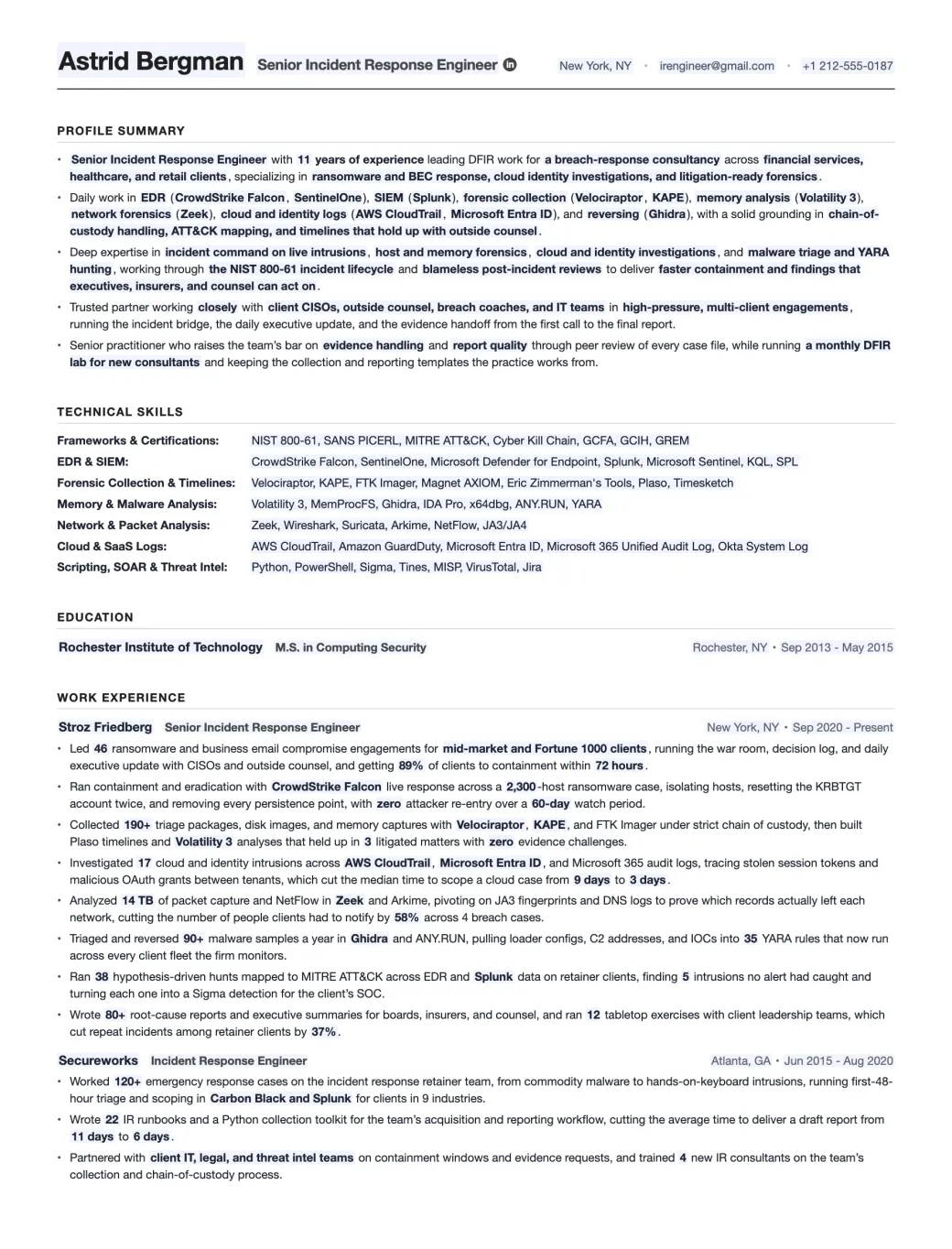
The Incident Response Engineer resume template, filled in for Astrid Bergman at Stroz Friedberg, with her summary, technical skills, education and 8 incident response bullets in her latest job
Emmanuel Gendre Ex-Google recruiter / Tech resume writer Updated Free, ATS-friendly, no signup

Interactive resume template generator

Interactive Incident Response Engineer Resume Template

Fill in the side panel, then download your resume as a PDF or a Word file.

Edits update live as you type. Toggle Edit to rewrite paper text directly.

Edit mode is on. Click anywhere on the resume to rewrite text. Side-panel placeholders still update live.

Astrid Bergman Senior Incident Response Engineer

New York, NY • irengineer@gmail.com • +1 212-555-0187

Profile Summary

  • Senior Incident Response Engineer with 11 years of experience leading DFIR work for a breach-response consultancy across financial services, healthcare, and retail clients, specializing in ransomware and BEC response, cloud identity investigations, and litigation-ready forensics.
  • Daily work in EDR (CrowdStrike Falcon, SentinelOne), SIEM (Splunk), forensic collection (Velociraptor, KAPE), memory analysis (Volatility 3), network forensics (Zeek), cloud and identity logs (AWS CloudTrail, Microsoft Entra ID), and reversing (Ghidra), with a solid grounding in chain-of-custody handling, ATT&CK mapping, and timelines that hold up with outside counsel.
  • Deep expertise in incident command on live intrusions, host and memory forensics, cloud and identity investigations, and malware triage and YARA hunting, working through the NIST 800-61 incident lifecycle and blameless post-incident reviews to deliver faster containment and findings that executives, insurers, and counsel can act on.
  • Trusted partner working closely with client CISOs, outside counsel, breach coaches, and IT teams in high-pressure, multi-client engagements, running the incident bridge, the daily executive update, and the evidence handoff from the first call to the final report.
  • Senior practitioner who raises the team’s bar on evidence handling and report quality through peer review of every case file, while running a monthly DFIR lab for new consultants and keeping the collection and reporting templates the practice works from.

Technical Skills

Frameworks & Certifications:
NIST 800-61, SANS PICERL, MITRE ATT&CK, Cyber Kill Chain, GCFA, GCIH, GREM
EDR & SIEM:
CrowdStrike Falcon, SentinelOne, Microsoft Defender for Endpoint, Splunk, Microsoft Sentinel, KQL, SPL
Forensic Collection & Timelines:
Velociraptor, KAPE, FTK Imager, Magnet AXIOM, Eric Zimmerman's Tools, Plaso, Timesketch
Memory & Malware Analysis:
Volatility 3, MemProcFS, Ghidra, IDA Pro, x64dbg, ANY.RUN, YARA
Network & Packet Analysis:
Zeek, Wireshark, Suricata, Arkime, NetFlow, JA3/JA4
Cloud & SaaS Logs:
AWS CloudTrail, Amazon GuardDuty, Microsoft Entra ID, Microsoft 365 Unified Audit Log, Okta System Log
Scripting, SOAR & Threat Intel:
Python, PowerShell, Sigma, Tines, MISP, VirusTotal, Jira

Education

Rochester Institute of Technology M.S. in Computing Security
Rochester, NY • Sep 2013 - May 2015

Work Experience

Stroz Friedberg Senior Incident Response Engineer
New York, NY • Sep 2020 - Present
  • Led 46 ransomware and business email compromise engagements for mid-market and Fortune 1000 clients, running the war room, decision log, and daily executive update with CISOs and outside counsel, and getting 89% of clients to containment within 72 hours.
  • Ran containment and eradication with CrowdStrike Falcon live response across a 2,300-host ransomware case, isolating hosts, resetting the KRBTGT account twice, and removing every persistence point, with zero attacker re-entry over a 60-day watch period.
  • Collected 190+ triage packages, disk images, and memory captures with Velociraptor, KAPE, and FTK Imager under strict chain of custody, then built Plaso timelines and Volatility 3 analyses that held up in 3 litigated matters with zero evidence challenges.
  • Investigated 17 cloud and identity intrusions across AWS CloudTrail, Microsoft Entra ID, and Microsoft 365 audit logs, tracing stolen session tokens and malicious OAuth grants between tenants, which cut the median time to scope a cloud case from 9 days to 3 days.
  • Analyzed 14 TB of packet capture and NetFlow in Zeek and Arkime, pivoting on JA3 fingerprints and DNS logs to prove which records actually left each network, cutting the number of people clients had to notify by 58% across 4 breach cases.
  • Triaged and reversed 90+ malware samples a year in Ghidra and ANY.RUN, pulling loader configs, C2 addresses, and IOCs into 35 YARA rules that now run across every client fleet the firm monitors.
  • Ran 38 hypothesis-driven hunts mapped to MITRE ATT&CK across EDR and Splunk data on retainer clients, finding 5 intrusions no alert had caught and turning each one into a Sigma detection for the client’s SOC.
  • Wrote 80+ root-cause reports and executive summaries for boards, insurers, and counsel, and ran 12 tabletop exercises with client leadership teams, which cut repeat incidents among retainer clients by 37%.
Secureworks Incident Response Engineer
Atlanta, GA • Jun 2015 - Aug 2020
  • Worked 120+ emergency response cases on the incident response retainer team, from commodity malware to hands-on-keyboard intrusions, running first-48-hour triage and scoping in Carbon Black and Splunk for clients in 9 industries.
  • Wrote 22 IR runbooks and a Python collection toolkit for the team’s acquisition and reporting workflow, cutting the average time to deliver a draft report from 11 days to 6 days.
  • Partnered with client IT, legal, and threat intel teams on containment windows and evidence requests, and trained 4 new IR consultants on the team’s collection and chain-of-custody process.


Done editing? Download a real PDF (selectable text, ATS-friendly, US Letter) or an editable Word file if a recruiter asks for one.

About this template

An Incident Response Engineer resume template, built by a tech recruiter.

As an incident response engineer (an IR engineer, for short), you’re the person a company calls when an attacker is already inside. You own the case from the first alert to the final report: scoping what was hit, pulling disk and memory evidence, cutting the attacker off and getting systems back. Some of you do it for an in-house team, others for a DFIR firm juggling several clients at once. Either way, plenty of it happens at 3 a.m.

Most IR resumes I get open with a tool inventory: CrowdStrike, Splunk, Volatility, Velociraptor. Everyone applying has that list, so it can’t show a hiring manager whether you’ve ever owned a case. Proof of the work can: the incidents you led to containment, the dwell time you cut, the evidence that held up with counsel, the cloud intrusion you traced end to end.

This IR template gives that proof a place to live. In your current job, there’s one bullet per role-profile area, 8 in total, from running the incident to the lessons-learned review. The 3 samples further down cover a first IR job, a senior in-house role and a principal at a response firm. Prefer a blank page? You’ll find 6 steps for writing an Incident Response Engineer resume below.

Got a draft already? Upload it and I’ll go through it personally for a free resume evaluation.

Industry signal

What the market says about Incident Response Engineer roles

Companies can’t take their time with a breach anymore. US public companies have 4 business days to file a Form 8-K once they decide an incident is material, and New York’s DFS cybersecurity rule gives covered firms 72 hours to report one. Since June 2026, even small brokers and investment advisers need a written incident response program under the SEC’s amended Regulation S-P. Deadlines that short mean someone has to scope the incident within hours, so your resume needs to prove you can contain an attack and explain it fast.

+21% US security analyst job growth, 2025 to 2035 US Bureau of Labor Statistics
$122,579 Estimated US incident responder pay in job ads NC State Online (Lightcast data)
  • Kostas @Kostastsale · Threat Hunting Labs
    While everyone is busy looking at PHP2Shell and waiting for exploitation, threat actors are continuing to exploit other exposed web applications. Here's an intrusion we investigated over the weekend involving ManageEngine ADSelfService Plus.
  • Chris Sanders 🔎 🧠 @chrissanders88 · Founder, Applied Network Defense
    Investigation Scenario 🔎 Your SIEM alerted on mshta.exe spawning PowerShell, but an overly aggressive analyst reimaged the host before you could investigate. You only have Windows Event Logs (default config) and network sensor data.
  • Unit 42 @Unit42_Intel · Palo Alto Networks threat intel and IR team
    We investigated a breach where autonomous AI agents executed an intrusion in under 10 hours, compressing weeks of tradecraft. The actor mapped networks, seized root credentials and left an AI-generated report. Explore our full investigation: bit.ly/4iKWXe2
  • Rapid7 @rapid7 · Managed security operations
    A sophisticated, state-sponsored intrusion observed in early 2026 appeared to be a standard Chaos ransomware attack. Forensic analysis has since unmasked it as a false flag attempt, linking the incident to the Iranian APT #MuddyWater. More in a new blog: r-7.co/4tiWod0

Resume Samples

Incident Response Engineer Resume Examples

When I screen incident response engineers, I’m looking for one thing first: proof you can work a case. What counts as proof changes a lot from year 3 to year 13, so I wrote 3 incident response sample resumes, one per level. The junior works BEC and ransomware cases for a cyber insurer, the senior runs in-house IR at a live streaming platform, and the principal leads ransomware recoveries at a response firm. You can download each one as a PDF or a Word file, free and with no signup.

Junior Incident Response Engineer Resume Example

At junior level, your incident response resume should show cases you worked hands-on: the evidence you collected, the logs you read and one number for each. Keep your SOC year on it, because that’s where most junior responders learn triage.

Years of experience
3 years
Industry
Cyber insurance
Stack
Microsoft 365Microsoft DefenderSentinelOneANY.RUN
Download PDF Download Word

Click to download the Junior Incident Response Engineer resume example as a PDF or a Word file. Free / No signup.

Saoirse Kelly

Junior Incident Response Engineer

San Francisco, CA · saoirse.kelly@gmail.com · +1 415-555-0137 · linkedin.com/in/saoirsekelly

Profile Summary

  • Junior Incident Response Engineer with 3 years in SOC and DFIR work, now handling BEC and ransomware cases for a cyber insurer’s small business policyholders, after a year at an MSSP.
  • Works daily in Microsoft 365 and Entra ID logs, collects evidence with KAPE and Velociraptor, contains hosts with SentinelOne, parses artifacts with Eric Zimmerman’s tools, and writes basic Python and PowerShell.
  • Building depth in Windows artifact analysis, Unified Audit Log searches and timeline building, following the team’s NIST 800-61 case steps so every finding ties back to hashed, logged evidence.
  • Works with senior responders, the claims team and breach coach counsel on every case, and walks policyholder IT contacts through evidence collection when the business has no security staff.
  • Keeps the BEC playbook and the team’s UAL query library up to date, shows new SOC hires how to read Windows event logs, holds GCIH, and is studying for GCFA.

Technical Skills

Frameworks & Certifications:
NIST 800-61, SANS PICERL, MITRE ATT&CK (basics), GCIH
EDR & SIEM:
SentinelOne Singularity, Microsoft Defender for Endpoint, Splunk (SPL), KQL (basics)
Forensic Collection & Timelines:
KAPE, Velociraptor (collections), FTK Imager, Eric Zimmerman’s Tools, chain of custody
Memory & Malware Analysis:
ANY.RUN, Joe Sandbox, Volatility 3 (basics), YARA (basics)
Network & Packet Analysis:
Wireshark, Zeek logs, Suricata alerts, firewall and VPN logs
Cloud & SaaS Logs:
Microsoft 365 Unified Audit Log, Microsoft Entra ID sign-in logs, Google Workspace audit logs
Scripting, SOAR & Threat Intel:
PowerShell, Python (basics), MISP, VirusTotal, Jira
Page 2 of 2

Work Experience

Coalition Inc. Junior Incident Response Engineer San Francisco, CA · Oct 2024 to Present
  • Ran the first call with policyholders after each claim, setting severity and the evidence plan under SANS PICERL, and started collection the same day on 91% of cases.
  • Scoped 68 business email compromise cases in Microsoft 365 tenants, tracing attacker sign-ins, inbox rules and MailItemsAccessed events through the Unified Audit Log and Entra ID sign-in logs.
  • Collected KAPE triage from Windows servers on ransomware cases and parsed event logs, Prefetch and Amcache with Eric Zimmerman’s tools, finding the attacker’s first logon on 19 of 22 cases.
  • Deployed SentinelOne across policyholder networks at the start of ransomware cases, isolating infected hosts and blocking AnyDesk and Rclone on 2,140 endpoints before the attacker could get back in.
  • Wrote the team’s BEC investigation playbook with ready-made Unified Audit Log searches, cutting the time a new analyst needs to scope a mailbox case from 2 days to 6 hours.
NTT DATA SOC Analyst Omaha, NE · Jul 2023 to Sep 2024
  • Triaged Suricata and firewall alerts for managed security clients, checking Zeek connection and DNS logs for beaconing, and escalated 37 confirmed compromises to the incident response team.
  • Detonated suspicious attachments and downloads in ANY.RUN, pulling C2 domains, hashes and dropped files from each report, and added 412 indicators to the team’s MISP instance.
  • Ran weekly Splunk hunts for scheduled task and Run key persistence mapped to MITRE ATT&CK, which found 6 infected hosts that no existing alert had caught.

Education

San José State University B.S. in Forensic Science, Digital Evidence San Jose, CA · Aug 2019 to May 2023
GIAC GCIH certification San Francisco, CA · Mar 2025

Senior Incident Response Engineer Resume Example

By senior level, hiring managers want proof you can run an incident yourself. Show the cases you led from first alert to closure, the forensics behind them and the detections and playbooks you left behind.

Years of experience
8 years
Industry
Live streaming
Stack
CrowdStrike FalconAWS CloudTrailVolatility 3Splunk
Download PDF Download Word

Click to download the Senior Incident Response Engineer resume example as a PDF or a Word file. Free / No signup.

Cyrus Petros

Senior Incident Response Engineer

Seattle, WA · cyrus.petros@gmail.com · +1 206-555-0158 · linkedin.com/in/cyruspetros

Profile Summary

  • Senior Incident Response Engineer with 8 years on in-house security teams at a live streaming platform and a global travel company, specializing in AWS intrusions, account takeover and Linux host forensics.
  • Works across EDR (CrowdStrike Falcon), SIEM (Splunk), cloud logs (AWS CloudTrail, GuardDuty, Okta), forensics (Velociraptor, Volatility 3), reversing (Ghidra) and Python for collection and parsing.
  • Knows AWS control plane attacks, Linux memory forensics and streamer account takeover patterns well, and closes every case with a root cause, a new detection and an updated runbook.
  • Works with Legal, Trust & Safety, cloud engineering and the SOC, runs the bridge on high-severity incidents, and writes the executive summary the CISO takes to leadership after each one.
  • Mentors 3 SOC analysts moving into IR, wrote the AWS key compromise and account takeover playbooks, runs the quarterly tabletop for engineering leads, and holds GCFA and GREM.

Technical Skills

Frameworks & Certifications:
NIST 800-61, MITRE ATT&CK, Cyber Kill Chain, GCFA, GREM
EDR & SIEM:
CrowdStrike Falcon (Insight, Real Time Response), Splunk Enterprise Security (SPL), Microsoft Defender for Endpoint
Forensic Collection & Timelines:
Velociraptor, KAPE, Plaso, Timesketch, Eric Zimmerman’s Tools, chain of custody
Memory & Malware Analysis:
Volatility 3, AVML, Ghidra, YARA, CAPA, Joe Sandbox
Network & Packet Analysis:
Zeek, Wireshark, Suricata, VPC Flow Logs, JA3/JA4
Cloud & SaaS Logs:
AWS CloudTrail, Amazon GuardDuty, Okta System Log, Microsoft Entra ID, Google Workspace audit logs
Scripting, SOAR & Threat Intel:
Python, Sigma, Tines, MISP, VirusTotal, Jira
Page 2 of 2

Work Experience

Twitch Senior Incident Response Engineer Seattle, WA · Mar 2022 to Present
  • Ran incident command on 17 high-severity incidents, keeping one timeline and decision log in Jira and updating Legal, Trust & Safety and executives on a fixed schedule until closure.
  • Traced an exposed CI access key through AWS CloudTrail and GuardDuty, mapping every API call the attacker made, and confirmed in 7 hours that no bucket with user data was read.
  • Pulled memory from compromised Linux build servers with Velociraptor and analyzed it in Volatility 3, finding an in-memory backdoor that disk triage had missed on 4 hosts.
  • Built containment runbooks that pair CrowdStrike RTR host isolation with Okta session revocation and AWS key rotation, cutting median time to contain from 74 minutes to 19.
  • Ran quarterly hunts mapped to MITRE ATT&CK across Splunk, Falcon and CloudTrail data, turning 14 confirmed findings into tested detections the SOC now owns.
Expedia Group Incident Response Engineer Seattle, WA · Jul 2018 to Feb 2022
  • Found beaconing from a compromised booking server by sorting Zeek connection logs by interval and JA3 hash, then sized the data that left at 2.3 GB for the legal team.
  • Reversed a credential-stealing loader from a phishing campaign in Ghidra, pulled its config and C2 list, and wrote YARA rules that found it on 27 more laptops.
  • Rewrote the incident response plan and ransomware playbook, then ran quarterly tabletops for engineering and communications leads, cutting the time to declare an incident from 3 hours to 40 minutes.

Education

University of Washington B.S. in Informatics, Information Assurance and Cybersecurity Seattle, WA · Sep 2014 to Jun 2018
GIAC GCFA and GREM certifications Seattle, WA · 2020 and 2023

Principal Incident Response Engineer Resume Example

A principal incident response resume has to go past your own cases. Show the big recoveries you led, the methods and tools the whole team now uses, and the people you trained, each with a number.

Years of experience
13 years
Industry
Incident response consulting
Stack
VelociraptorIDA ProMagnet AXIOMMicrosoft Entra ID
Download PDF Download Word

Click to download the Principal Incident Response Engineer resume example as a PDF or a Word file. Free / No signup.

Dahlia Stein

Principal Incident Response Engineer

Boca Raton, FL · dahlia.stein@gmail.com · +1 561-555-0182 · linkedin.com/in/dahliastein

Profile Summary

  • Principal Incident Response Engineer with 13 years of DFIR consulting at 2 response firms, leading ransomware, extortion and cloud intrusion cases for clients sent by cyber insurers and breach counsel.
  • Sets the team’s tooling across collection (Velociraptor, KAPE), forensics (Magnet AXIOM, X-Ways), timelines (Timesketch), reversing (IDA Pro, Ghidra), EDR (SentinelOne, CrowdStrike) and Python.
  • Expert in ransomware recovery planning, Microsoft 365 token theft and data theft scoping, and writes final reports that counsel, insurers and regulators can rely on when they decide who gets notified.
  • Works with breach coach counsel, carrier claims teams, threat actor negotiators and client IT and executive teams, runs the daily bridge on major cases, and joins board briefings alongside counsel.
  • Leads the firm’s DFIR methods group, trains new responders on Velociraptor and memory forensics, has coached 6 analysts into senior roles, and holds GCFA, GNFA and GREM.

Technical Skills

Frameworks & Certifications:
NIST 800-61, SANS PICERL, MITRE ATT&CK, Cyber Kill Chain, GCFA, GNFA, GREM
EDR & SIEM:
SentinelOne Singularity, CrowdStrike Falcon, Microsoft Defender for Endpoint, Splunk, Microsoft Sentinel (KQL)
Forensic Collection & Timelines:
Velociraptor (server and hunts), KAPE, Magnet AXIOM, X-Ways Forensics, FTK Imager, Plaso, Timesketch
Memory & Malware Analysis:
Volatility 3, MemProcFS, IDA Pro, Ghidra, x64dbg, YARA, CAPA
Network & Packet Analysis:
Zeek, Arkime, Wireshark, NetFlow, RITA
Cloud & SaaS Logs:
Microsoft Entra ID, Microsoft 365 Unified Audit Log, AWS CloudTrail, Azure Activity Logs, Okta System Log
Scripting, SOAR & Threat Intel:
Python, PowerShell, Sigma, Cortex XSOAR, MISP, VirusTotal
Page 2 of 2

Work Experience

Arete Principal Incident Response Engineer Boca Raton, FL · Mar 2020 to Present
  • Led the response on 58 ransomware and extortion cases, running the daily bridge with breach coach counsel, the insurer and client IT from first call to closure under NIST 800-61.
  • Planned containment and rebuild for a manufacturer whose whole VMware ESXi estate was encrypted, resetting every privileged account and krbtgt twice, and got core ERP back online in 6 days.
  • Wrote the firm’s method for Entra ID and Microsoft 365 token theft, including OAuth app abuse and device code phishing, cutting median cloud scoping time from 5 days to 2.
  • Built the Velociraptor collection kit every engagement starts with, hashing and logging each artifact for chain of custody, and cut time to first triage data from 2 days to 9 hours.
  • Reversed encryptors and exfiltration tools from new ransomware groups in IDA Pro and Ghidra, writing YARA rules and IOC packs the team has since run on 212 cases.
Kroll Cyber Risk Senior DFIR Consultant Washington, DC · Jul 2013 to Feb 2020
  • Rebuilt the exfiltration path in a law firm breach from firewall logs, NetFlow and Zeek, proving to counsel that 38 GB left over WinSCP, which set the notification scope.
  • Ran compromise assessments for private equity buyers before acquisitions, hunting across CrowdStrike and Splunk data mapped to MITRE ATT&CK, and found active intruders at 7 of 41 targets.
  • Ran ransomware tabletop exercises for client executives and IT teams, then rewrote their IR plans around the gaps, growing the readiness retainer list from 8 clients to 35.

Education

George Mason University M.S. in Computer Forensics Fairfax, VA · Aug 2011 to May 2013
GIAC GCFA, GNFA and GREM certifications Washington, DC · 2015, 2017 and 2019

Related job titles

This template also covers 2 titles that overlap with incident response. Here’s what I’d change for each one.

IT operations

Incident Manager Resume and CV

An incident manager gets IT services back after an outage, usually under ITIL 4 and a major incident process in ServiceNow. Recruiters reading an incident manager resume look for the P1 incidents you ran, how fast service came back and the SLAs you kept. I’d start from the senior sample and swap the forensics bullets for service restoration.

  • Major incidents. How many P1 and P2 bridges you ran a year, and for which services.
  • Restore times. Mean time to acknowledge and to resolve (MTTA, MTTR), before and after your changes.
  • ITSM tools. ServiceNow, PagerDuty or Jira Service Management, written the way the posting writes them.
  • Problem reviews. Root causes you closed through problem management, and the repeat incidents that stopped.

DFIR

Digital Forensics Engineer Resume

In security, a forensic engineer usually goes by Digital Forensics Engineer or DFIR Engineer. That resume leans on the evidence: collection, chain of custody, disk and memory analysis, and reports that hold up in court. If that’s your job, start from the principal example. The template above works for a digital forensics engineer CV too.

  • Evidence handled. Hosts, disk images and memory captures you collected, and how you kept chain of custody.
  • Analysis depth. The artifacts you parse and the samples you reverse, with the tools you used.
  • Court-ready reports. Litigated matters, expert witness work or depositions, and how your evidence held up.
  • Certifications. GCFA, GCFE or GREM, plus EnCE when a job ad asks for it.

Free resume review

A recruiter screen, but with feedback

You applied to hundreds of jobs: no result. Companies won’t give you feedback, so you’re stuck in a loop. Rejections will keep coming until you know what’s wrong.

Let’s break this cycle today!

I’ll screen your resume the same way I did at Google.

You’ll get:

  • Your resume sections and content scored.
  • A clear list of what to improve, why, and how.
  • Behind the scenes secrets on the screening process.

How I rewrite Incident Response Engineer resumes

How to write an Incident Response Engineer resume

Emmanuel Gendre, ex-Google recruiter

Emmanuel Gendre Ex-Google recruiter, tech resume writer

I’ve spent 13 years on the screening side, including many years at Google, and DFIR resumes are some of the hardest to read quickly. IR engineers send me theirs all the time, and I keep seeing the same thing: someone who’s run dozens of ransomware cases sums it all up as “Responded to security incidents and performed forensic analysis.” Any analyst who ever closed a ticket could write that, so it won’t put you on a shortlist.

When an incident responder hires me through my tech resume service, I rewrite each bullet with them and suggest what to add, usually the case counts and containment times they left out. If you’re doing it yourself, though, focus on these 6 steps. Each step comes with incident response examples.

  1. Step 1 Format & layout Keep the layout dull so the ATS and the recruiter can both read it. Go to step 1
  2. Step 2 Profile Summary 5 opening lines that show your level, your tools and your cases. Go to step 2
  3. Step 3 Work Experience Cover all 8 IR areas in the job you have now. Go to step 3
  4. Step 4 Bullet Points Turn “handled incidents” into a line with tools, a framework and a result. Go to step 4
  5. Step 5 Technical Skills 7 rows of DFIR tools, plus 5 behaviours worth proving in a bullet. Go to step 5
  6. Step 6 Keywords & Metrics Match what the posting asks for, then put a number on every case. Go to step 6

Step 1 · Format & Layout

Incident Response Engineer resume format and layout

The layout is the easy part, so let’s get it out of the way. 2 readers see your file: an ATS that pulls out your titles and dates, and a recruiter who skims for the same things. Keep it simple and they’ll both find what they need.

01ATS Compliance

ATS compliance for your Incident Response Engineer resume

Most employers’ hiring software, the Applicant Tracking System (ATS), breaks your file into fields and lets a recruiter search the whole pile later for terms like “KAPE” or “incident response”. If your skills sit inside a table or a sidebar, the ATS can mix them up or drop them, and you won’t show up when someone searches. For the full picture, read my explainer on ATS resume parsing. For an IR resume, it comes down to 3 rules:

The 3 rules
  1. Use a 100% text based format (no Canva!)

  2. Avoid tables, pictures, and complex structures.

  3. Use the most predictable section names, like “Profile Summary” and “Work Experience”

02Design & Layout

Incident Response Engineer resume design and layout

Every few weeks, someone sends me an IR resume made to look like a terminal or a SIEM console, with skill bars on a dark background. Clever, sure. But recruiters hate fancy designs. Someone reading resume after resume wants the job title, company and dates in the same place every time. Make a recruiter look for them and you’ve lost them.

Go plain and boring, on purpose. Pick a normal font, keep everything in one column, and use the 4 section titles recruiters expect. A GitHub link is worth adding only when it has DFIR scripts, Velociraptor artifacts or YARA rules you’d be happy to defend in an interview. The template above is set up like this already. If you’d rather build your own in Word, copy the specs below.

Layout Spec
Columns
One. No sidebars, tables, columns, pictures or tabs.
Margins
0.7 in on all four sides
Body size
10 to 11 pt
Type
One family, weight for hierarchy
Length
One page under 5 years, two after
Section order
Summary, Skills, Experience, Education
PDF

03File Format

Resume file format for your Incident Response Engineer resume

PDF is my default for IR roles. The formatting can’t move around when a recruiter opens it, and ATS software reads a PDF fine if you exported it from Word or Google Docs (a scanned page is just a picture). A .docx is for when you’re asked: security staffing firms and some federal contractors like to edit it before they submit you. My guide to choosing between PDF and Word for a resume covers the edge cases.

Format Guide
PDF
Your default. Layout holds, text stays selectable.
Word (.docx)
When the posting or a recruiter asks for it. Use the Word download above.
Plain text
For portals that make you paste into a box
Never
Images, scans, password-protected PDFs, shared-drive links
File name
Astrid-Bergman-Incident-Response-Engineer.pdf

Step 2 · Profile Summary

Incident Response Engineer profile summary

You’ll need a profile summary on an IR resume, even as a junior. As I explain in my article on how a recruiter reads your resume, the screen happens in 2 steps. The first is a skim of the top third of the page, and if your 5 summary bullets don’t match the role, nobody reaches your case history.

For incident response, a recruiter wants 3 answers from those bullets. What kind of cases have you handled, and how many? Which forensic and EDR tools are you fluent in? Will lawyers, IT and executives trust you once a breach is live? Below is what each bullet is for, and my profile summary writing guide goes further.

  1. 1

    Title, years and scope

    Your target title, copied from the posting (Incident Response Engineer, DFIR Consultant, Incident Responder), your years, and where you’ve done the work: a consultancy, an in-house team or an MDR. Then add the case types you’re best at.

  2. 2

    Your stack

    Your toolset, sorted into the buckets IR postings use: EDR, SIEM, forensic collection, memory, network, cloud logs and reversing. A recruiter checks this line against the ad, so match its product names exactly.

  3. 3

    Domain expertise

    Where you’re strongest, in 3 or 4 phrases (ransomware response, cloud identity cases, memory forensics), plus the frameworks you work to, like NIST 800-61. It’s the line that tells a hiring manager which cases they could hand you on day one.

  4. 4

    Collaboration

    The people around you during an incident (IT, outside counsel, breach coaches, communications, the CISO) and the places you meet them: the bridge, the executive update, the evidence handoff. IR runs on trust under pressure, and recruiters check for it.

  5. 5

    Leadership

    Playbooks, report templates, a DFIR lab, analysts you brought up from the SOC: anything your team keeps using once you’ve left. No direct reports needed. A manager reads it as a sign the next case will run faster with you on the team.

Incident Response Engineer resume summary example, from the template above
  • Senior Incident Response Engineer with 11 years of experience leading DFIR work for a breach-response consultancy across financial services, healthcare, and retail clients, specializing in ransomware and BEC response, cloud identity investigations, and litigation-ready forensics.
  • Daily work in EDR (CrowdStrike Falcon, SentinelOne), SIEM (Splunk), forensic collection (Velociraptor, KAPE), memory analysis (Volatility 3), network forensics (Zeek), cloud and identity logs (AWS CloudTrail, Microsoft Entra ID), and reversing (Ghidra), with a solid grounding in chain-of-custody handling, ATT&CK mapping, and timelines that hold up with outside counsel.
  • Deep expertise in incident command on live intrusions, host and memory forensics, cloud and identity investigations, and malware triage and YARA hunting, working through the NIST 800-61 incident lifecycle and blameless post-incident reviews to deliver faster containment and findings that executives, insurers, and counsel can act on.
  • Trusted partner working closely with client CISOs, outside counsel, breach coaches, and IT teams in high-pressure, multi-client engagements, running the incident bridge, the daily executive update, and the evidence handoff from the first call to the final report.
  • Senior practitioner who raises the team’s bar on evidence handling and report quality through peer review of every case file, while running a monthly DFIR lab for new consultants and keeping the collection and reporting templates the practice works from.

Step 3 · Work Experience

Incident Response Engineer work experience

Now for the closer read. The recruiter goes through your jobs from newest to oldest, but the decision mostly rests on one of them: about 95% of it comes down to your current role. A case from 2018 shows how you got here. Your work this year shows what you can handle now.

That’s why your current job needs to show the full IR role profile: the 8 areas recruiters screen for, each with its own bullet. A missing area reads as a gap: leave out the cloud bullet, and a hiring manager starts asking what you’d do with a compromised Entra ID tenant.

Incident Response Engineer role profile
  1. Incident Command & Coordination

    You run the incident from the first page until the case is closed. Without one person keeping the timeline, IT, legal and executives each act on their own version of events, and that’s when mistakes get expensive. Walk them through how you used severity levels and a decision log to keep everyone on one plan until containment.

    Techniques
    severity triage, war room facilitation, decision logs, executive updates
    Tools
    PagerDuty, Slack, Jira, ServiceNow SIR
    Metrics
    incidents led, time to containment, update cadence
  2. Containment, Eradication & Recovery

    You cut the attacker off without warning them first. Isolate too early and they switch to a backup channel, too late and they reach the backups, so hiring managers want to see your timing. Explain how you used EDR host isolation and credential resets to stop the attack with no re-entry afterwards.

    Techniques
    host isolation, credential resets, C2 blocking, persistence removal
    Tools
    CrowdStrike RTR, Microsoft Entra ID, Palo Alto NGFW, Tanium
    Metrics
    hosts isolated, re-entry rate, time to recover
  3. Host & Memory Forensics

    You rebuild what the attacker did from the evidence they left behind. Every claim in your final report depends on that evidence, and counsel will ask how you collected it. Describe how you used KAPE, Velociraptor and Volatility 3 to build timelines that held up in a legal review.

    Techniques
    triage collection, disk imaging, memory capture, super-timelines
    Tools
    KAPE, Velociraptor, FTK Imager, Volatility 3, Plaso
    Metrics
    endpoints collected, evidence challenges, time to first timeline
  4. Cloud & Identity Investigations

    You trace intrusions that never touch a laptop. More and more cases start with a stolen session token or a malicious OAuth app, so a hiring manager will look for cloud work early in the read. Point out how you used CloudTrail and Entra ID sign-in logs to scope a cloud case in a few days.

    Techniques
    sign-in log analysis, token theft tracing, OAuth app review, IAM policy review
    Tools
    AWS CloudTrail, Microsoft Entra ID, Unified Audit Log, Okta
    Metrics
    cloud cases led, time to scope, accounts recovered
  5. Network Forensics & Traffic Analysis

    You read packet captures and flow logs to see what actually left the network. That answer often decides whether a company has to notify regulators and customers, so it’s got real legal weight. Tell them how you used Zeek and JA3 fingerprints to find C2 traffic and measure exfiltration.

    Techniques
    beacon detection, TLS fingerprinting, DNS analysis, exfiltration sizing
    Tools
    Zeek, Wireshark, Arkime, Suricata
    Metrics
    C2 channels found, capture volume, notification scope
  6. Malware Analysis & Reverse Engineering

    You take apart the samples that matter and turn them into detections. A hiring manager wants to know you’ll handle a new loader without waiting days for a vendor report. Show them how you used Ghidra and a sandbox to pull configs and IOCs into YARA rules the team still runs.

    Techniques
    sandbox triage, static reversing, config extraction, YARA authoring
    Tools
    Ghidra, IDA Pro, x64dbg, ANY.RUN
    Metrics
    samples analyzed, IOCs shared, analysis turnaround
  7. Threat Hunting & Detection Development

    You go after attackers before any alert fires. Plenty of intrusions sit in a network for weeks before anyone notices, and a manager wants proof you’ve found one first. Mention how you used ATT&CK-based hypotheses and SIEM queries to find intrusions and hand new detections to the SOC.

    Techniques
    hypothesis hunts, ATT&CK mapping, Sigma rules, intel pivots
    Tools
    Splunk, CrowdStrike Falcon, MISP, Velociraptor
    Metrics
    hunts run, dwell time, detections added
  8. Post-Incident Reviews & IR Readiness

    You make sure the company learns something from every incident. Executives, insurers and regulators all read your report, and when the same root cause comes back twice, that’s a hard conversation for any CISO. Let them know how you used blameless reviews and tabletop exercises to close gaps and cut repeat incidents.

    Techniques
    root cause analysis, blameless reviews, tabletop exercises, playbook updates
    Tools
    Confluence, Jira, Tines
    Metrics
    repeat incidents, tabletops run, report delivery time

Coming from a SOC? Your escalations count, as long as they’ve got numbers: incidents scoped, hosts isolated, timelines built. No cloud cases yet? Keep all 8 areas and put an on-prem identity case (Active Directory, Kerberos abuse) in that slot.

Submit your resume for a free review!

Step 4 · Bullet Points

Incident Response Engineer resume bullet points

When I rewrite an IR resume, the bullets are where the hours go. Over time, I turned my approach into the Level System, which takes the XYZ formula Google recruiters know and adds the detail a technical resume needs. The full write-up is in my bullet point writing guide for tech resumes.

You climb 5 levels, adding one thing at each: what you did, how, with which tools, under which framework, and the result. For responders, that last part is usually hours to containment, days of dwell time or hosts brought back. Below, I take a single ransomware bullet from level 1 to level 5.

  1. Level 1Task

    What did I work on? Start with a strong verb and one case you handled. On its own, it reads like a line from a ticket queue.

    Led the response to a ransomware attack on a regional hospital network.

  2. Level 2+ Techniques

    How did I do it? Add the techniques. Two responders can work the same ransomware case in very different ways, and this is where yours shows.

    Led the response to a ransomware attack on a regional hospital network, using memory triage and staged host isolation.

  3. Level 3+ Tools

    What tools did I use? Write the exact products. A recruiter searching for “Velociraptor” won’t find a line that says “forensic tools”.

    Led the response to a ransomware attack on a regional hospital network with CrowdStrike Falcon, Velociraptor and Volatility 3, using memory triage and staged host isolation.

  4. Level 4+ Method

    What method did I follow? Mention the framework or playbook you worked to. With lawyers on the call, it shows the case was run by the book.

    Led the response to a ransomware attack on a regional hospital network with CrowdStrike Falcon, Velociraptor and Volatility 3, using memory triage and staged host isolation, following the NIST 800-61 playbook agreed with outside counsel.

  5. Level 5+ Metric

    What was the result? End on one number a CISO would repeat to the board, like the hours it took to contain the attack.

    Led the response to a ransomware attack on a regional hospital network with CrowdStrike Falcon, Velociraptor and Volatility 3, using memory triage and staged host isolation, following the NIST 800-61 playbook agreed with outside counsel, and contained it within 19 hours of the first call.

    1. 01 Task What you worked on
    2. 02 Techniques How you did it
    3. 03 Tools The stack you used
    4. 04 Method The method you followed
    5. 05 Metric The result, one number

You’ve probably got these numbers already. Your case tracker holds open and close dates, the EDR console logs every isolation, and your final reports list the hosts, accounts and timelines. Pull last year’s cases before you start writing.

Step 5 · Technical Skills

Incident Response Engineer resume skills

Most IR postings sort their requirements into the same buckets: frameworks and certs, EDR and SIEM, collection, memory and malware, network, cloud logs, scripting. Mirror the posting’s spelling of each product. When the ad asks for “Microsoft Defender for Endpoint”, a recruiter who searches for that exact phrase won’t find “MDE”.

Don’t pad this list. Write Ghidra or IDA Pro and an IR lead will ask which sample you reversed and what you found in it. Coming up, you’ve got my 7 IR skill categories, the skills block from the template above, and 5 soft skills that need a bullet behind them. Keywords get their own step next.

The 7 skill categories for an Incident Response Engineer resume

A star marks the tools most IR postings ask for. Lead each row with those, then add the others you’ve used on actual cases (for juniors, a home lab counts if you say so).

Frameworks & Certifications

The IR frameworks you work to and the certs you hold. GIAC certs like GCFA and GCIH count for more in DFIR hiring than in most security jobs, so list yours here and in Education.

NIST 800-61MITRE ATT&CKGCFASANS PICERLCyber Kill ChainGCIHGREMGNFA

EDR & SIEM

The consoles you work in during a case. Write the product, like CrowdStrike Falcon or Splunk, and the query language you use, because plenty of IR postings ask for KQL or SPL by name.

CrowdStrike FalconSplunkMicrosoft Defender for EndpointSentinelOneMicrosoft SentinelGoogle SecOpsKQLSPL

Forensic Collection & Timelines

How you collect evidence and turn it into a timeline. Velociraptor and KAPE show up on most IR postings, and Plaso or Timesketch tells a lead you can handle large cases.

VelociraptorKAPEFTK ImagerMagnet AXIOMX-Ways ForensicsEric Zimmerman's ToolsPlasoTimesketchChain of custody

Memory & Malware Analysis

Your memory forensics tools, your disassembler and your sandbox. IR leads look for Volatility 3 and Ghidra first, and YARA shows you’re able to turn findings into detections.

Volatility 3GhidraYARAMemProcFSIDA Prox64dbgANY.RUNJoe SandboxCAPA

Network & Packet Analysis

The tools you read traffic with. Zeek and Wireshark cover most postings. Add Arkime or RITA if you’ve hunted beacons across large captures.

ZeekWiresharkSuricataArkimeNetFlowRITAJA3/JA4

Cloud & SaaS Logs

The audit and sign-in logs you investigate in. Cloud IR postings list them by log name, so copy that: CloudTrail, Entra ID sign-in logs, the Unified Audit Log.

AWS CloudTrailMicrosoft Entra IDAmazon GuardDutyAzure Activity LogsMicrosoft 365 Unified Audit LogOkta System LogGoogle Workspace audit logs

Scripting, SOAR & Threat Intel

The languages you automate collection with, your SOAR platform and your intel sources. Python and PowerShell are close to required, and Sigma shows you write detections other teams can run.

PythonSigmaPowerShellTinesCortex XSOARMISPVirusTotalJira

A finished Incident Response Engineer skills section

Technical Skills sample, from the template above
Frameworks & Certifications
NIST 800-61, SANS PICERL, MITRE ATT&CK, Cyber Kill Chain, GCFA, GCIH, GREM
EDR & SIEM
CrowdStrike Falcon, SentinelOne, Microsoft Defender for Endpoint, Splunk, Microsoft Sentinel, KQL, SPL
Forensic Collection & Timelines
Velociraptor, KAPE, FTK Imager, Magnet AXIOM, Eric Zimmerman's Tools, Plaso, Timesketch
Memory & Malware Analysis
Volatility 3, MemProcFS, Ghidra, IDA Pro, x64dbg, ANY.RUN, YARA
Network & Packet Analysis
Zeek, Wireshark, Suricata, Arkime, NetFlow, JA3/JA4
Cloud & SaaS Logs
AWS CloudTrail, Amazon GuardDuty, Microsoft Entra ID, Microsoft 365 Unified Audit Log, Okta System Log
Scripting, SOAR & Threat Intel
Python, PowerShell, Sigma, Tines, MISP, VirusTotal, Jira

Soft skills for an Incident Response Engineer resume

Writing “works well under pressure” in a skills list convinces nobody. A bullet with a real incident behind it does. These are the 5 behaviours IR managers care about most, each with a bullet that proves it.

  • Keeping a war room calm and on one timeline

    Resume bulletKept a 6-day ransomware bridge on one shared timeline, so IT, legal and the board always worked from the same facts.

  • Briefing executives and lawyers in plain words

    Resume bulletBriefed a retailer’s board twice a day during a card data breach, in plain words, and got the notification decision signed off in 3 days.

  • Sticking to the evidence when a theory looks obvious

    Resume bulletKept the case open when the first theory pointed at a phishing email, and found the real entry point (an unpatched VPN appliance) within 2 days.

  • Writing case notes that hold up in a legal review

    Resume bulletKept dated case notes and hash logs on 60+ engagements, and outside counsel never questioned a single piece of evidence.

  • Coaching SOC analysts through their first big incident

    Resume bulletCoached 6 SOC analysts through their first ransomware cases, then handed them the evidence collection on the next one.

Step 6 · Keywords & Metrics

Incident Response Engineer resume keywords and metrics

I check 2 things before an IR resume goes back to a client. The first is keywords: if a recruiter types “Velociraptor” or “memory forensics” into the ATS, will yours come up? The second is metrics, meaning each bullet ends on a figure (hours to contain, days of dwell time, hosts recovered) that shows the work paid off.

Go through the keyword tiers first, then drop a live IR posting into the keyword finder to see what it asks for. The metrics table at the bottom has 24 ways to put a number on IR work, grouped by role-profile area.

+42%

Incident Response Engineer resume keywords, ranked

Tap any keyword for a typical line from an IR job ad. Postings describe the same skill in several ways (“DFIR”, “digital forensics”, “forensic analysis”), and you’ll want to recognize all of them.

Must-have

8

Get each one into your summary, at least one bullet and your skills section.

In a job description“Lead incident response from detection and triage through containment, eradication and recovery”

Strong supporting

10

Use the ones you’ve done for real in a bullet. The skills rows can hold the rest.

In a job description“Run triage collections using KAPE targets and modules”

Bonus

7

Add them when the posting asks. They help you stand out among the shortlisted candidates.

In a job description“Reverse engineer malware using Ghidra or IDA Pro”

Extract Incident Response Engineer keywords from a job description

Copy in an incident response engineer, DFIR consultant or incident responder posting. The finder pulls out the frameworks, forensic tools and EDR or cloud platforms it asks for and sorts them into tiers. Anything on that list that isn’t on your resume yet is your to-do list.

Must-have
Put these in your skills section and back each one with a bullet.
Strong supporting
Add the ones you’ve actually worked with. Skip the rest.

Nothing is uploaded: it all happens in your browser.

Metrics for an Incident Response Engineer resume

Three metrics per role-profile area, each next to a bullet that shows the number in a real sentence. One number in a bullet is plenty.

MetricExample bullet
Incident command
Incidents led Count Cases where you were the incident lead from the first call to closure.Ran the incident bridge on 31 critical-severity cases in 2025, from the first client call to the closing report.
Mean time to contain (MTTC) Time Average time from the first call to the point where the attacker can no longer act.Cut the firm’s median time from first call to containment from 3 days to 26 hours by running scoping and collection side by side.
Mean time to respond (MTTR) Time Average time from detection to a closed incident, often tracked next to MTTD and MTTA.Brought mean time to respond on critical client incidents from 9 days to 4 by starting evidence collection during the first call.
Containment & recovery
Hosts isolated Count Machines cut off from the network with EDR isolation during a case.Isolated 68 compromised hosts from the CrowdStrike Falcon console in one afternoon without shutting down the client’s production line.
Re-entry rate Percent Share of contained cases where the attacker got back in afterwards.Kept attacker re-entry at 0% across 22 contained cases in 2025 by resetting KRBTGT twice and clearing every persistence point.
Time to recover Time Time from containment until business systems are back in service.Brought a distributor’s ERP and email back online 4 days after containment by restoring from offline backups in a set order.
Host & memory forensics
Endpoints collected Count Hosts where you pulled triage packages, disk images or memory.Pulled KAPE triage packages from 1,140 endpoints in 2 days with Velociraptor during a single ransomware case.
Evidence challenges Count Times opposing counsel or a court questioned your evidence handling.Delivered evidence in 3 litigated matters with 0 challenges to chain of custody or hash verification.
Time to first timeline Time Time from collection to a timeline the case lead can work from.Cut the time from collection to a first working timeline from 5 days to 30 hours with Plaso and Timesketch templates.
Cloud & identity
Cloud cases led Count Investigations centred on a cloud control plane or the identity provider.Took the lead on 11 Microsoft 365 business email compromise cases in 2025, from sign-in log review to mailbox rule cleanup.
Time to scope Time Time to find every account, token and resource the attacker touched.Scoped a stolen-token intrusion across 3 AWS accounts in 2 days by joining CloudTrail with Entra ID sign-in logs in Splunk.
Accounts recovered Count Compromised identities reset, cleaned up and handed back to users.Reset and cleaned up 212 compromised accounts after an OAuth consent phishing campaign, revoking every malicious app grant.
Network forensics
C2 channels found Count Command-and-control paths confirmed from traffic analysis.Found 7 active C2 channels in Zeek logs by clustering JA3 fingerprints and beacon intervals across client networks.
Capture volume Count Packet capture and flow data reviewed during a case.Worked through 3.2 TB of full packet capture from a manufacturing client to confirm which file shares the attacker had copied.
Notification scope Percent Drop in people a client had to notify once exfiltration was measured.Proved from proxy and DNS logs that only HR files had left the network, which cut the people the client had to notify by 71%.
Malware analysis
Samples analyzed Count Malware samples triaged or reversed in a year.Reversed 94 samples in Ghidra in 2025, including 3 loader families no public report had covered yet.
IOCs shared Count Indicators pulled from your analysis and handed to defenders.Pulled 120+ IOCs from one ransomware loader’s config and pushed them to every client SOC within a day.
Analysis turnaround Time Time from receiving a sample to a written analysis the case team can use.Cut the time from sample to written analysis from 3 days to 6 hours with a FLARE-VM triage checklist and CAPA.
Threat hunting
Hunts run Count Hypothesis-driven hunts completed and written up.Wrote up 12 hunt reports a quarter for retainer clients, each tied to an ATT&CK technique and a query they could rerun.
Dwell time Time Time between the attacker getting in and someone finding them (close to mean time to detect, or MTTD).Cut median dwell time across retainer clients from 24 days to 6 by hunting for new persistence every week.
Detections added Count New detections created from hunt findings and handed to the SOC.Turned hunt findings into 27 Sigma detections that the client SOC now runs in Splunk and Microsoft Sentinel.
Reviews & readiness
Repeat incidents Percent Drop in incidents with a root cause you had already reported.Followed up on every root-cause finding after 90 days, and repeat incidents from the same cause fell 44% across 18 retainer clients.
Tabletop exercises Frequency How often you ran IR exercises with technical or executive teams.Ran 2 tabletop exercises a year with each retainer client’s leadership team, closing 31 gaps in their IR plans.
Report delivery time Time Time from containment to the final report reaching the client.Cut the time from containment to final report from 15 to 9 business days with a shared report template and peer review.

What if you don’t have exact numbers?

  • 1

    Start with your case tracker. Jira or ServiceNow tickets, EDR isolation logs and the timelines in your final reports usually hold a year or more of dates and host counts, and they’re easy to export.

  • 2

    Estimate on the low side. Write “about 40 engagements” if that’s your honest floor, and know how you’d back the figure up if an interviewer asks.

  • 3

    Show the size of the case. When a case didn’t have a clean result, its size still counts: 2,000 hosts in scope, 300 accounts reset, 6 TB of logs reviewed.

Free resume review

A recruiter screen, but with feedback

You applied to hundreds of jobs: no result. Companies won’t give you feedback, so you’re stuck in a loop. Rejections will keep coming until you know what’s wrong.

Let’s break this cycle today!

I’ll screen your resume the same way I did at Google.

You’ll get:

  • Your resume sections and content scored.
  • A clear list of what to improve, why, and how.
  • Behind the scenes secrets on the screening process.

Frequently asked

Incident Response Engineer resume FAQ

It’s free. You don’t sign up or give me an email. Edit it here, save it in the format you need, and update it after your next big case.

Yes. The Word button sits next to Download PDF and saves a .docx you can keep editing, and all 3 DFIR samples come as Word files too. For most applications, send the PDF. The .docx is for security staffing agencies that want to edit your resume before it goes to their client.

Yes. Everything sits in a single column under the 4 headings an ATS expects, with no tables, graphics or sidebars, and the PDF text can be selected and copied. The big systems, Workday and Greenhouse included, read layouts like this correctly. If you rework the design in Word, test the new file before you send it.

IR engineer is short for incident response engineer: the person who investigates and contains security incidents, from the first alert to the final report. Job ads also say incident responder, DFIR engineer or DFIR consultant, and this template works for each of those titles.

Under about 5 years, aim for one page. Past that, 2 pages is fine for IR: a senior responder has cases, tools and reports worth showing, and length isn’t a problem if every line says something. I’d save a third page for principal and practice lead roles with expert witness work or published research.

Use 5 bullets: your title, years and the incidents you handle, then your tools, your strongest areas, who you work with and what you leave behind for the team. A strong first line reads like this: “Senior Incident Response Engineer with 8 years leading ransomware and cloud identity cases for an in-house security team.” Step 2 covers all 5 bullets.

The GIAC certs are the ones IR hiring managers know best: GCFA for forensics, GCIH for incident handling, GREM for malware and GNFA for network forensics. At junior level, CySA+ or BTL1 helps. Put them in Education with the year you earned them, and add your strongest 1 or 2 to the Frameworks & Certifications row. Once you’re past 5 years in the job, your cases count for more than another cert.

The ones IR leads track: mean time to detect, acknowledge and respond (MTTD, MTTA, MTTR), containment time, dwell time, hosts or accounts recovered, re-entry after containment and repeat incidents after your reviews. Use one per bullet, the one that shows its result best. The Step 6 table has 24 of them, each in a sample bullet.

SOC teams usually work in tiers: L1 analysts triage alerts, L2 analysts investigate the ones that look real, and L3 or the IR team takes the confirmed incidents. A SOC analyst resume is about that alert queue. An IR resume starts where the escalation ends: owning the case, collecting evidence, containing the attacker and writing the report legal and executives act on. If you’re still working the queue, my SOC Analyst resume template is the better fit.

An incident manager runs the response to IT outages. ITIL 4 describes the goal as restoring normal service as quickly as possible, usually through a major incident process in ServiceNow, PagerDuty or Jira Service Management. An IR engineer handles security incidents, where there’s an attacker and the evidence has to be kept. An incident manager resume leads with major incidents run, MTTR and SLAs, and you’ll find what to change in the Incident Manager card above.

Follow the job ad. A DFIR consulting role or a forensics-heavy posting wants your evidence work first: the memory analysis, the timelines, the samples you reversed. An in-house IR lead or incident commander posting wants the cases you ran, the bridges you led and the tabletops you organized. Keep all 8 areas either way, and change which bullets come first.

Yes, if you work in digital forensics. Security teams call that job Digital Forensics Engineer or DFIR Engineer, and the evidence, timeline and reporting bullets here fit it well. Forensic engineers outside IT investigate structural, fire or equipment failures for legal cases, usually with a PE license, so they’ll need a resume built around those projects.

For US jobs, they’re the same document: recruiters say resume and expect 1 to 2 pages. In the US, a CV often means a long academic record, but in the UK and most of Europe, CV is the everyday word for a resume. If you’re asked for an IR CV, you can send this template as it is.

Most teams work in the phases set out in NIST SP 800-61 Rev. 2: preparation; detection and analysis; containment, eradication and recovery; and post-incident activity. SANS splits them into 6 (PICERL). In April 2025, NIST replaced Rev. 2 with NIST SP 800-61 Rev. 3, which maps incident response to the CSF 2.0 functions. You’ll want every stage somewhere in your bullets, and mention the framework your team follows in your summary.

Describe the client without the company name: “a regional hospital network” or “a Fortune 500 retailer” is enough. Leave out anything that identifies the victim or the threat actor, and keep the numbers (hosts, days to contain, accounts reset), which are rarely confidential on their own. If your firm has a policy on this, check your draft against it before you post it on LinkedIn.

Most IR teams don’t hire straight out of school: they take juniors from the SOC or from IT. Show the incidents you helped with, the evidence you collected under supervision, and lab work with numbers, like Velociraptor or KAPE collections, Volatility memory challenges, CTFs or Blue Team Labs cases. A GCFE, GCIH or BTL1 also helps you get past the first screen.

The 4 I fix most: tools listed with no cases behind them, certifications with no matching investigation work, “EDR” where the actual console should be (CrowdStrike Falcon, SentinelOne), and no cloud or identity case anywhere. Close behind is missing legal vocabulary, like chain of custody or breach notification, and it’s exactly what DFIR firms look for.

More resources

More help with your Incident Response Engineer resume