
Product Designer Resume Examples & Free Template (PDF, Word)

Put your launches and test wins where Olivia’s are, and this product designer resume template is ready to send as a PDF or Word file. Scroll down for 3 samples, junior to staff, and a 6-step guide from me, an ex-Google recruiter.

4.9 5.0
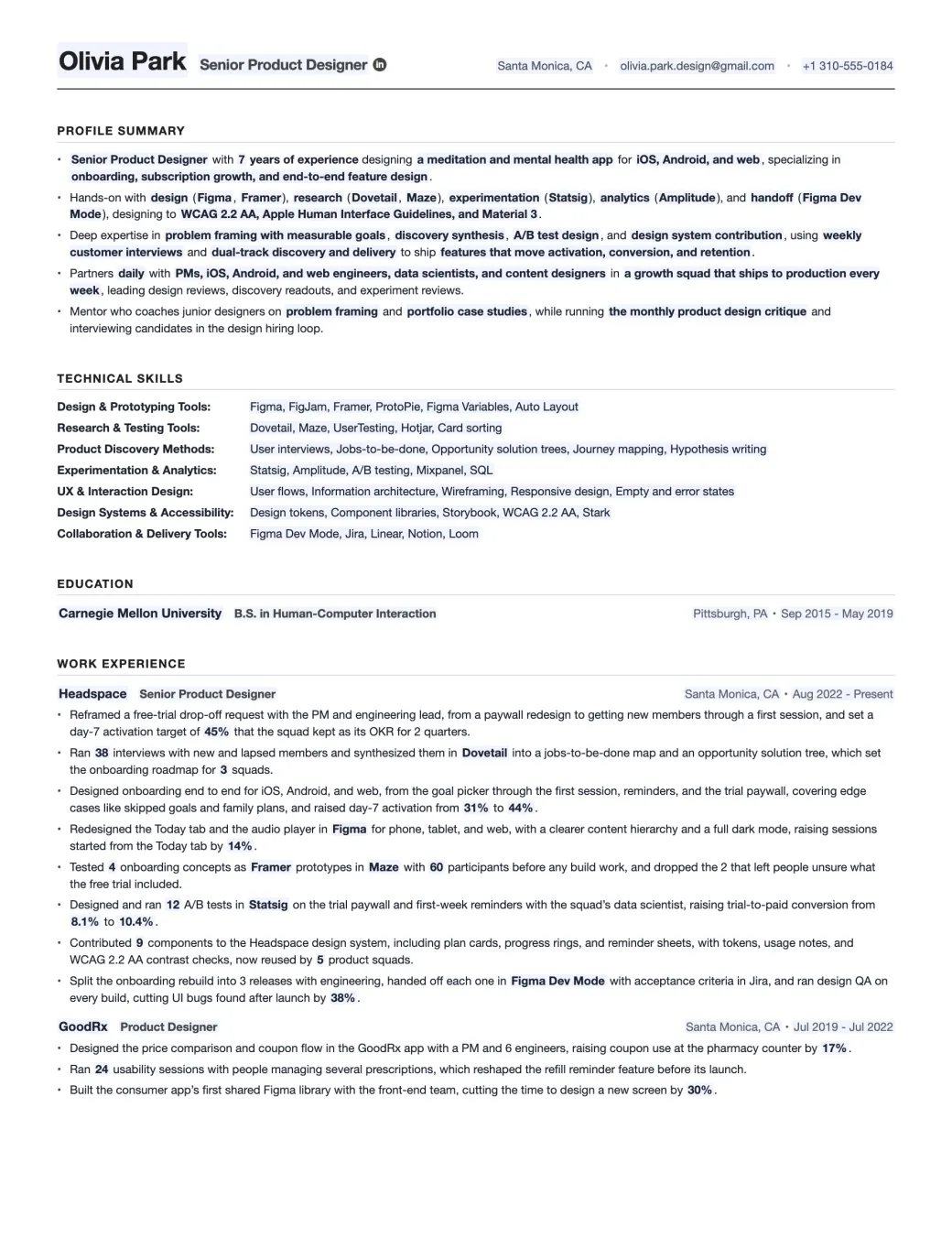
The Product Designer resume template filled in for Olivia Park at Headspace, showing her profile summary, technical skills, education and 8 bullets from problem framing to shipping
Emmanuel Gendre Ex-Google recruiter / Tech resume writer Updated Free, ATS-friendly, no signup

Interactive resume template generator

Interactive Product Designer Resume Template

Fill in the side panel, then download your resume as a PDF or a Word file.

Edits update live as you type. Toggle Edit to rewrite paper text directly.

Edit mode is on. Click anywhere on the resume to rewrite text. Side-panel placeholders still update live.

Olivia Park Senior Product Designer

Santa Monica, CA • olivia.park.design@gmail.com • +1 310-555-0184

Profile Summary

  • Senior Product Designer with 7 years of experience designing a meditation and mental health app for iOS, Android, and web, specializing in onboarding, subscription growth, and end-to-end feature design.
  • Hands-on with design (Figma, Framer), research (Dovetail, Maze), experimentation (Statsig), analytics (Amplitude), and handoff (Figma Dev Mode), designing to WCAG 2.2 AA, Apple Human Interface Guidelines, and Material 3.
  • Deep expertise in problem framing with measurable goals, discovery synthesis, A/B test design, and design system contribution, using weekly customer interviews and dual-track discovery and delivery to ship features that move activation, conversion, and retention.
  • Partners daily with PMs, iOS, Android, and web engineers, data scientists, and content designers in a growth squad that ships to production every week, leading design reviews, discovery readouts, and experiment reviews.
  • Mentor who coaches junior designers on problem framing and portfolio case studies, while running the monthly product design critique and interviewing candidates in the design hiring loop.

Technical Skills

Design & Prototyping Tools:
Figma, FigJam, Framer, ProtoPie, Figma Variables, Auto Layout
Research & Testing Tools:
Dovetail, Maze, UserTesting, Hotjar, Card sorting
Product Discovery Methods:
User interviews, Jobs-to-be-done, Opportunity solution trees, Journey mapping, Hypothesis writing
Experimentation & Analytics:
Statsig, Amplitude, A/B testing, Mixpanel, SQL
UX & Interaction Design:
User flows, Information architecture, Wireframing, Responsive design, Empty and error states
Design Systems & Accessibility:
Design tokens, Component libraries, Storybook, WCAG 2.2 AA, Stark
Collaboration & Delivery Tools:
Figma Dev Mode, Jira, Linear, Notion, Loom

Education

Carnegie Mellon University B.S. in Human-Computer Interaction
Pittsburgh, PA • Sep 2015 - May 2019

Work Experience

Headspace Senior Product Designer
Santa Monica, CA • Aug 2022 - Present
  • Reframed a free-trial drop-off request with the PM and engineering lead, from a paywall redesign to getting new members through a first session, and set a day-7 activation target of 45% that the squad kept as its OKR for 2 quarters.
  • Ran 38 interviews with new and lapsed members and synthesized them in Dovetail into a jobs-to-be-done map and an opportunity solution tree, which set the onboarding roadmap for 3 squads.
  • Designed onboarding end to end for iOS, Android, and web, from the goal picker through the first session, reminders, and the trial paywall, covering edge cases like skipped goals and family plans, and raised day-7 activation from 31% to 44%.
  • Redesigned the Today tab and the audio player in Figma for phone, tablet, and web, with a clearer content hierarchy and a full dark mode, raising sessions started from the Today tab by 14%.
  • Tested 4 onboarding concepts as Framer prototypes in Maze with 60 participants before any build work, and dropped the 2 that left people unsure what the free trial included.
  • Designed and ran 12 A/B tests in Statsig on the trial paywall and first-week reminders with the squad’s data scientist, raising trial-to-paid conversion from 8.1% to 10.4%.
  • Contributed 9 components to the Headspace design system, including plan cards, progress rings, and reminder sheets, with tokens, usage notes, and WCAG 2.2 AA contrast checks, now reused by 5 product squads.
  • Split the onboarding rebuild into 3 releases with engineering, handed off each one in Figma Dev Mode with acceptance criteria in Jira, and ran design QA on every build, cutting UI bugs found after launch by 38%.
GoodRx Product Designer
Santa Monica, CA • Jul 2019 - Jul 2022
  • Designed the price comparison and coupon flow in the GoodRx app with a PM and 6 engineers, raising coupon use at the pharmacy counter by 17%.
  • Ran 24 usability sessions with people managing several prescriptions, which reshaped the refill reminder feature before its launch.
  • Built the consumer app’s first shared Figma library with the front-end team, cutting the time to design a new screen by 30%.


Done editing? Download a real PDF (selectable text, ATS-friendly, US Letter) or an editable Word file if a recruiter asks for one.

About this template

A Product Designer resume template, built by a tech recruiter.

A product designer owns how a feature works and whether it moves the numbers the business cares about. You’re in the room with a PM and an engineering lead when they decide which problem is worth solving. Then you talk to users, sketch flows, design screens, test prototypes, help set up the A/B test and stay with engineering until it ships. The job isn’t done at handoff. It’s done when the result comes in.

Most product designer resumes I read could belong to anyone. Figma, design thinking, user-centered, a portfolio link... a design manager has seen that exact list a few hundred times this year. What they’re after is evidence your work changed the product, like the activation rate you raised, the A/B test you set up with data science, the interviews that killed a bad idea and the launch that hit its date.

Olivia’s template is built on that kind of evidence. Her 8 Headspace bullets each take one slice of the job, from framing the problem to shipping it, so a manager checking for gaps won’t find any. After it you’ll see Jonah’s, Zainab’s and Rowena’s resumes (junior, senior, staff). 6 steps to write a Product Designer resume sit right after those, if you’d rather build yours from zero.

Got a draft that isn’t getting replies? Send it through the form below and I’ll give you a personal CV critique, free.

Industry signal

What the market says about Product Designer roles

Product design is changing shape in 2026. Figma’s 2026 AI report (June 2026) found that the share of designers taking part in development doubled to 41%, and tools like Figma Make turn a design into a working prototype. And since June 28, 2025, banking services, e-books and phones sold in the EU have had to meet the European Accessibility Act. When anyone can make screens fast, companies still need someone to decide which problem the screens should solve, and to check that they did. That’s the product designer.

+6% US web and digital designer jobs, 2025 to 2035 US Bureau of Labor Statistics
$112,352 Average US product designer salary, Nov 2026 Salary.com
  • Karri Saarinen @karrisaarinen · CEO and co-founder of Linear
    Tomorrow: my conversation with Soleio about how we build and design @linear also met his cat
  • Amplitude @Amplitude_HQ · Official Amplitude account
    You can ship more than ever. The real question is whether all of it should be built. Join Amplitude (hey @Jacob__Newman!), @Superhuman, @figma, and @GoogleDeepMind for The Software Factory: Turn AI Speed Into Outcomes. November 5 · Register here: amplitude.com/events/2026-11…
  • Maze @mazedesignHQ · Official Maze account
    “AI hasn't changed why I do the work. It's changed where I spend my time.” For Jen Murphy, Principal Researcher at Fin, AI means less time working through research alone and more time collaborating with others. Read Jen's guest article: bit.ly/4znEeKU
  • Julie Zhuo @joulee · Founder of Sundial, former VP of Product Design at Facebook
    The software of the future promises more power and flexibility for more imagination. We started with use-case software, moving to platform software, moving to all-purpose coding agents. Interface design is shifting rightward. A few things to keep in mind for designers: 1. Make the interface malleable. 2. Let preferences reach past the rule book. A descriptive vision beats fifty toggles. 3. Let feedback change the product.

Resume Samples

Product Designer Resume Examples

What should a product designer resume prove at your level? The answer changes between a first design job and a staff seat, which is why these 3 product designer resume samples sit far apart. The junior came from customer support and now designs billing screens at a payments company. The senior owns activation at a mobile bank, and the staff designer frames problems for several teams at a home services marketplace. You can download each one as a PDF or a Word file, free and with no signup.

Junior Product Designer Resume Example

A junior product designer resume has to show you can carry one problem from research to a shipped screen, and say what changed once it was live.

Years of experience
2 years (after 5 in customer support)
Industry
Payments SaaS
Stack
FigmaMazeHotjarLinear
Download PDF Download Word

Click to download the Junior Product Designer resume example as a PDF or a Word file. Free / No signup.

Jonah Whitfield

Junior Product Designer

London, UK · jonah.whitfield@gmail.com · +44 20 7946 0151 · linkedin.com/in/jonahwhitfield

Profile Summary

  • Junior Product Designer with 2 years in product design after 5 in customer support, working on the billing and subscription screens of a payments platform that software companies sell through.
  • Designs in Figma and FigJam, tests with Maze and Hotjar, and follows each project on the team’s Linear board from first research to release.
  • Strongest in discovery from support tickets, end-to-end billing flows and clear error messages, turning the questions customers ask most often into screens that answer them.
  • Works with a product manager, 5 engineers and the support team, and brings support agents into usability sessions as observers so they hear the problems first hand.
  • Runs a monthly review with the support leads where the top ticket themes are sorted and the clearest ones go onto the design backlog.

Technical Skills

Design & Prototyping Tools:
Figma, FigJam, Auto Layout, Figma Variables
Research & Testing Tools:
Maze, Hotjar, Dovetail, Surveys
Product Discovery Methods:
User interviews, Support ticket analysis, Journey mapping
Experimentation & Analytics:
A/B testing, Amplitude, Google Analytics 4
UX & Interaction Design:
User flows, Wireframing, Empty and error states, Responsive design
Design Systems & Accessibility:
Component libraries, Design tokens, WCAG 2.2 AA
Collaboration & Delivery Tools:
Figma Dev Mode, Linear, Notion, Slack
Page 2 of 2

Work Experience

Paddle Junior Product Designer London, UK · Nov 2024 to Present
  • Sorted 1,200 billing support tickets with the product manager into 6 problem themes, and made plan-change confusion the quarter’s focus with a goal of halving those tickets.
  • Redesigned the plan-change flow end to end, from the upgrade prompt to the proration preview and the confirmation email, cutting plan-change support tickets by 48% in 2 months.
  • Tested 3 invoice page layouts as Figma prototypes in Maze with 40 merchants, then shipped the one that raised first-try task success from 62% to 85%.
  • Added 6 billing components to the shared Figma library with the design systems team, including a proration table and a failed-payment banner, each checked for WCAG 2.2 AA contrast.
  • Ran a 4-week A/B test on the annual plan prompt with the growth PM and shipped the winner with 2 front-end engineers, lifting annual plan take-up by 9%.
Ovo Energy Customer Support Specialist Bristol, UK · Aug 2019 to Oct 2024
  • Handled 1,600+ customer conversations a year on bills, meter readings and smart meter installs, and sent the app team a monthly list of the top issues.
  • Wrote 90 help center articles based on the questions customers asked most, which cut average handling time on billing calls by 2.8 minutes.
  • Took notes in 8 research sessions on the meter reading flow in the Ovo app, then sketched a fix for the photo step that the app team picked up.

Education

University of the West of England B.A. in Digital Media Bristol, UK · Sep 2016 to Jun 2019
Interaction Design Foundation UX Design Certificate Remote · May 2024

Senior Product Designer Resume Example

A senior product designer resume has to show you own a part of the product and its numbers: the goal you set, the experiments you ran and which results held up.

Years of experience
8 years
Industry
Mobile banking
Stack
FigmaProtoPieMixpanelDovetail
Download PDF Download Word

Click to download the Senior Product Designer resume example as a PDF or a Word file. Free / No signup.

Zainab Osei-Bonsu

Senior Product Designer

Amsterdam, Netherlands · zainab.oseibonsu@gmail.com · +31 20 555 0196 · linkedin.com/in/zainaboseibonsu

Profile Summary

  • Senior Product Designer with 8 years in fintech, currently owning onboarding and activation for a mobile bank used by millions of people across Europe.
  • Works in Figma and ProtoPie, reads funnels in Mixpanel, keeps research in Dovetail, and writes each test plan with the data team before a variant goes live.
  • Strong in activation design, regulated onboarding flows such as identity checks, and experiment design, with the numbers to show which changes held up after launch.
  • Partners with 2 product owners, 11 engineers, the compliance team and data analysts, and runs a fortnightly experiment review for the growth area.
  • Mentors 2 product designers on writing test plans and reading results, and interviews candidates in the product design hiring loop.

Technical Skills

Design & Prototyping Tools:
Figma, ProtoPie, FigJam, Figma Variables
Research & Testing Tools:
Dovetail, Maze, UserTesting, Surveys
Product Discovery Methods:
User interviews, Jobs-to-be-done, Opportunity solution trees
Experimentation & Analytics:
Mixpanel, A/B testing, SQL, Looker
UX & Interaction Design:
User flows, Information architecture, iOS and Android patterns
Design Systems & Accessibility:
Design tokens, Component libraries, WCAG 2.2 AA, Stark
Collaboration & Delivery Tools:
Figma Dev Mode, Jira, Confluence, Loom
Page 2 of 2

Work Experience

bunq Senior Product Designer Amsterdam, Netherlands · Apr 2021 to Present
  • Changed the growth area’s goal with the product owner from new sign-ups to accounts that make a first payment within 7 days, which reshaped 4 of 6 projects on the roadmap.
  • Ran 22 interviews with people who opened an account and never used it, and mapped the findings into an opportunity tree that put identity checks at the top.
  • Redesigned the identity check flow with compliance, from ID scan to proof of address and the manual review state, cutting median time to an approved account from 2 days to 6 hours.
  • Tested 5 home screen concepts as ProtoPie prototypes with 48 customers, then took the winner to full UI with dark mode, raising weekly use of savings goals by 21%.
  • Ran 34 experiments over 2 years on onboarding, the first top-up and card ordering, and the winners together lifted 7-day activation by 17 percentage points.
Adyen Product Designer Amsterdam, Netherlands · Aug 2018 to Mar 2021
  • Contributed 14 components to the design system for data-heavy merchant screens, such as filterable tables and payout timelines, later used across the Customer Area.
  • Shipped the settlement report redesign with 7 engineers in 4 releases, handing off in Figma with acceptance criteria, which cut report support requests by 31%.
  • Led the redesign of payment page styling for merchants, cutting the time to set up a branded checkout from 3 weeks to 5 days.

Education

Delft University of Technology M.Sc. in Design for Interaction Delft, Netherlands · Sep 2016 to Jun 2018

Staff Product Designer Resume Example

A staff product designer resume has to show influence across teams you don’t manage: the problems you framed, the bets you changed and the results several teams share.

Years of experience
13 years
Industry
Home services marketplace
Stack
FigmaAmplitudeUserTestingNotion
Download PDF Download Word

Click to download the Staff Product Designer resume example as a PDF or a Word file. Free / No signup.

Rowena Castellanos

Staff Product Designer

Austin, TX · rowena.castellanos@gmail.com · +1 512-555-0104 · linkedin.com/in/rowenacastellanos

Profile Summary

  • Staff Product Designer with 13 years on two-sided marketplaces, currently working across 5 product teams on how customers find, book and pay local service pros.
  • Uses Figma and FigJam for design and planning, Amplitude and SQL for funnel analysis, UserTesting for remote studies, and Notion for strategy docs.
  • Known for marketplace problem framing, trust and safety design and experiment programs that span several teams, and for agreeing the success metric before the first sketch.
  • Works with product directors, engineering leads, data science and operations, and brings the design view into quarterly planning for the marketplace.
  • Coaches 6 designers across the marketplace teams, co-runs the weekly product design critique, and wrote the case study guide the team uses when hiring.

Technical Skills

Design & Prototyping Tools:
Figma, FigJam, Framer, Figma Variables
Research & Testing Tools:
UserTesting, Dovetail, Maze, Surveys
Product Discovery Methods:
User interviews, Jobs-to-be-done, Opportunity solution trees, Competitive analysis
Experimentation & Analytics:
Amplitude, A/B testing, Geo-split tests, SQL
UX & Interaction Design:
User flows, Information architecture, Service blueprints, Responsive design
Design Systems & Accessibility:
Component libraries, Design tokens, WCAG 2.2 AA, Storybook
Collaboration & Delivery Tools:
Figma Dev Mode, Jira, Notion, Loom
Page 2 of 2

Work Experience

Thumbtack Staff Product Designer Austin, TX (remote) · Feb 2019 to Present
  • Wrote the problem brief behind the booking quality bet with 3 product directors, putting a cost on cancelled jobs and making repeat booking the shared metric for 3 teams.
  • Set up a monthly research program with 2 UX researchers, joining customers and pros on 40+ job site visits and calls a year to feed the marketplace roadmap.
  • Led the trust and safety redesign across 3 teams, from pro verification badges to dispute handling and refunds, cutting disputed bookings by 38%.
  • Designed the instant booking experiment with data science, a 12-week geo-split test across 40 metro areas, which lifted booking conversion by 9% before the national rollout.
  • Got shared marketplace patterns (price ranges, pro cards, review summaries) into the design system, adopted by 5 teams in place of their own one-off versions.
HomeAway Senior Product Designer Austin, TX · Jun 2013 to Jan 2019
  • Led the host onboarding redesign for vacation rental owners, from first listing details to photos and pricing, lifting listing completion from 44% to 68%.
  • Tested 6 checkout concepts as clickable prototypes with 50 travelers, and the version with the full price shown upfront cut checkout drop-off by 14%.
  • Shipped the responsive redesign of the traveler site with 9 engineers, handing off specs and running design QA on 4 country sites before each launch.

Education

Carnegie Mellon University M.Des. in Interaction Design Pittsburgh, PA · Aug 2011 to May 2013
University of Texas at Austin B.A. in Psychology Austin, TX · Aug 2007 to May 2011

Free resume review

A recruiter screen, but with feedback

You applied to hundreds of jobs: no result. Companies won’t give you feedback, so you’re stuck in a loop. Rejections will keep coming until you know what’s wrong.

Let’s break this cycle today!

I’ll screen your resume the same way I did at Google.

You’ll get:

  • Your resume sections and content scored.
  • A clear list of what to improve, why, and how.
  • Behind the scenes secrets on the screening process.

How I rewrite Product Designer resumes

How to write a Product Designer resume

Emmanuel Gendre, ex-Google recruiter

Emmanuel Gendre Ex-Google recruiter, tech resume writer

For 13 years my job was hiring for tech teams, many of those years inside Google. These days I’m on the other side, rewriting resumes, and product designers make up a good share of them. The weak ones read like a portfolio index: “Redesigned onboarding”, “Designed the new dashboard”. A design manager can’t tell from that which problem you chose, what users said, or what the numbers did after launch.

Designers who book my tech resume writing services get bullets that each carry a decision, the reason for it and the number that moved. If you’re doing it yourself, though, focus on these 6 steps. Every example below is from Olivia’s resume in the template.

  1. Step 1 Format & layout Keep it to one column, the usual headings and a real-text PDF. Go to step 1
  2. Step 2 Profile Summary 5 lines on what you design, for whom, and with which tools. Go to step 2
  3. Step 3 Work Experience Your current job, from problem framing through shipping, in 8 bullets. Go to step 3
  4. Step 4 Bullet Points Go from “designed onboarding” to a bullet with the result in it. Go to step 4
  5. Step 5 Technical Skills 7 tool and method groups, plus the soft skills design leads check. Go to step 5
  6. Step 6 Keywords & Metrics Mirror the job ad’s wording and put a product number in every bullet. Go to step 6

Step 1 · Format & Layout

Product Designer resume format and layout

Let’s get the cheap win out of the way. Your resume’s first reader is software, and its second is a recruiter giving it a quick look. If the format’s wrong, your best launch won’t even get seen.

01ATS Compliance

ATS compliance for your Product Designer resume

Before anyone at a product company opens your resume, Ashby, Greenhouse or another Applicant Tracking System (ATS) has read it and stored each piece (company, title, dates, tools) in a field. Later, a recruiter searches those fields for “Figma”, “Amplitude” or “growth design”. A skills list sitting in a text box or a fancy header can end up stored as nothing, and then you don’t show up. My explainer on ATS resume parsing goes deeper, if you’re curious. For a product design application, that comes down to 3 rules:

The 3 rules
  1. Use a 100% text based format (no Canva!)

  2. Avoid tables, pictures, and complex structures.

  3. Use the most predictable section names, like “Profile Summary” and “Work Experience”

02Design & Layout

Product Designer resume design and layout

Designers hate hearing this, but recruiters hate fancy designs. I spent hours at a time reading resumes at Google, and you learn to look in one spot for the latest title and dates. Put them in a colored sidebar or a timeline and you’ve made the recruiter’s job harder. Save the visual skill for your portfolio. That’s the link they’ll click next anyway.

So keep the resume itself simple and predictable: 1 column, 1 font, the usual section names, and your portfolio URL in the header where one click opens it. That’s how Olivia’s template is set up. Making your own in Google Docs? Here are the specs I’d copy.

Layout Spec
Columns
One. No sidebars, tables, columns, pictures or tabs.
Margins
0.7 in on all four sides
Body size
10 to 11 pt
Type
One family, weight for hierarchy
Length
One page under 5 years, two after
Section order
Summary, Skills, Experience, Education
PDF

03File Format

Resume file format for your Product Designer resume

Your product designer resume goes out as a PDF, and as a Word file only when a job ad or a recruiter asks for one. Export the PDF from Google Docs or this template as real text, not as a flattened image, or the ATS can’t read a word of it. And don’t attach a 40-page portfolio deck either. Put the link on your resume instead. My comparison of PDF and Word resumes has the details.

Format Guide
PDF
Your default. Layout holds, text stays selectable.
Word (.docx)
When the posting or a recruiter asks for it. Use the Word download above.
Plain text
For portals that make you paste into a box
Never
Images, scans, password-protected PDFs, shared-drive links
File name
Olivia-Park-Product-Designer.pdf

Step 2 · Profile Summary

Product Designer profile summary

Juniors ask me if they can drop the profile summary. They can’t. Recruiters read in 2 stages (here’s how a recruiter screens your resume, step by step), and at the first one, those 5 lines are close to everything they’ll read. If yours could belong to a graphic designer, you won’t get to the portfolio click.

Design managers want to know one thing from it: do you own a problem, or do you wait for a spec from the PM? Every bullet below handles one part of that answer, starting with your title and product and ending with the people you coach. For worked examples from other roles, see my profile summary article.

  1. 1

    Title, years and scope

    Lead with the title from the posting, like Product Designer II, Senior Product Designer or Growth Designer, followed by your years, the product and where it runs (iOS, Android, web). One glance at that line, and a recruiter knows which level to put you at.

  2. 2

    Your stack

    Product design postings ask for tools in groups, so list yours the same way: design (Figma, Framer), research (Dovetail, Maze), experiments (Statsig), analytics (Amplitude) and handoff. It’s the line an ATS search matches before anything else.

  3. 3

    Domain expertise

    Your 3 or 4 best areas from the role profile go here, such as problem framing, discovery or experiment design, plus a habit behind them like weekly customer calls. A hiring manager should finish it thinking you own outcomes, not just Figma files.

  4. 4

    Collaboration

    Write down the people you ship with (PMs, engineers, data scientists, content designers) and the meetings you lead, like design reviews, discovery readouts and experiment reviews. A manager hiring for a squad wants to see you’re easy to build with.

  5. 5

    Leadership

    Show what you’ve added beyond your own files: a critique you run, a case study guide, juniors you coach, interviews on the hiring loop. Plenty of ICs write this line with zero reports. Managers read it as a preview of the culture you’d bring to their squad.

Product Designer resume summary example, from the template above
  • Senior Product Designer with 7 years of experience designing a meditation and mental health app for iOS, Android, and web, specializing in onboarding, subscription growth, and end-to-end feature design.
  • Hands-on with design (Figma, Framer), research (Dovetail, Maze), experimentation (Statsig), analytics (Amplitude), and handoff (Figma Dev Mode), designing to WCAG 2.2 AA, Apple Human Interface Guidelines, and Material 3.
  • Deep expertise in problem framing with measurable goals, discovery synthesis, A/B test design, and design system contribution, using weekly customer interviews and dual-track discovery and delivery to ship features that move activation, conversion, and retention.
  • Partners daily with PMs, iOS, Android, and web engineers, data scientists, and content designers in a growth squad that ships to production every week, leading design reviews, discovery readouts, and experiment reviews.
  • Mentor who coaches junior designers on problem framing and portfolio case studies, while running the monthly product design critique and interviewing candidates in the design hiring loop.

Step 3 · Work Experience

Product Designer work experience

If your summary holds up, the recruiter keeps reading, and then the design manager goes through your jobs line by line. Around 95% of their decision comes down to the role you’re in today. That’s only fair, because it’s where they’ll see the designer you’d be on day one of the new job.

So Olivia’s Headspace job, and yours, should carry 8 bullets. Each one answers a separate competency in the product designer role profile. Recruiters hold your resume up against that list. Leave an area out and they’ll assume you lack it. With no experiment bullet, say, you look like a designer who hands off screens and never hears what happened.

Product Designer role profile
  1. Problem Framing & Success Metrics

    You find out what problem a request is really about before anyone opens Figma. Squads burn whole sprints on the wrong feature, and design managers trust designers who ask “why” early. Explain how you used problem statements and opportunity sizing with your PM to agree a goal the squad could measure.

    Techniques
    problem statements, opportunity sizing, success metrics, OKR setting
    Tools
    FigJam, Notion, Miro, Amplitude
    Metrics
    OKR targets, opportunity size, roadmap changes
  2. Discovery & Research Synthesis

    You talk to customers every week and bring back patterns, not just quotes. Interview notes on their own don’t move a roadmap, and hiring managers can tell when research led to a real decision. Walk them through how your interviews and Dovetail synthesis picked the next problem your team took on.

    Techniques
    customer interviews, jobs-to-be-done, opportunity solution trees, synthesis
    Tools
    Dovetail, Maze, Notion, Hotjar
    Metrics
    interviews run, insights acted on, teams informed
  3. End-to-End Feature UX

    You design a feature from the first entry point to the last error message. Engineers fill any gap you leave with a guess, and those guesses turn into support tickets after launch. Describe how you used user flows and edge-case walkthroughs with engineering to ship a complete feature that more people finished.

    Techniques
    user flows, information architecture, wireframes, edge cases
    Tools
    Figma, FigJam, Miro
    Metrics
    task completion, activation, support tickets
  4. UI Design & Visual Polish

    You give every screen a clear hierarchy, on a phone, a tablet and the web. Product designers still get judged on craft, and a messy UI makes a good idea look weak in a portfolio review. Point out how Figma variables, a type scale and dark mode helped you make a key screen easier to use.

    Techniques
    visual hierarchy, responsive layouts, dark mode, type and color
    Tools
    Figma, Figma Variables, Auto Layout
    Metrics
    screen engagement, task success, usability score
  5. Prototyping & Concept Testing

    You put prototypes in front of users while changing course is still cheap. A concept that fails in week one costs a few days, and one that fails after launch costs a quarter, which is why managers ask about it. Tell them how Framer or ProtoPie prototypes and Maze tests helped you drop weak concepts early.

    Techniques
    concept tests, clickable prototypes, unmoderated tests, moderated sessions
    Tools
    Framer, ProtoPie, Figma, Maze
    Metrics
    concepts tested, participants, ideas dropped before build
  6. Experiments & Product Outcomes

    You set up experiments with data science and read the results honestly. Product teams answer for activation, conversion and retention, and they hire designers who can argue about those numbers in planning. Show the A/B tests you ran in Statsig and the Amplitude funnels you read to move one of them.

    Techniques
    A/B tests, holdouts, funnel analysis, hypothesis writing
    Tools
    Statsig, Amplitude, Mixpanel, LaunchDarkly
    Metrics
    conversion, activation, retention
  7. Design System Contribution

    You build on the design system and add to it when the product needs something new. One-off components slow engineering down and make the product feel patchy, so managers look for designers who give back. Mention how you used tokens, documented components and WCAG contrast checks to get your work reused by other teams.

    Techniques
    component proposals, design tokens, usage docs, contrast checks
    Tools
    Figma, Storybook, Stark, Zeroheight
    Metrics
    components contributed, teams reusing them, accessibility issues fixed
  8. Shipping with Engineering

    You stay with engineers until the feature is live, not just until the handoff. A design that ships late or half-built is worth very little, and most managers have seen both happen. Detail how you used scope trade-offs, Figma Dev Mode specs and design QA to launch on time with fewer bugs.

    Techniques
    scope trade-offs, acceptance criteria, design QA, launch reviews
    Tools
    Figma Dev Mode, Jira, Linear, Loom
    Metrics
    on-time releases, post-launch bugs, QA rounds

Freelance or agency designer? Base every bullet on a single client project: what the product was, the problem and what changed once it launched. Then take each one up the Level System below.

Submit your resume for a free review!

Step 4 · Bullet Points

Product Designer resume bullet points

Bullets are where I rewrite the most on product designer resumes. “Redesigned the checkout” hides the decisions, the tools and the result. Olivia’s bullets went through my Level System, a method that started from Google’s XYZ formula and that I’ve kept adjusting for designers and engineers. My bullet point guide covers every level in depth.

Picture Olivia’s trial paywall bullet. Level 1 is the bare task, and every level after it answers one more question about the work: how, with what, following which method, and with what result. By level 5 it closes on trial-to-paid conversion.

  1. Level 1Task

    What did I work on? Start with a verb and the one feature you changed. A recruiter skips a bullet that only says you did your job.

    Redesigned the free trial paywall.

  2. Level 2+ Techniques

    How did I do it? Add the design decisions. They show you solved a problem instead of reskinning a screen.

    Redesigned the free trial paywall with a plan comparison table and a reminder before the trial ends.

  3. Level 3+ Tools

    What tools did I use? Write the real product names. Recruiters search for Statsig and Framer, not “testing tools”.

    Redesigned the free trial paywall with a plan comparison table and a reminder before the trial ends, designed in Figma and tested in Statsig.

  4. Level 4+ Method

    What method did I follow? Say how you checked the idea, like a set of A/B tests. It tells a manager you don’t ship on a hunch.

    Redesigned the free trial paywall with a plan comparison table and a reminder before the trial ends, designed in Figma and tested in Statsig through 4 A/B tests run with the squad’s data scientist.

  5. Level 5+ Metric

    What was the result? End on one number the PM would put in a quarterly review. Then stop.

    Redesigned the free trial paywall with a plan comparison table and a reminder before the trial ends, designed in Figma and tested in Statsig through 4 A/B tests run with the squad’s data scientist, raising trial-to-paid conversion from 8.1% to 10.4%.

    1. 01 Task What you worked on
    2. 02 Techniques How you did it
    3. 03 Tools The stack you used
    4. 04 Method The method you followed
    5. 05 Metric The result, one number

Most designers tell me they have no numbers, and then find a dozen once they look. Funnels sit in Amplitude or Mixpanel, test results in Statsig or Optimizely, and the rest in your PM’s quarterly review deck. Ask for read access if you can’t open them.

Step 5 · Technical Skills

Product Designer resume skills

Your skills section is really written for the ATS. When a recruiter searches “Figma” plus “A/B testing”, this is where the match usually comes from. Match the job ad’s wording for every tool (Figma Dev Mode, not “dev handoff”), and leave out self-ratings like “advanced Figma”. Nobody’s going to believe a rating they can’t test.

Your bullets still matter more. If Statsig’s in your skills, a design manager goes looking for the test you ran with it, and it’s a bad sign when there isn’t one. Below, you’ll get my 7 skill groups for product design, the skills section from Olivia’s resume, and 5 soft skills I’d rather see in a bullet than in a list. Keywords get their own step next.

The 7 skill categories for a Product Designer resume

A star means it’s on most product designer job ads I’ve read, so it leads its row. After them, add only what you’ve used on a product that shipped.

Design & Prototyping Tools

Where you design and prototype. Everyone lists Figma, so add the prototyping tool too, since recruiters search for Framer and ProtoPie separately.

FigmaFramerFigJamProtoPieFigma VariablesAuto LayoutSketch

Research & Testing Tools

How you hear from users and test ideas. Maze and UserTesting come up most in postings, and Dovetail shows you keep findings where the team can use them.

MazeUserTestingDovetailHotjarMiroSurveysCard sorting

Product Discovery Methods

How you choose the right problem. Interviews are the baseline, and opportunity solution trees or a jobs framework show you plan discovery with your PM.

User interviewsJobs-to-be-doneOpportunity solution treesJourney mappingHypothesis writingCompetitive analysis

Experimentation & Analytics

How you measure what your design changed. Amplitude or Mixpanel plus A/B testing covers most postings, and SQL helps when you pull your own numbers.

AmplitudeA/B testingMixpanelStatsigLaunchDarklyGoogle Analytics 4SQL

UX & Interaction Design

The core UX work behind every feature. List user flows and wireframing, plus the platform patterns you know well, like iOS and Android.

User flowsWireframingInformation architectureResponsive designEmpty and error statesiOS and Android patterns

Design Systems & Accessibility

How you build on the shared system and for every user. Postings ask most for design tokens and the WCAG 2.2 AA standard.

WCAG 2.2 AADesign tokensComponent librariesStorybookStarkMaterial 3Apple Human Interface Guidelines

Collaboration & Delivery Tools

Where you hand off and track work with engineers. Most teams run on Jira with Figma Dev Mode, and Linear shows up a lot at startups.

Figma Dev ModeJiraLinearNotionLoomConfluenceSlack

A finished Product Designer skills section

Technical Skills sample, from the template above
Design & Prototyping Tools
Figma, FigJam, Framer, ProtoPie, Figma Variables, Auto Layout
Research & Testing Tools
Dovetail, Maze, UserTesting, Hotjar, Card sorting
Product Discovery Methods
User interviews, Jobs-to-be-done, Opportunity solution trees, Journey mapping, Hypothesis writing
Experimentation & Analytics
Statsig, Amplitude, A/B testing, Mixpanel, SQL
UX & Interaction Design
User flows, Information architecture, Wireframing, Responsive design, Empty and error states
Design Systems & Accessibility
Design tokens, Component libraries, Storybook, WCAG 2.2 AA, Stark
Collaboration & Delivery Tools
Figma Dev Mode, Jira, Linear, Notion, Loom

Soft skills for a Product Designer resume

You can write “great collaborator” in your skills and a design manager won’t believe it. Write the behavior into a bullet and attach a number, and they will. These 5 are the ones I’d want to see proven on a product designer resume.

  • Asking what problem a feature solves before you design it

    Resume bulletAsked for 1 week of customer interviews before designing a requested rewards tab, and the team shipped a simpler streak reminder in 2 sprints instead of 6.

  • Bringing PMs and engineers into research sessions

    Resume bulletBrought 9 engineers and 2 PMs into live interview sessions over a quarter, so the squad agreed on the onboarding fix before design started.

  • Trading scope with engineers to keep a launch date

    Resume bulletCut the family plan screens from the first release with the engineering lead, keeping the onboarding launch on its date and shipping them 3 weeks later.

  • Explaining design decisions to leadership in business terms

    Resume bulletPresented the paywall redesign to the leadership team as a revenue case, and got 2 more engineers for the growth squad the next quarter.

  • Reporting a flat test result without dressing it up

    Resume bulletShared a 6-week home screen test that showed no lift, and moved the squad on to reminders a sprint earlier than planned.

Step 6 · Keywords & Metrics

Product Designer resume keywords and metrics

You’ve got two checks left before you hit send. Recruiters find people by searching the ATS for words from the job ad, so your keywords need to be the same ones. After that, a design manager looks at your metrics for the product numbers your work moved. A product designer resume can’t get by on one of the two.

First up are product design keywords in 3 tiers, must-have to bonus. The finder after them checks any product, UX or growth design job ad for you. Then you’ll find 24 product metrics, sorted by competency, with a Headspace bullet for each.

+42%

Product Designer resume keywords, ranked

Tap any chip to read how real postings tend to phrase it. A fintech might write “experimentation”, a retailer “A/B testing and data-informed design”, and they want the same skill.

Must-have

8

Get each of these into your summary, a bullet and your skills rows.

In a job description“Own end-to-end product design for core features across web and mobile”

Strong supporting

8

Prove the ones you’re best at in a bullet, and list the others in your skills.

In a job description“Design and analyze A/B tests with data science to improve key metrics”

Bonus

8

Include them when a posting mentions them. They can tip a close shortlist your way.

In a job description“Experience building realistic prototypes in Framer or ProtoPie”

Extract Product Designer keywords from a job description

Every company words its product design posting a little differently. Paste one you’re applying to (product, UX or growth design) and you’ll see its tools, methods and metric terms ranked by importance. If the finder lists something true for you, add it to a bullet.

Must-have
Put these in your skills section and back each one with a bullet.
Strong supporting
Add the ones you’ve actually worked with. Skip the rest.

Nothing is uploaded: it all happens in your browser.

Metrics for a Product Designer resume

Every area gets 3 metrics, each next to a line from Olivia’s resume. Keep each bullet to one number, ideally one your PM already reports.

MetricExample bullet
Problem framing
OKR target set Percent The goal you agreed with your PM before design started.Set a day-7 activation target of 45% with the PM, which the squad kept as its OKR for 2 quarters.
Opportunity size Count How many users or sessions the problem touches each month.Sized the trial drop-off problem at 180,000 new trials a month before the squad committed to it.
Roadmap items changed Count Planned projects added, cut or reordered because of your framing.Reframed the growth roadmap around first sessions, which changed 3 of 7 planned projects.
Discovery
Interviews run Count Customer conversations you ran or joined in a period.Ran 38 interviews with new and lapsed members in one quarter.
Insights acted on Count Research findings that became roadmap items or shipped changes.Turned interview findings into 7 roadmap items, most of them shipped within 2 quarters.
Teams using your research Count Squads that planned work from your synthesis.Built an opportunity solution tree that set the onboarding roadmap for 3 squads.
Feature UX
Activation rate Percent Share of new users who reach the first moment of value.Raised day-7 activation from 31% to 44% with a rebuilt onboarding flow.
Steps to complete Count Screens a user goes through to finish a core task.Cut the path from sign-up to a first meditation from 11 screens to 6.
Support tickets Count Tickets about a feature before and after your redesign.Cut subscription support tickets from 1,400 to 610 a month after the account settings redesign.
UI design
Feature engagement Percent Change in use of a screen or feature after a redesign.Raised sessions started from the Today tab by 14% after the redesign.
Usability score Score A standard score like SUS from usability tests.Raised the audio player’s SUS score from 68 to 82 across 2 test rounds.
App store rating Score Average rating in the months after a release you designed.Lifted the iOS app rating from 4.5 to 4.8 in the 3 months after the player redesign.
Prototyping
Concepts tested Count Ideas tested as prototypes before engineering started.Tested 4 onboarding concepts as Framer prototypes before any build work.
Task success in tests Percent Share of participants who finish the task in a prototype.Raised task success on the plan picker prototype from 58% to 91% over 3 Maze rounds.
Build time saved Time Engineering time saved by dropping concepts in testing.Dropped 2 concepts in prototype tests, saving about 6 engineer-weeks of build work.
Experiments
Conversion rate Percent Share of users who complete a paid or key action.Raised trial-to-paid conversion from 8.1% to 10.4% through paywall tests.
Retention Percent Share of users still active after a set period.Lifted 30-day retention for new members from 22% to 27% with reminder tests.
Experiments run Count A/B tests you designed and shipped in a period.Designed and ran 12 A/B tests in Statsig with the squad’s data scientist in a year.
Design system
Components contributed Count New components or variants you added to the shared library.Contributed 9 components to the design system, from plan cards to reminder sheets.
Teams reusing your work Count Squads using components you contributed.Got the paywall and progress components reused by 5 product squads.
Accessibility issues fixed Count WCAG issues closed in screens you own.Fixed 23 contrast and touch target issues across onboarding before the WCAG 2.2 AA audit.
Shipping
Post-launch bugs Percent Change in UI bugs reported after release.Cut UI bugs found after launch by 38% with design QA on every build.
On-time releases Count Releases that shipped on the planned date.Shipped 3 of 3 onboarding releases on their planned dates by trading scope with engineering.
Design QA rounds Frequency How often you reviewed builds before release.Ran 2 design QA reviews a week on staging builds during the onboarding rebuild.

What if you don’t have exact numbers?

  • 1

    Ask for the dashboards. Amplitude, Mixpanel and Statsig hold most product numbers, and your PM can usually share the funnel or the test readout in a minute.

  • 2

    Estimate, then go a little lower. “About 30 interviews” works when you could explain to a design manager how you counted.

  • 3

    Show scope when results aren’t yours to share. The features you owned, the platforms, the squads using your components or the people you tested with still give a sense of scale.

Free resume review

A recruiter screen, but with feedback

You applied to hundreds of jobs: no result. Companies won’t give you feedback, so you’re stuck in a loop. Rejections will keep coming until you know what’s wrong.

Let’s break this cycle today!

I’ll screen your resume the same way I did at Google.

You’ll get:

  • Your resume sections and content scored.
  • A clear list of what to improve, why, and how.
  • Behind the scenes secrets on the screening process.

Frequently asked

Product Designer resume FAQ

It’s free, with no login and no card. Make your edits here, download the file, and come back after your next launch to add it.

Yes, there’s a Word version. Click Word, to the right of Download PDF, and save the .docx wherever you keep your job search files. All 3 samples come as a .docx too. I’d attach the PDF to most applications anyway, and save the .docx for recruiting agencies, which often add their own header before they put you forward to a client.

It is. Greenhouse, Lever, Workday and Ashby can all parse it, because it sticks to the 3 Step 1 rules. Designers get into trouble later, when they add portfolio touches like icon rows, skill bars or a 2-column header. Keep those for your case studies.

One page works for most juniors. Past 5 years in product design, 2 pages is normal and nobody will hold it against you. Whatever the length, your current job needs room for its 8 bullets. There’s more on page counts in my resume length guide for tech jobs.

Always, and in the header, right by your email. The resume gets the click, and the portfolio gets the interview. Lead with a couple of case studies (3 at most) that follow your bullets: the problem, the research, the design and the result. Open the link on your phone before you apply, since that’s where many recruiters will see it first.

You don’t need one, and design managers will look at your case studies first. On the resumes I see, the ones that come up most are NN/g’s UX Certification and Google’s UX Design certificate. They’re most useful for career changers. List them below your degree, with the year.

Stick to numbers your squad already tracks, like activation, conversion, retention, task success, support tickets and test results. One per bullet is plenty. Olivia’s bullets in Step 6 show 24 of these in use, 3 per area of the role profile.

Yours should lead with the problems you framed and the product numbers you moved, from discovery to the experiment. UX/UI designer resumes lean harder on screens and visual craft, and my UX/UI Designer resume template leans that way too. Work mostly on behavior, like flows, states and motion? The Interaction Designer template and examples will fit better. And if you spend your days running studies, go with the UX Researcher resume template.

Start from the job you’ve got. A support agent knows where customers get stuck, a marketer has run A/B tests, and a front-end developer has shipped UI. Add 2 self-initiated case studies on top, each with interviews, a flow and a usability test with real people. That’s exactly how Jonah’s resume makes the jump from customer support.

No. Recruiters don’t ask which template you used, and they can’t tell anyway once it’s filled in. They’re reading what your bullets prove. A simple one-column file is the safe pick, since parsers and people both know where to look.

More resources

More help with your Product Designer resume