
Staff Engineer Resume Examples & Free Template (PDF, Word)

Replace Rachel’s teams, RFCs and numbers with yours, then grab a PDF or Word copy of this Staff Engineer resume template. I’ve also written 3 sample resumes for the staff ladder, from Staff up to Principal, and the 6 steps I go through on each section.

4.9 5.0
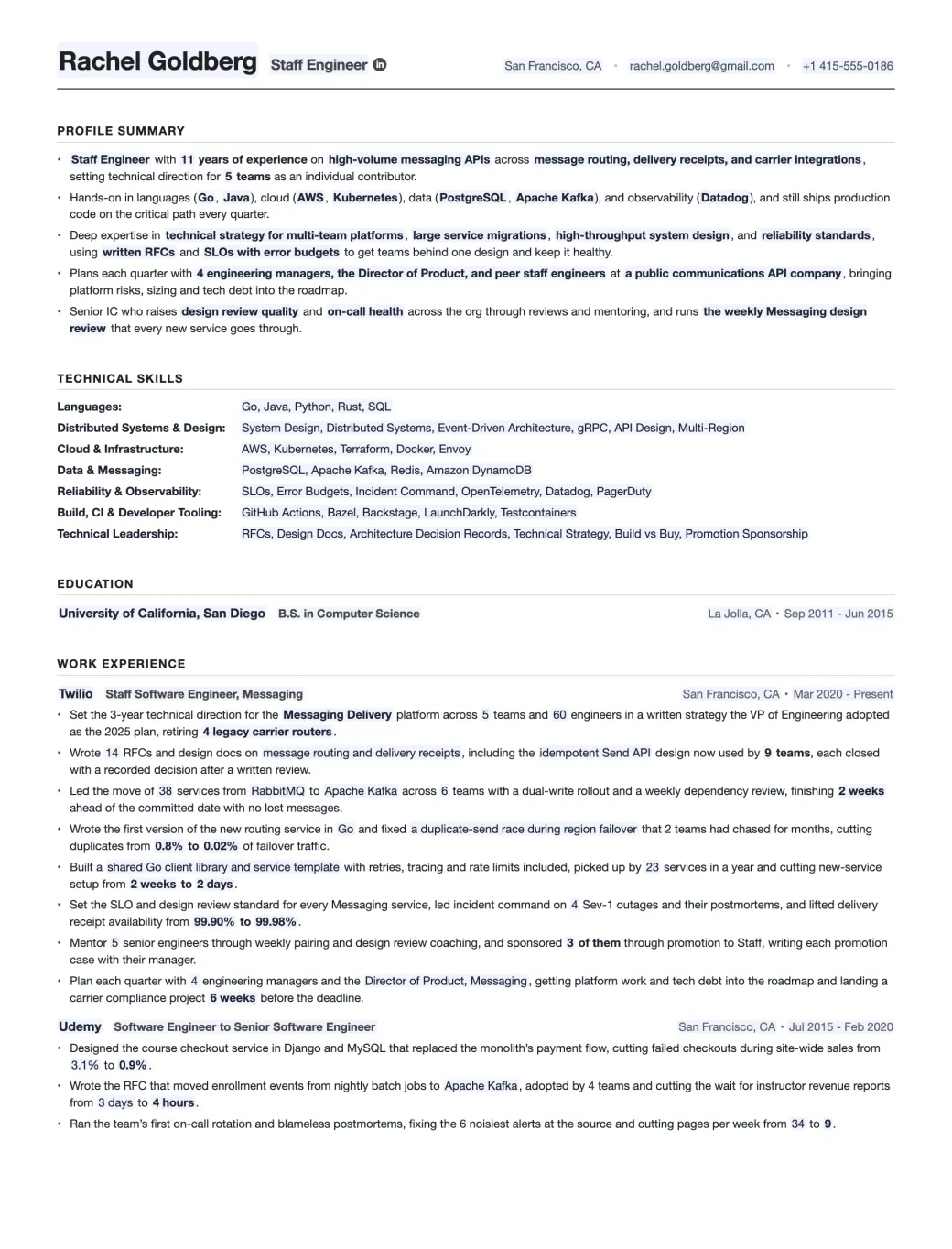
The Staff Engineer resume template filled in for a messaging platform engineer, showing the profile summary, skills, education and work experience
Emmanuel Gendre Ex-Google recruiter / Tech resume writer Updated Free, ATS-friendly, no signup

Interactive resume template generator

Interactive Staff Engineer Resume Template

Fill in the side panel, then download your resume as a PDF or a Word file.

Edits update live as you type. Toggle Edit to rewrite paper text directly.

Edit mode is on. Click anywhere on the resume to rewrite text. Side-panel placeholders still update live.

Rachel Goldberg Staff Engineer

San Francisco, CA • rachel.goldberg@gmail.com • +1 415-555-0186

Profile Summary

  • Staff Engineer with 11 years of experience on high-volume messaging APIs across message routing, delivery receipts, and carrier integrations, setting technical direction for 5 teams as an individual contributor.
  • Hands-on in languages (Go, Java), cloud (AWS, Kubernetes), data (PostgreSQL, Apache Kafka), and observability (Datadog), and still ships production code on the critical path every quarter.
  • Deep expertise in technical strategy for multi-team platforms, large service migrations, high-throughput system design, and reliability standards, using written RFCs and SLOs with error budgets to get teams behind one design and keep it healthy.
  • Plans each quarter with 4 engineering managers, the Director of Product, and peer staff engineers at a public communications API company, bringing platform risks, sizing and tech debt into the roadmap.
  • Senior IC who raises design review quality and on-call health across the org through reviews and mentoring, and runs the weekly Messaging design review that every new service goes through.

Technical Skills

Languages:
Go, Java, Python, Rust, SQL
Distributed Systems & Design:
System Design, Distributed Systems, Event-Driven Architecture, gRPC, API Design, Multi-Region
Cloud & Infrastructure:
AWS, Kubernetes, Terraform, Docker, Envoy
Data & Messaging:
PostgreSQL, Apache Kafka, Redis, Amazon DynamoDB
Reliability & Observability:
SLOs, Error Budgets, Incident Command, OpenTelemetry, Datadog, PagerDuty
Build, CI & Developer Tooling:
GitHub Actions, Bazel, Backstage, LaunchDarkly, Testcontainers
Technical Leadership:
RFCs, Design Docs, Architecture Decision Records, Technical Strategy, Build vs Buy, Promotion Sponsorship

Education

University of California, San Diego B.S. in Computer Science
La Jolla, CA • Sep 2011 - Jun 2015

Work Experience

Twilio Staff Software Engineer, Messaging
San Francisco, CA • Mar 2020 - Present
  • Set the 3-year technical direction for the Messaging Delivery platform across 5 teams and 60 engineers in a written strategy the VP of Engineering adopted as the 2025 plan, retiring 4 legacy carrier routers.
  • Wrote 14 RFCs and design docs on message routing and delivery receipts, including the idempotent Send API design now used by 9 teams, each closed with a recorded decision after a written review.
  • Led the move of 38 services from RabbitMQ to Apache Kafka across 6 teams with a dual-write rollout and a weekly dependency review, finishing 2 weeks ahead of the committed date with no lost messages.
  • Wrote the first version of the new routing service in Go and fixed a duplicate-send race during region failover that 2 teams had chased for months, cutting duplicates from 0.8% to 0.02% of failover traffic.
  • Built a shared Go client library and service template with retries, tracing and rate limits included, picked up by 23 services in a year and cutting new-service setup from 2 weeks to 2 days.
  • Set the SLO and design review standard for every Messaging service, led incident command on 4 Sev-1 outages and their postmortems, and lifted delivery receipt availability from 99.90% to 99.98%.
  • Mentor 5 senior engineers through weekly pairing and design review coaching, and sponsored 3 of them through promotion to Staff, writing each promotion case with their manager.
  • Plan each quarter with 4 engineering managers and the Director of Product, Messaging, getting platform work and tech debt into the roadmap and landing a carrier compliance project 6 weeks before the deadline.
Udemy Software Engineer to Senior Software Engineer
San Francisco, CA • Jul 2015 - Feb 2020
  • Designed the course checkout service in Django and MySQL that replaced the monolith’s payment flow, cutting failed checkouts during site-wide sales from 3.1% to 0.9%.
  • Wrote the RFC that moved enrollment events from nightly batch jobs to Apache Kafka, adopted by 4 teams and cutting the wait for instructor revenue reports from 3 days to 4 hours.
  • Ran the team’s first on-call rotation and blameless postmortems, fixing the 6 noisiest alerts at the source and cutting pages per week from 34 to 9.

Done editing? Download a real PDF (selectable text, ATS-friendly, US Letter) or an editable Word file if a recruiter asks for one.

About this template

A Staff Engineer resume template, built by a tech recruiter.

A Staff Engineer sits above senior on the IC ladder, with nobody reporting to them. The job is technical leadership across a group of teams: picking the direction for the systems they share, writing the RFCs that end long design debates, and running the migrations that cross team lines. Most staff engineers still code a few days a week, usually on the riskiest piece, and spend the rest reviewing designs and coaching senior engineers.

Here’s why so many staff resumes blur together: they use the same verbs a senior engineer would, just with bigger nouns. “Led architecture” and “mentored engineers” show up on almost every one I get. A hiring manager wants evidence that your decisions spread: the teams that built on your design, the migration you closed out, the standard other teams picked up and the engineers you got promoted.

This template makes room for all 4. Rachel’s Twilio job on the paper carries 8 bullets, a bullet for every staff competency, and you can replace her teams and numbers with yours in the side panel. After the 3 samples, read the 6 steps I take on every Staff Engineer resume.

Not sure your draft sounds staff-level yet? I’ll go through it in a free CV review and mark every line that reads as single-team work.

Industry signal

What the market says about Staff Engineer roles

Hiring in 2026 leans hard toward experience, and that works in your favor at staff level. Indeed Hiring Lab counted senior-level postings 14.7% higher in May 2026 than a year earlier, while entry-level jobs were a small sliver of software development postings in Q1. Companies have flattened too: Amazon’s September 2024 memo set a goal of at least 15% more individual contributors per manager across its S-team orgs. Fewer managers means senior ICs make more of the technical calls, and that’s the work staff engineers get hired to do.

69.3% Senior-level share of US software dev job ads Indeed Hiring Lab
$212,812 Average base pay, US staff software engineer ads Indeed

Resume Samples

Staff Engineer Resume Examples

Staff resumes I review tend to undersell the job, and on paper they could be mistaken for a senior engineer’s. I wrote one sample per rung of the ladder, which makes 3 Staff Engineer resume examples. The Staff Engineer sets the direction for rider dispatch at a food delivery company, the Senior Staff Engineer owns simulation compute at a self-driving company, and the Principal Engineer leads payments strategy at Amazon. You can download each one as a PDF or a Word file, free and with no signup.

Staff Engineer Resume Example

A first Staff resume has to answer one question for the hiring manager: does your work reach past your own team? I look for a direction several teams now follow, a migration you took all the way to the end and a hard problem you still solved in the code.

Years of experience
9 years
Industry
Food delivery and logistics
Stack
GoApache KafkaKubernetesPostgreSQL
Download PDF Download Word

Click to download the Staff Software Engineer resume example as a PDF or a Word file. Free / No signup.

Jakub Zieliński

Staff Software Engineer

Berlin, Germany · jakub.zielinski@gmail.com · +49 30 5557 0193 · linkedin.com/in/jakubzielinski

Profile Summary

  • Staff Software Engineer with 9 years in backend and logistics systems, setting the technical direction for order-to-rider assignment at Delivery Hero across 4 teams, with no direct reports.
  • Writes Go and Java on AWS and Kubernetes, with PostgreSQL, Apache Kafka and Redis behind the dispatch services, Terraform for infrastructure and Datadog for monitoring.
  • Strongest in event-driven design, zero-downtime migrations and latency work on hot paths, using short RFCs and load tests to settle a design before any team commits to building it.
  • Plans each quarter with 4 engineering managers, the logistics product lead and the dispatch algorithms team, and represents logistics at the monthly platform architecture review.
  • Mentors 3 senior engineers, wrote the on-call handbook for the logistics teams and runs the monthly Go meetup for engineers across the Berlin office.

Technical Skills

Languages:
Go, Java, Python, SQL
Distributed Systems & Design:
System Design, Event-Driven Architecture, gRPC, Geospatial Indexing (H3), Caching
Cloud & Infrastructure:
AWS (EKS, SQS), Kubernetes, Terraform, Docker
Data & Messaging:
PostgreSQL, Apache Kafka, Redis, Amazon DynamoDB
Reliability & Observability:
SLOs, Incident Command, Datadog, OpenTelemetry, k6
Build, CI & Developer Tooling:
GitHub Actions, Argo CD, Testcontainers
Technical Leadership:
RFCs, Design Docs, Architecture Reviews, Mentoring
Page 2 of 2

Work Experience

Delivery Hero Staff Software Engineer, Logistics Berlin, Germany · Apr 2022 to Present
  • Wrote the RFC that set the 2-year plan for rider dispatch, replacing country-specific assignment code with one shared service that 4 teams build on, and retired 6 legacy services by mid-2025.
  • Led the switch of order-to-rider assignment from database polling to Apache Kafka events across 4 teams, using shadow traffic and country-by-country cutovers to move 11 countries with no missed orders.
  • Rewrote the hot path of the assignment service in Go, swapping per-request geo lookups for an H3 grid cache in Redis, and cut p99 assignment time at dinner peak from 4.2 s to 0.9 s.
  • Set SLOs and alerting rules for the 23 logistics services and took incident command on the worst dispatch outages, bringing Sev-2 incidents down from 12 a quarter to 5.
  • Coach 3 senior engineers through their first cross-team RFCs and design reviews, and co-wrote the promotion cases with their managers that took 2 of them to Staff in 2025.
SoundCloud Backend Engineer to Senior Backend Engineer Berlin, Germany · Jul 2017 to Mar 2022
  • Built a shared Go library for service-to-service auth, retries and timeouts that replaced 4 homegrown clients, and got it into 31 services across the backend teams in a year.
  • Worked with the uploads product manager to split track processing into separate queued stages in Scala, cutting failed uploads from 2.3% to 0.6% of new tracks.
  • Moved the play-count service from one overloaded MySQL host to sharded PostgreSQL, cutting p95 query time for artist dashboards from 1.8 s to 210 ms.

Education

Warsaw University of Technology M.Sc. in Computer Science Warsaw, Poland · Oct 2012 to Jul 2017

Senior Staff Engineer Resume Example

At Senior Staff, the scope grows from a few teams to a whole org. I want to see a multi-year plan that several managers built their roadmaps around, a design other teams reused without being told to, and one number that shows what the org got out of it.

Years of experience
13 years
Industry
Autonomous driving
Stack
C++PythonBazelGoogle Cloud
Download PDF Download Word

Click to download the Senior Staff Software Engineer resume example as a PDF or a Word file. Free / No signup.

Yuki Hamada

Senior Staff Software Engineer

Mountain View, CA · yuki.hamada@gmail.com · +1 650-555-0127 · linkedin.com/in/yukihamada

Profile Summary

  • Senior Staff Software Engineer with 13 years in distributed compute and simulation infrastructure, setting the technical direction for Waymo’s simulation compute platform across 7 teams and about 90 engineers.
  • Builds in C++, Python and Go with Bazel, on Kubernetes and Google Cloud, with Apache Beam batch pipelines, Prometheus and Grafana for monitoring and gRPC between services.
  • Strongest in multi-year technical strategy, scheduling and capacity design for large batch jobs and org-wide migrations, using design docs, cost models and staged rollouts to get 7 teams onto one plan.
  • Works with the directors of simulation and evaluation, 6 engineering managers and the safety teams that depend on the results, and sits on the infrastructure architecture council.
  • Coaches 4 senior and staff engineers, sponsors promotion cases at Staff and Senior Staff, and runs the design doc review that every new simulation service goes through.

Technical Skills

Languages:
C++, Python, Go, SQL
Distributed Systems & Design:
System Design, Distributed Systems, Batch Scheduling, gRPC, Capacity Modeling
Cloud & Infrastructure:
Google Cloud, Kubernetes, Terraform, Docker
Data & Messaging:
Apache Beam, Spanner, Google Cloud Pub/Sub, Apache Parquet
Reliability & Observability:
SLOs, Error Budgets, Prometheus, Grafana, Incident Command
Build, CI & Developer Tooling:
Bazel, GitHub Actions, Remote Build Execution
Technical Leadership:
Technical Strategy, Design Docs, Architecture Reviews, Promotion Sponsorship
Page 2 of 2

Work Experience

Waymo Senior Staff Software Engineer, Simulation Infrastructure Mountain View, CA · Oct 2019 to Present
  • Wrote the 3-year strategy for simulation compute that 7 teams adopted, moving scenario runs from fixed per-team clusters to one shared scheduler and cutting compute cost per simulated mile by 38% in 2 years.
  • Authored the design doc for a deterministic replay format that removed hidden timing from scenario runs, adopted by 5 teams and cutting flaky simulation results from 6% to 0.7%.
  • Led the move of 140 simulation pipelines from a legacy job runner to the shared scheduler across 7 teams, with parallel runs and weekly milestones, and retired the old runner 1 quarter early.
  • Set SLOs and error budgets for the simulation services that release evaluations depend on, cutting evaluations blocked by infrastructure failures from 9 a quarter to 2.
  • Built the 2026 infrastructure plan with the directors of simulation and evaluation and 6 engineering managers, turning a backlog of platform debt into funded work that closed 21 of 26 items.
VMware Senior Member of Technical Staff to Staff Engineer, vSphere Palo Alto, CA · Jul 2013 to Sep 2019
  • Built a shared test harness that simulated full clusters for the vSphere DRS placement code, picked up by 9 teams and cutting integration test runs from 3 hours to 25 minutes.
  • Rewrote VM placement scoring in C++ for clusters of up to 64 hosts, cutting placement time during host maintenance from 9 s to 1.4 s.
  • Mentored 5 engineers through their first design docs as tech lead of the DRS placement team, and 3 of them were promoted to Senior Member of Technical Staff.

Education

University of Michigan B.S.E. in Computer Science Ann Arbor, MI · Sep 2009 to May 2013

Principal Engineer Resume Example

A Principal resume gets read for judgment at company scale. I look for a strategy that crossed organizations, a design that protects money or customers when things fail, and the standards and engineers you leave behind in the org.

Years of experience
17 years
Industry
E-commerce payments
Stack
JavaAWSAmazon DynamoDBAmazon Aurora
Download PDF Download Word

Click to download the Principal Engineer resume example as a PDF or a Word file. Free / No signup.

Rohan Deshpande

Principal Engineer

Seattle, WA · rohan.deshpande@gmail.com · +1 206-555-0158 · linkedin.com/in/rohandeshpande

Profile Summary

  • Principal Engineer with 17 years in payments and large-scale storage systems, setting technical direction for checkout payment services at Amazon across 14 teams in 3 organizations.
  • Works in Java and Rust on AWS (Amazon DynamoDB, SQS, Lambda, ECS), with Aurora PostgreSQL for ledgers, Amazon Kinesis for payment events and CloudWatch for monitoring.
  • Strongest in multi-year technical strategy, correctness for money-moving systems and org-wide data migrations, using written narratives, tenets and correction-of-error reviews to make decisions hold across teams.
  • Partners with 2 directors, 9 engineering managers and the payments product leads on the 3-year plan, and reviews designs for other payment orgs through the principal engineering community.
  • Chairs the weekly payments operational review, mentors 6 senior and principal-track engineers and sponsors promotion cases to Principal.

Technical Skills

Languages:
Java, Rust, Python, C++, SQL
Distributed Systems & Design:
System Design, Idempotency, Double-Entry Ledgers, Event-Driven Architecture, Multi-Region
Cloud & Infrastructure:
AWS (Lambda, ECS, SQS), AWS CDK, Docker
Data & Messaging:
Amazon DynamoDB, Amazon Aurora PostgreSQL, Amazon Kinesis, Redis
Reliability & Observability:
SLOs, Correction of Error Reviews, Amazon CloudWatch, AWS X-Ray, Load Testing
Build, CI & Developer Tooling:
AWS CodePipeline, Fault Injection Testing, Feature Flags
Technical Leadership:
Technical Strategy, Written Narratives, Design Reviews, Build vs Buy, Promotion Sponsorship
Page 2 of 2

Work Experience

Amazon Principal Engineer, Payments Seattle, WA · Aug 2016 to Present
  • Wrote the 3-year technical strategy for checkout payments that 14 teams in 3 organizations adopted, folding 5 separate card authorization paths into 1 idempotent service by 2025.
  • Designed a double-entry payments ledger on Aurora PostgreSQL and Amazon DynamoDB, reviewed with 3 principal engineers and finance, cutting daily reconciliation breaks from about 1,200 to under 40.
  • Led the move of 62 services off a shared Oracle payments database onto stores each team owns, using dual writes and reversible cutovers, with no Sev-1 incident during the switch.
  • Built the retry and idempotency layer for card authorizations in Java and tuned it in peak-event load tests, holding p99 latency at 310 ms under 4 times normal traffic.
  • Made the case with 2 directors and 9 engineering managers to fund ledger and fraud platform work in the 3-year plan, which cut payment-related customer contacts by 27%.
Microsoft Software Engineer to Senior Software Engineer, Azure Storage Redmond, WA · Jul 2009 to Jul 2016
  • Built a fault-injection library for the blob storage front end and made it part of every team’s release checklist, catching 40+ failover bugs before release in its first year.
  • Redesigned metadata caching in C++ for the blob front end, cutting p99 read latency for small blobs from 48 ms to 19 ms.
  • Mentored 6 engineers as tech lead of the blob front-end team, and 4 of them were promoted to Senior Software Engineer.

Education

Indian Institute of Technology Bombay B.Tech. in Computer Science and Engineering Mumbai, India · Jul 2005 to May 2009

Free resume review

A recruiter screen, but with feedback

You applied to hundreds of jobs: no result. Companies won’t give you feedback, so you’re stuck in a loop. Rejections will keep coming until you know what’s wrong.

Let’s break this cycle today!

I’ll screen your resume the same way I did at Google.

You’ll get:

  • Your resume sections and content scored.
  • A clear list of what to improve, why, and how.
  • Behind the scenes secrets on the screening process.

How I rewrite Staff Engineer resumes

How to write a Staff Engineer resume

Emmanuel Gendre, ex-Google recruiter

Emmanuel Gendre Ex-Google recruiter, tech resume writer

Staff engineer resumes cross my desk constantly, and the first thing I check is whether the work ever leaves the team. I learned that habit in 13 years of recruiting, many spent inside Google. On most drafts, the work doesn’t leave the team, at least on paper. You’ll see “drove technical excellence across the org” from someone who moved 38 services to Kafka, and the hiring manager never hears about the 38 services.

When I rewrite one as a technical resume writer, the numbers go back in first: how many teams, which RFCs got adopted, what the migration moved and when it finished. If you’re doing it yourself, though, focus on these 6 steps. I pulled an example for every step from the staff template above.

  1. Step 1 Format & layout Parser-safe layout, plain section names, and a PDF first. Go to step 1
  2. Step 2 Profile Summary 5 summary lines that make your cross-team reach obvious. Go to step 2
  3. Step 3 Work Experience Your current role, covering the 8 staff competencies bullet by bullet. Go to step 3
  4. Step 4 Bullet Points 5 rounds of detail between a bare task and a measured result. Go to step 4
  5. Step 5 Technical Skills 7 skill rows with stars on the essentials, then 5 soft skills. Go to step 5
  6. Step 6 Keywords & Metrics Keywords to mirror from the posting, and 24 metrics to pick from. Go to step 6

Step 1 · Format & Layout

Staff Engineer resume format and layout

Let’s get the mechanical part done first. Your file gets parsed by software, and then the first person to look at it decides your level in seconds. A clean layout, the right file type and 3 ATS rules take care of both.

01ATS Compliance

ATS compliance for your Staff Engineer resume

Big tech or Series B startup, your application ends up in an Applicant Tracking System (ATS). It chops the resume into labeled pieces (title, company, dates, skill list), and 6 months on, a recruiter searching for a staff engineer who knows Kafka queries those pieces. Tables and side-by-side columns often get the chopping wrong, so the job that matters most might be stored as something else. Here’s the way an ATS splits a resume into fields, if you’d like the full picture. For a staff resume, my advice comes down to 3 rules:

The 3 rules
  1. Use a 100% text based format (no Canva!)

  2. Avoid tables, pictures, and complex structures.

  3. Use the most predictable section names, like “Profile Summary” and “Work Experience”

02Design & Layout

Staff Engineer resume design and layout

If my time at Google taught me anything about resume layout, it’s that recruiters hate fancy designs. Somebody working a staff search reads resume after resume all morning, and they want every resume to put the same facts in the same place. Skill meters, logos and colored side panels slow them down on the one question that matters for staff roles: how big was your scope?

Pick a boring, predictable format and let the systems you changed do the impressing. Nobody on a staff panel’s going to remember your font. Making your own version? These specs come straight from the template.

Layout Spec
Columns
One. No sidebars, tables, columns, pictures or tabs.
Margins
0.7 in on all four sides
Body size
10 to 11 pt
Type
One family, weight for hierarchy
Length
One page under 5 years, two after
Section order
Summary, Skills, Experience, Education
PDF

03File Format

Resume file format for your Staff Engineer resume

Nearly every time, the file you’ll want for a staff resume is a PDF. Every recruiter, hiring manager and ATS sees the same page, and nothing moves around when someone opens it on a phone. Export from Word or Google Docs (never Canva) so the text stays selectable. Keep a Word copy for agencies, a few of which copy your resume into a branded layout of their own. My PDF or Word breakdown for resumes covers the rare exceptions.

Format Guide
PDF
Your default. Layout holds, text stays selectable.
Word (.docx)
When the posting or a recruiter asks for it. Use the Word download above.
Plain text
For portals that make you paste into a box
Never
Images, scans, password-protected PDFs, shared-drive links
File name
Rachel-Goldberg-Staff-Engineer.pdf

Step 2 · Profile Summary

Staff Engineer profile summary

A staff resume without a profile summary throws away its best line. If anything, the summary carries more weight here than at any other level. The first screen lasts a few seconds (here’s how recruiters split their screening into 2 rounds), and they mostly go to your summary. If it doesn’t make clear that several teams depend on your work, you’ll get grouped with senior engineers.

I give every bullet its own task. Read together, the 5 should tell a recruiter how wide your work goes, what you’re hands-on with and which partners you plan with, all before they scroll. Below are the 5 tasks, followed by the summary Rachel has in the template.

  1. 1

    Title, years and scope

    Put your target title and your years first, then what systems you own and how many teams build on top of them. Saying you’re an individual contributor helps: it tells the recruiter you picked the IC track on purpose.

  2. 2

    Your stack

    Your hands-on stack in groups: cloud (AWS, Kubernetes), languages (Go, Java), data (PostgreSQL, Kafka). Expect a coding round and a system design round at staff level, so only list what you’d happily get grilled on.

  3. 3

    Domain expertise

    The problems people bring to you (strategy, migrations, system design, reliability) and how you handle them, through written RFCs or SLOs for example. Hiring managers use this line to picture which projects would land on your desk in month one.

  4. 4

    Collaboration

    Who you plan with (engineering managers, product, fellow staff engineers) and the forums you attend: quarterly planning, architecture reviews, incident reviews. Staff engineers get results through influence, not authority, and recruiters look for signs you’ve figured that out.

  5. 5

    Leadership

    The habits and people you leave in place: a design review you run, a standard teams follow, senior engineers who grew under you. This bullet proves teams improve when you’re around, which counts for more at staff level than your own commits.

Staff Engineer resume summary example, from the template above
  • Staff Engineer with 11 years of experience on high-volume messaging APIs across message routing, delivery receipts, and carrier integrations, setting technical direction for 5 teams as an individual contributor.
  • Hands-on in languages (Go, Java), cloud (AWS, Kubernetes), data (PostgreSQL, Apache Kafka), and observability (Datadog), and still ships production code on the critical path every quarter.
  • Deep expertise in technical strategy for multi-team platforms, large service migrations, high-throughput system design, and reliability standards, using written RFCs and SLOs with error budgets to get teams behind one design and keep it healthy.
  • Plans each quarter with 4 engineering managers, the Director of Product, and peer staff engineers at a public communications API company, bringing platform risks, sizing and tech debt into the roadmap.
  • Senior IC who raises design review quality and on-call health across the org through reviews and mentoring, and runs the weekly Messaging design review that every new service goes through.

Step 3 · Work Experience

Staff Engineer work experience

This is where the second, slower read happens. Every job gets attention this time, from the recruiter and from whoever you’d report to, usually a director or a principal engineer. Still, the job you have now decides most of it.

There’s a good reason for that, since no other job on the page shows as clearly the scope you’re ready for. So spread its bullets across the whole staff engineer role profile (the areas recruiters score you on), one competency per bullet. Skip mentoring or the migration, and a reader will guess your manager handled it. I’ve put the 8 cards in roughly the order recruiters look for them.

Staff Engineer role profile
  1. Technical Direction Across Teams

    You decide where several teams’ systems should be a few years out. When nobody holds that picture, each team patches its own corner and the platform drifts apart, so hiring managers want a direction that other teams actually followed. Show how you used a technical strategy doc and a retirement list for old systems to get several teams building toward one plan.

    Techniques
    technical strategy docs, tech radar, deprecation plans, investment cases
    Tools
    Google Docs, Confluence, Notion, Miro
    Metrics
    teams on the plan, systems retired, roadmap items delivered
  2. RFCs & Design Docs That Get Adopted

    You write the documents that settle how hard problems get solved. A design doc nobody builds on isn’t worth much, and staff loops often ask you to walk through one, so recruiters want adoption, not page counts. Let them know how you used decision records and RFC reviews to turn a contested design into one other teams built.

    Techniques
    RFCs, design reviews, decision records, tradeoff tables
    Tools
    Google Docs, Confluence, GitHub, Excalidraw
    Metrics
    RFCs approved, teams adopting a design, time to decision
  3. Cross-Team Projects & Migrations

    You lead the projects that span teams and that nobody else owns end to end. Big migrations often stall at 80%, and a hiring manager knows it’s rare to find a staff engineer who finishes them. Describe how you used shadow traffic and a weekly dependency review to move every service across and turn the old system off.

    Techniques
    phased rollouts, dual writes, shadow traffic, dependency tracking
    Tools
    Jira, LaunchDarkly, Argo CD, Terraform
    Metrics
    services migrated, weeks ahead or behind, legacy systems shut down
  4. Hands-On Work on Critical Systems

    You keep your hands on the code the riskiest parts of a system depend on. Staff loops include coding and deep system design rounds, and a resume with no hands-on work makes the panel wonder whether you can still do it. Point out how you used flame graphs and a prototype to fix a bug or a bottleneck other engineers couldn’t crack.

    Techniques
    prototyping, profiling, load testing, root-cause debugging
    Tools
    pprof, perf, k6, Datadog APM
    Metrics
    p99 latency, throughput per node, bug recurrence
  5. Shared Tooling & Paved Roads

    You build the libraries and templates that make other engineers faster. One good shared library can save dozens of teams the same week of work, and that’s the staff-level impact a hiring manager wants to see. Mention how you used golden paths and a shared client library to get teams adopting them by choice.

    Techniques
    service templates, shared libraries, golden paths, CI pipelines
    Tools
    Backstage, GitHub Actions, Bazel, Testcontainers
    Metrics
    services adopting, new-service setup time, build time
  6. Engineering Standards & Reliability

    You set the bar for how code gets reviewed, tested and run in production. When a key system goes down at 2 a.m., it’s often the staff engineer running the call, and recruiters check that you’ve run one. Tell them how you used error budgets and postmortem reviews to bring repeat incidents down across the services you cover.

    Techniques
    incident command, SLOs, error budgets, postmortems, review standards
    Tools
    Datadog, PagerDuty, OpenTelemetry, Prometheus
    Metrics
    availability, Sev-1 and Sev-2 counts, repeat incidents
  7. Mentoring Senior Engineers

    You help senior engineers grow into the next level. Companies can’t hire enough staff engineers, so they expect you to grow a few, and promotion results are the proof a hiring manager trusts. Detail how you used pairing on hard problems and design review coaching to get senior engineers promoted.

    Techniques
    design review coaching, pairing, promotion cases, interview calibration
    Tools
    Google Docs, GitHub, Lattice, Greenhouse
    Metrics
    engineers mentored, promotions sponsored, interviewers trained
  8. Partnering with Managers & Product

    You work as the technical partner to engineering managers and product. Roadmaps that ignore tech debt blow up a year later, and a director wants someone who can explain that risk before it bites. Explain how you used sizing estimates and a written tradeoff memo to get platform work funded next to features.

    Techniques
    build vs buy, quarterly planning, sizing, tradeoff memos
    Tools
    Productboard, Jira, Google Slides, Confluence
    Metrics
    platform work funded, deadlines met, tech debt closed

A single job with 8 bullets might look like overkill. For staff resumes, it isn’t: the screen here is about reach, and nobody counts lines. Every bullet does need specifics and a number, though, and the next step is all about that.

Submit your resume for a free review!

Step 4 · Bullet Points

Staff Engineer resume bullet points

On my staff rewrites, the bullets take the longest by a wide margin, which is why I use a fixed method, the Level System. It starts with Google’s XYZ formula, then adds 3 things most staff engineers never write down: the techniques, the tools and the method. The details are in this article on writing bullet points for tech resumes.

You start from the task alone, then layer on techniques, tools and method, one per level, and finish on the result. For staff work, the closing number should prove the work crossed team lines: services moved, teams that adopted something, incidents avoided. Here’s Rachel’s Kafka migration bullet, from bare task to finished line.

  1. Level 1Task

    What did I work on? Start with one project you saw through to the end. On its own it’s just a task, and it doesn’t show scope yet.

    Led the move of 38 services to a new message queue.

  2. Level 2+ Techniques

    How did I do it? Add the techniques. They tell a hiring manager how you got 6 teams to move, not just that they moved.

    Led the move of 38 services to a new message queue across 6 teams with dual writes and a weekly dependency review.

  3. Level 3+ Tools

    What tools did I use? List the real systems. Recruiters search for them, and staff engineers leave them out more than anyone.

    Led the move of 38 services from RabbitMQ to Apache Kafka across 6 teams with dual writes and a weekly dependency review.

  4. Level 4+ Method

    What method did I follow? Add the rollout method behind the work. It shows the clean finish was planned, not lucky.

    Led the move of 38 services from RabbitMQ to Apache Kafka across 6 teams with dual writes and a weekly dependency review, cutting over one service group at a time behind feature flags.

  5. Level 5+ Metric

    What was the result? End on one number. For staff work, pick one that shows the whole project landed, not just your part.

    Led the move of 38 services from RabbitMQ to Apache Kafka across 6 teams with dual writes and a weekly dependency review, cutting over one service group at a time behind feature flags, finishing 2 weeks ahead of the committed date.

    1. 01 Task What you worked on
    2. 02 Techniques How you did it
    3. 03 Tools The stack you used
    4. 04 Method The method you followed
    5. 05 Metric The result, one number

Staff engineers usually have these numbers lying around: the migration tracker, RFC approval threads, SLO dashboards, the promotion cases they co-wrote. The gap I fix most often is a bullet that describes the project and stops there. Add the result and it’ll read like staff work.

Step 5 · Technical Skills

Staff Engineer resume skills

Recruiters screening staff resumes check for system design and distributed systems first. After that come your languages, cloud and data stack, reliability work like SLOs and incident command, and the written side: RFCs, design docs, architecture reviews. Mirror the job ad’s phrasing exactly, because an ATS compares strings, not meaning.

Keep it short. Your skills section works as an index, so every skill on it needs a matching bullet in your experience. This step covers the 7 categories I use on staff resumes, the finished rows from Rachel’s template and 5 soft skills that need proof in the experience section. Keywords get their own step next.

The 7 skill categories for a Staff Engineer resume

Starred items show up in most of the staff job ads I go through, so put them at the front of each row. Place the section right after the summary, above your experience.

Languages

The languages you’d write production code in tomorrow. Lead with your main one, and drop anything you haven’t touched in years.

GoJavaPythonRustTypeScriptC++SQL

Distributed Systems & Design

This row carries the most weight. System design and distributed systems go first, then the patterns you’ve built with, like event-driven designs or gRPC.

System DesignDistributed SystemsEvent-Driven ArchitecturegRPCAPI DesignCachingMulti-Region

Cloud & Infrastructure

Where your systems run. Put the cloud provider first, followed by the compute and infrastructure tools you could defend in a design review.

AWSKubernetesGoogle CloudTerraformDockerEnvoy

Data & Messaging

The stores and streams behind your services. Lead with the ones you’ve migrated or scaled, not the ones you’ve only queried.

PostgreSQLApache KafkaRedisApache CassandraAmazon DynamoDBSpanner

Reliability & Observability

How you keep systems up across teams. SLOs and incident command come first, then your monitoring and tracing stack.

SLOsIncident CommandError BudgetsOpenTelemetryPrometheusGrafanaDatadog

Build, CI & Developer Tooling

The tooling you’ve built or improved for other engineers, like CI pipelines, build systems or a developer portal.

GitHub ActionsBazelBackstageArgo CDLaunchDarklyTestcontainers

Technical Leadership

The written side of the job. RFCs and design docs first, then decision records, architecture reviews and the promotions you sponsor.

RFCsDesign DocsArchitecture Decision RecordsArchitecture ReviewsTechnical StrategyBuild vs BuyPromotion Sponsorship

A finished Staff Engineer skills section

Technical Skills sample, from the template above
Languages
Go, Java, Python, Rust, SQL
Distributed Systems & Design
System Design, Distributed Systems, Event-Driven Architecture, gRPC, API Design, Multi-Region
Cloud & Infrastructure
AWS, Kubernetes, Terraform, Docker, Envoy
Data & Messaging
PostgreSQL, Apache Kafka, Redis, Amazon DynamoDB
Reliability & Observability
SLOs, Error Budgets, Incident Command, OpenTelemetry, Datadog, PagerDuty
Build, CI & Developer Tooling
GitHub Actions, Bazel, Backstage, LaunchDarkly, Testcontainers
Technical Leadership
RFCs, Design Docs, Architecture Decision Records, Technical Strategy, Build vs Buy, Promotion Sponsorship

Soft skills for a Staff Engineer resume

Putting “influence without authority” on a skills line doesn’t prove you have it. A result does. Staff interviewers dig into these 5 more than any others, and every one below comes with a sample bullet.

  • Changing a team’s mind with a written argument

    Resume bulletArgued in a 4-page tradeoff doc against adding a second message queue, and the 3 teams pushing for it agreed to extend Kafka instead.

  • Talking a team out of a rewrite they don’t need

    Resume bulletShowed with profiling data that 2 slow queries caused the billing service’s latency, which saved a planned 2-quarter rewrite.

  • Handing a senior engineer the project you’d enjoy leading

    Resume bulletGave a senior engineer the lead on the routing redesign and coached her through it. It shipped on time, and she made Staff 8 months later.

  • Pushing back on a director’s plan with data

    Resume bulletUsed load test results to show a Q3 launch plan needed 40% more capacity, and moved it to a phased launch that hit every date.

  • Writing a one-page summary an executive will read

    Resume bulletBoiled a 20-page migration RFC down to 1 page for the VP of Engineering, and the project got funded in one meeting.

Step 6 · Keywords & Metrics

Staff Engineer resume keywords and metrics

Run this check last, right before you hit submit. Keywords are the terms software filters and recruiters search on, phrases like “technical direction” or “system design”, so copy the wording of the posting you’re applying to. Metrics back up each bullet, and on a staff resume they should describe something bigger than your own team.

You’ll get staff keywords ranked must-have to bonus, a finder you can run on any posting, and 24 metrics, 3 per area, with an example bullet beside each one.

+42%

Staff Engineer resume keywords, ranked

Each keyword opens the phrasing a staff posting would typically use. Wording changes between companies, so train your eye on the underlying skill.

Must-have

8

Put each of these in your summary or skills rows, then back it up again in a bullet that has a number.

In a job description“Deep system design expertise across large distributed services”

Strong supporting

10

Add the ones you can back up with real work, both in your skills rows and in the bullets where you used them.

In a job description“Expert in at least one of Go, Java or Python”

Bonus

7

Nice to have. Include them when they’re true and the posting brings them up.

In a job description“Write the multi-year technical strategy for your domain”

Extract Staff Engineer keywords from a job description

Have a staff posting you’re eyeing? Paste the full text below, even when the title reads Staff Software Engineer, Senior Staff or Lead Engineer. The finder groups its system design, stack and leadership terms by tier and points out what your resume is missing.

Must-have
Put these in your skills section and back each one with a bullet.
Strong supporting
Add the ones you’ve actually worked with. Skip the rest.

Nothing is uploaded: it all happens in your browser.

Metrics for a Staff Engineer resume

A bullet only needs one metric. Each staff area has 3 options, and the example bullets all come from Rachel’s messaging platform.

MetricExample bullet
Technical direction
Teams on the plan Count How many teams build toward the technical strategy you wrote.Wrote the 3-year platform strategy that 5 teams and about 60 engineers now plan their quarters around.
Legacy systems retired Count Old systems switched off because of the direction you set.Retired 4 legacy carrier routers under the routing strategy and moved their traffic to one shared service.
Milestones delivered Count Milestones in your plan that shipped on schedule.Delivered 9 of 11 milestones in year one of the platform strategy, and the other 2 moved by agreement.
RFCs & design docs
RFCs approved Count Design docs or RFCs that reached a recorded decision.Wrote 14 RFCs on routing and delivery receipts in 2 years, each closed with a recorded decision.
Teams adopting a design Count Teams that built on a design you wrote.Designed the idempotent Send API that 9 teams now call instead of writing their own retry logic.
Time to decision Time How long an RFC takes from first draft to a decision.Cut the average RFC review from 5 weeks to 12 days with a 1-page summary and a fixed review date.
Migrations
Services migrated Count Services moved to the new system by the end of the project.Moved 38 services from RabbitMQ to Apache Kafka across 6 teams with no lost messages.
Finish vs committed date Time How far ahead of or behind the committed date the project finished.Finished the queue migration 2 weeks ahead of the date committed in quarterly planning.
Cutover incidents Count Customer-facing incidents caused by the migration.Ran 9 group cutovers for the Kafka move with 0 Sev-1 incidents during the switch.
Hands-on work
Error rate on a hard bug Percent How often the bug you fixed showed up, before and after.Fixed a duplicate-send race in region failover, cutting duplicates from 0.8% to 0.02% of failover traffic.
p99 latency Time The slowest 1% of requests on the path you rewrote.Rewrote the routing hot path in Go, cutting p99 send latency from 480 ms to 140 ms.
Throughput per node Count Requests or messages one instance handles at peak.Raised messages per routing node from 9,000 to 26,000 a second after removing a lock on the hot path.
Shared tooling
Services adopting Count Services or teams using the library or template you built.Built a shared Go client library that now runs in 23 services, all picked up without a mandate.
New-service setup time Time Time from a new repo to a service in production.Cut new-service setup from 2 weeks to 2 days with a service template that includes CI, tracing and alerts.
CI build time Time How long the main build and test pipeline takes.Moved the Messaging monorepo to cached CI jobs, cutting build time from 34 to 11 minutes.
Standards & reliability
Availability Percent Share of time a key service met its SLO.Lifted delivery receipt availability from 99.90% to 99.98% after setting SLOs for every Messaging service.
Sev-1 incidents Count High-severity outages per quarter or per year.Cut Sev-1 outages on Messaging from 7 a year to 2 after leading incident command and the postmortems.
Repeat incidents Percent Share of incidents with the same root cause as an earlier one.Brought repeat incidents down from 31% to 8% by tracking every postmortem action item to done.
Mentoring
Promotions sponsored Count Engineers you sponsored through a promotion.Sponsored 3 senior engineers through promotion to Staff, writing each case with their manager.
Engineers mentored Count Senior engineers you meet with on a regular schedule.Mentor 5 senior engineers through weekly pairing sessions and design review coaching.
Interviewers trained Count Engineers you trained to run system design interviews.Trained 14 engineers to run the staff system design interview with a shared scoring guide.
Managers & product
Platform work funded Percent Share of team capacity set aside for platform work and tech debt.Got 20% of capacity on 5 teams set aside for platform work in the 2026 plan.
Deadline margin Time How far ahead of a hard outside deadline a project landed.Landed the carrier compliance project 6 weeks before the deadline, planned with 4 engineering managers.
Tech debt closed Count Debt items on the roadmap that got closed.Closed 17 of 22 tech debt items agreed with the Director of Product over 3 quarters.

What if you don’t have exact numbers?

  • 1

    Check the places that already count things. Migration trackers, RFC approvals, SLO dashboards, incident reports and the promotion cases you helped write already hold the counts most staff bullets need.

  • 2

    An honest estimate beats no number. “Around 40 services” or “5 or 6 teams” is fine on a staff resume if you can back up the count when an interviewer asks.

  • 3

    Use reach when the result is hard to measure. The teams that adopted your design, the services running your library and the engineers you mentored still show a hiring manager how far your work’s gone.

Free resume review

A recruiter screen, but with feedback

You applied to hundreds of jobs: no result. Companies won’t give you feedback, so you’re stuck in a loop. Rejections will keep coming until you know what’s wrong.

Let’s break this cycle today!

I’ll screen your resume the same way I did at Google.

You’ll get:

  • Your resume sections and content scored.
  • A clear list of what to improve, why, and how.
  • Behind the scenes secrets on the screening process.

Frequently asked

Staff Engineer resume FAQ

Free, yes, and you won’t need an account. Work through the side panel, download your resume, and bookmark the page for your next update.

Yes. You’ll find 2 Word buttons, one above the paper and one below it, and both give you a .docx you can edit anywhere. Some agencies want Word so they can adjust the format before forwarding you. Jakub, Yuki and Rohan’s resumes have Word versions as well.

It is. Everything is plain text in a single column with the 4 headings ATS software expects (Profile Summary, Technical Skills, Education, Work Experience), and there are no graphics or tables to trip up Greenhouse, Ashby or Workday. If you change the layout, check the PDF with my free ATS scan for resumes before you apply.

Usually 2 pages, which is normal for staff engineers. Your current job needs all 8 bullets, so shrink the early-career roles to a couple of lines each instead. My rules on tech resume length go into more detail.

Very little. Staff postings ask for scope and judgment, and a certificate doesn’t prove either one. If you hold a cloud certification like AWS Solutions Architect Professional, one line under Education is plenty. Spend the space on adoption numbers and the migrations you finished.

Numbers that show reach past your own team: teams that adopted your design, services migrated, systems retired, availability before and after, setup time saved for other teams and engineers you helped promote. Step 6 lists 3 staff metrics for each area, all with an example bullet.

Use the tech lead resume template if your work is mostly inside one team: its sprints, its delivery, its code. A staff resume covers several teams and the direction they share. The software architect resume template leans on architecture decisions and reviews, while staff bullets show more hands-on code and finished migrations. And if you have direct reports, switch to the engineering manager resume template.

Yes, if your work already reaches past your team. Maybe you wrote the RFC 3 teams follow, or led a migration other teams depended on. Write those bullets at staff scope, and don’t inflate the areas you haven’t touched yet. Jakub’s Staff example above is the closest model.

It does, because the 8 areas don’t change at Principal. Only the scope grows: an org or a whole company instead of a few teams, and a multi-year strategy instead of a 1-year plan. Change the title, then look at Rohan’s Principal example above to see how the bullets read at that level.

No. Hiring managers have no idea which site a layout comes from, and it wouldn’t matter to them anyway. The real damage comes from a staff resume full of “drove alignment” and “owned architecture” with no teams, systems or numbers attached. This template leaves no space for those lines.

More resources

More help with your Staff Engineer resume