
Technical Artist Resume Examples & Free Template (PDF, Word)

Swap your work into Nia’s free technical artist template, built on her shaders, Houdini tools and Unreal pipeline at Obsidian. Below that sit tech art resumes from Ludia, MercurySteam and Remedy, and how I’d write yours in 6 steps, from the screening side at Google.

4.9 5.0
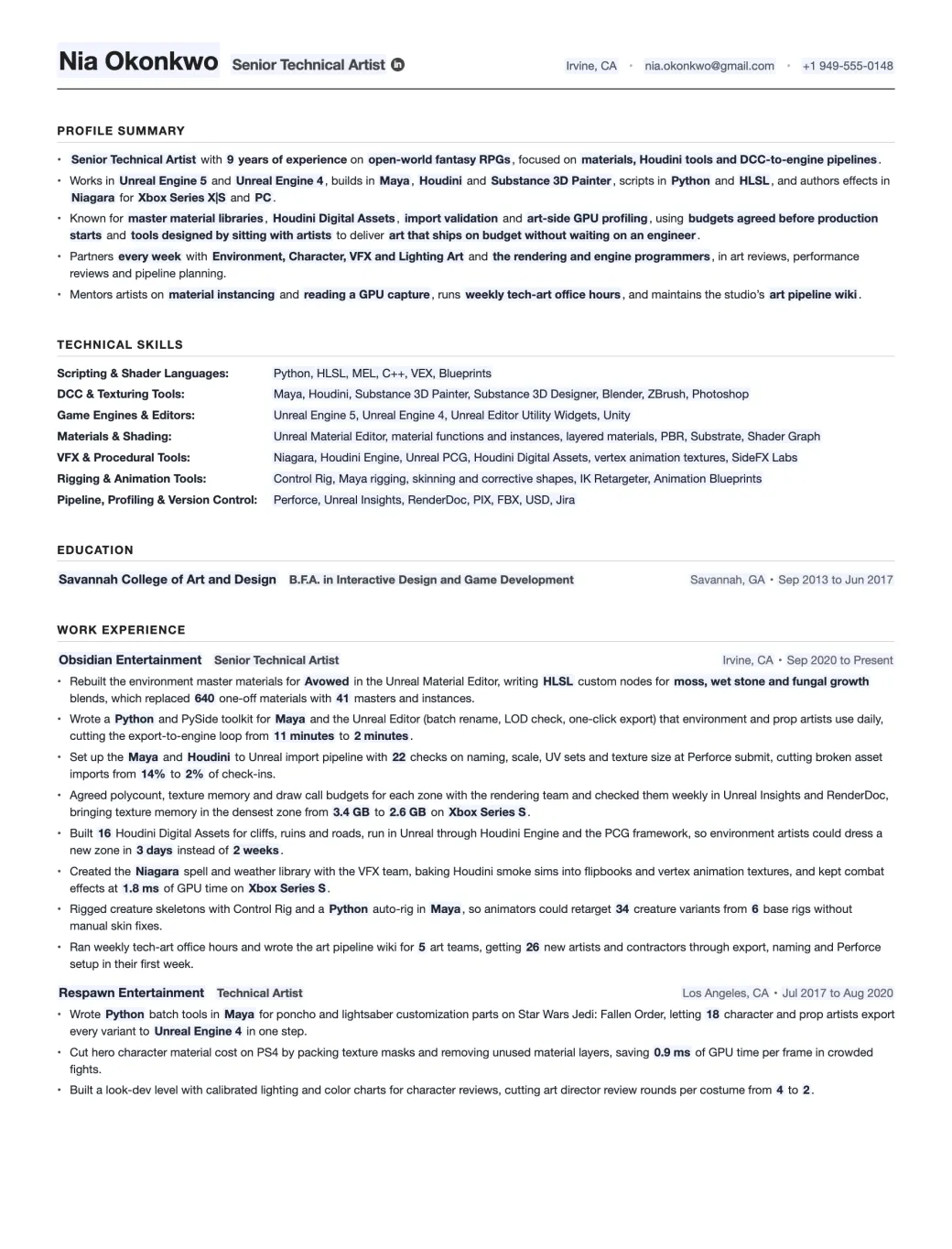
Nia Okonkwo’s technical artist resume in the template: profile summary, skills rows and bullets on materials, Houdini tools, asset budgets and rigging
Emmanuel Gendre Ex-Google recruiter / Tech resume writer Updated Free, ATS-friendly, no signup

Interactive resume template generator

Interactive Technical Artist Resume Template

Fill in the side panel, then download your resume as a PDF or a Word file.

Edits update live as you type. Toggle Edit to rewrite paper text directly.

Edit mode is on. Click anywhere on the resume to rewrite text. Side-panel placeholders still update live.

Nia Okonkwo Senior Technical Artist

Irvine, CA • nia.okonkwo@gmail.com • +1 949-555-0148

Profile Summary

  • Senior Technical Artist with 9 years of experience on open-world fantasy RPGs, focused on materials, Houdini tools and DCC-to-engine pipelines.
  • Works in Unreal Engine 5 and Unreal Engine 4, builds in Maya, Houdini and Substance 3D Painter, scripts in Python and HLSL, and authors effects in Niagara for Xbox Series X|S and PC.
  • Known for master material libraries, Houdini Digital Assets, import validation and art-side GPU profiling, using budgets agreed before production starts and tools designed by sitting with artists to deliver art that ships on budget without waiting on an engineer.
  • Partners every week with Environment, Character, VFX and Lighting Art and the rendering and engine programmers, in art reviews, performance reviews and pipeline planning.
  • Mentors artists on material instancing and reading a GPU capture, runs weekly tech-art office hours, and maintains the studio’s art pipeline wiki.

Technical Skills

Scripting & Shader Languages:
Python, HLSL, MEL, C++, VEX, Blueprints
DCC & Texturing Tools:
Maya, Houdini, Substance 3D Painter, Substance 3D Designer, Blender, ZBrush, Photoshop
Game Engines & Editors:
Unreal Engine 5, Unreal Engine 4, Unreal Editor Utility Widgets, Unity
Materials & Shading:
Unreal Material Editor, material functions and instances, layered materials, PBR, Substrate, Shader Graph
VFX & Procedural Tools:
Niagara, Houdini Engine, Unreal PCG, Houdini Digital Assets, vertex animation textures, SideFX Labs
Rigging & Animation Tools:
Control Rig, Maya rigging, skinning and corrective shapes, IK Retargeter, Animation Blueprints
Pipeline, Profiling & Version Control:
Perforce, Unreal Insights, RenderDoc, PIX, FBX, USD, Jira

Education

Savannah College of Art and Design B.F.A. in Interactive Design and Game Development
Savannah, GA • Sep 2013 to Jun 2017

Work Experience

Obsidian Entertainment Senior Technical Artist
Irvine, CA • Sep 2020 to Present
  • Rebuilt the environment master materials for Avowed in the Unreal Material Editor, writing HLSL custom nodes for moss, wet stone and fungal growth blends, which replaced 640 one-off materials with 41 masters and instances.
  • Wrote a Python and PySide toolkit for Maya and the Unreal Editor (batch rename, LOD check, one-click export) that environment and prop artists use daily, cutting the export-to-engine loop from 11 minutes to 2 minutes.
  • Set up the Maya and Houdini to Unreal import pipeline with 22 checks on naming, scale, UV sets and texture size at Perforce submit, cutting broken asset imports from 14% to 2% of check-ins.
  • Agreed polycount, texture memory and draw call budgets for each zone with the rendering team and checked them weekly in Unreal Insights and RenderDoc, bringing texture memory in the densest zone from 3.4 GB to 2.6 GB on Xbox Series S.
  • Built 16 Houdini Digital Assets for cliffs, ruins and roads, run in Unreal through Houdini Engine and the PCG framework, so environment artists could dress a new zone in 3 days instead of 2 weeks.
  • Created the Niagara spell and weather library with the VFX team, baking Houdini smoke sims into flipbooks and vertex animation textures, and kept combat effects at 1.8 ms of GPU time on Xbox Series S.
  • Rigged creature skeletons with Control Rig and a Python auto-rig in Maya, so animators could retarget 34 creature variants from 6 base rigs without manual skin fixes.
  • Ran weekly tech-art office hours and wrote the art pipeline wiki for 5 art teams, getting 26 new artists and contractors through export, naming and Perforce setup in their first week.
Respawn Entertainment Technical Artist
Los Angeles, CA • Jul 2017 to Aug 2020
  • Wrote Python batch tools in Maya for poncho and lightsaber customization parts on Star Wars Jedi: Fallen Order, letting 18 character and prop artists export every variant to Unreal Engine 4 in one step.
  • Cut hero character material cost on PS4 by packing texture masks and removing unused material layers, saving 0.9 ms of GPU time per frame in crowded fights.
  • Built a look-dev level with calibrated lighting and color charts for character reviews, cutting art director review rounds per costume from 4 to 2.


Done editing? Download a real PDF (selectable text, ATS-friendly, US Letter) or an editable Word file if a recruiter asks for one.

About this template

A Technical Artist resume template, built by a tech recruiter.

On most game teams, the technical artist is the one both the artists and the engineers call when something’s stuck between them. You build the materials and shaders artists use, write the Python that saves them clicks in Maya or Houdini, and keep the export into Unreal or Unity clean. You’re also the one holding art to its polycount, texture memory and draw call budget, and on many teams the rigs, VFX or procedural tools end up yours as well.

What bugs me about most tech art resumes I read is the opening: the same software list (Maya, Houdini, Substance, Unreal, Python). An art director’s eyes slide right past it, since every applicant’s got those licenses. A tech art lead stops when they see what your work did for the team: artist hours saved, tools artists actually adopted, memory and milliseconds cut and assets that shipped without breaking the build.

Nia’s Obsidian job covers all 8 tech art competencies, one bullet apiece, with a number in all 8. Aarav (Ludia), Inés (MercurySteam) and Cosima (Remedy) use that layout too, and once you’ve scrolled past their resumes, my method starts: 6 steps to write a Technical Artist resume.

Want a second pair of eyes before you apply to another studio? Upload your resume below and I’ll do a free cv review, circling every Houdini or Python bullet that forgets to say what changed for the artists.

Industry signal

What the market says about Technical Artist roles

I won’t sugarcoat it: the layoff number above comes from GDC’s own survey, and the last two years were hard on game jobs. The tools keep growing, though. Unreal Engine 5.8 landed in June with editable PCG output and a procedural vegetation editor, Houdini 22 followed in July, and Switch 2 sales hit 23 million by the end of June. Somebody’s got to turn those features into tools artists can actually use, and squeeze the same art onto one more console. That’s the tech art job.

33% US game workers laid off in the past 2 years GDC State of the Game Industry 2026
$102,030 US median pay, effects artists and animators US Bureau of Labor Statistics
  • Jettelly Inc. @jettelly · Game dev books and courses
    Furkan Doğan shared a real-time ivy simulation in Unreal Engine using Niagara, where vines grow and spread across surfaces entirely on the GPU. 🌿 See the breakdown: jettelly.com/blog/real-time… #UE5
  • Jesse Pitela @RedefineFX · Real-time VFX artist
    Real-time water VFX made with Niagara in Unreal. This uses my earlier particle advection setup to carry the particles with a smoke sim. Main challenge here was using multiple emitters (4 wheels) within one moving fluid sim grid.
  • SideFX @sidefx · Makers of Houdini
    Discover how the team at @EmbarkStudios built the procedural Houdini workflows and fracturing pipelines that drive the chaotic, real-time destruction in THE FINALS. In this article, Adrian Björkerud, Technical Artist at Embark Studios, breaks down the main tool design decisions.

Resume Samples

Technical Artist Resume Examples

Wondering how much tech art detail fits on one resume at your level? These 3 technical artist resume examples come from very different studios. Aarav, the junior, keeps creature shaders and rigs running on older phones at Ludia. Inés, the senior, builds Houdini tools and terrain materials for Blades of Fire at MercurySteam. Cosima, the lead, runs character and cinematics tech art on Alan Wake 2 at Remedy. You can download each one as a PDF or a Word file, free and with no signup.

Junior Technical Artist Resume Example

A junior tech art resume gets read for one thing: can you unblock an artist? Show a shader or rig problem you fixed with a number attached, a tool the team still opens, and the engine and devices you shipped on. A student project with real budgets counts too.

Years of experience
3 years
Industry
Mobile games
Stack
UnityMayaBlenderPython
Download PDF Download Word

Click to download the Junior Technical Artist resume example as a PDF or a Word file. Free / No signup.

Aarav Mathur

Junior Technical Artist

Montreal, QC · aarav.mathur@gmail.com · +1 514-555-0163 · linkedin.com/in/aaravmathur

Profile Summary

  • Junior Technical Artist with 3 years on live Unity mobile games, working between the 3D art team and client engineers on shaders, rigs and asset budgets for iOS and Android.
  • Builds in Maya, Blender and Substance 3D Painter, writes Shader Graph and HLSL materials in Unity, and scripts tools in Python and C#.
  • Strongest in mobile shader cost, animation retargeting and texture memory, after 2 years of adding new creatures to a game that still has to run on older Android phones.
  • Works with character artists, animators, client engineers and QA in weekly content reviews, and turns device test results into fixes the artists can make on their own.
  • Wrote the team’s Unity import checklist and helped 2 co-op students set up their first characters in the engine.

Technical Skills

Scripting & Shader Languages:
Python, C#, HLSL, MEL
DCC & Texturing Tools:
Maya, Blender, Substance 3D Painter, Photoshop
Game Engines & Editors:
Unity (URP), Unity Editor scripting, Unreal Engine 5 (personal projects)
Materials & Shading:
Shader Graph, PBR, mobile lit shaders, packed texture masks, texture atlases
VFX & Procedural Tools:
Unity Particle System, flipbooks, Houdini with SideFX Labs (learning)
Rigging & Animation Tools:
Maya rigging, skinning, Humanoid and Generic retargeting, blend shapes
Pipeline, Profiling & Version Control:
Unity Profiler, Frame Debugger, RenderDoc, Git LFS, Jira
Page 2 of 2

Work Experience

Ludia Junior Technical Artist Montreal, QC · Jul 2023 to Present
  • Rewrote the creature skin shaders for Jurassic World Alive in Shader Graph with packed masks and one less texture sample, cutting fragment shader cost in battle scenes by 35% on older Android phones.
  • Built a Python retargeting setup in Maya that maps new creature skeletons onto shared animation sets, cutting rig and animation setup per creature from 5 days to 2 days.
  • Agreed texture size and polycount limits per creature with the art lead, then added a Unity import check for them, which kept texture memory under 600 MB on 3 GB devices.
  • Made 14 attack and evolution effects with the Unity Particle System and flipbook textures, keeping each one under the team’s overdraw limit in Frame Debugger captures.
  • Wrote a C# editor tool that sets up prefabs, LOD groups and materials for each new creature in one click, saving character artists about 3 hours per release.
Drinkbox Studios Technical Art Intern Toronto, ON · May 2022 to Aug 2022
  • Wrote a Python script that turns layered Photoshop files into sprite sheets with the studio’s naming rules, cutting export time per character from 40 minutes to 5 minutes.
  • Prototyped a Houdini setup that rendered rock and plant variations to sprites for background artists, producing 60 variants from 8 hand-made shapes.
  • Wrote a 12-page guide to the art export scripts and ran 2 lunch sessions, so artists could fix their own export errors without waiting for the tools programmer.

Education

OCAD University Bachelor of Design (B.Des.) in Digital Futures Toronto, ON · Sep 2019 to Apr 2023

Senior Technical Artist Resume Example

At senior level, a lead wants to see a system with your name on it. Pick the HDA library, material framework or exporter you built and kept running through a shipped game, say who used it, and show the days or megabytes it saved. They also check that you find the problems before anyone hands them to you.

Years of experience
9 years
Industry
Console action games
Stack
HoudiniPythonUnreal EnginePS5
Download PDF Download Word

Click to download the Senior Technical Artist resume example as a PDF or a Word file. Free / No signup.

Inés Romero

Senior Technical Artist

Madrid, Spain · ines.romero@gmail.com · +34 612 555 041 · linkedin.com/in/inesromero

Profile Summary

  • Senior Technical Artist with 9 years in console action games, owning Houdini content tools and environment materials on Blades of Fire for PS5, Xbox Series X|S and PC.
  • Works in Houdini, Maya, Substance 3D Designer and MercurySteam’s in-house engine with Python, VEX and HLSL, plus a shipped game in Unreal Engine 4.
  • Strongest in procedural environments, layered terrain materials and VFX shaders, with HDAs built so environment artists keep control of the final layout.
  • Works with environment art, VFX, level design and the engine team, in weekly art reviews and the performance group that meets before each milestone.
  • Mentors 3 technical artists on Houdini and VEX and keeps the studio’s HDA library docs current.

Technical Skills

Scripting & Shader Languages:
Python, VEX, HLSL, MEL
DCC & Texturing Tools:
Houdini, Maya, Substance 3D Designer, Substance 3D Painter, ZBrush
Game Engines & Editors:
Proprietary engine (MercurySteam), Unreal Engine 4, Unreal Engine 5 (prototypes)
Materials & Shading:
Layered terrain materials, height blending, PBR, trim sheets, Unreal Material Editor
VFX & Procedural Tools:
Houdini Digital Assets, Houdini Engine, PDG, SideFX Labs, vertex animation textures
Rigging & Animation Tools:
Maya rigging, skinning, Houdini KineFX, Animation Blueprints
Pipeline, Profiling & Version Control:
Perforce, FBX, RenderDoc, PIX, Jira
Page 2 of 2

Work Experience

MercurySteam Senior Technical Artist Madrid, Spain · Mar 2022 to Present
  • Built Houdini Digital Assets for cliffs, ruined walls and forest scatter, baked out for the in-house engine, cutting the blockout of a new area from 6 days to 2 days.
  • Wrote the layered terrain material in HLSL with height blending and vertex color masks, replacing 90 hand-painted terrain textures with 12 tileable sets.
  • Set texture and polycount budgets per biome with the engine team and audited them in PIX captures, freeing 700 MB of texture pool in the heaviest level on Xbox Series S.
  • Made forge and weapon impact shaders that read each weapon’s metal type, so the VFX team covered 6 metals with one shader instead of a shader per metal.
  • Moved Houdini and Maya exports onto one Python exporter with naming and scale checks, cutting asset import errors per milestone from 18% to 3%.
Tequila Works Technical Artist Madrid, Spain · Sep 2017 to Feb 2022
  • Rigged Gylt’s creature enemies in Maya and set up their Unreal Engine 4 Animation Blueprints, reusing one base skeleton across 5 enemy types.
  • Wrote Python tools in Maya and Unreal for batch LODs and collision setup, saving the prop team about 2 days of manual work per level.
  • Onboarded 8 new artists onto the Unreal Engine 4 pipeline and wrote the studio’s guide to material instances and texture naming.

Education

Universidad Complutense de Madrid Master’s in Video Game Development Madrid, Spain · Sep 2016 to Jul 2017

Lead Technical Artist Resume Example

A lead tech art resume is judged on the team as much as the tools. Hiring managers look for the pipeline decisions you made, the budgets you defended with the art director, and the technical artists you hired or grew. Keep one or two hands-on bullets so they know you still open Maya.

Years of experience
12 years
Industry
Narrative console games
Stack
MayaHoudiniPS5Xbox Series X|S
Download PDF Download Word

Click to download the Lead Technical Artist resume example as a PDF or a Word file. Free / No signup.

Cosima Mancini

Lead Technical Artist

Espoo, Finland · cosima.mancini@gmail.com · +358 40 555 0172 · linkedin.com/in/cosimamancini

Profile Summary

  • Lead Technical Artist with 12 years in narrative console games, leading 5 technical artists on characters and cinematics for Alan Wake 2 and its expansions.
  • Works in Remedy’s Northlight engine, Maya, Houdini and MotionBuilder, writes Python and HLSL, and ships on PS5, Xbox Series X|S and PC.
  • Strongest in facial rigs and performance capture, character material pipelines and shared tool frameworks for large art teams.
  • Works with the art director, animation, cinematics, rendering and production, and sets the tech art plan at each milestone review.
  • Hires and mentors technical artists, with 3 promoted to senior, and runs the studio’s monthly tech art guild.

Technical Skills

Scripting & Shader Languages:
Python, HLSL, C++, MEL
DCC & Texturing Tools:
Maya, Houdini, MotionBuilder, Substance 3D Painter, ZBrush
Game Engines & Editors:
Proprietary engines (Northlight, Housemarque in-house), Unreal Engine 5 (prototypes)
Materials & Shading:
Skin, hair and eye shaders, PBR, layered materials, material LODs
VFX & Procedural Tools:
Houdini Engine, Houdini Digital Assets, GPU particles, vertex animation textures
Rigging & Animation Tools:
Facial rigs, performance capture cleanup, Maya rigging, blend shapes, MotionBuilder retargeting
Pipeline, Profiling & Version Control:
Perforce, FBX, PIX, Razor, Jira, Confluence
Page 2 of 2

Work Experience

Remedy Entertainment Lead Technical Artist Espoo, Finland · Apr 2020 to Present
  • Led a team of 5 technical artists on characters and cinematics, setting priorities with the art director and producers across Alan Wake 2 and both expansions.
  • Rebuilt the facial rig and performance capture pipeline with the animation team, cutting setup for each new character face from 3 weeks to 4 days.
  • Set up the skin, hair and eye material pipeline in Northlight with the rendering team, so 19 of 21 main cast characters got art director sign-off on first review.
  • Planned a shared Python tool framework with the tools engineers, giving Maya and Houdini tools one launcher and updater used by more than 60 artists.
  • Ran character memory reviews before each milestone, cutting hero character memory on Xbox Series S by 28% with no visible loss in cinematics.
Housemarque Technical Artist Helsinki, Finland · Jun 2014 to Mar 2020
  • Built GPU particle shaders and voxel destruction effects for Nex Machina with the VFX team, holding 60 fps on PS4 in the densest arena waves.
  • Wrote Houdini tools that generated arena geometry variations for Matterfall’s level artists, cutting blockout time per level by 40%.
  • Owned the Python export scripts from Maya to the in-house engine and added checks that caught about 9 in 10 broken assets before they reached a build.

Education

Aalto University M.A. in New Media (Game Design and Production) Espoo, Finland · Sep 2012 to May 2014

Free resume review

A recruiter screen, but with feedback

You applied to hundreds of jobs: no result. Companies won’t give you feedback, so you’re stuck in a loop. Rejections will keep coming until you know what’s wrong.

Let’s break this cycle today!

I’ll screen your resume the same way I did at Google.

You’ll get:

  • Your resume sections and content scored.
  • A clear list of what to improve, why, and how.
  • Behind the scenes secrets on the screening process.

How I rewrite Technical Artist resumes

How to write a Technical Artist resume

Emmanuel Gendre, ex-Google recruiter

Emmanuel Gendre Ex-Google recruiter, tech resume writer

Tech art resumes rank among the slowest I read, and I read plenty of them over 13 years of recruiting, many of those years at Google. The job’s half art and half code, so people try to cover both halves with a giant software list. What gets lost is the thing an art director actually hires for: what changed for the artists once you showed up.

When tech artists come to my technical resume writer service, each bullet gets rebuilt around 3 things: the tool, the team that used it and the result (hours, megabytes, broken imports). If you’re doing it yourself, though, focus on these 6 steps. There’s a tech art example in each one.

  1. Step 1 Format & layout One column and plain headings, so the ATS reads Maya as Maya. Go to step 1
  2. Step 2 Profile Summary 5 lines telling a tech art lead your level, engine and specialty. Go to step 2
  3. Step 3 Work Experience 8 bullets, one per competency, from master materials to office hours. Go to step 3
  4. Step 4 Bullet Points A Houdini road tool bullet, grown one question at a time into a result. Go to step 4
  5. Step 5 Technical Skills 7 groups of skills studios put in tech art ads, and 5 soft skills. Go to step 5
  6. Step 6 Keywords & Metrics The terms studios search for, then numbers to back each bullet. Go to step 6

Step 1 · Format & Layout

Technical Artist resume format and layout

Formatting is the one fix here you can finish tonight. Before an art director ever sees your resume, an ATS has parsed it and a recruiter has given it a few seconds, hunting for your studios, titles and dates. Plain formatting keeps both of them happy.

01ATS Compliance

ATS compliance for your Technical Artist resume

Big studios and small ones collect applications in an ATS, short for Applicant Tracking System, and for game jobs I mostly see Greenhouse, Workday, Lever and SmartRecruiters. It cuts your PDF up into fields (name, titles, studios, skills), and later the recruiter queries them for words like “Houdini” or “Python”. If the parse breaks, your name won’t come up, however strong your reel is. I’ve explained what happens to a PDF inside an ATS in a separate guide. For tech art resumes, a clean parse comes down to 3 rules:

The 3 rules
  1. Use a 100% text based format (no Canva!)

  2. Avoid tables, pictures, and complex structures.

  3. Use the most predictable section names, like “Profile Summary” and “Work Experience”

02Design & Layout

Technical Artist resume design and layout

Tech artists have an eye for presentation, so plenty of resumes reach me dressed up like a portfolio site: dark backgrounds, an icon for every DCC tool, a render behind the name. I understand why. But I learned this one at Google and it still holds: recruiters hate fancy designs. Somewhere around the 20th tech art application of a morning, all anyone wants is to find the studio names and dates without hunting for them.

Go plain and predictable instead, and let the reel carry the visuals. This template sticks to a single column, a single typeface and four standard section names, which puts your studios and dates where the eye lands first. If you’re building your own file, copy these specs.

Layout Spec
Columns
One. No sidebars, tables, columns, pictures or tabs.
Margins
0.7 in on all four sides
Body size
10 to 11 pt
Type
One family, weight for hierarchy
Length
One page under 5 years, two after
Section order
Summary, Skills, Experience, Education
PDF

03File Format

Resume file format for your Technical Artist resume

A PDF is what studios should receive. The ATS can parse all of it, and the layout won’t shift whether it opens on a studio laptop or an art director’s phone. Word only matters for agencies and outsourcing partners that edit resumes before forwarding them to a client. For file names, plain text boxes and odd portals, see my notes on choosing between PDF, Word and plain text.

Format Guide
PDF
Your default. Layout holds, text stays selectable.
Word (.docx)
When the posting or a recruiter asks for it. Use the Word download above.
Plain text
For portals that make you paste into a box
Never
Images, scans, password-protected PDFs, shared-drive links
File name
Nia-Okonkwo-Technical-Artist.pdf

Step 2 · Profile Summary

Technical Artist profile summary

Juniors ask me this all the time, and yes, a tech art resume needs a profile summary. That first scan is over in seconds, and in it the recruiter wants 4 things: level, years, engine, and which kind of tech art you do (tools, shaders, rigging or VFX). Here’s how recruiters screen resumes in 2 rounds if you want the background.

When a tech art lead reads those bullets, they’re checking two things. Do you build stuff artists actually use? And would the engineers trust you inside their engine? The list below takes those questions one bullet at a time, with what yours should say. Writing for a different role? My profile summary advice for other tech roles is the general version.

  1. 1

    Title, years and scope

    The job title you’re going for, your years in tech art, what you ship (open-world RPGs, mobile, VR) and your specialty. A tools TA and a rigging TA are different hires, so make yours obvious.

  2. 2

    Your stack

    Put your engine, DCC and texturing tools, scripting and shader languages and platforms in one line. Copy each spelling from the job ad (Substance 3D Painter, Unreal Engine 5). Recruiters run their ATS searches on exact terms, and this line gets matched first.

  3. 3

    Domain expertise

    Your top 4 skills (master materials, HDAs, import validation, GPU profiling), how you go about them and what the artists gained. Here’s where a list of software becomes a reason to call you.

  4. 4

    Collaboration

    Which art teams you support, which engineers you sit with, and the meetings where you see them: art reviews, performance reviews, pipeline planning. Tech art’s a service job, and leads want to see you like that part.

  5. 5

    Leadership

    What you teach and what you keep running, like office hours, a pipeline wiki or the artists you’ve onboarded. You don’t need a single direct report for this one. What a lead should take away is that the art team ships faster when you’re on it.

Technical Artist resume summary example, from the template above
  • Senior Technical Artist with 9 years of experience on open-world fantasy RPGs, focused on materials, Houdini tools and DCC-to-engine pipelines.
  • Works in Unreal Engine 5 and Unreal Engine 4, builds in Maya, Houdini and Substance 3D Painter, scripts in Python and HLSL, and authors effects in Niagara for Xbox Series X|S and PC.
  • Known for master material libraries, Houdini Digital Assets, import validation and art-side GPU profiling, using budgets agreed before production starts and tools designed by sitting with artists to deliver art that ships on budget without waiting on an engineer.
  • Partners every week with Environment, Character, VFX and Lighting Art and the rendering and engine programmers, in art reviews, performance reviews and pipeline planning.
  • Mentors artists on material instancing and reading a GPU capture, runs weekly tech-art office hours, and maintains the studio’s art pipeline wiki.

Step 3 · Work Experience

Technical Artist work experience

Round two is slower. The recruiter, often with the tech art lead beside them, reads job by job. From my side of the table, 95% of that call hinges on the role you hold right now, since it’s the nearest they’ll get to watching you work at their studio.

Your current role needs 8 bullets, mapped onto the role profile below (the 8 things a tech art lead hires for). Leave a gap and they’ll fill it in themselves. No budget bullet? They’ll picture an engineer cleaning up your assets the week before ship.

Technical Artist role profile
  1. Shaders & Material Authoring

    You build the materials the whole art team makes its assets with. A material setup that’s grown into hundreds of one-off shaders can’t be maintained, so art directors want someone who keeps the look consistent and the instruction count low. Show how you used master materials and HLSL custom nodes to replace one-off materials or hit a look target.

    Techniques
    master materials, material functions, HLSL custom nodes, layered blending
    Tools
    Unreal Material Editor, Shader Graph, Substance 3D Designer
    Metrics
    one-off materials replaced, instruction count, look sign-off rounds
  2. Artist Tools & Pipeline Scripting

    You write the tools that take repetitive clicks off artists’ plates. A 5-minute manual export step costs days across a 50-person art team, and that’s why leads hire the tech artist whose tools people open every morning. Tell them how you used Python and PySide in Maya or the Unreal Editor to shorten an artist loop.

    Techniques
    batch scripts, tool UIs, editor utilities, one-click fixes
    Tools
    Python, PySide, MEL, Unreal Editor Utility Widgets
    Metrics
    minutes per export, artists using the tool, steps removed
  3. DCC-to-Engine Asset Pipeline

    You keep art moving from the DCC tools into the engine without breaking the build. One bad import can stall the nightly build and a whole team’s morning, so studios value a pipeline that’s catching errors at check-in. Walk them through how you used export settings and import validators to cut broken assets.

    Techniques
    export presets, naming rules, import validation, check-in hooks
    Tools
    FBX, USD, Perforce, Python
    Metrics
    broken imports, build breaks, round-trip time
  4. Asset Budgets & Optimization

    You hold every asset to its polycount, texture and draw call budget. Art that’s gorgeous but tanks the frame rate on the weakest console gets reworked right before launch, and nobody forgets who saw it coming. Point out how you used LOD rules and Unreal Insights or RenderDoc captures to bring memory or frame time down.

    Techniques
    polycount budgets, LOD chains, texture streaming, instancing
    Tools
    Unreal Insights, RenderDoc, PIX, Simplygon
    Metrics
    texture memory, draw calls, triangle count, frame time
  5. Procedural Content & Houdini Tools

    You generate content that’d take artists weeks to place by hand. A procedural tool only counts if artists can still art-direct what it makes, so hiring managers ask what shipped, not how clever the node graph was. Describe how you used Houdini Digital Assets and Houdini Engine or PCG to fill a level faster.

    Techniques
    Houdini Digital Assets, scattering rules, procedural terrain, PCG graphs
    Tools
    Houdini, Houdini Engine, Unreal PCG, SideFX Labs
    Metrics
    assets generated, days per zone, artists using the HDA
  6. Real-Time VFX Systems

    You create effects that look right in the trailer and still fit the frame in a busy fight. VFX is often the first thing to blow the GPU budget once 4 players cast spells together, so leads want to see the milliseconds next to the effect. Mention how you used Niagara or VFX Graph and Houdini flipbooks to keep effects inside budget.

    Techniques
    particle systems, flipbooks, vertex animation textures, GPU particles
    Tools
    Niagara, Unity VFX Graph, Houdini, EmberGen
    Metrics
    GPU cost per effect, overdraw, emitters reused
  7. Character Rigging & Animation Tech

    You rig characters so animators don’t have to fight the setup. A clumsy rig slows down every shot and every retarget, so animation directors look for rigs that give animators time back. Explain how you used Control Rig or Maya and an auto-rig script to set up characters faster or share animation across them.

    Techniques
    control rigs, skinning and correctives, retargeting, auto-rigging
    Tools
    Maya, Control Rig, MotionBuilder, IK Retargeter
    Metrics
    rig setup time, animations reused, skin fixes
  8. Artist Support & Training

    You make every artist on the team faster. A tool nobody’s heard of saves nothing, and a new artist stuck on the pipeline costs a studio weeks, so leads want proof you teach and document. Detail how you used weekly office hours and a pipeline wiki to onboard artists or cut repeat tool tickets.

    Techniques
    onboarding, office hours, pipeline docs, tool ticket triage
    Tools
    Confluence, Jira, Slack, Perforce
    Metrics
    artists onboarded, open tool tickets, time to first check-in

No tech art title yet? That’s fine. Lots of technical artists started as environment or character artists with a handful of scripts. Give each script its own bullet: what it did, who ran it and the hours it gave back.

Submit your resume for a free review!

Step 4 · Bullet Points

Technical Artist resume bullet points

Bullets take up more of my writing hours than the whole rest of a resume. Every tech art bullet I write goes through my Level System: 5 questions, each adding a layer (technique, tools, method, result) on top of what Google calls the XYZ formula. The long version, with more examples, is my resume bullet writing guide.

Pick something you’ve shipped and ask yourself 5 questions about it. Every answer becomes part of one bullet, and in tech art that bullet nearly always ends on artist time, memory or broken assets. Below, a Houdini road tool starts as a single short line.

  1. Level 1Task

    What did I work on? Start with one tool, material or system you’ve shipped. By itself, it won’t tell a lead how hard it was.

    Built a road layout tool.

  2. Level 2+ Techniques

    How did I do it? Add the techniques. Tech art leads care about the decisions you made, and they don’t care which software you had open.

    Built a road layout tool, projecting splines onto terrain and scattering debris along the edges.

  3. Level 3+ Tools

    What tools did I use? Add the engine and DCC names exactly as studios spell them. Recruiters search for those words, so don’t abbreviate.

    Built a road layout tool as a Houdini Digital Asset in Unreal Engine 5 via Houdini Engine, projecting splines onto terrain and scattering debris along the edges.

  4. Level 4+ Method

    What method did I follow? Say how you made sure artists would pick it up. A tool that’s built without them in the room usually goes unused.

    Built a road layout tool as a Houdini Digital Asset in Unreal Engine 5 via Houdini Engine, projecting splines onto terrain and scattering debris along the edges, tested on one zone with the environment lead first.

  5. Level 5+ Metric

    What was the result? Close on one number. That’s the part a hiring manager repeats to the art director after the call.

    Built a road layout tool as a Houdini Digital Asset in Unreal Engine 5 via Houdini Engine, projecting splines onto terrain and scattering debris along the edges, tested on one zone with the environment lead first, cutting road layout per zone from 4 days to half a day.

    1. 01 Task What you worked on
    2. 02 Techniques How you did it
    3. 03 Tools The stack you used
    4. 04 Method The method you followed
    5. 05 Metric The result, one number

Most tech artists have these numbers already. They just haven’t looked. Check Jira, your Perforce history and old Unreal Insights captures, or ask the artists who use your tool how long the job took before it existed.

Step 5 · Technical Skills

Technical Artist resume skills

In tech art ads, skills fall into 7 buckets: scripting and shader languages, DCC tools, engines, materials, VFX and procedural tools, rigging, and pipeline tools. Match the studio’s spelling on every item. An ATS search for “Substance 3D Painter” can skip right over a line reading only “Substance”.

Your skills rows back up your bullets, not the other way round. List Houdini with no Houdini bullet to back it, and the interviewer’s first question writes itself. After the 7 categories you’ll see the rows from Nia’s resume, then 5 soft skills that come up in every tech art interview loop. Keywords get their own step next.

The 7 skill categories for a Technical Artist resume

A star marks a tool most tech art ads ask for, and starred tools go first. One row per category does the job, and anything you’ve only played with in a tutorial can go.

Scripting & Shader Languages

Python runs almost every tech art tool, and HLSL is what you reach for when a node graph isn’t enough. MEL still turns up in older Maya pipelines, VEX in Houdini, and C++ or C# once you write engine plugins.

PythonHLSLMELC++C#VEXBlueprints

DCC & Texturing Tools

It’s the software artists build in. Maya and Houdini lead most AAA postings, Substance 3D Painter covers texturing, and Blender keeps showing up at indie and mobile studios.

MayaHoudiniSubstance 3D PainterBlenderSubstance 3D DesignerZBrushPhotoshop3ds Max

Game Engines & Editors

The engine you ship in, plus its editor scripting. Unreal Engine 5 and Unity cover most ads, and even a studio on a proprietary engine likes seeing one of them.

Unreal Engine 5UnityProprietary enginesUnreal Editor Utility WidgetsGodot

Materials & Shading

It’s how you build the look: material graphs, master materials and instances, PBR and layered blending. Add stylized or toon shading if that’s the studio’s art style.

Unreal Material EditorShader GraphPBRMaterial instancesLayered materialsSubstrateToon shadingTrim sheets

VFX & Procedural Tools

Effects and generated content. Niagara and Houdini Engine are the names most ads use, and Unreal PCG’s coming up more and more in environment-heavy roles.

NiagaraHoudini EngineUnreal PCGHoudini Digital AssetsUnity VFX GraphVertex animation texturesSideFX LabsFlipbooks

Rigging & Animation Tools

If you’re the tech artist who owns characters, list rigs, skinning, retargeting and Animation Blueprints. Rigging TA postings ask for Maya and Control Rig by name.

Control RigMaya riggingSkinningIK RetargeterAnimation BlueprintsBlend shapesMotionBuilder

Pipeline, Profiling & Version Control

The plumbing around the art: Perforce for source control, FBX and USD for exports, and Unreal Insights, RenderDoc or PIX to prove an asset fits its budget.

PerforceUnreal InsightsRenderDocFBXUSDPIXGit LFSJira

A finished Technical Artist skills section

Technical Skills sample, from the template above
Scripting & Shader Languages
Python, HLSL, MEL, C++, VEX, Blueprints
DCC & Texturing Tools
Maya, Houdini, Substance 3D Painter, Substance 3D Designer, Blender, ZBrush, Photoshop
Game Engines & Editors
Unreal Engine 5, Unreal Engine 4, Unreal Editor Utility Widgets, Unity
Materials & Shading
Unreal Material Editor, material functions and instances, layered materials, PBR, Substrate, Shader Graph
VFX & Procedural Tools
Niagara, Houdini Engine, Unreal PCG, Houdini Digital Assets, vertex animation textures, SideFX Labs
Rigging & Animation Tools
Control Rig, Maya rigging, skinning and corrective shapes, IK Retargeter, Animation Blueprints
Pipeline, Profiling & Version Control
Perforce, Unreal Insights, RenderDoc, PIX, FBX, USD, Jira

Soft skills for a Technical Artist resume

A tech art panel won’t take “great communicator” on faith. Studios probe these 5 soft skills in interviews, so I’ve paired each with a bullet and a number that proves it.

  • Watching artists work before building them a tool

    Resume bulletSat with 6 environment artists for a week before building the export tool, and they picked it up without a single training session.

  • Sending an asset back when it breaks the budget

    Resume bulletSent back 40 props that broke the polycount budget with fix notes attached, and the zone still shipped under its memory limit.

  • Explaining shader cost to an art director in plain words

    Resume bulletShowed the art director side-by-side captures of a cliff material, and we agreed on cuts that saved 0.4 ms in the forest zone.

  • Getting engineers to fix the bug that blocks artists

    Resume bulletWrote a 1-page repro for a texture import crash that blocked 12 artists, and engineering shipped the fix in the same sprint.

  • Rolling out a new workflow in the middle of production

    Resume bulletMoved 30 artists from manual FBX exports to the new exporter over 3 weeks without missing a milestone.

Step 6 · Keywords & Metrics

Technical Artist resume keywords and metrics

Here’s the last check before you hit send on a tech art application. Keywords mean the tool and technique terms recruiters plug into ATS searches (“Houdini”, “Niagara”). Metrics mean the numbers showing your work made a difference: artist hours, megabytes, broken imports.

First you’ll get the tech art keywords in 3 ranked tiers, then a finder that reads real job ads, then 24 metrics you can drop into your bullets.

+42%

Technical Artist resume keywords, ranked

Tapping a chip shows the wording a studio might use for it, which helps when an ad wants “procedural content” and your resume says Houdini HDAs.

Must-have

8

Put each of these in your summary or skills rows and in at least one bullet from your current job.

In a job description“Write tools and pipeline scripts in Python for Maya, Houdini or Unreal”

Strong supporting

8

Add the ones you can back up to your skills rows, and use them in bullets where they fit.

In a job description“Texturing pipelines with Substance 3D Painter and Designer”

Bonus

8

Use these only when the posting asks for them and you’ve shipped or prototyped the work.

In a job description“Experience with USD-based asset pipelines”

Extract Technical Artist keywords from a job description

Paste a tech art posting into the box, whatever the studio calls it: technical artist, tools artist, pipeline TD or VFX technical artist. The finder pulls out its tools, languages and techniques and sorts them by tier. Anything your resume lacks jumps out.

Must-have
Put these in your skills section and back each one with a bullet.
Strong supporting
Add the ones you’ve actually worked with. Skip the rest.

Nothing is uploaded: it all happens in your browser.

Metrics for a Technical Artist resume

The table gives each competency 3 metrics, paired with a line from Nia’s Obsidian resume where the number appears.

MetricExample bullet
Materials and shaders
One-off materials replaced Count Single-use materials folded into shared masters and instances.Replaced 640 one-off materials with 41 masters and instances across Avowed’s environment art.
Shader instruction count Count Instructions in a material’s pixel shader, read from the material stats panel.Cut the hero rock material from 310 to 190 instructions by packing masks and removing an unused detail layer.
Look sign-off rounds Count Review rounds before the art director approves a material or a look.Built look-dev scenes for material reviews, bringing art director sign-off from 4 rounds to 2 per biome.
Artist tools
Minutes per task Time How long an artist task takes before and after your tool.Cut the export-to-engine loop for props from 11 minutes to 2 with a one-click Maya exporter.
Tool adoption Count Artists who use the tool every week, from launch logs or a quick survey.Shipped a Python and PySide toolkit used weekly by 70 artists across the environment, prop and character teams.
Manual steps removed Count Clicks or steps a tool takes out of a workflow.Turned a 14-step LOD and collision setup into one button in the Unreal Editor.
Asset pipeline
Broken import rate Percent Share of check-ins that fail import or validation.Cut broken asset imports from 14% to 2% of check-ins with 22 validation checks at Perforce submit.
Build breaks from art Frequency Nightly builds broken by art assets each month.Brought art-caused build breaks from 9 a month to 1 by blocking bad textures and missing LODs at submit.
Round-trip time Time Time from saving in the DCC tool to seeing the asset in the engine.Shortened the Houdini to Unreal round trip for environment kits from 25 minutes to 4.
Asset budgets
Texture memory Count Gigabytes of texture memory a zone needs at its peak on the target console.Brought texture memory in the densest zone from 3.4 GB to 2.6 GB on Xbox Series S.
Draw calls Count Draw calls per frame in a heavy scene, from an Unreal Insights or RenderDoc capture.Merged props and added instancing in the city hub, cutting draw calls from 7,200 to 3,900 per frame.
Assets over budget Count Assets that break their polycount or texture budget at a milestone.Reduced over-budget assets at the beta milestone from 180 to 12 with weekly budget reports for each art team.
Procedural content
Days per zone Time Time for an artist to dress a zone with the procedural tools.Built 16 Houdini Digital Assets that cut zone dressing from 2 weeks to 3 days.
Assets generated Count Pieces or placements your tools produced that shipped in the game.Generated 2,300 cliff, ruin and road pieces through Houdini Engine for the outdoor zones.
HDA adoption Count Artists using your Houdini Digital Assets in production.Got 18 environment artists using the cliff and road HDAs within a month of release.
Real-time VFX
GPU cost per effect Time Milliseconds an effect costs on the target console in a capture.Kept combat spell effects at 1.8 ms of GPU time on Xbox Series S in the busiest fights.
Emitters reused Count Effects built from shared emitters instead of from scratch.Built a Niagara library of 120 shared emitters that the VFX team used for most spell and weather effects.
Overdraw Percent Extra pixel shading from overlapping particles, read from the overdraw view.Cut particle overdraw in fire effects by 45% with tighter flipbook cards and vertex animation textures.
Rigging and animation
Rig setup time Time Time to rig a new character or creature.Brought creature rig setup from 5 days to 1.5 days with a Python auto-rig in Maya.
Animations reused Count Characters that share animation through retargeting.Retargeted shared animation sets onto 34 creature variants from 6 base rigs.
Skinning bugs Count Animation bugs caused by skinning or deformation, per milestone.Cut skinning bug tickets per milestone from 60 to 8 with corrective shapes and a weight-check script.
Artist support
Artists onboarded Count New artists and contractors trained on the pipeline.Onboarded 26 artists and contractors onto export, naming and Perforce setup in their first week.
Open tool tickets Count Unresolved tool and pipeline requests in the backlog.Brought open tool tickets from 120 to 35 with weekly office hours and a pipeline FAQ.
Time to first check-in Time Days from a new artist’s start date to their first asset in the build.Cut time to first check-in for new artists from 8 days to 3 with a written setup guide.

What if you don’t have exact numbers?

  • 1

    Ask the artists. The people running your tool remember how long the job took before it, and you’ll be able to defend their estimate in an interview.

  • 2

    Check the history. Perforce changelists, Jira tickets and old Unreal Insights or RenderDoc captures often have the before and after you’re missing.

  • 3

    Count what you touched. No baseline? That’s fine. Write how many artists ran the tool, how many assets your pipeline processed or how many zones shipped with your HDAs.

Free resume review

A recruiter screen, but with feedback

You applied to hundreds of jobs: no result. Companies won’t give you feedback, so you’re stuck in a loop. Rejections will keep coming until you know what’s wrong.

Let’s break this cycle today!

I’ll screen your resume the same way I did at Google.

You’ll get:

  • Your resume sections and content scored.
  • A clear list of what to improve, why, and how.
  • Behind the scenes secrets on the screening process.

Frequently asked

Technical Artist resume FAQ

It’s free, all of it. Fill in the template, grab both the PDF and the Word version, and take the 3 tech art examples too, with no account needed. Edit it again whenever you ship a game or move studios.

Yes. Click Word in the toolbar or Download Word below the preview, and the Aarav, Inés and Cosima examples come in .docx as well. Studios should still get your PDF, though. The Word copy is for an agency or recruiter who wants edit access.

Yes. Greenhouse, Workday and Lever read it cleanly, since everything sits in one column under four standard headings and the PDF holds real text, not an image. Tweaked fonts or columns? Upload your edited version to the free ATS resume checker on this site and check that Houdini and Maya survive the parse.

Juniors rarely need more than a page. With a few shipped games and tools other artists depend on, two pages are normal for a senior tech artist. Cut the bullets that only list software before anything that’s got a number.

Always. Put your reel link up top with your contact details, and fill the reel with problems you solved: a shader breakdown, a tool demo, a Houdini setup with before and after shots. A one-line note on what each piece fixed helps a tech art lead more than another polished render.

Anything that shows what changed for the artists or the game: minutes saved per task, how many artists use your tool, broken imports caught, texture memory, draw calls, GPU time per effect, assets generated. Step 6 lays out 24 of them, and every one comes with a bullet from Nia’s Obsidian job.

A tech art resume’s all about the art team: the materials, tools, pipelines, budgets, rigs and effects artists rely on. Renderer code and GPU APIs go further on a graphics engineer resume template, memory, threads and streaming belong on an engine programmer resume example, and gameplay systems fit a game developer resume.

Build things you can show. A Maya or Blender script that saves real clicks, an Unreal material breakdown, a Houdini HDA with screenshots or a game jam where you ran the pipeline all qualify. Write each one up with the tool, the problem and a number, and put the demo link in your header.

Hardly ever. I can’t remember a tech art posting that required one. Studios hire on shipped games, your reel and tools people actually used, so a course or certificate gets one line under Education at most.

It won’t. Art directors and tech art leads read for the tools you built. Whether a thousand other people started from this layout doesn’t come up. What would hurt is leaving Nia’s bullets in, so swap in your own tools, studios and numbers before you hit apply.

More resources

More help with your Technical Artist resume