

Smart Contract Developer Resume Examples & Free Template (PDF, Word)

Dimitri’s Chainlink Labs resume comes preloaded in this free smart contract developer template. Replace his audits, gas figures and chains with your own, then grab the PDF or .docx. Noa, Marisa and Anselm’s resumes follow, then a guide in 6 steps.

4.9 5.0
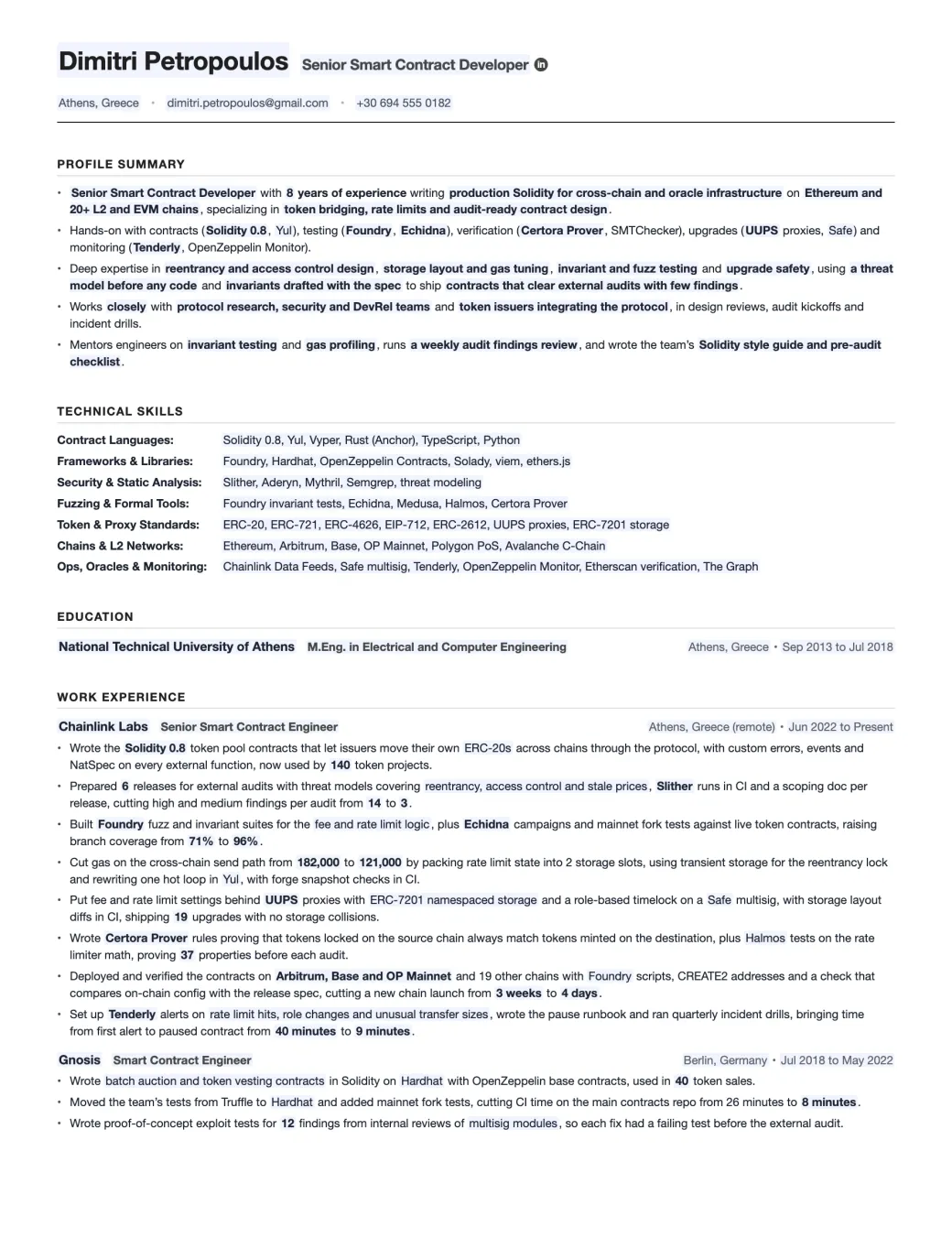
Dimitri Petropoulos’s Smart Contract Developer resume, filled in: 5 summary bullets, 7 skills rows and Chainlink Labs bullets on audits, gas, proxies and formal verification
Emmanuel Gendre Ex-Google recruiter / Tech resume writer Updated Free, ATS-friendly, no signup

Interactive resume template generator

Interactive Smart Contract Developer Resume Template

Fill in the side panel, then download your resume as a PDF or a Word file.

Edits update live as you type. Toggle Edit to rewrite paper text directly.

Edit mode is on. Click anywhere on the resume to rewrite text. Side-panel placeholders still update live.

Dimitri Petropoulos Senior Smart Contract Developer

Athens, Greece • dimitri.petropoulos@gmail.com • +30 694 555 0182

Profile Summary

  • Senior Smart Contract Developer with 8 years of experience writing production Solidity for cross-chain and oracle infrastructure on Ethereum and 20+ L2 and EVM chains, specializing in token bridging, rate limits and audit-ready contract design.
  • Hands-on with contracts (Solidity 0.8, Yul), testing (Foundry, Echidna), verification (Certora Prover, SMTChecker), upgrades (UUPS proxies, Safe) and monitoring (Tenderly, OpenZeppelin Monitor).
  • Deep expertise in reentrancy and access control design, storage layout and gas tuning, invariant and fuzz testing and upgrade safety, using a threat model before any code and invariants drafted with the spec to ship contracts that clear external audits with few findings.
  • Works closely with protocol research, security and DevRel teams and token issuers integrating the protocol, in design reviews, audit kickoffs and incident drills.
  • Mentors engineers on invariant testing and gas profiling, runs a weekly audit findings review, and wrote the team’s Solidity style guide and pre-audit checklist.

Technical Skills

Contract Languages:
Solidity 0.8, Yul, Vyper, Rust (Anchor), TypeScript, Python
Frameworks & Libraries:
Foundry, Hardhat, OpenZeppelin Contracts, Solady, viem, ethers.js
Security & Static Analysis:
Slither, Aderyn, Mythril, Semgrep, threat modeling
Fuzzing & Formal Tools:
Foundry invariant tests, Echidna, Medusa, Halmos, Certora Prover
Token & Proxy Standards:
ERC-20, ERC-721, ERC-4626, EIP-712, ERC-2612, UUPS proxies, ERC-7201 storage
Chains & L2 Networks:
Ethereum, Arbitrum, Base, OP Mainnet, Polygon PoS, Avalanche C-Chain
Ops, Oracles & Monitoring:
Chainlink Data Feeds, Safe multisig, Tenderly, OpenZeppelin Monitor, Etherscan verification, The Graph

Education

National Technical University of Athens M.Eng. in Electrical and Computer Engineering
Athens, Greece • Sep 2013 to Jul 2018

Work Experience

Chainlink Labs Senior Smart Contract Engineer
Athens, Greece (remote) • Jun 2022 to Present
  • Wrote the Solidity 0.8 token pool contracts that let issuers move their own ERC-20s across chains through the protocol, with custom errors, events and NatSpec on every external function, now used by 140 token projects.
  • Prepared 6 releases for external audits with threat models covering reentrancy, access control and stale prices, Slither runs in CI and a scoping doc per release, cutting high and medium findings per audit from 14 to 3.
  • Built Foundry fuzz and invariant suites for the fee and rate limit logic, plus Echidna campaigns and mainnet fork tests against live token contracts, raising branch coverage from 71% to 96%.
  • Cut gas on the cross-chain send path from 182,000 to 121,000 by packing rate limit state into 2 storage slots, using transient storage for the reentrancy lock and rewriting one hot loop in Yul, with forge snapshot checks in CI.
  • Put fee and rate limit settings behind UUPS proxies with ERC-7201 namespaced storage and a role-based timelock on a Safe multisig, with storage layout diffs in CI, shipping 19 upgrades with no storage collisions.
  • Wrote Certora Prover rules proving that tokens locked on the source chain always match tokens minted on the destination, plus Halmos tests on the rate limiter math, proving 37 properties before each audit.
  • Deployed and verified the contracts on Arbitrum, Base and OP Mainnet and 19 other chains with Foundry scripts, CREATE2 addresses and a check that compares on-chain config with the release spec, cutting a new chain launch from 3 weeks to 4 days.
  • Set up Tenderly alerts on rate limit hits, role changes and unusual transfer sizes, wrote the pause runbook and ran quarterly incident drills, bringing time from first alert to paused contract from 40 minutes to 9 minutes.
Gnosis Smart Contract Engineer
Berlin, Germany • Jul 2018 to May 2022
  • Wrote batch auction and token vesting contracts in Solidity on Hardhat with OpenZeppelin base contracts, used in 40 token sales.
  • Moved the team’s tests from Truffle to Hardhat and added mainnet fork tests, cutting CI time on the main contracts repo from 26 minutes to 8 minutes.
  • Wrote proof-of-concept exploit tests for 12 findings from internal reviews of multisig modules, so each fix had a failing test before the external audit.

Done editing? Download a real PDF (selectable text, ATS-friendly, US Letter) or an editable Word file if a recruiter asks for one.

About this template

A Smart Contract Developer resume template, built by a tech recruiter.

As a smart contract developer, you’re responsible for the code in a crypto product that actually holds the money: token contracts, lending markets, vaults, bridges and DAO voting. On Ethereum and its L2s that’s Solidity, sometimes Vyper, and on Solana or Sui it’s Rust or Move. You can’t hotfix a deployed contract. One bug can be drained in a single transaction, so testing, audits and upgrade planning eat up much of the week.

Line up 10 Solidity resumes and the first lines read the same: DeFi, ERC-20, gas efficient, “security-minded”. Anyone can type those words. That’s the problem, because a protocol lead won’t hand their treasury to a keyword. They’re looking for evidence: the audits you prepared and the findings you closed, the invariants you wrote and the gas you saved. They also want the upgrades you shipped with no storage collision and the value sitting in your contracts.

Dimitri’s Chainlink Labs job is built around that evidence. His 8 bullets each prove a different competency a contracts team screens for, from Solidity design to exploit response, and each one ends on a number. Noa, Marisa and Anselm’s resumes come next, and my method follows right after Anselm: 6 steps to write a Smart Contract Developer resume.

Getting silence back from the protocols you apply to? Drop your file into the form after the samples, and I’ll email you a free resume evaluation. I write every one myself, not software, and on Solidity resumes my first edits usually hit bullets that describe language features instead of what got shipped.

Industry signal

What the market says about Smart Contract Developer roles

If you write contracts for a living, it’s worth re-checking your gas assumptions this year. The Glamsterdam testnet upgrade went live on Sepolia on October 6 and changes what it costs to create and read state. On October 22, core developers delayed the Hoodi upgrade to study how EIP-8037 affects contracts already on mainnet. The Chainalysis 2025 crypto theft report counted $3.4B stolen, yet DeFi hack losses stayed low as teams added monitoring and fast pauses. That’s why protocols want developers who can handle both.

$83.0B Value locked in DeFi smart contracts, Nov 2026 DefiLlama
$112,528 Average advertised pay, US smart contract jobs Talent.com

Resume Samples

Smart Contract Developer Resume Examples

Junior, senior and staff contract developers get judged on different proof. Compare how my 3 smart contract developer resume samples change from rung to rung. Noa, the junior, moved over from payments backend work and now writes token contracts for regulated issuers. Marisa, the senior, works on an L2’s bridge and governance contracts. Anselm, at staff level, sets the security bar for a stablecoin issuer’s contract teams. You can download each one as a PDF or a Word file, free and with no signup.

Junior Smart Contract Developer Resume Example

A junior smart contract resume has to show you can be trusted near code that holds money: contracts you shipped under review, audit findings you fixed with a test first, and the fuzz tests that catch a bug before an attacker does.

Years of experience
4 years (2 in Solidity)
Industry
Digital asset infrastructure
Stack
SolidityOpenZeppelinEthereumPolygon
Download PDF Download Word

Click to download the Junior Smart Contract Developer resume example as a PDF or a Word file. Free / No signup.

Noa Halperin

Junior Smart Contract Developer

Tel Aviv, Israel · noa.halperin@gmail.com · +972 54-555-0147 · linkedin.com/in/noahalperin

Profile Summary

  • Junior Smart Contract Developer with 2 years writing Solidity token contracts for a digital asset infrastructure company, after 2 years of Java and Go backend work on payouts.
  • Builds with Solidity 0.8 and Foundry, OpenZeppelin Contracts Upgradeable, Slither for static checks and viem scripts for deploys on Ethereum, Polygon PoS and Base.
  • Strong in role-based access control, allowlist and freeze logic for regulated tokens and fuzz testing, and writes the attack test before the fix on every reported issue.
  • Works with 2 senior contract engineers, the security research team and solution engineers who help banks and fintechs launch their tokens.
  • Keeps the team’s Foundry test template current and runs a monthly exploit post-mortem reading group for engineers new to Solidity.

Technical Skills

Contract Languages:
Solidity, Yul (reading), TypeScript, Java, Go
Frameworks & Libraries:
Foundry, OpenZeppelin Contracts Upgradeable, Hardhat, viem
Security & Static Analysis:
Slither, Aderyn, checks-effects-interactions, threat modeling (basics)
Fuzzing & Formal Tools:
Foundry fuzz and invariant tests, SMTChecker, Echidna (basics)
Token & Proxy Standards:
ERC-20, ERC-721, ERC-1155, UUPS proxies, EIP-712, ERC-2612
Chains & L2 Networks:
Ethereum, Polygon PoS, Base, Sepolia testnet
Ops, Oracles & Monitoring:
Safe multisig, Tenderly alerts, Etherscan verification
Page 2 of 2

Work Experience

Fireblocks Smart Contract Engineer Tel Aviv, Israel · Sep 2024 to Present
  • Wrote ERC-20 and ERC-1155 token contracts with allowlist, freeze and forced-transfer controls for regulated issuers, now running 11 customer tokens on Ethereum and Polygon PoS.
  • Closed 12 of 13 findings from an external audit of the token library, including a medium-severity missing role check, each with a regression test written before the fix.
  • Added Foundry fuzz and invariant tests on supply and allowlist rules, plus SMTChecker runs on the mint math, raising branch coverage on the token library from 78% to 95%.
  • Cut gas per recipient on batch mint from 61,000 to 38,000 by packing allowlist flags into a bitmap and swapping revert strings for custom errors.
  • Shipped 9 UUPS upgrades to live customer tokens on Ethereum, Polygon PoS and Base, with storage layout checks, Safe multisig signing and Tenderly alerts on role changes.
Payoneer Backend Developer Petah Tikva, Israel · Aug 2022 to Aug 2024
  • Built Java and Spring Boot services for payout reconciliation, matching 2M transactions a day against bank files.
  • Cut duplicate payout incidents from 9 a quarter to 1 by adding idempotency keys and a ledger consistency check to the payout API.
  • Entered Code4rena audit contests in spare time and had 2 medium-severity findings accepted, which led to the move into Solidity full time.

Education

Tel Aviv University B.Sc. in Computer Science Tel Aviv, Israel · Oct 2018 to Jul 2022

Senior Smart Contract Developer Resume Example

At senior level, I want to see one protocol you know inside out: the contracts you work on every week, the audits you got them ready for, the invariants you wrote, and the upgrades you took through governance without breaking anything.

Years of experience
8 years
Industry
Ethereum L2 rollup
Stack
SolidityArbitrumEthereumHardhat
Download PDF Download Word

Click to download the Senior Smart Contract Developer resume example as a PDF or a Word file. Free / No signup.

Marisa Okonjo

Senior Smart Contract Developer

New York, NY · marisa.okonjo@gmail.com · +1 646-555-0129 · linkedin.com/in/marisaokonjo

Profile Summary

  • Senior Smart Contract Developer with 8 years on rollup bridge and governance contracts for an Ethereum L2, after 4 years building regulated stablecoin contracts.
  • Works in Solidity 0.8, Yul and Foundry, with Echidna and Certora Prover for assurance, OpenZeppelin governance contracts and Tenderly for monitoring on Ethereum and Arbitrum.
  • Strong in cross-chain message and withdrawal logic, upgrades through DAO governance and invariant design, and brings a written threat model to every design review.
  • Partners with protocol researchers, the node software team, external auditors and chain operators building on the stack, and takes the contracts on-call rotation one week in five.
  • Leads pre-audit reviews for the contracts team, mentors 3 engineers on invariant testing, and wrote the team’s upgrade proposal checklist.

Technical Skills

Contract Languages:
Solidity, Yul, TypeScript, Go (reading), Python
Frameworks & Libraries:
Foundry, Hardhat, OpenZeppelin Contracts, viem
Security & Static Analysis:
Slither, Aderyn, threat modeling, Solodit
Fuzzing & Formal Tools:
Foundry invariant tests, Echidna, Medusa, Certora Prover, Halmos
Token & Proxy Standards:
ERC-20, EIP-712, ERC-2612, transparent proxies, UUPS, ERC-7201
Chains & L2 Networks:
Ethereum, Arbitrum One, Arbitrum Nova, Base
Ops, Oracles & Monitoring:
Safe multisig, Tenderly, OpenZeppelin Monitor, Etherscan verification, Dune
Page 2 of 2

Work Experience

Offchain Labs Senior Smart Contract Engineer New York, NY · Apr 2022 to Present
  • Rewrote the outbox withdrawal path for Arbitrum One and Nova in Solidity 0.8 with custom errors and leaner event data, cutting gas per withdrawal on Ethereum from 132,000 to 97,000.
  • Ran audit prep for 4 contract releases with threat models, scoping docs and Slither in CI, bringing high and medium findings per external audit from 9 to 2.
  • Wrote Echidna and Foundry invariant suites for the dispute contracts and proved 23 Certora Prover rules on bond accounting before the external audit started.
  • Prepared 14 upgrade proposals that went through DAO votes and a timelock, each with a storage layout diff, a fork test on mainnet state and a simulation link for voters.
  • Built Tenderly and OpenZeppelin Monitor alerts for bridge balance drift and role changes, cutting time from alert to on-call response from 25 minutes to 6 minutes.
Paxos Software Engineer, Blockchain New York, NY · Jul 2018 to Mar 2022
  • Added EIP-712 permit support and a pause role to ERC-20 stablecoin contracts holding over $1B in supply, with a full Hardhat test suite.
  • Moved releases from manual scripts to Hardhat tasks with Gnosis Safe approvals, cutting release prep from 3 days to 4 hours.
  • Built an hourly supply reconciliation job in Go that compared minted supply with reserve records, catching 2 mint config errors before any customer saw them.

Education

Rutgers University B.S. in Computer Science New Brunswick, NJ · Sep 2014 to May 2018

Staff Smart Contract Developer Resume Example

A staff smart contract resume gets read for judgment across teams: the security standard other teams ship against, the formal specs behind the riskiest contracts, and how you run upgrades and incident drills when a mistake would cost real money.

Years of experience
13 years
Industry
Stablecoins and payments
Stack
SolidityRustSolanaBase
Download PDF Download Word

Click to download the Staff Smart Contract Developer resume example as a PDF or a Word file. Free / No signup.

Anselm Krüger

Staff Smart Contract Developer

Boston, MA · anselm.kruger@gmail.com · +1 617-555-0173 · linkedin.com/in/anselmkruger

Profile Summary

  • Staff Smart Contract Developer with 13 years in security engineering and smart contracts, now on stablecoin and cross-chain transfer contracts at a regulated stablecoin issuer.
  • Works in Solidity, Yul and Rust (Anchor) with Foundry, Certora Prover, Halmos and Echidna, across Ethereum, Arbitrum, Base, Avalanche C-Chain and Solana.
  • Strong in formal specs for token accounting, upgrade and key management design and incident response, and sets the security bar the contract teams ship against.
  • Works with compliance, treasury operations and key custody teams, 4 external audit firms and exchange and wallet partners during launches and drills.
  • Chairs the smart contract security review board, mentors 5 senior engineers, and wrote the pre-audit standard used across 4 contract teams.

Technical Skills

Contract Languages:
Solidity, Yul, Rust (Anchor), Python, Go
Frameworks & Libraries:
Foundry, OpenZeppelin Contracts, Solady, Anchor, viem
Security & Static Analysis:
Slither with custom detectors, Semgrep, threat modeling
Fuzzing & Formal Tools:
Certora Prover, Halmos, Kontrol, Echidna, Medusa, Foundry invariant tests
Token & Proxy Standards:
ERC-20, EIP-712, ERC-2612, EIP-3009, transparent proxies, UUPS, ERC-7201
Chains & L2 Networks:
Ethereum, Arbitrum, Base, OP Mainnet, Avalanche C-Chain, Solana
Ops, Oracles & Monitoring:
Safe multisig, HSM signing, Hypernative, OpenZeppelin Monitor, Immunefi
Page 2 of 2

Work Experience

Circle Staff Smart Contract Engineer Boston, MA · Feb 2020 to Present
  • Led formal verification for the stablecoin token contracts with 58 Certora Prover rules on supply, blocklist and minter allowance logic, run on every pull request before audit.
  • Set the pre-audit standard 4 contract teams follow (threat model, invariant list, Slither and Semgrep gates), cutting high and medium findings per external audit from 11 to 2.
  • Designed the upgrade process for proxied token contracts on 9 chains, with HSM-backed multisig approvals, timelocks and storage layout diffs, shipping 31 upgrades with no failed transactions.
  • Wrote the on-chain incident runbook and ran quarterly pause drills with treasury and custody teams, bringing time from alert to paused minting from 45 minutes to 8 minutes.
  • Cut gas per transfer by 18% on a new token contract version by packing blocklist and balance data into shared slots, checked with differential fuzz tests against the old version.
Kudelski Security Senior Security Engineer Lausanne, Switzerland · Sep 2013 to Jan 2020
  • Audited Solidity contracts for 21 DeFi and token clients from 2017 on, writing a working exploit test for every high-severity finding.
  • Reviewed cryptographic code for finance and telecom clients, reporting over 40 issues in key handling and random number generation.
  • Built the team’s Echidna fuzzing harness for client Solidity code, used on 30 later engagements.

Education

ETH Zurich M.Sc. in Computer Science Zurich, Switzerland · Sep 2011 to Aug 2013

Free resume review

A recruiter screen, but with feedback

You applied to hundreds of jobs: no result. Companies won’t give you feedback, so you’re stuck in a loop. Rejections will keep coming until you know what’s wrong.

Let’s break this cycle today!

I’ll screen your resume the same way I did at Google.

You’ll get:

  • Your resume sections and content scored.
  • A clear list of what to improve, why, and how.
  • Behind the scenes secrets on the screening process.

How I rewrite Smart Contract Developer resumes

How to write a Smart Contract Developer resume

Emmanuel Gendre, ex-Google recruiter

Emmanuel Gendre Ex-Google recruiter, tech resume writer

I have 13 years of recruiting experience, including many years at Google. Now my job is fixing tech resumes, and Solidity resumes tend to break in one particular way. Every ERC and DeFi buzzword is there, yet I can’t work out what the code does, how much value sits in it, or what its last audit turned up.

When a smart contract engineer books a rewrite through the tech resume service I run, I start by putting that missing layer back: contracts, audit results, invariants and the value they guard. If you’re doing it yourself, though, focus on these 6 steps. I’ll use Dimitri’s resume as the running example.

  1. Step 1 Format & layout The layout parsers and recruiters both read without tripping. Go to step 1
  2. Step 2 Profile Summary Your level, chains and audit record, packed into 5 bullets. Go to step 2
  3. Step 3 Work Experience Dimitri’s 8 Chainlink Labs bullets, one per competency. Go to step 3
  4. Step 4 Bullet Points Turning a 7-word gas fix into proof with a number. Go to step 4
  5. Step 5 Technical Skills Languages, tools, standards and chains in 7 rows, then soft skills. Go to step 5
  6. Step 6 Keywords & Metrics Ranked keywords, a scanner for job ads, and 24 contract metrics. Go to step 6

Step 1 · Format & Layout

Smart Contract Developer resume format and layout

Formatting’s the step most Solidity developers already get half right. Software reads your file first and copies the text into its database. Next, a recruiter wants 3 facts almost instantly: who employs you now, your title there and how long you’ve held it. A simple page serves both readers.

01ATS Compliance

ATS compliance for your Smart Contract Developer resume

Your application to a crypto company hits an ATS, or applicant tracking system, well ahead of any recruiter. Web3 startups often use Ashby, Greenhouse or Lever, and banks with on-chain teams tend to run Workday. Whatever the brand, it slices your resume into database fields, and a sidebar or text box can knock Foundry or Certora out of your skills field entirely. I explain how an ATS parses a resume in detail in another article. Getting every contract keyword through intact comes down to 3 rules:

The 3 rules
  1. Use a 100% text based format (no Canva!)

  2. Avoid tables, pictures, and complex structures.

  3. Use the most predictable section names, like “Profile Summary” and “Work Experience”

02Design & Layout

Smart Contract Developer resume design and layout

Solidity resumes still reach me with an Ethereum diamond in the header and skill bars rating “DeFi” at 90%. Recruiters hate fancy designs, and my years at Google only confirmed it. A dark background or a 2-column grid doesn’t help either. It just buries the current employer someone is scanning for.

So I kept this template deliberately plain. One column, one typeface, standard headings, wide empty margins. Your data should do the standing out, like that drop to 121,000 gas per message. Building a file of your own? The spec sheet below has every setting.

Layout Spec
Columns
One. No sidebars, tables, columns, pictures or tabs.
Margins
0.7 in on all four sides
Body size
10 to 11 pt
Type
One family, weight for hierarchy
Length
One page under 5 years, two after
Section order
Summary, Skills, Experience, Education
PDF

03File Format

Resume file format for your Smart Contract Developer resume

Unless a job ad says otherwise, send your Solidity resume as a PDF. Workday, Greenhouse and Ashby all extract its text, a Mac and a phone show it identically, and nobody can accidentally change your gas figures. Save the Word copy for recruitment agencies that rebrand candidate files, or an application portal that insists on .docx. For Google Docs links and plain text, read my PDF, Word and plain text resume guide.

Format Guide
PDF
Your default. Layout holds, text stays selectable.
Word (.docx)
When the posting or a recruiter asks for it. Use the Word download above.
Plain text
For portals that make you paste into a box
Never
Images, scans, password-protected PDFs, shared-drive links
File name
Dimitri-Petropoulos-Smart-Contract-Developer.pdf

Step 2 · Profile Summary

Smart Contract Developer profile summary

Some Solidity developers drop the summary and let GitHub do the talking. Recruiters rarely click through to a GitHub profile at first glance. In those opening seconds they check your title, your years and the chains you’ve deployed on, then make a call on reading further. Why that top section matters so much is in my breakdown of the recruiter screen, round by round.

A smart contract summary has 3 doubts to settle fast. Has your code held real money on mainnet? Do you know attack patterns, or only syntax? Will auditors and front-end teams enjoy working with you? Dimitri’s 5 bullets below tackle those doubts one piece at a time. For rules that apply to every role, see my profile summary walkthrough.

  1. 1

    Title, years and scope

    The title you’re after, your years writing Solidity (plus any backend or security work before that), what your contracts do and the chains they live on. A recruiter who reads nothing else should still know your seniority and whether you build DeFi, bridges or tokenized assets.

  2. 2

    Your stack

    Language and compiler version, test framework, fuzzer, prover, proxy pattern and monitoring tool, grouped under labels like testing or upgrades. ATS keyword searches often match here first, so don’t improvise: copy how the posting writes Foundry, Certora or UUPS.

  3. 3

    Domain expertise

    The strengths you’d want a protocol to hire you for, 4 of them (reentrancy defense, gas tuning, invariant design, safe upgrades), plus the methods behind them and what they produced. Borrow phrases from the job ad wherever they honestly describe your work.

  4. 4

    Collaboration

    The people your contracts depend on every week (protocol researchers, auditors, front-end and DevRel teams, integrators) and where those conversations happen: design reviews, audit kickoffs, incident drills. A contract change lands on every one of those teams, and a manager wants signs that you loop them in early.

  5. 5

    Leadership

    What you do beyond your own pull requests: the pre-audit checklist, the style guide, reviews of other people’s contracts, coaching. Juniors can keep it to one line. At senior level, an empty line here makes a hiring manager wonder who’s reviewing your code.

Smart Contract Developer resume summary example, from the template above
  • Senior Smart Contract Developer with 8 years of experience writing production Solidity for cross-chain and oracle infrastructure on Ethereum and 20+ L2 and EVM chains, specializing in token bridging, rate limits and audit-ready contract design.
  • Hands-on with contracts (Solidity 0.8, Yul), testing (Foundry, Echidna), verification (Certora Prover, SMTChecker), upgrades (UUPS proxies, Safe) and monitoring (Tenderly, OpenZeppelin Monitor).
  • Deep expertise in reentrancy and access control design, storage layout and gas tuning, invariant and fuzz testing and upgrade safety, using a threat model before any code and invariants drafted with the spec to ship contracts that clear external audits with few findings.
  • Works closely with protocol research, security and DevRel teams and token issuers integrating the protocol, in design reviews, audit kickoffs and incident drills.
  • Mentors engineers on invariant testing and gas profiling, runs a weekly audit findings review, and wrote the team’s Solidity style guide and pre-audit checklist.

Step 3 · Work Experience

Smart Contract Developer work experience

Step 2 was about the quick first look. This is the slow second one, usually by the engineering manager or a senior contracts engineer, and your latest job carries about 95% of their decision. It’s the closest preview they get of the Solidity you’d write on their codebase.

Make that job carry the Smart Contract Developer role profile: 8 competencies, a bullet for each. Reviewers credit only what they can read, so no audit bullet means no audit experience. Below, I’ve ordered the 8 the way a contracts lead usually screens them.

Smart Contract Developer role profile
  1. Solidity & Contract Design

    You build the contracts that hold users’ tokens and deposits. A clumsy interface or a missing event lives on chain for years, and every integrator’s stuck with it. Show how you used OpenZeppelin base contracts and standards like ERC-4626 to ship contracts other teams plugged into without asking you for help.

    Techniques
    interface design, events and custom errors, NatSpec, vault and fee accounting
    Tools
    Solidity, OpenZeppelin Contracts, Solady, ERC-4626
    Metrics
    contracts deployed, value held, integrations, integration tickets
  2. Security Patterns & Audit Readiness

    You close off attack paths long before an auditor opens the repo. One reentrancy path or forgotten role check can empty a protocol in a single block, and audit firms charge for every week of review. Explain how you used a threat model and Slither to reach audit day with fewer high and medium findings.

    Techniques
    checks-effects-interactions, role-based access control, oracle sanity checks, threat modeling
    Tools
    Slither, Aderyn, Mythril, Solodit
    Metrics
    findings per audit, high-severity findings, time to fix, audit weeks
  3. Testing, Fuzzing & Invariants

    You attack your own contracts before anyone else gets the chance. Unit tests only cover the cases you’d imagined, and exploits come from the ones you didn’t. Describe how you used Foundry invariant tests and Echidna campaigns to find accounting bugs that slipped through code review.

    Techniques
    fuzz testing, invariant testing, mainnet fork tests, exploit replays
    Tools
    Foundry, Echidna, Medusa, Hardhat
    Metrics
    branch coverage, bugs found before audit, fuzz runs, CI time
  4. EVM Internals & Gas Optimization

    You measure what each opcode and storage slot costs the people calling your contract. On mainnet, every extra storage write is paid on every call, and Glamsterdam, now on testnet, reprices state access again. Mention how you used slot packing and forge snapshot to make a busy function cheaper.

    Techniques
    slot packing, transient storage, calldata over memory, Yul on hot paths
    Tools
    forge snapshot, Foundry gas reports, evm.codes, Tenderly gas profiler
    Metrics
    gas per call, deploy cost, storage slots used, bytecode size
  5. Upgradeable Proxies & Governance

    You upgrade live contracts without corrupting a single storage slot. One bad upgrade can brick a protocol or wipe balances, and token holders won’t vote until they’ve read the plan. Detail how you used UUPS proxies, storage layout diffs and a timelock to get upgrades through governance with no surprises.

    Techniques
    UUPS and transparent proxies, namespaced storage, storage layout diffs, timelocks
    Tools
    OpenZeppelin Upgrades, Safe, OpenZeppelin Governor, ERC-7201
    Metrics
    upgrades shipped, storage collisions, proposals approved, timelock delay
  6. Formal Verification

    You prove properties that tests can only spot-check. With hundreds of millions in a contract, “we fuzzed it a lot” won’t always satisfy a security lead, and more audit firms now scope proofs into the engagement. Show them how you used Certora Prover rules or Halmos to prove a balance or access property before the audit.

    Techniques
    invariant specs, symbolic testing, rule writing, counterexample triage
    Tools
    Certora Prover, Halmos, Kontrol, SMTChecker
    Metrics
    properties proven, rules per contract, bugs found by proofs, prover runtime
  7. L2 & Multi-Chain Deployment

    You ship one codebase to Ethereum and a list of L2s without a config slip. Chains differ on gas rules, opcodes and bridge quirks, and one wrong address in a deploy script isn’t a cheap mistake. Let them know how you used Foundry scripts and CREATE2 to launch on new chains faster, with nothing missed.

    Techniques
    CREATE2 deploys, source verification, per-chain config checks, bridge messaging
    Tools
    Foundry scripts, Etherscan, Blockscout, Safe
    Metrics
    chains live, launch time, failed deploys, config mismatches
  8. Monitoring & Exploit Response

    You keep watching your contracts after launch and act fast when an alert fires. Chainalysis found DeFi hack losses stayed low in 2025 while teams added monitoring and quick pauses, so expect interviewers to ask about it. Write about how you used Tenderly alerts and a pause runbook to shrink the gap between alert and action.

    Techniques
    on-chain alerts, pause guardians, incident drills, post-mortems
    Tools
    Tenderly, OpenZeppelin Monitor, Hypernative, Immunefi
    Metrics
    time to pause, alerts per month, bounty reports triaged, funds recovered

Freelancer or agency developer? Give each client protocol its own bullet: what you wrote, the chain it runs on and the result. Mention the client by name if you’re allowed to. The next step’s all about building those bullets.

Submit your resume for a free review!

Step 4 · Bullet Points

Smart Contract Developer resume bullet points

Bullets eat most of my editing time on a smart contract resume, since they carry the proof. My Level System handles them, one question per level, asked in the order a protocol lead would raise it. It’s built on the XYZ formula from my Google days, stretched for engineering work. For the full walkthrough, open my tutorial on writing resume bullets.

The 5 levels work like an interview about one change you shipped. On contract work, the closing answer tends to be gas saved, findings avoided, coverage gained or upgrades shipped without incident. Below, a 7-word note about Dimitri’s gas fix turns into 46 words of evidence.

  1. Level 1Task

    What did I do? Write the task in one line. It’s accurate, but a hiring manager has no idea how hard it was.

    Cut gas on the cross-chain send path.

  2. Level 2+ Techniques

    How did I do it? Add the techniques. On gas work, they’ll judge whether you knew which slots and opcodes to touch.

    Cut gas on the cross-chain send path by packing rate limit state into 2 storage slots and moving the reentrancy lock to transient storage.

  3. Level 3+ Tools

    Which tools did I use? Write the real tool names. They’re the keywords a recruiter types into the search box.

    Cut gas on the cross-chain send path by packing rate limit state into 2 storage slots and moving the reentrancy lock to transient storage, measured with forge snapshot and Tenderly’s gas profiler.

  4. Level 4+ Method

    What method did I follow? Say how you kept the change safe. A gas cut that breaks an invariant isn’t a win.

    Cut gas on the cross-chain send path by packing rate limit state into 2 storage slots and moving the reentrancy lock to transient storage, measured with forge snapshot and Tenderly’s gas profiler while keeping the invariant suite green on every change.

  5. Level 5+ Metric

    What changed? Finish on one number you can back up. You’ll get asked about it in the interview.

    Cut gas on the cross-chain send path by packing rate limit state into 2 storage slots and moving the reentrancy lock to transient storage, measured with forge snapshot and Tenderly’s gas profiler while keeping the invariant suite green on every change, bringing each message from 182,000 to 121,000 gas.

    1. 01 Task What you worked on
    2. 02 Techniques How you did it
    3. 03 Tools The stack you used
    4. 04 Method The method you followed
    5. 05 Metric The result, one number

Nearly every figure here lives in files you already have: forge snapshot output, coverage reports, audit PDFs and your Safe transaction history. Gather them first, then write. If an interviewer pushes on a figure, the audit report’s got your back.

Step 5 · Technical Skills

Smart Contract Developer resume skills

The skills that matter most on a smart contract resume are Solidity, Foundry and the security tools you run before an audit. Next come fuzzing and formal tools, the token and proxy standards you’ve shipped, and your chains. ATS searches match exact words, so write Certora Prover, not “formal methods tooling”.

Treat this list as a summary of your bullets, not a replacement. If Halmos sits here but no bullet mentions a proof, an interviewer’s going to ask what you proved. Under the skill categories (must-haves get a star) come Dimitri’s rows, followed by 5 soft skills a contracts team weighs as heavily as your Solidity. Keywords get their own step next.

The 7 skill categories for a Smart Contract Developer resume

Stars mark the chips that show up in most smart contract job ads. Lead with them in every row. A version’s worth adding only when it tells a reader something, such as the Solidity release you compile with.

Contract Languages

Solidity goes first, with the version you compile with. Add Yul if you’ve written assembly on hot paths, and Vyper, Rust or Move only when the job’s on those chains.

SolidityYulVyperRust (Anchor)MoveTypeScriptPython

Frameworks & Libraries

Foundry’s in most new codebases and Hardhat in many older ones. List the base libraries you build on, like OpenZeppelin Contracts or Solady, and the client library your scripts use.

FoundryOpenZeppelin ContractsHardhatSoladyviemethers.jsAnchor

Security & Static Analysis

The tools you run before an auditor does. Slither’s the one most ads ask for, and a threat model shows you think about attackers, not just linter warnings.

SlitherThreat modelingAderynMythrilSemgrepSolodit

Fuzzing & Formal Tools

Invariant tests and Echidna or Medusa show you don’t stop at the happy path. Halmos, Certora Prover or Kontrol belong here only if you’ve proven something with them.

Invariant testingEchidnaMedusaHalmosCertora ProverKontrolSMTChecker

Token & Proxy Standards

The ERCs and proxy patterns you’ve shipped to mainnet. ERC-20’s a given. ERC-4626, UUPS and ERC-7201 tell a reader you’ve built vaults and handled upgrades.

ERC-20ERC-4626UUPSERC-721ERC-1155EIP-712ERC-2612ERC-7201ERC-4337

Chains & L2 Networks

Where your contracts actually run today: Ethereum plus the L2s from your own deployments, like Arbitrum or Base. Add non-EVM chains only if you’ve deployed there.

EthereumArbitrumBaseOP MainnetPolygon PoSAvalanche C-ChainSolana

Ops, Oracles & Monitoring

What keeps contracts safe once they’re live: Chainlink feeds for prices, a Safe multisig for admin keys, and alerting from Tenderly, OpenZeppelin Monitor or Hypernative.

ChainlinkSafe multisigTenderlyOpenZeppelin MonitorHypernativeEtherscanThe Graph

A finished Smart Contract Developer skills section

Technical Skills sample, from the template above
Contract Languages
Solidity 0.8, Yul, Vyper, Rust (Anchor), TypeScript, Python
Frameworks & Libraries
Foundry, Hardhat, OpenZeppelin Contracts, Solady, viem, ethers.js
Security & Static Analysis
Slither, Aderyn, Mythril, Semgrep, threat modeling
Fuzzing & Formal Tools
Foundry invariant tests, Echidna, Medusa, Halmos, Certora Prover
Token & Proxy Standards
ERC-20, ERC-721, ERC-4626, EIP-712, ERC-2612, UUPS proxies, ERC-7201 storage
Chains & L2 Networks
Ethereum, Arbitrum, Base, OP Mainnet, Polygon PoS, Avalanche C-Chain
Ops, Oracles & Monitoring
Chainlink Data Feeds, Safe multisig, Tenderly, OpenZeppelin Monitor, Etherscan verification, The Graph

Soft skills for a Smart Contract Developer resume

“Detail-oriented” next to Solidity won’t convince a protocol lead, but a bullet can. Contract teams screen for these 5. For each, there’s a resume line with a number as proof.

  • Saying no to a launch date when the audit isn’t finished

    Resume bulletHeld a vault launch back 2 weeks until 3 open medium findings were fixed and retested, and the head of product agreed.

  • Writing findings and fixes so auditors can verify them fast

    Resume bulletWrote a fix note with a failing test for each of 14 audit findings, and the audit firm verified every fix in 2 days.

  • Keeping calm and following the runbook during a live incident

    Resume bulletPaused 3 markets 11 minutes after an oracle alert by working through the runbook step by step, with no funds lost.

  • Explaining protocol risk to token holders who don’t read Solidity

    Resume bulletTurned each of 6 upgrade proposals into a one-page plain-English risk note, and the DAO approved all 6 on the first vote.

  • Asking for a second review on code that holds user funds

    Resume bulletAsked for a second reviewer on every change to withdrawal logic, which caught 2 rounding bugs before the audit started.

Step 6 · Keywords & Metrics

Smart Contract Developer resume keywords and metrics

After all that work, you’ve still got 2 filters to clear. Recruiters search their ATS for terms like Solidity, Foundry or “smart contract audit”, so keywords decide whether you appear in the results. Then a protocol engineer reads your bullets, and metrics are what they’ll trust: gas, findings, coverage, numbers they can check on-chain.

First, 3 tiers of keywords, ranked by importance. Second, a finder for the exact posting you want. Last, 24 contract metrics, all of them written into sample bullets.

+42%

Smart Contract Developer resume keywords, ranked

Under the tiers, each chip shows a sample job ad sentence once you tap it. A DeFi team might write “Solidity” while a bank’s tokenization team writes “EVM smart contract development”, so echo the wording of the ad you’re answering.

Must-have

8

Put each of these in your summary, a skills row and at least one bullet under your current job.

In a job description“Strong proficiency in Solidity and the EVM”

Strong supporting

10

List the ones you’ve really used in your skills rows and back each one with a bullet.

In a job description“Optimize contracts for gas efficiency without trading away safety”

Bonus

9

Add these only for ads that mention them, and only if you’ve done the work.

In a job description“Formal verification experience (Certora, Halmos, Kontrol)”

Extract Smart Contract Developer keywords from a job description

Drop in a smart contract, Solidity or protocol engineer posting. Its languages, frameworks, standards and chains come back sorted by tier. Compare that output with your skills rows, and the gaps stand out.

Must-have
Put these in your skills section and back each one with a bullet.
Strong supporting
Add the ones you’ve actually worked with. Skip the rest.

Nothing is uploaded: it all happens in your browser.

Metrics for a Smart Contract Developer resume

Dimitri’s years at Chainlink Labs and Gnosis supply every bullet in this table, 3 metrics per competency. Pick the ones your audit reports, CI runs and block explorers can prove.

MetricExample bullet
Solidity & contract design
Contracts in production Count Contracts you wrote that are live on mainnet and still in use.Wrote 12 pool and rate limiter contracts that now run in production on Ethereum and 21 other chains.
Value held Money Assets held by contracts you wrote, read from a block explorer or DefiLlama.Wrote the lock-and-release pool contracts that held over $400M in bridged tokens at their peak.
Integration tickets Count Support requests from teams integrating your contracts, a sign of how clear the interface is.Rewrote the issuer-facing interface and examples with full NatSpec, cutting integration support tickets from 30 to 8 a month.
Security & audit readiness
Findings per audit Count High and medium findings in each external audit report.Ran a pre-audit review on the fee manager release that caught 5 issues early, so the external audit reported 1 medium and 0 highs.
Time to fix findings Time Days from receiving an audit report to having every fix reviewed.Set up a findings tracker with a test per fix, cutting the time from audit report to verified fixes from 3 weeks to 6 days.
Contest findings Count Valid issues reported by a public audit contest on your code.Prepared the code and docs for a public audit contest that ended with 2 medium findings and no highs across 4,100 lines.
Testing & fuzzing
Branch coverage Percent Share of code branches your tests run, from forge coverage.Added fork tests and edge-case unit tests to the rate limiter, raising branch coverage from 64% to 93%.
Bugs found before audit Count Bugs your fuzz or invariant tests caught before external review.Wrote 26 invariants for the fee accounting, which caught 4 rounding bugs before the code went to audit.
Fuzz calls per release Count Fuzz or invariant calls run in CI against each release candidate.Moved Echidna campaigns into nightly CI, running 5M fuzz calls against every release candidate.
EVM & gas
Gas per call Count Gas used by one call to a function users hit often.Replaced a mapping of structs with packed slots in the fee quoter, cutting gas per quote from 48,000 to 29,000.
Deploy cost Money What it costs to deploy a set of contracts, in gas or dollars.Shrank bytecode with custom errors and shared libraries, lowering the cost of deploying the pool set on Ethereum by $3,900.
Gas regressions caught Count Pull requests blocked by a gas snapshot check before merge.Added forge snapshot checks to CI that blocked 17 pull requests with gas regressions in a year.
Upgrades & governance
Upgrades shipped Count Proxy or module upgrades deployed to mainnet with no incident.Shipped 11 upgrades to multisig wallet modules at Gnosis with storage layout checks and no rollback.
Storage collisions caught Count Layout conflicts found before an upgrade reached mainnet.Added a storage layout diff step to upgrade reviews that caught 3 slot collisions before deployment.
Timelock delay Time Time between an approved change and the moment it takes effect.Moved admin changes from instant multisig calls to a timelock, giving integrators 48 hours of notice before any config change.
Formal verification
Properties proven Count Rules or invariants a prover verified for a contract.Proved 22 Certora Prover rules on the access control setup, including that only the timelock can change rate limits.
Bugs found by proofs Count Issues a prover or symbolic test found that the tests missed.Ran Halmos symbolic tests on the rate limiter math, which found 2 overflow edge cases the fuzz suite had missed.
Prover runtime Time Time for the prover to check every rule in CI.Split prover specs by contract and cached the results, cutting the CI verification run from 55 to 14 minutes.
L2 & multi-chain deployment
Chains live Count Networks where your contracts are deployed and verified.Took the pool contracts from 4 to 22 chains in 2 years, each one verified on Etherscan or Blockscout.
Config mismatches Count On-chain settings that didn’t match the release spec after a deploy.Added a post-deploy check that compares on-chain config with the release file, bringing mismatches per launch from 5 to 0.
Failed deploys Count Deployment transactions that reverted or had to be redone.Moved deploys to Foundry scripts with dry runs on forked chains, cutting failed deployment transactions from 9 a quarter to 1.
Monitoring & response
Incident drills Frequency How often the team rehearses pausing and fixing a contract.Ran 4 pause drills a year with the security team, each timed from the first alert to a signed pause transaction.
Alert precision Percent Share of alerts that turned out to need action.Tuned Tenderly alert thresholds on transfers and role changes, raising the share of alerts that needed action from 12% to 61%.
Bounty reports triaged Count Bug bounty reports reviewed and answered.Triaged 85 bug bounty reports in a year with the security team, answering every valid one within the program’s deadline.

What if you don’t have exact numbers?

  • 1

    Look on-chain and in the repo first. Block explorers, Dune queries, forge snapshot files and audit reports already store most of these figures, and they’re dated.

  • 2

    Be conservative and save the source. It’s fine to claim “over $200M in deposits” if DefiLlama or a Dune dashboard shows it, or “about 30% less gas” if the snapshot diff does.

  • 3

    Missing a before and after? Fall back on scope. Chains deployed to, contracts maintained, audits prepared and the value you secure all show what’s riding on your code.

Free resume review

A recruiter screen, but with feedback

You applied to hundreds of jobs: no result. Companies won’t give you feedback, so you’re stuck in a loop. Rejections will keep coming until you know what’s wrong.

Let’s break this cycle today!

I’ll screen your resume the same way I did at Google.

You’ll get:

  • Your resume sections and content scored.
  • A clear list of what to improve, why, and how.
  • Behind the scenes secrets on the screening process.

Frequently asked

Smart Contract Developer resume FAQ

Completely free. No login screen stands between you and the download. Type your own contracts and results over Dimitri’s, export, and return whenever an audit or a mainnet deployment gives you a fresh number.

You can. The Word option sits beside Download PDF, and each sample (Noa, Marisa, Anselm) has a .docx link beside its PDF button. Apply with the PDF. Agencies that reformat resumes into a branded template are the only ones who’ll really need Word.

It is. You get a single column, headings every parser recognizes, and selectable characters in the PDF rather than an image. To test it, paste your PDF’s contents into any editor and read it top to bottom. Employers, dates and bullets should appear in order.

Juniors with under 5 years should stick to 1 page. More senior developers with audits, multi-chain launches or a security research past can use 2 pages. Recruiters skip Solidity resumes for a vague first page, not for running long.

A little, early on. Courses like Cyfrin Updraft or the Secureum bootcamp show you’ve studied security on purpose, and they fit under Education. Contracts you shipped to mainnet and audits you got through count for far more with a hiring manager.

Anything that’s checkable: gas per call, high and medium findings per audit, branch coverage, properties proven, upgrades shipped, chains deployed to, time from alert to pause, and the value your contracts hold. Step 6 puts 24 of them into sample bullets.

Lean on work that’s public: accepted contest findings, a contract you deployed and verified on testnet or mainnet, a merged pull request to OpenZeppelin or Solady, a hackathon build. List each one under Projects with its repo or explorer link and one number, below your current job.

Yes, if findings were accepted. Write the platform (Code4rena, Sherlock or Cantina), how many high and medium findings were valid and, when it’s public, your leaderboard rank. Leave out contests with no accepted findings. Contest leaderboards are public, and protocol teams do check them.

It won’t. Recruiters read a layout they know faster, and nobody checks where a format originated. Keeping Dimitri’s numbers would hurt, though. Picture an interviewer bringing up “your” 37 Certora properties. Every bullet has to describe your own contracts.

More resources

More help with your Smart Contract Developer resume