

Web3 Developer Resume Examples & Free Template (PDF, Word)

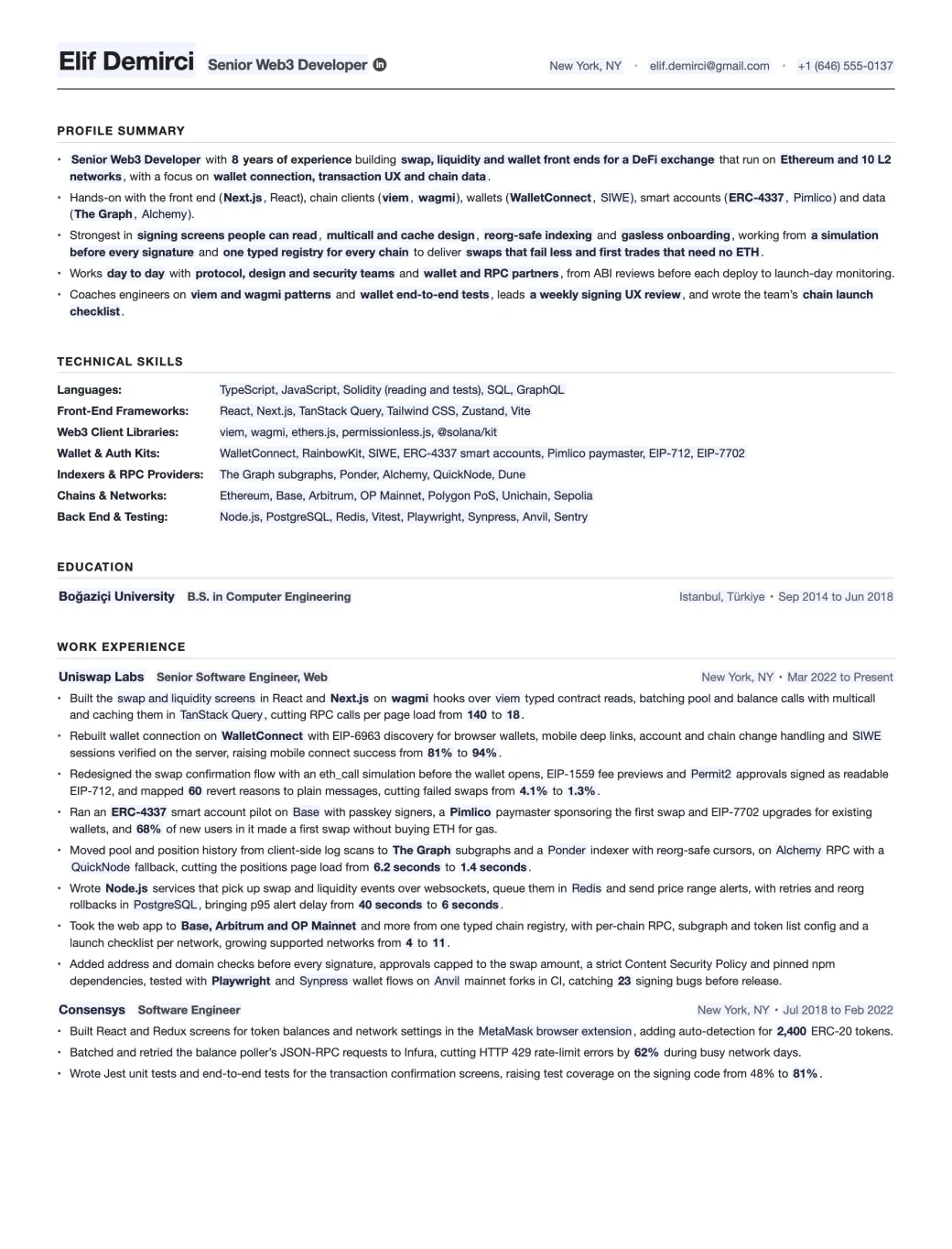
I built this free web3 developer template around Elif’s Uniswap Labs resume. Swap her wallets, chains and failure rates for yours, save a PDF or Word copy, then scroll on for 3 more dApp examples and my 6 writing steps.

4.9 5.0
Elif Demirci’s Web3 Developer resume, filled in: 5 summary bullets, 7 skills rows and Uniswap Labs bullets on wallets, signing flows, subgraphs and L2 support
Emmanuel Gendre Ex-Google recruiter / Tech resume writer Updated Free, ATS-friendly, no signup

Interactive resume template generator

Interactive Web3 Developer Resume Template

Fill in the side panel, then download your resume as a PDF or a Word file.

Edits update live as you type. Toggle Edit to rewrite paper text directly.

Edit mode is on. Click anywhere on the resume to rewrite text. Side-panel placeholders still update live.

Elif Demirci Senior Web3 Developer

New York, NY • elif.demirci@gmail.com • +1 (646) 555-0137

Profile Summary

  • Senior Web3 Developer with 8 years of experience building swap, liquidity and wallet front ends for a DeFi exchange that run on Ethereum and 10 L2 networks, with a focus on wallet connection, transaction UX and chain data.
  • Hands-on with the front end (Next.js, React), chain clients (viem, wagmi), wallets (WalletConnect, SIWE), smart accounts (ERC-4337, Pimlico) and data (The Graph, Alchemy).
  • Strongest in signing screens people can read, multicall and cache design, reorg-safe indexing and gasless onboarding, working from a simulation before every signature and one typed registry for every chain to deliver swaps that fail less and first trades that need no ETH.
  • Works day to day with protocol, design and security teams and wallet and RPC partners, from ABI reviews before each deploy to launch-day monitoring.
  • Coaches engineers on viem and wagmi patterns and wallet end-to-end tests, leads a weekly signing UX review, and wrote the team’s chain launch checklist.

Technical Skills

Languages:
TypeScript, JavaScript, Solidity (reading and tests), SQL, GraphQL
Front-End Frameworks:
React, Next.js, TanStack Query, Tailwind CSS, Zustand, Vite
Web3 Client Libraries:
viem, wagmi, ethers.js, permissionless.js, @solana/kit
Wallet & Auth Kits:
WalletConnect, RainbowKit, SIWE, ERC-4337 smart accounts, Pimlico paymaster, EIP-712, EIP-7702
Indexers & RPC Providers:
The Graph subgraphs, Ponder, Alchemy, QuickNode, Dune
Chains & Networks:
Ethereum, Base, Arbitrum, OP Mainnet, Polygon PoS, Unichain, Sepolia
Back End & Testing:
Node.js, PostgreSQL, Redis, Vitest, Playwright, Synpress, Anvil, Sentry

Education

Boğaziçi University B.S. in Computer Engineering
Istanbul, Türkiye • Sep 2014 to Jun 2018

Work Experience

Uniswap Labs Senior Software Engineer, Web
New York, NY • Mar 2022 to Present
  • Built the swap and liquidity screens in React and Next.js on wagmi hooks over viem typed contract reads, batching pool and balance calls with multicall and caching them in TanStack Query, cutting RPC calls per page load from 140 to 18.
  • Rebuilt wallet connection on WalletConnect with EIP-6963 discovery for browser wallets, mobile deep links, account and chain change handling and SIWE sessions verified on the server, raising mobile connect success from 81% to 94%.
  • Redesigned the swap confirmation flow with an eth_call simulation before the wallet opens, EIP-1559 fee previews and Permit2 approvals signed as readable EIP-712, and mapped 60 revert reasons to plain messages, cutting failed swaps from 4.1% to 1.3%.
  • Ran an ERC-4337 smart account pilot on Base with passkey signers, a Pimlico paymaster sponsoring the first swap and EIP-7702 upgrades for existing wallets, and 68% of new users in it made a first swap without buying ETH for gas.
  • Moved pool and position history from client-side log scans to The Graph subgraphs and a Ponder indexer with reorg-safe cursors, on Alchemy RPC with a QuickNode fallback, cutting the positions page load from 6.2 seconds to 1.4 seconds.
  • Wrote Node.js services that pick up swap and liquidity events over websockets, queue them in Redis and send price range alerts, with retries and reorg rollbacks in PostgreSQL, bringing p95 alert delay from 40 seconds to 6 seconds.
  • Took the web app to Base, Arbitrum and OP Mainnet and more from one typed chain registry, with per-chain RPC, subgraph and token list config and a launch checklist per network, growing supported networks from 4 to 11.
  • Added address and domain checks before every signature, approvals capped to the swap amount, a strict Content Security Policy and pinned npm dependencies, tested with Playwright and Synpress wallet flows on Anvil mainnet forks in CI, catching 23 signing bugs before release.
Consensys Software Engineer
New York, NY • Jul 2018 to Feb 2022
  • Built React and Redux screens for token balances and network settings in the MetaMask browser extension, adding auto-detection for 2,400 ERC-20 tokens.
  • Batched and retried the balance poller’s JSON-RPC requests to Infura, cutting HTTP 429 rate-limit errors by 62% during busy network days.
  • Wrote Jest unit tests and end-to-end tests for the transaction confirmation screens, raising test coverage on the signing code from 48% to 81%.

Done editing? Download a real PDF (selectable text, ATS-friendly, US Letter) or an editable Word file if a recruiter asks for one.

About this template

A Web3 Developer resume template, built by a tech recruiter.

A web3 developer builds everything a user touches before a transaction lands on chain. That’s the dApp itself, the wallet connection, the screen where people sign, and the services that read chain data back into the app. Most of the week goes into TypeScript and React with viem or wagmi, plus subgraphs and event listeners. You’ll read Solidity every day, but you usually don’t own the contracts.

Most web3 resumes I open have the same top half: a wall of logos. React, ethers.js, MetaMask, “DeFi”... A hiring manager at a wallet or an exchange has read that wall a hundred times. They’re hunting for proof instead: transactions that stopped failing, wallets that connect on the first try and pages that stopped hammering the RPC. Throw in the chains you launched on and the users you onboarded without gas.

Elif’s Uniswap Labs job is written around that proof. Each of her 8 bullets covers a different competency a dApp team hires for, from contract reads to signing security, and closes on a result. Teodor, Cormac and Priyasha’s resumes sit below hers, followed by my 6 steps to write a Web3 Developer resume.

Applying to wallet and DeFi teams and getting no replies? Drop your PDF into the upload box after the examples. I’ll review your CV personally and email you what I’d change. With web3 candidates, it’s usually a skills list packed with libraries and nothing on what got shipped.

Industry signal

What the market says about Web3 Developer roles

If you build dApps, the last 18 months moved a lot of work onto your side of the stack. Pectra’s EIP-7702 went live in May 2025 and lets ordinary wallets run smart account code. In July 2025, the GENIUS Act gave US stablecoins federal rules. Then Fusaka made room for cheaper L2 fees in December and added native support for the curve passkeys sign with. Each of those changes needs a front end before a user feels it.

$295.1B Stablecoins in circulation, Nov 2026 DefiLlama
$149k Average posted pay, web3 front-end jobs web3.career

Resume Samples

Web3 Developer Resume Examples

What changes from a junior to a staff web3 resume? Mostly how much of the wallet experience you’re trusted with. Here are my 3 web3 developer resume samples, one per level. Teodor, the junior, came over from React work and builds lending screens in London. Cormac, a senior, works on bridge and staking apps from Berlin. Priyasha, at staff level, sets direction for a self-custody wallet in Singapore. You can download each one as a PDF or a Word file, free and with no signup.

Junior Web3 Developer Resume Example

A junior web3 resume has to prove you can ship more than a React screen with a connect button: flows that survive wallet edge cases, error messages a user can act on, and tests that run against a real wallet.

Years of experience
5 years (2 in web3)
Industry
DeFi lending
Stack
ReactwagmiEthereumArbitrum
Download PDF Download Word

Click to download the Junior Web3 Developer resume example as a PDF or a Word file. Free / No signup.

Teodor Ilić

Junior Web3 Developer

London, UK · teodor.ilic@gmail.com · +44 7700 900418 · linkedin.com/in/teodorilic

Profile Summary

  • Junior Web3 Developer with 2 years building lending dApp front ends for a DeFi protocol on Ethereum and 3 L2s, after 3 years of React on a business messaging platform.
  • Builds with TypeScript, Next.js, wagmi and viem, WalletConnect and The Graph, and reads Solidity well enough to check an ABI change before it ships.
  • Strongest in repay and withdraw flows, wallet edge cases and wallet end-to-end tests, and built the team’s first passkey smart account login prototype on ERC-4337.
  • Works with 2 senior front-end engineers, the smart contracts team and the product designer, and joins the release review for every new market the app lists.
  • Keeps the team’s wallet test checklist current and writes the plain-English release notes the community team posts after each app update.

Technical Skills

Languages:
TypeScript, JavaScript, Solidity (reading), HTML, CSS, SQL
Front-End Frameworks:
React, Next.js, TanStack Query, Tailwind CSS, Zustand
Web3 Client Libraries:
viem, wagmi, ethers.js
Wallet & Auth Kits:
WalletConnect, MetaMask SDK, SIWE, EIP-712, ERC-4337 (prototype)
Indexers & RPC Providers:
The Graph subgraphs, Alchemy, Infura
Chains & Networks:
Ethereum, Arbitrum, Base, Polygon PoS, Sepolia
Back End & Testing:
Node.js, Vitest, Playwright, Synpress, Anvil
Page 2 of 2

Work Experience

Aave Labs Frontend Engineer London, UK · Oct 2024 to Present
  • Built the supply and borrow dashboards in Next.js and wagmi, batching reserve and balance reads into one multicall per block, which brought dashboard load on Arbitrum down to 1.2 seconds from 3.8.
  • Added a simulation step before signing and plain-English revert messages to the repay and withdraw flows with viem, cutting support tickets about failed transactions by 41% in one quarter.
  • Fixed chain switching and account change bugs across WalletConnect, MetaMask and Rabby and added EIP-6963 wallet discovery, raising first-session connect success from 86% to 93%.
  • Moved transaction history from client-side log scans to a subgraph on The Graph, with a small Node.js job that backfills missed blocks, so the history page now opens in about 2 seconds instead of 9.
  • Wrote Playwright and Synpress tests for supply, borrow and repay on Anvil forks of 4 networks, catching 9 signing and approval bugs before they reached a release.
Infobip Front-End Developer Zagreb, Croatia · Aug 2021 to Sep 2024
  • Built React and TypeScript screens for the customer portal’s campaign analytics, used by 3,000+ business accounts sending SMS and WhatsApp messages.
  • Cut the portal’s main JavaScript bundle by 34% by splitting routes and swapping a heavy charting library for a lighter one.
  • Built a wallet-connected tip jar on Base as a side project with wagmi and RainbowKit, which picked up 120 GitHub stars and led to the move into web3.

Education

University of Zagreb, Faculty of Electrical Engineering and Computing B.Sc. in Computing Zagreb, Croatia · Oct 2017 to Jul 2021

Senior Web3 Developer Resume Example

At senior level, a recruiter expects one product you know end to end: the flows people sign, the data that keeps the screens honest after a reorg, and numbers that show users got stuck less often because of your work.

Years of experience
8 years
Industry
Bridges and staking
Stack
Next.jsethers.jsPolygonWalletConnect
Download PDF Download Word

Click to download the Senior Web3 Developer resume example as a PDF or a Word file. Free / No signup.

Cormac Delaney

Senior Web3 Developer

Berlin, Germany · cormac.delaney@gmail.com · +49 152 5550 1726 · linkedin.com/in/cormacdelaney

Profile Summary

  • Senior Web3 Developer with 8 years of front-end work, the last 4 on bridge and staking apps that move assets between Ethereum and Polygon PoS.
  • Works in TypeScript, Next.js, viem and ethers.js, Reown AppKit, Ponder and Node.js, with enough Solidity to review a bridge contract’s interface before it ships.
  • Known for cross-chain transaction status, typed signature flows and gas sponsorship, built on simulation before signing and indexers the app can trust after a reorg.
  • Partners with protocol engineers, design and developer relations, and joins incident calls when a bridge delay shows up in Discord before it shows up on a dashboard.
  • Mentors 3 front-end engineers on chain state handling, runs the team’s wallet QA rotation and wrote the chain integration guide partner teams follow.

Technical Skills

Languages:
TypeScript, JavaScript, Solidity (reading), SQL, GraphQL
Front-End Frameworks:
React, Next.js, TanStack Query, Tailwind CSS, Vite
Web3 Client Libraries:
viem, wagmi, ethers.js, permissionless.js
Wallet & Auth Kits:
WalletConnect (Reown AppKit), SIWE, ERC-4337 paymasters, EIP-712
Indexers & RPC Providers:
Ponder, The Graph, Alchemy, QuickNode
Chains & Networks:
Ethereum, Polygon PoS, Arbitrum, Base, Sepolia, Amoy testnet
Back End & Testing:
Node.js, PostgreSQL, Redis, Playwright, Synpress, Anvil, Sentry
Page 2 of 2

Work Experience

Polygon Labs Senior Frontend Engineer Berlin, Germany (remote) · Apr 2022 to Present
  • Rebuilt the bridge flow in Polygon Portal on Next.js and viem, tracking each deposit and withdrawal across Ethereum and Polygon PoS on one status screen, which cut bridge support tickets by 47%.
  • Moved staking and delegation actions to EIP-712 typed signatures with readable field labels and a simulation step before the wallet opens, lowering abandoned signing prompts from 22% to 9%.
  • Built a Ponder indexer and a Node.js listener for bridge deposit and checkpoint events, so withdrawal status updates within 30 seconds of a checkpoint instead of on page refresh.
  • Added gas sponsorship for first-time bridgers through an ERC-4337 paymaster on Polygon PoS, covering 48,000 first transactions in 2025 within the team’s monthly gas budget.
  • Set up Synpress wallet tests and contract address allowlists in CI for every bridge UI release, catching 14 wrong-network and approval bugs before users ever saw them.
Scalable Capital Frontend Engineer Berlin, Germany · Jul 2018 to Mar 2022
  • Built React and TypeScript screens for savings plans and order entry in the broker’s web app, cutting order form errors reported to support by 38% after a validation rewrite.
  • Moved live price updates in the web app from polling to websockets, cutting requests from web clients by 70% at market open.
  • Built the shared price chart used on stock, ETF and crypto pages, shrinking it from 210 KB to 64 KB by dropping a charting library.

Education

University College Dublin B.Sc. in Computer Science Dublin, Ireland · Sep 2014 to Jun 2018

Staff Web3 Developer Resume Example

A staff resume is judged on decisions other teams build on. Show the standards you set for signing and chain support, the migrations you steered across products, and what changed for millions of users when they shipped.

Years of experience
12 years
Industry
Self-custody wallets
Stack
TypeScriptGoSolanaBase
Download PDF Download Word

Click to download the Staff Web3 Developer resume example as a PDF or a Word file. Free / No signup.

Priyasha Nandakumar

Staff Web3 Developer

Singapore · priyasha.nandakumar@gmail.com · +65 8555 0193 · linkedin.com/in/priyashanandakumar

Profile Summary

  • Staff Web3 Developer with 12 years in web and mobile engineering, 6 of them on a self-custody wallet used on web, extension and mobile across 27 networks.
  • Technical depth in TypeScript, React and React Native, viem, WalletConnect, EIP-7702 and ERC-4337, and Go services on Kafka and PostgreSQL.
  • Sets direction on smart account migration, multi-chain RPC routing, signing risk checks and dApp connections, using design docs with threat models and staged rollouts for changes that reach every user.
  • Works across 4 product teams, security engineering and compliance, and with outside wallet SDK and RPC vendors on roadmap and incident reviews.
  • Runs the web3 architecture review, mentors 5 senior engineers, and wrote the company’s signing UX standard for any screen that asks a user to sign.

Technical Skills

Languages:
TypeScript, Go, JavaScript, Solidity (reading), SQL
Front-End Frameworks:
React, React Native, Next.js, TanStack Query, Zustand
Web3 Client Libraries:
viem, wagmi, ethers.js, @solana/kit, Solana Wallet Adapter
Wallet & Auth Kits:
WalletConnect, EIP-7702, ERC-4337, EIP-712, SIWE, passkeys (WebAuthn)
Indexers & RPC Providers:
In-house indexers, Alchemy, QuickNode, Infura, Dune
Chains & Networks:
Ethereum, Cronos, Base, Arbitrum, Solana, Polygon PoS
Back End & Testing:
Go, Kafka, PostgreSQL, Redis, Playwright, Synpress, Anvil, Sentry
Page 2 of 2

Work Experience

Crypto.com Staff Software Engineer, Wallet Singapore · Feb 2020 to Present
  • Designed the EIP-7702 upgrade path for the wallet’s web, extension and mobile teams, so existing users kept their address and got batched approvals, adopted by 1.1M accounts in 6 months.
  • Led the shared chain registry and RPC routing layer used by 4 product teams, with per-chain health checks and automatic failover, taking the wallet from 14 to 27 supported networks.
  • Wrote the risk checks every signing screen runs (address poisoning, unlimited approvals, unverified contracts), which warned users on 210,000 risky signature requests in 2025.
  • Designed the event ingestion pipeline (Go services, Kafka, reorg-aware cursors) behind balances and history on every chain, holding p99 data freshness under 15 seconds through 2025’s busiest market days.
  • Built the cross-team release gate with Playwright and Synpress wallet tests on Anvil forks plus staged rollouts, cutting signing-related incidents from 9 a quarter to 2.
DBS Bank Software Engineer to Senior Software Engineer Singapore · Jul 2014 to Jan 2020
  • Built React screens for the digital bank’s web onboarding, cutting drop-off between the identity check and account opening from 31% to 18%.
  • Moved the web team from a single monolith build to independently deployed micro front ends, taking release frequency from monthly to weekly.
  • Built a React Native prototype of a wallet for loyalty points at an internal hackathon, placing 2nd of 40 teams and starting the interest that led to web3.

Education

Nanyang Technological University B.Eng. in Computer Science Singapore · Aug 2010 to May 2014

Free resume review

A recruiter screen, but with feedback

You applied to hundreds of jobs: no result. Companies won’t give you feedback, so you’re stuck in a loop. Rejections will keep coming until you know what’s wrong.

Let’s break this cycle today!

I’ll screen your resume the same way I did at Google.

You’ll get:

  • Your resume sections and content scored.
  • A clear list of what to improve, why, and how.
  • Behind the scenes secrets on the screening process.

How I rewrite Web3 Developer resumes

How to write a Web3 Developer resume

Emmanuel Gendre, ex-Google recruiter

Emmanuel Gendre Ex-Google recruiter, tech resume writer

I’ve been on the hiring side for 13 years, a good part of it in Google’s recruiting team, and now I fix tech resumes for a living. Web3 resumes I get have a very specific hole in them. The candidate lists every chain and library, but I can’t tell how many people used the app, how often transactions failed, or what happened when the RPC went down.

Whenever a dApp engineer hands me their resume via my tech resume writing service, I start by filling that hole: users, failure rates, chains and the numbers before and after. If you’re doing it yourself, though, focus on these 6 steps. I’ll keep coming back to Elif’s resume as the example.

  1. Step 1 Format & layout Layout rules so the ATS keeps every wallet and chain keyword. Go to step 1
  2. Step 2 Profile Summary Your level, products and chains in 5 short bullets. Go to step 2
  3. Step 3 Work Experience Elif’s 8 Uniswap Labs bullets, mapped to the role profile. Go to step 3
  4. Step 4 Bullet Points Watch a 7-word swap task grow into a bullet with a number. Go to step 4
  5. Step 5 Technical Skills 7 rows of libraries, wallets, indexers and chains, plus soft skills. Go to step 5
  6. Step 6 Keywords & Metrics Tiered keywords, a job post checker, then 24 dApp metrics. Go to step 6

Step 1 · Format & Layout

Web3 Developer resume format and layout

Of the 6 steps, formatting takes the least effort on a dApp resume. A parser reads your file before anyone else and stores each part in its own field. A recruiter comes next, hunting for your current employer, title and start date. Give them a single column and neither one gets lost.

01ATS Compliance

ATS compliance for your Web3 Developer resume

At wallet companies, exchanges and DeFi teams, your application lands in ATS software (applicant tracking system) well before a human sees it. The system chops the file into an employer field, a dates field, a skills field and more. When the recruiter searches those fields for wagmi or ERC-4337 later, anything trapped in a second column or a text box may not show up. There’s my write-up on ATS parsing if you want the mechanics. Getting your dApp keywords through comes down to 3 rules:

The 3 rules
  1. Use a 100% text based format (no Canva!)

  2. Avoid tables, pictures, and complex structures.

  3. Use the most predictable section names, like “Profile Summary” and “Work Experience”

02Design & Layout

Web3 Developer resume design and layout

Some web3 resumes I get look like a token launch page: black background, purple gradients, a skill bar giving “DeFi” 90%. Recruiters hate fancy designs, and nothing I saw at Google changed my mind. Halfway through a pile of applications, someone looking for “Uniswap Labs, 2022 to now” shouldn’t have to dig past purple gradients to find it.

So this template stays boring on purpose, and that’s a compliment. One column, regular headings, black text on white. Elif’s 1.3% failed swap rate gets noticed because nothing else competes with it. If you’d rather build your file in Google Docs, copy the settings from the table below.

Layout Spec
Columns
One. No sidebars, tables, columns, pictures or tabs.
Margins
0.7 in on all four sides
Body size
10 to 11 pt
Type
One family, weight for hierarchy
Length
One page under 5 years, two after
Section order
Summary, Skills, Experience, Education
PDF

03File Format

Resume file format for your Web3 Developer resume

Default to PDF for your web3 resume. Greenhouse, Lever and Ashby all pull text out of a PDF cleanly, and your connect rates and chain counts can’t shift around when someone opens the file on a phone. Keep Word for an agency that reformats candidates into its own branded layout, or a form that won’t take PDFs. Google Docs and plain text are covered too in my comparison of resume file formats.

Format Guide
PDF
Your default. Layout holds, text stays selectable.
Word (.docx)
When the posting or a recruiter asks for it. Use the Word download above.
Plain text
For portals that make you paste into a box
Never
Images, scans, password-protected PDFs, shared-drive links
File name
Elif-Demirci-Web3-Developer.pdf

Step 2 · Profile Summary

Web3 Developer profile summary

Hiring teams at wallets and exchanges get flooded with applications, so the first look at yours is short. In that look, the recruiter wants your title, how long you’ve built dApps and whether real users touched your work on mainnet. If those 3 aren’t at the top, they move on. I go deeper into what recruiters check first on a resume in a separate article.

Each of the 5 summary bullets does a separate job. Line 1 is your level and product, line 2 is your stack in the exact words of the job ad, and lines 3 to 5 cover your strengths, your teams and the way you raise everyone’s game. Elif’s summary sits under the list. For advice that isn’t web3-specific, there’s how to write a resume summary that gets read.

  1. 1

    Title, years and scope

    The job title you’re applying for, how many years you’ve been building, what kind of product it is (DEX, wallet, NFT marketplace, payments app) and which networks it runs on. Even if nobody reads past this line, your level and your corner of web3 should be clear.

  2. 2

    Your stack

    Your framework, chain client, wallet kit, smart account setup and data layer, grouped by type in parentheses. It’s often the first line a keyword search matches, so use the posting’s spelling: wagmi, not “Wagmi hooks library”.

  3. 3

    Domain expertise

    Your top 4 strengths on a dApp team (signing flows, caching, indexing, onboarding), the working habits behind them and what they produce. This is where “knows viem” becomes “ships swaps that fail less”.

  4. 4

    Collaboration

    The teams your work depends on: protocol engineers who own the contracts, designers, security, and outside wallet or RPC partners. Mention where you meet, like ABI reviews and launches. A dApp breaks fast when nobody talks to the contracts team.

  5. 5

    Leadership

    Whatever you do beyond your own tickets: a checklist the team follows, a weekly review you lead, engineers you coach. One line is plenty for a junior. Senior candidates who skip it often get read as mid-level.

Web3 Developer resume summary example, from the template above
  • Senior Web3 Developer with 8 years of experience building swap, liquidity and wallet front ends for a DeFi exchange that run on Ethereum and 10 L2 networks, with a focus on wallet connection, transaction UX and chain data.
  • Hands-on with the front end (Next.js, React), chain clients (viem, wagmi), wallets (WalletConnect, SIWE), smart accounts (ERC-4337, Pimlico) and data (The Graph, Alchemy).
  • Strongest in signing screens people can read, multicall and cache design, reorg-safe indexing and gasless onboarding, working from a simulation before every signature and one typed registry for every chain to deliver swaps that fail less and first trades that need no ETH.
  • Works day to day with protocol, design and security teams and wallet and RPC partners, from ABI reviews before each deploy to launch-day monitoring.
  • Coaches engineers on viem and wagmi patterns and wallet end-to-end tests, leads a weekly signing UX review, and wrote the team’s chain launch checklist.

Step 3 · Work Experience

Web3 Developer work experience

Now the hiring manager slows down and reads your experience properly, starting at the top. That top job matters most by far: around 95% of the screening decision rides on your current role. Older jobs just show how you got here, and they’re read faster.

So your current job has to hit every part of the Web3 Developer role profile, the 8 things dApp teams hire for, one bullet apiece. No wallet bullet, and the reader assumes you’ve never shipped wallet work. I’ve listed them below in the order hiring managers usually check them.

Web3 Developer role profile
  1. dApp Front Ends & Contract Reads

    You ship the screens people use to reach the protocol. If balances load slowly or show stale numbers, users decide the app’s broken and go to a competitor. Show how you used wagmi hooks and multicall to load positions in one round trip and keep them current on every block.

    Techniques
    typed contract reads, multicall batching, block-based refresh, loading states
    Tools
    React, Next.js, wagmi, viem, TanStack Query
    Metrics
    RPC calls per page, page load time, stale data reports
  2. Wallet Connection & Sign-In

    You get people connected and signed in on the first try. Every wallet behaves a little differently, and a failed connect is where plenty of new users quit for good. Tell them how you used WalletConnect and EIP-6963 discovery to raise connect success across browser and mobile wallets.

    Techniques
    EIP-6963 discovery, chain switching, mobile deep links, SIWE sessions
    Tools
    WalletConnect, Reown AppKit, RainbowKit, MetaMask SDK
    Metrics
    connect success rate, wallets supported, sign-in drop-off
  3. Transaction Flows & Signing UX

    You guide users from a click to a confirmed transaction without surprises. A failed swap still costs gas and a support ticket, and hiring managers at DEXs want someone who makes failures rare and easy to understand. Walk them through how you used simulation and EIP-712 signatures to cut failed or abandoned transactions.

    Techniques
    pre-sign simulation, fee previews, EIP-712 typed data, revert mapping
    Tools
    viem, Permit2, Tenderly, ethers.js
    Metrics
    failed transactions, abandoned signatures, stuck transaction tickets
  4. Account Abstraction & Embedded Wallets

    You remove seed phrases and gas from someone’s first session. Apps that onboard people new to crypto lose many of them at the “buy ETH for gas” step, and EIP-7702 made this work far more common in 2025. Explain how you used ERC-4337 smart accounts and a paymaster to get more new users to a first transaction.

    Techniques
    smart accounts, sponsored gas, passkey signers, session keys
    Tools
    ERC-4337, EIP-7702, Pimlico, Privy
    Metrics
    first transaction rate, gas sponsored, time to first transaction
  5. Subgraphs & Chain Data Indexing

    You turn raw chain events into data the app can query in milliseconds. Asking an RPC node for every read is slow and costly, you’ll hit rate limits, and history pages fall over under load. Describe how you used The Graph subgraphs and reorg-safe cursors to make history and position pages load fast.

    Techniques
    subgraph design, event decoding, reorg-safe cursors, RPC fallbacks
    Tools
    The Graph, Ponder, Goldsky, Alchemy
    Metrics
    indexing lag, query latency, RPC cost
  6. Event Listeners & Back-End Services

    You run the services that react when something happens on chain. Alerts, notifications and order updates all depend on listeners that keep up with every block and recover after a reorg. Mention how you used Node.js event listeners and a queue to send alerts within seconds of a block.

    Techniques
    websocket listeners, queues and retries, nonce management, reorg rollbacks
    Tools
    Node.js, Redis, PostgreSQL, Alchemy webhooks
    Metrics
    alert delay, events processed, missed or duplicate alerts
  7. Multi-Chain & L2 Rollout

    You add networks without breaking the ones already live. Each L2 has its own RPC quirks, token list and indexer setup, and if a contract address is wrong on a new chain, it’s users who lose money. Let them know how a typed chain registry and launch checklists helped you add networks faster.

    Techniques
    chain registries, per-chain config, bridge widgets, launch checklists
    Tools
    Base, Arbitrum, OP Mainnet, LI.FI
    Metrics
    networks supported, time to launch a chain, chain-specific bugs
  8. Client-Side Security & Wallet Testing

    You protect users at the moment they sign. Wallet drainers and poisoned addresses go after the front end, not the contract, and a good dApp team treats every signature request as a risk. Point out how you used address checks and wallet end-to-end tests to catch signing bugs before release.

    Techniques
    address and domain checks, approval limits, dependency pinning, wallet E2E tests
    Tools
    Playwright, Synpress, Anvil, Sentry
    Metrics
    signing bugs caught, risky requests warned, signing code coverage

Coming from hackathons or open source instead of a web3 job? That’s fine. List your best 2 projects as their own entry, with the contract address, the users or stars they got and what you built. The next step turns those projects into bullets a hiring manager will actually read.

Submit your resume for a free review!

Step 4 · Bullet Points

Web3 Developer resume bullet points

Bullets are where a dApp resume wins or loses, so they get most of my attention when I edit. I use the Level System for them. Its first layer is the XYZ formula I picked up at Google, and the next ones ask what a dApp hiring manager would: which library, which chain, how you tested it. My resume bullet points tutorial covers every level in detail.

Picture an interviewer asking 5 questions about a single change you shipped, with your bullet answering each in turn. For dApp work, you’ll often end on a failure rate, a connect rate, a load time or a count of users onboarded. Below, Elif’s 7-word note about swap failures turns into a full bullet.

  1. Level 1Task

    What did I work on? Start with the task in plain words. It’s true, but it tells a hiring manager nothing about how hard it was.

    Reduced failed swaps in the web app.

  2. Level 2+ Techniques

    How did I do it? Add the techniques. On a transaction flow, they show you fixed the causes, not the symptoms.

    Reduced failed swaps in the web app by simulating each swap before the wallet opened and mapping 60 revert reasons to plain messages.

  3. Level 3+ Tools

    What did I use? Write the real library and contract names. They’re what a recruiter types into the ATS search box.

    Reduced failed swaps in the web app by simulating each swap with viem before the wallet opened, moving approvals to Permit2 and mapping 60 revert reasons to plain messages.

  4. Level 4+ Method

    What method did I follow? Say how you made the change safe to ship. A senior reader wants to know you measured it.

    Reduced failed swaps in the web app by simulating each swap with viem before the wallet opened, moving approvals to Permit2 and mapping 60 revert reasons to plain messages, tested against the old flow on 10% of traffic.

  5. Level 5+ Metric

    What changed? End on one number you can defend. Expect an interviewer to ask where it came from.

    Reduced failed swaps in the web app by simulating each swap with viem before the wallet opened, moving approvals to Permit2 and mapping 60 revert reasons to plain messages, tested against the old flow on 10% of traffic, bringing failures from 4.1% to 1.3% of swaps.

    1. 01 Task What you worked on
    2. 02 Techniques How you did it
    3. 03 Tools The stack you used
    4. 04 Method The method you followed
    5. 05 Metric The result, one number

Where do you find numbers like 4.1%? Your product analytics events, the wallet kit’s connection dashboard, Sentry error counts and your RPC provider’s usage page hold most of them. Grab the before and after first, then write the bullet.

Step 5 · Technical Skills

Web3 Developer resume skills

On a web3 resume, the skills that count most are TypeScript and React, a chain client like viem or ethers.js, and the wallet kit you connect with. After those come smart accounts, your indexer and RPC provider, and the chains you’ve shipped to. ATS searches match exact strings, so copy the ad’s exact spelling: “wagmi”, not “React hooks for Ethereum”.

Your skills rows should point back to your bullets. Spot Ponder in Elif’s rows and you’ll find the indexer she built with it a few lines up. Below are the 7 skill categories (stars mark must-haves), her finished rows, then 5 soft skills I’d back with proof on any web3 application. Keywords get their own step next.

The 7 skill categories for a Web3 Developer resume

Starred chips are the ones I see in most web3 job ads, so they go first in a row. Version numbers earn a spot only when they mean something, like wagmi v2 after you led the upgrade.

Languages

TypeScript first, since almost every dApp and back end is written in it. Add Solidity at the level you really use it (reading, tests or small contracts), plus SQL and GraphQL for the data side.

TypeScriptSolidityJavaScriptRustGoSQLGraphQL

Front-End Frameworks

React and Next.js are what most web3 ads ask for. Add the data-fetching cache and state library you use, like TanStack Query and Zustand, and React Native if you build mobile wallets.

ReactNext.jsTanStack QueryTailwind CSSZustandViteReact Native

Web3 Client Libraries

viem and wagmi on newer codebases, ethers.js on many older ones. List both if you’ve migrated between them, and the Solana clients only if you’ve shipped on Solana.

viemwagmiethers.js@solana/kitSolana Wallet AdapterAnchor clientpermissionless.js

Wallet & Auth Kits

How users connect and sign in: WalletConnect or RainbowKit, SIWE for sessions, and your smart account setup (ERC-4337, a paymaster like Pimlico, EIP-7702). Privy goes here if you’ve built embedded wallets.

WalletConnectSIWEERC-4337RainbowKitMetaMask SDKPrivyPimlicoEIP-712EIP-7702

Indexers & RPC Providers

Where your app gets its chain data. The Graph shows up in most postings. Add Ponder or Goldsky if you run your own indexers, and the RPC providers you’ve set up with fallbacks.

The GraphAlchemyPonderGoldskyInfuraQuickNodeDune

Chains & Networks

The networks your app runs on right now: Ethereum and whichever L2s you launched, like Base or Arbitrum. Include a testnet only to show where you test, and Solana only if you’ve shipped there.

EthereumBaseArbitrumOP MainnetPolygon PoSSolanaSepolia

Back End & Testing

The services and tests behind the front end: Node.js listeners, PostgreSQL and Redis, Playwright with Synpress for wallet flows, Anvil forks for chain state, and Sentry for errors.

Node.jsPlaywrightPostgreSQLRedisVitestAnvilSynpressSentry

A finished Web3 Developer skills section

Technical Skills sample, from the template above
Languages
TypeScript, JavaScript, Solidity (reading and tests), SQL, GraphQL
Front-End Frameworks
React, Next.js, TanStack Query, Tailwind CSS, Zustand, Vite
Web3 Client Libraries
viem, wagmi, ethers.js, permissionless.js, @solana/kit
Wallet & Auth Kits
WalletConnect, RainbowKit, SIWE, ERC-4337 smart accounts, Pimlico paymaster, EIP-712, EIP-7702
Indexers & RPC Providers
The Graph subgraphs, Ponder, Alchemy, QuickNode, Dune
Chains & Networks
Ethereum, Base, Arbitrum, OP Mainnet, Polygon PoS, Unichain, Sepolia
Back End & Testing
Node.js, PostgreSQL, Redis, Vitest, Playwright, Synpress, Anvil, Sentry

Soft skills for a Web3 Developer resume

Calling yourself “user-focused” in a skills row won’t convince anyone on a dApp team. Proof will. Below are the 5 people skills a dApp lead actually screens for. Next to each sits a bullet proving it with a number.

  • Writing error messages a first-time wallet user can act on

    Resume bulletReplaced 45 wallet and transaction error messages with plain-English ones that each give a next step, cutting related support tickets by 38%.

  • Agreeing ABI and event changes with the contracts team before they deploy

    Resume bulletRan an ABI review with 2 protocol teams before each contract release, and 9 releases in a row shipped with no front-end breakage.

  • Holding back a new chain until its RPC and indexer are ready

    Resume bulletDelayed a network launch 3 weeks until its RPC and subgraph met latency targets, so positions loaded on day one.

  • Answering users in Discord when a transaction gets stuck

    Resume bulletTook a weekly shift in the support Discord and turned 30+ stuck-transaction threads into 4 fixes for the pending screen.

  • Refusing to ship a signing prompt users can’t read

    Resume bulletHeld back a release that asked users to sign raw hex, then shipped it a week later with EIP-712 labels on all 6 fields.

Step 6 · Keywords & Metrics

Web3 Developer resume keywords and metrics

You’re nearly done. Two filters are left, and they’re easy to check. Keywords control whether your resume shows up when a recruiter types “wagmi” or “account abstraction” into the ATS. Metrics control whether the engineer reading it next believes you: failure rates, connect rates, load times, users onboarded.

First, the dApp keywords in 3 tiers. Second, a keyword finder for the posting you’re eyeing. Third, 24 metrics, every one of them inside a bullet from Elif’s resume.

+42%

Web3 Developer resume keywords, ranked

Tapping a chip shows the kind of sentence a hiring company writes around it. A wallet company might write “viem” while an exchange asks for “TypeScript Ethereum clients”, so mirror whichever posting you’re answering.

Must-have

8

Get each of these into your summary, your skills rows and a bullet under your latest job.

In a job description“Strong TypeScript skills and experience shipping production web apps”

Strong supporting

10

Include the ones you’ve actually used, each backed by a bullet.

In a job description“Experience with account abstraction (ERC-4337) or smart wallets”

Bonus

8

Only add these when the posting asks for them and you’ve done the work.

In a job description“Experience with embedded wallet providers such as Privy or Dynamic”

Extract Web3 Developer keywords from a job description

Copy the text of any web3, dApp or wallet engineering posting into the box. The finder pulls out its frameworks, chain libraries, wallet kits and networks, tiered must-have, strong or bonus. Then hold that list up against your Technical Skills rows.

Must-have
Put these in your skills section and back each one with a bullet.
Strong supporting
Add the ones you’ve actually worked with. Skip the rest.

Nothing is uploaded: it all happens in your browser.

Metrics for a Web3 Developer resume

Elif’s jobs at Uniswap Labs and Consensys supply all 24 bullets below, 3 per competency. Pick the metrics your analytics, error logs or a block explorer can prove.

MetricExample bullet
dApp front ends
RPC calls per page Count Calls the app makes to load one page, a measure of how well reads are batched and cached.Batched pool and balance reads with multicall, cutting RPC calls per swap page load from 140 to 18.
Page load time Time Time until a page shows real on-chain data instead of a spinner.Moved pool detail reads to server components with a cached multicall, bringing the page from 4.8 to 1.6 seconds on mobile.
Stale data reports Count User reports of balances or prices that didn’t match the chain.Refreshed balances on every new block instead of a 30-second timer, cutting stale balance reports from 25 to 3 a month.
Wallet connection
Connect success rate Percent Share of connect attempts that end with a connected wallet.Rebuilt the connect flow on WalletConnect with EIP-6963 discovery, raising mobile connect success from 81% to 94%.
Wallets supported Count Wallet apps and extensions tested and listed in the connect modal.Added and tested deep links for 14 mobile wallets, up from 5, so iOS users could connect without copying a link.
Sign-in drop-off Percent Share of connected users who leave before finishing Sign-In with Ethereum.Cut SIWE sign-in drop-off from 19% to 7% by explaining the message before the wallet prompt opened.
Transaction flows
Failed transaction rate Percent Share of submitted transactions that revert or get dropped.Added simulation before signing, cutting failed swaps from 4.1% to 1.3% of submitted transactions.
Abandoned signatures Percent Share of signing prompts users close without signing.Labelled every field in the Permit2 signature request, lowering abandoned signing prompts from 17% to 8%.
Stuck transaction tickets Count Support tickets about pending or dropped transactions.Added speed-up and cancel options to the pending screen, cutting stuck-transaction tickets from 210 to 60 a month.
Account abstraction
First transaction rate Percent Share of new users who complete a first on-chain action.Sponsored the first swap through a Pimlico paymaster, and 68% of pilot users made a first swap without buying ETH.
Gas sponsored Money Gas the paymaster pays on users’ behalf.Kept paymaster spend at $0.04 per sponsored swap on Base by capping gas limits and sponsoring first trades only.
Time to first transaction Time Time from landing on the app to a confirmed first transaction.Replaced seed phrase setup with passkey smart accounts, cutting time to first swap from 9 minutes to 70 seconds.
Chain data indexing
Indexing lag Time Delay between a new block and the indexer having its events.Moved to a Ponder indexer with websocket ingestion, keeping indexing lag under 2 blocks on every supported L2.
Query latency Time Time for the app to get history or position data back from the indexer.Replaced client-side log scans with subgraph queries, taking the positions page from 6.2 to 1.4 seconds.
RPC cost Money Monthly spend with RPC providers.Cached hot reads and moved history to the indexer, cutting the monthly RPC bill from $38,000 to $14,000.
Event services
Alert delay Time Time from an on-chain event to the user’s notification.Moved price range alerts to websocket listeners with a Redis queue, bringing p95 alert delay from 40 to 6 seconds.
Events processed Count On-chain events a service handles per day.Scaled the swap event listener to 3.2M events a day across 11 networks with no missed blocks in 2025.
Missed or duplicate alerts Count Alerts lost or sent twice, usually after a reorg or a restart.Added idempotency keys and reorg rollbacks in PostgreSQL, cutting duplicate alerts from 1,200 to under 50 a month.
Multi-chain rollout
Networks supported Count Chains where the app is live for users.Grew the web app from 4 to 11 networks with one typed chain registry and no chain-specific UI code.
Time to launch a chain Time Engineering time from the go decision to a chain being live.Wrote a per-network launch checklist and config generator, cutting time to add a chain from 15 to 4 engineering days.
Chain-specific bugs Count Bugs found after launch that only happen on one network.Added per-chain Anvil fork tests to CI, cutting post-launch chain-specific bugs from 11 to 2 per new network.
Client-side security
Signing bugs caught Count Bugs in signing or approval flows found before release.Ran Synpress wallet tests on Anvil forks for every release, catching 23 signing bugs before users saw them.
Risky requests warned Count Signature requests the app warned users about, like unlimited approvals or unknown contracts.Added approval caps and unknown-contract warnings, which showed on 48,000 signature requests in their first quarter.
Signing code coverage Percent Share of signing and approval code covered by tests.Wrote Jest and end-to-end tests for MetaMask’s confirmation screens, raising coverage on signing code from 48% to 81%.

What if you don’t have exact numbers?

  • 1

    Check your dashboards and the chain. Product analytics, Sentry, your RPC provider’s usage page and a block explorer already hold most of these numbers, and they’re dated.

  • 2

    Go conservative and note the source. “About 40% fewer failed swaps” is fine when your analytics back it up, and you’ll want to explain the source if an interviewer asks.

  • 3

    Only have scale? Use it. Networks supported, wallets you connect, monthly active users and events indexed a day still show how much depends on your code.

Free resume review

A recruiter screen, but with feedback

You applied to hundreds of jobs: no result. Companies won’t give you feedback, so you’re stuck in a loop. Rejections will keep coming until you know what’s wrong.

Let’s break this cycle today!

I’ll screen your resume the same way I did at Google.

You’ll get:

  • Your resume sections and content scored.
  • A clear list of what to improve, why, and how.
  • Behind the scenes secrets on the screening process.

Frequently asked

Web3 Developer resume FAQ

Free, with no account needed. Put your own wallets, chains and figures where Elif’s are, save the file, and update it again the next time a network launch gives you a new number.

Sure. Use the Word button in the template toolbar, and each sample (Teodor, Cormac, Priyasha) has a .docx download too. For applications, I’d stick with the PDF. Word’s mainly useful when an agency recruiter asks to reformat your file.

Yes, on both counts that matter: the layout is one column with headings parsers expect, and the PDF holds selectable text. Here’s a quick test for your own copy: select all the text in the PDF and paste it into Notes or Notepad. If your roles, dates and bullets land in the right order, you’re fine.

Stick to 1 page for your first 5 years. After that, 2 pages is OK when you’ve got several chain launches or wallet projects to cover. Length never gets a web3 resume rejected on its own. A first page that hides what you built does.

Only a little. A course like Alchemy University can show a career changer is serious, and it belongs under Education. What actually impresses a dApp team is a live app with users, a contribution merged into wagmi or viem, or a hackathon build people still use.

Anything an engineer on the panel could verify: failed transaction rate, wallet connect success, page load time, RPC calls per page, indexing lag, networks supported, users onboarded without gas and signing bugs caught before release. All 24 sit in the Step 6 table, inside sample bullets.

A web3 developer resume is about the app around the chain: wallets, signing flows, indexing and multi-chain support. Mostly writing Solidity, prepping audits and cutting gas? Then the smart contract developer resume template suits you better. Protocol and node engineers should look at the blockchain developer resume examples, and for apps that never touch a chain, the full-stack developer resume template is the closer match.

Public work counts. A dApp with a verified contract, a hackathon build, an open-source pull request or a wallet integration you made for fun can all carry a resume. Put each under a Projects heading with its link and a single number, placed after your most recent job.

Only when it helps the reader check your work, like a contract you deployed or an ENS name tied to a public portfolio. Leave out personal wallets that show your holdings. Recruiters won’t open a block explorer, but an engineer on the panel might.

No. A familiar layout is faster to read, and no recruiter cares where the format came from. Copying Elif’s numbers would hurt, though. Someone on the panel is bound to ask about “your” 68% first-swap rate, so every bullet needs to describe your own work.

More resources

More help with your Web3 Developer resume