
Svelte Developer Resume Examples & Free Template (PDF, Word)

Lotte’s runes, form actions and Svelte 5 upgrade fill this free template. Swap her Decathlon bullets for your SvelteKit work, then hit PDF or Word. Below are samples from Brave, 1Password and The New York Times, and my 6-step method.

4.9 5.0
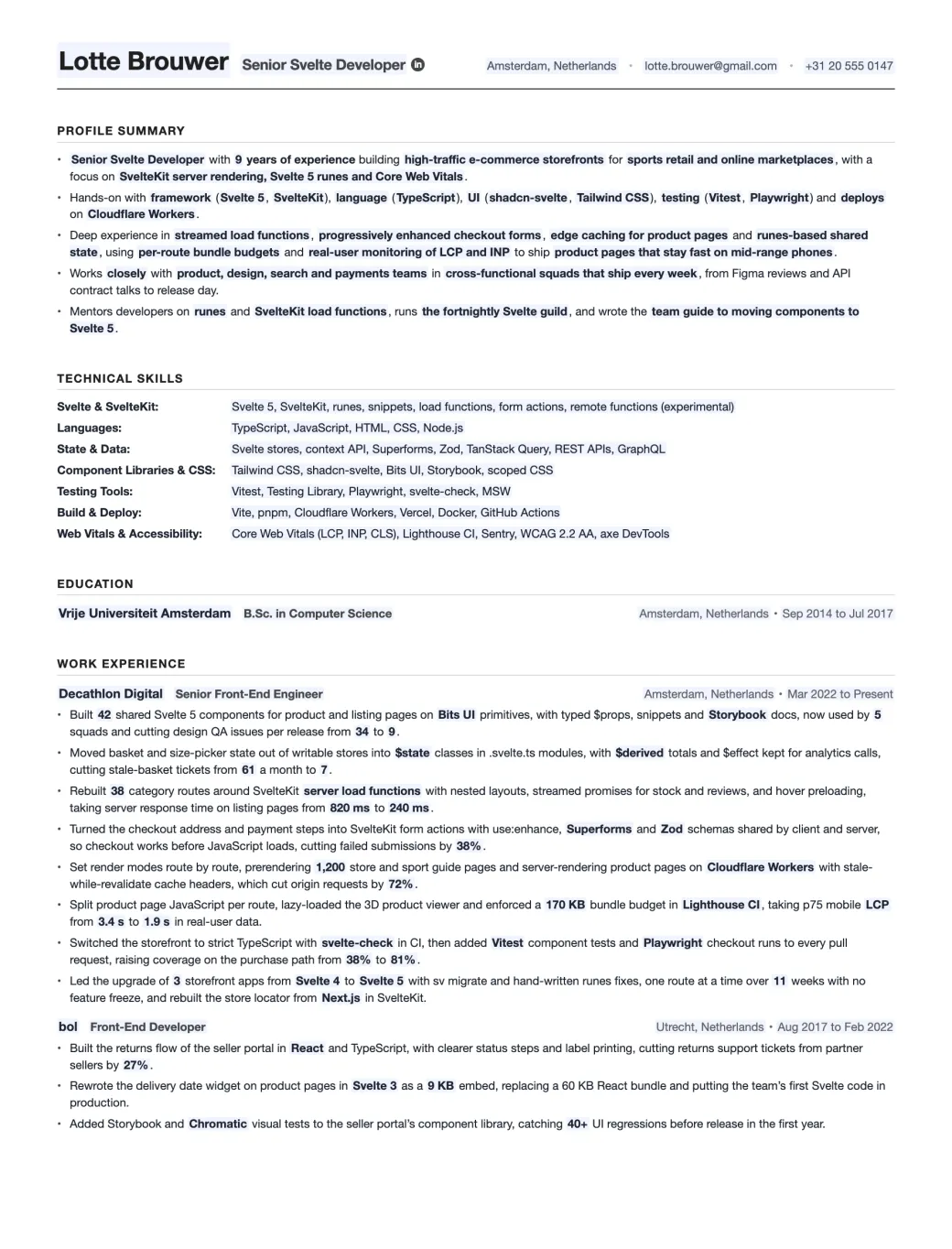
Filled-in Svelte Developer resume template for a senior developer at Decathlon Digital: profile summary, 7 technical skills rows, education and 2 jobs with 11 bullets
Emmanuel Gendre Ex-Google recruiter / Tech resume writer Updated Free, ATS-friendly, no signup

Interactive resume template generator

Interactive Svelte Developer Resume Template

Fill in the side panel, then download your resume as a PDF or a Word file.

Edits update live as you type. Toggle Edit to rewrite paper text directly.

Edit mode is on. Click anywhere on the resume to rewrite text. Side-panel placeholders still update live.

Lotte Brouwer Senior Svelte Developer

Amsterdam, Netherlands • lotte.brouwer@gmail.com • +31 20 555 0147

Profile Summary

  • Senior Svelte Developer with 9 years of experience building high-traffic e-commerce storefronts for sports retail and online marketplaces, with a focus on SvelteKit server rendering, Svelte 5 runes and Core Web Vitals.
  • Hands-on with framework (Svelte 5, SvelteKit), language (TypeScript), UI (shadcn-svelte, Tailwind CSS), testing (Vitest, Playwright) and deploys on Cloudflare Workers.
  • Deep experience in streamed load functions, progressively enhanced checkout forms, edge caching for product pages and runes-based shared state, using per-route bundle budgets and real-user monitoring of LCP and INP to ship product pages that stay fast on mid-range phones.
  • Works closely with product, design, search and payments teams in cross-functional squads that ship every week, from Figma reviews and API contract talks to release day.
  • Mentors developers on runes and SvelteKit load functions, runs the fortnightly Svelte guild, and wrote the team guide to moving components to Svelte 5.

Technical Skills

Svelte & SvelteKit:
Svelte 5, SvelteKit, runes, snippets, load functions, form actions, remote functions (experimental)
Languages:
TypeScript, JavaScript, HTML, CSS, Node.js
State & Data:
Svelte stores, context API, Superforms, Zod, TanStack Query, REST APIs, GraphQL
Component Libraries & CSS:
Tailwind CSS, shadcn-svelte, Bits UI, Storybook, scoped CSS
Testing Tools:
Vitest, Testing Library, Playwright, svelte-check, MSW
Build & Deploy:
Vite, pnpm, Cloudflare Workers, Vercel, Docker, GitHub Actions
Web Vitals & Accessibility:
Core Web Vitals (LCP, INP, CLS), Lighthouse CI, Sentry, WCAG 2.2 AA, axe DevTools

Education

Vrije Universiteit Amsterdam B.Sc. in Computer Science
Amsterdam, Netherlands • Sep 2014 to Jul 2017

Work Experience

Decathlon Digital Senior Front-End Engineer
Amsterdam, Netherlands • Mar 2022 to Present
  • Built 42 shared Svelte 5 components for product and listing pages on Bits UI primitives, with typed $props, snippets and Storybook docs, now used by 5 squads and cutting design QA issues per release from 34 to 9.
  • Moved basket and size-picker state out of writable stores into $state classes in .svelte.ts modules, with $derived totals and $effect kept for analytics calls, cutting stale-basket tickets from 61 a month to 7.
  • Rebuilt 38 category routes around SvelteKit server load functions with nested layouts, streamed promises for stock and reviews, and hover preloading, taking server response time on listing pages from 820 ms to 240 ms.
  • Turned the checkout address and payment steps into SvelteKit form actions with use:enhance, Superforms and Zod schemas shared by client and server, so checkout works before JavaScript loads, cutting failed submissions by 38%.
  • Set render modes route by route, prerendering 1,200 store and sport guide pages and server-rendering product pages on Cloudflare Workers with stale-while-revalidate cache headers, which cut origin requests by 72%.
  • Split product page JavaScript per route, lazy-loaded the 3D product viewer and enforced a 170 KB bundle budget in Lighthouse CI, taking p75 mobile LCP from 3.4 s to 1.9 s in real-user data.
  • Switched the storefront to strict TypeScript with svelte-check in CI, then added Vitest component tests and Playwright checkout runs to every pull request, raising coverage on the purchase path from 38% to 81%.
  • Led the upgrade of 3 storefront apps from Svelte 4 to Svelte 5 with sv migrate and hand-written runes fixes, one route at a time over 11 weeks with no feature freeze, and rebuilt the store locator from Next.js in SvelteKit.
bol Front-End Developer
Utrecht, Netherlands • Aug 2017 to Feb 2022
  • Built the returns flow of the seller portal in React and TypeScript, with clearer status steps and label printing, cutting returns support tickets from partner sellers by 27%.
  • Rewrote the delivery date widget on product pages in Svelte 3 as a 9 KB embed, replacing a 60 KB React bundle and putting the team’s first Svelte code in production.
  • Added Storybook and Chromatic visual tests to the seller portal’s component library, catching 40+ UI regressions before release in the first year.

Done editing? Download a real PDF (selectable text, ATS-friendly, US Letter) or an editable Word file if a recruiter asks for one.

About this template

A Svelte Developer resume template, built by a tech recruiter.

A Svelte developer builds web apps with Svelte, a framework that doesn’t ship a big runtime to the browser: it compiles your components into small JavaScript files instead. Most of the work happens in SvelteKit. That’s the routes, the load functions that fetch data on the server, the form actions, and the adapter that decides where the app runs. You’ll find the role at online stores, newsrooms, dev tool companies and SaaS teams that watch page weight closely.

Here’s the trouble: plenty of Svelte resumes are React resumes with the framework name swapped. Components, state, TypeScript, all listed, and not one line that only a Svelte developer could have written. Svelte teams hire for the framework’s own tools. Show them the runes you moved a codebase to, the routes you prerender or run at the edge, the kilobytes you cut from a bundle and the forms that still work before JavaScript loads.

Lotte, the developer in this template, works on Decathlon’s storefront. All 8 Svelte areas, snippets through to the Svelte 5 upgrade, get one bullet each in her current job, and every bullet ends in a figure. Under her resume you’ll find 3 finished samples. Prefer a blank page? Skim the samples, then work through 6 steps to write a Svelte Developer resume.

Applications going nowhere? Send your current resume through the form, and as part of a free CV review I’ll mark every line a React developer could have written word for word.

Industry signal

What the market says about Svelte Developer roles

Svelte is a smaller market than React, and it’s growing. About 7 in 100 professional developers told Stack Overflow’s 2025 survey they’d built something substantial in Svelte that year. The framework also moves quickly. Svelte 5 and its runes landed in October 2024, and SvelteKit 3 shipped on October 1, 2026, with Node 22.17, TypeScript 6 and Vite 8 as the new minimums. Teams need people who can upgrade without stopping feature work, so write the exact versions you use and the upgrades you ran yourself.

27.5M svelte npm downloads in October 2026 npm registry
$123,925 Average advertised pay, US Svelte developer jobs Talent.com

Resume Samples

Svelte Developer Resume Examples

Svelte teams come in very different shapes, so I picked 3 that have little in common for these Svelte developer resume samples. The junior writes result widgets for Brave Search from Bratislava. The senior works on the 1Password browser extension in Toronto. The lead heads a team at The New York Times that ships live election pages. You can download each one as a PDF or a Word file, free and with no signup.

Junior Svelte Developer Resume Example

At junior level, a Svelte resume has to show you can ship inside an existing SvelteKit app: components merged, tests written, one bug you tracked down yourself. Write runes, not reactive statements, because most teams are on Svelte 5 now. No Svelte job yet? Put a SvelteKit project where Job 1 would go, with the repo, where it’s deployed and one number.

Years of experience
3 years
Industry
Web search
Stack
SvelteTypeScriptVitestPlaywright
Download PDF Download Word

Click to download the Junior Svelte Developer resume example as a PDF or a Word file. Free / No signup.

Marek Dvorník

Junior Svelte Developer

Bratislava, Slovakia · marek.dvornik@gmail.com · +421 2 555 0195 · linkedin.com/in/marekdvornik

Profile Summary

  • Junior Svelte Developer with 3 years in web development, the last 2 on the Brave Search results page, after a year building game launch and campaign sites at Pixel Federation.
  • Works in Svelte 5 and SvelteKit with TypeScript, styles with Tailwind CSS, tests with Vitest and Playwright, and ships through GitHub Actions several times a week.
  • Strongest on small, fast UI components and keyboard accessibility, and checks every change against the widget bundle budget and a screen reader before asking for review.
  • Works in a squad of 2 senior engineers and a designer, reviews code every day, and agrees the JSON shape of new result types with the search backend team before building them.
  • Keeps the team’s runes cheat sheet up to date for new joiners, answers questions in the Svelte Discord, and is learning remote functions for the next settings page.

Technical Skills

Svelte & SvelteKit:
Svelte 5, SvelteKit, runes, snippets, load functions, transitions
Languages:
TypeScript, JavaScript, HTML, CSS
State & Data:
$state classes, Svelte stores, context API, REST APIs, JSON
Component Libraries & CSS:
Tailwind CSS, Bits UI, scoped CSS, Storybook (basics)
Testing Tools:
Vitest, Testing Library, Playwright, svelte-check
Build & Deploy:
Vite, pnpm, adapter-node, Docker (basics), GitHub Actions
Web Vitals & Accessibility:
Core Web Vitals, Lighthouse, WCAG 2.2 AA, axe DevTools, VoiceOver
Page 2 of 2

Work Experience

Brave Junior Front-End Engineer, Search Bratislava, Slovakia (remote) · Sep 2024 to Present
  • Built 11 result widgets for Brave Search in Svelte 5, including weather, currency and recipe cards, on one shared card shell with typed $props and a snippet for each layout.
  • Moved the filters panel from Svelte 4 reactive statements to $state and $derived, fixing region and safe search filters that fell out of sync and cutting related bug reports from 14 a month to 1.
  • Returned slow widget data as streamed promises from the results page load function, so the main results render first, cutting time to first result on throttled 3G from 2.6 s to 1.4 s.
  • Kept every new widget under a 6 KB gzipped budget by loading its code only when a query triggers it, so the results page bundle stayed flat while 11 widgets shipped.
  • Wrote Vitest component tests and Playwright keyboard tests for the widget shell, raising coverage on the widget code from 41% to 86%.
Pixel Federation Junior Web Developer Bratislava, Slovakia · Jul 2023 to Aug 2024
  • Built pre-registration forms for 4 game launches with SvelteKit form actions and server-side validation that still worked when JavaScript failed, collecting 62,000 sign-ups.
  • Moved campaign sites from WordPress to prerendered SvelteKit pages on adapter-static, cutting average page load on mobile from 4.1 s to 1.2 s.
  • Rewrote 6 jQuery campaign widgets, including a countdown and a reward calendar, as Svelte components, shrinking the shared script from 240 KB to 38 KB.

Education

Slovak University of Technology in Bratislava B.Sc. in Informatics Bratislava, Slovakia · Sep 2020 to Jun 2023

Senior Svelte Developer Resume Example

A senior Svelte resume should prove you own a hard part of the product and the calls behind it: how state moves, what ships to the browser, how it gets tested. I look for one migration you led, with numbers from before and after. Write the Svelte version too, since recruiters check it against the posting.

Years of experience
9 years
Industry
Password management
Stack
SvelteViteStorybookSentry
Download PDF Download Word

Click to download the Senior Svelte Developer resume example as a PDF or a Word file. Free / No signup.

Rowan Ashcroft

Senior Svelte Developer

Toronto, ON · rowan.ashcroft@gmail.com · +1 416-555-0121 · linkedin.com/in/rowanashcroft

Profile Summary

  • Senior Svelte Developer with 9 years in front-end work, at 1Password since 2022 on the browser extension, building the inline autofill menu and save prompts in Svelte for Chrome, Firefox, Safari and Edge.
  • Hands-on with Svelte 5, TypeScript, Vite, the WebExtensions APIs, Storybook, Vitest and Playwright, plus SvelteKit for the extension’s settings and onboarding pages.
  • Deep experience in runes-based state shared across extension contexts, shadow DOM isolation on third-party pages and keyboard-first menus, and profiles every change on a low-end Chromebook before it ships.
  • Works with the Rust core, design, security and QA teams, and agrees the message contracts between content scripts, the background worker and the UI before anyone writes code.
  • Mentors 3 developers on runes and component testing, leads the extension’s Svelte 5 migration working group, and wrote its guide to replacing slots with snippets.

Technical Skills

Svelte & SvelteKit:
Svelte 5, runes, snippets, attachments, SvelteKit, transitions
Languages:
TypeScript, JavaScript, HTML, CSS, Rust (reading level)
State & Data:
$state classes, Svelte stores, context API, Zod, extension messaging, IndexedDB
Component Libraries & CSS:
Bits UI, Tailwind CSS, Storybook, CSS custom properties, shadow DOM styling
Testing Tools:
Vitest, Testing Library, Playwright, svelte-check, MSW
Build & Deploy:
Vite, pnpm, Manifest V3, GitHub Actions, Chrome Web Store and AMO releases
Web Vitals & Accessibility:
INP, Chrome DevTools Performance panel, Sentry, WCAG 2.2 AA, NVDA, VoiceOver
Page 2 of 2

Work Experience

1Password Senior Developer, Browser Extension Toronto, ON (remote) · Feb 2022 to Present
  • Rebuilt the inline autofill menu as 24 Svelte 5 components inside a shadow root, with a snippet per item type so logins, cards and identities share one keyboard-navigable list.
  • Replaced 17 writable stores with $state classes synced through the background service worker, ending the duplicate save prompts that had made up 19% of extension bug reports.
  • Cut the content script injected into every page from 310 KB to 96 KB by lazy-loading the menu UI on first focus and dropping a date library the menu no longer used.
  • Added Playwright tests that load the built extension against 140 saved sign-in page fixtures, so autofill breakages fail in CI instead of reaching support.
  • Led the move of 180 extension components from Svelte 4 to Svelte 5 with sv migrate and small reviewed batches, shipping every 2 weeks with no feature freeze.
ecobee Front-End Developer Toronto, ON · Jul 2017 to Jan 2022
  • Built the energy history pages of the web portal in Sapper and Svelte 3 with server-side data loading, replacing a React page and cutting load time from 5.2 s to 1.8 s.
  • Rewrote the save flow of the thermostat schedule editor with server-side validation and clear error states, cutting failed schedule saves by 63%.
  • Set up server-side rendering and CDN caching for the public help pages, which took time to first byte from 1.1 s to 180 ms.

Education

Toronto Metropolitan University B.Sc. in Computer Science Toronto, ON · Sep 2013 to Apr 2017

Lead Svelte Developer Resume Example

A lead resume moves the focus from your own components to what your team ships: the standards you set, the migration you planned, the people you hired or trained. Keep 1 or 2 bullets that prove you still write Svelte, and open with the scale of the pages your team runs.

Years of experience
13 years
Industry
News and media
Stack
SvelteNode.jsFastlyGoogle Cloud
Download PDF Download Word

Click to download the Lead Svelte Developer resume example as a PDF or a Word file. Free / No signup.

Thandiwe Molefe

Lead Svelte Developer

New York, NY · thandiwe.molefe@gmail.com · +1 212-555-0166 · linkedin.com/in/thandiwemolefe

Profile Summary

  • Lead Svelte Developer with 13 years in front-end engineering, leading a team of 5 engineers at The New York Times that builds election results, live trackers and the Svelte kit behind interactive stories.
  • Works across Svelte 5, SvelteKit, TypeScript, Node.js, D3 and Playwright, choosing prerendering, server rendering or static HTML page by page and caching it all at the CDN.
  • Known for pages that hold up under traffic spikes, like results pages read by millions of people within minutes, and for component APIs that graphics editors can use without help.
  • Plans each election cycle with editors, graphics editors, the data desk and platform engineering, and agrees data formats with the results team months before the first race.
  • Sets the team’s Svelte coding standards, runs architecture reviews for interactive projects, mentors its 2 junior engineers, and has hired 3 through the interview loop.

Technical Skills

Svelte & SvelteKit:
Svelte 5, SvelteKit, runes, snippets, prerendering, streaming SSR, remote functions (trial)
Languages:
TypeScript, JavaScript, Node.js, HTML, CSS, Python (data scripts)
State & Data:
$state classes, Svelte stores, server-sent events, polling, D3, JSON feeds
Component Libraries & CSS:
in-house Svelte component kit, Storybook, CSS custom properties, scoped CSS
Testing Tools:
Vitest, Playwright, visual regression tests, svelte-check, k6 load tests
Build & Deploy:
Vite, adapter-node, adapter-static, Docker, Google Cloud Run, Fastly
Web Vitals & Accessibility:
Core Web Vitals, SpeedCurve RUM, WCAG 2.2 AA, axe-core, screen reader testing
Page 2 of 2

Work Experience

The New York Times Lead Software Engineer, Interactive News New York, NY · Mar 2021 to Present
  • Rebuilt the live results pages in SvelteKit with prerendered page shells and server-rendered race data behind the CDN, keeping them up through a 6x traffic spike on election night 2024.
  • Designed the Svelte component kit graphics editors use for maps, tables and charts, 64 components with typed props and snippets, now behind most interactive stories the desk publishes.
  • Moved live race state from polling stores to a $state class fed by server-sent events, cutting the delay between a vote update and the reader’s screen from 45 s to 8 s.
  • Shipped static charts as plain HTML and hydrated only the interactive parts of each story, cutting JavaScript per graphics story by 61%.
  • Led the migration of 200+ graphics templates and the shared kit from Svelte 3 and 4 to Svelte 5, with sv migrate, a checklist per template and weekly office hours for graphics editors.
Takealot Front-End Developer to Senior Front-End Developer Cape Town, South Africa · Jan 2013 to Feb 2021
  • Built the product listing and search pages of the storefront in React with server-side data loading and route-level caching, keeping them fast through Black Friday peaks of 10x normal traffic.
  • Rewrote the checkout address and delivery forms with server-side validation and a no-JavaScript fallback, cutting checkout errors on low-end Android phones by 34%.
  • Introduced Cypress end-to-end tests on the checkout path and ran them on every merge, catching 9 release-blocking bugs in the first year.

Education

University of the Witwatersrand B.Sc. Honours in Computer Science Johannesburg, South Africa · Feb 2009 to Dec 2012

Free resume review

A recruiter screen, but with feedback

You applied to hundreds of jobs: no result. Companies won’t give you feedback, so you’re stuck in a loop. Rejections will keep coming until you know what’s wrong.

Let’s break this cycle today!

I’ll screen your resume the same way I did at Google.

You’ll get:

  • Your resume sections and content scored.
  • A clear list of what to improve, why, and how.
  • Behind the scenes secrets on the screening process.

How I rewrite Svelte Developer resumes

How to write a Svelte Developer resume

Emmanuel Gendre, ex-Google recruiter

Emmanuel Gendre Ex-Google recruiter, tech resume writer

My 13 recruiting years included many at Google. Now I sit on the writing side and fix the kind of resumes I used to turn down. With Svelte developers, one mistake keeps coming back. Someone’s moved 150 components to runes or halved the JavaScript on a product page, and their resume says “Built responsive UIs with Svelte and TypeScript”. Nobody reading that can tell what they actually did.

On my tech resume writing service, every Svelte bullet gets rebuilt one at a time, until it shows the feature, the Svelte tools behind it and the numbers that moved. If you’re doing it yourself, though, focus on these 6 steps. There’s a Svelte example under each one.

  1. Step 1 Format & layout Fonts, columns, headings and PDF or Word, sorted in a few minutes. Go to step 1
  2. Step 2 Profile Summary Svelte version, stack, strengths and level in 5 quick bullets. Go to step 2
  3. Step 3 Work Experience One bullet per Svelte area in your current role, 8 in all. Go to step 3
  4. Step 4 Bullet Points Turn “built a component” into a bullet a team lead remembers. Go to step 4
  5. Step 5 Technical Skills Svelte, SvelteKit and 5 other skill rows, plus soft skills. Go to step 5
  6. Step 6 Keywords & Metrics Must-have keywords, a JD scanner and 24 Svelte metrics. Go to step 6

Step 1 · Format & Layout

Svelte Developer resume format and layout

I deal with layout before touching a single bullet, because it’s the smallest job on the list. An ATS strips the text out of your file and a recruiter skims it for titles and dates, both before anyone on the Svelte team sees it. Neither of them gives points for style.

01ATS Compliance

ATS compliance for your Svelte Developer resume

Picture a recruiter at a Svelte shop 3 months from now, typing “SvelteKit” into their Applicant Tracking System (ATS) to find past applicants. The ATS can only return your resume if it read your file properly when you applied. Skills tucked into a sidebar or a table often get skipped, and then you’re invisible to that search. I wrote a full explainer on ATS parsing if you want the details. Getting SvelteKit and Svelte 5 into the right fields comes down to 3 rules:

The 3 rules
  1. Use a 100% text based format (no Canva!)

  2. Avoid tables, pictures, and complex structures.

  3. Use the most predictable section names, like “Profile Summary” and “Work Experience”

02Design & Layout

Svelte Developer resume design and layout

Front-end people send me the most designed resumes I see: gradient headers, skill bars, once a whole page built in Svelte and printed to PDF. I get why, you make interfaces for a living. Still, recruiters hate fancy designs. When resumes come in stacks of 50, a creative layout means hunting for the job title on every single one.

Make it boring on purpose. One column, Calibri at 10 or 11 points, and the section titles everybody expects. Your design taste can live in a portfolio link or a deployed SvelteKit demo. Setting the document up yourself? Copy the settings in the table below.

Layout Spec
Columns
One. No sidebars, tables, columns, pictures or tabs.
Margins
0.7 in on all four sides
Body size
10 to 11 pt
Type
One family, weight for hierarchy
Length
One page under 5 years, two after
Section order
Summary, Skills, Experience, Education
PDF

03File Format

Resume file format for your Svelte Developer resume

Apply with a PDF. Your margins and fonts survive the trip to the recruiter’s screen, an ATS can read the text (a scanned image is the one exception), and nobody edits a bullet by mistake. The .docx is for agency recruiters who like to put their own logo on top before they forward you. Everything else about file types is in my PDF vs Word article.

Format Guide
PDF
Your default. Layout holds, text stays selectable.
Word (.docx)
When the posting or a recruiter asks for it. Use the Word download above.
Plain text
For portals that make you paste into a box
Never
Images, scans, password-protected PDFs, shared-drive links
File name
Lotte-Brouwer-Svelte-Developer.pdf

Step 2 · Profile Summary

Svelte Developer profile summary

Yes, even a junior Svelte resume opens with a profile summary. It’s 5 bullets, and it replaced the career objective years ago. Screening happens twice. The first look lasts seconds, and if this block doesn’t land, there’s no second look. Both stages are explained in my breakdown of how recruiters screen resumes.

On Svelte resumes, I use those 5 bullets to settle 3 things: which Svelte you write (5 with runes, or 3 and 4), what you ship with it, and how senior you’ve become. Below, I give each bullet a single task. My profile summary guide covers other tech roles if you want more examples.

  1. 1

    Title, years and scope

    Mirror the posting’s title, be it Svelte Developer, Front-End Engineer or SvelteKit Developer, then your years and the products you ship: storefronts, dashboards, news pages or extensions. Someone skimming should know your level from this bullet alone.

  2. 2

    Your stack

    Everything you open daily, in labelled groups: framework, language, UI kit, tests and deploy target. Put versions in. To someone hiring for a runes codebase, “Svelte 5” and plain “Svelte” are different claims.

  3. 3

    Domain expertise

    Your strongest Svelte work, like streamed load functions, forms that survive without JavaScript or edge caching, plus how you approach it. From this line, a team lead can guess which corner of their codebase you’d take over.

  4. 4

    Collaboration

    Designers, API and back-end developers, product managers, QA. Mention where you meet them, like Figma reviews or a talk about response shapes. Svelte developers who can’t agree on data with the API team end up rewriting load functions.

  5. 5

    Leadership

    Reviews you give, the Svelte guild you run, the migration notes you wrote, a junior you helped through their first runes refactor. No direct reports? Doesn’t matter. What counts is other developers copying how you work.

Svelte Developer resume summary example, from the template above
  • Senior Svelte Developer with 9 years of experience building high-traffic e-commerce storefronts for sports retail and online marketplaces, with a focus on SvelteKit server rendering, Svelte 5 runes and Core Web Vitals.
  • Hands-on with framework (Svelte 5, SvelteKit), language (TypeScript), UI (shadcn-svelte, Tailwind CSS), testing (Vitest, Playwright) and deploys on Cloudflare Workers.
  • Deep experience in streamed load functions, progressively enhanced checkout forms, edge caching for product pages and runes-based shared state, using per-route bundle budgets and real-user monitoring of LCP and INP to ship product pages that stay fast on mid-range phones.
  • Works closely with product, design, search and payments teams in cross-functional squads that ship every week, from Figma reviews and API contract talks to release day.
  • Mentors developers on runes and SvelteKit load functions, runs the fortnightly Svelte guild, and wrote the team guide to moving components to Svelte 5.

Step 3 · Work Experience

Svelte Developer work experience

Get past the skim and your experience gets read line by line, with 95% of the decision resting on your latest role. It’s a fair rule. Your latest role is where your Svelte version, codebase and team are right now.

The role profile below lists 8 core skills Svelte teams screen for, and your current job should prove each one with its own bullet. Gaps get noticed. If you never mention SSR or adapters, the reader assumes somebody else picked where your app runs.

Svelte Developer role profile
  1. Svelte Components & Snippets

    You build the pieces every page is made from, and the shared ones other squads import. A messy component API slows down each team that touches it, which is why Svelte leads check for clean props and real reuse. Show them how you used typed $props and snippets to build a library other teams adopted.

    Techniques
    typed $props, snippets, attachments, transitions
    Tools
    Bits UI, shadcn-svelte, Storybook, Tailwind CSS
    Metrics
    components shipped, squads using them, design QA issues
  2. Runes & Reactive State

    You keep state correct as the app grows. Stale totals and filters that drift apart are the bugs users notice first, and Svelte 5 changed how that state gets written. Explain how you used $state classes and $derived values to stop a whole type of bug coming back, and where you’ve kept $effect out.

    Techniques
    $state classes, $derived values, context API, .svelte.ts modules
    Tools
    Svelte 5 runes, Svelte stores, $inspect
    Metrics
    state bugs per month, stores removed, effects removed
  3. SvelteKit Routing & Load Functions

    You lay out the routes and decide what each page loads and when. Slow or duplicated fetching is the usual reason a SvelteKit app feels sluggish, so your judgment gets tested here. Describe how you used server load functions and streamed promises to get the main content on screen sooner.

    Techniques
    nested layouts, streamed promises, invalidation, link preloading
    Tools
    SvelteKit router, hooks, route groups, TanStack Query
    Metrics
    server response time, routes rebuilt, duplicate requests
  4. Form Actions & Server Endpoints

    You handle what happens when a user submits something. A checkout or signup form that breaks on a flaky connection loses real money, and that’s why teams like SvelteKit’s progressive enhancement. Point out how you used form actions with use:enhance and shared Zod schemas to keep submissions working and errors down.

    Techniques
    progressive enhancement, server-side validation, use:enhance
    Tools
    form actions, Superforms, Zod, +server.ts endpoints
    Metrics
    failed submissions, form errors, completion rate
  5. SSR, Prerendering & Adapters

    You decide how each route renders and where it runs. Prerendering, server rendering and edge deploys each have a cost, and a wrong pick shows up on the hosting bill or as stale pages. Walk them through how you used per-route render settings and an adapter like Cloudflare or Vercel to make pages faster or cheaper to serve.

    Techniques
    prerendering, server-side rendering, stale-while-revalidate caching
    Tools
    adapter-cloudflare, adapter-vercel, adapter-node, Netlify
    Metrics
    origin requests, time to first byte, hosting cost
  6. Bundle Size & Hydration Cost

    You shrink the JavaScript each page ships and make it quick to respond. Small bundles are a big reason companies pick Svelte, so a hiring manager won’t settle for adjectives here. Tell them how you used code splitting, lazy imports and a bundle budget in CI to bring LCP or INP down.

    Techniques
    code splitting, lazy imports, image optimisation, bundle budgets
    Tools
    Vite, Lighthouse CI, rollup-plugin-visualizer, Sentry
    Metrics
    KB of JavaScript, LCP, INP
  7. TypeScript & Test Coverage

    You make sure a change doesn’t break checkout on a Friday afternoon. Svelte teams are often small, so there may be no QA group to catch what you miss. Mention how you used svelte-check in strict mode, Vitest and Playwright to raise coverage on the pages that bring in money.

    Techniques
    strict mode, component tests, browser tests, mocked APIs
    Tools
    svelte-check, Vitest, Playwright, MSW
    Metrics
    coverage, bugs that reach production, flaky tests
  8. Migrations to Svelte 5 & SvelteKit

    You drag old code forward while the team keeps shipping. Plenty of companies still run Svelte 4 or a half-migrated React app, and they’re hiring for exactly this. Detail how you used sv migrate and a route-by-route plan to finish the upgrade without a feature freeze.

    Techniques
    sv migrate, route-by-route rewrites, slots to snippets
    Tools
    Svelte 5, SvelteKit 3, Svelte 4, Next.js
    Metrics
    components migrated, weeks to finish, regressions

Your current job now has 8 bullets. That’s fine when every one of them ends on a result. Stuck on Svelte 4 at work? Describe that job honestly, then add a side project written in runes as its own entry.

Submit your resume for a free review!

Step 4 · Bullet Points

Svelte Developer resume bullet points

Ask me where a rewrite’s hours go and the answer’s always bullets, which is why the Level System exists. Underneath it sits the XYZ formula Google made famous. I’ve stacked 2 extra parts on top, your stack and your method, because that’s what a Svelte team lead reads for. The Level System, explained step by step, is in my job search toolkit.

Each level adds the answer to one question. The bare task answers the first. Every later answer makes the line more specific, and on Svelte work the fifth one’s usually kilobytes saved, a faster LCP, a coverage jump or a count of components on runes. Below, one storefront search bullet climbs all 5 levels.

  1. Level 1Task

    What did I work on? Start with the feature you built and a strong verb. At this level, the bullet could belong to any front-end developer.

    Built the search autocomplete for the storefront.

  2. Level 2+ Techniques

    How did I do it? Add the technique you used. Now the reader sees a decision you made, not just a task.

    Built the search autocomplete for the storefront with debounced queries and keyboard navigation.

  3. Level 3+ Tools

    What tools did I use? Add Svelte 5, SvelteKit and the libraries, written the way job ads write them.

    Built the search autocomplete for the storefront in Svelte 5 and SvelteKit with debounced queries and keyboard navigation, served from a +server.ts endpoint on Cloudflare Workers.

  4. Level 4+ Method

    What method did I follow? Explain how you checked it worked: tests, a budget in CI or a gradual rollout.

    Built the search autocomplete for the storefront in Svelte 5 and SvelteKit with debounced queries and keyboard navigation, served from a +server.ts endpoint on Cloudflare Workers, tested in Playwright and rolled out behind a feature flag.

  5. Level 5+ Metric

    What was the result? End on one number: kilobytes cut, seconds off LCP or more people finding what they searched for.

    Built the search autocomplete for the storefront in Svelte 5 and SvelteKit with debounced queries and keyboard navigation, served from a +server.ts endpoint on Cloudflare Workers, tested in Playwright and rolled out behind a feature flag, lifting search-to-product clicks by 14%.

    1. 01 Task What you worked on
    2. 02 Techniques How you did it
    3. 03 Tools The stack you used
    4. 04 Method The method you followed
    5. 05 Metric The result, one number

Look in your tools before you guess. Vite prints chunk sizes after every build, Sentry or your analytics keeps months of real-user LCP and INP, and your merged pull requests show how many components went to runes.

Step 5 · Technical Skills

Svelte Developer resume skills

Svelte postings ask for a short, predictable list, and I sort it into 7 rows: Svelte and SvelteKit, languages, state and data, component libraries and CSS, testing, build and deploy, and Web Vitals. Use the product names exactly as the ad prints them, because an ATS looking for “SvelteKit” won’t match “Svelte meta-framework”.

Anything in this section can come up in a technical interview. Put “remote functions” down and someone may ask why they’re still marked experimental. Then come the 7 categories, Lotte’s skills block, and the soft skills I check for, proved in bullets. Keywords get their own step next.

The 7 skill categories for a Svelte Developer resume

Starred skills turn up in most Svelte ads I read, so they lead their row. Add the others only when you can point to real work that used them.

Svelte & SvelteKit

The framework, the version and the SvelteKit features you use. If you’re on runes, write Svelte 5, since many postings now ask for it by name.

Svelte 5SvelteKitrunessnippetsload functionsform actionsremote functionsSvelte 4

Languages

TypeScript leads almost every Svelte posting, with JavaScript, HTML and CSS taken for granted. Add Node.js if you write server code in SvelteKit.

TypeScriptJavaScriptHTMLCSSNode.js

State & Data

How you hold state and talk to APIs. Svelte stores still show up in ads, next to validation with Zod and data fetching with TanStack Query.

Svelte storesREST APIscontext APIZodTanStack QueryGraphQLSuperforms

Component Libraries & CSS

Your UI kit and styling. Tailwind CSS is the most common pairing with Svelte, and shadcn-svelte or Skeleton tells a recruiter which component library you know.

Tailwind CSSshadcn-svelteBits UISkeletonFlowbite SvelteStorybookscoped CSS

Testing Tools

Vitest for unit and component tests, Playwright for end-to-end runs. Add svelte-check and MSW if they run in your pipeline.

VitestPlaywrightTesting Librarysvelte-checkMSWCypress

Build & Deploy

Vite builds every SvelteKit app, so the real signal is where yours runs: the adapter and the platform, like Vercel or Cloudflare Workers.

ViteSvelteKit adaptersVercelCloudflare WorkersNetlifyDockerGitHub Actionspnpm

Web Vitals & Accessibility

Where your speed and accessibility claims come from. Say which Core Web Vitals you watch and which WCAG level your components meet.

Core Web VitalsWCAG 2.2LighthouseSentryaxe DevTools

A finished Svelte Developer skills section

Technical Skills sample, from the template above
Svelte & SvelteKit
Svelte 5, SvelteKit, runes, snippets, load functions, form actions, remote functions (experimental)
Languages
TypeScript, JavaScript, HTML, CSS, Node.js
State & Data
Svelte stores, context API, Superforms, Zod, TanStack Query, REST APIs, GraphQL
Component Libraries & CSS
Tailwind CSS, shadcn-svelte, Bits UI, Storybook, scoped CSS
Testing Tools
Vitest, Testing Library, Playwright, svelte-check, MSW
Build & Deploy
Vite, pnpm, Cloudflare Workers, Vercel, Docker, GitHub Actions
Web Vitals & Accessibility
Core Web Vitals (LCP, INP, CLS), Lighthouse CI, Sentry, WCAG 2.2 AA, axe DevTools

Soft skills for a Svelte Developer resume

A skills line that says “great communicator” proves nothing to a Svelte team lead. Proof works better, so each of the 5 behaviours below comes with a resume line that shows it in action.

  • Teaching runes to developers who came from React

    Resume bulletRan 4 runes workshops for React developers joining the team, and all 6 of them shipped a Svelte 5 feature in their first month.

  • Agreeing on load function data with the back-end team

    Resume bulletAgreed typed response shapes for 12 product endpoints with the API team before writing the load functions, so no page needed rework after launch.

  • Shipping a big migration in small weekly steps

    Resume bulletSplit the Svelte 5 upgrade into 30 route-sized pull requests and merged 1 or 2 a week, without blocking a single release.

  • Checking every change on a budget Android phone

    Resume bulletTested every release on a budget Android phone over throttled 4G, which caught a 300 ms INP regression before it shipped.

  • Turning down a dependency SvelteKit already replaces

    Resume bulletKept a 40 KB form library out of checkout by showing the team that SvelteKit form actions already covered validation and errors.

Step 6 · Keywords & Metrics

Svelte Developer resume keywords and metrics

I test the finished resume like a recruiter would. First I search it for keywords such as “SvelteKit” or “Vitest”, the words they’d type into the ATS. Then I check every bullet for metrics, a figure like kilobytes of JavaScript, seconds of LCP or test coverage.

Keywords come first, in 3 tiers. Then there’s the finder: paste an ad you’re interested in and it lists what your resume lacks. Last, a table of 24 Svelte metrics, sorted by area, with each metric used in a bullet.

+42%

Svelte Developer resume keywords, ranked

Each chip opens the wording Svelte postings usually use for that skill. That matters because ads rarely agree: “SSR”, “server-side rendering” and “SvelteKit SSR” all describe the same job.

Must-have

8

Use these in your summary and skills section, and back each one with a bullet.

In a job description“3+ years building production web apps with Svelte”

Strong supporting

10

Add the ones you’ve used to your skills rows and work them into 2 or 3 bullets.

In a job description“Comfortable with $state, $derived and $effect”

Bonus

10

Mention them where they’re true. They help you stand out, but they rarely decide the screen.

In a job description“Experience with Svelte 5 snippets and component composition”

Extract Svelte Developer keywords from a job description

Got a Svelte, SvelteKit or front-end engineer ad open? Paste all of it here. You’ll see every Svelte feature, library, test tool and hosting platform it asks for, split into 3 tiers. Add the ones that are true for you and missing from your resume.

Must-have
Put these in your skills section and back each one with a bullet.
Strong supporting
Add the ones you’ve actually worked with. Skip the rest.

Nothing is uploaded: it all happens in your browser.

Metrics for a Svelte Developer resume

Choose the metric that matches the area a bullet covers. You’ll only need one per bullet, and an honest small figure is better than an empty claim.

MetricExample bullet
Components & snippets
Shared components published Count Components other squads or apps import from your library.Published 36 components to the internal Svelte library, now imported by 4 apps.
Design QA issues per release Count UI bugs designers log against a release before it ships.Moved every form to shared input components, cutting design QA issues per release from 27 to 6.
Time to build a new page Time How long a squad needs to put a new page together from existing components.Gave squads a kit of layout snippets and cards, so a new landing page takes 2 days instead of 2 weeks.
Runes & state
State bugs per month Count Bug reports caused by stale or out-of-sync state.Replaced chained reactive statements in the cart with $derived values, cutting state bugs from 23 a month to 3.
Components moved to runes Count Components rewritten from Svelte 4 syntax to $state, $derived and $props.Moved 120 components to runes in one quarter while the team kept shipping features.
Effects removed Count $effect calls replaced by derived values or event handlers.Cut 48 $effect calls to 9 by deriving values instead, which ended an update loop that froze the filter panel.
Routing & load functions
Server response time Time Time from the request to the first byte of a server-rendered page.Moved listing data into server load functions with streamed reviews, taking server response time from 780 ms to 210 ms.
Duplicate requests Percent API calls fired twice for the same data during one navigation.Shared parent layout data instead of refetching it in each page, cutting duplicate API calls by 64%.
Routes owned Count Pages and layouts in the router that you built or maintain.Own 45 routes in the account area, including nested layouts for settings and billing.
Form actions & endpoints
Failed submissions Percent Form submits that end in an error or a timeout.Rebuilt signup as a form action with use:enhance, cutting failed submissions on mobile by 41%.
Forms that work without JavaScript Count Forms that still submit when client JavaScript fails to load.Made 14 checkout and account forms work without client JavaScript through progressive enhancement.
Invalid requests stopped early Percent Bad input caught by shared schemas before it reaches the API.Shared Zod schemas between client and server, so 97% of invalid orders stop before the payment API sees them.
SSR & adapters
Pages prerendered Count Routes built to static HTML at deploy time.Prerendered 2,400 guide and store pages, keeping server rendering for pages with live stock.
Origin requests Percent Requests that miss the CDN and reach your servers.Added stale-while-revalidate headers to product routes on Cloudflare Workers, cutting origin requests by 68%.
Hosting cost Money What it costs each month to serve the app.Moved marketing routes to adapter-static on a CDN, cutting the hosting bill from $4,100 to $900 a month.
Bundle size & hydration
JavaScript per page Count Kilobytes of compressed JavaScript a page downloads.Lazy-loaded the reviews widget and the size guide, cutting product page JavaScript from 390 KB to 150 KB.
Largest Contentful Paint Time p75 time until the main content shows, from real-user data.Preloaded the hero image and streamed below-the-fold data, bringing p75 mobile LCP from 3.2 s to 1.8 s.
Interaction to Next Paint Time p75 delay between a tap and the next screen update.Moved filter sorting off the main thread, taking p75 INP on listing pages from 420 ms to 140 ms.
TypeScript & testing
Coverage on key flows Percent Share of checkout or signup code covered by tests.Added Vitest and Playwright tests to checkout, raising its coverage from 35% to 82%.
Bugs reaching production Count Defects users report after a release.Ran svelte-check and Playwright on every pull request, cutting production bugs per release from 11 to 2.
Type errors in CI Count Errors svelte-check reports on the main branch.Turned on strict mode and cleared 640 type errors, then kept the main branch at zero.
Migrations
Components migrated Count Components moved from Svelte 4, React or Vue to Svelte 5.Migrated 210 components from Svelte 4 to Svelte 5 with sv migrate and hand fixes.
Time to finish the upgrade Time Calendar time from the first migrated route to the last.Finished the SvelteKit 2 upgrade in 6 weeks with no feature freeze, one route group at a time.
Regressions after a migration Count Bugs the migration caused that were found after release.Rebuilt the account area from React in SvelteKit with only 2 regressions reported in the first month.

What if you don’t have exact numbers?

  • 1

    Check the tools that already measure your work. Vite prints chunk sizes on every build, Lighthouse CI and Sentry keep performance history, and your Git log shows how many components you’ve touched.

  • 2

    Estimate, and stay on the low side. “About 40 components” or “roughly half the JavaScript” is honest enough if you can explain the maths when an interviewer asks.

  • 3

    Count what you own. If nobody’s measured anything, the routes you maintain, the squads importing your components or the apps you upgraded still give your work a size.

Free resume review

A recruiter screen, but with feedback

You applied to hundreds of jobs: no result. Companies won’t give you feedback, so you’re stuck in a loop. Rejections will keep coming until you know what’s wrong.

Let’s break this cycle today!

I’ll screen your resume the same way I did at Google.

You’ll get:

  • Your resume sections and content scored.
  • A clear list of what to improve, why, and how.
  • Behind the scenes secrets on the screening process.

Frequently asked

Svelte Developer resume FAQ

It’s free, with no paywall or sign-up screen anywhere. Type over Lotte’s details, export the file, and bookmark the page so you can add your next SvelteKit project later.

Yes, there’s a .docx export. It’s the Word button in the toolbar, and the file opens in Word, Google Docs or Pages. Marek’s, Rowan’s and Thandiwe’s samples come as Word files too. My advice is still to apply with a PDF and keep Word for the rare recruiter who needs to change your wording.

It’s built for it. One column, normal section names, no tables or icons, and the export keeps your words as text, so “SvelteKit” stays searchable. Curious what a parser actually extracts from your current resume? My ATS compatibility checker shows you in a few seconds.

Most juniors and mid-level Svelte developers fit on one page. Once you’re past about 5 years, a second page is normal. Recruiters weigh what you shipped, not the page count, and my resume length article goes through why.

No. There’s no official Svelte certification, and hiring managers don’t ask for one. They want proof that you’ve shipped with Svelte 5 and SvelteKit: a public repo, a live site or a bullet with a number. A cloud certification for the platform you deploy to can still go under Education.

The ones Svelte teams track: kilobytes of JavaScript per page, LCP and INP from real users, test coverage on the main flows, failed form submissions, and how many components you’ve moved to runes. Each bullet gets one, and Step 6 has a table of 24 to pick from.

Same structure, different proof. For Svelte I want runes, load functions, form actions and adapters, plus a focus on small bundles. Someone filling in a React developer resume template should be heavy on React hooks and Next.js routing instead. A Vue developer resume template is all about the Composition API, Pinia and Nuxt. Worked in two of them? Lead with the framework in the job title.

Use this one when the job ad asks for Svelte or SvelteKit by name. Some postings don’t care which framework you use, and some developers split their week between Svelte, React and plain web platform work. In both cases you’re better off with the front-end developer resume template, which leads with accessibility, design work and cross-browser testing.

Treat your strongest SvelteKit side project as Job 1: what it does, how it’s built (Svelte 5, SvelteKit, the adapter and host) and one figure, such as its Lighthouse score or bundle size. Include the repo link. Merged pull requests to Svelte libraries also count, so list them.

No. A recruiter can’t see which template you used, and it wouldn’t matter if they could. The danger is a leftover sample line, like a bullet about Decathlon’s store locator. Before you apply, swap each line for your own projects.

More resources

More help with your Svelte Developer resume