
Engine Programmer Resume Examples & Free Template (PDF, Word)

Edit this free engine programmer resume template, which opens with Aidan’s Unreal Engine 5 work at Epic Games (allocators, job systems, load times, console ports). Further down you’ll find junior, senior and lead examples and a 6-step writing guide from a former Google recruiter.

4.9 5.0
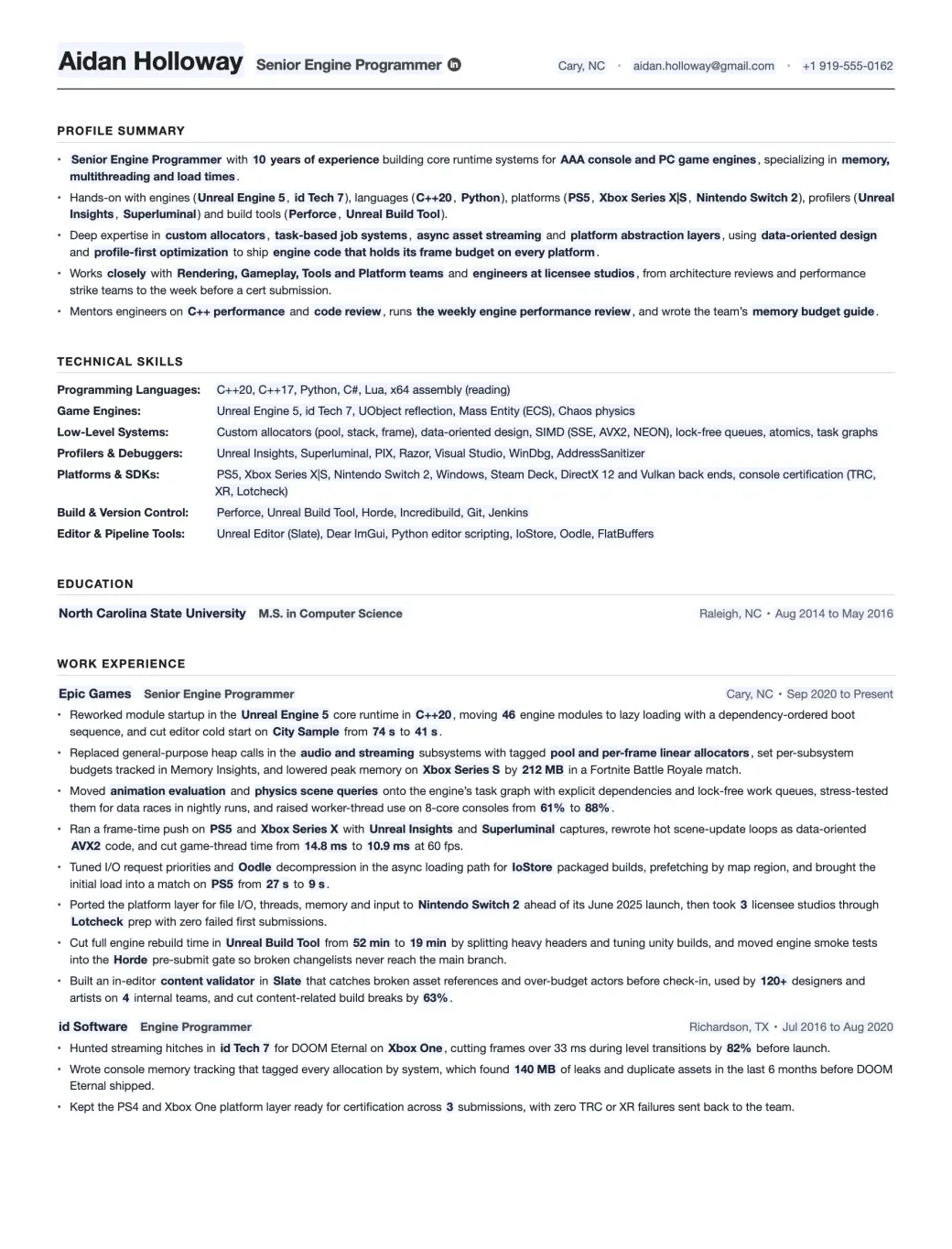
The Engine Programmer resume template with Aidan Holloway’s details: profile summary, technical skills, education and bullets on memory, job systems, load times and console ports
Emmanuel Gendre Ex-Google recruiter / Tech resume writer Updated Free, ATS-friendly, no signup

Interactive resume template generator

Interactive Engine Programmer Resume Template

Fill in the side panel, then download your resume as a PDF or a Word file.

Edits update live as you type. Toggle Edit to rewrite paper text directly.

Edit mode is on. Click anywhere on the resume to rewrite text. Side-panel placeholders still update live.

Aidan Holloway Senior Engine Programmer

Cary, NC • aidan.holloway@gmail.com • +1 919-555-0162

Profile Summary

  • Senior Engine Programmer with 10 years of experience building core runtime systems for AAA console and PC game engines, specializing in memory, multithreading and load times.
  • Hands-on with engines (Unreal Engine 5, id Tech 7), languages (C++20, Python), platforms (PS5, Xbox Series X|S, Nintendo Switch 2), profilers (Unreal Insights, Superluminal) and build tools (Perforce, Unreal Build Tool).
  • Deep expertise in custom allocators, task-based job systems, async asset streaming and platform abstraction layers, using data-oriented design and profile-first optimization to ship engine code that holds its frame budget on every platform.
  • Works closely with Rendering, Gameplay, Tools and Platform teams and engineers at licensee studios, from architecture reviews and performance strike teams to the week before a cert submission.
  • Mentors engineers on C++ performance and code review, runs the weekly engine performance review, and wrote the team’s memory budget guide.

Technical Skills

Programming Languages:
C++20, C++17, Python, C#, Lua, x64 assembly (reading)
Game Engines:
Unreal Engine 5, id Tech 7, UObject reflection, Mass Entity (ECS), Chaos physics
Low-Level Systems:
Custom allocators (pool, stack, frame), data-oriented design, SIMD (SSE, AVX2, NEON), lock-free queues, atomics, task graphs
Profilers & Debuggers:
Unreal Insights, Superluminal, PIX, Razor, Visual Studio, WinDbg, AddressSanitizer
Platforms & SDKs:
PS5, Xbox Series X|S, Nintendo Switch 2, Windows, Steam Deck, DirectX 12 and Vulkan back ends, console certification (TRC, XR, Lotcheck)
Build & Version Control:
Perforce, Unreal Build Tool, Horde, Incredibuild, Git, Jenkins
Editor & Pipeline Tools:
Unreal Editor (Slate), Dear ImGui, Python editor scripting, IoStore, Oodle, FlatBuffers

Education

North Carolina State University M.S. in Computer Science
Raleigh, NC • Aug 2014 to May 2016

Work Experience

Epic Games Senior Engine Programmer
Cary, NC • Sep 2020 to Present
  • Reworked module startup in the Unreal Engine 5 core runtime in C++20, moving 46 engine modules to lazy loading with a dependency-ordered boot sequence, and cut editor cold start on City Sample from 74 s to 41 s.
  • Replaced general-purpose heap calls in the audio and streaming subsystems with tagged pool and per-frame linear allocators, set per-subsystem budgets tracked in Memory Insights, and lowered peak memory on Xbox Series S by 212 MB in a Fortnite Battle Royale match.
  • Moved animation evaluation and physics scene queries onto the engine’s task graph with explicit dependencies and lock-free work queues, stress-tested them for data races in nightly runs, and raised worker-thread use on 8-core consoles from 61% to 88%.
  • Ran a frame-time push on PS5 and Xbox Series X with Unreal Insights and Superluminal captures, rewrote hot scene-update loops as data-oriented AVX2 code, and cut game-thread time from 14.8 ms to 10.9 ms at 60 fps.
  • Tuned I/O request priorities and Oodle decompression in the async loading path for IoStore packaged builds, prefetching by map region, and brought the initial load into a match on PS5 from 27 s to 9 s.
  • Ported the platform layer for file I/O, threads, memory and input to Nintendo Switch 2 ahead of its June 2025 launch, then took 3 licensee studios through Lotcheck prep with zero failed first submissions.
  • Cut full engine rebuild time in Unreal Build Tool from 52 min to 19 min by splitting heavy headers and tuning unity builds, and moved engine smoke tests into the Horde pre-submit gate so broken changelists never reach the main branch.
  • Built an in-editor content validator in Slate that catches broken asset references and over-budget actors before check-in, used by 120+ designers and artists on 4 internal teams, and cut content-related build breaks by 63%.
id Software Engine Programmer
Richardson, TX • Jul 2016 to Aug 2020
  • Hunted streaming hitches in id Tech 7 for DOOM Eternal on Xbox One, cutting frames over 33 ms during level transitions by 82% before launch.
  • Wrote console memory tracking that tagged every allocation by system, which found 140 MB of leaks and duplicate assets in the last 6 months before DOOM Eternal shipped.
  • Kept the PS4 and Xbox One platform layer ready for certification across 3 submissions, with zero TRC or XR failures sent back to the team.


Done editing? Download a real PDF (selectable text, ATS-friendly, US Letter) or an editable Word file if a recruiter asks for one.

About this template

An Engine Programmer resume template, built by a tech recruiter.

An engine programmer writes the part of a game players never see. You build the C++ underneath everything else. That means the memory allocators, the job system that spreads work across cores, asset loading and streaming, the platform layer for PS5, Xbox and Switch 2, and the tools designers use all day. Gameplay programmers make the game fun. You make sure it boots, loads fast and holds its frame rate.

Ten engine resumes in a row usually say the same thing: C++, Unreal, “performance optimization” and a row of console names. A lead programmer has seen that line hundreds of times and won’t slow down for it. The resumes that get a call carry measured results: milliseconds off the frame, megabytes back under the memory budget, seconds off a load screen, builds that cleared cert and tools the team relies on. Studios pay engine programmers to move those numbers, so put them up front.

That’s the idea behind this template. Aidan’s Epic Games job gives each competency in the engine profile its own bullet, which shows you where allocators stop and editor tools start. A junior at Coffee Stain, a senior at Crytek and a lead at Infinity Ward follow on the same layout. 6 steps to write an Engine Programmer resume come right after the examples.

Already applying to studios? Upload your draft in the form below to use my free resume critique service. I’ll point out every bullet that still reads like a feature list.

Industry signal

What the market says about Engine Programmer roles

Is engine programming a smart move in 2026? There’s no official headcount for the job, which is why the first number above is for US software developers as a whole. The signs inside games are clearer. Nintendo had sold 23.68 million Switch 2 consoles by June 30, 2026, Unreal Engine 5.8 shipped in June with new cooking and handheld paths, and Unity 6.0 LTS support ends this month. Each of those means ports, upgrades and tighter budgets, which is engine work.

+10% US software developer job growth, 2025 to 2035 US Bureau of Labor Statistics
$195,000 Median total pay, US game software engineers Levels.fyi
  • Sebastian Aaltonen @SebAaltonen · Former principal engineer at Unity and Ubisoft
    ROG Ally first impressions with Petafab: I play at 66% resolution scale to match Steam Deck. Frame rate hovers at 90-120Hz. A bit above Deck, but battery drains much faster (25W mode). Deck offers 4 hours. Ally a lot less. But the game has fluids now -> 10% higher GPU usage.
  • Unity @unity · Official Unity account
    Introducing Unity 7 - built for a faster-moving, more open industry where creators, cross-functional teams, and coding agents can seamlessly collaborate across every stage of the development cycle. Featuring: - Create faster: Modernized CoreCLR foundation with a near-instant…
  • Godot Engine @godotengine · Official Godot Engine account
    #GodotEngine 4.7 is here! 🎉 Like a cult classic movie, Godot 4 has only gotten better with age; the 4.7 Director's Cut helms a bevy of new features to eliminate any remaining friction between you and your vision! godotengine.org/releases/4.7/
  • Unreal Engine @UnrealEngine · Epic Games' official Unreal Engine account
    Just announced live: Unreal Engine 5.8 is releasing today! We’ve focused on pushing performance further while also bringing many core features to maturity and readiness for production. More headroom, fewer hitches, less friction: epic.gm/ue-5-8-blog

Resume Samples

Engine Programmer Resume Examples

I picked 3 engine programmer resume examples for this page, one per level, so you can compare year 3 with year 14. They come from 3 studios on 3 different engines. Kai, the junior, profiles giant save files and builds editor checks for Satisfactory at Coffee Stain Studios. Vihaan, the senior, owns job system, memory and streaming work in CryEngine at Crytek. Marisol, the lead, manages 7 engine programmers on Call of Duty at Infinity Ward. You can download each one as a PDF or a Word file, free and with no signup.

Junior Engine Programmer Resume Example

At junior level, the engine lead reading your resume wants one answer: can you find a real problem in a big C++ codebase and prove you fixed it? Give them a profiling win, a memory or load-time fix, and a tool other people use every day. An internship or a student engine counts too, as long as you measured it.

Years of experience
3 years
Industry
PC and console games
Stack
Unreal EngineC++UnityPerforce
Download PDF Download Word

Click to download the Junior Engine Programmer resume example as a PDF or a Word file. Free / No signup.

Kai Schneider

Junior Engine Programmer

Skövde, Sweden · kai.schneider@gmail.com · +46 70 555 0142 · linkedin.com/in/kaischneider

Profile Summary

  • Junior Engine Programmer with 3 years on a factory-building game in Unreal Engine 5, working on game-thread performance, save memory and editor tools for the PC and console versions.
  • Writes C++20 and Python, profiles with Unreal Insights and Superluminal, builds tools in Slate, and works in Perforce with Unreal Build Tool and Jenkins.
  • Strongest in late-game performance, memory leaks in saves and asset validation, after chasing slowdowns that only showed up in player saves with huge factories and thousands of conveyor belts.
  • Works with Gameplay, Tech Art and the console team, joins the weekly performance review, and pairs with QA on crash repros from player bug reports.
  • Wrote the studio’s Unreal Insights quick-start guide for new programmers and helped 2 interns land their first engine changes.

Technical Skills

Programming Languages:
C++20, C++17, Python, C#
Game Engines:
Unreal Engine 5, Unity (DOTS)
Low-Level Systems:
Data-oriented design, multithreading, Unreal memory tags, SIMD basics
Profilers & Debuggers:
Unreal Insights, Superluminal, Visual Studio, PIX
Platforms & SDKs:
Windows, PS5, Xbox Series X|S, Steam
Build & Version Control:
Perforce, Unreal Build Tool, Jenkins, Git
Editor & Pipeline Tools:
Unreal Editor (Slate), Python editor scripting, Dear ImGui
Page 2 of 2

Work Experience

Coffee Stain Studios Junior Engine Programmer Skövde, Sweden · Aug 2023 to Present
  • Built an in-editor checker in Slate and Python that catches building meshes with missing collision or LODs before check-in, stopping 300+ broken assets in its first 4 months.
  • Profiled late-game player saves in Unreal Insights and moved conveyor belt item updates into one batched, cache-friendly loop, cutting game-thread time by 2.1 ms on the heaviest test save.
  • Traced a save-system leak in object serialization with Unreal’s memory tags, which stopped long sessions from growing by about 1.4 GB over 6 hours of play.
  • Split the starting world’s level streaming into smaller cells with soft asset references, and brought the first load on a mid-range PC from 48 s to 31 s.
  • Fixed 27 certification issues in save data, suspend and resume, and controller handling for the November 2025 PS5 and Xbox Series X|S launch, as the junior on a 4-person console team.
Stunlock Studios Engine Programming Intern Skövde, Sweden · Jun 2022 to Dec 2022
  • Rewrote a projectile collision check as a Burst-compiled Unity job across worker threads, cutting its CPU cost in 40-player server tests from 3.2 ms to 0.9 ms.
  • Added a gate and door state component and system to the game’s ECS code, with save support, which 3 gameplay programmers reused for later content.
  • Set up a nightly Jenkins job running 120 automated play-mode tests on the server build, so regressions showed up the morning after they landed.

Education

University of Skövde B.Sc. in Computer Game Development (Programming) Skövde, Sweden · Aug 2020 to Jun 2023

Senior Engine Programmer Resume Example

A senior engine resume is about ownership. Show the systems a studio trusted you with (the job system, the allocators, streaming), the platforms you shipped them on, and the frame time, memory or load time you moved. Console certification work belongs here as well, since plenty of engine programmers have never done it.

Years of experience
8 years
Industry
Multiplayer and action games
Stack
CryEngineC++PlayStation 5Jenkins
Download PDF Download Word

Click to download the Senior Engine Programmer resume example as a PDF or a Word file. Free / No signup.

Vihaan Bhatt

Senior Engine Programmer

Frankfurt am Main, Germany · vihaan.bhatt@gmail.com · +49 69 5550 1730 · linkedin.com/in/vihaanbhatt

Profile Summary

  • Senior Engine Programmer with 8 years on in-house engines for multiplayer and action games, focused on multithreading, memory and streaming for PS5, Xbox Series X|S and PC.
  • Works in C++20 and Python on CryEngine and Fledge, profiles with PIX, Razor and Superluminal, and builds with Incredibuild and Jenkins.
  • Deep experience in fiber job systems, frame allocators and memory budgets, and texture and geometry streaming, using capture-based performance reviews to hold 60 fps in 12-player matches.
  • Partners with Rendering, Network, Gameplay and QA teams, from the weekly performance review to the certification checklist before each console update.
  • Mentors 3 engine programmers, reviews every change to the job system, and wrote the studio’s guide to console memory budgets.

Technical Skills

Programming Languages:
C++20, C++17, Python, Lua
Game Engines:
CryEngine, Fledge (in-house), Unreal Engine 5 (side projects)
Low-Level Systems:
Fiber job systems, lock-free queues, frame and pool allocators, data-oriented design, SIMD (SSE, AVX2)
Profilers & Debuggers:
PIX, Razor, Superluminal, Visual Studio, WinDbg, AddressSanitizer
Platforms & SDKs:
PS5, Xbox Series X|S, Windows, PS4, Xbox One, TRC and XR requirements
Build & Version Control:
Perforce, Incredibuild, Jenkins, CMake, Git
Editor & Pipeline Tools:
CryEngine Sandbox, Dear ImGui, Python asset scripts, FlatBuffers
Page 2 of 2

Work Experience

Crytek Senior Engine Programmer Frankfurt am Main, Germany · Mar 2022 to Present
  • Moved physics and AI updates in CryEngine onto fiber-based jobs with explicit dependencies, and raised average core use on PS5 from 58% to 83% in 12-player matches.
  • Built tagged frame allocators and per-system budgets during the 2024 engine upgrade, cutting peak memory on Xbox Series S by 410 MB on the Mammon’s Gulch map.
  • Rewrote texture and geometry streaming priorities around player distance and line of sight, and brought the match load on PS5 from 41 s to 23 s.
  • Led a 6-week frame-time push before the Hunt: Showdown 1896 launch on console, using PIX and Razor captures, taking the main thread from 21 ms to 15.6 ms.
  • Moved engine builds to Incredibuild with a shared cache and added overnight soak tests in Jenkins, cutting a full rebuild from 38 to 14 minutes.
Deck13 Interactive Engine Programmer Frankfurt am Main, Germany · Sep 2018 to Feb 2022
  • Rebuilt entity update order in the in-house Fledge engine around explicit tick groups, removing a class of frame-order bugs behind 30+ crashes in The Surge 2 QA builds.
  • Ported the file I/O and save layer to PS4 and Xbox One for The Surge 2, fixing 45 TRC and XR issues before the September 2019 launch.
  • Wrote a Dear ImGui debug menu that lets level designers toggle AI, spawn enemies and drop performance markers, used daily by 25 designers and QA testers.

Education

Technische Universität Darmstadt M.Sc. in Computer Science Darmstadt, Germany · Oct 2016 to Aug 2018

Lead Engine Programmer Resume Example

At lead level, your bullets move from your own code to the engine as a whole: the team you run, the architecture other studios build on, and the milestones you got through. Keep a couple of hands-on wins in there, because most lead engine jobs still expect you to write and review C++ every week.

Years of experience
14 years
Industry
AAA live-service shooters
Stack
C++PlayStation 5XboxPerforce
Download PDF Download Word

Click to download the Lead Engine Programmer resume example as a PDF or a Word file. Free / No signup.

Marisol Quintero

Lead Engine Programmer

Los Angeles, CA · marisol.quintero@gmail.com · +1 310-555-0184 · linkedin.com/in/marisolquintero

Profile Summary

  • Lead Engine Programmer with 14 years on AAA live-service shooters, leading 7 engine programmers on core runtime, streaming and performance for console and PC releases.
  • Works in C++20 on the IW engine and, before that, Bungie’s Tiger engine, with PIX, Razor, Superluminal, Perforce and Incredibuild on PS5, Xbox Series X|S and PC.
  • Deep experience in engine architecture and code ownership, world streaming for large maps, and job systems and allocators, using per-system frame budgets and nightly capture runs so several studios can ship on one engine branch.
  • Partners with Rendering, Online, Production and studio technical directors across Call of Duty, from milestone planning to the certification checklist.
  • Leads 7 engine programmers, has mentored 4 of them to senior, chairs the weekly engine architecture review, and wrote the team’s engine change review guide.

Technical Skills

Programming Languages:
C++20, C++17, Python, Lua
Game Engines:
IW engine (in-house), Tiger engine (in-house), Unreal Engine 5 (evaluation)
Low-Level Systems:
Job graphs, fibers, pool and frame allocators, lock-free queues, data-oriented design, SIMD (AVX2, NEON)
Profilers & Debuggers:
PIX, Razor, Superluminal, Intel VTune, Visual Studio, WinDbg
Platforms & SDKs:
PS5, Xbox Series X|S, PS4, Xbox One, Windows, TRC and XR requirements
Build & Version Control:
Perforce, Incredibuild, Jenkins, TeamCity, Git
Editor & Pipeline Tools:
Qt editor tools, Dear ImGui, Python pipeline scripts, FlatBuffers
Page 2 of 2

Work Experience

Infinity Ward Lead Engine Programmer Woodland Hills, CA · Apr 2019 to Present
  • Lead 7 engine programmers on the IW engine’s core runtime, and set the module boundaries and code ownership rules that let 4 Call of Duty studios work on one engine branch.
  • Led the rework of world streaming for large Warzone maps, with priority by player density and predictive loading, and cut pop-in bug reports by 64% between seasons.
  • Ran performance strike teams before each Modern Warfare II milestone, with per-system budgets and nightly PIX and Razor captures, holding 60 fps in 95% of benchmark frames on console.
  • Moved the engine team to distributed compilation and a shared build cache on Incredibuild, bringing the average incremental build for 400+ developers from 9 minutes to under 2.
  • Ran the engine team’s certification checklist across 5 platforms for the Modern Warfare II launch, with zero engine-side failures in the launch submissions.
Bungie Senior Engine Programmer Bellevue, WA · Jun 2012 to Mar 2019
  • Moved simulation and animation work onto the Tiger engine’s job graph for Destiny 2, raising average CPU use across 8 console cores from 54% to 79%.
  • Designed per-activity memory pools for Destiny 2’s activity loading, which cut fragmentation and freed 180 MB on PS4 for new raid content.
  • Built in-engine tools that let designers replay network sessions and inspect entity state frame by frame, adopted by 60+ designers and QA testers across the studio.

Education

University of Southern California M.S. in Computer Science Los Angeles, CA · Aug 2010 to May 2012

Free resume review

A recruiter screen, but with feedback

You applied to hundreds of jobs: no result. Companies won’t give you feedback, so you’re stuck in a loop. Rejections will keep coming until you know what’s wrong.

Let’s break this cycle today!

I’ll screen your resume the same way I did at Google.

You’ll get:

  • Your resume sections and content scored.
  • A clear list of what to improve, why, and how.
  • Behind the scenes secrets on the screening process.

How I rewrite Engine Programmer resumes

How to write an Engine Programmer resume

Emmanuel Gendre, ex-Google recruiter

Emmanuel Gendre Ex-Google recruiter, tech resume writer

Resume writing is my full-time job now, after 13 years on the recruiting side, a lot of them at Google. Some of the most technical resumes in my inbox come from engine programmers. Yet the same thing goes wrong nearly every time: the page turns into a catalog of engine features, and I can’t tell which ones you built or what they changed for the game.

With my tech resume writing service, I go through an engine resume bullet by bullet and add what’s missing: the system, the platform and a number (milliseconds, megabytes, seconds of load time). If you’re doing it yourself, though, focus on these 6 steps. You’ll find an engine example in every one.

  1. Step 1 Format & layout A plain one-column layout, saved as a PDF an ATS can parse. Go to step 1
  2. Step 2 Profile Summary 5 bullets that tell an engine lead your level, engines and platforms. Go to step 2
  3. Step 3 Work Experience 8 bullets for your current job, allocators through editor tools. Go to step 3
  4. Step 4 Bullet Points One load-time bullet, taken through my 5 levels of detail. Go to step 4
  5. Step 5 Technical Skills 7 rows of engine skills, plus the soft skills interviewers dig into. Go to step 5
  6. Step 6 Keywords & Metrics The keywords engine ads rank highest, a finder and 24 metrics. Go to step 6

Step 1 · Format & Layout

Engine Programmer resume format and layout

Format first, since you can fix it in an evening. Before a person sees your resume, software parses it. After that, a recruiter glances at your title, your dates and your shipped games for a few seconds. A plain layout serves both of them.

01ATS Compliance

ATS compliance for your Engine Programmer resume

Most studios, from small indies to Activision, run hiring through an Applicant Tracking System (ATS) such as Greenhouse, Workday or Lever. The software breaks your PDF apart (job titles, employers, dates, skills) so recruiters can search it by keyword. If the parser can’t follow your layout, your C++ and console experience won’t come up when they search. Here’s how ATS software parses a resume, step by step. Keeping your engine work findable comes down to 3 rules:

The 3 rules
  1. Use a 100% text based format (no Canva!)

  2. Avoid tables, pictures, and complex structures.

  3. Use the most predictable section names, like “Profile Summary” and “Work Experience”

02Design & Layout

Engine Programmer resume design and layout

Engine programmers rarely overdesign their resumes, but I still see two-column templates with skill bars and a little gamepad icon. I get the appeal. My years screening resumes at Google left me with one firm rule, though: recruiters hate fancy designs. By the fiftieth resume of the day, nobody wants to hunt for your job title or your dates.

That’s why the template above is boring and predictable on purpose: one column, one typeface, the headings every recruiter knows. Your shipped games and your milliseconds will do the standing out. Building your file from scratch? Use these specs.

Layout Spec
Columns
One. No sidebars, tables, columns, pictures or tabs.
Margins
0.7 in on all four sides
Body size
10 to 11 pt
Type
One family, weight for hierarchy
Length
One page under 5 years, two after
Section order
Summary, Skills, Experience, Education
PDF

03File Format

Resume file format for your Engine Programmer resume

Studios should get a PDF from you by default. It keeps your layout fixed on any monitor, its text parses cleanly, and nobody at the studio can tweak your frame-time numbers by mistake. Word only makes sense when a studio or a recruiting agency requests that format, often to add their own branding. For rarer cases (plain text, Google Docs links), my guide to resume file formats has the answers.

Format Guide
PDF
Your default. Layout holds, text stays selectable.
Word (.docx)
When the posting or a recruiter asks for it. Use the Word download above.
Plain text
For portals that make you paste into a box
Never
Images, scans, password-protected PDFs, shared-drive links
File name
Aidan-Holloway-Engine-Programmer.pdf

Step 2 · Profile Summary

Engine Programmer profile summary

Should a junior engine programmer bother with a profile summary? Yes. Recruiters give your page a few seconds at first, and in that window they look for your title, your years, your engines and your platforms. I’ve written up the 2-step recruiter screen separately if you want the details.

Here, the summary answers 3 questions for the lead programmer reading it. How deep do you go (runtime code or gameplay scripts)? Which engines and consoles do you know? Can a team count on you near a milestone? Five bullets do it, one task per bullet, and you’ll find them below. Writing for a different tech role? Read my profile summary writing guide.

  1. 1

    Title, years and scope

    Your target title, how many years you’ve spent in engine code, the kind of engine and games (AAA console, proprietary, a licensed Unreal fork) and the systems you specialize in. A lead should be able to place your seniority from this one line.

  2. 2

    Your stack

    Your engines, languages, platforms, profilers and build tools, with a label in front of each group: engines (Unreal Engine 5), platforms (PS5, Switch 2). Copy the exact names from the job ad, because ATS keyword matching starts on this line.

  3. 3

    Domain expertise

    The 4 areas you’re strongest in (allocators, job systems, streaming, platform layers), how you work on them and what the game got out of it. This is where “knows C++” turns into “holds the frame budget on console”.

  4. 4

    Collaboration

    Who you work with weekly (Rendering, Gameplay, Tools, QA, platform holders) and in which meetings: architecture reviews, performance strike teams, cert week. Engine code touches everyone, so recruiters check that people like working with you.

  5. 5

    Leadership

    Proof you lift the team: a coding standard you wrote, a performance review you run, juniors you helped land their first engine change. Nobody expects direct reports here. A recruiter reads it as a sign other programmers will learn from you.

Engine Programmer resume summary example, from the template above
  • Senior Engine Programmer with 10 years of experience building core runtime systems for AAA console and PC game engines, specializing in memory, multithreading and load times.
  • Hands-on with engines (Unreal Engine 5, id Tech 7), languages (C++20, Python), platforms (PS5, Xbox Series X|S, Nintendo Switch 2), profilers (Unreal Insights, Superluminal) and build tools (Perforce, Unreal Build Tool).
  • Deep expertise in custom allocators, task-based job systems, async asset streaming and platform abstraction layers, using data-oriented design and profile-first optimization to ship engine code that holds its frame budget on every platform.
  • Works closely with Rendering, Gameplay, Tools and Platform teams and engineers at licensee studios, from architecture reviews and performance strike teams to the week before a cert submission.
  • Mentors engineers on C++ performance and code review, runs the weekly engine performance review, and wrote the team’s memory budget guide.

Step 3 · Work Experience

Engine Programmer work experience

In Step 2 I said recruiters read twice. The second time, they open each job. Even so, your current role carries roughly 95% of the decision, from what I’ve seen. It’s logical: that job is the freshest evidence of the systems you’d own if they hired you.

So your current job gets 8 bullets, one for each competency in the role profile an engine lead hires against. Drop the platform bullet and it looks like you’ve never shipped on a console.

Engine Programmer role profile
  1. Engine Architecture & Core Systems

    You build the runtime code every other team writes on top of. A messy core slows down every gameplay feature for years, so engine leads look for structure you designed and others adopted. Show how you used module boundaries and the object model in Unreal source or your own engine to cut startup time or crashes.

    Techniques
    main loop and tick order, module lifecycle, ECS, reflection
    Tools
    C++20, Unreal Engine 5 source, Unity, proprietary engines
    Metrics
    startup time, tick cost, crash rate, teams building on it
  2. Memory Management & Allocators

    You keep the game inside its memory budget on every console. Running out of memory on a Series S or a Switch 2 is a crash, not a slowdown, so studios want evidence you’ve held a budget. Point out how you used custom allocators and memory tags to bring peak memory down.

    Techniques
    pool and frame allocators, memory tagging, fragmentation fixes, leak tracking
    Tools
    Memory Insights, Razor, PIX, AddressSanitizer
    Metrics
    peak memory, allocations per frame, fragmentation, leaks fixed
  3. Multithreading & Job Systems

    You split each frame’s work across all the cores the hardware gives you. An 8-core CPU with one busy thread is wasted hardware, and threading bugs rank among the nastiest to track down, so leads ask about both. Walk them through how a task graph and lock-free queues let you raise core use without new races.

    Techniques
    task graphs, work stealing, fibers, lock-free queues
    Tools
    C++ atomics, Unreal task system, ThreadSanitizer, Superluminal
    Metrics
    core use, main-thread time, races fixed, job latency
  4. Frame Time & Performance Profiling

    You hunt down the milliseconds that keep a game from hitting 60 fps. A missed frame budget can push a launch back or cost a platform feature, and studios remember the person who found the time. Describe how you used CPU captures and data-oriented rewrites to cut game-thread time on a real platform.

    Techniques
    CPU captures, hitch hunting, SIMD, data-oriented rewrites
    Tools
    Unreal Insights, Superluminal, PIX, Razor
    Metrics
    frame time, game-thread time, hitch count, frames over budget
  5. Asset Pipeline & Streaming

    You move content from artists’ tools to the player’s screen without a long wait. Load screens and pop-in are what players complain about first, and slow cooks cost the content team hours every week. Explain how you used async loading and incremental cooking to cut load times or cook times.

    Techniques
    async loading, world streaming, cooking, compression
    Tools
    IoStore, Zen Server, Oodle, FlatBuffers
    Metrics
    load time, cook time, package size, pop-in reports
  6. Platform Ports & Console Certification

    You port and certify the engine on PlayStation, Xbox, Nintendo and PC. Few engine programmers have taken a build through Sony TRC or Nintendo Lotcheck, so studios count that experience as a real plus. Mention how your platform layer and the cert checklists got builds out with no failed submissions.

    Techniques
    platform abstraction, SDK integration, suspend and resume, save data
    Tools
    PS5 SDK, Xbox GDK, Nintendo Switch 2 SDK, Steamworks
    Metrics
    cert failures, platforms shipped, first-time submissions, port time
  7. Build Systems & Engine CI

    You run the builds and tests that keep a studio compiling and merging every day. An engine that takes 50 minutes to compile eats hours of every programmer’s week, and a broken main branch can stop a team of hundreds. Tell them how build caching and automated engine tests cut build times and kept the branch green.

    Techniques
    build caching, distributed builds, pre-submit tests, engine upgrades
    Tools
    Unreal Build Tool, Incredibuild, Horde, Jenkins
    Metrics
    build time, broken builds, test coverage, upgrade time
  8. Engine Tools & Editor Workflows

    You write tools that let designers and artists stop waiting on programmers. Every minute a level designer loses to a slow editor or a broken asset adds up across a team, so studios value engineers who fix iteration time. Detail how you used editor extensions and content validation to cut iteration time or bad check-ins.

    Techniques
    editor extensions, debug menus, hot reload, content validation
    Tools
    Unreal Editor (Slate), Dear ImGui, Qt, Python
    Metrics
    iteration time, tool adoption, bad check-ins caught, build breaks

No engine title yet? Engine work on a gameplay team still counts: an allocator, a system you pulled off the game thread, a tool designers rely on. List it under your current employer with a system, a platform and a number.

Submit your resume for a free review!

Step 4 · Bullet Points

Engine Programmer resume bullet points

Bullets eat most of the hours I spend on an engine rewrite. To keep them consistent, I use the Level System, a method I built on top of Google’s XYZ formula. It adds what an engine lead reads for: techniques, tools and method. Here’s the bullet point method, explained in full.

The method is 5 questions about one project, and every answer you give stacks onto the bullet. Engine bullets tend to finish on milliseconds, megabytes or seconds. Below, you’ll watch a load-time bullet grow from 8 words to 45.

  1. Level 1Task

    What did I work on? Start with one system you actually changed. A bare task tells an engine lead nothing about how hard it was.

    Reworked the async loading path for packaged builds.

  2. Level 2+ Techniques

    How did I do it? Add the techniques. They show the engineering choices you made, and that’s what separates you from the next C++ resume.

    Reworked the async loading path for packaged builds, reordering I/O requests by priority and prefetching by map region.

  3. Level 3+ Tools

    What tools did I use? Write the real engine, platform and compression names. Recruiters search for those exact words.

    Reworked the async loading path for packaged Unreal Engine 5 builds on PS5, reordering I/O requests by priority and prefetching by map region with Oodle decompression.

  4. Level 4+ Method

    What method did I follow? Say how you approached it. Engine leads want to know you measured first and changed code second.

    Reworked the async loading path for packaged Unreal Engine 5 builds on PS5, reordering I/O requests by priority and prefetching by map region with Oodle decompression, after mapping every load stall in Unreal Insights captures.

  5. Level 5+ Metric

    What was the result? End on one number from a capture or a test run. It turns a claim into something an interviewer can ask you about.

    Reworked the async loading path for packaged Unreal Engine 5 builds on PS5, reordering I/O requests by priority and prefetching by map region with Oodle decompression, after mapping every load stall in Unreal Insights captures, cutting the initial load from 27 s to 9 s.

    1. 01 Task What you worked on
    2. 02 Techniques How you did it
    3. 03 Tools The stack you used
    4. 04 Method The method you followed
    5. 05 Metric The result, one number

Chances are the numbers already exist: old PIX or Unreal Insights captures, the nightly performance dashboard, build logs, cert reports. Dig them out before you write. Interviewers love asking where a number came from, and a capture is a great answer.

Step 5 · Technical Skills

Engine Programmer resume skills

Read a dozen engine postings and you’ll see 7 skill groups keep coming back. There are languages (C++ first, always), game engines and low-level systems work. Then come profilers and debuggers, platforms and SDKs, build and version control, and editor and pipeline tools. Copy each tool exactly as the ad writes it, so “Unreal Insights” doesn’t turn into “profiling tools”.

That said, skills are supporting evidence. A tool that appears here but in none of your bullets makes a lead programmer wonder where you used it. What follows is the 7 categories, Aidan’s finished skills rows and the 5 soft skills engine interviews probe. Keywords get their own step next.

The 7 skill categories for an Engine Programmer resume

Stars mark what most engine postings list. Lead each row with those, and skip any engine or console you couldn’t discuss for 10 minutes in an interview.

Programming Languages

C++ is the language of almost every engine job, and senior ads often ask for C++17 or C++20 by name. Python covers build scripts and editor tools, and C# or Lua turn up wherever a studio scripts gameplay above the C++ layer.

C++C++20PythonC++17C#LuaRustAssembly (x64, ARM)

Game Engines

The engines you’ve worked inside, not just used. Say whether it was Unreal source code, Unity or a studio’s proprietary engine, since engine leads read those 3 very differently.

Unreal Engine 5Proprietary enginesUnityGodotCryEngineO3DE

Low-Level Systems

The techniques behind fast engine code: custom allocators, multithreading, data-oriented design and SIMD. An engine interview digs into these, so list only what you can explain on a whiteboard.

Custom allocatorsMultithreadingData-oriented designSIMDLock-free programmingECSFibersCache optimization

Profilers & Debuggers

Where you find the milliseconds and the crashes. Visual Studio and PIX are in most ads, Unreal Insights at Unreal shops, and Razor once you’ve had PlayStation dev kit access.

Visual StudioPIXUnreal InsightsSuperluminalTracyIntel VTuneRazorWinDbgAddressSanitizer

Platforms & SDKs

The hardware you’ve shipped on. Console experience filters engine candidates harder than almost anything, so list PlayStation, Xbox and Nintendo Switch if you have them, plus the certification steps you’ve been through.

PlayStationXboxWindowsNintendo SwitchSteam DeckDirectX 12VulkanTRC/Lotcheck

Build & Version Control

How the studio builds and merges. Perforce is still the default at most game studios, and Unreal Build Tool, Incredibuild or FASTBuild show you’ve worked on build times, not just waited for them.

PerforceUnreal Build ToolCMakeGitFASTBuildJenkinsTeamCity

Editor & Pipeline Tools

What you build tools with: Dear ImGui for in-game debug menus, Slate or Qt for editor tools, and asset formats like FBX or glTF when you’ve worked on importers.

Dear ImGuiUnreal Editor (Slate)QtUnity Editor scriptingAutodesk FBX SDKglTFFlatBuffers

A finished Engine Programmer skills section

Technical Skills sample, from the template above
Programming Languages
C++20, C++17, Python, C#, Lua, x64 assembly (reading)
Game Engines
Unreal Engine 5, id Tech 7, UObject reflection, Mass Entity (ECS), Chaos physics
Low-Level Systems
Custom allocators (pool, stack, frame), data-oriented design, SIMD (SSE, AVX2, NEON), lock-free queues, atomics, task graphs
Profilers & Debuggers
Unreal Insights, Superluminal, PIX, Razor, Visual Studio, WinDbg, AddressSanitizer
Platforms & SDKs
PS5, Xbox Series X|S, Nintendo Switch 2, Windows, Steam Deck, DirectX 12 and Vulkan back ends, console certification (TRC, XR, Lotcheck)
Build & Version Control
Perforce, Unreal Build Tool, Horde, Incredibuild, Git, Jenkins
Editor & Pipeline Tools
Unreal Editor (Slate), Dear ImGui, Python editor scripting, IoStore, Oodle, FlatBuffers

Soft skills for an Engine Programmer resume

“Strong communicator” in a skills row means nothing to a lead programmer. A bullet about the feature you talked down or the crash you owned means a lot. Here are my 5, with a sample bullet beside each.

  • Saying no to a feature that would break the frame budget

    Resume bulletShowed capture data against a 64-player PS5 mode and agreed a 48-player cap that held 60 fps.

  • Explaining an engine change to designers in plain words

    Resume bulletRan 6 short sessions for level designers on the new streaming setup, and their streaming bugs fell by half.

  • Staying calm during cert week

    Resume bulletTriaged 41 open cert issues in the last week before a PS5 and Xbox submission. Both cleared first time.

  • Reviewing gameplay code the same day

    Resume bulletReviewed about 30 gameplay changes a week with same-day replies, catching 2 memory leaks before QA.

  • Owning the hard crash bugs nobody picks up

    Resume bulletTook on a 3-month-old shutdown crash hitting 1 in 500 sessions and traced it to an audio thread race in 9 days.

Step 6 · Keywords & Metrics

Engine Programmer resume keywords and metrics

The final check I run on every engine resume covers 2 things. Keywords decide whether a recruiter typing “C++”, “multithreading” or “PS5” into the ATS ever sees you. Metrics (frame time, memory, load time, build time) prove your code changed something for the game.

Three parts follow. The keyword tiers feed your skills rows, the finder tests them against a real posting, and the 24 metrics in the table feed your bullets.

+42%

Engine Programmer resume keywords, ranked

Each chip shows the wording studios tend to use for it. One studio says “job systems”, another “task graphs”, a third “multithreaded engine code”, and they all mean the same skill.

Must-have

8

Work each of these into your summary, your skills rows and at least one bullet in your current job.

In a job description“Strong C++ skills (C++17 or later) and experience writing performance-critical code”

Strong supporting

8

Add the ones you can back up to your skills rows, then mention them in a bullet where they fit.

In a job description“Experience with job systems, task graphs or fiber-based scheduling”

Bonus

8

Use these when the job ad mentions them and you have real work to back them up.

In a job description“Experience with first-party certification requirements (TRC, XR, Lotcheck)”

Extract Engine Programmer keywords from a job description

Got an engine, core tech or systems programmer posting open in another tab? Drop its text in here. You’ll see its languages, engines, consoles and low-level skills sorted by tier, plus the gaps between that ad and your resume.

Must-have
Put these in your skills section and back each one with a bullet.
Strong supporting
Add the ones you’ve actually worked with. Skip the rest.

Nothing is uploaded: it all happens in your browser.

Metrics for an Engine Programmer resume

Every competency has 3 options, and each sits inside a line from Aidan’s resume. Pick the one that fits your bullet.

MetricExample bullet
Engine architecture
Startup time Time Seconds from launch to a usable editor or the game’s main menu.Moved 46 engine modules to lazy loading, cutting editor cold start on City Sample from 74 s to 41 s.
Tick cost Time Milliseconds the core subsystems spend in their update every frame.Reordered subsystem ticks by dependency and removed 3 duplicate updates, lowering core tick cost from 2.4 ms to 1.1 ms.
Systems adopted Count How many teams build features on a system you designed.Designed the plugin interface for engine subsystems that 9 internal teams now build their features on.
Memory & allocators
Peak memory Count The highest memory use during a session, measured against the platform budget.Moved audio and streaming to tagged pool allocators, lowering peak memory on Xbox Series S by 212 MB.
Allocations per frame Count Heap allocations the game makes in an average frame.Replaced per-frame heap calls in animation with a linear frame allocator, cutting allocations from 3,800 to 240 per frame.
Fragmentation Percent Share of free memory too broken up to serve large allocations.Split long-lived and per-level allocations into separate arenas, bringing fragmentation after 4 hours of play from 31% to 7%.
Threading & job systems
Core use Percent Average share of worker-thread time spent on useful work each frame.Moved physics scene queries onto the task graph, raising worker-thread use on 8-core consoles from 61% to 88%.
Main-thread time freed Time Milliseconds taken off the game thread by moving work to jobs.Moved animation evaluation into parallel jobs, freeing 3.2 ms of game-thread time per frame on PS5.
Threading bugs fixed Count Data races and deadlocks found and fixed, usually through stress tests.Added nightly thread stress runs to CI that caught and fixed 17 data races before they reached QA.
Frame time & profiling
Frame time Time Milliseconds per frame against a 33.3, 16.6 or 8.3 ms budget.Rewrote hot scene-update loops as AVX2 code, cutting game-thread time from 14.8 ms to 10.9 ms at 60 fps.
Hitches Frequency How often a frame spikes past its budget during play.Moved blocking asset loads off the game thread, cutting frames over 33 ms from 1 in 200 to 1 in 5,000.
Regressions caught Count Performance drops stopped by automated tests before a release.Built nightly performance tests on 6 benchmark maps that caught 23 regressions before a milestone build.
Assets & streaming
Load time Time Seconds from pressing play to controlling the character.Reordered I/O request priorities in the async loader, bringing the initial load on PS5 from 27 s to 9 s.
Cook time Time How long it takes to turn source assets into a platform build.Turned on incremental cooking with a shared Zen Server cache, cutting the nightly PS5 cook from 3 h 10 min to 55 min.
Package size Count Size of the shipped build on disk.Removed duplicate assets and retuned Oodle compression levels, shrinking the console package by 11 GB.
Platforms & certification
Certification failures Count Requirements a platform holder sends back after a submission.Took 3 licensee studios through Lotcheck prep on Switch 2 with 0 failed first submissions.
Platforms shipped Count Hardware targets your engine code runs on in a released build.Ported the platform layer for file I/O, threads and memory to Switch 2, bringing the engine to 6 shipping platforms.
Port time Time Weeks from first boot on new hardware to a build that meets its requirements.Took the engine from first boot on Switch 2 hardware to a cert-ready sample in 11 weeks.
Build & engine CI
Build time Time Minutes for a full or incremental engine build.Split heavy headers and tuned unity builds in Unreal Build Tool, cutting the full rebuild from 52 to 19 minutes.
Broken builds Frequency How often the main branch fails to build or test.Moved engine smoke tests into the Horde pre-submit gate, cutting main-branch breaks from 4 a week to 1 a month.
Engine upgrade time Time Time to merge a new engine version and get the game stable on it.Led a licensee project’s move to a new Unreal Engine 5 release and had it stable in 5 weeks instead of the planned 10.
Engine tools & editor
Iteration time Time Time from changing content to seeing it in the running game.Added hot reload for gameplay config files, cutting a designer’s change-to-test loop from 90 s to 4 s.
Tool adoption Count How many people use a tool you built, week to week.Built a Slate content validator now used by 120+ designers and artists on 4 internal teams.
Content build breaks Percent Drop in builds broken by bad assets after a tool goes live.Caught broken asset references before check-in, cutting content-related build breaks by 63%.

What if you don’t have exact numbers?

  • 1

    Go back to your captures. Old Unreal Insights, PIX or Razor captures, the nightly performance dashboard and your build logs usually hold the before and after you need.

  • 2

    Round down and know your source. “About 200 MB saved on Series S” works if you can point to the capture or memory report behind it.

  • 3

    Fall back on scope. Platforms shipped, subsystems owned or the number of people using your tool all give a sense of size when there’s no before and after.

Free resume review

A recruiter screen, but with feedback

You applied to hundreds of jobs: no result. Companies won’t give you feedback, so you’re stuck in a loop. Rejections will keep coming until you know what’s wrong.

Let’s break this cycle today!

I’ll screen your resume the same way I did at Google.

You’ll get:

  • Your resume sections and content scored.
  • A clear list of what to improve, why, and how.
  • Behind the scenes secrets on the screening process.

Frequently asked

Engine Programmer resume FAQ

Yes. No account, no email capture, nothing locked behind a paywall. Fill in your details, export the PDF and refresh it after each ship or engine upgrade.

Yes, there’s a Word button right beside Download PDF above the preview, and every sample on this page (Kai, Vihaan and Marisol) has a .docx too. Studios should get your PDF. Keep the Word copy for agency recruiters who move resumes into their own template.

Yes. It’s a single-column layout using the section names ATS software expects, and the PDF export is selectable text rather than an image. Greenhouse, Workday and Lever, common at game studios, read it cleanly. Edited the design in Word? Paste the whole thing into a plain text file. If your jobs come out in the right order, so will the parser’s version.

One page covers most engine programmers with under 5 years, and 2 pages is normal after that, especially once you have shipped titles and console ports. Length isn’t the problem. Vague lines are. Keep the bullets that have a system and a number, and cut the ones that only list features.

They help a lot, because a shipped game proves your code survived a real platform, a real deadline and real players. Put the title and its platforms in the job line or a bullet. No shipped game yet? A personal engine, a mod or open-source engine contributions with numbers still count, so link them in your header.

Numbers a profiler, a test run or a build log can back up: frame time and game-thread time, peak memory, load and cook times, core use, build times, crash rates and cert results. Step 6 has 24 of them, each written into a bullet.

An engine resume is about the code underneath the game: memory, threading, streaming, platform layers, build systems and tools. A game developer resume template leads with gameplay systems, mechanics and features players touch. Shaders, lighting and rendering techniques belong on the graphics engineer resume template. And if your C++ runs on devices with hard real-time limits rather than consoles, the embedded software engineer resume template fits better.

Start with the engine-level work you’ve already done on a gameplay or tools team: a profiling fix, a custom allocator, a job you moved off the main thread, an editor tool. Add a personal C++ project (a small engine, a job system, an allocator) with measured results on GitHub. Most juniors I see get in through a gameplay or tools role first.

Almost none. Engine job ads don’t ask for certifications, and no certificate replaces shipped code. What studios do ask for is platform experience, and the closest thing to a credential there is a game you got through Sony, Microsoft or Nintendo certification. Put that on the page.

No. Engine leads judge what you built, not whether your layout is original. What hurts is generic copy like “passionate about performance” with no platform or number behind it. Put your own work into this structure and nobody will care where the layout came from.

More resources

More help with your Engine Programmer resume