There are fewer IT roles open than there used to be, and a lot more people chasing each one. MSPs took over work that used to live in-house, cloud platforms compressed three jobs into one, and AI-assisted ops made smaller IT teams workable. So the resume that got you hired last time probably isn't getting you read this time, and you almost never find out why.
And every month, it costs you more
This isn't just about the salary you're missing. It's the next role you should already be in, the skills you've built that nobody can see on paper, and the career momentum that flattens every month you stay invisible.
Here are the 3 reasons your IT resume isn't getting opened.
Sent200 applications
Calls2
Offers0
1Too many candidates, not enough open seats
A few years ago, you'd send out 10 applications and get a couple of callbacks. Now you send 50 and hear nothing. That's not bad luck. There are simply fewer IT seats open per company, and a lot more people competing for each one. So an average resume just gets passed over. Recruiters don't have time to dig for the good stuff anymore. If it's not obvious in the first 6 seconds, you're out.
Your IT resumetarget role, level, stack...
SummaryExperience?
2Nobody tells you what's actually wrong
Here's the worst part: when you get rejected, no one tells you why. You get a template email if you're lucky, silence otherwise. So you keep tweaking your resume in the dark. A friend says it looks fine. ChatGPT says it looks fine. The recruiters reading it disagree, but they're never going to tell you. You're trying to fix something without knowing what's actually broken.
So you go looking for help. Reddit says one thing, LinkedIn says the opposite, ChatGPT gives you a third answer, and your friend who got hired last year swears by something else. Everyone argues about certs, page count, summary length, whether to list every tool you've ever touched. And none of it answers the question that actually matters: is what's written on your resume strong enough? Because if it isn't, no template or fancy verb is going to save you.
The solution
Why use an IT resume writing service
AI tools won't fix this
I get it. AI is the obvious thing to try first. You paste in your resume, you get back something that reads better. But read it slowly and you'll notice the same vague stuff is still there, just with cleaner grammar. Every line sounds confident. Almost none of them give a hiring manager something to actually grab onto. The bit AI can't do is decide what to lead with. That's a human job, and that's the whole point of hiring a writer.
Templates make it worse, not better
The other thing people try is a fancy template. Two columns, sidebars, icons, color blocks. Looks great. Here's the thing though: recruiters don't care. They spend about 10 seconds on your resume the first time around, scanning for fleet size, scope, your stack, and whether your level looks right. Anything that gets in the way of that scan hurts you, and ATS parsers struggle with fancy designs too. Boring single-column wins every time.
ATS9/10
Summary8/10
Coverage5/10
Bullets4/10
1Solves pain 1
Your resume needs to clear a recruiter's checklist
Your resume gets read by a recruiter first. They've got a stack to get through and a checklist in their head (sometimes literally on paper). They're looking for specific things, and if they don't find them quickly, you're out. I spent 13 years on the recruiter side of that screen, many of them at Google. So when I rewrite your resume, I'm writing it to clear that checklist. This is what gets recruiters to pick up the phone.
Before
Managed Windows servers and supported end users.
After
Consolidated 3 AD forests during M&A (0 downtime), cut Tier-2 MTTR 45m → 12m via Intune.
ADMTTRIntune
2Solves pain 2
I speak enough IT to write your bullets myself
Getting past the recruiter is only half the job. Your resume then lands in front of an IT hiring manager, and they want different things. How big was the environment? How stable did you keep it? What did you actually modernize? I've been writing code on the side for 6 years now, mostly internal admin tools and integrations, the unsexy stuff. That's enough to write a bullet about your AD migration or your Intune rollout the way an IT lead would write it themselves. A generic writer can't do that, and AI definitely can't fake it.
3Solves pain 3
Everything happens in one shared Google Doc
No video calls, no booking time in your calendar. The whole thing happens in one Google Doc that you and I share. I write, I leave comments where I need to check a fact with you, you reply, I update. Simple. By the end, you've signed off on every single line, so you can defend any of it in an interview. And the back and forth almost always pulls out stuff you'd forgotten you'd done. That stuff usually ends up being some of the strongest material on the final version.
Domain expertise
Best IT Resume Writers know IT, not just resumes
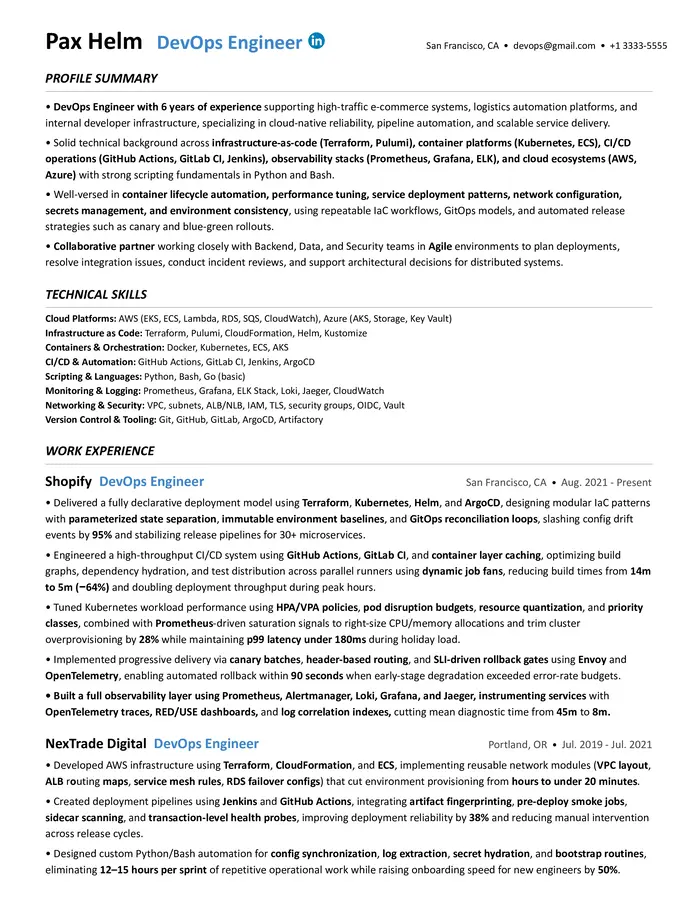
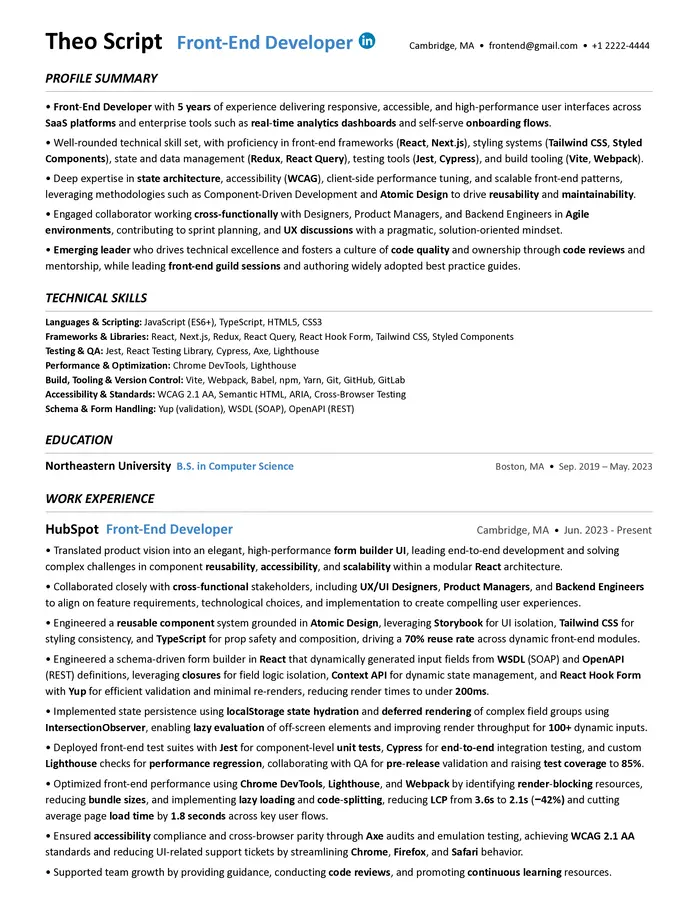
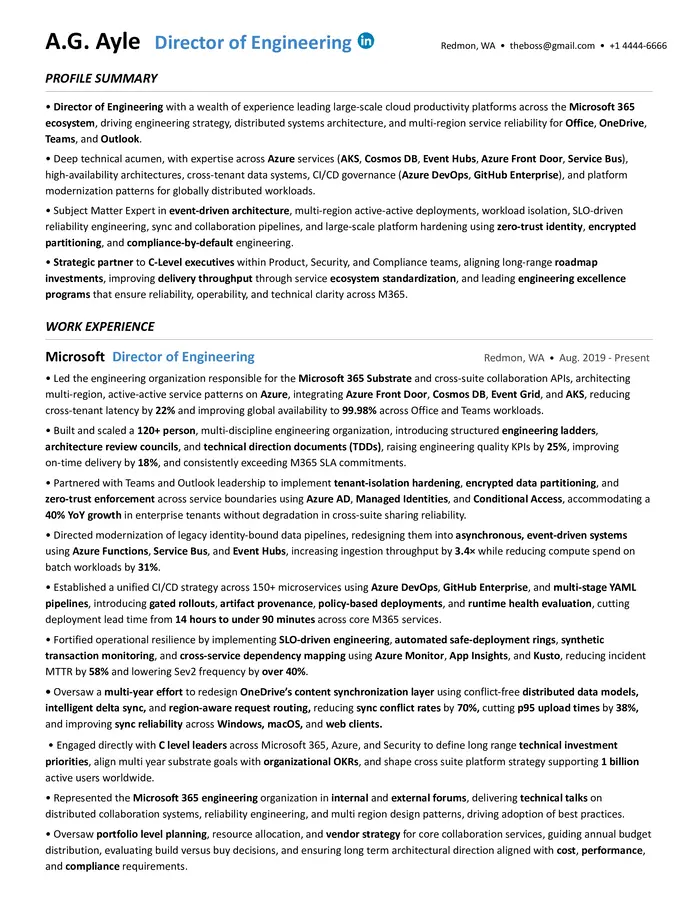
Most IT resume services hand you the same template no matter the role. Doesn't work. A SysAdmin resume reads nothing like a SOC Analyst one, an IT Manager resume reads nothing like a Cloud Engineer one. Different scope, different signals, different vocabulary. So the Best IT Resume Writers need to know more than resumes. They need to know IT. 13 years of recruiting taught me the role profile for every tech job family below.
Software Engineering
Front-End Developer
React Developer
Back-End Engineer
Full-Stack Developer
Software Architect
Mobile Engineer
Web Developer
Hardware & Firmware
Embedded SWE
Systems Engineer
Hardware Engineer
Electrical Engineer
FPGA Engineer
ASIC Engineer
Data, ML & AI
Data Analyst
Data Engineer
Data Scientist
ML Engineer
AI Engineer
MLOps Engineer
BI Developer
Cloud, DevOps & SRE
DevOps Engineer
Cloud Engineer
SRE
Infrastructure Engineer
Platform Engineer
DevSecOps Engineer
IT & Networking
SysAdmin
Network Engineer
Network Admin
IT Support
Database Admin
CyberSecurity
Security Engineer
SOC Analyst
Penetration Tester
GRC Analyst
Cloud Security
AppSec Engineer
IR Engineer (DFIR)
Testing & QA
QA Engineer
SDET
Performance Engineer
QA Manager
Product
Product Manager
Product Owner
Technical Product Manager
Projects & Programs
Business Analyst
Program Manager
Project Manager
Engineering Leadership
IT Manager
Head of IT
IT Director
CIO / CTO
Engineering Manager
Game Development
Game Developer
Engine Programmer
Graphics Engineer
Technical Artist
Design
UX/UI Designer
Side by side
Why you should use a resume writing service for IT
Most resume services for IT professionals are general-purpose agencies. They fix your formatting and your verbs. But that's not why your resume is getting rejected. Recruiters reject it because your scope isn't clear, your scale isn't there, or your stack doesn't read modern enough. Here's how a specialist IT resume writing service stacks up against a generic service and an AI tool.
What it does
IT Resume Writer
TechieCV (IT resume writing service)
Generic Resume Service
Non-technical writer ("template shop")
AI Rewriter
ChatGPT, Claude, Gemini or AI resume builders
Three honest options. Use AI if you just need a starting point. Go with a generic service if formatting is your only problem. Hire a specialist IT resume writer when you've tried both and your inbox is still quiet.
Meet your writer
What makes me different from other IT resume writers
Hi, I'm Emmanuel. Quick intro: I've got 13 years of recruiting experience, including many years at Google, where IT and infrastructure roles were a regular part of my hiring desk. Before Google I was in-house at Groupon, and before that I spent 4 years at a Tokyo recruiting agency placing tech and creative people for clients like Warner, Disney, and Universal. So when you tell me about your Tier-2 escalation queue or your Azure tenancy split, I'm not hearing it for the first time.
The other thing that matters: I write code. About 6 years now, all self-taught. Nothing fancy, mostly internal admin tools, ticket-system integrations, scripts to automate the boring half of an IT manager's week. I'm not a senior IT engineer and I won't pretend to be. But I'm technical enough to read what you actually did, push back on a bullet that's hiding scale, and ask a useful follow-up about your forest trust setup or your Okta cutover. A generic writer just can't do that.
By the numbers: 1,500+ resumes rewritten one at a time, tens of thousands screened during my recruiting years, 4.9 / 5 across 419 Fiverr reviews, Top Rated Seller. Past clients now work at Google, Meta, Amazon, Microsoft, Electronic Arts, and a long list of MSPs, mid-market enterprises, and Series A to D scale-ups.
Want the longer version? My About page goes deeper. If you want to verify any of this, my LinkedIn is right there.
Let me screen your IT resume and give you feedback (for free)
Upload your resume and I'll actually spend time on it. Within 12 hours, you get a Google Doc back from me with comments on every section. Not generic feedback. Real comments on the lines that are losing you callbacks. I'll also score you across 4 things: how the ATS reads it, whether your summary positions you well, whether your bullets carry enough scope, and whether your experience matches the role you're going for.
Done by me, personally. Not a junior offshore reviewer. Free. No account to make, no upsell coming.
The real difference is what gets touched in the rewrite. A generic writer fixes your grammar and swaps a few verbs around. That's about it, because that's all they can read. The fleet sizes, the change-failure rates, the migration you ran on a Saturday night, the compliance scope you owned... all of that just sits there because they don't have the context to evaluate it. I do. 13 years of recruiting experience, including many years at Google, plus 6 years writing code on the side. That combination is what lets me pull the right facts out of you and write them the way IT hiring managers actually want to read them.
Yes, all the time. Most Tier-1 and helpdesk resumes get rejected because they read like a list of tickets closed, with no scope and no real sign of progression. I rewrite them to show how many tickets you handled per week, your SLA hit rate, your first-contact resolution, what categories you owned, the runbooks you wrote, the escalations you handled without bouncing them up the chain. That's what hiring managers for Tier-2 and sysadmin roles actually want to see in a junior IT resume.
Pretty much any modern IT role. Service desk and helpdesk (Tier 1, 2, 3, desktop support, deskside, IT support specialist). Systems and infrastructure (sysadmin, Windows admin, Linux admin, M365, Google Workspace, infrastructure engineer). Networking (network admin, network engineer, network architect, Cisco, Juniper, Meraki, SD-WAN). Endpoint and identity (Intune, Jamf, AD, Azure AD/Entra, Okta, identity engineer). Cloud ops (cloud admin, AzureOps, AWS sysops). Security (SOC analyst, GRC, IAM, vulnerability management). And IT leadership (IT manager, IT director, head of IT, CIO). If your title isn't on the list, send me a message anyway. I've got an internal profile for almost every IT role out there.
Honestly, this is one of the most common rewrites I do. The trick isn't to stuff your resume with DevOps buzzwords. It's to pull out the work you've already done that maps to DevOps or cloud, and show it the right way. Your shell scripts? That's automation. Your one-off PowerShell? That's infrastructure-as-code work, just informal. The on-prem-to-Azure migration you helped on? That's cloud migration experience. We're not making things up. We're re-framing the real work so the recruiter doesn't filter you out before someone with context can even read it. This includes writing about transferable skills, and addressing as much of the role profile for your target role as possible with your existing experience.
No. The whole one-page rule is a myth, no matter what your career coach told you. What recruiters actually care about is signal density, not page count. If you've got 10 years of progression from helpdesk to sysadmin to infrastructure lead, two pages is fine, because you've got that much real material. If you've got one solid sysadmin role with a clear specialty, one page works. The right question isn't "how long should it be?" It's "can I delete this line without losing a fact a recruiter would care about?" If yes, cut it. No mercy. If no, keep it, and let the length sort itself out.
This is the question I get the most, so let me be honest about it. ChatGPT, Claude, all of them, they're great at rewording stuff. They're not great at deciding. They can't tell you whether your three years on the service desk should be one line or three bullets, whether to lead with your ITIL work or the Okta cutover from last quarter, or what a Senior Network Engineer resume should actually look like at a regulated bank versus a fast-moving SaaS company. Most people who book me have already tried AI. The output reads fine. The callbacks still don't come. Hiring a writer is about making those editorial calls, not making your prose smoother. That's the part AI can't do.
Not sure yet? Send your resume to the free resume review first. You'll get my feedback in 12 hours, and that'll tell you whether you actually need a full rewrite or whether a couple of edits on your end will do the trick.