





A Tech Resume Writing Service That Actually Understands What You Do

Generic resume writers don't know the difference between a microservice and a monolith. This one does.
Built for Software Engineers, DevOps, SREs, and IT professionals. Written by a recruiter who has screened thousands of tech roles at Google.

This isn't a template service or an AI tool. It's a collaborative rewrite by a code-literate tech resume writer with 12+ years of experience hiring people like you.

Get a Free Resume Review
Top section of a tech resume rewritten by a professional resume writer showing header, profile summary, and first experience entry Recruiter-optimized summary ATS-friendly structure Role Profile targeting

By a former recruiter

star rating for tech resume writing

4.9 / 5

388 reviews

Clients got hired at

Why This Resume Writing Service Gets Results
Where Others Can't

There are dozens of resume services out there. Most will clean up your formatting, change weak verbs for strong ones, and hand you back something that looks polished. That is not enough to land interviews at competitive companies like Google, Meta, Amazon, and Microsoft.
Here is what actually makes the difference.

Your Resume Is Written Against a Recruiter's Checklist, Not a Template

Recruiters screen your resume against role profiles: internal documents that definewhat a strong candidate looks like for a given role and level.

They cover expected areas of contribution, performance signals per skill, depth of technical mastery, and seniority indicators. They are never made public, and most candidates do not even know they exist.

After 12 years screening engineers at Google and top tech companies, I have built role profiles for every role in tech. Your new resume is optimized against the role profile for your target role and level, so that your new resume ticks all the boxes in recruiters' checklist.

This is the only reliable way to maximize your results during resume screens and converts more applications into interviews.

Role Profile: DevOps Engineer

Internal
Core Competencies Signal Strength Status
CI/CD Pipeline Design & Automation
Perfect
Monitoring, Logging & Observability
Solid
Cloud Infrastructure Management
Acceptable
Scripting & Automation
Vague
Infrastructure as Code (IaC)
Perfect
Networking & Load Balancing
Absent
Containerization & Orchestration
Solid
Incident Management & Reliability
Acceptable
Configuration Management
Absent
Collaboration & Release Management
Solid
Security & Compliance (DevSecOps)
Acceptable
Cost Optimization & Resource Mgmt
Absent

Every Section Is Written for the Right Stage of the Screening Process

A recruiter does not read your resume once. It goes through several reviews, each focused on different parts of your resume.

First, recruiters will review your resume as part of a batch to apply a first filter. They will use a "Profile Summary" instead of your work experience and look for 4-5 key pieces of information to evaluate your general fit against the role. That's why even juniors need a strong Profile Summary.

Then, they'll review the pre-selected list in more detail and focus on your work experience, overall career trajectory and technical skills. To succeed here, you need a detailed main experience covering the entire role profile for your target role.

Lastly, recruiters (and sometimes hiring managers) will create the interview shortlist by reading and analyzing your entire resume for performance signals. This is where very detailed technical bullet points win interviews.

Most resumes treat every section the same way. Every section of a TechieCV resume is calibrated to what each reviewer needs to see during each of the screening phases.

Phase 1

Batch Filter

Recruiter scans in seconds

Profile Summary

Role fit, main stack, domain expertise, cross-functional scope

TechieCV optimizes: Summary clarity
Phase 2

Detailed Review

Recruiter evaluates depth

Work Experience Technical Skills Career Trajectory

Role Profile coverage, specificity, impact metrics, relevance

TechieCV optimizes: Bullet precision & Role Profile coverage
Phase 3

Interview Shortlist

Hiring Manager analyzes

Full Resume Performance Signals

Engineering depth, architecture judgment, technical bullet points

TechieCV optimizes: Technical depth & performance signals

The Writing Process Is a Technical Conversation

Generic resume writers do not know what questions to ask an engineer. AI tools do not know what recruiters want to read about. My resume writing process is a technical discussion. We talk about your architectural decisions, your stack choices, the engineering principles you followed, and performance metrics that will impress a hiring manager.

I am a self-taught developer with 6 years of hands-on coding experience, on top of 6 years writing tech resumes and 12 years recruiting tech talent. Wearing both engineering and recruiting hats lets me ask the right questions to uncover the details.

Before

Worked on backend services to improve application performance.

After

Broke a monolithic Node.js API into event-driven microservices behind Kafka, isolating the heaviest read paths (search, filtering) from write-bound flows. Dropped p99 latency from 1.2s to 180ms across 4M daily requests and cut deploy cycles from weekly to daily.

Architecture Eng. techniques Tech Stack Quantified outcome

What Goes Into a TechieCV Resume

Every section has a specific job during the screening process.

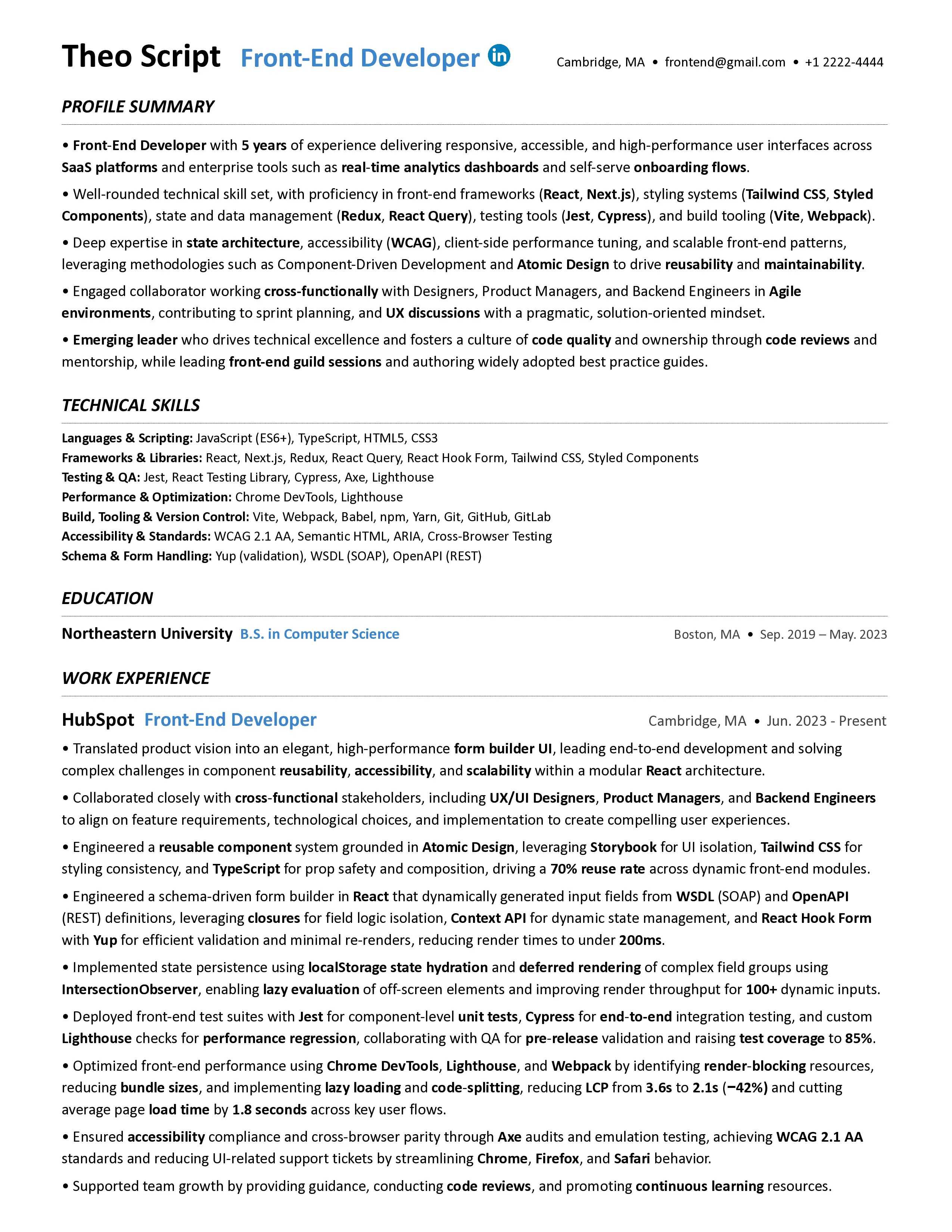
Theo Script

Front-End Developer

Cambridge, MA frontend@gmail.com +1 2222-4444

Profile Summary


  • Front-End Developer with 5 years of experience delivering responsive, accessible, and high-performance user interfaces across SaaS platforms and enterprise tools such as real-time analytics dashboards and self-serve onboarding flows.
  • Well-rounded technical skill set, with proficiency in front-end frameworks (React, Next.js), styling systems (Tailwind CSS, Styled Components), state and data management (Redux, React Query), testing tools (Jest, Cypress), and build tooling (Vite, Webpack).
  • Deep expertise in state architecture, accessibility (WCAG), client-side performance tuning, and scalable front-end patterns, leveraging methodologies such as Component-Driven Development and Atomic Design to drive reusability and maintainability.
  • Engaged collaborator working cross-functionally with Designers, Product Managers, and Backend Engineers in Agile environments, contributing to sprint planning, and UX discussions with a pragmatic, solution-oriented mindset.
  • Emerging leader who drives technical excellence and fosters a culture of code quality and ownership through code reviews and mentorship, while leading front-end guild sessions and authoring widely adopted best practice guides.

Work Experience


HubSpot Front-End Developer
Cambridge, MA • Jun. 2023 – Present
  • Translated product vision into an elegant, high-performance form builder UI, leading end-to-end development and solving complex challenges in component reusability, accessibility, and scalability within a modular React architecture.
  • Collaborated closely with cross-functional stakeholders, including UX/UI Designers, Product Managers, and Backend Engineers to align on feature requirements and implementation.
  • Engineered a reusable component system grounded in Atomic Design, leveraging Storybook for UI isolation, Tailwind CSS for styling consistency, and TypeScript for prop safety, driving a 70% reuse rate across dynamic front-end modules.
  • Engineered a schema-driven form builder in React that dynamically generated input fields from WSDL (SOAP) and OpenAPI (REST) definitions, reducing render times to under 200ms.
  • Deployed front-end test suites with Jest for component-level unit tests, Cypress for end-to-end integration testing, raising test coverage to 85%.
  • Optimized front-end performance using Chrome DevTools, Lighthouse, and Webpack, reducing LCP from 3.6s to 2.1s (~42%) and cutting average page load time by 1.8 seconds.
  • Ensured accessibility compliance and cross-browser parity through Axe audits, achieving WCAG 2.1 AA standards and reducing UI-related support tickets by streamlining Chrome, Firefox, and Safari behavior.

Education


Northeastern University B.S. in Computer Science
Boston, MA • Sep. 2019 – May. 2023

Technical Skills


Languages & Scripting: JavaScript (ES6+), TypeScript, HTML5, CSS3

Frameworks & Libraries: React, Next.js, Redux, React Query, React Hook Form, Tailwind CSS, Styled Components

Testing & QA: Jest, React Testing Library, Cypress, Axe, Lighthouse

Performance & Optimization: Chrome DevTools, Lighthouse

Build, Tooling & Version Control: Vite, Webpack, Babel, npm, Yarn, Git, GitHub, GitLab

Accessibility & Standards: WCAG 2.1 AA, Semantic HTML, ARIA, Cross-Browser Testing

Schema & Form Handling: Yup (validation), WSDL (SOAP), OpenAPI (REST)

Software Projects


Accessible Component Library Open Source
Jan. 2023 – Present
  • Built an open-source accessible UI component library in React and TypeScript with full keyboard navigation and screen reader support, adopted by 200+ developers
  • Implemented Storybook documentation with interactive examples and automated WCAG 2.1 AA compliance checks using Axe integration in CI/CD pipeline
Real-Time Analytics Dashboard Personal Project
Sep. 2022 – Dec. 2022
  • Designed and built a real-time analytics dashboard using React, D3.js, and WebSockets, rendering 50K+ data points with sub-100ms update latency

Awards & Leadership


Speaker: React Boston 2024 — "Scaling Design Systems for Enterprise Front-Ends"

Award: HubSpot Engineering Excellence, 2024 — for leading the form builder rewrite

Mentor: Code for Boston — front-end track lead (2023–present)

Personal Information

The Resume Title is the first thing a recruiter reads, and it sets the frame for everything that follows. Especially during the first screening, recruiters want to know that your application was intentional. They want to know that you generally correspond to the role they're hiring for.

We'll add a resume title that frames your experience in a way that it influences their perception of your entire resume. This is extremely powerful for role switches, career reorientation and other reframing strategies.

For developers, GitHub and portfolio links belong here too. A strong GitHub profile with active repositories is supporting evidence a recruiter or hiring manager can check. The personal information section is often overlooked, but it should act as your hub for credibility.

Resume Title

Sets the recruiter's evaluation frame before they read a single bullet point.

Location & Contact

City and state only, formatted for ATS parsing.

GitHub Profile

Active repositories serve as verifiable evidence of your technical skills.

LinkedIn & Portfolio

Additional credibility signals that most candidates omit.

Custom Info

Relocation, Visa Statuses, and other key information based on your specific case.

Profile Summary

During the first-pass batch review you have roughly 10 seconds to answer one question: is this person relevant to the role? During this step, they prefer not to read your entire resume. The best way for them to get all key information quickly is with a Profile Summary. If yours is not good enough, you get rejected.

A TechieCV Profile Summary is structured to answer that immediately. Your target role, an overview of your experience, key projects and industry/vertical expertise. Your main tech stack should be in there too, differentiated from your technical skills list. Domain expertise mapped to the role profile's core competencies is also a must, and so is evidence of cross-functional collaboration and leadership signals.

Most Profile Summaries read like a self-description. This one reads like a pitch to recruiters. Learn more in our Profile Summary guide.

Target Role & Scope

Proves your level and area of ownership so the recruiter knows exactly what you bring to the table.

Primary Tech Stack

Your main tools are listed upfront, separated from the full technical skills list.

Domain Expertise

Mapped to Role Profile competency areas the recruiter is scoring you on.

Cross-Functional Signals

Leadership and collaboration evidence that show your character beyond technical contribution.

Work Experience

Recruiters weight your most recent role more heavily than anything else on the page. This is where most of the screening time goes, and where most resumes fall short.

Every most-recent role is written to full Role Profile coverage, meaning every competency area a recruiter is evaluating is addressed explicitly. If something is missing, it gets written in collaboration with you during the process.

Bullet points are rewritten to Level 5 of the Levels System: every bullet contains the specific technologies involved, the design or architectural pattern applied, the engineering technique used, and a metric that measures the impact. Vague bullets are the single most common reason strong engineers get filtered out.

Role Profile Coverage

Every competency area a recruiter evaluates is addressed explicitly in your bullets.

Level 5 Bullet Points

Each bullet includes technology, pattern, technique, and a measurable impact metric.

Syntax Optimization

Sentence structure engineered for recruiter scanning speed and ATS keyword extraction.

Scope & Impact Framing

Every achievement is contextualized with scale, ownership level, and business outcome.

Projects

For experienced engineers, projects are selected and framed based on seniority. For junior engineers and career changers with limited professional experience, this section does the heavy lifting.

Projects are written in the same format and depth as work experience, mapped against the Role Profile for your target role. This is how a bootcamp graduate or self-taught developer competes for a first engineering role without a three-year work history.

Seniority-Matched Selection

Projects are chosen based on what signals strength at your target level.

Role Profile Depth

Written to the same standard as work experience, with full technical detail.

Career Changer Strategy

For candidates without a work history, projects carry the weight of the entire resume.

Miscellaneous

Awards, publications, patents, volunteering, and leadership activities. Most candidates either omit this section or list items without context.

A published paper signals research depth. A patent signals inventiveness. A conference talk signals credibility and communication skills. None of that lands without the right framing, and most candidates never frame it.

Awards & Recognition

Framed with context so reviewers understand why the award matters.

Publications & Patents

Signals research depth and inventiveness that set you apart from other candidates.

Conference Talks

Demonstrates credibility, communication skills, and industry visibility.

Leadership & Volunteering

Mentorship and community involvement that signals seniority beyond technical work.

How It Works

No video calls. No back-and-forth scheduling. Just a clear, structured process that happens in writing, moves at your pace, and keeps you in control at every step.

Working in writing is a deliberate choice. Google Docs lets us attach comments to specific bullets, technical terms, and individual sections. You can see every change, ask questions in context, and provide input whenever it suits you.

01

You Share Your Requirements

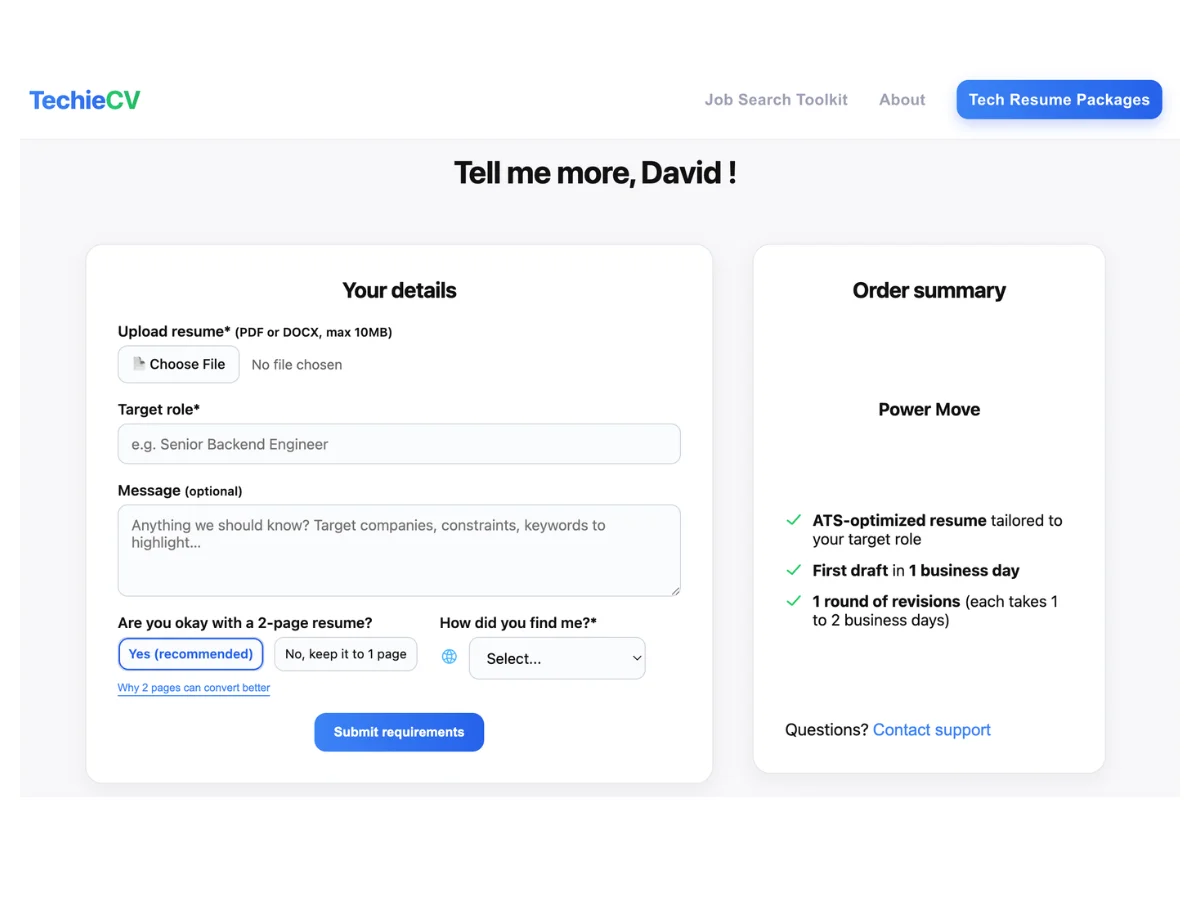
I start from your current resume and a short requirements form: your target role, seniority level, and any specific job descriptions you're targeting.

If your resume isn't up to date or there's context it doesn't include yet, you can add a brain dump document. No formatting required, just write whatever comes to mind.

You also get direct email access throughout the entire process, so questions are left unanswered!

Requirements form for tech resume writing service

02

First Draft Delivered in 4 Business Days

Your resume is rewritten entirely and delivered as a shared Google Doc. Not edited. Not cleaned up. Rewritten from scratch.

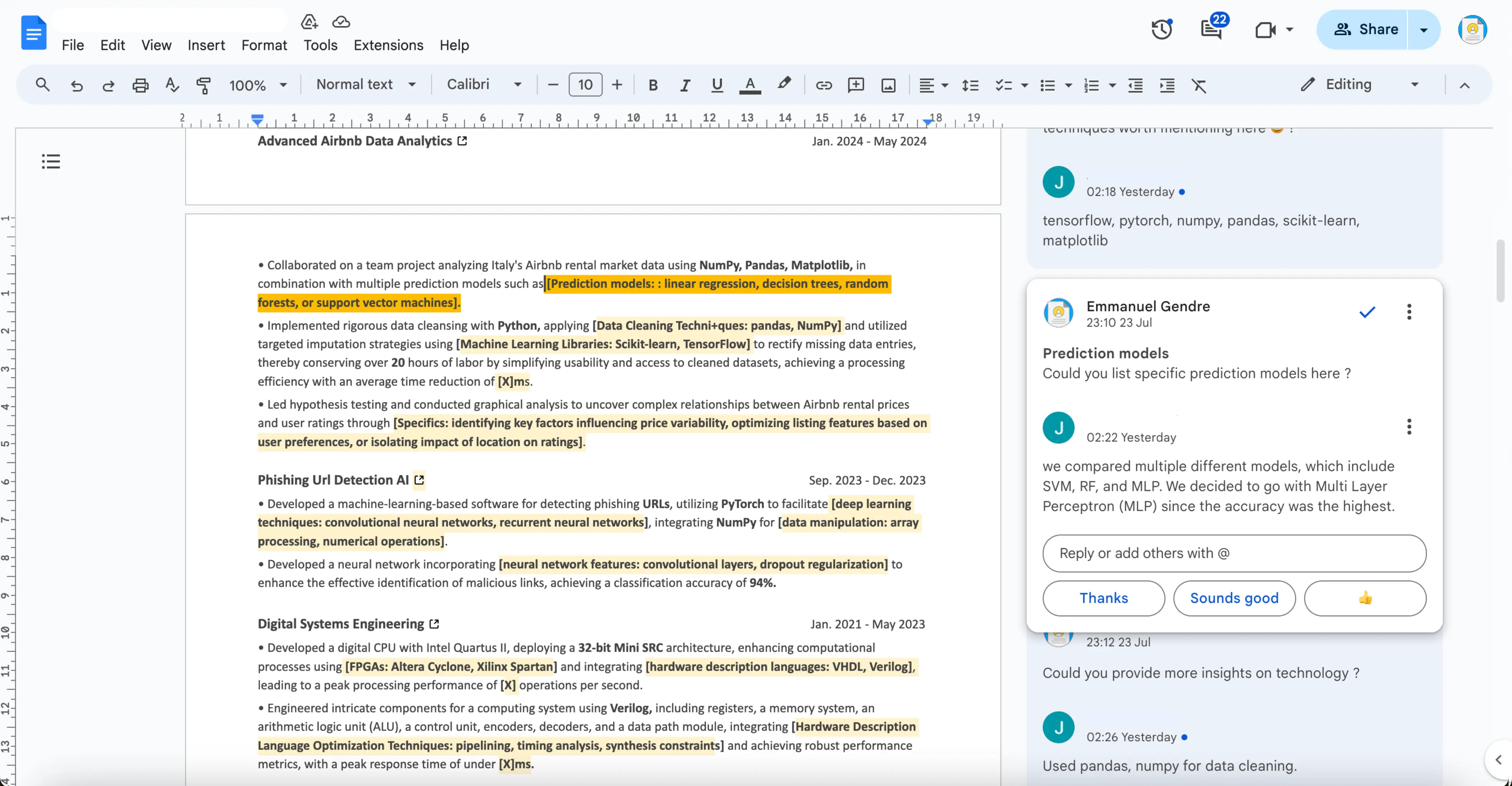
The draft includes comments throughout explaining specific decisions: why a bullet was restructured, why a section was added, what a recruiter is looking for in that specific area.

Placeholders flag suggestions for technical depth: specific tools, architectural patterns, engineering techniques, metrics, etc... so you know exactly what to fill in and why it matters.

Power Move clients receive their first draft within 1 business day.

Tech resume first draft in Google Docs with recruiter comments and technical placeholders

03

Your Input

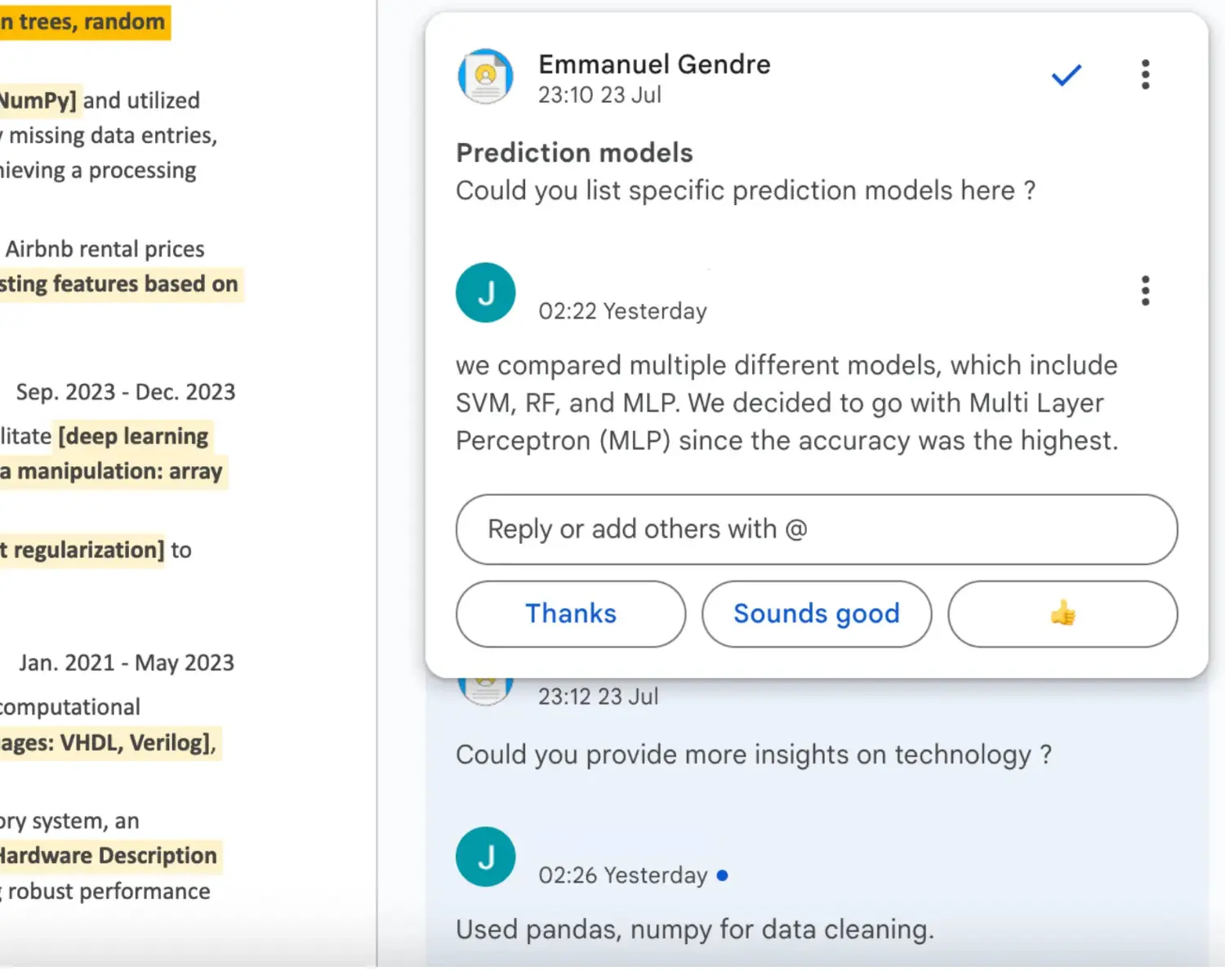
Take as much time as you need. The comments in the doc lay out clearly how to respond to each suggestion. You can edit directly in the document, reply via comment, ask questions, or add more context. There's no right or wrong way to engage. Some clients write paragraphs, others leave one-line notes. Both work.

This is the part most clients don't expect. Responding to specific technical questions about your own work tends to surface things you'd forgotten, undervalued, or never thought to include. Most clients say this is where the real material surfaces: accomplishments they'd forgotten, impact they'd undervalued, or context they never thought belonged on a resume.

Engineer providing input on tech resume rewrite via Google Doc comments

04

Final Version Within 1 Business Day

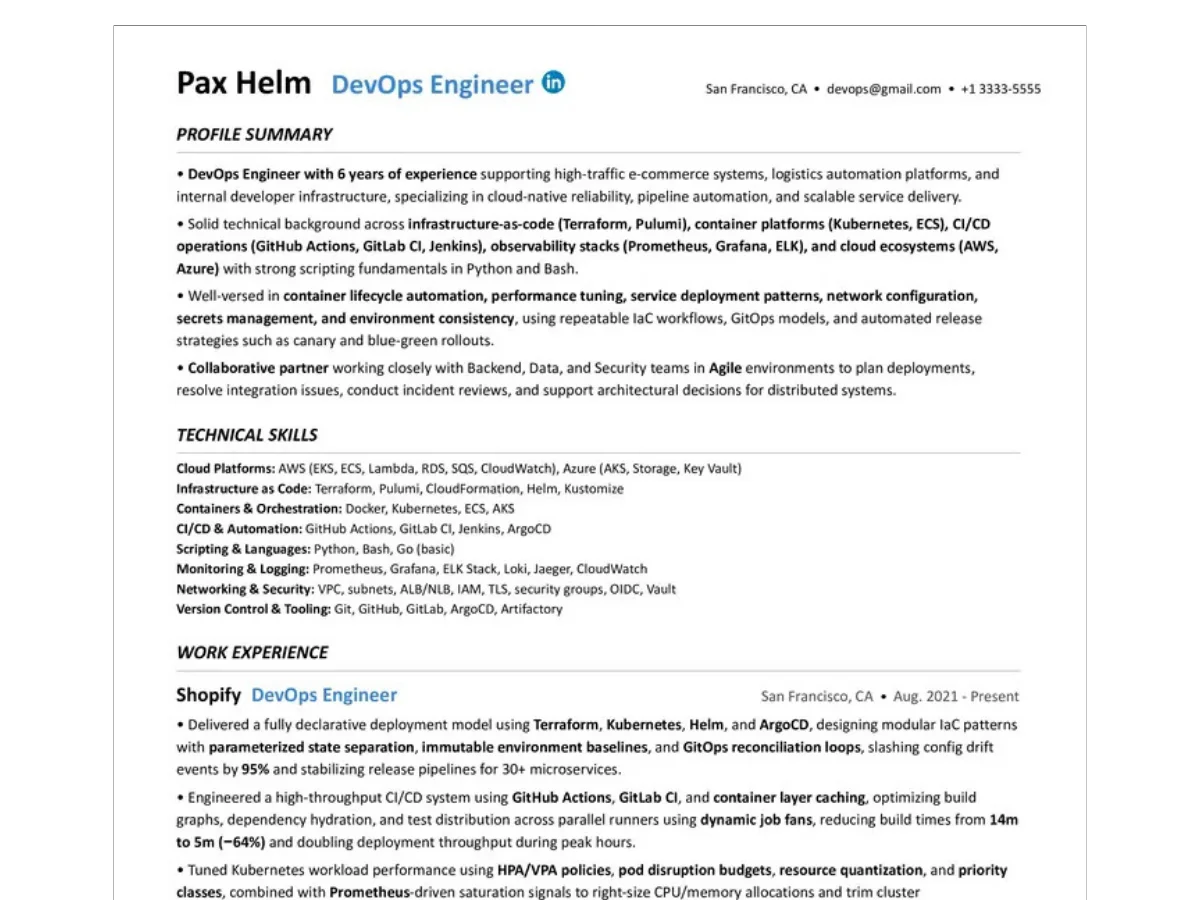
Once you have provided your input, the final version is delivered within 1 business day. Climb The Ladder and Power Move clients get unlimited revisions for 30 days from the date of first delivery, so we can iterate as many times as needed until the resume is exactly right.

Final version of a rewritten tech resume ready for job applications
Requirements form for tech resume writing service Tech resume first draft in Google Docs with recruiter comments and technical placeholders Engineer providing input on tech resume rewrite via Google Doc comments Final delivered tech resume

Step 1 of 4 — Share Your Requirements

Built for Every Role in Tech

Not sure if your role qualifies? It most likely does.
This resume writing service covers every discipline in the tech industry,
from software engineering to IT operations.

Software Eng

From frontend to principal engineer, every level and specialization of software engineering is covered, including embedded systems and game development.

Frontend Engineer
Backend Engineer
Full Stack Engineer
Mobile (iOS / Android)
Embedded Software Engineer
Game Developer
Staff Engineer
Principal Engineer
Engineering Manager
VP of Engineering

Data / ML / AI

Data engineering, machine learning, and AI roles require a specific depth of technical framing that generic resume services cannot provide.

Data Analyst
Data Engineer
Data Scientist
Machine Learning Engineer
AI Engineer
Analytics Engineer

Cloud / Sec

DevOps, platform, and security engineers need to demonstrate infrastructure thinking and operational impact. That requires a very different writing approach than application engineering.

DevOps Engineer
Cloud Engineer
SRE
Platform Engineer
Infrastructure Engineer
Security Engineer

Prod. & Design

Technical product managers and designers sit at the intersection of business and engineering. This service frames that cross-functional depth in a way that resonates with both sides of the hiring panel.

Product Manager
Technical Product Manager
UX Designer
Product Designer
UX Researcher

Biz & Ops

IT managers, TPMs, and business analysts in tech need to demonstrate strategic thinking alongside technical fluency. Both are written for here.

IT Analyst
IT Manager
Technical Program Manager
Scrum Master / Agile Coach
Business Analyst
CTO

IT & Systems

From helpdesk to systems engineering, this family covers the full spectrum of IT operations and infrastructure support roles.

Helpdesk / IT Support
Systems Administrator
Systems Engineer
Support Engineer
Network Engineer
IT Technician

Stop Guessing. Get Your Free Tech Resume Review Now.

You applied to hundreds of jobs: no result.
Companies won't bother giving you feedback, so you're stuck in a loop. This will keep happening until you know what's wrong.

Let's break this cycle today.

Learn why you're getting rejected with a Free resume review
from a specialized tech resume writer.

Get a Google-level recruiter screen + clear grading & checklist.

Get a Free Resume Review today

I review personally all resumes within 12 hrs

PDF, DOC, or DOCX • under 5MB

Frequently Asked Questions

The Process

No call needed. When you place an order you fill in a requirements form covering your target role, seniority, and the job descriptions you are targeting. You can also submit a brain dump document with any context not captured in your current resume. From there, the Google Doc process takes over: comments are attached to specific bullets, sections, and technical decisions so the conversation stays in context. Nothing gets lost and everything is documented.

The entire resume is rewritten from scratch. Every section, every bullet, every line of copy is reworked to optimize for recruiter screens and Role Profile coverage. If sections are missing they get added. If depth is lacking it gets written in collaboration with you.

Not a problem. You can include a brain dump document with your requirements: rough, unformatted notes covering anything relevant that is not in your current resume. No structure needed. That information gets incorporated into the rewrite.

Break Into Tech includes one round of revisions. Climb The Ladder and Power Move include unlimited revisions for 30 days from the date of first delivery.

The first draft is delivered within 4 business days of receiving your requirements, or 1 business day for Power Move. After you provide your input, the final version is delivered within 1 to 2 business days. Total time from order to finished resume is typically 1 to 2 weeks, depending on how quickly you provide your input.

Quality & Expertise

AI can reword your bullets. It cannot tell you what a Staff Engineer's Role Profile looks like at a Series B versus a FAANG. It cannot ask whether your Kafka implementation is the right thing to lead with for a distributed systems role. It cannot explain why your Profile Summary is getting you filtered out in the first three seconds of a recruiter screen.

The engineers who use AI to rewrite their resumes are often the ones who come to this service. Their resume looks polished. It still is not working. There is a difference between well-written and strategically written.

Yes, and this is what most clients say surprises them most. The writing process is a technical discussion about your architecture decisions, stack choices, and what will actually impress a hiring manager for your target role. This service is built on 12 years of screening engineers across every major tech role, combined with 6 years of hands-on coding experience.

Both. Most resumes I receive do not cover everything recruiters want to see for a given role and level. New content is written to fill those gaps, flagged with comments in the Google Doc so you can verify accuracy before the final version is delivered.

A Role Profile is an internal competency framework recruiters use to screen candidates. It defines what a strong candidate looks like for a specific role, level, and company tier: areas of contribution, performance signals, depth of technical mastery, and seniority indicators. They are never made public and most candidates do not know they exist. Every resume I write is analyzed against the Role Profile for your target role so your content hits the exact signals recruiters are scoring you on.

Especially then. Junior engineers and career changers face a specific challenge: limited professional experience competing against candidates with longer track records. Projects are written with the same depth and Role Profile coverage as work experience, which is how a bootcamp graduate or self-taught developer competes for a first engineering role without a three-year work history.

Yes. All resumes are written in an ATS-friendly format. That said, ATS compliance is rarely the real problem. A resume that passes ATS filters but does not address what recruiters are evaluating will still get rejected. Both problems are solved here.